Chapter 1: The Missing Bell
The first thing I noticed was the repetition.
Three short rings. A pause. Then three more.
It was not the school bell. It was a handbell—bright, old-fashioned, the kind you'd expect in a tiny shop where the owner knows your name and your favorite candy.
“Detective Hale?” Ms. Ketteridge asked, twisting the strap of her tote bag until her knuckles went pale. “It's gone.”
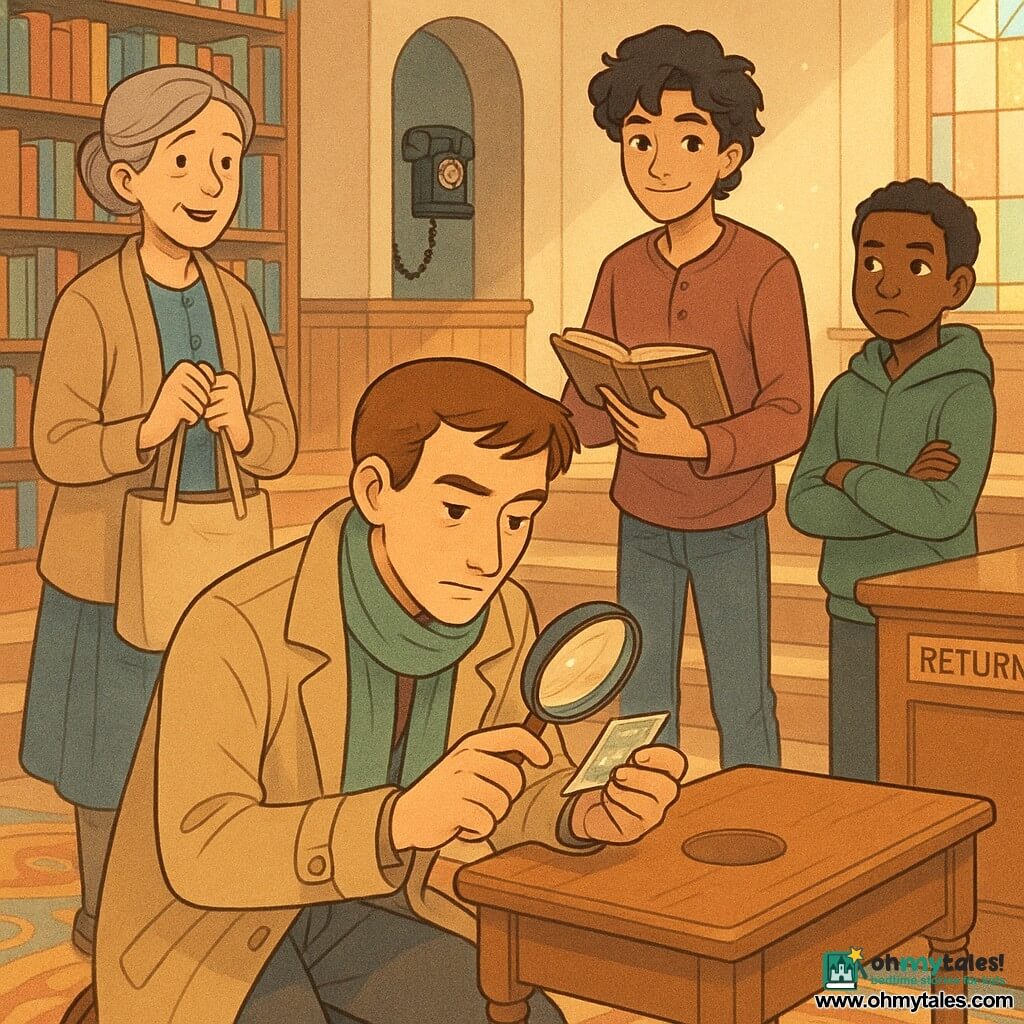
We stood inside Maple Street Community Library, right by the front desk. The air smelled of paper and lemon cleaner. A poster for the Saturday Book Swap leaned against a stand, slightly crooked, like it had been bumped and never straightened.
“What's gone?” I asked, though I already knew. The emptiness on the desk told the story.
“The brass bell,” she said. “Our service bell. We ring it before events. We ring it to call volunteers. We ring it when we're closing.”
Three rings. Pause. Three rings.
I leaned over the polished wood. There was a pale circle where the bell usually sat, cleaner than the rest of the desk, like a sunburn outline. Next to it lay a small piece of folded paper, as neat as a tucked-in bedsheet.
Ms. Ketteridge hovered. “We didn't touch anything. I mean, I didn't. I told the staff not to. Is that right? Is it wrong? I don't know how detectives like their… their scenes.”
“I like them honest,” I said, and picked up the paper by one corner.
The note was written in block letters, careful and stiff:
MEET ME WHERE STORIES ECHO.
Then, under that, three dots. A space. Three dots again.
“… … … … … …”
Three. Pause. Three.
“Who found this?” I asked.
“Eli,” she said. “The volunteer. Tall kid with the green hoodie. He came early to set up for the Book Swap and saw the bell missing. He said the note was right there.”
“And who knew the bell mattered?” I asked.
Ms. Ketteridge blinked. “Everyone? It's… it's just a bell.”
“No,” I said. “It's a signal. A habit. A pattern. Someone used it, or wants to use it.”
She swallowed. “It sounds silly. But our Book Swap is this afternoon. The whole neighborhood comes. Kids. Parents. The mayor's assistant. We have a reading corner and—”
“And you want the bell back before the crowd arrives,” I finished.
She nodded so fast her earrings flickered.
I folded the note and slid it into my coat pocket. “Tell me who's involved today. Everyone with a reason to be here.”
Ms. Ketteridge drew a breath like she was about to recite a long poem. “There's Nina Patel—she runs the crafts table. Mr. Grady from the antique shop is donating old books. Coach Darnell is bringing his team for community hours. And—” She hesitated. “And Mr. Finch.”
“Finch,” I repeated. Names can be keys if you turn them the right way.
“The janitor,” she said quickly. “He's… he's fine. He's just very particular about noise.”
Particular. Habits. Patterns. Repetitions.
I looked around the quiet library. Sunlight lay in rectangles on the carpet, and the shelves stood like rows of patient witnesses.
“Where do stories echo?” I asked aloud, not only to Ms. Ketteridge, but to the room.
She shrugged helplessly.
I tapped the desk. “Think like the person who wrote it. If you wanted to be found, you'd choose a place everyone knows. If you wanted to control the meeting, you'd choose a place with rules.”
Ms. Ketteridge's eyes darted to the far side of the library. “The reading amphitheater,” she whispered. “The little step seats. When someone reads there, the sound bounces.”
“Then that's where we start,” I said.
As we walked, I listened.
The library wasn't silent. It never truly is. There were faint clicks of a computer mouse, the soft rasp of a cart wheel, the tiny sigh of an air vent.
And under it all, in my mind, a rhythm:
Three rings. Pause. Three rings.
Chapter 2: Echo Corner
The amphitheater was tucked behind the children's section, a half-circle of wooden steps facing a small rug printed with a map of imaginary islands. Painted whales swam along the wall. Someone had taped up paper stars, and a few had fallen, dangling by one corner like tired fireflies.
“Stories echo here,” Ms. Ketteridge said, almost apologizing for how true it sounded.
I crouched near the lowest step and scanned the floor. A detective doesn't look for what should be there. He looks for what shouldn't.
A smear of mud marked the edge of the rug. Not a lot. Just enough to show someone had stepped in with a damp shoe and tried not to.
“Who's been in here this morning?” I asked.
“Eli. Me. Mr. Finch,” she said, counting on her fingers. “Oh—and Nina came by earlier to drop off scissors.”
“Let's talk to Eli,” I said.
We found him near the returns slot, stacking books with the seriousness of someone defusing a bomb. He was tall, like Ms. Ketteridge said, and his green hoodie had a small rip at the elbow. He glanced up when we approached, eyes sharp.
“I didn't take it,” he blurted before I'd even said hello. “I don't even like bells. They're loud.”
“That's useful,” I said. “People often steal what they like, not what they hate. But sometimes they steal what they fear.”
He frowned. “What?”
“It means I'm not here to accuse you. I'm here to understand what happened. Tell me exactly what you saw, in order. Every detail. Even the boring ones.”
Eli exhaled, a little calmer. “Okay. I came in at nine. The doors were unlocked because Mr. Finch was already inside, I think. I went to the desk. The bell was missing, and the note was there. I didn't touch anything. I yelled for Ms. K.”
“Did you hear anything?” I asked. “A sound. A rhythm.”
Eli's forehead wrinkled. “Well… earlier, before I noticed the bell, I heard something like tapping. Not like typing. Like… tick-tick-tick.”
“How many?” I asked.
He blinked. “Uh. Three taps. Then a pause. Then three again.”
Ms. Ketteridge's mouth fell open.
I felt my thoughts click into place, one tooth at a time. “Where did the tapping come from?”
Eli pointed without hesitation. “The back hallway. Near the supply closet.”
The back hallway smelled of mop water and old cardboard. The fluorescent light above us flickered, a small stutter that repeated at the same beat every few seconds. It made my eyes itch.
There was the supply closet door, painted beige. A narrow line of dust lay along the bottom edge, undisturbed except for one small drag mark, like something had been nudged.
I knelt and examined it. “Something heavy was moved,” I murmured.
Ms. Ketteridge hugged her tote to her chest. “Mr. Finch keeps his cart in there.”
“Then let's ask Mr. Finch,” I said.
We found him in the periodicals area, straightening magazines so their corners aligned like soldiers. He was lean, gray-haired, and wore a ring of keys that jingled softly whenever he moved. His face had the calm of a man who trusts routines more than people.
“Mr. Finch,” Ms. Ketteridge began, “this is Detective Hale. The desk bell is missing.”
Mr. Finch didn't gasp or clutch his chest. He simply paused, then set a magazine down precisely. “That bell was obnoxious,” he said.
“Obnoxious bells can still be stolen,” I replied. “Were you here earlier?”
He looked at me with eyes like clean glass. “I arrive at eight. Always. I unlocked the front door and began my rounds. I heard no bell.”
“Did you hear tapping?” I asked.
His jaw tightened. “I heard children running yesterday. I heard laughter. I heard chaos.”
“Today,” I said, patient. “Three taps. Pause. Three taps.”
For the first time, his expression shifted—barely. A flicker, like a curtain moved by a draft.
“I heard something,” he admitted. “From the hallway. But I assumed it was the pipes.”
“Pipes don't tap in patterns,” I said.
He lifted his keys. “Everything has patterns, Detective. Even pipes. Even people.”
I smiled a thin smile. “Then you understand why I notice repetition.”
He didn't smile back.
As he turned away, something fell from the pocket of his coveralls—just a sliver of paper. He snatched it quickly, too quickly.
But I'd already seen a corner of it: a sketch, in pencil, of a bell.
“Mr. Finch,” I said, voice even, “we need to gather everyone involved before the Book Swap begins. I want everyone in the amphitheater in ten minutes. Volunteers, staff, donors. No exceptions.”
Ms. Ketteridge looked startled. “All of them?”
“All,” I said. “Mysteries get solved faster when the truth has nowhere to hide.”
As we walked away, I caught sight of someone in the far aisle—someone who didn't belong to the library staff, someone tall with a familiar stride.
My chest tightened.
It was my close friend, Jonas Reed.
He paused at the end of the shelf, holding a book, and met my eyes. Then, like he'd been expecting this exact moment, he gave a small nod—an invitation, or a warning.
And then he was gone, swallowed by the rows of stories.
Chapter 3: The Friend in the Aisles
I followed the path Jonas had taken, moving fast but not running. Running tells people you're chasing. Walking tells them you're thinking.
The aisle he'd disappeared into was labeled LOCAL HISTORY. Dust motes drifted in the sunbeam like tiny, floating question marks.
No Jonas.
Only a book left half-pulled from the shelf, as if someone had started to take it, then changed their mind. I slid it out.
The cover read: MAPLE STREET: THEN AND NOW.
Inside, a bookmark stuck out: a strip of postcard cardboard, blank on one side. On the other side, in pencil, three dots, a space, and three dots again.
“… … … … … …”
I turned the bookmark over. The cardboard had been torn from a real postcard—its edge jagged like a bite mark.
Jonas Reed loved puzzles. He used to leave me coded notes when we were kids, back when my biggest case was figuring out who kept hiding my left shoe.
He was helping. Or testing me.
I tucked the bookmark into my pocket and headed back toward the amphitheater.
When we arrived, the group was already forming a loose half-circle on the wooden steps. Ms. Ketteridge stood to one side, looking like she wished she could merge into a bookshelf.
Nina Patel sat on the second step, her craft tote open, ribbons spilling out like colorful snakes. Coach Darnell leaned against the wall with his arms crossed, wearing a whistle that he did not blow, probably out of respect for the library. Mr. Grady, the antique shop owner, held a small box wrapped in brown paper. Eli hovered near the back, alert. Mr. Finch stood apart, hands clasped behind his back, keys quiet for once.
And then Jonas slipped in, as if he'd been there the whole time. He sat casually on the top step, book in hand, eyes amused.
Ms. Ketteridge noticed him and mouthed, “Who is that?”
“My friend,” I said softly. Then, to the group: “Thank you for coming. This won't take long if we're honest and precise.”
Coach Darnell raised an eyebrow. “Detective, are we in trouble?”
“No,” I said. “But the library's service bell is missing. A note was left behind. And whoever took it wants attention.”
Nina huffed. “It's just a bell.”
“Then it should be easy to return,” I replied.
Mr. Grady cleared his throat. “I sell antiques. If you're looking at me, I can assure you I do not steal from libraries. Libraries are… sacred.”
“Sacred places still have sticky fingers,” Jonas murmured from the top step, voice light.
Several heads turned. Jonas lifted his book like a shield. “What? I'm just saying.”
I ignored the ripple of nervous laughter and focused on the note. I held it up. “MEET ME WHERE STORIES ECHO. Three dots. Pause. Three dots. Who recognizes that pattern?”
Eli raised his hand halfway. “I heard it. Tapping. Three, pause, three.”
Mr. Finch's jaw tightened again.
I continued. “This pattern shows up more than once. That means it matters. It could be a code. Or a habit. Either way, the person wants us to notice.”
Nina's eyes narrowed. “Are you saying the person is… in this room?”
“I'm saying the person had access,” I said. “And they wanted a meeting. So we're meeting.”
Ms. Ketteridge whispered, “Detective Hale—”
I lifted a hand to calm her. Then I addressed the group again. “I need each of you to tell me one thing: where you were between eight and nine this morning.”
Coach Darnell spoke first, blunt. “Gym. Then I walked here. Got here around nine-fifteen.”
Mr. Grady adjusted his scarf. “My shop. I arrived here at nine to drop off donations.”
Nina said, “My apartment. Then I came by at eight-fifty to leave supplies. I didn't stay. I have a dentist appointment.”
Eli said, “Outside until nine. Then inside. You know that.”
All eyes turned to Mr. Finch.
He spoke like someone reading from a rulebook. “I was here. Cleaning. As always.”
“And Jonas?” I asked, without looking up.
Jonas shrugged. “Coffee shop. Then I came to return a book.”
“Convenient,” Coach Darnell muttered.
Jonas grinned. “Everything is, if you show up at the right time.”
I let the moment hang, then said, “Someone in this library made three taps, pause, three taps. Someone moved something heavy near the supply closet. And someone dropped a drawing.”
At the word drawing, Mr. Finch's eyes sharpened.
That was the pivot point. The moment the story changed direction.
I stepped closer to him. “Mr. Finch. What did you pick up earlier?”
His lips pressed together. “Nothing of importance.”
“Show me,” I said.
Silence.
Then Jonas spoke from above, still casual. “If it's not important, it should be easy to show.”
Mr. Finch's face reddened, not with guilt exactly—something more like embarrassment. Slowly, he reached into his pocket and pulled out a folded paper, creased and worn.
He didn't hand it to me. He opened it himself.
It was a pencil drawing. Simple, but careful. The library desk, the empty circle where the bell sat, and beside it a stick-figure person with wide eyes. Above the figure were three marks, a space, and three more marks—like little sound effects.
||| |||
Not dots. Lines.
Three. Pause. Three.
Under the drawing, in smaller writing, it said:
THE BELL IS NOT THE ONLY THING THAT CAN RING.
Nina leaned forward. “That's… weird.”
Eli's voice was quiet. “That's not my drawing.”
Ms. Ketteridge looked like she might faint into her tote bag. “Who drew that?”
I took a careful step closer. “Where did you find it, Mr. Finch?”
He swallowed. “In the supply closet. On the floor.”
I nodded. “So someone went into the closet after you arrived. Someone who wanted to leave a message.”
Jonas tilted his head. “Or someone who wanted to make sure Finch looked suspicious.”
Every eye in the amphitheater slid toward Mr. Finch.
He stiffened. “I don't play games.”
“No,” I agreed. “You follow patterns.”
I turned to the group. “I want you to help me. Look at the drawing. Look at the note. What connects them?”
For a moment, no one spoke. Then Eli said slowly, “The pattern. Three-pause-three.”
“And ‘stories echo,'” Nina added. “Like sound repeating.”
Coach Darnell frowned. “You think it's about sound. Like a… signal?”
I nodded. “Now think bigger. If someone wanted us all here, why take a bell? Why not just leave a note?”
Jonas lifted a finger. “Because the bell is a prop. It makes it feel official. Like the library itself is calling you.”
“Exactly,” I said. “So the bell isn't just stolen. It's being used.”
Ms. Ketteridge whispered, “Used where?”
I pulled the torn postcard bookmark from my pocket and showed it. “A piece of postcard with the same pattern. Someone wants us to think about messages that travel.”
Nina's eyes widened. “Postcards. Mail.”
“Or—” Eli started.
“The old phone in the hallway,” Ms. Ketteridge blurted suddenly. “The payphone! It's decorative now, but it used to work. It's by the supply closet.”
I felt the pieces tighten into a shape. “The bell is not the only thing that can ring,” I repeated.
Jonas's gaze sharpened, playful no longer. “So the thief wants to ring something else.”
I looked at Ms. Ketteridge. “Take us to the payphone.”
Chapter 4: The Phone That Didn't Forget
The payphone stood in a narrow alcove near the back hallway, painted black and polished like a museum piece. A little sign above it read: DO NOT USE — DISPLAY ONLY.
The receiver hung neatly in place. Too neatly.
I stepped closer and studied it. The metal around the coin slot had scratches—newer than the rest, brighter, like someone had scraped it recently. On the floor beneath the phone was a faint trail of glitter. Not much. Just a stingy sprinkle that caught the light.
Nina made a small choking sound. “That's craft glitter.”
Eli sniffed. “Or someone stepped in it.”
“Or someone used it on purpose,” I said.
I lifted the receiver.
A dial tone buzzed in my ear.
Ms. Ketteridge's eyes went round. “It works?”
“Someone made it work,” I said. “Or never let it stop working.”
Jonas leaned in. “Call it. Three-pause-three, right? Like… a number pattern?”
“Or a knock,” Eli said. He raised his hand and tapped the metal side of the phone: tap-tap-tap… pause… tap-tap-tap.
The dial tone stuttered, then changed pitch, as if responding.
Coach Darnell took a step back. “Okay. That's creepy.”
I kept the receiver to my ear. “Listen. There's a click.”
A faint sound came through—paper rustling, then a small bell-like chime, muffled, as if wrapped in cloth.
Someone was on the line.
I spoke calmly. “You wanted a meeting. I'm here.”
No voice answered. Instead, I heard a series of soft taps, not on the phone, but somewhere nearby—like a pencil against wood.
Three taps. Pause. Three taps.
I lowered the receiver slowly and looked around.
The alcove had one small shelf built into the wall, meant for coins long gone. On that shelf sat a tiny folded square of paper that hadn't been there a moment ago.
I unfolded it.
A simple map was drawn in pen: the library's back hallway, the supply closet, the amphitheater, and a final X marked behind the LOCAL HISTORY shelves. Next to the X was the same pattern—three lines, pause, three lines.
||| |||
Jonas exhaled. “Behind Local History. That's where you found my bookmark.”
I studied the map. It was drawn with confidence. Whoever made it knew the library layout well.
Ms. Ketteridge's voice trembled. “Is someone… hiding in there?”
“Maybe hiding,” I said. “Maybe waiting.”
I turned to the group. “Stay together. No wandering. We go as one.”
Coach Darnell cracked his knuckles. “Finally, a plan.”
As we moved, I watched the small details. Mr. Grady's hands shook slightly around his brown-paper box. Nina's craft tote glittered at the seams. Eli kept scanning corners like a cat. Mr. Finch walked with stiff precision, but his eyes kept flicking toward the floor, as if searching for something he'd dropped.
And Jonas—Jonas watched everyone's faces, not their feet.
We reached the LOCAL HISTORY section. The shelves were taller here, the light dimmer, the air cooler, like time itself had slowed down to read.
Behind the shelves was a narrow space—used for storage, old display boards, rolled-up posters.
The X on the map pointed to a stack of flat cardboard envelopes tied with twine.
I crouched and cut the twine with my pocketknife.
Inside the top envelope was something that made the entire case tilt.
A postcard.
Not blank—this one had a picture on the front: Maple Street, decades ago, with horses and a dirt road where the modern sidewalk now lay.
On the back, in neat block letters, it read:
IF YOU WANT THE BELL BACK, FIND WHAT REPEATS.
START WITH WHAT EVERYONE HEARD.
END WITH WHO EVERYONE FORGOT.
Below the message were three dots, a space, and three dots again.
I held the postcard up for the group to see.
Nina whispered, “Who everyone forgot?”
Coach Darnell frowned. “We didn't forget anyone.”
Jonas's eyes narrowed. “Didn't we?”
I looked at Ms. Ketteridge. “List everyone again. Everyone connected to today.”
She began, counting on her fingers. “Me. Eli. Nina. Coach Darnell. Mr. Grady. Mr. Finch. And—”
She stopped. Her face drained.
“The mayor's assistant,” she said, voice small.
“What's their name?” I asked.
“I… I don't remember,” she admitted, horrified. “They email me. They sign off with initials. J. L.”
Jonas's gaze flicked to me. “J.L.”
My mind replayed the morning: the flicker of embarrassment on Finch's face, the glitter under the phone, the torn postcard piece, the way Jonas had appeared at exactly the right time.
But Jonas was my friend. Close friend. That mattered. It also meant I had to be extra careful. Friends can help. Friends can distract.
I turned the postcard over again and studied the handwriting. The block letters were careful, stiff—like the note at the desk.
Then I noticed something else: the letters leaned ever so slightly to the right, and the pressure marks on the card were heavy on the downstrokes.
Someone who presses hard. Someone used to writing on forms.
Like an assistant.
Or like someone who doesn't want their writing to be recognized.
I looked at the group. “We solve this by logic, not guessing. Here's the puzzle for you, too.”
I held up the postcard and spoke clearly, as if the library itself were listening.
“Clue one: everyone heard three-pause-three tapping. Clue two: craft glitter was under the phone. Clue three: the map led us to postcards in Local History. Clue four: the message says ‘end with who everyone forgot.'”
I paused. “So who is missing from our circle? Not someone we forgot existed. Someone we forgot to invite.”
Eli's eyes widened. “Wait. The mail carrier.”
Nina blinked. “What?”
Eli spoke faster. “Every time there's a community event, the mail carrier brings the flyers that got returned. He drops them off here. He always jokes about how the library gets more mail than anyone.”
Ms. Ketteridge nodded slowly. “Yes. Mr. Larkin.”
“Larkin,” I repeated. “L. J.L. Initials.”
Jonas leaned forward. “And the payphone—mail and calls. Messages traveling.”
Coach Darnell scratched his head. “But why steal a bell?”
“To make sure we noticed,” I said. “To force a meeting. To gather everyone. The thief wanted an audience.”
Mr. Finch suddenly spoke, voice tight. “Mr. Larkin loiters. Always tapping his fingers. Always waiting for someone to talk to.”
Repetition. A habit.
I straightened. “Where would a mail carrier go in this library if he didn't want to be seen?”
Ms. Ketteridge answered instantly now, as if the pattern had woken her brain. “The old sorting nook. Behind the staff room. It used to store outgoing mail.”
“Take us,” I said.
Chapter 5: The Sorting Nook
The sorting nook was a cramped space with pigeonholes that hadn't held real mail in years. Dust lay in the corners like gray snow. A single window looked out onto the alley, where a delivery truck rumbled past.
And there, on a small stool, sat Mr. Larkin.
He wore a postal cap and a jacket the color of storm clouds. His hands were clasped together, but his fingers moved—tap-tap-tap… pause… tap-tap-tap—against his own knuckles, as if the rhythm had moved into his bones.
On the table beside him lay the brass library bell, wrapped in a dish towel.
Ms. Ketteridge let out a sound halfway between relief and outrage. “Mr. Larkin!”
He flinched, then looked up with tired eyes. Not cruel eyes. Not even sneaky eyes. Just tired.
“Hello,” he said softly. “You found me.”
I stepped forward, keeping my voice calm. “Why take the bell?”
Mr. Larkin's gaze dropped to it. “Because nobody listens unless something is missing.”
Coach Darnell's eyebrows shot up. “That's not how you ask for attention.”
Mr. Larkin nodded once, like he'd already scolded himself. “I know. It was foolish.”
Nina crossed her arms. “And the glitter?”
He sighed. “That was me. I borrowed some from the craft table last week. It sticks to everything. I wanted… proof I'd been there. A trail. Like in stories.”
Eli said, quieter, “You made it into a mystery.”
Mr. Larkin's mouth twitched. “Yes. I did.”
Jonas stepped down from the doorway and spoke gently. “But why? What did you want us to find?”
Mr. Larkin reached into his jacket and pulled out a folded sheet of paper. He opened it carefully.
It was another drawing—this one much more detailed. It showed the library amphitheater filled with people. Above them, instead of words, were lines coming together, like sound waves, like voices joining.
Underneath, in neat writing, it said:
IF WE ALWAYS DO THE SAME THINGS,
WE FORGET THE QUIET ONES.
Ms. Ketteridge's face softened despite herself. “Mr. Larkin…”
He looked at her, and for a moment the tough shell of the mystery cracked. “I deliver flyers,” he said. “I bring mail. I'm in and out, in and out. I hear people talk about the Book Swap, about speeches, about donors. But no one asks me to come. No one asks me to sit. To listen. To be part of it.”
Eli shifted, embarrassed. “We just assumed you were busy.”
“I assumed you didn't care,” Mr. Larkin replied. “So I made a case. A puzzle. Something to make you look closely.”
I turned the drawing over. On the back was the same pattern again, but this time with words:
THREE QUESTIONS.
PAUSE.
THREE ANSWERS.
Curiosity pricked at me, sharp and clean. “What are the three questions?” I asked.
Mr. Larkin looked surprised I'd asked at all. Then he spoke, counting on his fingers.
“First: What repeats?” he said. “Second: What echoes?” He glanced toward the amphitheater hallway. “Third: Who is missing?”
“And the answers?” I asked.
He took a breath. “The tapping repeats. Stories echo in people. And the missing person is… me.”
Silence settled, not heavy this time, but thoughtful.
Coach Darnell cleared his throat. “You could've just said you wanted to come.”
Mr. Larkin nodded, eyes shiny. “I could have. But then no one would have had to think. And thinking is the point, isn't it? Curiosity. Looking again. Noticing.”
He looked at me. “You're a detective. You notice. I wanted to be noticed too.”
I studied him. Not a villain. A lonely man who chose a dramatic method.
“You put the bell back,” I said. “And you apologize. And then you come to the Book Swap as a guest, not a shadow.”
Mr. Larkin's shoulders sagged with relief. “Yes. I will.”
Ms. Ketteridge stepped forward and, after a hesitation, took the bell. “You're invited,” she said, firm. “Officially. But no more stealing.”
A small laugh escaped Eli. “Also, no more glitter trails. That stuff never leaves.”
Mr. Larkin managed a sheepish smile. “Deal.”
Jonas leaned toward me and murmured, “You solved it.”
“You helped,” I murmured back, thinking of the torn postcard bookmark.
Jonas shrugged. “I just nudged. You did the noticing.”
As we walked back toward the front desk, I felt the tight knot of the case loosen. But one piece still bothered me.
The postcards.
“Mr. Larkin,” I asked, slowing beside him, “why postcards? Why hide them in Local History?”
He looked almost pleased. “Because postcards are messages that travel. Like stories. And Local History is where the town remembers itself. I wanted the library to remember me.”
I nodded. It was oddly poetic, for a man in a postal cap.
At the front desk, Ms. Ketteridge placed the bell back on its pale circle, and it fit perfectly, like the last piece of a puzzle.
She looked at me. “Should we ring it?”
I thought of the pattern that started it all. Then I nodded.
Ms. Ketteridge rang the bell three times. Pause. Three times again.
This time, it didn't sound like a threat.
It sounded like an invitation.
Chapter 6: The Postcard at the End
The Book Swap began with a crowd and a low, happy roar. Books changed hands like secret treasures. Nina's craft table filled with paper dragons and glittery bookmarks (contained, mostly). Coach Darnell's team tried to whisper and failed. Mr. Grady told anyone who'd listen the dramatic life story of a first edition.
Mr. Larkin sat in the second row of the amphitheater, holding a cup of lemonade like it was something rare. Eli sat beside him and asked questions about mail routes and stamps. Ms. Ketteridge looked over at them more than once, as if checking that the library's circle had widened.
Jonas lingered near the Local History shelves, flipping through the old town book. When he caught my eye, he lifted a hand in a small salute, then disappeared into the moving crowd.
I stayed near the desk, where the bell rested, silent for once. My work was done, but my mind kept returning to the same lesson: patterns aren't just clues. They're also habits. And habits can hide people.
A little later, when the crowd thinned, Ms. Ketteridge brought me a small stack of mail that had been left on the desk.
“From today,” she said. “Thank you, Detective Hale. Truly.”
I nodded. Thanks are nice, but what matters is what changes after the mystery is solved.
As she walked away, one item on top caught my attention.
A postcard.
Front: a photograph of the library at sunset, the windows glowing warm, the front steps empty and peaceful.
Back: my name, neatly written. And a message.
Detective Hale,
Thank you for noticing.
Next time, I will ask with words first.
But I hope you keep asking questions.
Curiosity keeps people from disappearing.
— Larkin
Below his signature were three dots, a space, and three dots again. But this time, the dots had been turned into tiny stars.
“… … … … … …”
I slipped the postcard into my coat pocket and looked out at the library—the shelves, the steps, the people moving through stories together.
A good case doesn't just end with the answer.
It ends with the next question.