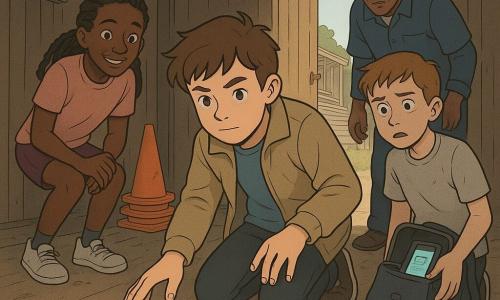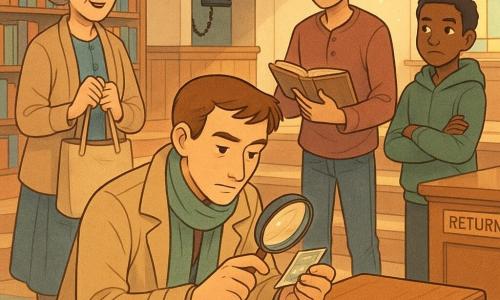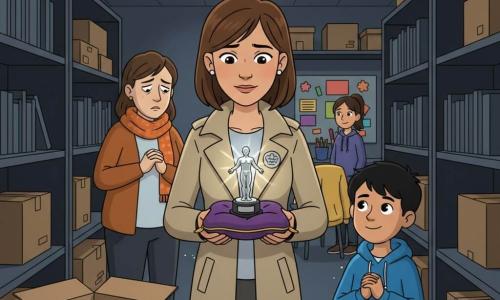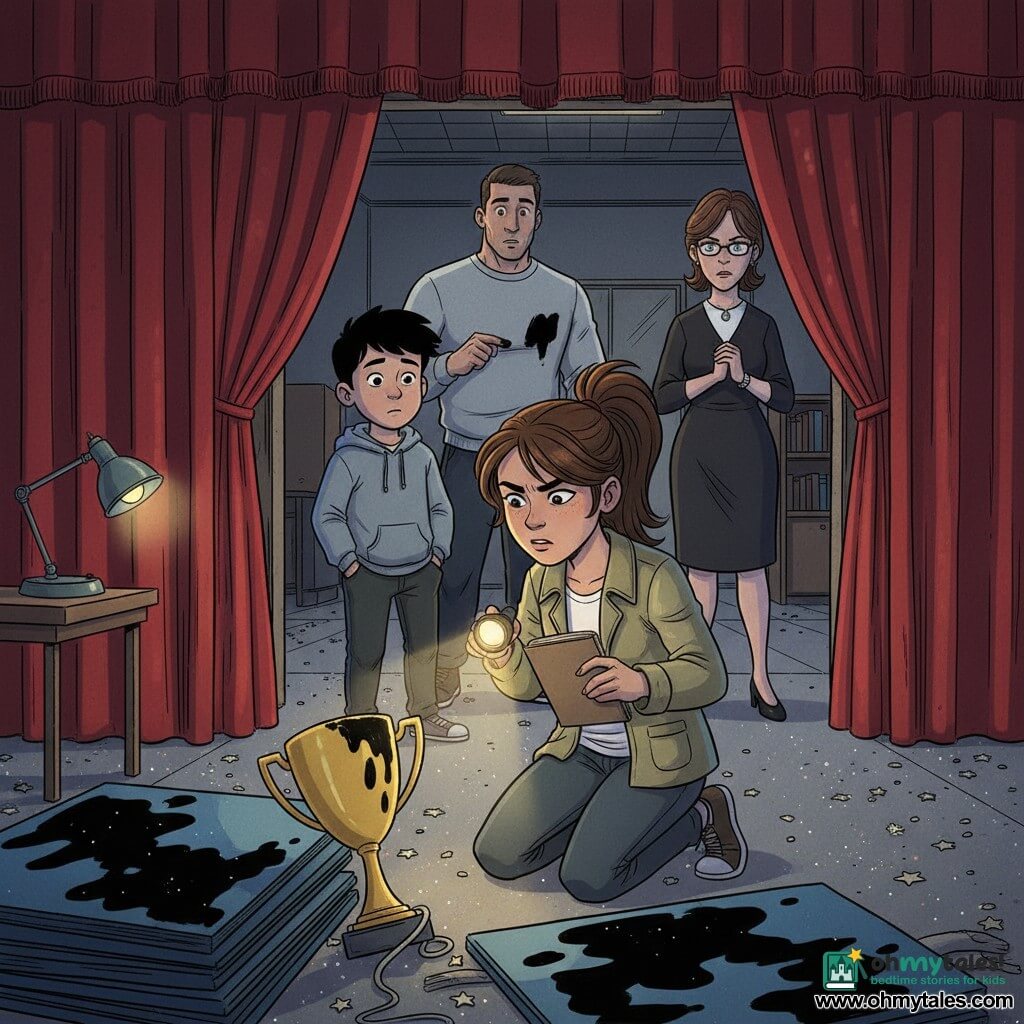
Chapter 1: The Case of the Silent Trophy
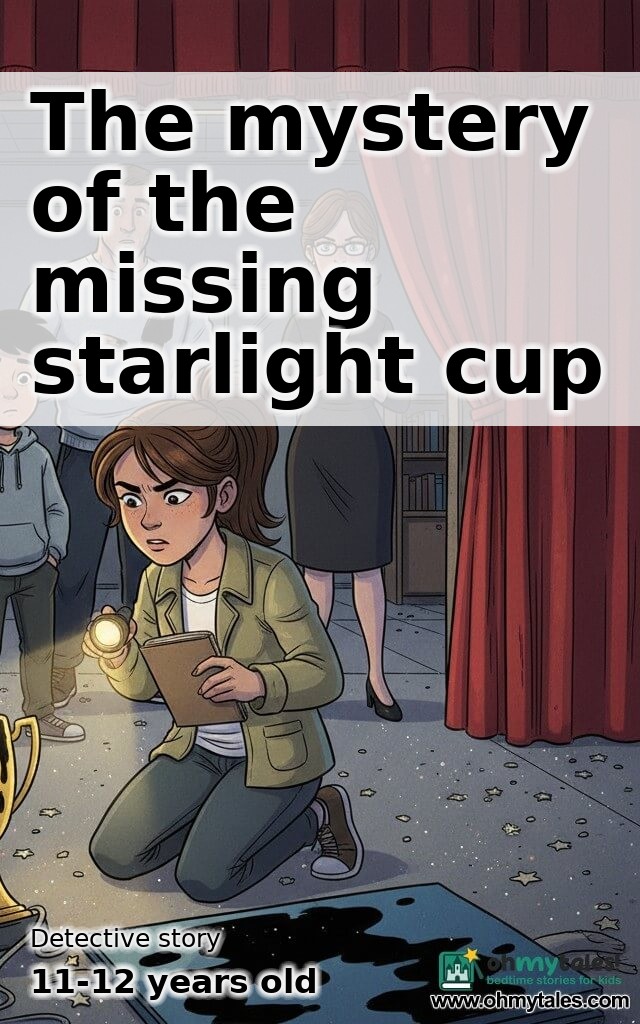
Mara Quinn kept her detective notebook in the same pocket every day, like a lucky charm with paper edges. She was new to real cases—official ones, with adults watching and deadlines breathing down your neck—but she wasn't new to noticing things.
The hallway of Briarwood Middle smelled like floor wax and pencil shavings. The school was dressed up for the Science Night ceremony: posters taped straight, balloons tied too tight, trophy table covered in a black cloth like it was hiding a secret.
Now it was.
Mr. Givens, the science teacher, stood beside the empty space where the trophy should have been. His smile was gone. “It was here at four thirty,” he said, voice clipped, eyes darting like they were searching for an escape route. “The ‘Starlight Cup.' Our whole display depends on it.”
Around them, a small crowd hovered—teachers, a couple of parent volunteers, and the student helpers who had stayed after school.
Mara scanned the table. The cloth was smooth except for one wrinkle near the edge, as if someone's sleeve had tugged it. She crouched, careful not to step on the scattered glitter stars on the floor.
“Don't touch anything,” Mrs. Vellum the librarian warned, though her whisper made it sound like she didn't want the thief to hear.
Mara nodded. “I won't. I'll just look.”
She looked at shoes first. People always forgot their shoes could tell stories. Mr. Givens wore shiny brown loafers, spotless. Mrs. Vellum had soft sneakers dusted with paper fuzz. The janitor, Luis, stood near the doors with heavy boots that left faint, square prints on the wax.
And there—near the trophy table—were thin, curved marks, like a small cart wheel had turned sharply.
Mara straightened. “Who moved anything with wheels in here?”
Nina Patel, a seventh-grader with a clipboard and a serious ponytail, said, “We brought the display board on a rolling stand.”
“And where is the stand now?” Mara asked.
Nina pointed. “Back by the stage.”
Mara watched Nina's face as she spoke. Not guilt—more like irritation, as if the missing trophy was an inconvenience to her schedule.
Mr. Givens rubbed his forehead. “We have an hour before parents arrive.”
Mara flipped open her notebook. “Then we have an hour to find what's missing. Everyone, tell me one thing: where were you between four and five?”
Groans answered her like a chorus.
“Alibis,” Mara said, calm. “We need them.”
Mrs. Vellum lifted her chin. “In the library, sorting returned books.”
Luis shrugged. “Changing trash bags in the cafeteria.”
Nina said, “In the lab. Organizing chemicals for the demo.”
Mr. Givens hesitated half a second too long. “I was… in the supply room. Counting batteries.”
Mara wrote. Hesitation didn't mean lying, but it meant thinking. Thinking could hide a gap.
A quiet voice drifted from the back. “I was here.”
It was Theo Marsh, another student helper. He was small for eighth grade, with sleeves too long and eyes that rarely met anyone else's.
“You were here in the hallway?” Mara asked.
He nodded, then pointed at the double doors. “I saw someone go out.”
“Someone who?” Mara asked.
Theo swallowed. “I didn't see their face. They wore a hood. They had a… a wheeled thing. Like a cart.”
Mara's pencil stopped. A cart. The curved marks.
Mr. Givens leaned in. “Why didn't you say this earlier?”
Theo's ears turned pink. “Everyone was talking. And you looked mad.”
Mara held up a hand. “Theo did the right thing by speaking now. Details matter.”
She looked at the doors. Outside, evening light glazed the windows. The school parking lot waited, innocent and wide.
A trophy didn't vanish into air. It moved. It left traces. Someone had taken it like they knew where they were going.
Mara shut her notebook. “Okay,” she said. “We start with the path.”
Chapter 2: Wheel Marks and Small Lies
Mara followed the faint wheel marks down the hallway. They curved toward the side corridor where the art room and music storage were. The marks weren't deep, but the wax caught them like a secret scratched into ice.
Nina trailed behind her. “Are we seriously doing detective stuff?” she muttered.
“We're seriously finding the trophy,” Mara said.
At the corner, the marks stopped abruptly—like the cart had been lifted or turned onto carpet. Mara knelt again, this time near the baseboard. A tiny smear of something dark clung to the wall, almost invisible.
She sniffed. Paint. Black paint.
The art room door stood shut, a hand-painted sign taped to it: KEEP OUT—WET PROJECTS.
Mara glanced at Nina. “Who has the art room key?”
Nina rolled her eyes. “Ms. Kline. But she's in a meeting.”
Mara didn't like locked doors in a mystery. Locked doors were either protection or performance.
She moved on, checking the music storage closet. The handle was cold, and the door opened with a soft sigh. Inside: stacked chairs, a dusty drum, and a row of instrument cases. No glittering cup.
Footsteps clicked behind her. Mrs. Vellum approached, arms folded tight. Her face was serious—more serious than a missing trophy should make someone. Her mouth was a straight line, her eyes sharp as paper cuts.
“You shouldn't be poking around,” she said.
Mara kept her voice polite. “I'm not breaking anything. I'm looking for evidence.”
Mrs. Vellum's gaze flicked to Mara's notebook. “Evidence should be left to adults.”
“Adults are busy,” Mara said. “And the trophy is still missing.”
Mrs. Vellum leaned closer. Her perfume smelled like old roses. “Some things are not your business, Mara Quinn.”
Mara's heartbeat sped up. It wasn't the words. It was how carefully they were spoken, like each one was placed to stop a door from opening.
“I think it is,” Mara said softly.
Mrs. Vellum turned and walked away, her steps quick and neat. Mara watched until she disappeared around the corner.
Nina whistled under her breath. “Wow. She looked like she could shush a thunderstorm.”
Mara wrote: Mrs. Vellum—protective? nervous? Why?
They returned to the auditorium. On the stage, the rolling display stand sat beside the big science posters. Mara checked its wheels. Black paint streaked the rubber like it had rolled through something wet.
“Paint,” Mara murmured.
Nina frowned. “So the trophy thief went through the art corridor?”
“Or the stand did,” Mara said. “And the stand might not be the thief's cart. It might be ours.”
She walked around the stand. A strip of glitter star tape hung loose, torn. Under it, a tiny white thread clung to the metal frame.
Mara pinched the thread between her fingers. It felt soft, like cotton from a hoodie.
She looked at Theo, who had come closer now, hands stuffed in his pockets. “Theo,” she said. “The hood you saw—what color was it?”
Theo blinked fast, thinking. “Light. Like… gray.”
Gray hoodie. Cotton thread. A cart.
Mara stared at the stage curtains. They were thick and dark, hiding whatever was behind them: props, cables, and the backstage storage.
“Who was backstage today?” she asked.
Mr. Givens answered quickly. “No one. It's locked.”
“Locked with whose key?” Mara asked.
Mr. Givens's eyes moved away. “Mine. And… Mrs. Vellum has one, for the reading club performances.”
Mara wrote that down. Then she raised her head. “I'm going to verify alibis,” she said. “Starting with the easiest.”
Nina snorted. “Meaning?”
“Meaning the ones we can check,” Mara said. “Not just accept.”
Perseverance, she reminded herself, wasn't dramatic. It was choosing to ask the next question even when people sighed like you'd stepped on their toes.
Chapter 3: The Alibi Test
Mara started with Luis in the cafeteria because cafeterias had witnesses—cooks, cameras, and leftover ketchup packets that never lied.
Luis stood by a mop bucket, looking tired. “I told you. Trash duty.”
“Show me,” Mara said.
He led her to the back hall where the trash bins waited. The bags were fresh and tied. The time log sheet on the wall had Luis's initials by 4:40.
“Anyone see you?” Mara asked.
“Chef Rana,” Luis said. “And Coach Dempsey. He came for his protein shake.”
Mara checked. Chef Rana nodded from the kitchen doorway. Coach Dempsey, sweating in gym shorts, gave a thumbs-up that looked like it took effort.
Luis's alibi held.
Next: Mrs. Vellum in the library.
The library was cool and hushed. Mrs. Vellum stood behind the desk, scanning barcodes with furious precision, as if the books had personally disappointed her.
“Were you here between four and five?” Mara asked.
Mrs. Vellum didn't look up. “Yes.”
Mara glanced around. A student shelver named Jada was stacking novels.
“Jada,” Mara asked, “did you see Mrs. Vellum here?”
Jada nodded. “She was here when I came in at 4:15. She left for a minute around… 4:35? To ‘check something.' Then she came back.”
Mrs. Vellum's scanner beeped. Beep. Beep. Like a heartbeat trying to sound normal.
“A minute?” Mara asked.
“Maybe two,” Jada said.
Mara's pencil scratched: gap at 4:35.
Mrs. Vellum finally looked up. Her eyes were calm now, too calm. “I went to the staff room for tea.”
Mara smiled, small and polite. “Which staff room?”
“The one by the main office,” Mrs. Vellum said without blinking.
Mara nodded, but her mind tugged at the detail. The main office staff room was the opposite direction from the art corridor and stage.
Next: Nina in the lab.
The science lab smelled like rubbing alcohol and lemon cleaner. Nina's clipboard sat on a table beside labeled bottles.
“I was here,” Nina said before Mara could ask. “I like being here. It's organized.”
“Anyone with you?” Mara asked.
Nina hesitated, then shrugged. “Mr. Givens came in once. To grab batteries.”
Mara's eyes narrowed. “When?”
Nina frowned, thinking. “Around… 4:20? Maybe.”
Mr. Givens's alibi had been “counting batteries” in the supply room. The supply room was connected to the lab.
Mara walked to the supply room door. It was open. Inside, shelves held boxes: wires, bulbs, tape, and—on a low shelf—batteries.
Mara picked up the box. It was full. Not even disturbed.
She didn't accuse. She just asked, “Mr. Givens, why were you counting batteries if the box is full?”
Mr. Givens's smile came back too fast. “I meant I was checking we had enough. Habit.”
Mara stared at him. Teachers were good at sounding reasonable. That didn't mean they always were.
Theo waited in the doorway, shifting his weight. “I can help,” he offered quietly.
“You already have,” Mara said. “But I have one more question. When you saw the hooded person, did you hear anything?”
Theo's brow furrowed. “A metal rattle. Like… something hollow.”
A trophy on a cart would rattle if it bumped.
Mara's mind built a timeline:
4:30 trophy present.
4:35 Mrs. Vellum leaves library briefly.
Around 4:20–4:?? Mr. Givens moving around.
Theo sees hood, cart, leaving through doors.
What could tie them together?
Then Mara remembered the wheel marks and the black paint. The art room sign said WET PROJECTS.
“Paint takes time to dry,” Mara murmured.
Nina frowned. “So?”
“So if the wheel marks have wet black paint,” Mara said, “then the cart rolled through fresh paint recently.”
She looked at the stage curtains again. “We need to see backstage.”
Mr. Givens stiffened. “It's messy back there.”
“That's fine,” Mara said. “Messy places are honest.”
Mara held out her hand. “The key, please.”
For a moment, Mr. Givens didn't move.
Then he pulled the key ring from his pocket and placed it in her palm, like he was handing over a fragile truth.
Chapter 4: Behind the Curtain
Backstage smelled like dust, wood, and old costumes. Mara pushed the curtain aside and stepped into a dim maze of props and storage shelves. A single work lamp glowed near a table, throwing long shadows that made every chair look suspicious.
Nina and Theo followed, quieter now.
Mara scanned the floor. The backstage area was carpeted, which meant wheel marks would disappear. But not everything vanished on carpet. Carpet kept crumbs, threads, tiny bits of proof.
She crouched and found it—glitter stars, the same kind scattered near the trophy table, pressed into the fibers like a trail.
“Over here,” she whispered.
They followed the glitter trail to a tall stack of folded backdrops. Mara tugged one aside. Her fingers brushed something cold and smooth.
The Starlight Cup sat behind the backdrops, still gleaming, like it had never caused trouble at all.
Nina exhaled sharply. “So someone hid it. But why?”
Mara didn't touch it. She leaned closer. Around the base, a smear of black paint streaked the gold. And caught in the paint was a pale fiber—cotton thread.
A gray hoodie thread.
Theo's gaze fixed on the trophy, then flicked to the doorway. “So the person in the hoodie hid it here.”
“Maybe,” Mara said. “Or they brought it here and someone else planned to move it later.”
A sound behind them—soft, like a shoe on carpet.
Mara turned.
Mrs. Vellum stood in the opening between curtains, posture straight, face serious enough to freeze water. Her hands were clasped tightly, knuckles pale.
“What are you doing back here?” she asked.
Mara kept her voice steady. “Finding the trophy.”
Mrs. Vellum's eyes darted to the cup behind the backdrops. For a blink, something flickered across her face—relief, then annoyance, then fear.
“You shouldn't have come in here,” Mrs. Vellum said.
Nina crossed her arms. “It's our trophy.”
Mrs. Vellum's jaw tightened. “It's not about ownership. It's about—” She stopped, like her own sentence had betrayed her.
Mara took a slow breath. “Mrs. Vellum, your alibi has a gap. You left the library at 4:35. You have a backstage key. And you're here now.”
Mrs. Vellum's gaze sharpened. “Are you accusing me?”
“I'm asking you to explain,” Mara said. “Logic first. Feelings second.”
Theo's voice was small. “I saw a hood.”
Mrs. Vellum looked at Theo. Her expression softened for half a second. “I didn't steal anything,” she said, quieter. “But you're close to something you don't understand.”
Mara's eyes moved to the work lamp on the table. Under its light sat a small stack of papers—scripts? Flyers? One paper had a corner torn, as if someone had grabbed it in a rush.
Mara picked up the torn piece.
Mrs. Vellum stepped forward fast. “Don't touch that.”
Mara froze, paper in hand. The torn piece showed a printed logo: BR IARWOOD READING CLUB, in bold letters. Under it, a glittery star sticker. And black paint smudges.
A forgotten piece of evidence, left behind in the rush.
Mara set it back carefully. “This was here with the trophy,” she said. “Why?”
Mrs. Vellum's shoulders rose and fell once, like she was swallowing a heavy stone. “Because I was planning a surprise.”
“A surprise that involves hiding the trophy?” Nina said. “That's the worst kind.”
Mrs. Vellum's eyes flashed. “The reading club is losing funding. Tonight the principal is deciding which clubs get support. I wanted to make the science kids notice the reading club booth. A joint display. A… dramatic reveal.”
Theo blinked. “So you hid it?”
Mrs. Vellum shook her head quickly. “No. I came back here to set up the reading club backdrop. I found the trophy already hidden. I panicked. If the trophy stayed missing, everyone would blame the reading club—because we're backstage, because we have keys, because we're always ‘in the way.'”
Mara listened. It sounded like a motive, but not necessarily for stealing—more for covering.
“Then why the black paint?” Mara asked.
Mrs. Vellum stared at the floor. “The backdrop is still wet. I painted stars for the reading club. If someone rolled a cart through the art corridor and backstage… they could pick up paint.”
Mara's thoughts clicked into place.
A gray hoodie.
A cart.
Wet paint.
A trophy hidden backstage.
A reading club flyer torn and forgotten.
Someone tried to frame the reading club—or at least make it look like their territory.
Mara looked at Theo. “You said the hood was gray.”
Theo nodded. “Like Coach Dempsey's gym hoodie.”
Nina's eyes widened. “Coach Dempsey came to the cafeteria. Luis said.”
Mara's pen hovered. “An alibi can be true and still incomplete.”
She turned toward the curtain. “We're not done.”
Chapter 5: The Serious Coach
They found Coach Dempsey near the gym entrance, stretching like he was preparing for a marathon nobody else had signed up for. He wore a gray hoodie, sleeves pushed up, a whistle bouncing at his chest.
When Mara approached, his face went serious immediately. Not “coach serious” like during drills—this was the kind of serious that locked doors inside someone's mind.
“What's up, Quinn?” he asked.
Mara held her notebook open. “I'm verifying your alibi. You were in the cafeteria around 4:40, yes?”
Coach Dempsey nodded. “Protein shake. Chef Rana makes it right.”
“After that,” Mara said, “where did you go?”
He blinked once. “Gym.”
“Did you carry anything with wheels?” Mara asked.
His mouth tightened. “No.”
Mara didn't argue. She watched his hands. There was a faint black smear on one finger, near the nail.
“Paint,” Mara said.
Coach Dempsey glanced at his finger, then rubbed it on his hoodie. “Could be from the bleachers. Old scuff.”
Mara tilted her head. “The bleachers are metal. The paint we found is wet black paint, like from the art room or a painted backdrop.”
Nina stepped closer. “And Theo saw someone in a gray hoodie with a cart.”
Coach Dempsey's eyes snapped to Theo. Theo looked down at his shoes.
Coach Dempsey lowered his voice. “Kid, you sure?”
Theo nodded, barely.
Mara said, “Here's what I think happened. Someone used the rolling display stand—the one from Science Night—to move the trophy. It rolled through wet black paint near the art corridor, then onto carpet backstage. The trophy got hidden behind backdrops. A reading club flyer was torn and left there, making it look like Mrs. Vellum did it.”
Coach Dempsey's throat moved. “That's a lot of ‘think.'”
Mara kept going. “I also think the thief didn't want to keep the trophy. They wanted to delay the ceremony. Or create chaos.”
Coach Dempsey's serious face cracked, just a little, like a wall showing a seam.
“Why would anyone want to delay it?” Nina asked.
Mara's eyes narrowed. “Because the trophy isn't just shiny. It has the entry envelope taped under the base—the one with the judges' notes and the finalists list.”
Nina's mouth fell open. “That list decides who gets invited to the district fair.”
Mara nodded. “If you could steal it, you could peek at it. Or swap it.”
Coach Dempsey exhaled slowly, like he'd been holding air in his lungs for too long. “You kids are nosy.”
“Persistent,” Mara corrected. “There's a difference.”
Coach Dempsey looked past Mara, toward the auditorium. “I didn't steal it,” he said. “But… I did move the stand.”
Mara's pencil paused. “When?”
“After the cafeteria,” he admitted. “I saw it in the hallway, and it was blocking the exit route for the emergency drill next week. I rolled it toward the stage.”
Nina stared. “That's it?”
Coach Dempsey's eyes shifted. “Then I saw the trophy table. People were crowded around, and I didn't want to get blamed for touching it. So I left.”
Mara believed that he moved the stand. It explained nothing about the trophy being hidden.
But it explained the paint on the wheels—if he rolled the stand through the art corridor by accident. Still, why would he go that way instead of the main hall?
Mara asked, “Which route did you take?”
Coach Dempsey hesitated. “Side corridor.”
“The art corridor,” Mara said.
He nodded, looking annoyed. “Shorter.”
Mara's mind clicked again: if Coach Dempsey moved the stand through wet paint, someone else could later use that same stand to move the trophy, leaving misleading paint traces. Evidence could be borrowed.
Mara flipped to a clean page. “Who else touched the stand today?” she asked.
Nina said, “Me. And Theo helped.”
Theo shook his head. “I didn't touch it. I carried posters.”
Mara looked at Mr. Givens, who had joined them, breathing fast. “Mr. Givens,” she said, “did you move the stand?”
Mr. Givens swallowed. “Only a little.”
“A little where?” Mara asked.
Mr. Givens's eyes darted—left, right, away. “Toward the stage.”
Mara's patience tightened into a thin wire. “Show me,” she said.
Because perseverance wasn't just continuing. It was insisting on clarity.
Chapter 6: The Forgotten Proof
In the auditorium, Mr. Givens walked to the display stand and placed his hands on it. “Here,” he said. “I nudged it, that's all.”
Mara studied him. His sleeves were rolled up. On his wrist was a faint sparkle—glitter. Not unusual for Science Night, except it was the same star glitter used on the trophy table.
“Mara,” Nina whispered, “look at his cuffs.”
A small white thread clung to Mr. Givens's sweater cuff.
Cotton thread.
Gray hoodie thread? Not exactly—Mr. Givens wasn't wearing a hoodie. But threads traveled. If he handled a hoodie or brushed against one…
Mara's gaze dropped to Mr. Givens's shoes. There was a tiny black speck on the edge of one loafer, like a dot of paint trying to hide.
“Mister Givens,” Mara said, “can I ask something simple?”
He forced a laugh. “Simple sounds nice.”
“Why did you say you were counting batteries,” Mara said, “when the battery box hasn't been touched?”
Mr. Givens's smile thinned. “I told you. Habit.”
Mara nodded slowly. “Then why is there glitter on your wrist and paint on your shoe? You weren't near the art corridor, were you?”
Mr. Givens's face tightened. “Are you interrogating me in front of children?”
“You're in front of the truth,” Mara said. “That's harder.”
Mr. Givens's eyes flicked to the stage, to the curtains, to the door. Like he was measuring distances.
Mara remembered something else: Theo's detail. A metal rattle, hollow.
“The trophy wasn't carried carefully,” Mara said. “It was moved fast. Like someone didn't want to be seen.”
Mr. Givens's voice rose. “This is ridiculous!”
Mrs. Vellum appeared at the aisle, arms crossed. “Then answer her,” she said sharply.
Mara didn't smile, but inside she felt a small click of satisfaction. Allies could be unexpected.
Mr. Givens's shoulders slumped. For a second he looked older than a science teacher should. “Fine,” he said. “I moved it.”
Nina gasped. Theo's eyes widened.
Mara kept her tone steady. “Why?”
Mr. Givens rubbed his face. “Because the trophy isn't the only thing on that table. There was an envelope underneath. Judges' notes. Rankings.”
“You wanted to see who won,” Nina said, voice hard.
Mr. Givens shook his head quickly. “No. I—” He swallowed. “I wanted to protect someone.”
Mara's eyebrows rose. “Who?”
Mr. Givens hesitated, then said, “My niece. She entered through another school. If people knew she was leading, some parents here would complain about ‘unfair judging,' because they always do when they lose. I thought if I could… delay the reveal, I could talk to the principal first. Make it smoother.”
Mara's mind ran the logic: he hid the trophy to access the envelope, created confusion, planned to put it back later. But why the reading club flyer?
Mr. Givens's eyes slid toward Mrs. Vellum. “I didn't mean to frame anyone,” he said quietly. “I was backstage and I saw her reading club papers on the table. I brushed one with my sleeve, it tore, and I left it. I thought… maybe no one would look backstage.”
Mara listened, then asked the question that mattered most: “Did you change the list?”
Mr. Givens's eyes snapped up. “No. I swear.”
Mara studied him. His fear wasn't the fear of someone hiding a bigger crime. It was the fear of being seen as weak, foolish, human.
She nodded once. “We'll check,” she said. “Because in detective work, promises aren't proof.”
They returned backstage. Mara, careful as a surgeon, lifted the trophy just enough to peek under the base. There was tape. And an envelope, still sealed.
Mara held it up for everyone to see. “Unopened,” she said.
A breath seemed to release from the whole room at once.
Mr. Givens's eyes glistened. “I'm sorry,” he whispered.
Mara didn't lecture. She wrote one line in her notebook: Mistakes grow when hidden.
“Put it back on the table,” Mara said. “Now.”
Mr. Givens nodded quickly. “Yes. Of course.”
They carried the trophy out—not on the stand, not on a cart, but in both hands, steady and visible. Perseverance, Mara thought, also meant doing things the right way even when the wrong way seemed faster.
As they stepped into the auditorium, the overhead lights buzzed softly.
Then, with a sudden click, the work lamp backstage went out behind them—switched off, leaving the curtain area in darkness.
The case ended the way it began: with something missing, then found… and a lamp extinguished, as if the mystery itself had finally decided to sleep.