Chapter 1: The Empty Hook
The rain had stopped five minutes ago, which meant the street outside Willow Court still looked like it was thinking about rain.
Mara Quinn stood under the awning of the building's front door and watched water slide from the gutters in thin, steady threads. She didn't rush. Rushing was for people who lost keys, forgot names, and stepped in puddles without noticing the deeper one.
Mara noticed everything.
She was twenty-three, with a neat braid, a small notebook, and the kind of calm that made other people talk too much. Most of her cases were small—missing packages, strange noises, a bike that “walked off by itself.” But small cases often had big lessons.
Tonight's lesson was hanging on a bare wall.
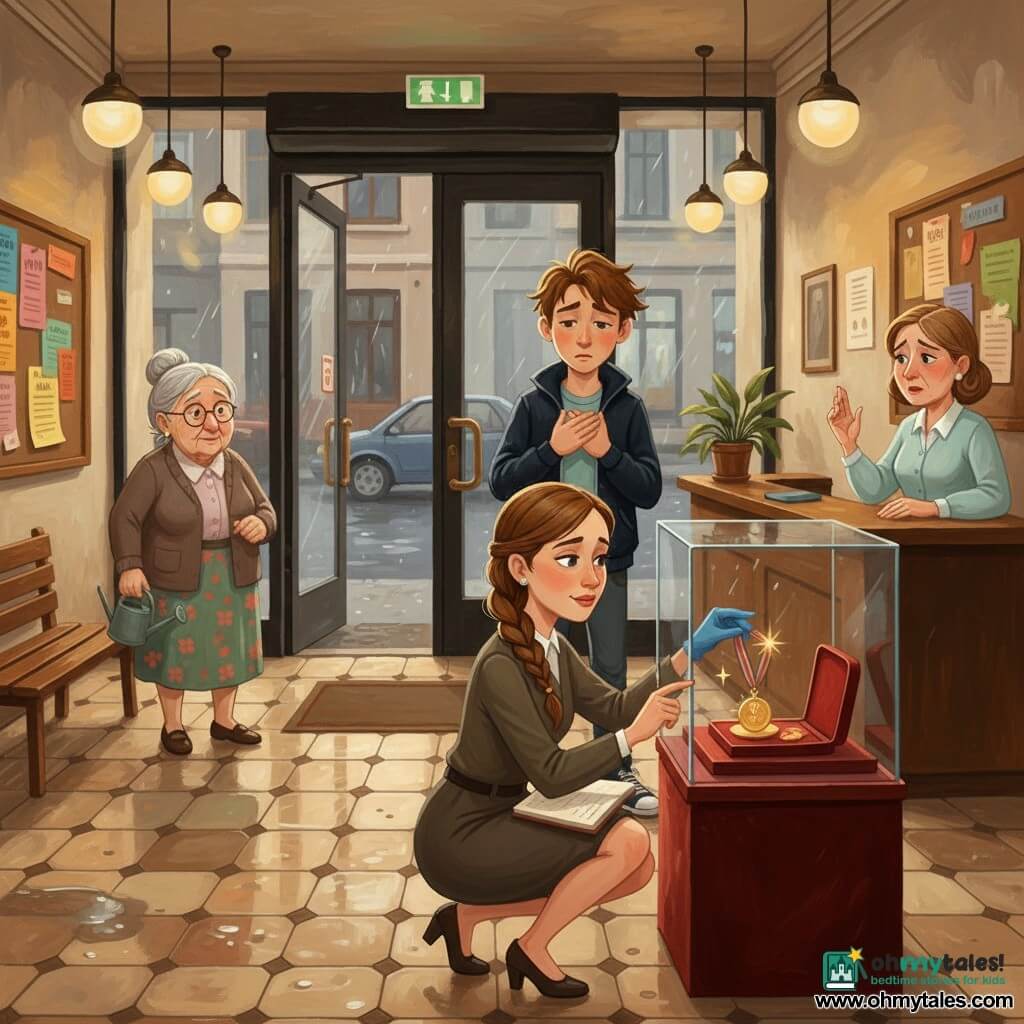
Inside the lobby, the community bulletin board was crowded with flyers: piano lessons, lost cat, bake sale. Under the board was a glass case displaying the building's pride and joy: the Willow Court Medal of Integrity, awarded last month after the residents raised money for the local shelter.
The medal was supposed to be in the middle, on a velvet stand, under a little plaque that read:
“Integrity is doing the right thing when no one is watching.”
Instead, there was a hook.
An empty hook.
Mrs. Vance, the building manager, paced in front of the case like a worried metronome. Her keyring clinked with every step.
“It was there at noon,” she said. “I dusted the glass myself. I locked it. And now—” She jabbed a finger at the empty hook, as if scolding it into returning the medal.
Mara crouched. She didn't touch the case yet. She watched.
The glass door was slightly ajar. The lock wasn't broken. There were no scratches around it.
No forced entry.
“Who has a key?” Mara asked.
“Me,” Mrs. Vance said quickly. “And Mr. Heller in 3B, because he helps when I'm away. That's it.”
Mara's eyes traveled over the floor tiles. The lobby was clean, but not perfectly. Near the case, a faint crescent of mud sat on a tile like a comma in a sentence.
Mara took out her notebook. “When did you last see the medal?”
“At noon,” Mrs. Vance repeated. “Then I went to the office to file the rent receipts. At five, I came back down to put up a new flyer. That's when I saw it.”
Mara nodded once. “Was the lobby busy today?”
Mrs. Vance sighed. “Always. People in and out. Kids. Deliveries. That new family in 2C still can't find the laundry room.”
Mara looked up at the bulletin board. Several flyers were pinned crookedly, and one had slipped halfway down, held by a single thumbtack. Someone had been in a hurry.
She asked the question she always asked first, because it often mattered more than people realized.
“Who benefits from the medal being gone?”
Mrs. Vance blinked. “Benefits? Nobody benefits! It's… it's symbolic.”
“Symbols can be valuable,” Mara said. “Sometimes more than money.”
A door opened on the left, and a tall man with gray hair and a sweater that looked too warm for June stepped into the lobby.
Mr. Heller, Mara guessed.
He saw the open case and stopped. His eyes narrowed like a camera lens focusing. “Well. That's disgraceful.”
Mrs. Vance spun toward him. “Disgraceful is a polite word, Victor.”
Mr. Heller's gaze flicked to Mara's notebook. “You're the detective?”
Mara smiled, small and professional. “I'm helping.”
He folded his arms. “People have no respect anymore.”
Mara studied him while he spoke. His shoes were polished. No mud. His cuffs were clean. He had the kind of posture that said he liked rules because rules liked him back.
Mara turned back to the case. If the lock wasn't broken, the medal left by key—or by someone who knew a trick.
She leaned closer. The latch showed a thin smear of something pale.
Wax?
She straightened. “Mrs. Vance, please don't close the case yet. And could you ask everyone to stay nearby? I'd like to speak to residents who were in the lobby this afternoon.”
Mrs. Vance nodded, already pulling out her phone like it was a lifeline.
Mara's eyes drifted once more to the little crescent of mud. It was small, but it was a beginning.
And beginnings mattered.
Before anyone else arrived, Mara wrote three words in her notebook and underlined them:
LOCK. MUD. HURRY.
Then she looked at the empty hook and quietly promised the missing medal, “We'll find you.”
Chapter 2: Three Stories and a Smudge
Within fifteen minutes, the lobby filled with that special kind of tension that makes people whisper even when they're standing two feet apart.
Mara stood beside the bulletin board and spoke calmly. “I'm not here to accuse. I'm here to understand. If you tell the truth, we solve this faster.”
A boy in a hoodie leaned against the wall, trying to look bored and failing. His name, according to Mrs. Vance, was Devon from 4D. He was twelve and had the restless knees of someone who'd rather be anywhere else.
Beside him stood Mrs. Lott from 1A, holding a grocery bag with a baguette poking out like an antenna. She looked offended on behalf of the entire building.
And then there was Jae Kim from 2C, the new kid, maybe eleven, with a backpack still on as if he hadn't decided where to put it yet. He watched Mara carefully, as if she were a puzzle he wanted to solve too.
Mr. Heller stayed back, arms still folded, like a statue of disapproval.
Mara began with a gentle question. “Who was in the lobby between noon and five?”
Mrs. Lott lifted her chin. “I was. Around two. I saw the medal.”
“You noticed it?” Mara asked.
“Of course I noticed it,” Mrs. Lott said. “It's shiny. I like shiny things. And I like knowing this building still has standards.”
Devon snorted softly. Mrs. Lott glared at him like she could melt his hoodie.
Mara looked at Devon. “How about you?”
Devon shrugged. “I came down around three to get my package. The delivery guy left it by the mailboxes. I didn't look at some medal.”
Mara didn't argue. She simply asked, “Did you see anyone near the display case?”
Devon hesitated just long enough for Mara to write it down. “Uh… I saw Mr. Heller. He was standing there, like, staring at it.”
Mr. Heller's face sharpened. “I was reading the plaque. That's not a crime.”
“It's not,” Mara agreed. “It's a detail.”
She turned to Jae. “And you?”
Jae shifted his backpack strap higher. “I was lost,” he admitted. “I came down at like… four? I was looking for the laundry room. I asked Mrs. Lott and she told me I was walking the wrong way.”
Mrs. Lott nodded briskly, as if guiding lost children was a public service.
Mara asked, “Did you notice the case?”
Jae thought. “It was closed. I remember because I saw the reflection of the lights. Like a mirror.”
Mara glanced at the case again. The lock was intact. The door had been opened, but not violently.
She knelt near the latch. “Mrs. Vance, may I?”
Mrs. Vance hovered nervously. “If it helps.”
Mara took a clean tissue from her pocket and gently rubbed the pale smear near the latch. The tissue came away with a faint chalky streak.
Wax, she thought. Like from a candle, or a crayon, or… a waxy key impression trick.
She held the tissue up so the group could see. “Someone may have used wax to copy the key shape.”
Mr. Heller let out a sound halfway between a scoff and a cough. “Nonsense. This isn't a spy movie.”
Mara kept her voice even. “It's simpler than that. Wax can be pressed into a keyhole cover or into soft material to copy grooves. If someone had access to the key for a minute, they might not need to steal it.”
Mrs. Vance paled. “My key has been on this ring all day.”
Mara's gaze shifted to the bulletin board again. “Then maybe they didn't copy your key. Maybe they copied Mr. Heller's.”
Mr. Heller's eyebrows rose. “My key never left my pocket.”
Mara didn't challenge him yet. She wasn't collecting arguments. She was collecting facts.
She pointed to the floor. “This mud mark—who came in with muddy shoes today? It rained earlier.”
Devon raised a hand halfway. “I did. Soccer practice. Field was gross.”
Mara looked at his sneakers. The soles were damp, but his shoes were mostly clean now. “Did you wipe them?”
Devon shrugged. “Yeah. On the mat.”
Mara nodded toward the entrance mat. It was dark and wet, like it had swallowed half the street.
Mrs. Lott huffed. “Young people bring the outdoors in with them.”
Mara asked, “Anyone else with muddy shoes?”
Jae lifted a foot slightly. His sneakers had tiny specks, not a crescent smear.
Mr. Heller's shoes were pristine.
Mara stood and took one slow breath. She could feel the story trying to shape itself, but it was still missing a piece.
She addressed the group. “I need to know something else. When you were in the lobby today, did you hear any sound—glass, metal, the case being opened?”
Mrs. Lott narrowed her eyes. “At two, I heard someone humming. Very confidently. Like they owned the hallway.”
Devon blinked. “That was probably Mr. Heller. He hums all the time.”
Mr. Heller bristled. “I do not ‘hum all the time.' I occasionally… appreciate a tune.”
Jae raised his hand. “At four, I heard the elevator ding, but no one came out. The doors opened and then closed.”
Mara wrote it down. Elevator ding with no passenger.
Then she noticed something else. On the bulletin board, the slipped flyer had a corner torn cleanly, like someone had yanked it away and then changed their mind.
Mara stepped closer. The torn corner left a small triangle of paper still pinned, and on it, faint pencil marks.
Numbers.
Not many. Just enough to suggest a note someone didn't mean to leave behind.
Mara copied them into her notebook without making a show of it.
She looked back at the empty case. Wax on the latch. A mud comma on the tile. A torn note on the board. An elevator ding that meant someone moved without being seen.
This wasn't a big, dramatic crime. It was a careful one.
Which meant the person who did it was either very calm… or pretending to be.
Mara closed her notebook softly. “Thank you. Please go back to your apartments. And if you remember anything else—anything that seems silly—tell me.”
As people drifted away, Mrs. Vance stayed, twisting her keyring.
“Mara,” she whispered, “do you think it was someone from the building?”
Mara looked at the lobby as if it were a map. “Most mysteries are close to home.”
Then the side door creaked open, and a voice called from the hallway, bright and curious.
“Are you investigating the missing medal?”
Mara turned.
In the doorway stood a woman with silver-streaked hair pulled into a bun and eyes that missed nothing. She held a watering can like it was an extension of her arm.
“I'm Celia from 2B,” she said. “And I saw something you'll want to hear.”
Chapter 3: The Observant Neighbor
Celia stepped into the lobby with the quiet confidence of someone who had been right about many things for many years.
Mrs. Vance looked relieved and worried at the same time. “Celia, if you have information—”
“I do,” Celia said, and set the watering can down carefully, not a drop wasted. “But first, young lady, may I see the display case?”
Mara's eyebrows lifted. “Of course.”
Celia leaned in, hands behind her back, and examined the latch and the edges of the glass. “No scratches. No panic. Whoever opened this knew what they were doing.” Her gaze dropped to the floor. “And they weren't alone in leaving marks.”
She pointed with one finger, hovering just above the tile. “That mud crescent. That shape comes from a heel that twists.”
Mara glanced at Celia's shoes: sensible flats, clean. “You noticed it right away.”
Celia's mouth curved slightly. “I notice when my basil looks sad. Of course I notice when a medal disappears.”
Mara kept her tone friendly but focused. “What did you see?”
Celia looked toward the elevator. “At about four-thirty, I was coming back from the courtyard. I had been watering the planters. The lobby lights were on, and I saw someone standing near the bulletin board.”
“Who?” Mara asked.
Celia held up a hand. “I didn't see their face. They were turned away. But I saw two things. One—” she nodded toward the bulletin board “—they pulled a flyer down, looked at it, and ripped off a small corner. Like they were taking a phone number, but in a hurry.”
Mara's notebook was already open. She had copied the faint numbers. “And two?”
Celia's eyes sharpened. “They had a ring of keys. A big one. But not like Mrs. Vance's, which jingles like a wind chime. This ring was quieter. The keys were spaced out with little rubber bits.”
Mrs. Vance blinked. “Rubber bits?”
Celia nodded. “To stop noise. I use them on my greenhouse keys. That's why I noticed.”
Mara asked, “Did the person go into the elevator?”
“No,” Celia said. “They went toward the stairwell. And here is the part that matters.” She paused, as if letting the sentence gather weight. “A minute later, the elevator dinged, the doors opened, and no one got out.”
Mara's mind clicked. Someone used the stairs, but called the elevator to create the sound Jae heard—so anyone listening would assume movement.
A small misdirection. Clean. Clever.
Mara asked, “Anything else? Clothing? Height?”
Celia tilted her head. “Medium height. Dark jacket. And their shoes—this is odd—had a lighter-colored heel. Like a strip of pale rubber.”
Mara looked again at the mud mark. A heel twist could leave a crescent. If the heel had a lighter strip, it might press differently.
She thanked Celia. “This helps a lot.”
Celia's eyes softened. “One more thing. I did see Mr. Heller earlier. Around three. He was by the case.”
Mara glanced toward the corridor where Mr. Heller had disappeared. “What was he doing?”
“He was polishing the glass,” Celia said, as if reciting an observation from a list. “With his own handkerchief. He looked proud of it. I almost scolded him for smudging, but he did it properly.”
Mara wrote: Heller polished case at 3.
Polishing could remove fingerprints. Or it could be a harmless habit. The question was why.
Mara turned to Mrs. Vance. “I'd like to see the spare key situation.”
Mrs. Vance led her into the small office just off the lobby. The space smelled like paper and lemon cleaner. A metal cabinet stood in the corner with a key box mounted inside.
Mrs. Vance opened it. Two hooks, labeled carefully: DISPLAY CASE—VANCE and DISPLAY CASE—HELLER.
The HELLER hook was empty.
Mrs. Vance's eyes widened. “That's… that's not right.”
Mara's voice stayed steady. “You keep a copy of his key here?”
Mrs. Vance looked embarrassed. “For emergencies. He gave it to me when he moved in. It's been here for years. I forgot it was even there.”
Mara nodded. Easy access. If someone could get into the office…
Mara scanned the desk. Pens aligned. A stapler squared to the edge. Mrs. Vance liked order. Order made missing things obvious.
“Was the office locked all day?” Mara asked.
Mrs. Vance hesitated. “I… I stepped out to speak to the mail carrier. For maybe two minutes. I left the door shut, but I don't remember if I locked it.”
Two minutes was enough.
Mara's eyes fell on a small candle on the windowsill, half-melted, decorative. A pale wax puddle hardened around its base.
Mara didn't touch it. She just looked at Mrs. Vance. “Do you use that candle?”
Mrs. Vance shook her head. “It's just for the scent. I never light it.”
Mara's thoughts tightened like a knot. Wax in the office. Wax on the latch. A missing key from the key box. A torn flyer corner with numbers. A quiet key ring with rubber spacers.
This wasn't random. It was planned, but not perfectly.
“Mara,” Mrs. Vance whispered, “is Victor… is he—”
Mara raised a hand gently. “Integrity means we don't decide before we know. We follow the evidence.”
She stepped back into the lobby with Celia, who watched Mara with a kind of respectful impatience.
“What do you think?” Celia asked.
“I think,” Mara said, “the person wanted the medal, but also wanted us to look in the wrong direction.”
Celia's eyes flicked to the bulletin board. “And those numbers?”
Mara closed her notebook. “That's what we'll use next. Want to help me?”
Celia smiled. “I was hoping you'd ask.”
Chapter 4: The Corner of Paper
Mara and Celia sat on the lobby bench under the bulletin board. Mara held the torn triangle of paper she'd gently removed, keeping it flat on her notebook.
The pencil marks were faint but readable: 4… 1… and a looping line that could be a 7 or a 1.
Celia leaned in. “It looks like a phone number.”
“Or an apartment number,” Mara said. “Or a code.”
She glanced up at the flyers. One stood out: “LOST: SMALL TORTOISE. Answers to ‘Captain.' Please call…”
The bottom strip with the phone number had been torn off in several neat tabs, like the flyer had been popular.
Mara's eyes moved to another flyer, newer, printed on pale blue paper: “COMMUNITY YARD SALE—SATURDAY—Contact for table spots.”
A corner of that blue flyer was missing.
Mara stood and studied the pinholes. The missing corner matched the torn triangle's color.
Celia's voice was dry. “So our hurried person wanted the contact information for the yard sale.”
“Maybe,” Mara said. “Or they wanted to remove a detail.”
She read the remaining text. “Contact: R. Sato, 5C.”
Celia hummed. “Rina Sato. She runs the yard sale like a general.”
Mara's mind moved fast but stayed careful. “If the contact detail was on the missing corner, then someone tore it off. But why leave the corner behind?”
“Because they panicked,” Celia said. “Or because they were interrupted.”
Mara nodded. She looked toward the stairwell door. “Who lives near the stairs?”
Celia answered without thinking. “Rina in 5C is closest on the fifth floor. Devon's on four. And Mr. Heller's on three, but he uses the elevator like it's a throne.”
Mara smiled briefly at that. Then she grew serious again. “Let's talk to Rina Sato.”
They rode the elevator up. This time, when it dinged, someone did get out—an older man carrying laundry who stared at Mara's notebook as if it might bite him.
On the fifth floor, the hallway smelled like curry and dryer sheets. Apartment 5C had a door wreath made of tiny fake lemons.
Mara knocked. After a moment, the door opened to reveal a woman in her thirties with sharp eyes and a measuring tape around her neck like a scarf.
“Yes?” Rina Sato said. “If this is about the yard sale, table spots are full.”
Mara held up her hand in greeting. “Mara Quinn. I'm investigating a theft in the lobby.”
Rina's expression changed—interest, then alarm. “The medal? Someone stole it?”
“We're trying to find it,” Mara said. “May we ask you a few questions?”
Rina stepped aside. “Fine. But make it quick. I'm sorting donations.”
Inside, boxes were stacked neatly. A label on one read “HONESTY JARS—YARD SALE.” Another read “COSTUMES.”
Celia's eyes lit up at the costumes box, then she snapped back to seriousness.
Mara asked, “Did you make the blue yard sale flyer?”
“Yes,” Rina said. “I put it up yesterday.”
“Was there contact information on the bottom corner?” Mara asked.
Rina frowned. “Yes. My phone number. Why?”
Mara showed her the tiny torn triangle. “A corner was ripped off. Did you tear any tabs yourself?”
Rina took the triangle and squinted. “No. I would tear the whole strip cleanly. This is sloppy.” She handed it back. “Someone wanted my number.”
Celia crossed her arms. “Do you give your number to everyone?”
Rina snorted. “No. I give it to people who pay on time and don't leave old couches in the hallway.”
Mara continued. “Where were you today between noon and five?”
Rina pointed with her measuring tape. “At the community center from one to three. I teach a sewing club. Then I came home. I was in my apartment from three-thirty onward.”
Mara's attention caught on the “COSTUMES” box. A dark jacket lay on top, half-folded. “Are those for the yard sale?”
Rina nodded. “Yes. Old theater stuff. Why?”
Mara asked, “Do you own a key ring with rubber spacers?”
Rina blinked. “Rubber spacers? No.”
Celia leaned in. “Do you know anyone who does?”
Rina thought. “My neighbor across the hall—Tomas, 5B. He's into gadgets. He fixes bikes and locks and whatever. He has key rings with all kinds of weird things.”
Mara's pencil paused. “Tomas in 5B. Was he home today?”
“I saw him around four,” Rina said. “He was carrying a box downstairs. Said he was dropping off ‘something for the lobby.' I didn't ask.”
Mara felt the story tilt. “Something for the lobby?”
Rina shrugged. “He likes to be helpful. Sometimes too helpful.”
Mara thanked her and stepped back into the hallway.
Celia's voice lowered. “So Tomas had reason to go downstairs, and he likes locks.”
“And someone tore off Rina's number,” Mara said. “If the thief needed to contact her, it could be about selling the medal.”
Celia made a face. “Selling integrity. That's poetic in the worst way.”
Mara walked to 5B and knocked.
No answer.
She listened. Silence.
Mara tried the doorknob—not turning it, just testing. It was locked.
Celia pointed down the stairwell. “If he went down around four, he could have done it.”
“Maybe,” Mara said. “But we still need proof. And we need to find the medal before it leaves this building.”
Mara's eyes sharpened. “Celia, you said the thief's heel had a pale strip. Tomas—what kind of shoes does he wear?”
Celia didn't hesitate. “White-soled sneakers. Always. He says they're ‘quiet for late-night projects.'”
Mara exhaled slowly. Quiet key ring. Quiet shoes. Quiet plan.
But quiet plans still made noise in the right place.
“Let's check the trash chute room,” Mara said. “If someone panicked, they might have ditched something—wax, paper, even the medal—somewhere close.”
Celia nodded, already moving. “I'll bring gloves.”
Chapter 5: The Stairwell Echo
The trash chute room on the fifth floor was small, tiled, and smelled like orange peels trying their best. A metal chute door sat in the wall like a mouth that never smiled.
Mara didn't open it yet. She looked around first.
On the floor, near the baseboard, was a thin curl of pale blue paper.
Celia saw it too. “From the flyer.”
Mara put on gloves Celia had brought—bright yellow, a little too big—and picked up the paper curl. It matched the blue flyer exactly.
Someone had ripped the corner and carried it up here, maybe while walking fast. The paper curl could have fallen from their pocket.
Mara checked the small trash can in the corner. Mostly tissues, a pizza box lid, and—she paused—an empty plastic wrapper with a picture of a candle on it.
Celia leaned closer. “A votive candle wrapper.”
Mara held it carefully. “Wax source.”
She opened the chute room door and listened. The building's sounds came through: distant water pipes, someone's TV, a dog barking like it had an opinion.
Then she heard it.
A faint metallic tapping from the stairwell, two flights down, like someone adjusting something.
Mara's eyes met Celia's. Celia's face said, Told you I notice things.
They stepped into the stairwell quietly. The concrete steps were still damp in places, and the air was cooler, holding old echoes.
They moved down one flight, then another.
On the landing between the third and second floors, a man crouched by the stairwell window, his back to them. A small toolkit lay open beside him. His hands were busy with something small and shiny.
Mara didn't shout. She didn't run.
She said, calmly, “Tomas?”
The man stiffened. He turned, startled, and for a second his expression was pure guilt—like a confession written on his face before he could erase it.
He was in his late teens, maybe nineteen, with messy hair and a dark jacket. White-soled sneakers. A key ring hung from his belt loop, keys spaced with tiny rubber circles.
In his hand was the medal.
The Willow Court Medal of Integrity glinted in the stairwell's gray light, looking suddenly less like a symbol and more like a piece of stolen sun.
Celia inhaled sharply. “So that's where it went.”
Tomas stood too quickly. “I—this isn't—”
Mara held up her gloved hands, empty. “I'm not here to wrestle you. I'm here to understand. Why did you take it?”
Tomas's eyes darted toward the stairs, then toward the window, as if searching for a way out that didn't involve answering.
“Because…” He swallowed. “Because everyone keeps talking about integrity like it's a poster. But nobody lives it.”
Celia's voice was sharp. “Stealing a medal about honesty is not exactly a strong argument.”
Tomas flinched. “I wasn't stealing it forever.”
Mara's tone stayed steady. “Then what were you doing with it?”
Tomas looked down at the medal. His shoulders slumped. “I wanted to make a point. I was going to put it back with a note.”
“What point?” Mara asked.
“That the case is easy to open,” Tomas said quickly, words spilling now. “That the office key box is basically a suggestion. That you can copy a key with wax and nobody notices. I… I wanted them to fix it.”
Celia stared at him. “So your plan was: commit a crime to protest crime.”
Tomas winced. “When you say it like that, it sounds dumb.”
“It is dumb,” Celia said, but her voice softened a fraction. “Also clever. Which is a dangerous combination.”
Mara asked, “You copied Mr. Heller's key?”
Tomas shook his head. “No. I copied the one from the office. Mrs. Vance left the door unlocked when she talked to the mail carrier. I've fixed her printer before, so she doesn't mind me in there. I saw the candle on the sill, pressed wax, made an impression of the key in the box. I didn't take the key. I just… borrowed its shape.”
Mara nodded. The wax on the latch. The missing key from the hook—because Tomas had taken it out briefly to compare it, then forgot to put it back.
“And the flyer corner?” Mara asked.
Tomas looked embarrassed. “I tore off Rina's number because I needed cardboard to press the wax against. I know, I know. I could've used something else. I was in a hurry.”
Celia crossed her arms. “The elevator ding?”
Tomas rubbed the back of his neck. “I called it so it would sound like I left. I took the stairs instead. Habit.”
Mara's eyes stayed on the medal. “And why were you about to… what, polish it?”
Tomas held up a cloth. “To remove my fingerprints before I returned it. I didn't want anyone blamed.”
Celia let out a short laugh that held no humor. “You didn't want anyone blamed, so you created a mystery that could have blamed everyone.”
Tomas's face reddened. “I didn't think it through.”
Mara was quiet for a moment. This was the part of detective work that wasn't about tricks or clues. It was about choices.
She said, “Integrity isn't a medal. It's what you do when you could get away with something.”
Tomas looked at her, eyes tired. “So what now?”
Mara held out her hand. “Now you do the right thing when people are watching too. You return it. And you tell Mrs. Vance the truth.”
Tomas hesitated, then placed the medal gently in Mara's gloved palm. It felt heavier than it looked.
He took a breath. “Okay. I'll tell her.”
Celia nodded once, satisfied in a strict way. “Good. And then you can use your cleverness to fix the lock properly, under supervision.”
Tomas managed a small, shaky smile. “Fair.”
As they walked back down toward the lobby, Mara glanced at the medal and thought about how easily people confused being smart with being right.
The mystery was almost over.
The lesson wasn't.
Chapter 6: The Right Thing
Mrs. Vance was still in the lobby, sitting stiffly at her desk, as if moving might make the problem worse. Mr. Heller stood nearby, radiating disapproval like a heater.
When Mara entered holding the medal, Mrs. Vance's hand flew to her mouth. “Oh! You found it!”
Mr. Heller leaned forward, eyes bright. “Who had it?”
Mara didn't answer for Tomas. She stepped aside.
Tomas walked in behind her, shoulders squared the way people square them when they're trying to be brave.
“I did,” Tomas said. His voice cracked on the first word, then steadied. “I took it.”
Mrs. Vance stared. “Tomas? Why?”
Tomas explained—briefly, clearly, without drama. He admitted to copying the key with wax, to calling the elevator, to tearing the flyer corner, to taking the medal and planning to return it.
He didn't excuse it. He didn't blame anyone. He owned it.
When he finished, the lobby felt quieter, like the building itself was listening.
Mr. Heller exhaled sharply. “So you admit you committed theft.”
“Yes,” Tomas said. “And I'm sorry.”
Mrs. Vance's face shifted through emotions like pages turning: shock, anger, disappointment, and then something tired. “You frightened everyone.”
“I know,” Tomas said. “I thought I was being… I don't know. Helpful. Bold. But it wasn't honest.”
Mara placed the medal back into the case, setting it on its stand. She closed the glass door and, this time, locked it while everyone watched.
The click sounded final.
Mara turned to Mrs. Vance. “The lock and key system needs improving. Keep the office locked. Remove spare keys from open hooks. Consider a coded lock or a new cylinder.”
Mrs. Vance nodded quickly. “Yes. Absolutely.”
Mr. Heller cleared his throat. “And what punishment will there be?”
Mara looked at Tomas. “That's for the building to decide. But there's something integrity requires.”
She faced Tomas. “You will apologize to Rina for damaging her flyer and give her your help at the yard sale—doing the unglamorous jobs. Carrying boxes. Sweeping up. No shortcuts.”
Tomas nodded. “I'll do it.”
Mara added, “And you'll write a note for the bulletin board explaining what you did and why it was wrong. Not to show off. To take responsibility.”
Tomas swallowed. “Okay.”
Celia, standing by the planters, spoke up. “And you'll help Mrs. Vance improve security, with her permission. Use your skills to protect, not to test.”
Tomas looked relieved to have a way forward. “Yes. I can do that.”
Mrs. Vance's voice softened slightly. “I'm still upset. But… I'm glad you told the truth.”
Mara nodded. “Truth doesn't erase the mistake. It prevents the next one.”
Mr. Heller looked unconvinced, but he said nothing.
Mara opened her notebook and tore out a clean page. She handed it to Tomas along with a pen. “Write the apology note now, while your courage is here.”
Tomas sat at the small lobby table and began to write. His handwriting was messy at first, then steadier.
Mara watched quietly. This, too, was detective work: making sure the ending was not just solved, but repaired.
When Tomas finished, he read it aloud. He admitted what he had done, apologized, and promised to earn back trust.
Mrs. Vance pinned the note to the bulletin board. The paper sat among the flyers like a new kind of announcement: not a sale, not a lesson, but a choice.
Mara turned to Celia. “Thank you for your help.”
Celia lifted her watering can again. “I do enjoy a mystery. But I enjoy a honest ending more.”
Mara glanced once more at the medal behind glass. The plaque beneath it seemed to speak louder now.
Integrity is doing the right thing when no one is watching.
And sometimes, Mara thought, it's doing the right thing even when everyone is.
Before she left, Mara looked at you—yes, you, the reader—and in her mind she asked a final question, the kind that matters after clues are done:
If you had found the spare key hook empty, the wax smear, and the torn flyer corner… would you have followed the evidence, even if it pointed to someone you liked?
Mara stepped out into the hallway, the building's lights warm behind her. The street outside was still wet, but the puddles reflected the world more clearly now.
And on the lobby board, next to the apology note, someone—probably Celia—had drawn a little reminder in pen.
+----------------------+
| (o) (o) |
| ____ |
| / \ |
| | ____ | |
| \______/ |
| "Integrity!" |
+----------------------+