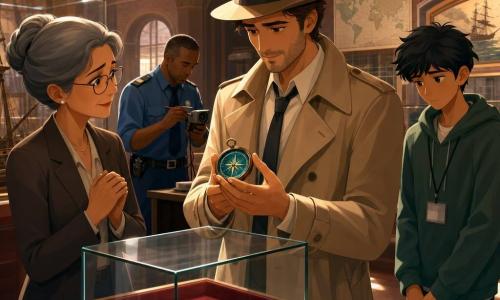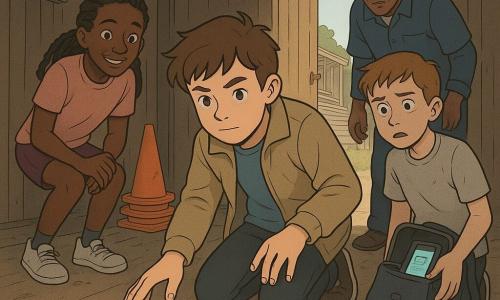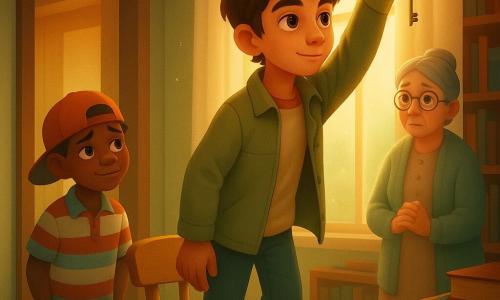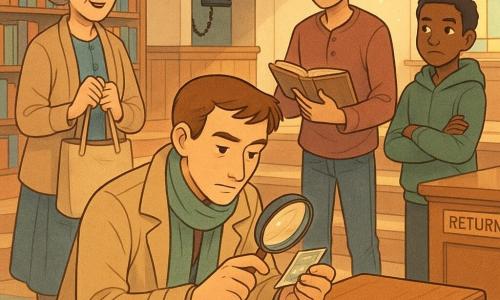
Chapter 1: The Missing Ledger
Mara Finch liked to arrive early, before people's stories got tangled by other people's opinions. She was the kind of detective who didn't fill silences with guesses. She let silence do its work.
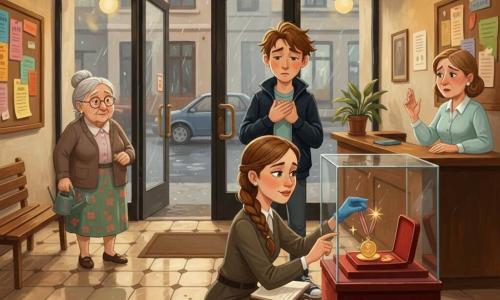
The Riverside Community Library smelled of paper and rain. Someone had left the front door open a crack, and cold air slid along the floor like a cautious visitor.
Mr. Dalloway, the head librarian, stood behind the desk with both hands pressed flat on the counter as if he could hold the whole building still.
“It's gone,” he said.
Mara's eyes moved, not in a rush, but in a steady sweep. A row of posters. A rack of bookmarks. A bowl of peppermints. The security camera perched in the corner. And behind the desk, an empty space where a thick book should have been.
“What's gone?” she asked.
“The donations ledger,” Mr. Dalloway said. “Names, amounts, dates. We use it for the annual report. It was in the locked drawer.”
Mara nodded. “When did you last see it?”
“Yesterday evening. Before closing.”
“Who had access to the drawer?”
Mr. Dalloway lifted one finger. “Me. And two volunteers—Juno Park and Theo Briggs. They help with events. They have a key.”
Mara held her notebook open, but she didn't write yet. She watched Mr. Dalloway's face when he mentioned the volunteers. His mouth tightened, just for a moment.
“Was anything else taken?” she asked.
“No.” He swallowed. “But there's… this.”
He slid a strip of paper across the desk. It looked torn from a notepad, the edges rough. Written in neat block letters was a line of nonsense:
RVOOLU OLC TL JYHZZ
Mara read it twice, then once more, slowly. “Where did you find it?”
“On the floor by the drawer,” Mr. Dalloway said. “Like it fell out of someone's pocket.”
Mara finally wrote: Message, block letters. Found by drawer.
“Do you recognize the handwriting?”
He shook his head too quickly. “No. Not at all.”
Mara slipped the note into an evidence envelope. “I'll need to see the drawer and the lock.”
Mr. Dalloway led her behind the desk. The drawer was shut. He unlocked it and pulled it open with a small, helpless gesture.
The ledger space was empty. No ripped papers. No scattered dust. Too tidy.
Mara leaned in. The lock wasn't scratched. The wood around it wasn't splintered. Whoever opened it had done it properly, with a key—or with skill.
She closed her eyes for a second, listening. Somewhere upstairs, a child laughed, then shushed. A librarian's soft footsteps. The building still worked as if nothing had happened.
Mara opened her eyes. “I'll talk to the volunteers. And anyone who was here last night.”
Mr. Dalloway's voice dropped. “Please. We can't have this… out there. People will assume the worst.”
Mara met his gaze. “Assumptions are loud,” she said. “Facts are quiet. We'll follow the quiet ones.”
Before she left the desk, she glanced at the peppermints. One wrapper lay beside the bowl, twisted tightly. Silver with blue stripes.
Tiny details mattered. They always did.
Chapter 2: The Message That Wouldn't Behave
Mara set up at a small table near the library's big window. Rain tapped the glass like impatient fingers. She laid the note flat and copied the letters into her notebook.
RVOOLU OLC TL JYHZZ.
Eleven-year-olds and twelve-year-olds liked puzzles when they felt invited into them, Mara thought. And whoever wrote this wanted it to be read.
A simple code, maybe. A substitution. A shift.
She tried the oldest trick first: a Caesar shift, sliding each letter back by a few steps in the alphabet. If you slid it back three, R became O, V became S…
OSLLIR LIZ QI GVEWW.
That looked like nonsense with better rhythm.
Back seven?
K O H H N N H E V M S R ?
Still wrong.
Mara didn't force it. She looked at the spacing. Five letters, then three, then two, then five. It felt like words. Real words hiding under a mask.
She wrote the alphabet twice and began matching patterns. In JYHZZ, the last two letters were the same. The fourth and fifth were the same. That often happened in words like “still,” “flood,” “grass,” “class.”
JYHZZ could be “SHE??” or “WILL?” depending on the code.
Mara's phone buzzed. A text from her younger cousin, Nia, who sometimes helped at the library and always asked too many questions.
NIA: Heard there's drama at Riverside. Are you there?
MARA: Yes. Stay out of the way, but if you saw anything last night, tell me later.
Mara returned to the note. She tried something else: Atbash, flipping the alphabet so A becomes Z, B becomes Y.
R became I. V became E. O became L. O became L. L became O. U became F.
IELLOF.
She blinked and did it again. RVOOLU became I E L L O F.
“IELLOF,” she murmured. That was close to “YELLOW” or “HELLO” or… “FOLLEI.”
She checked her mapping. Atbash: A-Z, B-Y, C-X… R corresponds to I, yes. V to E. O to L. L to O. U to F.
So RVOOLU = IELLOF.
That wasn't a word, but it looked like a word seen in a mirror.
Mara turned the paper upside down. Nothing.
She tried writing it backwards: ULOOVR.
No.
Then she noticed something she'd missed: the letters looked unusually clean, no smudges. As if written with a fresh marker, carefully.
A voice interrupted her thoughts. “Ms. Finch?”
She looked up. A boy with curly hair and an anxious face stood by the table. He had a volunteer badge pinned to his hoodie: THEO.
Theo held up his hands as if surrendering. “Mr. Dalloway said you wanted to talk.”
Mara gestured to the chair. “Sit. Tell me about last night.”
Theo sat, his knee bouncing. “I was here for the poetry night. We stacked chairs after. Juno and I helped.”
“What time did you leave?”
“Eight-thirty. Maybe eight-forty.”
“Did you go behind the desk?”
Theo frowned. “No. I mean, not then. Earlier I helped Mr. Dalloway carry boxes, but that was like… six.”
Mara's pencil hovered. “Boxes of what?”
“Old books from storage. For the sale.”
“Did you see the ledger?”
Theo shook his head. “I didn't even know it existed.”
Mara watched his eyes. He looked more scared of being accused than excited about a mystery. That could be genuine—or practiced.
“Do you recognize this?” Mara slid the coded note toward him.
Theo leaned in, lips moving as he read. “No. Looks like… one of those secret messages. My sister does that.”
“Your sister uses codes?”
“She watches spy videos,” Theo said. “She makes me decode stuff to get snacks.”
Mara almost smiled. “What kind of code?”
“Like… shifting letters. Or the one where A becomes Z.”
Mara's pencil stopped. “The one where A becomes Z. Atbash.”
Theo nodded. “Yeah, that.”
Mara's mind clicked. Atbash had almost given her a real word. She tried it on the full message, right there, slowly, letting Theo see.
RVOOLU became IELLOF.
OLC became LOX.
TL became GO.
JYHZZ became QBSAA.
IELLOF LOX GO QBSAA.
Theo squinted. “Still weird.”
Mara said, “But ‘IELLOF' looks close to something.”
Theo's eyes widened. “Wait. If you swap I to H… no. If you—”
Mara lifted a hand. “Not guessing. Thinking.”
She looked at the first word again. IELLOF.
Then she heard it in her head, as if said fast by someone laughing.
“Yellow,” she thought. Not exactly, but close.
She wrote it in capitals: YELLOW.
YELLOW is six letters. IELLOF is six letters. And IELLOF is “FOLL EI”…
Mara tapped the paper. “This isn't Atbash alone,” she said softly. “It's Atbash and then reversed.”
Theo blinked. “Like… double?”
“Like a lock with two turns.”
Mara reversed IELLOF and got FOLLEI. Still not “YELLOW.”
But she wasn't done. What if the message had been reversed first, then Atbash?
She took the entire message and reversed the letters within each word:
RVOOLU → ULOOVR
OLC → CLO
TL → LT
JYHZZ → ZZH YJ? No—ZZHYJ.
Now Atbash ULOOVR:
U becomes F, L becomes O, O becomes L, O becomes L, V becomes E, R becomes I.
FOLLEI.
Mara exhaled. She was circling something.
Theo said, “Maybe it's not Atbash.”
“Maybe,” Mara agreed. “Or maybe it's Atbash, but not English.”
Theo's face fell. “Oh.”
Mara glanced at the window. Rain. Gray river. The world looked like a photo with the color turned down.
Then she remembered the peppermint wrapper: silver with blue stripes.
Blue stripes.
She looked down at the note again and noticed the letters were in blue ink.
Blue. Stripes. Lines.
“Tell me,” Mara said, turning to Theo, “during poetry night, did anyone do anything… unusual? A joke? A performance?”
Theo hesitated. “There was this guy. Not a kid. An adult. He wore a yellow raincoat even though he was inside half the time. He read a poem about… secrets.”
Mara's pencil moved. Yellow raincoat.
Theo added, “He had a key lanyard. Like, lots of keys. But people have keys.”
Mara looked up sharply. “Did he go behind the desk?”
Theo chewed his lip. “I think he asked Mr. Dalloway something. Mr. Dalloway let him back there for a minute.”
Mara wrote: Adult, yellow coat, keys, behind desk.
A clue, or a distraction. Either way, it was now part of the quiet facts.
Chapter 3: Juno's Timeline
Juno Park arrived ten minutes late and acted as if time should apologize to her. She wore a neat ponytail and an expression that said she didn't enjoy being questioned, but she would win at it anyway.
“Detective Finch,” she said, sliding into the chair opposite Mara. “Is this about the ledger? Because I did not take it.”
Mara kept her voice level. “I didn't say you did. I'm building a timeline.”
Juno's eyes flicked to the envelope holding the coded note. “Ooh. Secret message. Cute.”
“Not cute,” Theo muttered from the next table, where Mara had asked him to wait.
Juno ignored him. “Poetry night ended at eight-fifteen. We cleaned up. Mr. Dalloway locked the drawer. I saw him do it.”
Mara's eyebrows lifted slightly. “You saw him lock the drawer?”
“Yes,” Juno said, confident. “He put the ledger back, shut it, locked it.”
“That's specific,” Mara said.
Juno shrugged. “I notice things. Also, he was being weird about it. Like, guarding treasure.”
Theo piped up, “I left around eight-thirty.”
Juno turned her head. “You left earlier than me. I stayed until nine because Ms. Brenner asked for help with the chairs.”
Mara asked, “Ms. Brenner?”
“The children's librarian,” Juno said. “Short hair, always has glitter on her sleeves from crafts.”
Mara wrote it down. “So you stayed until nine. Did you see anyone behind the desk after eight-fifteen?”
Juno's mouth tightened. “No. I was in the main room. But—” She paused, and something like satisfaction flashed in her eyes. “There was a man in a yellow raincoat. He kept hovering.”
Theo nodded quickly. “That's what I said!”
Juno continued, “He talked to Mr. Dalloway. Then he wandered upstairs. I didn't like him. He smiled too much.”
Mara said, “Smiling is not a crime.”
Juno leaned forward. “He had wet shoes, but his coat was dry. Explain that.”
Theo frowned. “Maybe he dried off?”
Juno shook her head. “Or maybe he didn't come from outside. Maybe he came from the storage entrance in the basement. That door sticks. It makes a squeal.”
Mara's gaze sharpened. “Did you hear it?”
Juno hesitated. “Not last night. But I've heard it before. And the yellow coat guy knew where things were. Like he'd been here often.”
Mara leaned back, letting the details settle. A contradiction was forming, but it wasn't clear yet.
She asked Juno, “What time did Mr. Dalloway leave?”
Juno said, “He left around eight-forty-five. He told me he had to pick up his niece.”
Theo's face scrunched. “He told me he was going to a meeting.”
Juno looked at Theo. “He said that?”
Theo nodded. “Yeah. Like a library board thing.”
Silence dropped between them like a heavy curtain.
Mara's pencil stopped. Two different reasons. Same time.
Contradiction.
People can have two errands, Mara reminded herself. But people also invent reasons when they don't want you to know the real one.
Mara closed her notebook gently. “Thank you. Both of you. Stay available.”
Juno crossed her arms. “So you think Mr. Dalloway did it.”
“I think,” Mara said, “that the story of the night has a loose thread. Loose threads lead somewhere.”
As the volunteers left, Mara turned the coded note over again. On the back, faintly, there was an imprint—like someone had pressed hard while writing on top of another sheet.
Mara angled it to the light. Letters appeared, ghost-pale.
…MEET… 9:10… RIVER…
She felt a small surge of excitement, held back by discipline. Excitement made people sloppy.
She needed the rest of that hidden message.
Chapter 4: The Witness in the Stacks
Mara asked Ms. Brenner to open the children's craft closet. Inside, shelves held glue, paper, string, and a box of blue-striped peppermint wrappers for rewards during reading challenges.
Blue stripes again.
“Do you keep peppermints behind the desk too?” Mara asked.
Ms. Brenner nodded. “Mr. Dalloway likes them. He says they help him think.”
Mara held up one wrapper from the box. It matched the twisted wrapper near the front desk.
“Who was on shift last night?” Mara asked.
“Me, Mr. Dalloway, and the volunteers,” Ms. Brenner said. “And… oh. There was Mrs. Kettle.”
“Who's Mrs. Kettle?” Mara asked.
Ms. Brenner's face softened. “She's our quiet regular. Elderly. Always sits in the history aisle with her thermos. She's sweet as anything. She sees more than people realize.”
Mara's patience had brought her here. Important witnesses were often invisible on purpose.
“Can I speak with her?” Mara asked.
Ms. Brenner pointed. “History aisle, second floor. If she's there, she'll be under the window.”
Upstairs, the air was warmer, thicker with the smell of old bindings. Mara moved between shelves, footsteps muffled by carpet.
By the window, a small woman sat with a gray knit hat and a thermos decorated with tiny planets. She had a book open but wasn't reading. She was watching the rain like it was a story she already knew.
“Mrs. Kettle?” Mara asked gently.
The woman looked up, eyes sharp as new pins. “Detective,” she said as if she'd been expecting her.
Mara sat across from her, careful not to loom. “You know who I am?”
Mrs. Kettle smiled. “I used to be a crossing guard. You learn to recognize who watches and who charges. You watch.”
Mara took out her notebook. “I'm looking into a missing donations ledger. Did you notice anything unusual last night?”
Mrs. Kettle tipped her thermos, poured tea into the cap, and sipped with calm precision. “Unusual? In a library? Only the people who forget it's a quiet place.”
Mara waited.
Mrs. Kettle continued, “The head librarian, Mr. Dalloway, was upset. Not angry—worried. He kept checking his phone.”
Mara asked, “Did he leave the desk?”
“Yes,” Mrs. Kettle said. “At eight-twenty-something, he went downstairs. Basement direction.”
Juno's theory returned, sharper now.
“Did anyone go with him?” Mara asked.
“The man in the yellow raincoat followed,” Mrs. Kettle said. “He thought he was sneaky. He was not.”
Mara's pencil moved fast. “Did you see them come back?”
Mrs. Kettle nodded. “Yes. Mr. Dalloway came up first. He looked like he'd swallowed a stone. The yellow man came up later, humming.”
Mara asked, “What time?”
Mrs. Kettle didn't guess. She reached into her bag and pulled out a small notebook of her own. “I write times,” she said. “It keeps my memory honest.”
She flipped to a page. “Eight thirty-one: Mr. Dalloway down the stairs. Eight thirty-four: yellow coat down. Eight forty-two: Mr. Dalloway up. Eight forty-seven: yellow coat up.”
Mara felt respect settle in her chest. Rigor, in its quiet form.
“Did you see anything else?” Mara asked.
Mrs. Kettle's finger traced the next line. “Nine twelve: a girl volunteer—Juno—left. Nine fifteen: the children's librarian turned off the big lights.”
Mara asked, “And the yellow coat man?”
Mrs. Kettle's eyes narrowed. “Nine ten: he went outside and stood by the river gate, near the bike racks. Like waiting.”
Mara's mind returned to the faint imprint: MEET… 9:10… RIVER…
She held up the coded note. “Did you see this paper?”
Mrs. Kettle leaned in. “No. But I saw him drop something. A small slip. Near the front desk. He bent down and picked it up again, quick.”
“A slip like this,” Mara murmured.
Mrs. Kettle added, “Detective, people assume old ladies are decoration. That's their mistake.”
Mara stood. “Thank you. You've been… exact.”
Mrs. Kettle gave a small salute with her teacup. “Exact is safer than dramatic.”
Downstairs, Mara's thoughts formed a clean line: basement trip, meeting at 9:10 by the river, yellow coat involved, Mr. Dalloway anxious.
Now she needed the rest of the hidden imprint—and to test the contradiction. Why did Mr. Dalloway tell two different stories about leaving?
Chapter 5: A Ledger of Lies
Mara requested access to the basement storage. Mr. Dalloway hesitated, then forced a smile that didn't reach his eyes.
“Of course,” he said. “Nothing down there but dust.”
They descended the stairs. The air cooled, smelling of cardboard and damp concrete. A single bulb buzzed softly.
Mara walked slowly, scanning. Boxes labeled BOOK SALE. A cart with bent wheels. A metal cabinet.
“Do you come down here often?” she asked.
“Not really,” Mr. Dalloway said. “Only when needed.”
Mara crouched by the storage door that led outside. The metal frame was scratched near the latch, like it had been forced at some point. And on the floor—tiny flakes of yellow paint.
She stood, holding one flake on her fingertip. “Someone scraped a painted object against this door,” she said.
Mr. Dalloway's throat bobbed. “Maybe… a cart.”
“Carts don't wear raincoats,” Mara said.
He stared at the floor. “You think that man took the ledger.”
“I think he's connected,” Mara replied. “But I'm not done.”
She crossed to the metal cabinet and opened it. Inside were folders. One had a sticky note: REPORT DRAFT.
Mara didn't touch the papers. “Do you keep copies of the ledger information?”
Mr. Dalloway's eyes darted. “Not copies. Just… summaries.”
Mara heard the careful word choice. Summaries could hide missing parts.
She asked, “Why was the ledger so important that you locked it away?”
He bristled. “Because it contains private donations.”
“And why did you tell Theo you were going to a meeting,” Mara said, “but tell Juno you were picking up your niece?”
Mr. Dalloway stiffened. “Did they say that?”
Mara didn't answer. Silence again—her oldest tool.
Mr. Dalloway's shoulders slumped. “Fine,” he said, voice thin. “I didn't want them to worry. My niece was sick. The meeting was… later. It was complicated.”
Mara nodded. “Complicated often means ‘I don't want to explain.' But I need facts.”
She pulled out the coded message. “This was found by the drawer. It likely connects to a meeting at 9:10 by the river. Did you meet someone by the river last night?”
Mr. Dalloway's face went pale. “No.”
It was too quick. Too flat.
Mara said quietly, “A witness saw the yellow coat man waiting there at 9:10.”
Mr. Dalloway's eyes widened. “Who—”
“Doesn't matter,” Mara said. “Did you meet him?”
Mr. Dalloway's jaw worked. “I… I went outside. Just for air.”
Mara stared at him. “Air doesn't require a time.”
He squeezed his eyes shut. “All right,” he whispered. “Yes. I met him. But I didn't steal anything.”
Mara's voice stayed steady. “Then tell me who he is.”
Mr. Dalloway opened his eyes, defeated. “His name is Cal. He used to work here. He was let go. He said he deserved credit for the donations he brought in. He wanted his name listed… bigger. Like he was the reason people gave.”
Mara heard the shape of the motive now: pride, money, recognition.
“And the ledger proves what,” Mara asked, “that he didn't bring in those donations?”
Mr. Dalloway swallowed. “It proves… that some donations were anonymous. That some names aren't meant to be revealed.”
Mara's mind clicked again. Anonymous donors might be at risk if exposed. The ledger wasn't just numbers; it was trust.
Mara said, “Cal took the ledger to pressure you.”
Mr. Dalloway nodded miserably. “He said he'd publish the names online if I didn't—” He stopped.
“If you didn't what?” Mara asked.
“If I didn't change the report,” Mr. Dalloway admitted. “To make it look like he brought in money. And… to hide a mistake I made.”
Mara's eyes narrowed. “What mistake?”
Mr. Dalloway rubbed his forehead. “I recorded one donation under the wrong name. It was late, I was tired. It could cause trouble. Cal found out and—” He spread his hands. “He used it.”
Mara didn't judge him out loud. She filed it under: human error, then panic. Panic created openings for criminals.
She asked, “Where is Cal now?”
Mr. Dalloway shook his head. “He disappeared after the river meeting.”
Mara slipped the coded note back into her pocket. “Then we find him. And we recover the ledger. But first, we decode this message properly.”
Theo's sister and snack puzzles floated through Mara's mind. Codes were built by people. People left habits.
Mara went upstairs and asked to see the sign-in sheet for poetry night. Names. Times. Handwriting.
There, among the signatures, was one that stood out: CAL RIVERS.
And the letters—blocky, neat, carefully spaced—matched the note.
Now she had something solid.
Chapter 6: The Solution in Plain Sight
Mara sat at the same table by the window, sign-in sheet beside her, the coded note in front. She didn't rush. She compared strokes: the squared-off R, the sharp angles of V, the way the writer pressed hardest on downstrokes.
Same hand.
Now the code. Cal wanted to be noticed. People like that often chose flashy tricks, not complicated ones.
Theo returned, hovering. “Any luck?”
Mara said, “Help me test something. Read the message again.”
Theo read, “RVOOLU OLC TL JYHZZ.”
Mara slid him her notebook. “If you were trying to hide ‘MEET ME' or ‘FOLLOW' or ‘RIVER,' what would you do?”
Theo thought. “I'd do a Caesar shift. Or reverse words. Or… maybe use a key.”
“A key,” Mara repeated, glancing at the blue-striped peppermint wrappers again. Stripes. Alternating. Like shifting back and forth.
She wrote the alphabet in two rows and tried a Vigenère? Too much for a show-off like Cal.
Then she noticed something else: the word RVOOLU looked like “FOLLOW” if you shifted letters by a pattern.
F O L L O W
R V O O L U
She compared positions: F→R is +12. O→V is +7. L→O is +3. L→O is +3. O→L is -3. W→U is -2.
Not consistent.
But what if it was typed on the wrong keyboard layout? No.
Mara inhaled slowly. “Maybe we're overthinking,” she said.
She took a pencil and wrote the phrase “FOLLOW ME TO CLASS” beneath it, just as a guess, because JYHZZ had the double letters like “CLASS.”
FOLLOW ME TO CLASS
RVOOLU OLC TL JYHZZ
Theo leaned in. “Wait—‘TO' matches ‘TL' kind of.”
Mara felt the pieces align. If the message was “FOLLOW ME TO CLASS,” then:
F→R
O→V
L→O
L→O
O→L
W→U
Mara looked at the alphabet. F is the 6th letter. R is the 18th. That's 12 ahead.
O is 15th. V is 22nd. 7 ahead.
L is 12th. O is 15th. 3 ahead.
Same.
O to L is 3 back.
W to U is 2 back.
A pattern could be hidden: +12, +7, +3, +3, -3, -2… not elegant.
Unless the code wasn't shifts—unless it was a simple substitution, where each letter maps to another, consistent across the message.
Test it. If RVOOLU = FOLLOW, then:
R=F, V=O, O=L, L=O, U=W.
But that makes O both L and O, impossible. Contradiction again—this time inside the code.
Mara smiled faintly. “Good,” she said. “The message is lying. Or rather, our method is.”
Theo frowned. “Messages can lie?”
“People can,” Mara said. “Codes just obey rules.”
She held the paper up to the light again. The imprint on the back was clearer now that she'd been handling it and warming it. She took a soft graphite stick from Ms. Brenner's craft supplies, laid the note face-down on the table, and gently rubbed.
Letters rose from the paper like a photograph appearing.
MEET ME 9:10 RIVER GATE
Theo's eyes widened. “So the code was a decoy?”
“Not a decoy,” Mara said. “A cover. Cal wrote the real message on top of this sheet, pressing hard. Then he tore off the top message and dropped the bottom by accident.”
Theo pointed. “But then what is RVOOLU…?”
Mara looked at the coded note with new eyes. “It's what Cal wanted Mr. Dalloway to focus on. A puzzle to waste time.”
Theo groaned. “That's so annoying.”
“It's also arrogant,” Mara said. “Arrogance leaves footprints.”
She stood. “Come on. River gate.”
At the river path, the rain had slowed to a mist. The gate by the bike racks squeaked when Mara pushed it. Mrs. Kettle had been right about sounds.
A man in a yellow raincoat stood under a tree, pretending to scroll on his phone. His coat was too bright for the gray day, like a warning sign.
Mara approached calmly. “Cal Rivers?”
He glanced up, startled, then recovered with a grin. “Detective Finch. I hoped you'd come. Smart people always do.”
Mara didn't react to the bait. “Where's the ledger?”
Cal's grin faltered. “Safe.”
“You stole it,” Mara said, plain and steady. “Then you threatened to expose donor names.”
Cal tilted his head. “Maybe I was going to expose a different name. Maybe the wrong name in the book. Mistakes are so interesting, aren't they?”
Theo, standing behind Mara, whispered, “He's creepy.”
Mara kept her voice even. “You met Mr. Dalloway here last night at 9:10. You demanded changes to the report. You also left a message.”
Cal laughed. “And you decoded it?”
Mara held up the rubbed page so the imprint showed. “I didn't need your code.”
For the first time, Cal looked unsure.
Mara continued, “You like control. But you dropped the evidence by the drawer. And you signed in with the same handwriting.”
Cal's mouth tightened. “So what? You'll call the police?”
Mara nodded once. “If you don't return the ledger now.”
Cal's eyes flicked to Theo. “And the kid?”
“The kid is learning,” Mara said.
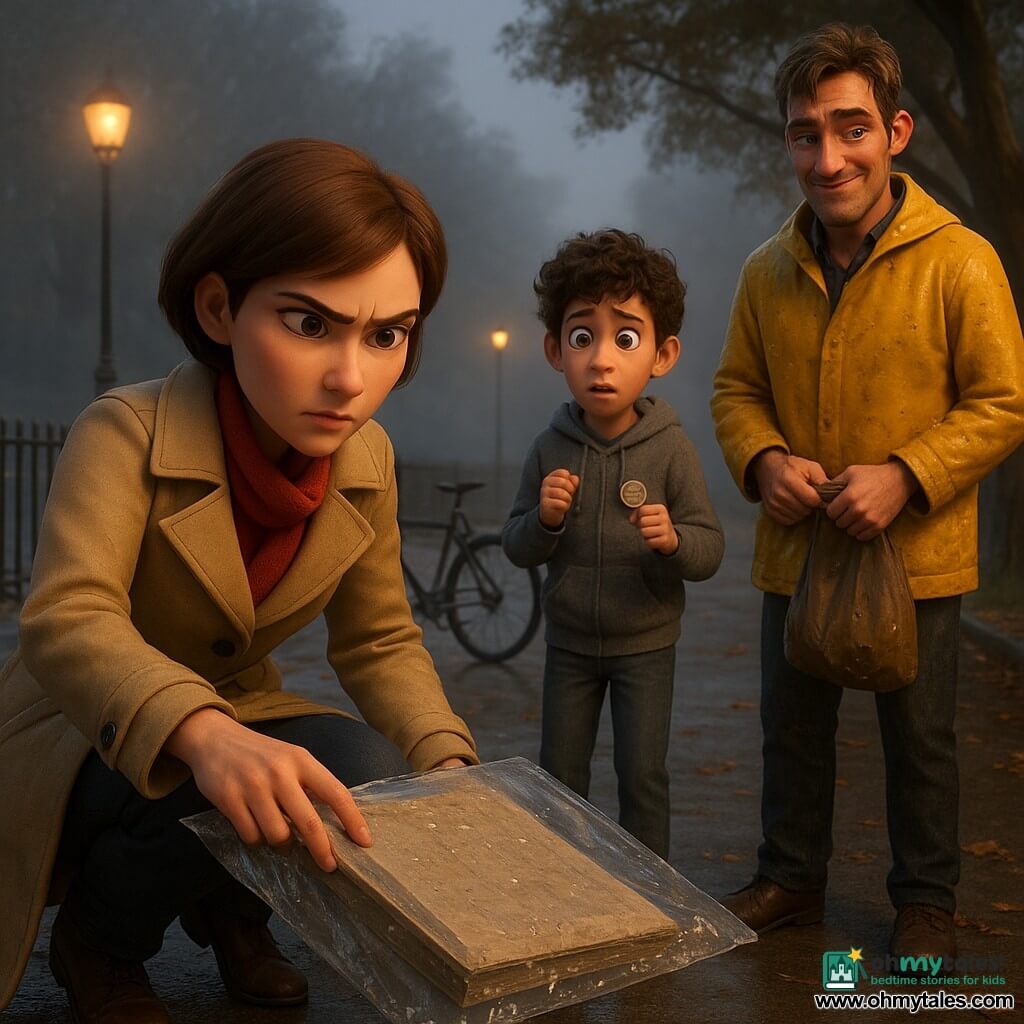
Cal huffed, reached into his bag, and pulled out a thick book wrapped in a plastic grocery bag. “It got wet. Happy?”
Mara took it carefully. “Relieved,” she said. “Not happy.”
Cal leaned closer. “You know, Mr. Dalloway made a mistake. People should know.”
Mara met his gaze. “People should know the truth,” she replied. “Not whatever you can weaponize.”
She stepped back and dialed. When she spoke to the officer on duty, her voice stayed calm, crisp, and factual.
When she ended the call, Cal's shoulders slumped. The bright coat suddenly looked less powerful, like a costume after the play was over.
Chapter 7: The Quiet After
Back at the library, Mr. Dalloway sat at his desk as if it were the only solid thing in the world. His eyes fixed on the ledger Mara placed in front of him.
“It's intact,” Mara said. “Dry it carefully. Page by page. No shortcuts.”
He nodded, swallowing hard. “Thank you.”
Mara added, “Now the mistake. The wrong name. Fix it properly. Document the correction. Inform whoever needs to know, privately and respectfully.”
Mr. Dalloway's shoulders rose in a shaky breath. “I was ashamed.”
“Shame likes secrecy,” Mara said. “Rigor likes light.”
Theo and Juno hovered nearby, pretending not to listen. Juno finally spoke. “So… Cal was the yellow coat guy. I knew he was suspicious.”
Theo muttered, “You think everyone's suspicious.”
Juno's mouth twitched. “Only people who smile too much.”
Mara looked at them both. “You helped by telling the truth about times and details,” she said. “That's what matters.”
Juno straightened, pleased. Theo looked quietly proud.
Later, Mara found Mrs. Kettle upstairs and thanked her again. Mrs. Kettle waved a hand. “I just wrote what I saw.”
“That's rarer than you'd think,” Mara replied.
When Mara finally stepped outside, the rain had stopped. The river moved steadily, carrying leaves and tiny twigs downstream with patient purpose.
She walked along the path for a while without thinking about codes or threats. The air smelled clean, rinsed.
At a bench, she sat and listened to the soft rush of water. No buzzing phone. No hurried footsteps. Just the steady world, doing its steady work.
Mara took out her notebook and wrote one line, not as evidence, but as a reminder:
Be exact. Be patient. Let the facts speak.
Then she closed the notebook, rested her hands on her knees, and watched the river until everything inside her felt quiet again.