Chapter 1
Detective Rowan Pike noticed lies the way some people noticed rain—before it hit the ground.
Not that he enjoyed catching anyone. He preferred the quiet moment right before a story cracked, when a person's eyes flicked to the side or their hands changed their mind. Rowan's job, as he liked to say, was to observe without judging. People lied for reasons. Some were petty. Some were frightened. Some were trying to protect someone else.
On Tuesday afternoon, the Riverside Community Museum called him.
“The Starling Compass is missing,” the director said. “It's… it's our centerpiece.”
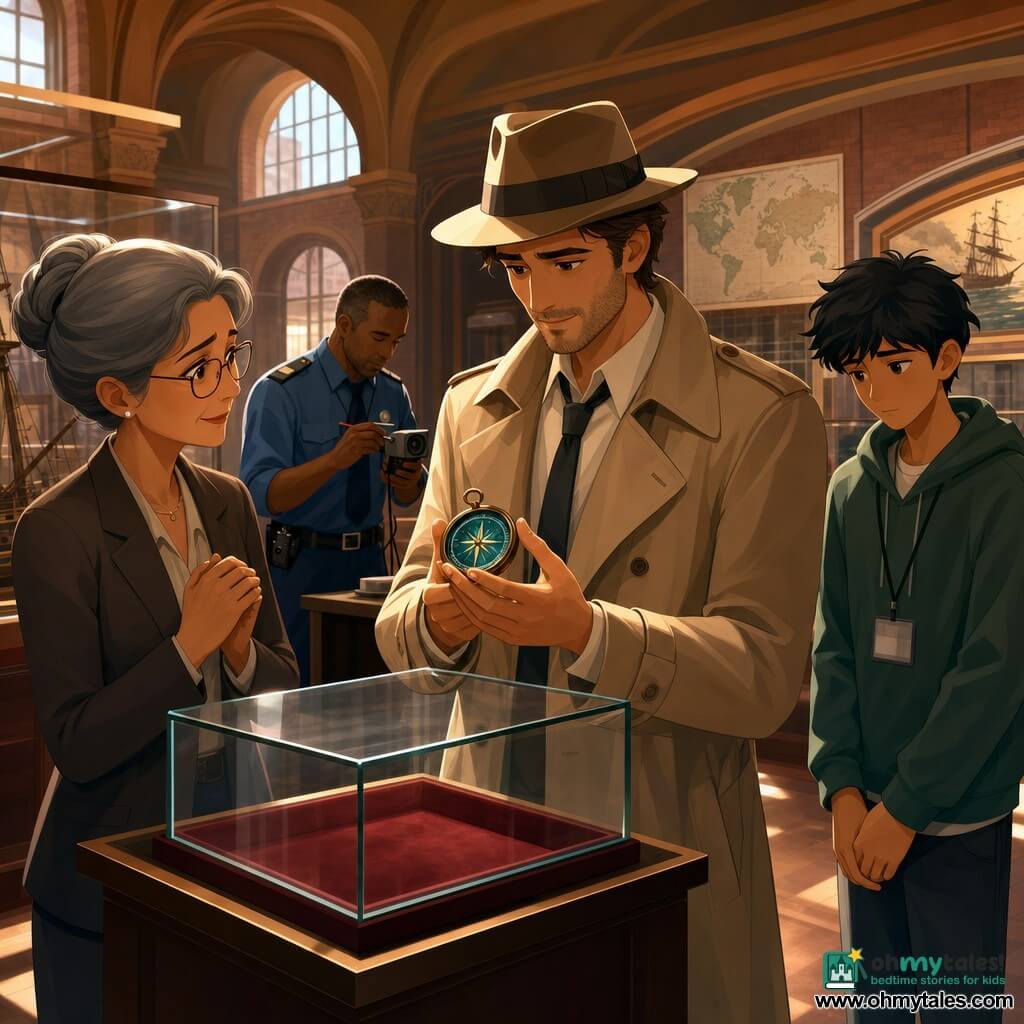
Rowan arrived to find the museum humming with worried voices. The building used to be a train station, all brick arches and polished wood. Posters of old maps lined the walls. The air smelled faintly of wax and paper.
Director Sima Hart met him at the entrance to the exhibit hall. She had sharp glasses and a pen tucked behind her ear like it belonged there.
“It was here,” she said, pointing to an empty glass case. “A small brass compass. Nineteenth century. Donated by Captain Starling's family.”
Rowan leaned toward the case. The lock wasn't broken. The glass wasn't cracked. Nothing screamed “smash-and-grab.” It whispered something else.
“Who had access?” Rowan asked.
“Staff. Volunteers. The night guard. And…” Sima hesitated. “The case uses a key. Only two exist. Mine and the head curator's.”
“Where are they now?”
Sima touched her pocket as if to prove the key was still there. “Mine never leaves me. The curator's is in his office—unless…”
“Unless someone borrowed it?” Rowan finished.
Sima's mouth tightened. “No one borrows it.”
Rowan's eyes moved across the room. Three people hovered near a display of ship models as if pretending to look. Pretending was useful; it meant they were paying attention.
Sima lowered her voice. “We have a school tour in two days. If this gets out—”
Rowan nodded. “Let's keep it simple. I'll ask questions. You keep breathing.”
He stepped toward the three.
A lanky man in a tweed vest introduced himself first. “Dr. Mason Reed. Head curator.” His smile was polite, the kind you could iron. “Terrible thing. Terrible.”
Next, a woman with paint smudges on her fingers. “Lila Trent. I run the kids' art workshops.” Her eyes were bright, a little too bright, like she'd had too much coffee or too little sleep.
And finally, a teen in a museum volunteer badge, holding a clipboard like a shield. “Jay Kapoor. I was helping set up the navigation display.”
Rowan watched each of them as he spoke. Not for guilt. For sincerity.
“Tell me,” he said gently, “when was the last time you saw the compass?”
Mason answered first. “Yesterday evening. I locked the case myself. No one else touched it.”
Lila said, “I saw it during my workshop. Kids love shiny things. I kept them back, don't worry.”
Jay swallowed. “This morning. I walked by at nine. It was there. I think.”
Rowan let the “I think” hang in the air. It wasn't a lie, exactly. It was a fog.
He turned back to the empty case. The velvet base inside was still smooth, except for one faint mark, like a small circle had been lifted carefully. No struggle. No hurry.
A theft that wanted to look like nothing happened.
Rowan straightened. “I need to see the staff-only areas,” he said.
Sima nodded quickly. “Of course.”
As they walked, Rowan glanced at the museum doors. A sign read: PLEASE DO NOT FEED THE PIGEONS. Under it, someone had drawn a tiny compass rose in pen—four points and a crooked “N.”
Rowan filed it away. Small details often learned to speak later.
Chapter 2
Back corridors in museums always felt like the building's private thoughts: dimmer, quieter, full of closed doors and labeled boxes.
Sima led Rowan past a storage room and into Mason Reed's office. It smelled of old books and lemon cleaner. Mason hovered behind them, trying not to hover.
“My key,” Mason said quickly, opening a drawer with a neat click. Inside lay a ring with one key. “See? Still here.”
Rowan didn't touch it. He looked instead at the drawer's edges. No scratch marks. No panic. The key had been placed with care. That didn't prove anything—only that Mason liked order.
“Who has been in this office since yesterday?” Rowan asked.
Mason blinked. “Just me.”
Sima cleared her throat. “And me, briefly, to sign the invoice.”
Mason nodded stiffly. “Yes. And Director Hart.”
Rowan listened to the way Mason said “Director Hart.” Not angry. More… contained.
He moved to the bulletin board. Notices, schedules, a flyer for a weekend “Treasure Map Challenge,” and a postcard pinned with a thumbtack: a lighthouse on a cliff, waves foaming below. The writing on the back was visible: Wish you were here.
Rowan studied the handwriting for a second—rounded letters, careful spacing—then turned away. Not because it was suspicious, but because it might matter later.
“Show me the security log,” Rowan said.
Sima led him to the guard desk near the back entrance. The desk was tidy. Too tidy, Rowan thought, until he saw the guard himself.
A man about fifty sat behind the desk, reading a battered paperback. His uniform was neat, but his eyes were softer than the badge on his chest.
“Mr. Pike?” he said, standing at once. “I'm Omar Delling. Night guard.”
His movements were measured, like he didn't want to startle anyone. On the desk lay a notebook with times written down in straight lines.
Rowan liked him immediately, which was annoying because liking someone could make you careless. He reminded himself: observe, don't judge.
Omar opened the log. “I did my rounds. Ten, midnight, two, four. Everything normal.”
“Any unusual sounds?” Rowan asked.
“A clatter at about one fifteen,” Omar admitted. “But it came from outside. Alley side. Probably a cat, or the wind knocked the trash bins.”
“What did you do?”
“I checked the cameras and went to the alley door.” Omar's gaze held steady. “It was locked. No one there.”
“Did you see anyone inside?” Rowan asked.
Omar hesitated. Not long. Just enough to be real. “I saw Dr. Reed's light on earlier than usual yesterday evening. Around seven. I assumed he was finishing the new exhibit labels.”
Mason Reed made a small sound. “I was.”
Rowan watched Omar as Mason spoke. Omar didn't flinch. No secret there. Just a fact shared without drama.
Rowan turned to the camera monitor. Four feeds. Hallway, exhibit room, lobby, back entrance. Sima leaned in, anxious.
“Are they recorded?” Rowan asked.
“Yes,” Omar said. “But—” He rubbed the back of his neck. “The exhibit camera glitched overnight. The screen went gray for… twenty minutes. From one ten to one thirty.”
“Only that one?” Rowan asked.
“Yes.”
Sima's voice sharpened. “That's when the clatter happened.”
Rowan's mind clicked softly, like a lock turning. A glitch on the exact camera facing the missing object. Not random.
He stepped back. “Omar, you're attentive,” Rowan said. “I'm going to ask you something, and I want you to answer even if it feels unhelpful.”
Omar nodded.
“Who would know which camera to ‘glitch,' and when?” Rowan asked.
Omar considered. “Someone who's watched the routine. Or someone who can see the monitor from here.”
Rowan looked at the desk's position. From the corridor, you could glance in. Staff passed by all the time.
He turned to Sima. “Who closes up at night?”
“Omar locks the back. Mason locks his office. I lock the exhibit hall case, but I do that earlier, before I leave.”
Rowan held his questions for a beat. A museum wasn't a bank. People didn't expect theft, so they didn't watch each other closely. That made listening more important.
“Let's walk the exhibit room,” Rowan said.
They entered the hall where the empty case sat under bright lights, like a stage missing its main actor. Rowan crouched, studying the base of the display.
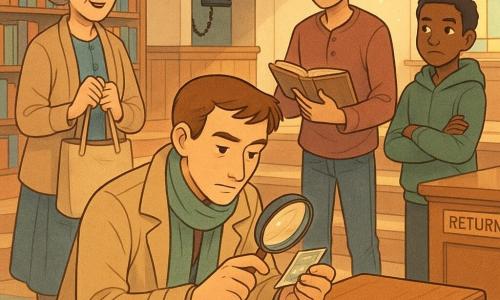
There, near the cabinet leg, was a tiny shred of paper. Not much bigger than a fingernail. Rowan pinched it carefully. It was thick, like drawing paper, and it had a streak of blue-green crayon across it.
He lifted it so Sima could see. “Did you have art workshops yesterday?”
Lila's name appeared in Rowan's mind like a note sliding under a door.
Sima nodded. “Yes. Here, after hours. The kids made ‘explorer journals.'”
Rowan tucked the shred into an evidence envelope.
“Now,” he said, “I'd like to talk to Lila and Jay again. Separately.”
Because the truth, Rowan had learned, liked privacy.
Chapter 3
Rowan found Lila Trent in the art room, washing brushes. Paint jars lined the counters like a bright city skyline. A half-finished poster leaned against the wall: TREASURE MAP CHALLENGE—FIND THE CLUES!
Lila glanced at the evidence envelope. “That looks serious.”
“It's small,” Rowan said. “Small things can be serious. Tell me about yesterday.”
Lila dried her hands on a towel. “We had twelve kids. We talked about compass roses, directions, ‘how explorers wrote notes.' Then they drew their own maps. Some were silly. One kid made a map to his fridge.”
Rowan nodded. “Were you in the exhibit hall?”
“Yes, for the activity. We sat on the floor near the cases. I kept everyone back. I'm careful.”
Rowan watched her eyes as she said “careful.” They didn't dart away. Her voice didn't flatten. She believed herself.
“Did anyone linger near the compass case?” Rowan asked.
Lila frowned. “A boy did. Hugo, I think. He liked the brass shine. But he didn't touch it. I'd have seen.”
Rowan didn't argue. “Did you leave the room at any point?”
“Only to grab more paper from storage. Two minutes. The volunteer helped.”
“Jay?” Rowan asked.
“Yes.”
Rowan thanked her and went to find Jay Kapoor. He was in the lobby, straightening pamphlets that were already straight.
Rowan kept his voice calm. “Walk me through yesterday evening.”
Jay's fingers paused on the pamphlets. “I was assigned to help with the workshop. I handed out pencils. Then I did some shelf-labeling. Dr. Reed asked me to print a new sign for the ship model display.”
“That's a lot,” Rowan said. “You're useful.”
Jay gave a quick, uneasy laugh. “I try.”
Rowan leaned slightly closer—not to intimidate, but to hear. “This morning you said you saw the compass at nine. You added ‘I think.' Why?”
Jay swallowed. His eyes flicked toward the exhibit hall. “Because… I didn't stop. I was rushing. And maybe I assumed it was there because it always is.”
“That's honest,” Rowan said. “Good. Honesty makes things faster.”
Jay let out a breath, as if he'd been holding it since nine.
Rowan asked, “Did you go near the guard desk last night?”
Jay blinked. “No. I left at six.”
“Did you ever see the camera monitor?” Rowan asked.
Jay hesitated again. “I mean… everyone sees it. It's right there. When you pass.”
“Do you know how to make a camera glitch?” Rowan asked.
Jay's cheeks warmed. “No. I can barely make the printer behave.”
Rowan almost smiled. “Printers are the most criminal machines in any building.”
Jay's shoulders loosened a little.
Rowan pulled out the tiny shred of paper in its envelope. “Recognize this?”
Jay leaned in. “That's from our sketch paper. Lila uses thick sheets.”
“Did any drawings go missing?” Rowan asked.
Jay shook his head. “Kids took theirs home.”
Rowan nodded, then asked the question that mattered most.
“Jay, is there anything you haven't told me because you're afraid you'll get blamed?” Rowan said. “I'm not here to blame. I'm here to understand.”
Jay's eyes shone with something like relief and something like fear. “Okay. I did come back later.”
Rowan waited. Silence was a tool; used gently, it invited details.
Jay continued. “I forgot my hoodie. It has my bus pass. I came back around… eight. The front doors were locked, so I knocked at the side. Omar let me in. I grabbed it from the volunteer closet and left.”
Rowan turned that over in his mind. “Did you pass the exhibit hall?”
Jay nodded. “Yes. The lights were dim, but I… I saw Dr. Reed in there.”
“What was he doing?” Rowan asked.
Jay pressed his lips together, choosing words. “Standing by the compass case. Like he was checking it.”
Rowan didn't react. Not outwardly. People often checked things. But the timing—eight, after closing—was a piece on the board.
“Did you tell anyone?” Rowan asked.
Jay shook his head. “I didn't want to be dramatic.”
Rowan nodded. “Thank you for telling me now.”
Rowan left Jay in the lobby and returned to the exhibit hall alone. He stood where the compass case sat, then walked the path someone might take to carry a small object out. Not the front—too public. Not the back entrance—guard desk.
Unless you could make a camera go gray for twenty minutes.
Rowan looked down again near the cabinet leg. Another tiny mark on the floor—barely visible. A smear of blue-green, matching the crayon streak on the paper shred.
He followed it with his eyes. It led, faintly, toward the hallway that passed the art room.
Rowan's thoughts tightened into a clear line.
If someone had the compass, where would they hide it in a building full of hiding places?
Somewhere no one searched because it looked like it belonged.
Rowan turned toward the art room.
And that was when he saw it: a rolled-up sheet of thick paper sticking out of a recycling bin, just enough to show a corner covered in blue-green crayon.
A drawing.
Rowan carefully lifted it out, unrolled it, and felt the museum air turn colder.
The drawing wasn't a child's fridge map.
It was the exhibit hall, drawn from above, with the compass case marked by a red X. A dotted line led to a storage closet behind the art room. Next to the closet, someone had drawn a simple symbol: a tiny compass rose with a crooked “N.”
The same crooked “N” from the pigeon sign.
Rowan stared at it, then folded the drawing gently.
Now the mystery had a voice.
And it was pointing somewhere specific.
Chapter 4
Rowan didn't run. Running made people run, too. He walked to the storage closet behind the art room with the steady pace of someone going to fetch a forgotten umbrella.
Omar appeared at the end of the hallway, as if he'd been watching quietly to make sure the building stayed calm.
“Everything all right?” Omar asked.
Rowan held up the folded drawing. “I found this. You're observant, Omar. Help me observe one more thing.”
Omar's eyebrows rose, but he nodded. “Of course.”
Rowan asked Sima to join them, then called Mason Reed and Lila Trent. He didn't summon Jay yet. Jay had already done something brave by speaking up.
They gathered in the narrow hallway. The closet door was painted the same beige as the walls, meant to disappear.
Rowan spoke evenly. “Someone drew a map of the exhibit hall and marked this closet. Before we open it, I want to hear something.”
He looked at each face. “If you're scared, say so. If you're angry, say so. But tell the truth about what you know.”
Mason's jaw tightened. “This is absurd.”
Lila's hands fluttered near her apron pockets. “It's just a kid's drawing. Kids draw X's all the time.”
Sima's eyes stayed on the closet. “Open it.”
Rowan turned to Omar. “Would you do the honors?”
Omar stepped forward. “I'll open it slowly. No surprises.”
The way he said it—calm, careful—made Rowan trust him more. An attentive guardian didn't just guard objects. He guarded people's nerves.
Omar unlocked the closet. The door creaked. Inside: folded tables, stacks of paper, boxes of markers, a bin of costumes for museum skits. Dust motes floated in the thin light like tiny, nervous planets.
Rowan scanned the shelves. Nothing gleamed like brass.
Then he noticed a pirate hat on a hook, the kind with gold trim. Slightly lopsided, as if it had been knocked.
Rowan reached up and lifted it.
A small brass compass slid from inside the hat and landed in Rowan's palm with a soft, guilty clink.
Sima sucked in a breath. Lila's hand flew to her mouth. Mason's eyes widened, then narrowed.
Rowan didn't celebrate. He just held the compass carefully, like it might be ashamed.
“The Starling Compass,” Sima whispered. “It's really it.”
Rowan nodded. “Now we shift from ‘where' to ‘why.'”
He looked at Lila. “This closet is part of your workshop supplies.”
Lila's voice came quick. “Yes, but— I didn't put it there! I swear.”
Rowan watched her closely. Her panic was messy, not rehearsed.
He turned to Mason. “And the pirate hat?”
Mason blinked. “That's from the children's program. I hate that hat. It sheds glitter.”
Omar cleared his throat. “Not glitter, sir. Gold thread. It's… contained.”
Rowan almost smiled again. Humor had a way of letting people breathe.
He unfolded the drawing and laid it on a nearby table. “Who drew this?”
Lila said softly, “That compass rose… that's not any kid I taught. That's… older.”
Rowan turned to Sima. “Can you bring Jay here?”
When Jay arrived, he froze at the sight of the compass in Rowan's hand. His face went pale, then bright red, like someone had switched his skin from winter to summer.
“I didn't—” he started.
Rowan raised a hand. “I'm not asking you to defend yourself. I'm asking you to help me understand. Do you recognize the crooked ‘N'?”
Jay stared at the drawing. His shoulders sagged. “Yes.”
Sima's voice shook. “Jay…?”
Jay spoke fast, words tumbling. “It's from my notebook. I draw compass roses like that. My dad taught me—he's a sailor. I make the ‘N' crooked because… because perfect ones look boring.”
Rowan's voice stayed level. “So you drew the map.”
Jay nodded, tears starting but not falling yet. “Yes. But not to steal it. I drew it for the Treasure Map Challenge. I wanted it to be… cooler. Like real clues.”
Rowan felt the pieces begin to fit, but one still resisted. “Then how did the compass end up in a pirate hat?”
Jay wiped his face with his sleeve. “Because I'm an idiot.”
Rowan waited. No judgment. Just attention.
Jay continued, quieter. “Yesterday, when Lila left to get paper, I saw the compass case key on the table near Director Hart's clipboard. It must have fallen out of her pocket when she signed the invoice in Dr. Reed's office. I… I picked it up because I thought someone might step on it. I was going to return it.”
Sima's eyes went wide. Her hand went to her pocket as if the key could time-travel back into it.
Jay went on. “But then I had this idea. For the challenge, what if the first ‘clue' was that the compass was missing? Not really stolen, just hidden for an hour during the event. Like a game. I thought people would be impressed.”
Mason made a sharp sound. “Impressed?”
Jay flinched. “I know. I know it was stupid. I opened the case after everyone left, just for a minute. I took the compass and hid it in the pirate hat in the closet because it was funny. Then I planned to put it back before anyone noticed.”
Rowan asked, “Why didn't you put it back?”
Jay's voice cracked. “Because I got scared. This morning I saw the case empty and thought maybe someone else took it after me. Then Director Hart called you, and I… I couldn't breathe.”
Rowan nodded slowly. “And the camera glitch?”
Everyone turned toward Omar.
Omar looked startled. “Me?”
Rowan shook his head. “Not you. Someone did it. But maybe not on purpose.”
Sima frowned. “What do you mean?”
Rowan pointed to the guard desk down the hall. “Omar, you said you checked the cameras at one fifteen after hearing a clatter.”
“Yes.”
Rowan continued, “If the exhibit camera went gray from one ten to one thirty, that suggests a loose cable or a software hiccup. Not necessarily a hacker. The timing is suspicious, but not proof.”
Mason folded his arms. “So you're saying the camera failure was coincidence.”
Rowan met his eyes. “I'm saying we don't accuse a thundercloud of stealing a bicycle.”
Omar let out a breath he'd been holding. Lila, too.
Rowan looked at Jay again. “You meant it as a game. But you created a real problem. Do you understand why people panicked?”
Jay nodded hard. “Yes. I'm sorry.”
Rowan's voice softened. “An apology is a start. Returning it is next. And listening—really listening—to what the museum needs is the lesson.”
Sima's shoulders loosened, just a fraction. “We need trust,” she said. “And we need our compass back where it belongs.”
Rowan placed the brass compass into Sima's hands, and she held it like something fragile and valuable—because it was both.
But Rowan wasn't finished.
One detail still bothered him: Jay said he found the key “near Director Hart's clipboard” in Mason's office. That meant the key had been out of Sima's pocket.
And someone else had been in the exhibit hall after closing: Mason, seen by Jay at eight.
Rowan turned to Mason. “Dr. Reed, Jay saw you near the case at eight. Why?”
Mason's face shifted—annoyance, then resignation. “Because I noticed the key was missing.”
Rowan waited.
Mason continued, voice low. “Director Hart came into my office to sign the invoice. She must have dropped the key there, and I saw it later… and then realized it was gone. I went to check the case. It was still locked, so I assumed the key was simply misplaced. I didn't want to alarm anyone.”
Sima stared at him. “You didn't tell me you thought my key was missing.”
Mason's eyes flickered. “You're under enough stress.”
Rowan watched Sima's expression. She wasn't grateful. She was hurt.
Rowan said quietly, “Sometimes ‘not alarming' someone means not listening to what they'd want to know.”
Mason's shoulders sank a little. “Perhaps.”
Rowan folded the drawing again. “This,” he said, “is why listening matters. Jay didn't listen to the museum's need for trust. Dr. Reed didn't listen to the director's right to information. And fear makes everyone guess instead of ask.”
He looked at Jay. “Next time you have an idea, who do you tell first?”
Jay sniffed. “The person in charge.”
Sima managed a thin smile. “Correct.”
Rowan nodded. “Good. Now let's put the compass back and close the case.”
They walked together—no longer a group of suspects, but a group of people trying to repair what a moment of bad judgment had broken.
The glass case clicked shut.
The compass lay on velvet again, quiet as a held breath.
Chapter 5
By evening, the museum felt calmer, as if the building itself had stopped bracing.
Rowan stayed long enough to watch Omar adjust the exhibit camera cable with a small screwdriver and a patient frown. The screen flickered once, then steadied.
“Loose connection,” Omar said. “It happens. Like shoelaces.”
Rowan nodded. “Good catch.”
Omar smiled, faint but real. “I try to notice things before they fall.”
Sima approached with a clipboard. Her expression was tired, but clearer. “I spoke to Jay's parents,” she said. “He'll apologize to the staff and help during the Treasure Map Challenge—properly, with permission.”
Rowan said, “He's not a bad kid. Just a kid who wanted attention.”
Sima sighed. “And we all want something, don't we?”
Rowan glanced toward Mason, who was replacing a label near the ship model display with careful hands. “We do,” Rowan said. “The trick is asking for it the right way.”
Sima hesitated, then added, “I also spoke to Dr. Reed. We… cleared the air.”
Rowan didn't pry. Cleared air was good.
He was about to leave when Lila hurried over, holding a piece of paper. “Detective Pike,” she said, “this was in the recycling bin too. I didn't see it earlier.”
Rowan took it. Not thick sketch paper this time—thin cardstock.
A postcard.
On the front: a lighthouse on a cliff, waves foaming below. The same image Rowan had seen pinned in Mason's office. On the back, a short message in rounded handwriting:
Wish you were here.
Still chasing north, even when it's crooked.
—S.
Rowan looked up. “This was in Dr. Reed's office.”
Sima blinked. “That's… from me.”
Rowan held it carefully between two fingers, like it might reveal fingerprints just by being touched. “Why was it in the recycling?”
Sima's eyes moved toward Mason across the room. “Because I wrote it weeks ago,” she said softly. “After an argument. I wanted to make peace. I thought he threw it away.”
Rowan watched Mason's face from a distance. Mason wasn't looking at them, but his shoulders were very still.
Rowan handed the postcard back to Sima. “May I?” he asked, pointing to the signature.
Sima nodded.
Rowan studied the “S.” It was not Director Hart's last name initial. It was just… S. Like a small flag planted in the sand.
He said gently, “This wasn't only a postcard. It was an attempt to be heard.”
Sima swallowed. “Yes.”
Rowan's voice stayed quiet. “Sometimes people don't throw away what they can't answer. They hide it where they don't have to feel it.”
Sima's eyes shone. She gave a small, sad laugh. “That sounds like a detective thing to say.”
“It's more of a human thing,” Rowan said.
He nodded toward Mason. “Go talk to him. Not as director and curator. As two people who both care about this place.”
Sima held the postcard to her chest for a moment, then walked across the lobby.
Rowan watched her go, then turned toward the exhibit hall. The Starling Compass sat under the light again, needle steady, pointing where it always pointed—north, whether straight or crooked.
Omar stood beside Rowan. “So,” he said, “mystery solved?”
Rowan listened to the museum's quiet—the soft footsteps, the distant hum of the lights, the calm that comes after a storm.
“Yes,” Rowan said. “And no.”
Omar raised an eyebrow.
Rowan nodded toward Sima and Mason, now speaking in low voices near the ship models. “Objects get found. Trust is what takes longer.”
Omar considered that, then nodded once. “That's true.”
Rowan slipped his hands into his coat pockets and headed for the door. Outside, pigeons strutted like they owned the sidewalk. The pen-drawn compass rose on the sign caught the last sunlight.
Rowan paused, then took out his notebook and wrote a single line:
Listen first. Solve second.
He closed the notebook and walked on, the museum behind him, the case locked, the compass safe—and a postcard finally on its way to being answered.