Chapter 1: The Shadow Watcher
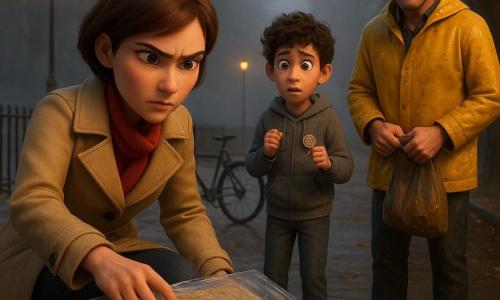
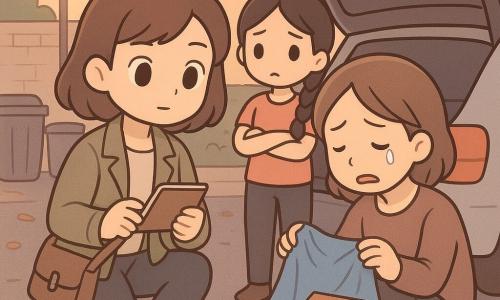
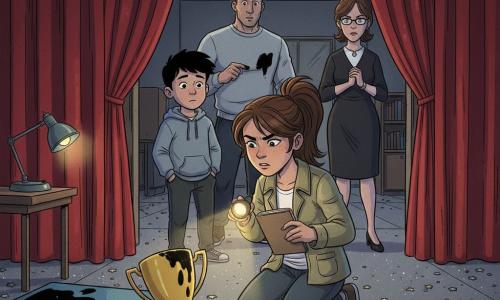
Mara Keene didn't chase people. She chased patterns.
At 6:17 p.m., the sun slid behind the old clock tower, and the alley beside Maple Street filled with long, sharp shadows. Mara stood still in the doorway of a closed bakery, hands in her coat pockets, eyes calm and alert. Shadows told the truth when people didn't. They stretched, bent, and pointed—silent arrows for anyone patient enough to read them.
A boy on a scooter swerved past, laughing, his shadow wobbling like spilled ink. A woman hurried by with grocery bags, her shadow lurching, then snapping straight when she stopped to check her phone. Normal.
Then came the call.
“Mara? It's Ms. Dalloway from the City Archive.” The voice crackled through Mara's earbuds. “Something's missing. Something important.”
Mara pictured the Archive: a quiet stone building that smelled of paper and dust, with tall windows and strict rules about touching. “Missing how?” she asked.
“A map,” Ms. Dalloway said, almost whispering. “Not just any map. An old one. Hand-drawn. It was part of a local collection. We were preparing an exhibit for Founders Week. And now it's gone.”
“A map doesn't walk away,” Mara said. “So someone carried it.”
“Yes,” Ms. Dalloway said. “And I… I didn't notice until closing.”
Mara's eyes moved to the alley floor. A thin smear of something pale crossed the pavement, as if chalk had been dragged by a shoe. She crouched, but a gust of wind scraped grit over it, hiding the mark.
“Did anyone unusual visit today?” Mara asked.
Ms. Dalloway hesitated. “A few students. Two tourists. And—there was one person. Serious. Discreet. Didn't speak much. Wore a dark coat and gloves. I can't even remember their face properly.”
A serious, discreet person in gloves. On a warm day. Mara felt the small click of interest in her mind.
“I'm coming,” she said. “Don't touch anything. And listen carefully: think back. Did you hear anything? A cough, a ring tone, a phrase?”
“I'll try,” Ms. Dalloway promised. “Please, Mara. That map—”
“I'll find it,” Mara said. She paused, then added, “And I'll need your ears as much as your keys.”
When she ended the call, she stepped out of the doorway. The streetlights flickered on. Shadows thickened. The clock tower chimed once, deep and hollow, like a warning.
Mara started walking toward the Archive, letting the night stretch around her like a coat.
Chapter 2: Dust, Paper, and a Trace
The City Archive was quieter than a library. Even the air seemed trained to whisper.
Ms. Dalloway met Mara at the front desk. She was a thin woman with worried eyes and ink-stained fingers. “Thank you for coming so fast,” she said.
Mara nodded and kept her voice low. “Show me where it was.”
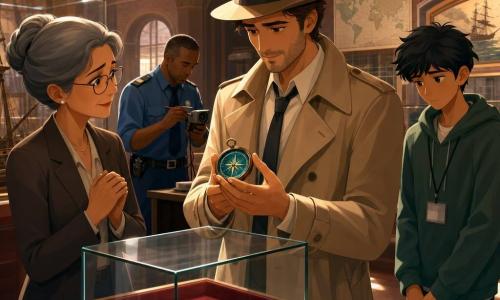
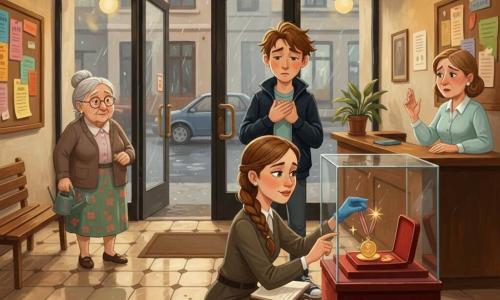
They passed locked cabinets and framed photographs of the town from a hundred years ago: horses on muddy roads, people in hats like upside-down bowls, the river wider and wilder. The exhibit room sat at the back. A glass display case waited under bright lights, empty except for a label card that read: RIVERSIDE MAP, 1891 — PROPERTY OF THE CITY ARCHIVE.
Ms. Dalloway wrung her hands. “It was in there this morning.”
Mara didn't look at the empty case first. She looked at the floor. Then the corners. Then the lock.
“May I?” Mara asked.
Ms. Dalloway handed her a pair of cotton gloves. “We use these,” she said, as if apologizing for needing rules at a time like this.
Mara put them on. The lock had no scratches. The glass was clean. That didn't mean much. Careful thieves were like careful editors—nothing looked different until you compared it to what should be there.
“Who has the key?” Mara asked.
“Only staff,” Ms. Dalloway said. “Me, Mr. Pell, and Nora—our intern. She left at four.”
Mara opened her notebook. “And visitors?”
“We had a school group at ten. Then a few walk-ins. The serious person came around two. They asked about ‘foundational documents' and stood near the exhibit room, but I assumed they were interested in history.”
Mara moved closer to the display case. She leaned in, eyes scanning the bottom edge. There—near the hinge—was a faint smudge, like a fingerprint that didn't quite belong. It wasn't oily. It was dusty, as if someone had brushed against old paper, then touched the glass.
“A trace,” Mara murmured.
Ms. Dalloway looked hopeful. “Can you tell who it was?”
“Not yet,” Mara said. She pulled a small flashlight from her pocket and angled it along the glass. The smudge became clearer: a crescent shape with tiny specks embedded in it. Paper dust, maybe. Or something else.
Mara turned her light to the floor. Under the case, close to the wall, she found another mark—barely visible—a pale streak.
“Chalk?” she guessed, leaning closer. It had the grainy look of sidewalk chalk, the kind kids used outside. But why would chalk be here?
She pointed. “Do you have any chalk in the Archive?”
Ms. Dalloway frowned. “No. We don't—unless the school group—”
“Did they do an activity?” Mara asked.
“They sketched artifacts,” Ms. Dalloway said quickly. “With pencils only. I made sure.”
Mara followed the streak toward the doorway. It faded, then reappeared as a dot, then vanished again. Like someone tried to wipe it but missed spots.
“Who cleans here?” Mara asked.
“Mr. Pell does a quick tidy at lunch,” Ms. Dalloway said. “He's… very particular.”
Mara wrote his name. She didn't accuse; she collected.
She stepped into the hallway and listened. The building hummed softly—old pipes, distant traffic, the quiet pressure of stored time.
“Ms. Dalloway,” Mara said, “I need you to do something that sounds simple but matters. Listen. Not just to me—listen to your own memory. The serious person in gloves… did they have a bag? A folder? Anything that could hold a map?”
Ms. Dalloway shut her eyes. Her brow tightened. “A slim case,” she said slowly. “Like an artist's portfolio. Black. I thought it was for drawings.”
Mara's pen paused. “That's useful.”
“And… they smelled faintly of peppermint,” Ms. Dalloway added, surprised. “Like strong mints.”
Mara looked up. “Peppermint. Good. That's another trace—just not the kind you can photograph.”
Ms. Dalloway exhaled shakily. “Will you talk to Mr. Pell and Nora?”
“Yes,” Mara said. “And then I want to see the visitor log. Every name. Every time.”
As they walked back to the desk, Mara glanced at the polished floor. Under the overhead lights, her own shadow moved with her—steady, sharp-edged, loyal.
Somewhere, another shadow had passed here today. And it had taken something that didn't belong to it.
Chapter 3: A Serious, Discreet Person
Mr. Pell was in the records room, lining up folders like soldiers. He was broad-shouldered and neat, with gray hair combed so flat it looked painted on.
He looked up when Mara entered. “If this is about the missing map, I've already told Ms. Dalloway I locked the exhibit room at lunch.”
Mara let silence do its work for a moment. “You locked it,” she said, “but did you check the case?”
Mr. Pell's jaw tightened. “I saw it. The map was inside.”
“Did you see anyone near the exhibit room around two?” Mara asked.
“No,” Mr. Pell said quickly. Too quickly. “I was cataloging donations.”
Mara watched his face, not hunting for guilt, but for effort. People who lied often spent energy controlling their expression. People who told the truth spent energy remembering.
“And chalk,” Mara added, as casually as she could. “Do you use chalk here?”
Mr. Pell blinked once. “Chalk? No.”
Mara nodded. “Do you know anyone who carries peppermints?”
Mr. Pell frowned, then snorted. “Half the town.”
“Do you carry them?” Mara asked.
He looked offended. “I don't eat candy.”
Mara wrote: claims no candy. She didn't underline it. Not yet.
Nora, the intern, arrived twenty minutes later, breathless and wide-eyed. She had a lanyard with too many keys and the tired look of someone balancing school and work.
“I swear I didn't take it,” she blurted before Mara could speak.
Mara raised a hand. “I didn't say you did. Sit. Breathe. Tell me what you noticed today.”
Nora sat at the desk, fingers twisting her lanyard. “The school group was loud. Then it got quiet. That's normal.” She swallowed. “But around two, someone asked me where the ‘foundational documents' were. I pointed them to the exhibit wing.”
“Describe them,” Mara said.
Nora's eyes darted as she searched her memory. “Tall. Dark coat. Gloves. Didn't smile. Didn't frown either. Just… serious. Like they were always listening for something.”
“Did they speak?” Mara asked.
“Only a little,” Nora said. “Their voice was low. And they said, ‘Thank you,' but… weirdly careful, like each word was chosen.”
Mara leaned forward. “Did you see a bag?”
Nora nodded. “A flat portfolio case. Black. Like for art.”
Mara exchanged a glance with Ms. Dalloway. Two matching details. Good.
“And the smell?” Mara asked.
Nora sniffed, as if she could pull scent from the air. “Peppermint,” she said. “Strong.”
Mara's pen moved. “Anything else? Shoes? Walk? A sound?”
Nora's face brightened with sudden certainty. “Their shoes squeaked,” she said. “Not like normal sneakers. Like rubber soles on polished floors. Squeak—pause—squeak. And when they turned a corner, I heard a soft scrape. Like something dragging lightly.”
Mara thought of the pale streak by the display case. Chalk, maybe, dragged on the floor by a shoe sole. Or a stick of chalk dropped and nudged along by accident. But why chalk at all?
“Show me exactly where you heard the scrape,” Mara said.
Nora led them down the hallway. She stopped near the exhibit room door. “Here,” she said. “Right here.”
Mara crouched and looked at the baseboard. A faint white dust clung to the edge where the wall met the floor. She touched it with a gloved fingertip, then rubbed it between finger and thumb. It crumbled like chalk.
A trace again.
Mara stood. “Nora, did the person go in alone?”
Nora nodded. “Ms. Dalloway was helping someone at the front. Mr. Pell was in records. I was sorting pamphlets. They could've—” Nora stopped, eyes widening. “Oh.”
Mara kept her voice steady. “We don't jump. We build. Here's what we know: someone with gloves and a portfolio case entered the exhibit wing around two. The map disappeared. There's chalk dust near the scene. And they smelled of peppermint.”
Ms. Dalloway's voice trembled. “Who would do this?”
Mara looked toward the dark window at the end of the hall. Outside, the streetlights made bright pools on the pavement. Between those pools, shadows gathered—thick, unreadable.
“Someone who planned,” Mara said. “Or someone who thought they planned.”
She turned back to the desk. “Bring me the visitor log.”
Chapter 4: The Logbook and the Listening
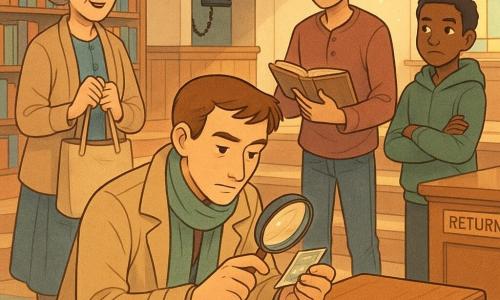
The visitor log was a heavy book with lined pages and smudged ink. Names sprawled across it in different handwritings: LOPEZ FAMILY, TOURISTS FROM OHIO, J. MARTIN, SCHOOL GROUP—ROOM 7B.
Mara's eyes skimmed the entries around two o'clock.
There it was: S. HART — 2:03 p.m.
Nora leaned over. “I didn't see their face clearly, but… that could be it.”
Mara traced the letters with her gaze. The handwriting was neat, almost printed, like someone afraid of making mistakes. Serious. Discreet.
“Do we have a phone number?” Mara asked.
Ms. Dalloway checked the column. “No. We don't require it.”
Mara tapped the paper lightly. “Then we use what we do have.”
She asked Ms. Dalloway and Nora to describe the person again, slowly. Not as a story, but as a list. Height. Coat. Gloves. Portfolio case. Peppermint. Squeaky shoes. Careful voice.
Then Mara asked something different. “When they said ‘foundational documents,' did they sound like they knew what they wanted?”
Nora nodded. “Yes. Like they'd rehearsed it.”
“And did they look around while waiting?” Mara asked.
“They looked at the security camera,” Nora said. “Not staring. Just… one glance. Like checking.”
Mara felt the puzzle tighten. A rehearsed phrase. A check for cameras. Gloves to avoid fingerprints. A portfolio case for carrying flat paper. This wasn't a random swipe.
“But chalk,” Mara murmured. “Why chalk?”
Ms. Dalloway lifted a hand timidly. “We have chalk in the maintenance closet. For marking boxes. Mr. Pell uses it sometimes on the floor when he's moving heavy shelves, so he remembers where they go.”
Mr. Pell, who had been hovering at the doorway, cleared his throat. “It's not for the floor,” he said stiffly. “It's for the shelf bases. So they line up.”
Mara's eyes flicked to his shoes. Black, polished. No rubber. No squeak.
“May I see the maintenance closet?” Mara asked.
Mr. Pell's posture stiffened further. “It's messy.”
“That's fine,” Mara said. “Messy places can still be honest.”
Inside the closet, cleaning supplies sat in strict rows, as if even the dust had been organized. A small box on a shelf read: CHALK STICKS.
Mara opened it. Several sticks remained. One was broken.
She didn't accuse. She listened.
“Mr. Pell,” she said quietly, “who else knows about this chalk?”
He hesitated. “Anyone who's been here long enough.”
“And the security cameras,” Mara asked, “where do they store footage?”
Ms. Dalloway answered. “On the office computer. But the exhibit wing camera has been glitchy. It freezes sometimes.”
“Since when?” Mara asked.
Ms. Dalloway looked embarrassed. “A few weeks. We reported it. Budget delays.”
A thief didn't need to be brilliant. They just needed to notice what others stopped noticing.
Mara closed the closet door and turned to Nora. “When you heard the squeak—did it stop at any point?”
Nora thought hard. “Yes. Right after the scrape. Like they stepped on something, then… adjusted.”
Mara pictured it: chalk stick dropped, stepped on, grinding into dust—squeak—scrape—adjust.
A mistake.
And mistakes left trails.
“Ms. Dalloway,” Mara said, “who would benefit from that map?”
Ms. Dalloway's eyes narrowed as she finally let herself think like a detective. “Collectors,” she said. “People who sell historical items. Or… someone who wants what the map shows.”
“And what does it show?” Mara asked.
Ms. Dalloway swallowed. “Old property lines. Underground water routes. A section labeled ‘Riverside Works'—a place that doesn't exist anymore. There's a note about a ‘sealed entrance.'”
Mara's mind shifted. This wasn't just about stealing an artifact. It was about what the artifact pointed to.
A new track, cutting through the old one.
“Then we're not only looking for a thief,” Mara said. “We're looking for someone chasing a location.”
She closed her notebook. “I want to walk the route from the Archive to the river. If the map leads to a sealed entrance, someone might try to reach it tonight.”
Nora's eyes shone with fear and excitement. “Can I come?”
Mara considered, then nodded once. “Yes. But you'll do exactly what I say. And you'll use your best skill.”
Nora blinked. “Which is?”
“Listening,” Mara said. “The quiet kind.”
Chapter 5: River Shadows and a New Lead
The river path ran behind the old warehouses, where metal fences leaned like tired giants. The air smelled of wet stone and algae. Streetlamps buzzed, and moths fluttered in their pale halos.
Mara walked with steady steps. Nora kept pace beside her, quieter now, her earlier nerves packed away like a folded note.
“Tell me what you hear,” Mara murmured.
Nora tilted her head, concentrating. “Water. Distant cars. A dog barking… far left. And—” She paused. “Footsteps.”
Mara stopped under a lamp and let her shadow fall long across the path. The footsteps slowed too.
A shape moved near the fence line. Someone keeping to the edges, where darkness pooled. Serious. Discreet.
Mara didn't rush. Rushing spooked people into stupid decisions, and stupid decisions could get someone hurt.
She stepped forward, voice calm. “Evening,” she called. “Lovely night to walk where no one else walks.”
The figure froze. The light didn't reach their face, but Mara saw the outline of a dark coat. Gloves. A flat case tucked under an arm.
Nora inhaled sharply, but stayed silent.
Mara continued, conversational. “You know, shadows are honest. They show what you carry, even when you hide it.”
The figure shifted, and their shadow slid across the gravel. The portfolio case made a clean rectangle of darkness. No denying it.
“I don't want trouble,” the figure said. Their voice was low, careful, like Nora had described. “I'm just—going somewhere.”
“Where?” Mara asked.
A pause. Then, “Home.”
Mara didn't laugh. She kept her tone polite. “Your home must be interesting if it requires gloves and an art case.”
The figure's shoulders tightened. “You're following me.”
“I'm walking,” Mara said. “Following is a matter of perspective.”
Nora whispered, so softly Mara barely heard: “Peppermint.”
Even from a few steps away, the scent drifted in the damp air.
Mara angled her body slightly, not blocking the path, but guiding the situation. “Give me the map,” she said. “No one needs to get into bigger trouble.”
The figure's head turned, as if listening to something else—maybe a distant sound, maybe their own nerves. Then they made a sudden choice: they ran.
“Stay behind me,” Mara snapped to Nora, and sprinted.
The runner's shoes squeaked on a patch of smooth concrete—squeak, pause, squeak—then pounded gravel. They cut left between two warehouses, heading toward the river stairs.
Mara followed, breathing controlled. She didn't need to be faster forever—just long enough to make the other person make another mistake.
At the stairs, the figure stumbled. The portfolio case slipped. Something small rolled out—white, cylindrical.
A chalk stick.
It bounced down two steps and snapped. Dust puffed like a tiny cloud.
The figure scooped it up, cursed under their breath, and kept going. But in that second, Mara saw their sleeve catch on a rusty bolt. Threads tore. A small patch of fabric remained snagged, fluttering like a flag.
Mara didn't chase blindly down to the riverbank. She stopped long enough to collect the fabric, then pointed her flashlight at it.
Dark wool. Expensive. And stuck to it—one bright, glittery fleck.
Nora leaned in. “Glitter?”
Mara's mind clicked again. Glitter didn't come from warehouses. Glitter came from crafts. School projects. Parade decorations.
Founders Week.
A new lead rose like a streetlight switching on: the Founders Week committee had been preparing decorations in the community hall near the river. Glitter everywhere. And peppermint—some people chewed mints to stay awake during late-night work.
Mara tucked the fabric into an evidence bag.
“Which way?” Nora asked, breathless.
Mara listened. The river hissed against stones. Farther off, a door slammed. Footsteps faded.
“We won't catch them by running in the dark,” Mara said. “We catch them by thinking in the light.”
She turned back toward town. “Come on. We're going to the community hall. If our thief brushed against glitter, they were near it. And if they want what the map shows, they'll try to use it soon.”
Nora hurried beside her. “What if the map leads to… treasure?”
Mara's voice stayed even. “More often it leads to trouble people forgot to finish dealing with.”
They walked quickly, their shadows sliding over the path like two long questions.
Chapter 6: The Quiet Room and the Confession
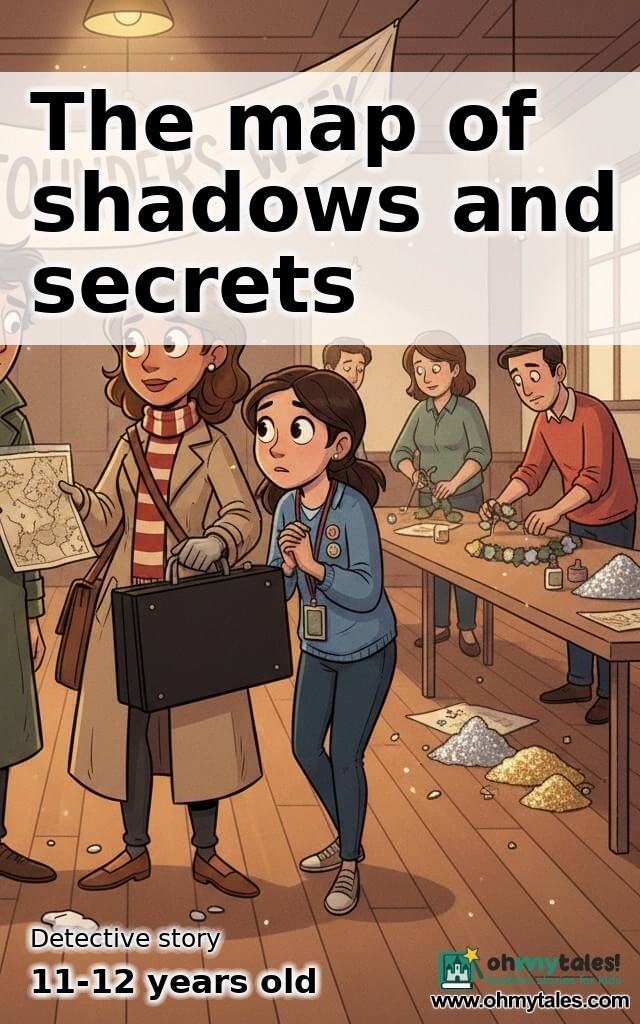
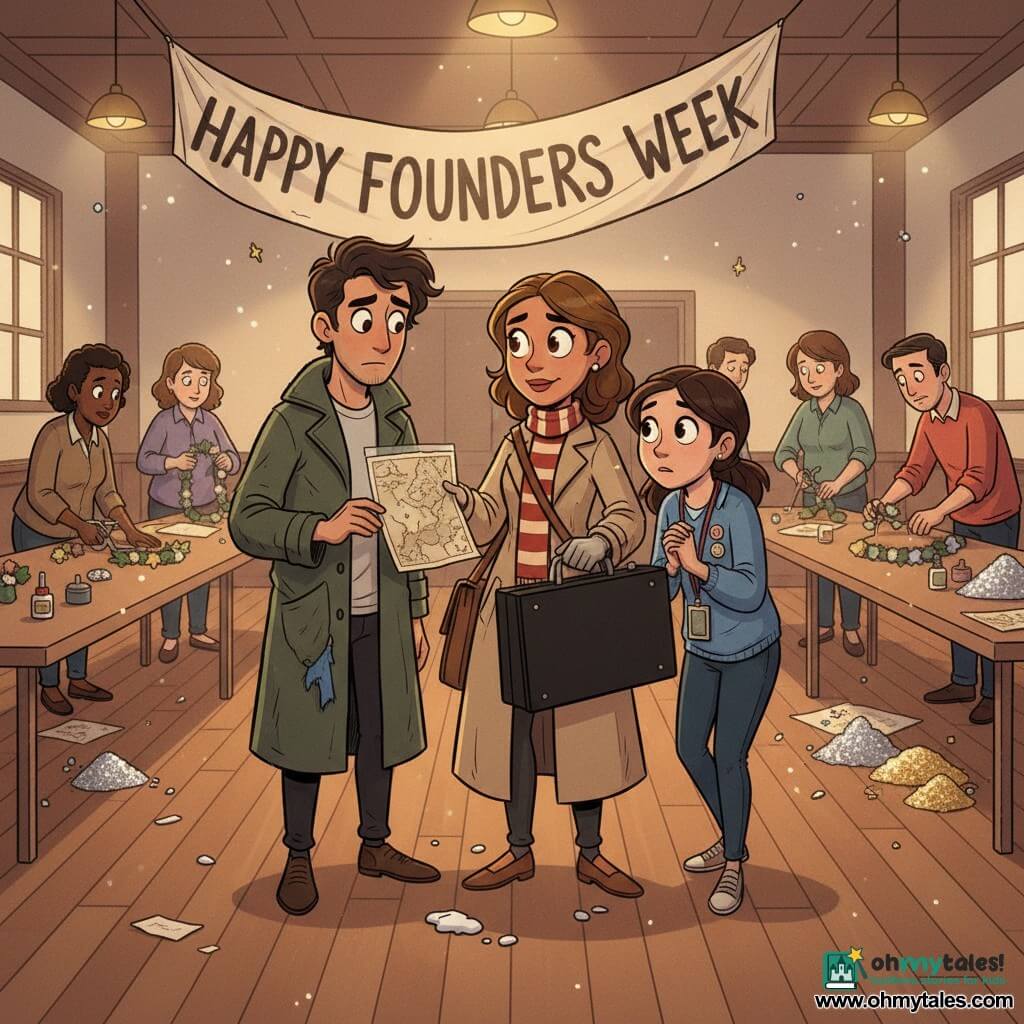
The community hall was bright, loud, and full of paper chains. A banner half-painted on the floor read: HAPPY FOUNDERS WEEK! Someone had spelled FOUNDERS as FONDERS and crossed it out with thick red paint.
At a side table, volunteers cut stars from glitter paper. The air smelled of glue, coffee, and—yes—peppermint.
Mara scanned faces, watching not just people but what followed them: their shadows. Shadows didn't smile for cameras. They didn't pretend to be busy. They simply moved.
Near the back, a person in a dark coat stood too still, as if hoping stillness could erase them. A black portfolio case leaned against their leg.
Mara approached without drama. Nora stayed close, eyes wide, listening.
The person looked up. Their face was plain, tired, and tense. Not a movie villain. Just someone who had made a bad decision and kept walking deeper into it.
“Mara Keene,” Mara said softly. “City Archive map. I'd like it back.”
The person's lips pressed together. For a moment, it seemed they might run again. But the hall was crowded, the doors watched, and Mara's calm was oddly heavier than shouting.
“I didn't want to steal,” the person said at last. “I needed it.”
“People who need things still ask,” Mara said. “And if they can't ask, they explain.”
The person's gaze flicked to Nora, then back to Mara. “My name is Soren Hart,” they said quietly. “I'm… an assistant for the Founders Week committee. I help set up, clean up, fix what others forget.”
Mara nodded. “And the map?”
Soren swallowed. “My grandmother worked at Riverside Works before it closed. She told me stories. Not treasure stories. Warning stories.” Their voice shook on the last word. “She said there was an old access tunnel by the river. Sealed. She said papers were hidden there—records that showed the factory dumped chemicals into the river and paid people to stay quiet.”
Mara felt Nora go still beside her.
“You wanted proof,” Mara said.
Soren nodded. “The exhibit label mentioned Riverside Works. I thought the map might show the entrance. If I could find the papers before the Founders Week speeches, before everyone celebrates the town like it never did anything wrong—” Soren's eyes were bright with anger and fear. “I thought I could make them listen.”
Mara let the word hang: listen.
“You could have come to the Archive,” Mara said. “To Ms. Dalloway. To me.”
“They would have said no,” Soren muttered.
“Did you try?” Mara asked.
Soren opened their mouth, then closed it. The answer was clear.
Mara lowered her voice. “Here's what I hear: you wanted the truth to be heard. That matters. But stealing the map makes your message easier to ignore. People stop listening when they feel attacked.”
Soren's shoulders sagged. “I didn't think it through.”
“That's why we slow down and think,” Mara said. “Give it to me.”
Soren picked up the portfolio case with trembling hands and opened it. Inside was the old map, rolled carefully, protected by plastic sleeves. No tears. No stains. Soren had stolen like someone borrowing—still wrong, but not careless.
Mara took the case. “Thank you,” she said, and meant it.
Nora blurted, “So the tunnel is real?”
Soren nodded, wary now. “I think so. The map—” They stopped themselves.
Mara watched Soren's face. “You already found something else,” she said.
Soren hesitated, then reached into their coat pocket and pulled out a folded square of paper. “I didn't take only the map,” they admitted, shame rising in their voice. “It fell out of a folder near the display case when I opened it. I thought it was part of the map set. I—” They swallowed hard. “I kept it.”
Mara held out her hand.
Soren placed the folded paper in Mara's palm.
It was thicker than normal paper. Older. On the outside was a quick sketch, drawn in pencil: the river bend, three warehouses, a stairway, and a mark that looked like an X. Along the bottom, in cramped handwriting, were words:
IF THEY WON'T LISTEN, SHOW THEM WHERE IT HIDES.
Nora leaned in. “That's… a clue.”
Mara unfolded it carefully.
Inside was a smaller map—rough, urgent, and more recent than the 1891 one. Not an artifact. A guide.
“The map we needed,” Mara said quietly.
Soren's eyes filled. “I didn't mean to cause trouble.”
“You did,” Mara said. “But trouble can be turned into truth if we handle it correctly.”
She looked around the hall: volunteers laughing, scissors snipping, glitter clinging to sleeves. So many people busy making a celebration. Not many thinking about what was being celebrated.
Mara folded the found map and slipped it into her notebook. “We'll return the Archive map tonight,” she said. “And tomorrow, we do this the right way. We tell Ms. Dalloway. We contact the environmental office. We present evidence, not rumors.”
Soren stared at Mara. “You'll help me?”
“I'll help the truth,” Mara said. “And I'll help people listen long enough to hear it.”
Nora nodded fiercely, as if the word listen had become a tool she could hold.
Outside, the night pressed against the windows. Inside, glitter drifted on the air like tiny stars—pretty, distracting, and impossible to fully clean up.
Mara tightened her grip on her notebook.
The mystery hadn't ended with a chase. It ended with a map found—one that didn't just point to a place, but to a choice: how to solve problems without becoming one.