1. The Missing Clock
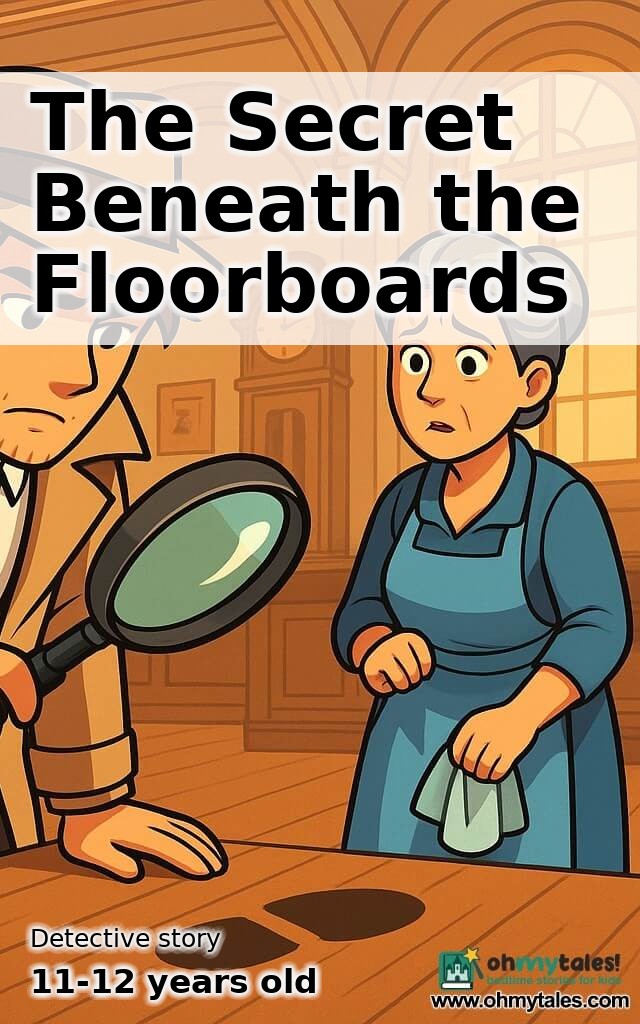
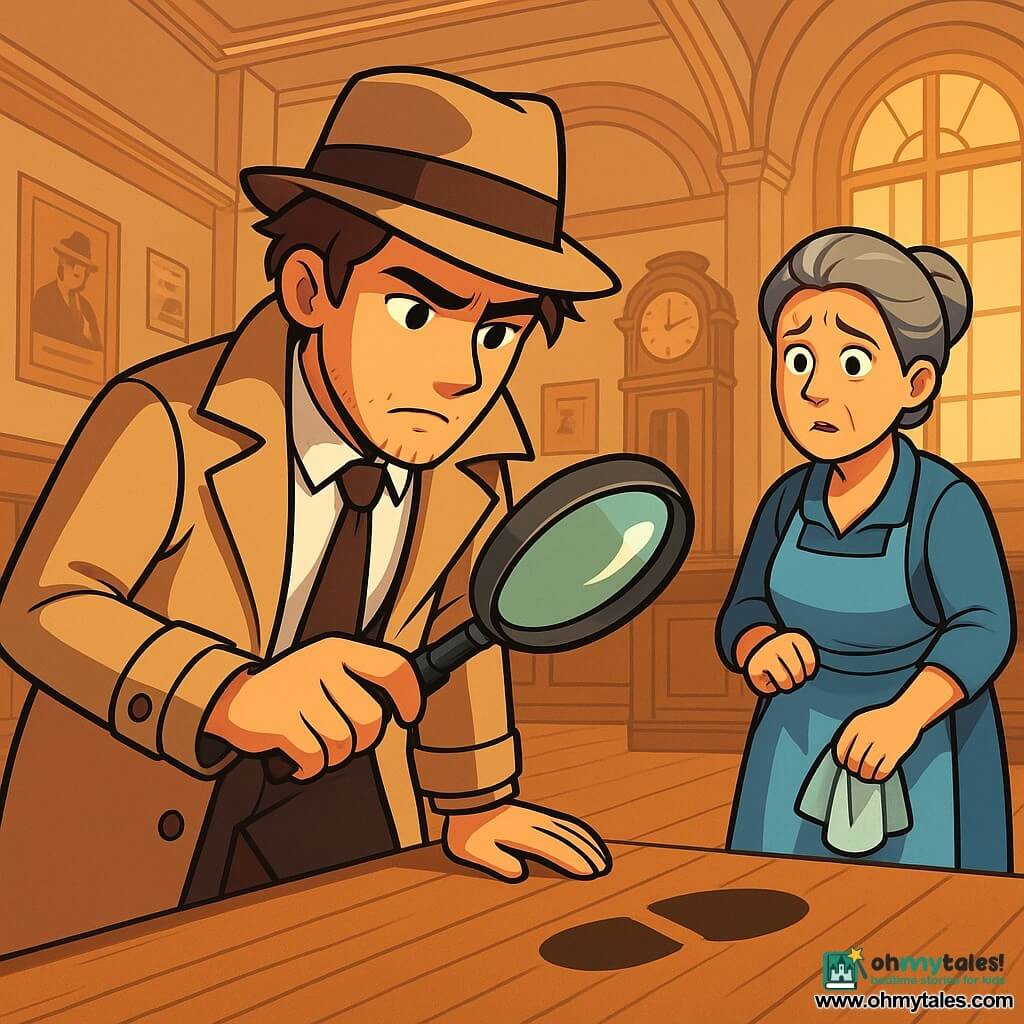
The town hall smelled of dust and lemon polish. Afternoon sunlight cut through tall windows and landed in squares on the wooden floor. Detective Arthur Finch stood very still in one of those squares and listened.
"The clock was there this morning," said Mrs. Lyle, the caretaker, wringing her hands. "It stood by the west wall in its glass case. I dusted it myself at nine."
Arthur tilted his head and looked at the empty glass case. The velvet inside was clean except for a faint circular mark where something heavy had rested. No glass was shattered. The lock on the case had not been forced; its tiny keyhole was neat and unworn. Someone had taken the clock without breaking anything.
He crouched and examined the floor with his fingertips. The varnish near the case had a dull ring, like a bruise on wood. There were no muddy prints—only fine dust and a hairline scratch, almost invisible, running toward the stage.
"Who found it?" he asked.
"Mr. Hargreaves, the mayor," Mrs. Lyle said. "He was hosting the council meeting. People noticed the case was empty right after lunch."
Arthur looked up across the room at the dais where the council sat. The town hall had been built in 1890; the floorboards were old and held stories in their grain. An antique clock was not just an object here; it was a mark of the town's history, a thing everyone noticed when it chimed noon.
"Did anyone handle the clock this week?" he asked.
"A few people. The clockmaker came Wednesday to oil it," said Mrs. Lyle. "And Mr. Corbin—that's his name—left his tool kit under the stairs. He said he'd finish on Thursday but he left early."
Arthur nodded. He knew the first rule in a missing-object case: objects don't disappear without someone who knew where to put them. The second rule came next: always look where people would not think to look—to the underside, behind, beneath.
He pocketed a smooth scrap of paper he found between the velvet folds of the empty case—a tiny piece, like a torn map, with a single smear of oil and three letters written in pencil: "G.R." He turned it over in the light. Whoever had touched the clock last had left a trace.
"Keep the hall closed," he told Mrs. Lyle. "Don't move anything."
She nodded, eyes wide. "Do you think it's stolen?"
"It was taken," Arthur said. "Now we find out why."
2. Questions and Alibis
Arthur's note-book was a small leather thing that liked to be opened on particular pages. He wrote: CLOCK—MISSING. CASE LOCK—INTACT. SCRATCH TO STAGE. NOTE: "G.R." He drew the floor plan in quick strokes: dais, case, stairway, basement door.
He went to see the clockmaker first. Mr. Corbin's workshop smelled of brass and oil; tiny gears lay like silver seeds in shallow bowls. Corbin was not large, but his hands were strong and steady.
"I oiled the movement on Wednesday," Corbin said. "Two screws to take out the face—easy for anyone who knows a clock. I told the mayor it might need a brass pin replaced. I came back with my screwdriver Thursday morning but the hall was closed. Look, my toolkit's missing a small flat-head." He opened a drawer and showed Arthur an empty slot.
"Did you have the key to the case?" Arthur asked.
"No." Corbin scratched his chin. "I used to. The town keeps the key in the municipal safe now. I never touch the key."
"Who else would know where the clock goes and how to move it without damage?"
Corbin pointed to the dais. "Council members, staff, the janitor—Tom. He locks up each night."
Arthur took a breath. He liked to see faces when he made questions. Details lived there: in the edge of a smile, the pitch of a voice, the way someone avoided a glance.
He found the janitor in a shed behind the hall, leaning on a broom. Tom was young but careful in his speech.
"I went home after lunch," Tom said. "I was at the grocer until five. Robbers would have needed a crowbar; they'd have broken glass. Whoever did this knew what they were doing."
"Did you notice anyone around the hall before the meeting?"
"No," Tom said. "Only Nell at the library. She stopped by to drop off old minutes for the archive."
The librarian, Nell, had ink on her fingers and a posture like a person who keeps things in order. She spoke softly but directly.
"I keep an index of town artifacts," she said. "The clock has a ledger entry for every repair. I updated it last month. Someone crossed out the entry for last Thursday's oiling—but the handwriting isn't mine."
"Crossed out for what?" Arthur asked.
Nell shrugged. "To hide a line, perhaps. Or to save space. People cross things out when they're nervous."
Arthur's notebook grew lines. He wrote: MISSING SCREWDRIVER. CROSS-OUT IN LEDGER. NOTE "G.R." He circled each item. The names formed a net: Corbin, Tom, Nell, Mayor Hargreaves. He would speak with Mr. Hargreaves last. In his experience, the mayor's eyes often had practice at hiding things.
3. A Night on the Floor
Arthur waited until the town hall was empty and the streetlamps outside cast long, parked shadows. He returned after midnight with a small flashlight and his own gloved hands. The town at night was a different place—quieter, its secrets more obedient.
He crouched near the empty case and tapped the floorboard with the end of his pen. The sound changed as he moved: solid, then hollow, then solid again. The hollow note was a single plank just forward of the dais, where the varnish ring had been. The thin scratch he had seen in daylight now looked like the edge of something peeled back.
He pried gently with a putty knife. The board lifted a little and the wood gave way, releasing a sigh of old air. Underneath, he found sawdust—fresh sawdust, pale and fragrant—and a trace of oil. Someone had cut into the floor, then covered it. He ran his fingers through the powder. On his glove, the dust left a mark.
He shone the light around the room. No footprints, but there were scuffs near the mayor's dais and a faint smudge on the back of the chair where the mayor sat. The smudge matched the dust from beneath the plank.
Arthur thought of the three letters on the scrap—G.R. Could they mean a name? A place?
He explored the underside of the dais, crouching until his knees protested. A small slot was visible at the base where the floor met the dais, the size for a key or a metal rod. The slot had the faint shine of being used recently.
Someone had hidden a way into the floor. And that someone had known which board to cut.
He took a sample of the dust and sealed it in a paper envelope he found in his kit. He wrote: sawdust—fresh. oil. slot under dais. He taped the envelope to the back of his notebook.
Before leaving, he looked toward the mayor's office, a small room behind the hall. The door was closed. He peered through the glass and saw a small smear on the mayor's carpet, like a hand had brushed across it and left a line of dust.
"hmm," he muttered. He made his mind work through a web of possibilities. If the clock had been removed intentionally to access whatever was under the floor, the thief needed the clock's absence to hide something—or to use the clock itself to open a mechanism.
Arthur liked the idea of an object becoming a key. It made elegant sense.
4. Threads and Motives
The next morning Arthur returned the evidence and began to stitch threads together. He asked Mrs. Lyle about the mayor's schedule.
"Mr. Hargreaves opened the meeting at two," she said. "He stepped away at quarter past for about ten minutes. He said he'd taken a call."
Ten minutes was a long time to be alone by the dais. Arthur asked again, and Mrs. Lyle remembered the mayor putting his hand on the dais when he returned, as if steadying himself.
He found Mr. Hargreaves in his office, a room wallpapered with certificates and photos of ribbon-cuttings. The mayor was not large, but his voice was full of practiced authority.
"Detective Finch," he said, as if company were expected. "A shame about the clock. It belonged to my grandfather."
"Who has access to the floor beneath the dais?" Arthur asked.
"The building's engineers did, once, when the heating pipes were replaced," Hargreaves said. "A long time ago. Why do you ask?"
Arthur showed the smear of sawdust on the mayor's carpet. "This was in your office at night."
The mayor's expression flickered. "I was here late last night," he said. "I couldn't sleep. I stepped down to check some files."
Arthur placed his hands on the mayor's desk and listened to the wood. "There was a cut plank near the clock," he said. "Someone used the floor to get somewhere. A workman would have left a log. Where did you go last night?"
Hargreaves blinked, then told a quick story about keeping the town's archive up to date. He had papers to sign, land agreements to approve. There was a developer coming next week, a man named Gregory Rains—G.R.
Arthur's pen hovered over his notebook. He wrote: G.R. = Gregory Rains. Developer. Mayor—late night. Motive: land sale?
"Why a developer's name in your papers?" Arthur asked.
The mayor's fingers tightened. "Rumors. Gregory Rains has been showing an interest in the town green. There's little point in the past unless you can build something on it, Finch."
Arthur let that land for a moment. If a developer wanted land under the hall or nearby, and someone at the hall had documents proving consent or secret plans, removing the clock to access a hidden compartment made sense. The clock could serve as a simple cover—remove the clock, open a trap, take the papers.
But who wanted the papers? The developer for a sale, or someone to expose a sale? He needed proof, not speculation.
He visited Gregory Rains' office—a shiny place with brochures and models of tidy neighborhoods. Rains was brisk and polite. "I want to build housing," Rains said. "The mayor and some council members have shown interest. But I wouldn't steal an antique clock for a deed. That's not my way."
Arthur left with a card and a picture of Rains' neat hands. He wrote: developer denies theft. Look for papers missing from archive.
Back at the town library, Nell checked the archives with him. She opened the old wooden chest where council minutes and deeds were stored. Several envelopes sat waiting—some were stamped "Confidential." One small envelope was gone: it had been labeled Town Green—Plans, circa 1920s.
"Someone cleared it," Nell said. "The chest is locked. The key is kept in the mayor's file drawer."
Arthur's heart clenched. The pattern had become a line: missing clock, missing envelope, secret interest from a developer, mayor late at night. He had motives and means. But he needed the final move—the proof that the floor's hollow led to a place where such envelopes could be kept.
5. The Trapdoor
Arthur returned to the hall with a small crowbar, a flashlight, and the town's clerk—reluctant but obedient. They lifted the same plank he had pried before. This time, the cut gave way with less protest. He slid the plank aside and peered into a narrow, dark seam.
There was a brass latch where the floor met the dais. The lacquer around it was polished from frequent use. The latch looked like it was made to be turned with a key the size and shape of a clock's foot. He thought of the heavy round base of the antique clock. He could almost see how a clock might sit over that brass ring and, when removed, reveal a space.
"You see?" Arthur said. "This space was used."
He turned the latch gently. The mechanism resisted at first, then moved with a small, disgusted creak. A trapdoor rose and a cool breath of stale air washed his face. A ladder descended into darkness.
They climbed down. The room below smelled of paper and old glue, like a bookshop shut for a hundred winters. Shelves lined the damp stone walls. Old crates and boxes filled the space. At the center, under a small lamp, was a low safe built into the floor. Its lid was open.
On top of the safe lay an envelope marked Town Green—Plans. Arthur picked it up. Inside were maps and handwriting that promised to carve the green into a new development. Next to the maps was a note, neat and hurried: "Bring to G.R. - H."
A name, and a hand that matched the mayor's. Someone had used the floor to hide documents that would settle the fate of the town green. Someone had needed the clock removed to get the papers.
Arthur examined the pages for fingerprints. There were smudges of oil on the maps—the same oil as the scrap of paper he'd found in the clock case. He smiled in a small, private way; the facts lined themselves up like dominos.
Upstairs voices made him look toward the ladder. He heard the scrape of a shoe. They were not alone.
He climbed back, closing the trapdoor behind him. The clerk had stayed just outside the hall. "Mr. Hargreaves is calling for you," he said. "He says he needs the town council to see a—"
Arthur stepped into the hall at the same moment the mayor entered from his office, hands bent in a way that tried for casualness but landed at stiffness.
"Detective Finch," Hargreaves said. "I heard you found the trapdoor."
Arthur watched the mayor's face. He noticed a faint smear of sawdust on the mayor's cuff and a thin line of oil on his ring finger. Hargreaves opened his mouth as if to speak, then closed it.
"Why," Arthur asked, "did you need those plans?" He kept his voice even.
The mayor's shoulders sagged. "We were discussing the town's future," he said. "If the green could raise taxes to rebuild the school, isn't it worth thinking about?"
"And removing the clock?"
"It wasn't removal," Hargreaves said. "It was... temporary. I needed to bring the papers downstairs where no one would look, to protect them until the council decided."
"Protected from whom?"
"From people who would make trouble," he said. "From scandal."
Arthur looked at him. "You met with Gregory Rains, and you wrote 'Bring to G.R. - H.' on that note. You had the key to the chest in your drawer. You were here last night during the ten minutes when the clock disappeared. There is sawdust under the plank. Someone with a tool removed the clock to open the latch."
The mayor's eyes—usually practiced—fumbled. "I was thinking of the town. I didn't mean harm."
"You took a town heirloom to hide papers that would decide the green's fate," Arthur said. "You thought secrecy would protect the plan. But secrecy is also theft. You removed something that wasn't yours to move, and you left the town guessing."
Hargreaves sank into the nearest chair. He looked older than his photographs. "I did it because I believed it would save the school," he said. "I did not mean to steal the clock or to lie."
Arthur leaned back and let the space measure itself. He had a choice: arrest, exposure, or persuasion. He wanted the town to have its say.
"Return the clock publicly," Arthur said. "Bring the plans to the council meeting. Let the town decide what to do. Secrets never make good policy."
The mayor closed his eyes for a long breath, then nodded. "I'll put them on the table."
6. The Quiet After
The clock was found where the mayor had hidden it—wrapped in old cloth in his office, on the top shelf of a locked closet. It was dusty and sad where it had been kept, but its hands were unbroken and its face unmarked. Arthur let the council handle the political parts. He did what he did best: lay out the things the town needed to know.
At the council meeting, the mayor confessed. He explained the maps and the developer's interest and his fear for the school. Gregory Rains sat at the back and listened quietly. The town spoke, some voices angry, some fearful, some stubbornly practical. In the end, the matter was put to a vote. The plans were set aside while the council explored less intrusive ways to raise funds.
Arthur sat at the back of the room and watched the clock swing its pendulum again. When it chimed, the room shifted a little on its axis—people looked at one another, as if waking from a shared dream. The clock had been used to hide a secret. Now it kept time on public terms.
Later, as people drifted out and the dusk painted the windows blue, Mrs. Lyle came up to Arthur.
"How did you know?" she asked, curious and grateful.
Arthur thought of the scrap of paper with the letters G.R., the missing screwdriver, the fresh sawdust and the dirt on the mayor's cuff. He thought of motives and timing, of small slips that add up.
"You watch for the odd pieces," he said. "A missing tool. A scratch on a floor. A single line of pencil. They all point to the person who wanted something hidden. You don't assume the worst first—you gather the facts. Then you place them in order and ask who benefits."
Mrs. Lyle smiled. "I think I saw it," she said. "The way the mayor's hand trembled when he said 'school.'"
Arthur nodded. "People forget the weight of doing something without asking. They think the end will justify the means. But the means leave traces."
As he stepped outside, Arthur looked at the town green. It was small, stubbornly green, with a bench near the lamppost and a dog sleeping under it. He thought of the maps and the meetings and the way secrets can lodge like grit under a fingernail.
He took the sawdust sample he'd kept and opened the paper to feel its texture one last time. He liked proofs. He liked how careful work could turn a tangle of accusations into a straight line of fact.
A boy on a bicycle rode past and rang his bell. Arthur smiled and felt the answer of the city in his chest: that things can be found again, that wrong turns can be corrected if people are patient and brave enough to show what they know.
He had come to the town hall for a missing clock and found a secret beneath the floorboards. He had solved the puzzle by looking, listening, and following the small, honest clues.
That evening, when the clock chimed six, Arthur walked home under a sky the color of pewter, and the town's ordinary noises—shutters, distant laughter, the rumble of a van—fit together like the gears of a well-kept clock.