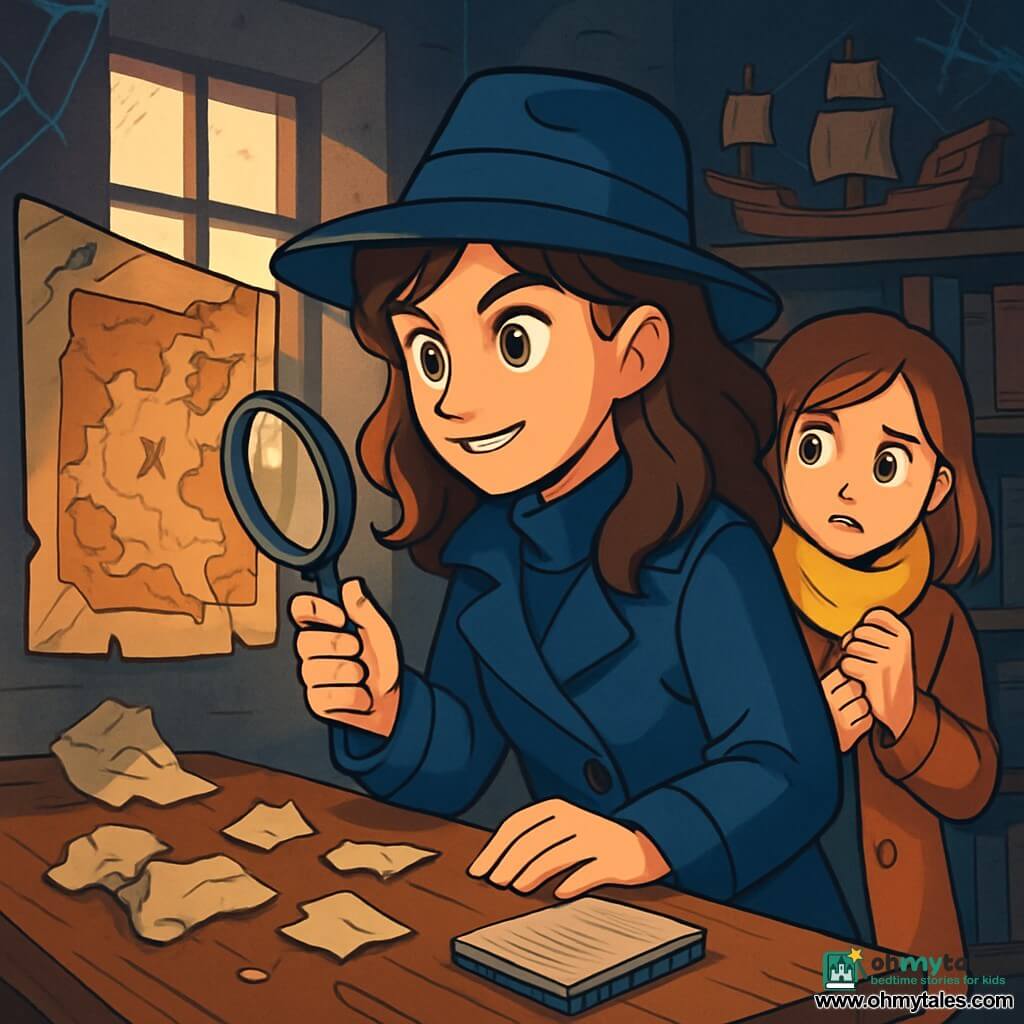
Chapter 1 — The Missing Song
The museum smelled of old paper and polished wood, the kind of quiet that makes you notice the softest creak in the floor. Clara Hale bent down, palms on her knees, and looked at the empty velvet cushion as if the music box might be hiding behind the baseboard and play its two gentle notes out of embarrassment.
"It was here when I locked up," Mr. Alden said, voice thin as the ribbon on the velvet. He held his hands together as if keeping something warm. His spectacles caught the pale light and threw it back in a way that made his eyes look smaller. "At midnight. I turned the key and I checked—twice."
The display case stood open. The lock hung loose, a small metal mouth with nothing in it. Clara's flashlight brushed across the wood of the case and lit a smear of pale blue across the band where the box had rested, like a sigh left in paint. Fine grains of sand scattered on the baseboard as if someone had come back from the shore and forgotten the walk home. A tiny shell fragment winked under the light.
On the floor beside the case was a torn scrap of brown paper. Clara picked it up with the corner of a glove and smoothed it on her palm. Only a few words were legible: "...meet at break..." and a hurried little scribble—a round, simple smiley face with two dots for eyes and a crescent mouth, more of a doodle than a note. The smiley was a childish touch, and it sat oddly on that rough paper like a pressed flower in a ledger.
"You found the note," Mr. Alden said. "I—" He stopped and swallowed. "We have volunteers. Someone could have taken it to protect it from being sold. I... we were arguing at the council meeting. They talk about selling off pieces to fund repairs. I thought—"
A young woman in a worn denim jacket stood near the doorway, hands in her sleeves. Her name was Maya Finch, she was seventeen and had been helping at the museum since summer. When Clara met her eyes there was a jitter in them, like a small animal watching for danger. Maya's yellow scarf hung over one shoulder and a bit of pale blue paint dusted the fringe near where it met her jacket.
— "I saw someone," Maya said, voice small. "I thought I saw them moving something toward the clock tower. But it was dark. I couldn't be sure. I—" She stopped and looked at Mr. Alden. "I didn't touch the box. I swear."
Clara knelt and leaned forward, careful not to disturb the footprint marks on the dusted floor. The museum had only one security camera for that wing, but its lens had been angled away overnight. The wiring had been re-routed; a thin professional zip tie leaned neatly against the plant pot. Someone had known exactly how long they needed.
"Who has access to the clock tower?" Clara asked, eyes on Mr. Alden.
"Staff. Me. Maya. The council—on occasion. And the lighthouse keeper, when he brings up the salute lantern." He rubbed his temple. "Why would anyone—"
Clara looked back at the torn paper. A smell of lemon clung to it faintly, like old polish. She lifted the edge and found, pressed into the fibers, a trace of red wool. A thread, half hidden, like a secret tucked into a seam.
She pocketed the scrap and stood. There was a lightness to the museum's noise now: people whispering, footsteps on stone, the distant clatter of a kettle in the tearoom. Lantern Night had been loud and bright the evening before; the town had walked along the pier with glowing jars and songs. But the music box—the Seafarer's Song—had vanished in the blue hour before dawn.
"All right," Clara said. "I want to see the cameras, talk to anyone who was here last night, and I want to know where that clock tower is locked from and by whom."
Mr. Alden rubbed his hands together. "Of course. Anything. Please. It's not just the box—it's the history. My grandfather—"
"I know," Clara said. "We'll find it."
She told herself she wouldn't be quick to blame. Small towns keep small secrets the way the sea keeps shells, but they also have the kind of stubborn truth that can't stay hidden forever. She tucked the torn paper into her pocket like a map and stepped into the shallow bright of the morning, the town still smelling faintly of smoke and lantern oil.
Chapter 2 — Threads and Footprints
Clara's first stop was the surveillance room behind the tearoom, where a young man named Uri kept a vigil over six grainy screens. He clicked through the footage with a practiced thumb.
"The camera in the gallery rotated away for twelve minutes between 00:16 and 00:28," Uri said without looking up. "Someone tampered with the timecode after. They were careful. The door sensor didn't record a forced entry."
Clara watched the stretch of footage. Shadows moved across the frame. A shape crossed the floor in two steps and then two more, and then the frame was blank while the camera swivelled. It happened at 00:20. Clara froze it and enhanced—though the image remained just a silhouette. The person was slim, moved in a quick curling stride. There was a flash of yellow across the shoulder at one second—the yellow of the volunteer's scarf—and then nothing.
"Someone masked it as a staff rotation," Clara said. "Someone who knew where the camera sat."
"That narrows it," Uri said. "Which, unless the whole town's a staff, leaves only a handful."
Clara stepped outside. The museum faced the harbor, and the morning light wrestled on the water like a sheet. She walked along the pier where Lantern Night debris had been swept into piles—paper cups, a few lantern tongues that had gone out, strings of seaweed caught on the rails. Near the end of the pier, a vendor's stall had pale blue paint flaking down its legs. Someone had been painting signs there in the night; a smear on the vendor's shoe matched the paint on the museum display board.
On the wooden boardwalk a pair of boot prints pressed into the sand dust. The soles bore a pattern of tiny anchors—an anchor like a small repeating brand. The print beside it was smaller, narrower, faint as though the weight had been shifted. And tucked beneath a bench, a scrap of yellow thread—identical to the scarf Maya wore—caught in a nail.
Clara ran her finger along the drift of sand by the step and found a few tiny shell shards, the same kind as in the display case. The tide would have brought shells here, but the grain and grit suggested someone had walked from the shore and up the pier toward the museum, not the other way around.
She kept a small evidence bag in her coat and slipped the thread into it. The sun made the water look like broken mirrors. She felt the town watching her; the townspeople liked mysteries in the abstract but not when those mysteries pointed a finger at one of them.
Back at the museum, Clara returned to the clock tower. The iron stairs smelled of oil and rain. The clock's face was a dull white with black numerals, and the bell sat hollow and patient in its cage. Someone had tossed a cloth up by the rafters—paint still wet in places. A blue smudge marked a cleat near the ladder, and on the floor beneath the bell, dust had been swept into a tidy pattern as if someone had been trying to hide footsteps.
"Who uses this at night?" Clara asked no one in particular.
"A lot of us," Mr. Alden called from below. "I go up to wind the tower. The lighthouse keeper checks the alignment. Volunteers do odd checks when there's an event."
"Anyone else?" Clara looked at the beam. A small scrap of paper stuck to the rung. It had the same childish smiley face drawn in the corner. She smoothed it with her finger. The same little curve. A doodle habit became a signature.
Clara thought about the smiley. She'd seen that mark before, in the volunteer logbook—Maya's little habit, a punctuation of her sentences. The volunteer logbook also contained duty shifts. Someone had been scheduled for the night. Maya, in fact. Someone deliberately turned the camera, someone with access to the tower, someone who carried sand and a yellow scarf, and someone who doodled smiley faces.
But motive lurked behind opportunity like cold water under a rock. Why move the box? Mr. Alden's voice on Clara's recorder trembled when he spoke about the council. The town needed funds and his museum's ledger—if anyone had seen it—showed a missing sum. Clara slipped into the back office and found the ledger under a tea-stained diary. The figures were small and careful. A handful of unpaid invoices, a line scratched out and written over. Late fees stacked like thin ice.
She didn't like jumping to accusations, but finance sharpened motives like a whetstone. She made a list in her head of people who had reason to hide or remove the box: Mr. Alden, who feared the council's auctions; Councilor Fenwick, who wanted to clear debts; a thief looking to sell to a collector; or a well-meaning volunteer trying to protect a piece of history. The facts so far pointed to more than one.
Clara opened the back of the display case where wires fed into the base. The lock had a new scratch along the edge—small, clean—and a faint residue of petroleum jelly smeared in the deep grooves as if someone had lubricated a mechanism. On the baseboard, at the place the box had sat, a thin hair caught in the fiber. Clara picked it up with tweezers: red, dyed perhaps, not from nature, with a single tiny knot of wool stuck to it. Someone's scarf thread, held with the hair like a binding.
She tucked the hair into an evidence bag and thought of the smiley face again. A small habit and a small piece of thread were tiny truths. Sometimes the smallest things were the loudest. Clara had no proof yet that Maya took the box; she had only clues: the yellow scarf, the smiley doodle, the sand. She had even less proof of anyone selling it. But she had enough to ask questions that would not let people sleep.
Chapter 3 — Confessions in the Clock Tower
Clara found Maya sitting on the lowest step of the clock tower, knees up to her chest, the yellow scarf wrapped tight. She looked like a small comet who'd lost her destination.
— "What happened?" Clara asked, sitting beside her. Up in the rafters, the bell ticked as if annoyed.
Maya's eyes went to the rafters and then back. "I didn't mean to," she said simply. "They were going to sell it. At the council meeting... I heard them. Mr. Alden was furious; he told them it was the town's heart. Councilor Fenwick said it was a relic and we had to pay for the repairs to the pier. She used that word—relocate."
— "Relocate?"
"Sell," Maya said. "To the collector in the city. He has deep pockets. They said the money would pay for the repairs and that the music box would be safe with him. But safe? That's not the same. I called my grandmother—"
— "You took it."
Maya nodded. Her fingers twisted the edge of the scarf until it wrinkled. "I thought if I could hide it until the council cooled down, maybe we could find another way. I know the clock tower. I put it up in the bell housing, wrapped in a blanket. I left a note in case someone needed it—just 'meet at break', a stupid note. I didn't mean to go this far. I didn't tell Mr. Alden because he... he panics."
Clara's mouth softened into a thin line. "Who else knew?"
"Only me and Jack," Maya said. "He helps me fix boats. He saw me carry it when I walked past the pier. He promised not to tell. He said, 'You can't do that, Maya,' but he didn't. He says he's going to help keep it safe."
Clara memorized the cadence of the confession. It was not the voice of someone hiding a plan meant for profit; it was the voice of someone who had acted on a thought too fast. But the box was not in the bell housing now. Clara climbed the narrow ladder without Maya and peered into the dark where the wood embraced the bell. The blanket had been there; its corner now hung over a beam, snagged.
Someone had unwrapped the music box and taken it.
Clara and Maya sat at the base of the tower in the pale afternoon sun. A gull cried as if calling for a missing note.
— "Did you lock the way you left it?" Clara asked.
"I did." Maya's eyes were big and glossy. "I used the back door and made sure the latch clicked."
"Who else could open it?" Clara asked.
"Mr. Alden, the lighthouse keeper—Marcus—and Councilor Fenwick, in an emergency. But no one should have been up here."
Clara recounted the camera tampering, the blue paint, the boot prints. Maya stared and then, quickly, shame turned to fear. "I saw someone near the tower about an hour after I left," she said. "They had wet paint on their sleeve. They were—" She stopped, pressed a hand to her mouth.
"Who?"
"A man. Tall. He moved like he was used to being here. Mr. Alden has those boots. He always wears them when he winds the clock. He—" Maya's voice cracked. "He said something about 'protecting the town' and then he left."
Clara thought of the ledger she'd seen, the erased numbers. She thought of the boot prints with anchor soles. She thought of the blue paint on a merchant's stall and the smear of the same hue on the display base. The picture grew sharper: someone who had keys, knowledge, and perhaps a desperate reason.
Clara walked down to the museum office and asked to see Mr. Alden's ledger again. He sat across from her, hands folded, as if he had been waiting for this scene and had practiced his lines.
"I found the box," he said before Clara could ask, "in the clock tower this morning—someone had taken it there. I brought it down to the office to keep it safe."
"Why not hand it to the police?" Clara asked.
Mr. Alden blinked. "I... I was afraid. I thought I could keep it until the council meeting. I wanted to avoid a scandal."
Clara slid the torn paper across the desk. "Your fingerprints are on the desk lock and the baseboard," she said. "And the strip of blue paint on your sleeve—someone saw you with wet paint on you after midnight. Your boots match the prints on the pier. You have sole patterns like the anchors."
Mr. Alden's face went white as chalk. He licked his lips. "There are things in the ledger I should have told the town. I am behind on payments. My account—" His voice faltered. "I had someone ask if I could find a collector who would pay for a piece privately. I thought if I had the box in my hands, I could negotiate a loan. I—I didn't want to sell it to them, to the council. I wanted to stop someone else from buying it and locking it away. But I did talk to someone."
Clara waited. She had seen men say "I did it to save it" before. People used safety as an excuse for wrongdoing all the time. But Mr. Alden's confession did not quite align with the neatness of the evidence.
"Then why move the camera?" Clara asked. "Why the tampering with the timecode? You had keys and access. Why make it look like a theft?"
Mr. Alden rubbed his palms on his knees. "I panicked," he said. "I thought if it looked like a theft, the council would have to delay any decision. I thought I could keep control and then—God, I made mistakes."
Clara watched his fingers fidget. He'd left a smudge of paint along the edge of his sleeve where his palm had brushed it in a hurry. He had indeed been in the clock tower. He had lied in part. But something about his words didn't fit the neat stunt of a thief-for-hire. He had motive and opportunity, yes, but what about Maya's yellow scarf and the smiley face? Both suggested someone else had been involved before Mr. Alden came into the picture.
Clara turned the questions like a stone in her hand. Someone had put the box in the bell housing—Maya. Someone had then taken it from there—Mr. Alden. But who had been the first mover? And why leave a childish doodle on a scrap of a note? She thought of the smiley as a breadcrumb.
"You said you found it in the tower," Clara said, watching Mr. Alden. "Did you see any evidence someone else had been there first?"
He looked at his hands. "There were crumbs—sand. A scrap of yellow thread. I thought it belonged to a volunteer."
"Who is your contact in the city?" Clara asked quietly.
Mr. Alden's jaw tightened. "I haven't sold it. There was a message. A man with an email. I was trying to secure a buyer for a different piece—" He stopped. "Clara, I know how this looks. But I wasn't going to sell the music box to the collector. I wanted—to be honest, I wanted the council to see the box's value and stop the sale. I thought by making it appear stolen, we'd force a different conversation. It was foolish."
Clara felt the small pieces sliding together. Maya had had the right to act and did; Mr. Alden had reacted, misread the problem, and tried to control it; but the missing piece—the evidence that pointed to who might try to profit—remained a shadow. If Mr. Alden had been the second mover, who else had motive to take it from the bell with knowledge and purpose? Councilor Fenwick? The collector? Or someone else who knew enough to mask their actions with paint and anchors?
She asked for the staff rota and fingerprints and compared the handwriting on the torn note with the logbook. The smiley matched Maya's cheeky habit exactly. The yellow thread matched her scarf. Maya had moved the box. Mr. Alden had taken it after. But whom had he planned to sell it to? The ledger had a faint email address scrawled at the back—part of it rubbed out but enough to show a city domain.
Clara taped these facts together and walked to the harbor again, where the old merchant Mr. Greene sold model ships and gossip in equal portions. He kept his paint in jars and his secrets in the floorboards.
— "You said someone had pale blue on their sleeve last night," Clara said.
Mr. Greene lifted his jar and smelled it. "That's the paint we use on the new pier signage. Everyone's been getting messy with it. The councilor's crew were here late repainting the bench numbers."
"Did you see Mr. Alden?"
"Ah, yes. He was here, all right. Asked about local buyers. Mentioned a mark-up. And he spoke to the councilor, too, mind you. He seemed troubled."
Clara thanked him and walked back toward the museum, the town folding around her like a small dare. In her pocket the torn note warmed and the hair threads chewed on her thoughts.
Chapter 4 — The Measure of Truth
Clara arranged an upstairs room in the town hall for a small meeting. Mr. Alden sat on one side of the table, shoulders hunched. Maya sat on the other, scarf wrapped like a flag. Councilor Fenwick arrived late, brisk as wind through a sail, her hands clasped in front of her. Jack, the boat mechanic, who'd been mentioned, stood near the doorway like a man holding his breath.
— "We need to put the pieces together," Clara began. "Maya, you admitted you moved the music box to the clock tower because you believed the council would sell it."
Maya nodded.
— "Mr. Alden, you admitted you later took it from the tower, saying you wanted to 'keep' it safe and perhaps stall the council. You have motives: ledger entries show your accounts are strained and you have been in talks with someone in the city about buying pieces. Is that correct?"
Mr. Alden's face crumpled. "Yes," he said. "I didn't plan a sale for the music box. But I thought—If I had it, I could make the council stop their plan. Maybe convince a donor to help. Foolish. Yes."
— "Who else knows of collectors interested in town artifacts?" Clara asked.
Fenwick's face didn't change. "Collectors are flogging the coastal antiques. You cannot keep them all in a town with ratty roofs. We were discussing options, not an auction."
— "Where were you at midnight?" Clara asked Fenwick.
"I was at home—" she said, then added quickly, "—I came to the pier with a paint crew earlier but left at ten."
Clara watched her. If anyone wanted to hasten a sale, to cut a deal under the table, they'd likely have to move things quickly. But the councilor had no visible sign of the blue smear. She had been paint-conscious and neat.
Clara pinched the bridge of her nose. The evidence now pointed to a two-stage event. An impulsive volunteer protected the box; a struggling curator took advantage of that protection; and an auction in the city hovered like a shark in deep water. But who had been planning to make money? Mr. Alden had spent time with Mr. Greene and had a fragment of an email address for a city buyer. That was a line too clear.
— "Mr. Alden," Clara said softly, "you lied about the timing. The camera was deliberately turned away. You have paint on your sleeve that matches paint used down the pier and boot prints like the anchors. You had a reason to take it. The question is: did you move it so you could sell it, or did you move it to stop someone else from selling it for worse reasons?"
Mr. Alden's chin shook. "I was afraid the council would sell it to the collector without considering the town. I thought I could keep it until I found a way. Then the email came—I was offered funds for a different item and I thought if I could show them this piece, we could get backing. I... I wanted to bargain, not betray."
— "Where is the box now?" Clara asked.
Silence. Mr. Alden looked down at his hands as if they were strangers.
Clara stood and walked to the window, the glare of the water throwing light between them. She considered the torn note in her pocket, the smiley face, Maya's scarf yellow as dawn. She considered the hair with red wool, the smudge of paint, and the ledger's last line where someone had scrawled part of an email.
A thin, steady click came from the door as it opened. The lighthouse keeper Marcus stepped in, quiet as the lantern he tended. His boots were clean, his eyes steady.
"I found it," he said, and there, in his hands, sat the Seafarer's Song music box.
It was wrapped in cheap newspaper, the corners damp from the morning dew. Clara's breath caught. The box looked small and weathered now, not a prize but something between people—the kind of object that could heal a town if treated gently.
— "How did you come by it?" Clara asked.
Marcus placed it on the table with care. "A fisherman found it at the foot of the old pier this morning and handed it to me," he said. "He said someone had left a blanket by the bell and then a man took the blanket and left. The fisherman thought it odd. He brought it to me. I knew the town would be raw—so I waited until I saw Mr. Alden on the pier. He looked upset. I asked about it. He said, 'I'm trying to save it.'"
— "You confronted him?" Clara asked.
Marcus nodded. "He said he was trying to keep it from being sold, that no one would buy it, and he had a plan to use it to gather support. I wanted no part of plans and lies. This town shares things. We don't hide them." He looked at Mr. Alden. "I took it from him for safekeeping."
Mr. Alden's eyes shone. "I didn't mean to sell it," he repeated. "I meant to..."
Clara returned to the desk and opened the drawer where she'd last seen the scrapped email. A folded letter sat there now—new, not old—an apology from Mr. Alden to the council, explaining his accounts and asking for time. The tears along the fold looked like rain.
— "Why would someone put a smiley face and yellow thread?" Clara asked.
Maya's hands trembled. "I wrote the note," she said. "I wrote the note and left it in the bell because I knew that's where I'd hide it. I didn't want to get in trouble. I thought if anyone came they'd know it was a volunteer who cared, not a thief."
Clara looked at everyone in turn. "So here's what happened," she said. "Maya, you moved the box to the clock tower to hide it from a sale. You left the hurried note with your doodle. You were scared and left. Mr. Alden, you saw the box in the tower and, panicked by the town's finances and by some private talks you'd had with people in the city, you seized the opportunity. You moved the box thinking you could control the outcome—either keep it in the museum by buying time or use it to leverage support."
Mr. Alden's shoulders sagged. "Yes."
"Then a fisherman found the music box after it was left by the pier. Either the box was dropped accidentally when Mr. Alden moved it, or he left it somewhere to avoid suspicion. The fisherman brought it to Marcus, who brought it here. The camera tampering was Mr. Alden's attempt to make it look like a theft so no one would trace the movement back to his ledger."
Clara paused. "This is not a simple theft. It's a chain of small decisions stretched by fear. Maya acted out of love for the object's history. Mr. Alden acted out of fear for the museum's survival. Both are mistakes; one is wrongdoing."
Councilor Fenwick crossed her arms. "So the council did not take it—no outside buyers were here."
"No," Clara said. "Not yet. But the town nearly sold what it loved because no one spoke openly about money or value. People started assuming motives when they should have asked questions."
Mr. Alden dropped his face into his hands. "I thought I was protecting the town," he whispered. "Instead I made the town suspect each other."
Clara watched him for a long moment. She had come to sort facts, not to amplify guilt. "You're going to have to explain yourself to the police," she said. "But also, you need to tell the council the truth about the accounts. Hiding things makes worse trouble. And Maya, you need to stop carrying secrets alone. This could have ended worse."
Maya looked down. "I know. I just wanted to save it."
"Which is why, perhaps," Clara said, "we return it where everyone can see it. We make this public. Let the town decide together."
They arranged a small meeting in the museum that evening, Lantern Night's quieter twin. People came with huddled faces and hands in pockets. Mr. Alden stood and read the ledger aloud, admitting his panic and errors. Maya spoke up and told the simple story of why she'd hidden the box. Marcus said little, but his look was steady and clear. Councilor Fenwick did not need to be coerced—she admitted, stoic, that mistakes had been made in the council's rush.
Clara watched the town listen to one another, the way a listener tilts their head to hear a story fully. The confession did not erase the wrong, but it opened a way forward. The museum would not sell. A fund was proposed to help with repairs, small donations from the town, a pledge to look for grants, and a few folks offering to teach night classes to raise money. Small solutions for small towns, stitched carefully.
Before they closed the meeting, Mr. Alden placed the Seafarer's Song on its velvet cushion in front of the gathered crowd. He turned the tiny key. The music played two notes and then one long, soft chord that sounded a little like a memory of waves.
Clara stood at the back and watched faces. In the crowd, a child held a handcrafted lantern and hummed along, not knowing the music's full history but feeling the way it fit the night. Clara thought of the smiley face on the scrap of paper and the yellow scarf, the little threads that had pulled the whole case together. Small clues told large truths when a person had the patience to read them.
As people drifted away, Mr. Alden caught Clara's sleeve.
— "Thank you," he said, voice small. "For seeing all the pieces."
Clara tilted her head. "I didn't see everything. You did things wrong. But you also care. That counts in a place like this."
Outside, the harbor held the sky in its black bowl and reflected the town like a mirror too honest to flinch. Clara walked down the pier with the sea at her side and the town breathing behind her. A little girl tugged on her mother's hand and pointed to the lanterns.
— "Can we keep it here?" the girl asked.
The mother smiled. "We can keep it if we hold on to each other, too."
Clara thought of how often mysteries can be resolved by small things: a thread, a doodle, a smudge of paint. Not everything needed the grand solution; sometimes a whisper of proof and a steady question were enough. She tucked the scrap of paper back into her pocket where she kept the world in little pieces—clues, notes, and the memory that the best answers often started with someone willing to ask why and then listen.
As she walked home the tide shifted, and far out, the lighthouse blinked once, twice—an eye that watched over memory and, tonight, kept its light for the town.