Chapter 1: The Checklist That Keeps You Safe
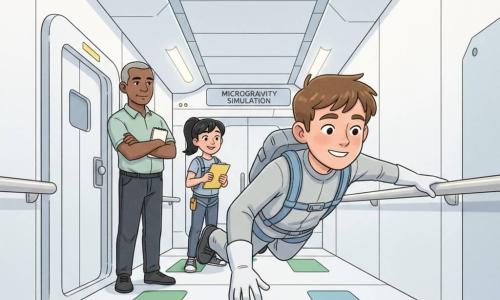
Milo Reyes floated in the quiet hallway of the space station, guiding himself with two fingers on a handrail. The station smelled faintly like metal, warm plastic, and someone's spicy noodles from yesterday. Outside the window, Earth rolled by—blue and white and unbelievably alive.
“Morning, Mission Control,” Milo said into his headset. His voice sounded calm, the way he practiced it.
“Good morning, Milo,” came the reply, crackly and comforting. “How's the station?”
“Still up,” Milo joked. “Gravity still missing.”
He reached the equipment locker and pulled out a tablet. A checklist filled the screen: water system, air filters, power levels, emergency gear. Some kids thought astronauts spent all day staring at stars. Milo did stare sometimes—but most of the job was careful work and teamwork.
He tapped each item. Green. Green. Green.
A small beep interrupted him. A message from Commander Hana Park: Change of plan. Solar panel inspection moved up. Meet at Airlock Two in fifteen.
Milo blinked. The inspection was supposed to be tomorrow.
“Copy,” he said, then grinned at the empty hallway. “Flexible, Milo. Like a space noodle.”
He pushed off toward Airlock Two, tucking the tablet under his arm. The station hummed softly, like a giant sleeping machine.
As he drifted, he remembered being eleven, lying on a blanket in his backyard and counting satellites. He'd made a cardboard helmet out of a cereal box, with a “visor” cut from a plastic salad lid. Back then, he thought astronauts were fearless.
Now he knew the truth: astronauts were careful. They were prepared. And they listened—to the station, to their training, and to each other.
At Airlock Two, Hana waited, her hair floating like a dark cloud around her head. Next to her was Theo, the flight engineer, holding a tool bag and trying to look awake.
Hana's eyes flicked over Milo. “We have a schedule shuffle. A small piece of debris passed nearby, so Mission Control wants the panel checked sooner.”
Milo nodded. “Then we check it sooner.”
Theo yawned and tried to hide it behind his hand. In zero gravity, the yawn looked even bigger, like his whole face was stretching.
Milo noticed. He didn't say anything yet. There were more important steps first.
Hana pointed at the airlock hatch. “Suit checks. Slow and steady. No shortcuts.”
“No shortcuts,” Milo repeated. In space, rushing wasn't brave. It was dangerous.
They moved into the prep area. Milo helped pull out the bulky suits, white as polar bears. Every suit had layers: protection from cold, heat, sharp dust, and the emptiness outside. A small backpack on the back—called a life support system—held oxygen and removed carbon dioxide.
Milo ran his fingers over his gloves. “Hello again,” he murmured. “Let's keep each other alive today.”
Theo snorted. “You talk to your suit?”
“It talks back,” Milo said. “Mostly in beeps.”
Hana's smile was quick but real. “Focus, you two.”
They started the routine: inspect the helmet seal, test the radio, check oxygen pressure, confirm the cooling water would circulate to prevent overheating. Milo said each step out loud. Not because he doubted himself—but because speaking it made it a team promise.
When he glanced at Theo again, Theo's eyes were slightly red, like he'd rubbed them too hard.
Milo stored that detail away like a note in a pocket. In space, the smallest details could matter later.
Chapter 2: The Plan Changes Again
The airlock door shut behind them with a heavy clunk. Suddenly, the station felt farther away, like a house you were leaving for a trip.
“Airlock depressurizing,” Hana said. “Everyone breathe normally. Don't hold your breath.”
Milo listened to the hiss as the air thinned. Outside the small window, sunlight blazed so bright it made shadows look like ink.
“Pressure at zero,” Mission Control said. “You are go for EVA.”
EVA meant Extra-Vehicular Activity—a spacewalk. It sounded fancy, but it was basically: Step outside and don't make mistakes.
Hana opened the outer hatch. Blackness spread beyond it, deep and endless, and then Earth swooped into view, spinning slowly below them.
Milo's chest tightened with wonder, even after all his training. “Every time,” he whispered.
Theo chuckled. “Yeah. It's like the universe is showing off.”
They clipped their safety tethers to the station. Milo always imagined tethers as invisible promises: You will come back.
“Remember,” Hana said, “three points of contact. Hand, hand, foot—or two hands and your tether. Move like you're underwater.”
Milo followed, pulling himself along the handrails. His gloves made everything clumsy. Each movement had to be planned. In space, if you pushed too hard, you'd float away like a dandelion seed.
They reached the solar panels—wide, dark-blue wings that drank sunlight and turned it into power. The panels fed the station's batteries. Without them, the station would be a cold, dark box.
Milo's job was to inspect the panel hinges and look for tiny cracks or burns from micrometeoroids. He held a flashlight and a small camera, taking photos for engineers on Earth.
Theo worked beside him, opening a cover with a specialized tool. He moved a little slower than usual, and his breathing sounded louder in Milo's headset.
“Everything okay, Theo?” Milo asked casually, as if he were asking about a TV show.
“Yep,” Theo said. “Just… didn't sleep great. Station fans sounded like a jazz band in my head.”
Milo pictured the fans as tiny trumpets and nearly laughed. Then Hana's voice cut in.
“Update,” Hana said. “Mission Control just detected an unexpected temperature rise near the panel's power junction. We need to check the thermal line. Plan changes—again.”
Milo's mind snapped into problem-solving mode. “Copy. We adapt.”
Theo muttered, “My favorite hobby. Surprise plans.”
Milo kept his voice light. “At least space keeps us entertained.”
They moved toward the junction box. Milo's flashlight swept over the metal, making it gleam. Tiny flecks of paint sparkled like confetti in the sunlight.
Hana inspected a sensor cable. “Theo, read me the temperature.”
Theo paused. “Uh… give me a second.” His gloved fingers hovered like he'd forgotten the sequence.
Milo's stomach tightened. Forgetting steps could happen to anyone, but it happened more when someone was tired.
Milo leaned closer, still calm. “Theo, you want me to read it? You can double-check my number.”
Theo exhaled. “Yeah. Thanks.”
Milo read the display. “Temp is three degrees above nominal.”
Hana's voice stayed steady. “Not critical, but we'll monitor it. Milo, take images. Theo, check the thermal line clamp.”
Theo's reply was quick. “On it.”
Milo watched Theo's hands. Theo fumbled once, then got the tool in place. Milo didn't judge. He just observed—like a scientist noticing patterns.
In the background, Earth's clouds looked like giant brushstrokes. Milo thought about how far away home felt, yet how connected it was. Their work up here mattered down there.
And their teamwork mattered right now.
Chapter 3: The Quiet Alarm of Tiredness
Back inside, after repressurizing the airlock, Milo peeled off his helmet. Warm station air wrapped around him like a blanket. His hair stuck up in every direction, as if it had been arguing with physics.
Theo drifted out behind him, rubbing his eyes again.
Hana unclipped her gloves and checked the data tablet. “Good work. Mission Control says the temperature rise might be from a sensor glitch. Still, we'll run tests.”
Theo's stomach growled so loudly it could have been a station alarm.
Milo raised an eyebrow. “Theo, was that you or a small alien?”
“Definitely me,” Theo admitted. “The alien is shy.”
They floated to the galley. Milo squeezed a pouch of applesauce and took a slow bite. Eating in space was its own skill. If you weren't careful, crumbs turned into tiny rockets that could drift into vents.
Hana glanced at Theo. “You're off duty after lunch. Get rest.”
Theo started to protest. “I'm fine—”
Milo cut in gently, before it could become an argument. “Theo, during the EVA you hesitated on the temperature readout. That's not like you.”
Theo's shoulders drooped. “I know. I thought I could power through.”
Milo nodded. “That's the tricky thing about fatigue. It doesn't always shout. Sometimes it whispers.”
Hana leaned forward, her tone firm but kind. “We rely on each other's brains as much as our hands. When one brain gets tired, the whole team gets slower.”
Theo looked down at his floating spoon. “So… what are the signs? Besides me yawning like a whale?”
Milo counted on his fingers. “Slower reactions. Forgetting steps. Being extra clumsy. Getting irritated at tiny problems. Even joking less—though you're still joking, so that's good.”
Theo managed a small smile. “I did almost call the thermal clamp a ‘thingy.' That's when you know I'm in trouble.”
Hana nodded. “Also, your breathing during the EVA was heavier than normal. That can happen when you're tired or stressed.”
Theo sighed. “Okay. I'll rest.”
Milo made his voice softer, like he was talking to his younger cousin. “Rest is part of the job. Not a reward. Not a weakness.”
Theo looked at him. “Did you always know that?”
Milo thought of the boy he used to be, building cardboard rockets. “No. I had to learn it. I used to think being an astronaut meant never needing anything.”
Hana sipped from a drink pouch. “Being an astronaut means knowing what you need—and saying it out loud.”
Theo pointed his spoon at them. “So you're saying the real secret to spaceflight is… naps.”
Milo chuckled. “Strategic naps. Very high-tech.”
After lunch, Theo pushed off toward the sleep quarters. Hana returned to her console. Milo floated near the window for a moment, watching Earth drift below.
He imagined all the people down there working together too—doctors, engineers, farmers, teachers—each doing their part. The station wasn't separate from Earth. It was an extension of it, like a hand reaching carefully into the sky.
Milo's headset beeped. “Milo,” Mission Control said, “we need a quick internal inspection near the power junction. Can you assist Hana?”
Milo glanced toward Theo's sleeping area. “Copy. Hana and I will handle it.”
As he pushed away from the window, he promised himself something: he would keep noticing the quiet alarms—especially the human ones.
Chapter 4: The Mystery of the Warm Cable
Hana met Milo near the station's electrical panel. The hallway was narrow, filled with labeled bags and velcroed tools.
“Mission Control wants us to inspect the cable route,” Hana said. “We're looking for a loose connection or a blocked airflow path.”
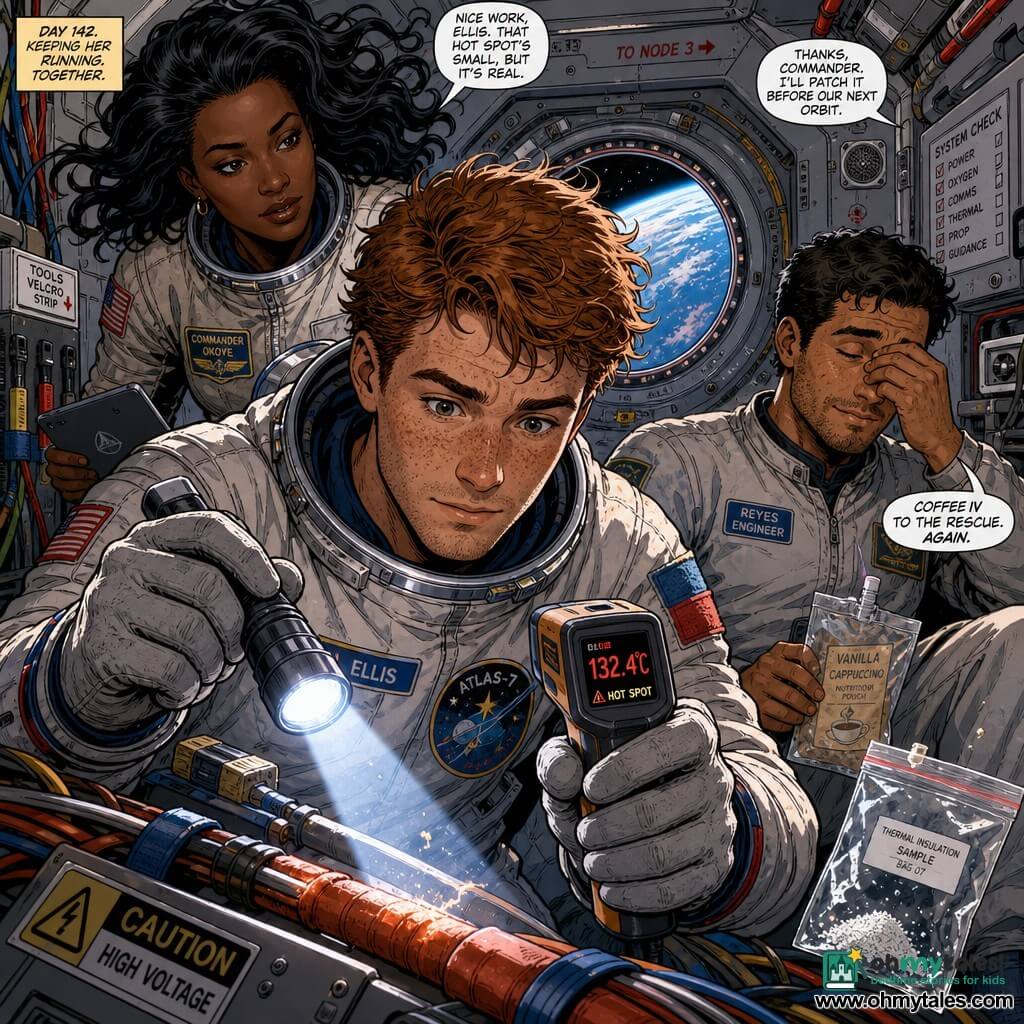
Milo pulled out a flashlight and a small infrared thermometer. “Like checking for a warm spot on a toaster cord.”
Hana's eyes gleamed. “Exactly. Except a toaster cord doesn't orbit Earth at 28,000 kilometers per hour.”
They opened the access panel carefully. Inside was a neat forest of wires, tubes, and connectors—organized, color-coded, and tied down.
Milo moved slowly. “Rule one: don't create floating chaos.”
Hana nodded. “Rule two: if you drop something, you tell someone.”
Milo scanned the cable with the thermometer. “This section is normal. This one too.”
Hana traced the airflow vent with her hand. “The vent seems a little blocked.”
Milo shone his light and spotted it: a stray piece of soft insulation, like a gray cottony patch, stuck near the vent grill.
“How did that get there?” Milo asked.
Hana frowned. “Could be from a maintenance bag. Even a small piece can reduce airflow.”
Milo reached for it with tweezers. The station was silent except for their breathing and the soft whir of fans.
He grabbed the insulation and eased it out. It floated for a second—then he trapped it in a sample bag.
“Nice catch,” Hana said. “Airflow keeps equipment cool. Heat in the wrong place can damage systems.”
Milo sealed the bag. “So the lesson is: even tiny fluff can cause big trouble.”
“Welcome to spacecraft life,” Hana said. “We battle crumbs, dust, and time.”
Mission Control's voice came through. “We're seeing the temperature return toward nominal. Good work.”
Milo exhaled, feeling his shoulders loosen. “Team effort,” he said.
Hana tilted her head. “You noticed Theo's fatigue quickly. Good call earlier.”
Milo hesitated. “I didn't want to embarrass him.”
“You didn't,” Hana said. “You supported him. That's what commanders do.”
Milo's cheeks warmed. “I'm not a commander.”
“Not yet,” Hana replied, and then her tone softened. “Being flexible isn't just adjusting to new plans. It's adjusting to people.”
Milo stored that sentence carefully. It felt important.
They secured the panel and wrote a brief report: Removed insulation fragment near vent. Temperature trending normal. Recommend checking maintenance bags for shedding material.
Milo loved that part of the job too—writing things down so the next team would know. Spaceflight was like a relay race. You carried knowledge forward.
On the way back, they passed Theo's quarters. A small light by his door showed “Rest Period.”
Milo slowed. “I hope he's actually sleeping.”
Hana smiled. “If not, we'll prescribe another high-tech nap.”
Milo laughed quietly, then floated onward, feeling lighter than gravity could ever explain.
Chapter 5: A Team That Watches Out for Each Other
That evening, the three of them gathered for a short debrief. Theo looked better—eyes clearer, shoulders less droopy.
He held up a pouch of rehydrated soup. “I have returned from the Land of Naps.”
Milo bowed dramatically. “Welcome back, O Rested One.”
Hana tapped her tablet. “All right. Let's review. We had a schedule change, then a temperature anomaly, then an internal blockage. What went well?”
Theo raised a hand. “Milo didn't let me pretend I was a robot.”
Milo said, “Theo admitted he was tired.”
Hana nodded. “And we kept the tone respectful. That matters. People hide fatigue when they fear being judged.”
Theo pointed at Hana. “Also, Commander Park did not throw me out an airlock. Very supportive leadership.”
“Tempting,” Hana said dryly, “but paperwork is too annoying.”
They all laughed, the sound filling the small module. Laughter in space felt like a shared rope—something you could hold onto together.
Hana grew serious again. “Fatigue can sneak up here. Our day-night cycle is strange. The station sees sixteen sunrises a day. Your body can get confused.”
Milo added, “That's why we stick to schedules: sleep times, exercise, meals. It's not just routine—it's safety.”
Theo nodded. “Exercise too. I always forget how important it is until my muscles complain.”
Milo explained, “In microgravity, muscles and bones get weaker because they don't have to fight gravity. So we use treadmills with straps and special resistance machines. It's like telling your body, ‘Hey, you still live on Earth. Act like it.'”
Hana looked at both of them. “And we keep talking. If you feel off, you say it. If you notice someone else is off, you ask.”
Theo's voice turned thoughtful. “It's weird. I used to think astronauts were solo heroes.”
Milo shook his head. “No one is a solo hero up here. Even when you're alone in a module, you're connected to your crew, to Mission Control, to engineers, and to everyone who built the station.”
Hana added, “And to the planet we're protecting.”
Milo glanced toward the window. “Earth looks peaceful from here. But it's fragile. Our job includes respecting it—using resources wisely, keeping experiments safe, making sure we don't create space junk.”
Theo made a face. “Space junk is like… the worst littering.”
“Exactly,” Milo said. “A small bolt moving fast can punch a hole in a spacecraft. That's why we track debris and plan carefully.”
Hana finished the debrief and closed her tablet. “Good work today. Tomorrow, we return to the original schedule—unless the universe gets creative again.”
Milo lifted his hands. “Universe, please be less creative. We're tired.”
Theo grinned. “Speak for yourself. I'm powered by naps.”
As they drifted apart toward their sleeping quarters, Milo felt a calm satisfaction. They had faced surprises, stayed flexible, and kept each other safe.
That was the real adventure.
Chapter 6: The Boy with the Cardboard Helmet
Lights dimmed to “night mode,” a soft amber glow that made the station feel cozy, like a lantern-lit cabin—if cabins floated at the edge of space.
Milo zipped himself into his sleeping bag, which was strapped to the wall. Sleeping in space meant you didn't lie down; you simply… existed in place, like a bookmark in a book.
Before closing his eyes, he floated to the window one last time. Earth filled the frame, swirling clouds over dark oceans, city lights sparkling like golden dust.
He remembered his childhood backyard again. The cool grass under his elbows. The smell of summer. His cardboard helmet slipping over his eyes. His mom calling from the porch, “Milo, bedtime!”
Back then, he'd thought astronauts were made of some rare material called bravery. Now he knew they were made of training, patience, and people.
His headset chimed softly—Hana's voice on the private crew channel. “Milo?”
“I'm here,” he whispered.
“Good instincts today,” Hana said. “You watched the mission and the crew.”
Milo swallowed. “I'm still learning.”
“We all are,” Hana replied. “That's why we do it together. Sleep well.”
The channel clicked off.
Milo rested his forehead against the window frame for a second, careful not to bump it. He watched a thin line of sunrise crawl across Earth's edge—bright, gentle, and unbelievably fast.
He thought of Theo, sleeping properly now because someone noticed. He thought of Hana, steady as a compass. He thought of the engineers on Earth who would read their report and improve the next maintenance bag so it wouldn't shed insulation.
And he thought of the boy in the backyard who wanted to touch the stars.
“I didn't become someone else,” Milo whispered to his reflection in the glass. “I just grew into the job.”
He floated back to his sleeping bag and zipped it up. The station's hum became a lullaby.
Somewhere beneath him, oceans rolled, forests breathed, and people dreamed.
Up here, Milo Reyes—flexible astronaut, careful teammate, former kid with a cardboard helmet—closed his eyes with a quiet feeling of wholeness, as if the path from the backyard to the stars had finally made perfect sense.