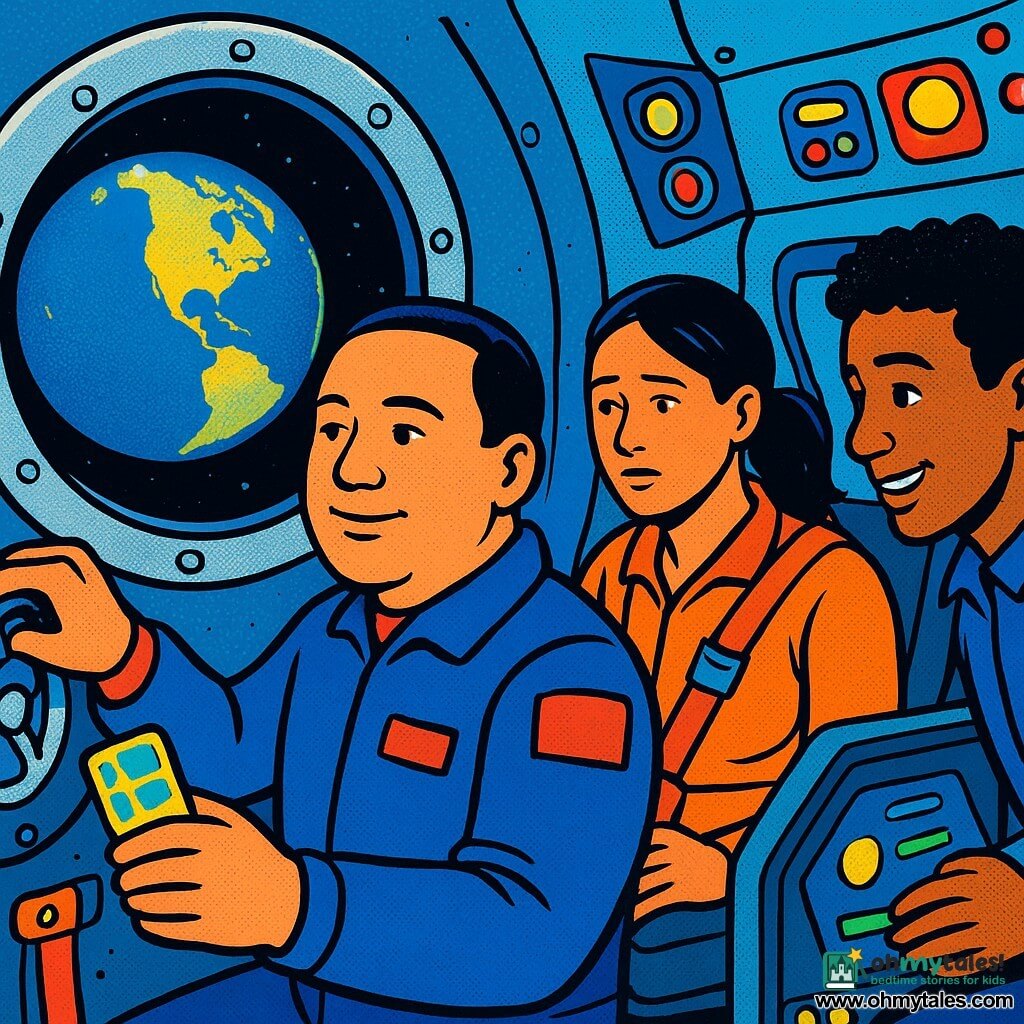
Chapter 1: The Quiet Alarm
Commander Leon Park floated in the space station's narrow corridor, one sock hooked under a handrail so he wouldn't drift away like an untied balloon. Outside the round window, Earth rolled by—blue, white, and busy.
“Okay, team,” Leon said into his headset. “Tonight we're doing a simulated evacuation. Keyword: simulated. Nobody is actually blasting off into the night like a startled popcorn kernel.”
A few chuckles crackled through the radio.
Mina, the flight engineer, answered first. “But Commander, I already packed my lucky spoon.”
“Excellent,” Leon said. “If the station ever runs out of tools, we'll fix it with soup.”
Tariq, the scientist, added, “I'm ready. My heart is not. My heart is doing tiny cartwheels.”
Leon pushed off gently and drifted toward the airlock module, where the emergency equipment waited in neat straps like a classroom that never got messy. “That's normal,” Leon said. “Nerves are like warning lights. They don't mean ‘stop forever.' They mean ‘pay attention.' We'll use them.”
On the wall, a tablet displayed the exercise plan: alarms, checklists, communication steps, and a timed route to the crew escape vehicle docked at the station.
Leon tapped the screen. The alarm began: a sharp, repeating beep that seemed to bounce off every metal surface.
Mina's voice came in, suddenly quicker. “Beep-beep-beep. Yep. That's the sound of my brain turning into a washing machine.”
“Name it,” Leon said. “What are you feeling?”
“Anxious,” Mina admitted. “Like… I forgot my homework and also the school is on fire.”
“Good job naming it,” Leon said. “Now breathe in for four counts, out for four. Like you're blowing up a slow balloon.”
He did it too, because commanders had lungs just like everyone else.
Outside, the station slid over a ribbon of night. City lights glittered like scattered coins. Leon felt the familiar tug of wonder—quiet but powerful, like a tide.
“Remember,” he said, “we're practicing safety because space is amazing, and also because space does not care if you are busy.”
Tariq muttered, “Space is the world's largest ‘no running' sign.”
Leon smiled. “Exactly. Everyone to your stations. We start with the first checklist.”
Chapter 2: The Checklist Dance
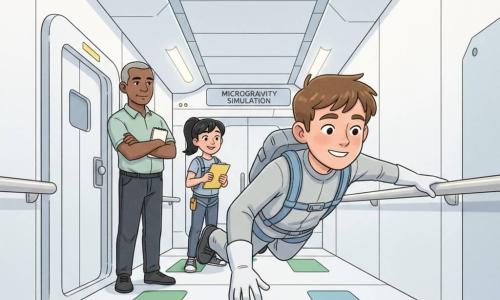
In microgravity, even a simple task became a strange kind of dance. Leon opened a pouch and pulled out laminated cards, each one attached to a cord so it wouldn't float away and become a future museum exhibit.
“Step one,” Leon said, “confirm the alarm type. Is this fire, pressure leak, toxic air, or a ‘someone burned their space burrito' situation?”
Mina read her panel. “Simulated pressure leak in Module Two.”
Tariq replied, “Copy that. Simulated leak. No actual hissing. Which is… comforting.”
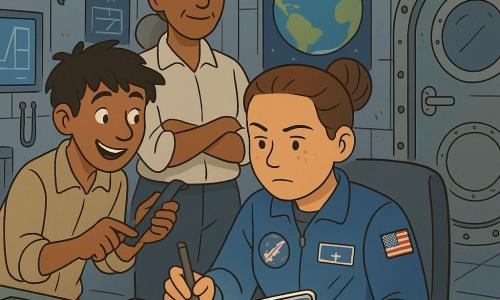
Leon's voice stayed calm on purpose. Calm was contagious. “Step two: seal off the module. Mina, you close the hatch. Tariq, you verify pressure readings. I'll communicate with Mission Control.”
He flicked a switch. “Houston, this is Station. Beginning simulated evacuation procedure. Crew is responding.”
A voice from Earth came back, warm and steady. “Copy, Station. We're with you. Take it step by step.”
Leon watched Mina push herself to the hatch. Her movements were practiced, but her eyes were wide.
“Hey,” Leon said gently over the private channel. “Mina.”
“Yeah?”
“If your thoughts start racing, give them a job. Tell them, ‘You're my helpers. Count the steps with me.'”
Mina exhaled. “My thoughts are currently sprinting in circles, but I will hand them tiny clipboards.”
She closed the hatch with a firm click. A green light glowed.
Tariq announced, “Pressure stable in the safe modules. Module Two is isolated. Simulated leak contained.”
Leon nodded, even though nods didn't travel through radio waves. “Nice work. Step three: grab emergency kits.”
They floated to a storage wall. Leon unstrapped three compact bags: oxygen masks, first-aid supplies, flashlights, water packets, and a thick manual that looked like it had eaten several dictionaries for breakfast.
Mina eyed the manual. “Does that book have its own gravity?”
“Only emotional gravity,” Leon said. “It pulls your mood downward if you stare too long.”
They clipped the bags to their suits. Each clip had a purpose. In space, anything not clipped was a future mystery.
As they moved, Leon glanced through a second window. The station was in daylight now, bright and clear. Below, a sandy curve spread across the planet—tan and gold with darker veins.
“Look,” Leon said, and his voice softened. “That's the Sahara. See the shape? Like a lion lying down.”
Tariq pressed his face close to the glass. “A sleepy lion made of sand. That's… huge.”
Mina's shoulders loosened. “It's weird,” she said. “The alarm makes my stomach flip. But the Earth makes me… settle.”
Leon nodded again. “That's another tool. When you feel panic rising, anchor yourself. Find something steady—your breath, your teammate's voice, or even the sight of home.”
The alarm kept beeping, but now it sounded less like doom and more like a metronome guiding their dance.
Chapter 3: The Practice Problem
The simulated evacuation route took them through a tunnel-like passage toward the crew escape vehicle. Leon led, one hand sliding along rails, the other holding the checklist card.
“Step four,” he read, “account for all crew. Confirm suit seals. Confirm communications.”
“Crew count: three,” Mina said. “Suit seals: secure. Comms: loud and clear, unfortunately.”
Tariq added, “If I start singing to calm down, you have permission to cut my microphone.”
Leon snorted. “Deal. But only if you promise not to sing the ‘Mission Control is Calling' song.”
They reached a junction where the station's modules met like branches of a tree. A small light blinked on a panel—part of the simulation, programmed to make their brains sweat.
Mina frowned. “Uh, Commander? The route map is showing a blockage.”
Leon checked. The screen indicated that the usual corridor to the escape vehicle was “closed” due to the simulated leak. They would need the alternate path.
Tariq's breathing quickened. “Alternate route means more steps. More steps means more time. My cartwheel-heart is now doing flips.”
Leon held up a hand. “Pause. Everyone, stop moving.”
In space, stopping was a choice. He hooked his foot under a rail. Mina and Tariq anchored too, their bodies suddenly still. The alarm beeped, the station hummed, and outside the window, the planet drifted with lazy confidence.
“Here's the thing,” Leon said. “When a plan changes, our brains shout, ‘Danger!' even if it's just… different. Let's answer that shout with facts.”
“Facts,” Mina repeated, like she was tasting the word.
“Fact one,” Leon said. “We trained for this. Fact two: the alternate route is longer, but it's safe. Fact three: we have time in this exercise to do it correctly.”
Tariq breathed out. “My brain likes facts. Facts are like handrails for thoughts.”
Leon smiled. “Exactly. Now, Mina, read the alternate route steps. Tariq, keep an eye on the clock. I'll keep Houston updated.”
Mina pulled up the route on her tablet. “Alternate path goes through the laboratory module, then around to Node Three, then to the vehicle.”
“Copy,” Leon said. “Let's go, slow is smooth and smooth is fast.”
They floated into the lab. Strapped-down plants in a growth box waved tiny leaves, as if cheering. A bag of experiment tools drifted slightly before its strap caught it.
Tariq pointed. “If we ever evacuate for real, please tell the plants we'll be back.”
“We will,” Leon said, and he meant it—not as a promise of perfection, but as a promise of effort.
Through the lab window, Earth offered another silhouette: a green-brown shape edged with sparkling coast.
“Is that… India?” Mina asked.
Leon leaned closer. “Yes. The triangle. And there—Sri Lanka, like a teardrop.”
Tariq's voice softened. “I used to trace maps with my finger in school. Now the map is moving under us.”
Leon felt a warm swelling in his chest, the kind that could turn into tears if you weren't careful. He blinked and kept his voice steady. “That's why we respect it,” he said. “Every coastline is someone's home.”
The timer beeped once—Tariq's reminder.
“Back to the checklist dance,” Leon said. “Wonder is allowed, but safety leads.”
Chapter 4: The Escape Vehicle Door
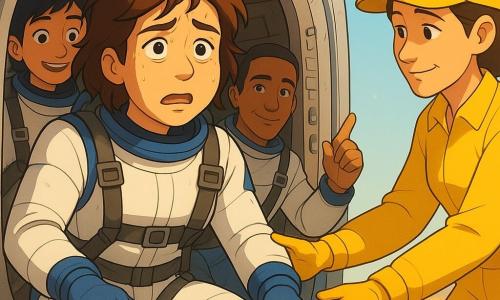
They arrived at Node Three, where the crew escape vehicle waited like a small, sturdy lifeboat. Its hatch was round and serious, as if it had never told a joke in its entire life.
Leon attached himself near the control panel. “Step five: prepare the vehicle. Power check. Seat harness check. Emergency communications check.”
Mina floated beside him and whispered, “I feel like I'm about to take a test I forgot to study for.”
Leon replied softly, “Then we study one question at a time.”
He spoke aloud for the team. “Power: on.”
Mina checked another panel. “Battery status: nominal.”
Tariq read a gauge. “Cabin pressure: good. Temperature: comfortable enough. Not cozy, but… not a freezer.”
Leon reached for the hatch handle and then stopped. A flash of nerves ran through him—quick, sharp. Even after years of training, an evacuation drill pressed a button in his body that said, Be ready.
He noticed it. Named it. “I'm feeling tense,” he said simply.
Mina blinked. “You? Commander Leon Park? The human instruction manual?”
Leon laughed. “I'm not a manual. I'm more like a… slightly wrinkled checklist.”
Tariq's voice brightened. “Wrinkled checklists are the most reliable. They've been used.”
Leon took a slow breath. “Being brave isn't being empty of fear,” he said. “It's doing the next right step while fear tries to narrate a scary story.”
He turned the hatch handle. It moved smoothly. The seal released with a soft sigh.
“Step six,” he said. “Boarding order and strap-in.”
They climbed in—float-climbed, really—careful not to bump heads on the doorway. Inside, the vehicle smelled like plastic, metal, and the faint ghost of lemon wipes.
Mina strapped into her seat, then paused, hands hovering over the buckle. “My fingers are shaking.”
Leon looked at her. “Try this: press your feet into the footrest. Feel the pressure. Tell your body, ‘I'm here. I'm safe.'”
Mina did it. Her shoulders lowered a fraction. “Okay. I'm here. I'm safe.”
Tariq buckled in and gave a dramatic sigh. “I would like to report that my heart has stopped doing gymnastics and is now… strolling.”
Leon secured his own harness, then spoke into the radio. “Houston, crew is strapped in. Proceeding with final checks.”
Houston answered, “Copy. You're doing great. Confirm hatch closure and readiness to undock—simulated.”
Leon closed the hatch and spun the handle until it locked. The sound was solid, reassuring.
For a moment, the three of them sat in the dim cabin, listening to their own breathing.
Leon imagined what a real emergency might feel like—how the station would still hum, how Earth would still shine, how fear would still try to climb into their throats. He also imagined the training, the teamwork, and the calm voices that would carry them through.
“Step seven,” he said, “report readiness.”
“Ready,” Mina said, voice steady now.
“Ready,” Tariq echoed.
Leon pressed the button. “Station to Houston: vehicle secured, crew ready, simulation complete pending your call.”
“Copy,” Houston replied. “Simulation complete. Great work.”
The alarm stopped. Silence spread out like a blanket.
Mina exhaled so hard her cheeks puffed. “I think I just aged three months.”
Tariq replied, “On the bright side, your lucky spoon did not abandon you.”
Mina held up the spoon from her pocket. “It behaved heroically.”
Leon laughed, and the sound filled the small cabin, warm as a lamp.
Chapter 5: Continents Like Shadows
After the drill, they floated back into the station, unclipped bags, and logged notes. Astronaut life wasn't just adventure; it was paperwork with excellent views.
Leon drifted to the cupola, the station's windowed observatory. The Earth below looked freshly painted.
Mina joined him, carrying a pouch of rehydrated cocoa that looked like chocolate-flavored science. “Commander,” she said, “after the alarm stopped, my body still felt like it was buzzing.”
Leon nodded. “That's your nervous system finishing its sprint. It doesn't slam on the brakes instantly. Want a trick?”
“Yes,” Mina said. “Preferably one that doesn't involve a yoga pose called ‘Floating Pretzel.'”
Leon pointed at the window. “We can do a grounding game. Spot five things you can see. Name them.”
Mina looked. “Okay. One: that cloud looks like a dragon with a very fluffy belly. Two: the ocean is a darker blue near the edge. Three: I can see the station's solar panel—like a giant blue wing. Four: those are city lights in the night side—tiny gold threads. Five: the curve of the Earth.”
Leon smiled. “Great. Your brain is back in the room.”
Tariq arrived too, holding his tablet. “I took a picture of the dragon cloud. I'm naming it ‘Sir Puffington.'”
They watched as the station swept over another coastline. Leon traced it with his finger on the glass, careful not to smudge too much.
“That's South America,” he said. “See the bulge on the east side? And the long taper down like a giant green chili pepper.”
Mina squinted. “A chili pepper continent. Now I'm hungry.”
Tariq tapped his screen. “Next orbit, we might pass over North America. If I see Florida, I'm going to wave.”
Leon kept looking, and his wonder deepened. Continents really did become silhouettes from up here—shapes and shadows, like cut-out pieces on a dark-blue tablecloth.
“And there,” Leon said as the station slipped onward, “Africa again. The horn. The curve. It's like Earth is saying hello with familiar outlines.”
Mina's cocoa pouch made a small slurping sound. “Do you ever get used to it?”
Leon considered. “You get used to the routine. The exercise schedules. The equipment. The way you have to chase runaway pens. But the view… it stays new if you let it.”
Tariq leaned against a handrail. “I was scared during the drill,” he admitted. “I felt silly. Like, we're trained professionals. Why am I nervous?”
Leon's voice turned gentle. “Because you're human. Fear is not a failure. It's a signal. The skill is listening without letting it drive.”
Mina nodded slowly. “So… feeling anxious is like hearing a loud passenger in your head.”
“Exactly,” Leon said. “You can say, ‘Thanks for the warning,' and still keep your hands on the wheel.”
Outside, Earth's thin atmosphere glowed—a faint blue line, delicate as the edge of a soap bubble.
Leon felt protective, like the whole planet was a sleeping sibling he had to watch over.
“We train for evacuation,” he said, “because we respect what space can do. But we also train because we want to come home. To this.”
They fell quiet, and the silence wasn't empty. It was full of breath, light, and the slow turning of the world.
Chapter 6: The Small Voice on the Radio
Later, Leon floated near the communications console for a scheduled call with a group of students back on Earth. Their school had sent questions, and Mission Control patched the line through.
A chorus of young voices burst into the station. “Hello!” “Can you do flips?” “Do you eat ice cream?” “Do you ever get scared?”
Leon laughed. “Hello, everyone. Yes, I can do flips, but only when I'm not near expensive equipment. Ice cream is tricky because it doesn't like to stay in a spoon. And yes—astronauts do get scared.”
A student's voice, clear and serious, asked, “But aren't you supposed to be brave?”
Leon thought about Mina's shaking fingers. About Tariq's cartwheel-heart. About his own tight chest before turning the hatch handle.
“I am brave,” Leon said. “And I'm also nervous sometimes. Bravery isn't a special bone in your body. It's a choice you practice—like reading, or riding a bike, or learning to cook without setting off the smoke alarm.”
The kids giggled.
Another student asked, “What do you do when you feel scared?”
Leon answered, “I do three things: I name the feeling, I breathe slowly, and I follow the checklist with my team. Teamwork is a kind of courage-sharing.”
A voice piped up, “What's the hardest part of your job?”
Leon didn't say “being far from pizza,” even though it was tempting.
“The hardest part,” he said, “is remembering that every exciting thing is built from small, careful steps. Space is not a place for rushing. It's a place for learning, practicing, and respecting safety.”
A student asked, “What's the coolest thing you see?”
Leon glanced at the window. The station was sliding over the Pacific, and clouds swirled like cream in blue tea.
“The continents,” he said. “From up here, you can spot them like silhouettes. Africa looks bold and strong. South America tapers like a chili pepper. India is a triangle. And at night, cities sparkle—reminding you that Earth is full of people, stories, and bedtime lights.”
The line went quiet for a second, the way it does when wonder drops into a room and everyone catches it.
Then one student asked, “Do you feel like a superhero?”
Leon smiled, feeling the station's gentle vibrations through his fingertips. “No,” he said. “I feel like a worker with a very unusual office. I have tools. I have training. I have a team. And I still need help, checklists, and reminders to drink water.”
The kids laughed again, louder this time.
When the call ended, Mina floated in, grinning. “You didn't tell them about the spoon hero.”
“I protected Mina's spoon privacy,” Leon said solemnly.
Tariq drifted past with a bag of equipment and said, “History will remember the spoon.”
Leon watched his crewmates move through their tasks—closing panels, recording notes, checking seals. The station wasn't a place of constant drama. It was a place of steady work, careful habits, and shared jokes that made the metal walls feel friendlier.
Outside, Earth kept turning.
Chapter 7: Staying Within Reach
That night—station night, which arrived every ninety minutes—Leon zipped into his sleeping bag and clipped it to the wall. Floating in place felt like being hugged by air.
He recorded a final note for the day: evacuation drill completed successfully, alternate route used, crew performed well under simulated stress. Then he paused, finger hovering over the tablet.
He thought about the students' voices. About how easy it would be, after seeing Earth from above, to start sounding like a person who belonged only to the sky.
Leon didn't want that.
He opened a fresh message to his little nephew, Jonah, who always asked questions like, “Do astronauts sneeze in space?” and “Can you high-five the Moon?”
Leon dictated softly. “Hey Jonah. Today we practiced an emergency evacuation. It was loud and a little scary, even for grown-ups. But we used our checklist, we breathed slowly, and we helped each other. That's what astronauts really do—practice safety and teamwork. Also, Earth looked like a map made of shadows. I saw Africa like a lion and South America like a chili pepper. When I get home, I'll show you pictures and we can trace the continents together on a globe.”
He paused, then added, “If you ever feel nervous about something, you can try the same tools: name the feeling, breathe, and do one small step at a time. You don't have to be perfect. You just have to keep going with care.”
Leon sent the message.
In the quiet, he listened to the station's soft hum. It sounded like a giant sleeping machine, dreaming of circuits and sunrises.
Mina's voice came over the radio, sleepy. “Commander?”
“Yeah?” Leon answered.
“Thanks for today,” she said. “For… not pretending you're never scared.”
Leon's throat tightened, but in a good way. “Thanks for saying it out loud,” he replied. “That helps everyone.”
Tariq chimed in, half-yawning. “Also thanks for not letting me sing.”
Leon chuckled. “Anytime.”
He closed his eyes. In his mind, the continents drifted by again—dark shapes against shining water. A planet full of people who would never see this view, and who still mattered just as much.
Leon decided something simple and firm: when he returned to Earth, he would keep telling the truth about space. Not just the glittering part, but the training, the safety rules, the teamwork, the emotions—and the way you could meet fear without letting it become the boss.
Because extraordinary experiences didn't have to make a person unreachable.
They could make him a better guide.
And as the station sailed into another gentle sunrise, Leon let wonder settle beside him like a calm friend, and he drifted into sleep, still connected to Earth—still within reach.