Chapter 1: The Notebook with Floating Tabs
The training module clicked shut with a soft clack, like a lunchbox, and Mira's locker light blinked on. Inside were her gloves, her flight shoes, and a notebook covered in little colored tabs.
“Still using paper?” her crewmate Ben asked, leaning on the locker door. His hair was damp from the gym, and he smelled faintly like lemon soap.
Mira tapped the notebook. “Paper doesn't crash. Also, it listens better than you.”
Ben put a hand on his chest as if wounded. “Ouch.”
Mira smiled, but she was serious, too. She had learned that being an astronaut was half science and half organization—and the tiniest missing detail could become a big problem. In space, you couldn't run to the store, or borrow a screwdriver from the neighbor, or call a plumber. You had what you had, and you had to remember where you put it.
She slid the notebook into a mesh pocket on her backpack and added a new tab labeled: STRESS WORKSHOP.
On the way down the hallway, the space center hummed with quiet energy. Wheels rolled on polished floors. Doors hissed open and closed. Somewhere, a vacuum pump thumped steadily, like a giant heart.
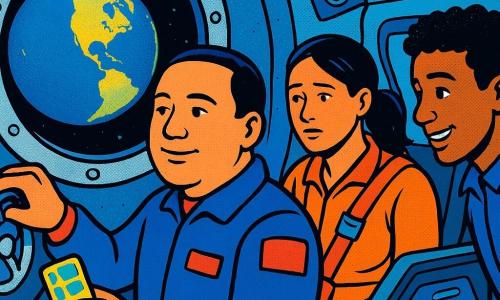
Mira passed a wall-sized photo of Earth: blue swirls, white clouds, and a thin, delicate atmosphere. She always stopped for a second, as if Earth were saying, Don't forget me.
She didn't.
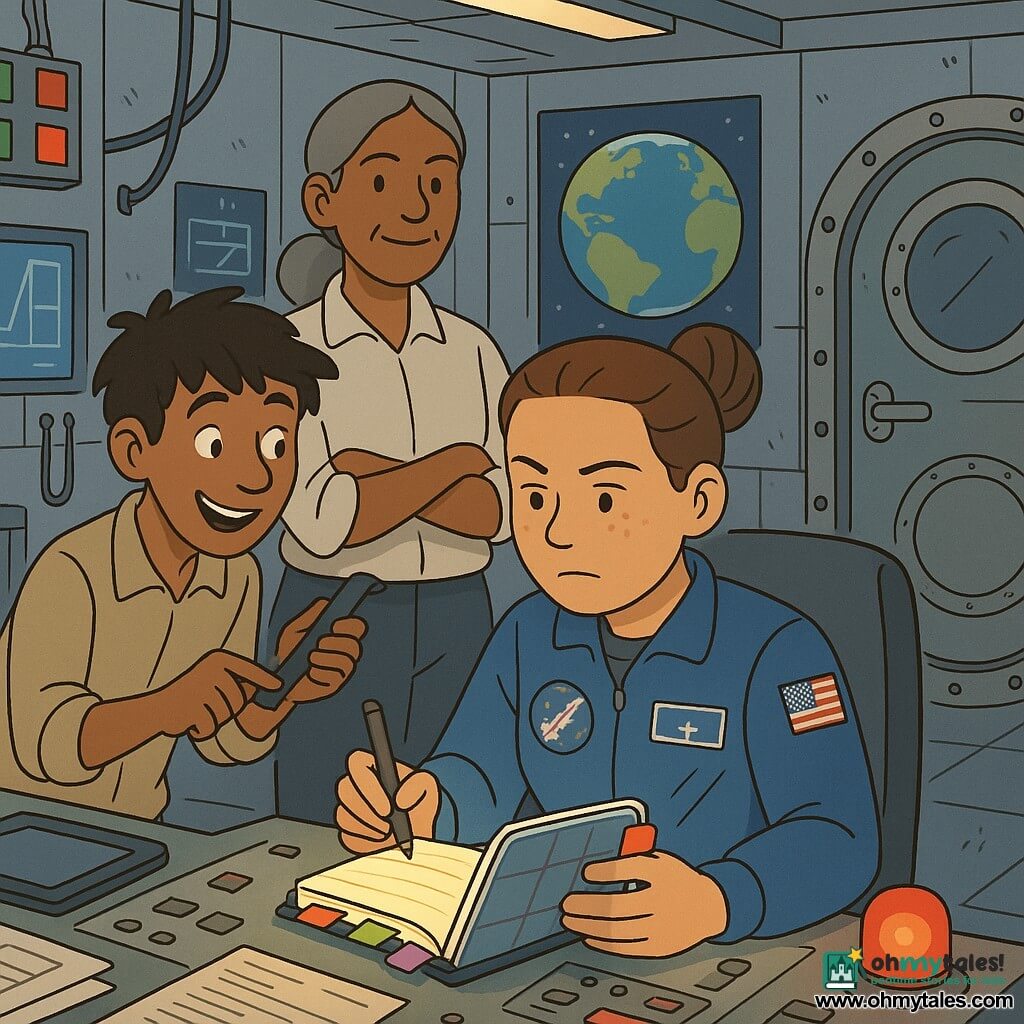
In the classroom, the instructor, Dr. Sato, had arranged the chairs in a circle. No desks. No hiding places. A big metal box sat in the center like a treasure chest.
“Welcome,” Dr. Sato said, her voice calm as warm tea. “Extreme situations don't only test your skills. They test your mind. Today we'll practice staying steady—while everything else feels wobbly.”
Ben whispered to Mira, “Like when my little brother eats sugar?”
Mira snorted. “Worse. No offense to your brother.”
Dr. Sato held up a marker and drew three words on a board: BREATHE. NOTICE. CHOOSE.
“An astronaut's job,” she said, “is not to be fearless. It's to be prepared. Prepared people can feel scared and still do the right thing.”
Mira wrote that down immediately. Under it she added a tiny drawing of Earth with a heart beside it, because every right thing in space started with remembering what they were protecting.
Dr. Sato tapped the metal box. “Inside are challenges. You'll practice your tools: breathing, naming emotions, dividing tasks, and communicating clearly. Mira, you'll lead the first round.”
Mira's stomach fluttered. Leading meant more responsibility—and more chances to mess up.
She opened her notebook, found a fresh page, and wrote at the top:
NEW ORGANIZING IDEA: “CALM CHECKLISTS.”
Then she looked up and said, “Okay. Let's do it step by step.”
She didn't say it loudly. She didn't need to. In space, steady voices traveled farther than panicked ones.
Chapter 2: The Box of Unhelpful Surprises
Mira opened the metal box. Inside were envelopes, each sealed with a bright red sticker that said: OPEN FAST.
Ben made jazz hands. “Fast! My specialty.”
“Your specialty is snacks,” Mira said.
Dr. Sato's eyes twinkled. “Open the first envelope. Then follow the instructions as a team.”
Mira broke the seal. A card inside read:
SCENARIO: You are in orbit. A warning alarm sounds. One of your science experiments is overheating.
GOAL: Keep everyone safe. Protect the station. Don't waste resources.
Mira felt her heart speed up, even though it was only a pretend scenario. Her brain wanted to sprint in ten directions at once.
She remembered the board: BREATHE. NOTICE. CHOOSE.
She took one slow breath in through her nose, then out like she was cooling soup. “Okay,” she said. “First, we breathe. Second, we notice. I'm feeling… jumpy.”
Ben nodded. “I'm feeling… dramatic.”
“That's normal for you,” Mira said, and a couple people chuckled. The laughter loosened the tightness in Mira's shoulders.
“Now we choose,” she continued. “We need roles. Ben, you call out the alarm procedure. Priya, you handle communications—pretend we're talking to Mission Control. I'll track steps in my notebook.”
Priya lifted an imaginary headset. “Copy.”
Ben began reciting from memory, but he stumbled. “Uh… step one is… don't—wait—”
Mira flipped a tab in her notebook. She had written practice procedures on purpose, because memory could get foggy under stress. “Here,” she said, sliding the page toward him. “Follow the checklist. No hero moves.”
Ben exhaled, relieved. “Bless your paper.”
They moved through the steps: identify the experiment, shut down power safely, report the status, monitor station temperature.
Dr. Sato watched like a lighthouse—quiet, steady, always there.
When the team finished, Dr. Sato said, “What helped?”
“The checklist,” Ben said immediately. “My brain turns into popcorn when alarms go off.”
Mira added, “Naming what I felt. It stopped the feeling from driving the spaceship.”
Dr. Sato nodded. “Excellent. Stress isn't a monster you defeat. It's weather you learn to navigate.”
She handed Mira another envelope. “Next scenario.”
Mira opened it.
SCENARIO: Spacewalk. Your tool bag floats away.
Ben gasped as if the tool bag were a beloved pet. “Noooo!”
Mira tried not to smile. Losing tools wasn't funny in real life. Tools meant repairs. Repairs meant safety. Safety meant going home.
“Okay,” she said. “Spacewalk rules: tether everything. If something floats, it becomes a fast, tiny comet.”
Priya said, “And comets don't care about schedules.”
Mira wrote that line down. It was too good to lose.
They practiced: secure a backup tether, call out the missing item, decide whether to retrieve it or abort the spacewalk, calculate fuel and time.
As they spoke, Mira noticed something else. When the team worked calmly, their words got shorter and clearer.
Mira underlined a sentence in her notebook:
CLEAR WORDS = CALMER BRAINS.
Dr. Sato clapped once. “You're learning the hidden part of astronaut work: how you organize your attention.”
Mira glanced again at the photo of Earth through the classroom window—only a poster here, not the real thing. Still, it reminded her why every tool had to be tethered. A careless mistake in orbit could mean debris—space junk—circling Earth like sharp confetti.
“We don't want to litter space,” Mira said softly, half to herself.
Ben heard her. “Agreed. Earth deserves better than a ring of trash.”
Mira added a final note on the page:
RESPECT EARTH: KEEP ORBIT CLEAN.
The words looked small, but they felt heavy in the best way.
Chapter 3: The Patience of Tiny Systems
After the workshop, Mira returned to her training pod, where a mock spacecraft wall waited—panels, switches, labels, and enough cables to knit a sweater the size of a bus.
Her supervisor, Captain Alvarez, met her there with a tablet. “How was Dr. Sato?”
“Like being taught by a calm mountain,” Mira said. “A mountain that gives homework.”
Captain Alvarez laughed. “Good. Your next assignment is organization. You'll test a new system for daily tasks. Slowly. Patiently. No rushing.”
Mira loved the word patiently. It made her think of astronauts not as action heroes, but as careful builders. They weren't supposed to fling themselves into danger. They were supposed to plan so well that danger had fewer places to hide.
Mira opened her notebook. On a fresh page, she drew three columns:
MORNING / MIDDAY / EVENING.
Under MORNING she wrote: “Health check, schedule review, equipment inspection.”
Under MIDDAY: “Experiments, maintenance, exercise.”
Under EVENING: “Debrief, messages home, cleanup.”
Ben wandered in, carrying a bundle of Velcro strips. “Behold,” he announced, “the mighty space sticker.”
“Velcro is basically magic,” Mira said.
“It is,” Ben agreed, solemn as a knight. “What are you building?”
“A new way to organize the day. In orbit, time gets slippery. You can't rely on sunset to tell you when to slow down.”
Ben frowned. “But there are like… sixteen sunsets.”
“Exactly. Too many sunsets. Your brain gets confused and tries to celebrate all of them.”
They worked together, attaching Velcro squares to the mock wall. Mira made a “task board” with moveable cards. Each card had a job: FILTER CHECK, WATER RECYCLER, MICROBE SAMPLES, TRASH COMPACTION.
Ben held up a card. “Trash compaction sounds gross.”
“It's important,” Mira said. “If we don't manage waste, the station gets messy fast. Also, trash can release particles. In microgravity, crumbs don't politely fall down. They float into vents.”
Ben shuddered. “Floating crumbs are villains.”
Mira placed the TRASH COMPACTION card under EVENING. “Villains with sprinkles.”
They tested the board by pretending it was a real day in orbit. Mira moved each card from TO DO to DOING to DONE.
Captain Alvarez watched. “What happens when an unexpected repair appears?”
Mira grabbed a blank card and wrote: SURPRISE TASK. She placed it at the top. “We add it, then re-check priorities. We don't pretend the schedule is a perfect sculpture. It's more like… a sandcastle. You reshape it.”
Ben whispered, “A sandcastle in space.”
Mira smiled. “A sandcastle with Velcro.”
Captain Alvarez nodded approvingly. “Good. Now apply your stress tools. If the surprise task feels scary, what do you do?”
Mira tapped the notebook. “Breathe. Notice. Choose. And communicate. No silent panicking.”
Ben saluted. “No silent panicking. Only loud teamwork.”
“Also,” Mira added, “we protect the Earth. That means using resources carefully. Water, power, oxygen… nothing is endless up there.”
Captain Alvarez's expression softened. “That respect is part of the job. We orbit Earth, but we're still responsible to it.”
Mira looked at the task board. All the cards were neat. But she knew neatness wasn't the real goal. The goal was safety—steady habits that held when things got weird.
She wrote one more line at the bottom of her page:
ORGANIZATION IS KINDNESS TO FUTURE ME.
Then she closed the notebook and felt, for the first time that day, completely ready to rest.
Chapter 4: The Simulator That Wouldn't Stop Shaking
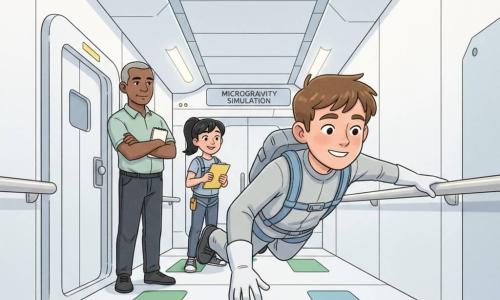
Two days later, Mira climbed into the launch simulator. The seat hugged her like a firm handshake. Straps crossed her shoulders and hips. In front of her, screens glowed with numbers and maps and bright warning colors that made her eyes feel wide.
Ben's voice crackled through the headset. “I'm in the next seat. If you scream, I will judge you kindly.”
“I won't scream,” Mira said. “I'll make a thoughtful squeak.”
Captain Alvarez's voice joined in. “Crew, today you'll practice handling multiple alarms while following procedure. Remember: no guessing.”
The simulator rumbled. A low vibration began, then grew until Mira felt it in her teeth. The screens flashed:
CABIN PRESSURE: CHECK.
TEMP FLUCTUATION: MONITOR.
COMM DELAY: SIMULATED.
Then an alarm shrieked—sharp as a whistle in a gym.
Mira's hands wanted to fly. She forced them to stay close to the checklist panel. “Breathe,” she said out loud.
Ben replied, “Breathing. Still alive.”
Mira glanced at her laminated checklist—her “calm checklist,” copied from her notebook. “Step one: identify alarm source.”
She pressed the correct button. The alarm changed pitch. Her chest tightened anyway.
“Notice,” she whispered. “I'm tense. My thoughts are racing.”
“Choose,” Ben said, surprising her with how steady he sounded. “We choose to slow down.”
Mira swallowed. “Reading the next step.”
Another screen flashed: COOLING LOOP: PERFORMANCE LOW.
Mira spoke clearly, like Dr. Sato had taught them. “Ben, confirm cooling loop status. I'll run the procedure.”
Ben answered, “Confirming. It's low but stable.”
Mira followed the steps: adjust settings, reduce non-essential power use, report to Mission Control. She imagined Earth below them—home to forests, oceans, cities, and people who didn't get to practice inside safe simulators. They deserved careful astronauts.
The shaking intensified. A new message appeared: UNEXPECTED VIBRATION—SIMULATED STAGE EVENT.
Ben muttered, “The simulator is in a bad mood.”
Mira almost laughed, but she kept her voice even. “We stay with the checklist. Vibration doesn't mean panic. It means check fasteners, check systems, communicate.”
She pressed the comm button. “Mission Control, we have vibration plus cooling loop performance low. We are executing procedure and conserving power.”
Captain Alvarez responded as “Control,” voice calm. “Copy. Continue.”
Mira's shoulders loosened a little. Calm was contagious, like yawns, but nicer.
Minutes later, the simulator slowly quieted. The screens returned to green.
Ben made an exaggerated sigh. “I survived. I will now accept medals in the form of cookies.”
Mira unclipped one strap and rubbed her forearm. “You did well.”
Ben blinked. “Wait. Was that a compliment?”
“It was educational,” Mira said. “Don't get used to it.”
Captain Alvarez opened the hatch. “Good work. Mira, your communication was clear. And you didn't rush.”
Mira slid out of the seat, legs a bit wobbly. “I wanted to rush,” she admitted. “But the breathing helped. Also the checklist. And Ben… being weirdly wise.”
Ben bowed. “Wisdom is my hidden talent.”
Captain Alvarez's gaze flicked to a small Earth patch on Mira's sleeve. “Remember why we do this.”
Mira touched the patch gently. “To learn. To protect. To explore without forgetting where we started.”
That night, back in her room, Mira placed her notebook on her bedside table. She flipped through pages of checklists, diagrams, and little reminders: TETHER TOOLS. USE WATER WISELY. CLEAR WORDS.
She added one final sentence before turning off the light:
IN SPACE, CALM IS A SAFETY TOOL.
Then she slept, as if her thoughts had been neatly velcroed into place.
Chapter 5: Notes Under a Quiet Lamp
A few days later, after more training and a long afternoon of studying life-support systems, Mira finally had a free evening. Rain ticked softly against her window, a gentle Earth sound that felt like a lullaby.
She made cocoa and sat on her bed with her notebook open on her knees. The lamp cast a warm circle of light, and everything outside it seemed far away—launchpads, alarms, schedules, and shaking simulators.
Mira reread her notes slowly, like reading messages from a past version of herself.
BREATHE. NOTICE. CHOOSE.
CLEAR WORDS = CALMER BRAINS.
ORGANIZATION IS KINDNESS TO FUTURE ME.
RESPECT EARTH: KEEP ORBIT CLEAN.
She paused on the last line. In her mind, she saw Earth again, not as a poster, but as the real thing: fragile and fierce at the same time. She thought about what astronauts learned up there—how thin the atmosphere looked, how borders disappeared, how oceans connected everything.
She imagined telling a class of kids about it one day.
“You don't go to space to escape Earth,” she murmured to the empty room. “You go to understand it better.”
Her phone buzzed with a message from Ben: DID YOU KNOW: IF YOU DROP A CRUMB IN SPACE IT BECOMES A TINY ADVENTURER.
Mira typed back: AND THEN IT TRIES TO CLOG A FAN. TELL YOUR CRUMBS TO STAY TETHERED.
She laughed quietly, the kind of laugh that doesn't wake anyone.
Then she turned another page and found her first idea from the workshop: CALM CHECKLISTS.
It didn't seem small anymore. It seemed like a bridge—between fear and action, between chaos and care. Being an astronaut, she realized, wasn't about doing incredible things all at once. It was about doing ordinary things correctly, again and again, even when alarms blared. It was about teamwork, and patience, and respecting the planet that gave you breath in the first place.
Mira set the notebook beside her pillow, as if it were a friend.
Outside, the rain kept tapping, and the world kept spinning—steady, blue, and worth protecting.
She closed her eyes and pictured Earth from orbit, wrapped in clouds like a soft blanket.
Tomorrow, she would train again. Step by step.
Tonight, it was enough to reread her notes and feel proud—not loud proud, but quiet proud, like a star that shines without trying.