Chapter 1: The Suit That Wasn't Just a Suit
Mateo Reyes stood in the training hangar with his hands on his hips, staring up at a white space suit hanging from a metal frame. It looked calm and quiet, like a big sleeping snowman.
“It's heavier than it looks,” said Juno, one of the other trainees, bouncing on her toes. “And it smells like… plastic and hard work.”
Mateo laughed. “Hard work has a smell now?”
Coach Dima, their instructor, walked in with a clipboard and the serious face he wore when something mattered. Which was… most of the time.
“Listen up,” Coach Dima said. “An astronaut's job is not only flying in space. It's learning to survive, to fix, to think clearly, and to respect every piece of equipment you touch. In orbit, a missing tool is not ‘oops.' It can be a disaster.”
He tapped the suit gently, like he was greeting an old friend.
“This suit is a small spaceship,” Coach Dima continued. “It has oxygen, cooling, radios, and layers that protect you from the cold, heat, and tiny pieces of fast-moving dust. Treat it like you'd treat a friend who is keeping you alive.”
Mateo nodded so hard his neck almost clicked. He had dreamed of space since he was eight, when he'd built a cardboard rocket in his bedroom and tried to convince his cat to become Mission Control. The cat had refused, but Mateo had never stopped believing.
He slipped a hand into the glove attached to the suit. The material felt stiff, strong, and strangely comforting. He imagined floating above Earth, watching clouds slide over oceans like slow white ships.
Juno leaned closer and whispered, “Do you think they let astronauts nap in space?”
Mateo whispered back, “Only if the nap is certified and double-checked.”
Coach Dima's eyes flicked toward them. “Talking is allowed,” he said, “as long as you keep your brains on.”
They grinned, then stood straighter.
“Today,” Coach Dima announced, “you begin learning what astronauts really do: practice, prepare, and protect what belongs to the whole team.”
Chapter 2: The Corridor of Floating Dreams
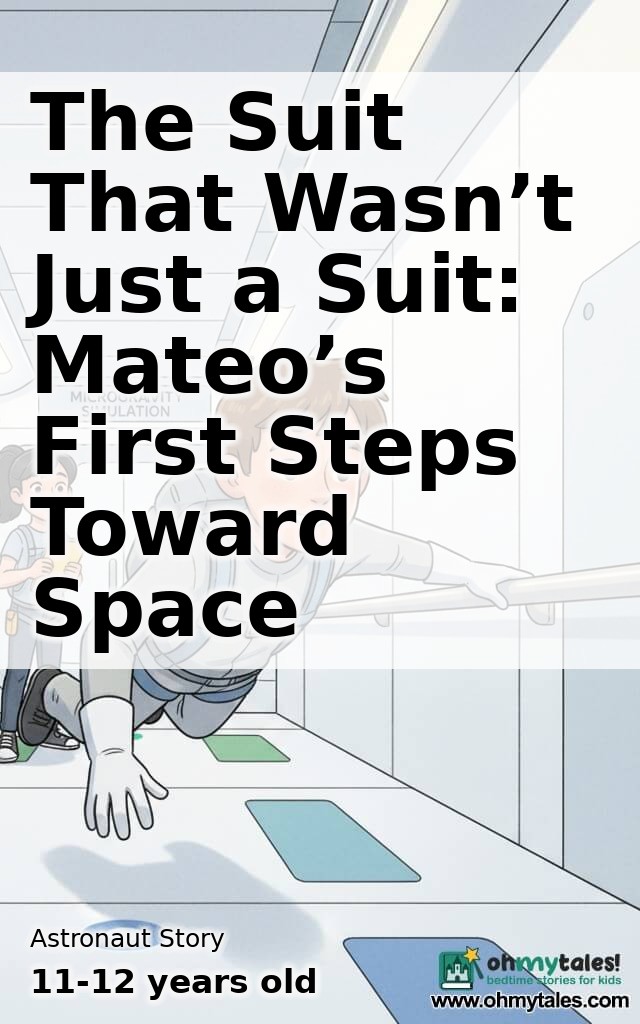
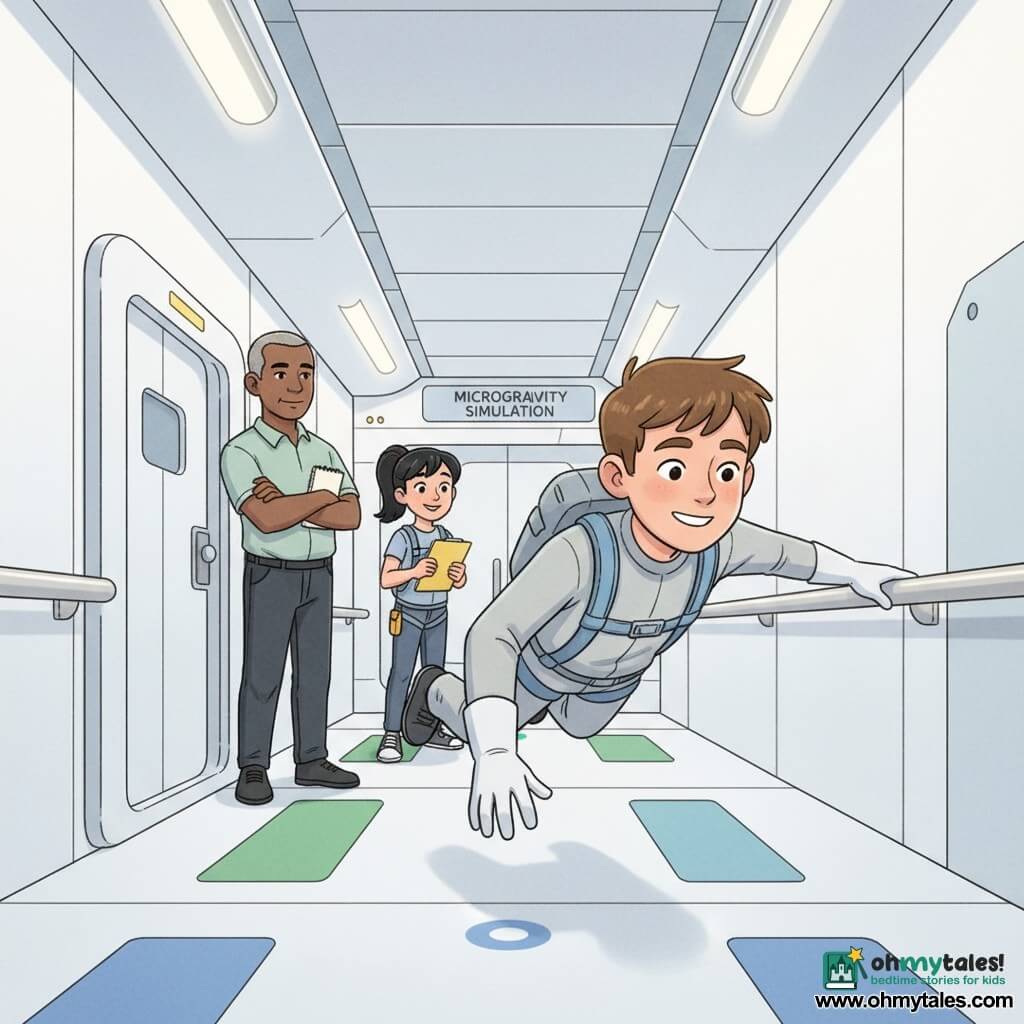
The next day, Mateo entered a long training corridor with smooth walls and handrails on both sides. It looked like a hallway from a science-fiction movie, except the floor had labels and arrows, like a classroom.
At the far end was a small airlock-like door. Above it, a sign read: MICROGRAVITY SIMULATION—MOVE SMART.
Coach Dima clapped once. “This is where you learn to move without walking. In space, you don't stomp down a hallway. You glide. And if you kick off too hard, you'll crash into something expensive. Or someone.”
Juno rubbed her elbows like she could already feel the bump. “So… no running?”
“No running,” Coach Dima said. “Only controlled pushing. Gentle. Accurate. Like you're playing chess with your body.”
Mateo's heart thumped. This was it. Not the rocket launch, not the roaring flames—this quiet skill that made astronauts look like they belonged among the stars.
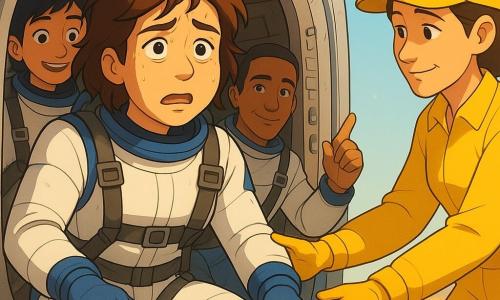
They wore light training harnesses attached to an overhead track. It didn't make them truly weightless, but it took away enough weight to teach the feeling.
Coach Dima pointed to the handrails. “Always use the rails. In a spacecraft, those rails are shared equipment. Don't yank them, don't hang from them like monkeys, and don't leave smudges you could have wiped.”
Juno raised a hand. “What if you're a very polite monkey?”
Coach Dima didn't smile, but his eyes softened. “Then you're still not allowed.”
Mateo stepped forward. His gloves squeaked on the rail as he gripped it. He remembered the videos: astronauts drifting down the International Space Station's modules like slow swimmers, turning corners with a fingertip.
“Mateo,” Coach Dima said, “demonstrate a safe float from the green marker to the blue one. One push. Two hand contacts. No spinning.”
Mateo swallowed. “Yes, Coach.”
He placed his feet on the green marker, held the rail, and pushed off gently. The harness helped, but the sensation still made his stomach flutter. The corridor slid past him, quiet and smooth.
He reached out, touched the rail once—soft, controlled—then again near the blue marker. He stopped as if invisible brakes had grabbed him.
For a second, he just hovered there, arms slightly out, like he was holding the air.
Juno whispered, “He looks like a slow superhero.”
Mateo's ears warmed, but he kept his voice calm. “It's all in the push.”
Coach Dima nodded. “Good. Notice how little force you needed. In orbit, even a small shove sends you drifting. You must respect the environment. A spacecraft is not a playground. It's a shared home.”
Mateo floated back to the start, feeling a bright, steady pride. He hadn't crashed. He hadn't spun. He had moved like someone who might, one day, belong up there.
And somehow, the hallway felt like a bridge between his bedroom rocket and the real sky.
Chapter 3: The Mystery of the Missing Marker
Later that week, the trainees gathered for a maintenance lesson. The room smelled like metal, markers, and cleaning wipes. On the wall hung tools: wrenches, tethers, small pouches, and labels for everything.
“Up there,” Coach Dima said, pointing at a model of a space station, “a screwdriver is not just a screwdriver. If it floats away, it can block a vent, damage equipment, or become a dangerous object.”
Juno lifted a tether. “So everything gets clipped?”
“Everything,” Coach Dima agreed. “And you return it where it belongs. That's respect. That's safety.”
Mateo loved this part. It felt like learning the secret rules of a hidden world. The rules weren't about being strict for no reason. They were about keeping people alive.
Coach Dima handed them a simple task: check a kit, confirm every tool matched the inventory list, and sign off.
Mateo and Juno worked together. Mateo read the list. Juno checked the slots.
“Wrench, check,” she said. “Tape roll, check. Multimeter, check—wow, that sounds like a robot snack.”
“It measures electricity,” Mateo said. “Like taking the heartbeat of a machine.”
Juno squinted into the kit. “Marker pens… one, two… wait.”
Mateo looked up. “What?”
“There should be three,” Juno whispered. “I only see two.”
Mateo's excitement cooled into alertness. A missing marker wasn't a meteor, but it was a problem. A small problem could grow teeth if ignored.
“Maybe it rolled under something,” Mateo said.
They searched carefully. Not wildly. Coach Dima had taught them that rushing made messes bigger.
Mateo checked the floor. Juno checked the workbench. Nothing.
Coach Dima walked by and noticed their faces. “Report,” he said.
Mateo stood straight. “Sir, the inventory says three markers. We found two.”
Coach Dima didn't sigh or scold. He nodded once. “Good catch. What do you do next?”
Juno answered, “We don't guess. We don't replace it without telling anyone. We report it and keep looking.”
“Exactly,” Coach Dima said. “Because this equipment is shared. It belongs to the mission, not to your pockets.”
Mateo felt a weird mix of worry and pride. Worry because something was missing. Pride because he wasn't ignoring it.
They widened their search area. Mateo looked behind a storage bin. His fingers brushed something smooth.
“I found it!” he said, pulling out the missing marker. It had rolled into a narrow gap like it was playing hide-and-seek.
Juno breathed out. “Sneaky little comet.”
Coach Dima took the marker, checked its cap, and put it back in the correct slot. “This,” he said, “is how astronauts protect each other. You pay attention. You respect what the team uses. You treat small details like they matter—because they do.”
Mateo stared at the kit, suddenly seeing it differently. It wasn't a box of tools. It was trust, arranged neatly in foam.
And he wanted to be worthy of it.
Chapter 4: The Pool That Pretends to Be Space
On Saturday, Mateo arrived at the Neutral Buoyancy Lab, a giant pool as blue and serious as an ocean. A full-sized mockup of space station equipment sat underwater, lit by lamps like a sunken spaceship.
Juno pointed at it with her mouth open. “It's like diving into the future.”
Mateo felt the same. Only the future had rules, checklists, and people with headsets.
An engineer named Ms. Halprin met them at the edge. “Underwater training helps astronauts practice spacewalks,” she explained. “Water supports your body the way microgravity does. It's not perfect, but it teaches you how to move slowly and use your hands carefully.”
She held up a tool pouch. “And what's the number one rule about tools?”
“Clip and tether everything,” Mateo and Juno said at the same time.
Ms. Halprin smiled. “Good. Because in the pool, a lost tool is annoying. In space, it's dangerous.”
Mateo got into the training suit—bulkier than the corridor harness. The helmet made his own breathing sound loud, like a tiny storm. Divers adjusted his position until he floated in the water, not sinking, not rising. Suspended. Balanced.
“Ready, Mateo?” Ms. Halprin's voice came through the radio.
Mateo's answer sounded calm, even though his stomach was doing cartwheels. “Ready.”
He practiced moving his hands along a rail underwater. Every motion felt slow, as if time itself was thicker. It reminded him of the corridor float, only this time his arms worked harder and his focus had to be sharper.
At one point, his tether snagged lightly on a corner.
Mateo froze. He didn't yank. He didn't twist and hope. He remembered Coach Dima's voice: Keep your brains on.
“Ms. Halprin,” he said, “my tether is caught. I'm stopping.”
“Good call,” she replied. “Hold position. We'll guide you.”
A diver came close and freed the tether with gentle fingers. Mateo watched carefully, learning.
When he continued, he moved with more awareness, as if every bolt and panel had a story.
After the session, dripping and tired, Mateo sat on a bench while technicians checked equipment.
Juno plopped down beside him. “So,” she said, “space is basically: float politely, don't lose stuff, and breathe like Darth Vader.”
Mateo chuckled. “Don't forget: checklists.”
Juno groaned dramatically. “Ah yes. The Sacred Scrolls of Not Messing Up.”
But her grin showed she didn't truly mind. Neither did Mateo. The checklists were like bedtime stories written by careful people: step by step, they promised you'd wake up safe.
Mateo looked back at the pool, where the underwater station waited quietly. He felt small compared to it—and also connected to it, like he was learning the language of a place he hadn't visited yet.
A place above the clouds, where being careful was not boring.
It was brave.
Chapter 5: The Simulation That Tested More Than Skills
Two weeks later came the big teamwork simulation. The trainees had to solve a “problem” inside a mock spacecraft module: a pretend power issue, a loose panel, and a list of tasks that had to be done in order.
Coach Dima stood at the entrance like a lighthouse. “Remember,” he said, “space missions are not solo adventures. You talk clearly. You listen. You respect the module and each other. And you never improvise with safety.”
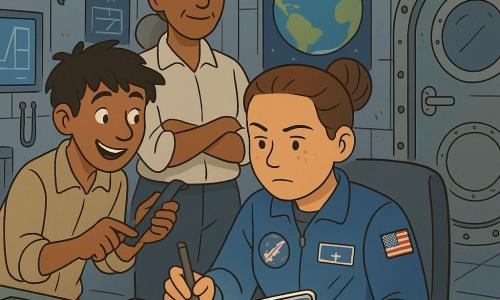
Mateo was assigned as “inside operator.” Juno was “support.” Another trainee, Omar, handled communications.
The module was narrow, with cables, panels, and storage lockers. It smelled like clean plastic and faint metal. Mateo's boots clicked softly on the floor.
Omar's voice crackled over the headset. “Checklist says: verify power switch position.”
Mateo read the label carefully. There were two switches that looked almost the same.
Juno hovered behind him with a clipboard. “Don't rush,” she murmured. “The universe can wait ten seconds.”
Mateo smiled. He checked the label again. Then again. He touched the correct switch and called out, “Power switch A is in OFF. Setting to ON on your mark.”
“Mark,” Omar said.
Mateo flipped it. A small light blinked green.
“Good,” Coach Dima's voice came through. “Continue.”
Next, Mateo had to remove a panel using a tool. He reached for a screwdriver—then stopped. The tool didn't have a tether.
He felt a flicker of panic. The clock in the simulation ticked loudly, like a dramatic movie. But this wasn't a movie. The right move was not to be dramatic.
“Pause,” Mateo said. “Tool isn't tethered. I'm not proceeding.”
Juno nodded fast. “I'll get a tether.”
Omar sounded relieved. “Copy that. Better slow than sorry.”
Juno returned with a tether strap, clipped it to the tool, and checked the connection twice. Mateo checked it too. Then he removed the panel carefully and found the “problem”: a cable that had come loose.
He didn't just shove it in. He inspected the connector for dust, lined it up, and pressed until it clicked.
“Connection secure,” he reported.
A beep sounded. The module's screen changed from red to green.
“Simulation complete,” Coach Dima announced.
Mateo's shoulders sagged with tired happiness. He hadn't been the fastest. But he had been careful. He had treated every tool like it mattered.
Coach Dima entered the module and looked around, taking in the tidy tools, the clipped tether, the panel placed gently on a pad instead of tossed on the floor.
“You respected the workspace,” Coach Dima said. “That is how you respect your crewmates. That is how you respect the mission. That is how you respect Earth—by not turning space into a junkyard.”
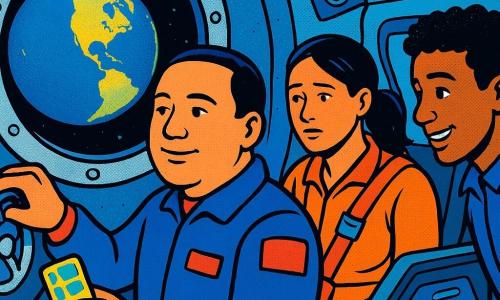
Mateo pictured Earth below, bright and fragile-looking from orbit. He imagined the thin layer of air wrapped around it like a clear blanket. He thought about how astronauts had to bring everything with them, and how nothing should be wasted or lost.
It was strange, how thinking about space made him want to take better care of home.
Chapter 6: A Quiet Promise Under the Same Sky
That evening, Mateo walked outside the training center. The air was cool, and the sky had that deep twilight color that made streetlights look like tiny moons.
Juno caught up with him, hands in her pockets. “You were solid in there,” she said. “Stopping for the tether was the right call.”
Mateo shrugged, but he couldn't hide his smile. “I kept hearing Coach Dima: ‘A missing tool is not oops.'”
Juno tilted her head. “Do you ever worry you'll never be ready?”
Mateo looked up at the first star pricking through the dusk. “Sometimes. But then I remember: astronauts aren't born ready. They train ready.”
They stood quietly for a moment. The building behind them hummed with lights and late-night work. Somewhere inside, someone was cleaning a helmet visor or charging a battery. Small tasks, repeated, shaping big dreams.
Coach Dima stepped out, carrying a folded checklist in one hand. He paused beside them.
“Tomorrow,” he said, “you'll repeat the corridor float. Same path. This time, you'll teach the new trainees. You'll show them how to move without making the corridor your personal pinball machine.”
Juno's eyes widened. “Us? Teach?”
Coach Dima nodded. “Teaching is part of the job. In space, you share knowledge as carefully as you share air.”
Mateo felt a warm spark in his chest. The corridor. The gentle push. The quiet glide. The way the rails felt under his gloves. It wasn't just a trick anymore. It was a skill he could pass on.
He thought about the marker they'd found, the tether he'd refused to ignore, the careful teamwork in the module. Each moment had been a step, like climbing a ladder you couldn't see from the bottom.
He took a slow breath. The sky above was wide and patient.
His efforts—every checklist, every pause, every respectful touch on shared equipment—had been building something real.
“I'm sure of it,” Mateo said softly, as if making a promise to the star. “None of this is wasted.”
Coach Dima's serious face softened into something almost like a smile. “Good,” he said. “Now go get some sleep. Even astronauts need rest. Tomorrow, you float again—smart and steady.”
Mateo and Juno headed toward the dorms. The night wrapped around them like a calm blanket, and the stars stayed where they were, shining quietly, waiting.
And Mateo, future astronaut-in-training, walked with the steady certainty that his dream was no longer just a dream.
It was a path—step by careful step—leading upward.