Chapter 1: The Tired Orbit
Lina Park floated through the quiet hallway of the space station like a slow, careful kite. Outside the window, Earth turned beneath her—blue oceans, white swirls of cloud, a thin line of sunrise like a glowing ribbon.
Inside, the lights were dimmed to “night mode,” but space didn't really do nights. Space did schedules.
Her wrist tablet chimed softly.
EXERCISE — 90 MINUTES — START IN 10 MINUTES.
Lina groaned. The sound came out smaller than she expected, as if even her complaints were weightless.
“Still awake?” called Commander Ruiz from the galley. He had a pouch of rehydrated soup floating beside him like a patient balloon.
“Unfortunately,” Lina said. She tried to smile, but her eyelids felt like someone had filled them with sand.
Ruiz pushed off the wall and drifted closer. “You look like a sleepy comet.”
“I feel like a sleepy comet,” Lina admitted. “Do astronauts ever get to skip exercise?”
“Only if we want our bones to complain louder than you just did,” Ruiz said. “In microgravity, your muscles don't have to fight gravity. They start getting… lazy.”
Lina knew that. She'd studied it for years, and she'd trained for it for even longer. Still, knowing something and doing it while tired were two very different planets.
She floated to the exercise module and stared at the equipment: a treadmill with a harness, a stationary bike, and the Advanced Resistive Exercise Device—everyone called it ARED, like it was a grumpy robot. It could mimic lifting weights by using vacuum cylinders that pulled back against you.
Lina touched the strap of the treadmill harness. “Okay,” she whispered to herself. “One step at a time. One strap at a time.”
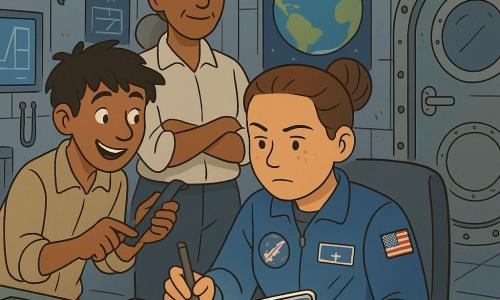
Her friend and crewmate Mina, the flight engineer, popped her head around the doorway. “Hey, Lina! Big day tomorrow.”
Lina's stomach did a tiny flip. Tomorrow they'd begin final preparations for returning to Earth. Not launching. Not floating. Returning—back into gravity, where everything had weight, including your own body.
Mina grinned. “You ready to meet the floor again?”
“I'm not sure the floor and I are on speaking terms,” Lina said.
Mina laughed. “Well, talk to it politely. Clear communication helps in every relationship.”
Lina rolled her eyes, but she felt warmer inside. “Fine. Dear Floor, I'm sorry I ignored you for six months.”
“Good start,” Mina said. “Now go sweat in peace.”
When Mina drifted away, Lina clipped into the treadmill harness. The straps hugged her shoulders and hips, pulling her down so her feet stayed on the belt. It felt strange—like being held by a firm, invisible hand.
She began to run.
Her breath fogged the little air vent near her face. Sweat gathered in round, shiny beads and tried to float away, but the airflow brushed it toward her hairline. The station hummed around her: fans, pumps, tiny clicks from machines that kept everyone alive.
Lina counted her steps.
“One… two… three…”
Not because she loved counting, but because it made tiredness feel smaller, like something she could measure and manage.
Halfway through, she wanted to quit. Her legs were heavy, even though “heavy” didn't exist up here.
She pictured Earth again. The green, the blue, the people walking without thinking about harness straps. She pictured kids in classrooms, drawing rockets in the corners of their notebooks. She pictured them believing astronauts were always brave, always energetic, always perfect.
“Not true,” she muttered between breaths. “But I'm still running.”
When her timer finally beeped, Lina slowed down and floated out of the harness like a cork released from a bottle.
Ruiz drifted by and gave her a thumbs-up. “See? You did it.”
“Barely,” Lina said, wiping sweat off her forehead with a cloth that tried to float away.
“Barely counts,” Ruiz replied. “In space, almost everything is done one careful step at a time.”
Lina looked out the window once more. Earth seemed so calm. She hoped she could be calm too—especially with gravity waiting like a giant, invisible blanket.
Chapter 2: Gravity Practice
The next morning, Lina woke to a gentle alarm that sounded like tiny bells. She pushed herself out of her sleeping bag, which was strapped to the wall like a soft cocoon, and drifted toward the hygiene station.
Her toothbrush floated away the moment she let go. She caught it with a snort. “You're not escaping. Not today.”
Over breakfast—oatmeal squeezed from a pouch—Mission Control called in.
“Station crew, Houston here,” said a calm voice through the speaker. “Today we'll review re-entry procedures and post-landing recovery.”
Lina swallowed. Even the word recovery sounded like it belonged in a hospital.
Mina leaned toward her and whispered, “We're basically going to learn how to be human again.”
Lina whispered back, “I was human yesterday.”
Mina pointed at Lina's floating spoon. “Humans don't chase spoons.”
Lina had to laugh. It helped.
A new voice joined—Dr. Chen, the medical officer on the ground. “Lina, we'd like you to increase your lower-body resistance sets today. It's part of gravity prep.”
Lina pressed the push-to-talk button. “Copy, Dr. Chen. Increasing lower-body resistance sets.”
“Also,” Dr. Chen continued, “remember: when you return to gravity, you may feel dizzy, weak, and wobbly. That's normal. Tell the recovery team exactly how you feel. Clear, simple words.”
Lina replied, “Understood. Clear and simple.”
After the call, she floated to ARED. The machine waited, silent and serious.
Commander Ruiz joined her. “Want a spotter?” he asked.
“In space?” Lina raised an eyebrow. “How do you spot someone when everything floats?”
Ruiz tapped the handholds. “We anchor our feet. We watch form. We communicate. If something feels wrong, you say it right away. No hero tricks.”
Lina nodded. Safety first. Always.
She strapped her shoes into the footplate and grasped the bar. Today's plan included squats and deadlifts—moves that sounded like they belonged in a monster movie, but were actually the building blocks of strong legs and hips.
Ruiz read from the checklist. “Set vacuum resistance to… there. Good. Ready?”
Lina inhaled. “Ready.”
She bent her knees, pushing against the machine's pull. Her muscles shook slightly. Not from fear, she told herself. From work.
“Nice pace,” Ruiz said. “Keep your back straight.”
Lina focused on form. In space, it was easy to twist weirdly because nothing forced you into a normal stance. That was the problem—and the reason for all this practice.
After a few sets, Lina's arms trembled. Her hair floated into her eyes. She wanted to groan again, but instead she did what she was trained to do.
She spoke clearly.
“Commander, I'm feeling strain in my right thigh,” she said.
Ruiz's expression turned sharp and kind at the same time. “Copy. Right thigh strain. Rate it: mild, moderate, or severe?”
“Mild,” Lina said. “Like a tight rubber band.”
“Good description,” Ruiz replied. “We'll pause. Stretch. Then adjust resistance.”
They floated together to the handrail. Lina held a stretch while Ruiz checked her posture and the settings.
Mina drifted in, holding a checklist like a flag. “How's gravity training?”
Lina exhaled. “Hard. Necessary. Annoying.”
Mina nodded solemnly. “A perfect summary of adulthood.”
Lina snorted. “Are you sure you're an engineer and not a comedian?”
“Both,” Mina said. “Engineering is just comedy with math.”
Lina stretched again, feeling the tightness ease. Her body was learning—slowly, stubbornly—how to stay strong without gravity's daily reminders.
Later, during a quiet moment, Lina stared at a photo taped near her sleeping area: her younger cousins, grinning on a playground, one of them hanging upside down from monkey bars.
They'd written a message in bright marker: COME BACK SAFE. TELL US EVERYTHING.
Lina touched the photo gently.
“Everything,” she whispered. “Even the tired parts.”
Chapter 3: The Re-Entry Rehearsal
Two days before landing, the station felt busier, even though the same walls and panels surrounded them. It was the kind of busy you could hear in people's voices—shorter sentences, sharper checklists, extra careful hands.
Lina and Mina floated into the capsule for a rehearsal. The capsule was their ride home: small, strong, packed with switches and straps and supplies. It smelled like metal, fabric, and the faintest hint of plastic—like a brand-new lunchbox.
Mina ran her fingers over the seat. “Hard to believe this little thing will drop us through the atmosphere like a stone with manners.”
“A stone with manners?” Lina repeated.
“It screams the whole way down,” Mina said. “But politely.”
Commander Ruiz clicked on his headset. “All right, team. Let's practice seat ingress, harness checks, and emergency communications.”
Lina slid into her seat. In microgravity, “slid” meant guiding herself with fingertips, but once she was strapped in, the harness hugged her tightly.
Ruiz's voice was steady. “Lina, read back your strap status.”
Lina looked down and checked each buckle. “Left shoulder locked. Right shoulder locked. Chest buckle secure. Lap buckle secure. Leg straps secure.”
“Good,” Ruiz said. “Now, comm check.”
Lina tapped her headset. “Capsule comm, this is Lina. Loud and clear.”
Houston replied, “Loud and clear, Lina. Remember, during re-entry we need short messages. No guessing. If you're unsure, say ‘unable' or ‘repeat.'”
Lina swallowed. It sounded strict, but she understood why. In fast, risky moments, confusing words could be dangerous.
Mina leaned toward her and murmured, “So no dramatic speeches like in movies?”
Lina whispered back, “I was planning to shout, ‘Tell my houseplants I love them!'”
Mina giggled, then caught herself. “Okay, okay. Clear words only.”
They practiced emergency calls.
Ruiz said, “Simulated alert: cabin pressure warning. Lina?”
Lina answered immediately, “Confirm warning. Checking pressure gauge. Reading is… stable. Request repeat of alert source.”
“Good,” Ruiz said. “No panic. No extra stories.”
During another drill, Lina purposely made a mistake, just to test herself. She said, “I think the indicator is fine.”
Houston's voice came back gentle but firm. “Lina, avoid ‘I think' during critical steps. State what you see.”
Lina felt her cheeks warm. “Copy. Indicator shows green. Pressure reading stable.”
“Much better,” Houston replied.
After rehearsal, they floated back into the station. Lina's mind buzzed with procedures, but her body buzzed with something else too—exercise fatigue.
She still had to do her daily workout.
When she arrived at the treadmill, she stared at it as if it were an unfair teacher assigning homework on a holiday.
Mina drifted beside her. “Want me to distract you with fun facts while you run?”
“Fun facts about what?”
“About gravity,” Mina said. “Like how it's always been there on Earth, pulling on you, and you never even sent it a thank-you card.”
Lina sighed theatrically. “Fine. Tell me about my clingy planet.”
Lina clipped into the harness again and started jogging.
Mina floated nearby, holding onto a handrail. “Okay, fun fact one: in microgravity, your heart doesn't work as hard to pump blood upward. So when you get back, your body has to relearn ‘up' and ‘down.' That's why astronauts can feel dizzy.”
Lina puffed. “So… my heart gets homework too.”
“Exactly,” Mina said. “Fun fact two: astronauts can lose bone density in space, like their bones get lighter. Exercise tells the bones, ‘Hey, we still need you strong.'”
Lina's feet thudded on the belt. “Hey, bones,” she said, breathy. “Please… don't get any… ideas.”
Mina continued. “Fun fact three: the harness you're wearing helps mimic the load of gravity. Not perfect, but better than nothing.”
Lina's legs burned. “Fun fact four,” she said. “Astronauts are… secretly very sweaty.”
Mina pretended to write it down. “Important scientific discovery.”
By the end, Lina's tiredness felt less scary. It had become something she could explain: muscles working, lungs working, bones being reminded what to do. It was still hard—but it was understandable.
And understandable things could be handled.
That night, before sleep, Lina recorded a short message for her family.
“I'm practicing for gravity,” she said into the camera. “It's weird to train for something everyone else does without thinking. But it's also kind of beautiful. Like learning to walk all over again.”
She paused, then added, “Also, please tell the houseplants I'm sorry.”
Chapter 4: Landing Day
Landing day arrived wrapped in quiet. The station seemed to hold its breath with them.
Lina packed her few personal items: the photo of her cousins, a tiny paper crane Mina had folded from a checklist scrap, and a small patch from her first training mission. She tucked them into a pouch like they were fragile stars.
In the capsule, the seats felt firmer than Lina remembered. She strapped in slowly, checking each buckle out loud.
“Left shoulder locked. Right shoulder locked. Chest buckle secure…”
Ruiz listened. “Nice and clear.”
Mina's voice came through her headset. “If you start narrating your snack choices like that, we'll never finish lunch.”
Lina smiled. “Snack status: imaginary and secure.”
The capsule undocked with a gentle push. For a moment, Lina watched the station drift away—home for months, now shrinking into a bright metal shape against the darkness.
Then the engines fired. A low vibration shivered through her bones.
Re-entry began like a long, tense slide. The capsule tilted, and Lina felt forces pressing her into the seat. Not painful—just firm, like gravity's big cousin showing up early.
Her breathing got louder in her ears.
Houston's voice: “Crew, how do you feel?”
Ruiz answered first, crisp and calm. “Commander stable.”
Mina followed. “Engineer stable. Feeling increased pressure.”
Then Lina. She focused on simple words, like stones in a stream you could step on.
“Pilot stable,” she said. “Feeling heavy. Breathing okay.”
Outside, the capsule shook. It was as if they were driving through a storm made of air. Lina imagined the heat shield doing its job, taking the fierce friction so the people inside could stay safe.
A warning light blinked once and went out.
Mina's voice tightened. “That light—”
Ruiz cut in smoothly. “Say what you see.”
Mina inhaled. “Indicator flashed amber once. Now off. No alarm tone.”
Houston replied, “Copy. Single amber flash, now off. Continue monitoring.”
Lina admired how the words lined up like building blocks. No drama, no confusion—just clear information passing from one mind to another.
The shaking eased. The parachutes deployed with a loud, sudden tug, and Lina's stomach floated for a second even though she was strapped in.
Then came the final drop—thump—and the world stopped moving.
For a moment, Lina couldn't tell if she was breathing. Then she heard Mina laugh, shaky but bright.
“We're… on the ground,” Mina said.
Lina blinked. The capsule smelled different now—dust and warm air sneaking in through tiny seams.
Ruiz spoke into comms. “Houston, we have landed. Crew status?”
Mina answered, “Conscious. Feeling dizzy.”
Lina swallowed. Her head swam as if her thoughts were turning in slow circles.
She spoke anyway, because that was part of the job.
“Conscious,” Lina said. “Dizzy. Legs feel weak. Nausea mild.”
“Copy,” Houston replied. “Recovery team is approaching. Stay seated and communicate any changes.”
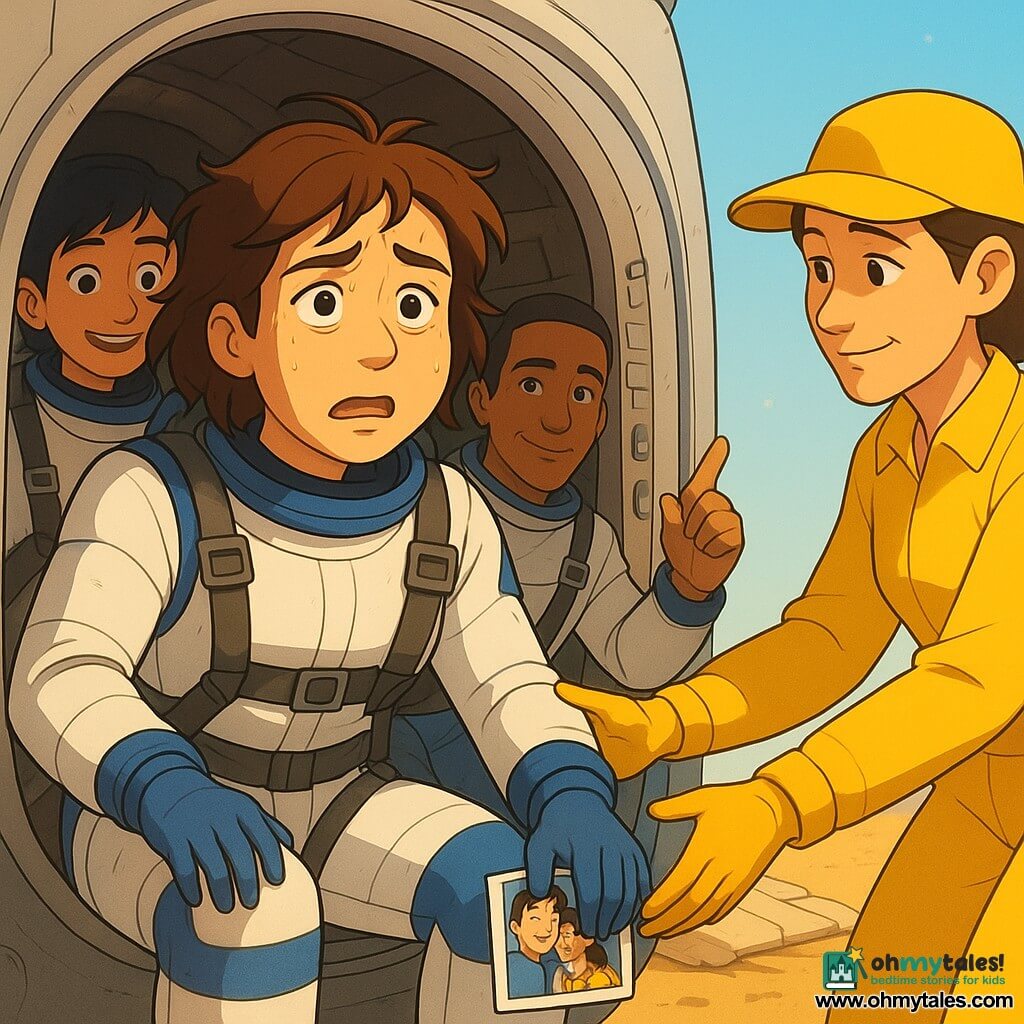
When the hatch opened, daylight poured in, dazzling and golden. Lina wanted to sit up like she always had on Earth, but her body refused, as if gravity had pinned her with a giant hand.
A recovery medic leaned in, face kind behind a visor. “Hi, Lina. Welcome home. We're going to help you out slowly. Tell me if anything feels worse.”
Lina took a careful breath. “Dizziness is still there. Not worse. Just… strong.”
“Good report,” the medic said. “We've got you.”
They guided her out, supporting her arms. Her boots touched the ground—real ground, solid and unyielding. Her knees trembled like new foals' legs.
The sky above looked enormous. Earth smelled like sun-warmed grass and metal equipment and people. Lina's eyes stung, and she wasn't sure if it was the brightness or the feeling of being back.
Mina, standing with help nearby, whispered, “Hello, Floor.”
Lina managed a laugh. “Dear Floor,” she murmured, “I'm back. Please be gentle.”
Chapter 5: The Wobbly Days
The first days after landing felt like living in a slightly tilted world. Lina could walk, but only with support at first. Her head didn't like quick turns. Her stomach didn't trust elevators. Even sitting in a chair felt strange, like her body had forgotten how to be folded.
In the recovery center, therapists guided her through exercises that looked simple but weren't. Standing on one foot. Turning her head while walking. Stepping over small blocks.
Lina's legs shook with the effort.
A therapist named Tessa held out a hand. “Talk me through what you feel,” she said.
Lina concentrated. “My feet feel… heavy. Like I'm wearing boots filled with rocks. My balance feels delayed.”
Tessa nodded. “Great description. That helps us choose the right training.”
Later, Lina sat with a doctor who asked about her sleep, her appetite, her mood. Lina answered honestly, even when the honest answer felt a bit embarrassing.
“I get tired quickly,” Lina admitted. “And I feel frustrated when I can't do what I used to.”
The doctor wrote notes. “That's normal. Your body is adapting again. Being clear about frustration doesn't make you weak. It makes your team smarter.”
Team. Lina liked that word. Astronauts didn't succeed alone. They had crews, engineers, doctors, trainers, and people on the ground watching the tiniest details.
One afternoon, Lina had a video call with her cousins' class. The teacher had written earlier: THEY HAVE A MILLION QUESTIONS.
Lina sat in front of the camera in a simple shirt, her hair still a little wild from the day's physical therapy. She could have waited until she looked more “astronaut-like,” whatever that meant.
But she remembered the photo: COME BACK SAFE. TELL US EVERYTHING.
So she did.
The screen filled with kids in a classroom, waving like a forest of hands. Some had space stickers on their notebooks. One kid held up a drawing of a rocket that looked like a very determined carrot.
“Hi, Lina!” the teacher said. “We're so excited. Everyone, remember: one person speaks at a time. Clear communication.”
Lina smiled. “That might be the most astronaut sentence I've heard all week.”
A boy raised his hand. “Is it true you can do flips in space all day?”
Lina chuckled. “You can, but you'll get dizzy. Also, astronauts have a schedule, and most of it is work.”
A girl asked, “What kind of work?”
Lina leaned closer to the camera. “Lots of things. We run experiments to learn how plants grow, how materials change, how the human body reacts without gravity. We fix equipment. We clean filters. We check safety systems. We talk to Mission Control every day.”
Another hand shot up. “Did you ever feel scared?”
Lina paused. She chose her words carefully, like placing fragile glass on a shelf.
“Yes,” she said. “Sometimes. Especially during re-entry. But we train a lot, and we follow checklists. And we talk clearly. Fear is easier to handle when you can describe it.”
A boy frowned. “But astronauts are supposed to be brave.”
Lina nodded. “Brave doesn't mean ‘never tired' or ‘never scared.' Brave means you do the right steps anyway. Even when you'd rather take a nap.”
Some kids giggled.
A girl near the front asked softly, “What was the hardest part when you came back?”
Lina didn't pretend it was only exciting. She didn't hide the wobbly truth.
“Gravity,” she said. “My body felt heavy. I got dizzy. My legs were weak. That's why we exercise in space even when we're tired—so we can come home safely. And after landing, we keep training. It's normal to need help.”
The classroom went quiet in a thoughtful way, not a bored way.
The teacher said, “Thank you for saying that.”
Lina continued, “Sometimes people think they should hide when something is hard. But clear words help. If you're dizzy, say ‘I'm dizzy.' If you don't understand, say ‘Please repeat.' If you feel worried, say ‘I feel worried.' It helps your team—your friends, your family—know how to support you.”
A kid raised a hand. “So… astronauts talk about feelings?”
Lina laughed, warm and honest. “Absolutely. We have to. Space is not a place for guessing games.”
At the end, the class held up a sign they'd made: WELCOME HOME, LINA! THANK YOU FOR TELLING THE TRUTH!
Lina blinked fast. Her eyes still did that sometimes.
“Thank you,” she said. “Keep asking questions. And take care of Earth. It's the only place with your favorite snacks, your families, and the best air in the whole universe.”
After the call, Lina sat quietly for a moment. Her body still felt tired, but her mind felt light.
She had done one more important part of her job: bringing the story back, clearly, kindly, without taboos.
And that, Lina decided, was its own kind of mission.