Chapter 1: The Checklist on the Kitchen Table
Commander Leon Park didn't pack like heroes in movies, tossing things into a bag at the last second. He packed like an astronaut—slowly, neatly, and with a pencil behind his ear.
On his kitchen table lay three piles: “Flight,” “Personal,” and “Don't Forget.” Each pile had its own sticky note. Leon's tablet beeped gently with a schedule: medical check, final training, launch.
His niece Mara, who was visiting for the weekend, leaned over the table. “Do you really need that many checklists?”
Leon smiled. “I need them the way a musician needs sheet music. They keep me from missing a note.”
Mara picked up a small plastic pouch. “What's this?”
“Emergency snacks,” Leon said, serious for a second. Then he winked. “Mostly for emergencies like ‘I miss chocolate.'”
Mara laughed. “And what's in ‘Don't Forget'?”
Leon tapped the last pile. “The small things that matter. Photos. A lucky pen. The paper note my sister wrote when I started training.”
“Do astronauts get nervous?” Mara asked, quieter now.
Leon didn't pretend. “Yes. But we don't hide it. We plan for it. We ask for help. That's part of the job.”
He slid a checklist toward her. “Want to be my assistant?”
Mara's eyes sparkled. “Absolutely.”
Together they checked each item: gloves, headset, notebooks, a tiny pouch for personal treasures. Leon explained how astronauts are trained to be organized because space is not forgiving. If you lose a tool, it can float into a vent. If you forget a step, you can waste precious air or time.
“Up there,” Leon said, pointing at the night sky through the window, “organization is safety.”
Mara scribbled a dramatic check mark. “Safety first. Got it.”
Leon folded his final checklist and placed it in his pocket, as if it were a promise he could carry. Outside, the evening was calm, but inside Leon's chest, his excitement was humming—steady, careful, ready.
Chapter 2: Training Day, Team Day
The next morning, the training center smelled like clean metal and coffee. Leon walked through bright hallways where posters showed rockets and planets. He wasn't alone for long.
“Leon! Your helmet's ready for fit-check,” called Dr. Nia Patel, the flight surgeon, holding a clipboard like it was a shield.
“And your simulation starts in twenty minutes,” added Oleg, the mission specialist, jogging up with a grin. “Try not to crash the space station this time.”
Leon raised his hands. “No promises.”
They moved from station to station like a well-practiced parade. First came the medical check. Dr. Patel listened to Leon's heartbeat and watched his eyes.
“Any dizziness? Headaches?” she asked.
Leon hesitated. He had felt a little lightheaded during a spin training yesterday.
“I did feel dizzy after the centrifuge,” he admitted. “Not terrible, but noticeable.”
Dr. Patel nodded, not surprised or annoyed—just focused. “Good you said it. We'll adjust your hydration plan and check your sleep logs. In space, small problems can become big problems. Speaking up is strength, Leon.”
Oleg clapped Leon lightly on the shoulder. “See? The boss of our bodies approves.”
Next came the safety briefing. A trainer named Ms. Alvarez pointed at a giant diagram of the spacecraft.
“Every switch is labeled. Every procedure has a backup. If the main oxygen system fails, you use the secondary. If the secondary has trouble, you follow the emergency steps and communicate clearly.”
She fixed them with a look. “Space is amazing. Space is also serious.”
Leon repeated the safety rules out loud with the others. “Check. Confirm. Communicate.”
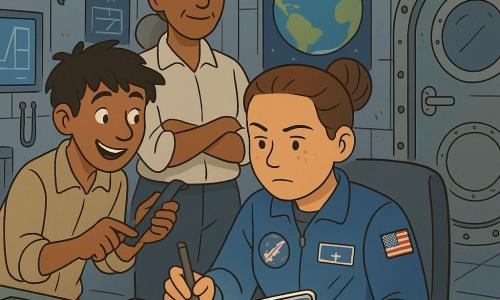
After lunch, they climbed into a full-size mock-up of the capsule. Leon strapped into his seat while Oleg pretended to be Mission Control, speaking through speakers in a steady voice.
“Commander Park, you have a warning light.”
Leon checked the panel, then the checklist, then the panel again. “Copy. I see it. Running procedure.”
His fingers moved carefully. Not fast—correct.
A minute later, Leon frowned. The warning stayed on.
Oleg's voice crackled. “Well?”
Leon took a breath. “I need a second set of eyes. Ms. Alvarez, can you confirm the valve position on line two?”
Ms. Alvarez leaned in, checked, and nodded. “You're right. The simulator's valve is stuck halfway. Good catch.”
Oleg groaned dramatically. “So the capsule wasn't your fault this time.”
Leon chuckled, relief warm in his chest. Asking for help hadn't made him smaller. It had made the team stronger.
That evening, as Leon left the training center, he saw the rocket on the launch pad in the distance—white against a peach-colored sky. It looked quiet, almost sleepy.
But Leon knew better. Inside that rocket were layers of planning, teamwork, and thousands of tiny organized steps, waiting to carry a human into the dark, sparkling sea above.
Chapter 3: The Quiet Hours Before Launch
Launch day arrived with a whispering rain that stopped just before sunrise, as if even the weather had checked the schedule.
Leon rode the bus with his crew toward the pad. The windows were tinted, turning the world into a soft gray movie. He watched the rocket grow larger, and he felt small in a good way—like standing at the edge of something enormous and meaningful.
At the suit-up room, technicians helped him into his launch suit. It wasn't the bulky spacewalking kind, but it still felt like a special uniform for a careful job. Zippers sealed. Straps tightened. A helmet clicked into place.
A technician named Harper leaned close. “Comfort level?”
Leon tested his gloves. “A little pressure at my wrist.”
Harper adjusted a strap. “Better?”
Leon flexed his hand. “Much. Thanks.”
No one acted like help was embarrassing. It was expected. The whole room was built on teamwork, like a giant puzzle where every person held a piece.
Before the final walkout, Leon opened a small pouch labeled “Personal.” Inside were several printed photos: his sister laughing at a picnic, Mara holding a model rocket, his best friend from training making a silly face, and a picture of his parents standing beside an old telescope.
He ran his thumb over the edges of the photos, then tucked them back carefully. Soon, he would take them with him—not just as memories, but as anchors.
“Ready, Commander?” Oleg asked, helmet under his arm.
Leon nodded. “Ready enough to be careful.”
As they stepped outside, cameras clicked, but Leon focused on his breathing. In the distance, Mission Control's voices flowed through his headset, calm and methodical.
“Crew, you are go for ingress.”
Leon climbed the stairs into the capsule. Inside, everything was close and precise: switches, screens, labels. He slid into his seat and followed the checklist, each step like a stone across a river.
“Leon,” Dr. Patel's voice came through the loop, “how are you feeling?”
Leon checked in with himself. Heart steady. Mouth a little dry.
“A bit dry,” he admitted.
“Copy. Take a sip from your water pouch. Slow, small sips.”
Leon did. The water tasted plain and perfect.
Outside, the countdown continued. Leon listened to the numbers and the steady voices. He wasn't alone. Not for a second.
At zero, the rocket didn't leap so much as it insisted itself upward. The vibration rattled Leon's teeth. Sound pressed against him. He felt heavy, as if an invisible giant hand was pushing him into his seat.
“Liftoff,” came the voice. “You are go.”
Leon couldn't see the ground, but he could feel the Earth letting go, gently and powerfully at the same time. He thought of his checklists. His team. His photos.
“Step by step,” he whispered, and the sky swallowed them whole.
Chapter 4: Floating Lessons
When the shaking stopped, the silence felt enormous.
Leon lifted his hand—and it floated up like a slow balloon. He let out a surprised laugh.
Oleg's voice came from across the cabin. “Welcome to microgravity, where your elbows have opinions.”
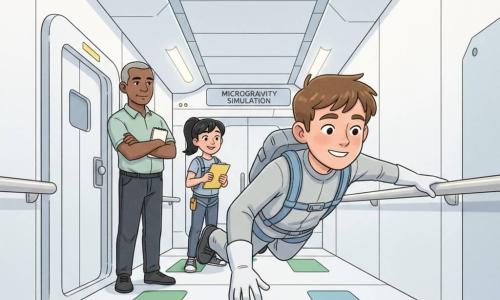
Leon unstrapped carefully, remembering training. In space, moving too fast could send you drifting into a panel. He pushed off with two fingers, gliding like he was swimming through air.
They reached the space station a few hours later. Docking was a delicate dance: small thruster bursts, careful alignment, and constant communication with Mission Control.
“Speed is good,” Leon reported. “Alignment within limits.”
“Copy,” Mission Control replied. “Proceed.”
When the hatch opened, the station smelled like warm electronics and something faintly like plastic. It felt lived-in, like a strange floating house.
Leon's first job wasn't to stare out the window, even though the curved blue Earth called to him. His first job was organization.
“Let's do the welcome checklist,” he said, clipping it to a Velcro strip. “Air pressure, fans, emergency gear locations.”
A veteran astronaut named Keisha greeted them with a grin. Her hair floated up like a playful cloud. “New crew! Rule number one: Everything gets a home. If it doesn't, it will try to live in the ventilation system.”
Oleg nodded gravely. “So the station eats pens?”
Keisha pointed to a mesh pocket labeled “PENS.” “Only if you feed it.”
Leon learned quickly how astronauts stay organized in microgravity. Tools were attached with tethers. Bags were zipped and labeled. Even the trash had a special compartment. They used Velcro patches like magic—stick, unstick, stick again.
Later, Leon moved to his sleeping area, a small nook with a sleeping bag strapped to the wall. It looked like a closet that had decided to become a bedroom.
He pulled out his personal pouch. One by one, he took the photos and carefully attached them near his sleeping bag with small Velcro squares: his sister, Mara, his friend, his parents.
Keisha floated by and noticed. “Good idea,” she said softly. “It helps on long days.”
Leon looked at the photos, floating slightly at the corners, as if they were trying to wave. “It reminds me why I'm careful,” he said. “Who I'm coming back to.”
That night, Leon zipped himself into the sleeping bag. Without gravity, sleep felt different—like drifting inside a cocoon. The station hummed steadily, fans breathing, systems working. Organization turned chaos into calm.
Before closing his eyes, Leon checked tomorrow's plan: science experiments, Earth observations, exercise, maintenance.
A life in space wasn't one big heroic moment. It was hundreds of small, organized choices—done with patience, done together.
Chapter 5: The Wrench That Wanted to Escape
On the third day, Leon's schedule included maintenance: replacing a filter in a water recycling system. The station cleaned and reused water because fresh supplies were limited. Even a sip of water in space had a story behind it.
Keisha floated beside Leon at the equipment panel. “Remember,” she said, “water is precious up here. We recycle what we can. It's one way we respect the Earth—even while we're far from it.”
Leon nodded. “Everything is borrowed. Air, water, time.”
He opened the tool kit, each tool clipped in place. Wrench. Screwdriver. Small flashlight. He followed the step-by-step procedure on a tablet.
Step 1: Secure tools.
Step 2: Close valve.
Step 3: Confirm pressure reading.
Step 4: Remove old filter.
Leon clipped the wrench to his wrist tether, but as he rotated to reach the valve, the tether twisted. The wrench bumped his elbow, slipped free, and floated away with slow confidence—like it owned the station.
Oleg, drifting nearby, pointed. “Your wrench is going on an adventure.”
Leon didn't lunge. Lunging was how you turned one problem into three. He held still, watched its path, and spoke calmly.
“Tool free-floating,” he reported. “No impact. It's drifting toward module two.”
Keisha's expression stayed steady. “Good callout. Oleg, block the vent intake. Leon, grab the spare tether. I'll intercept.”
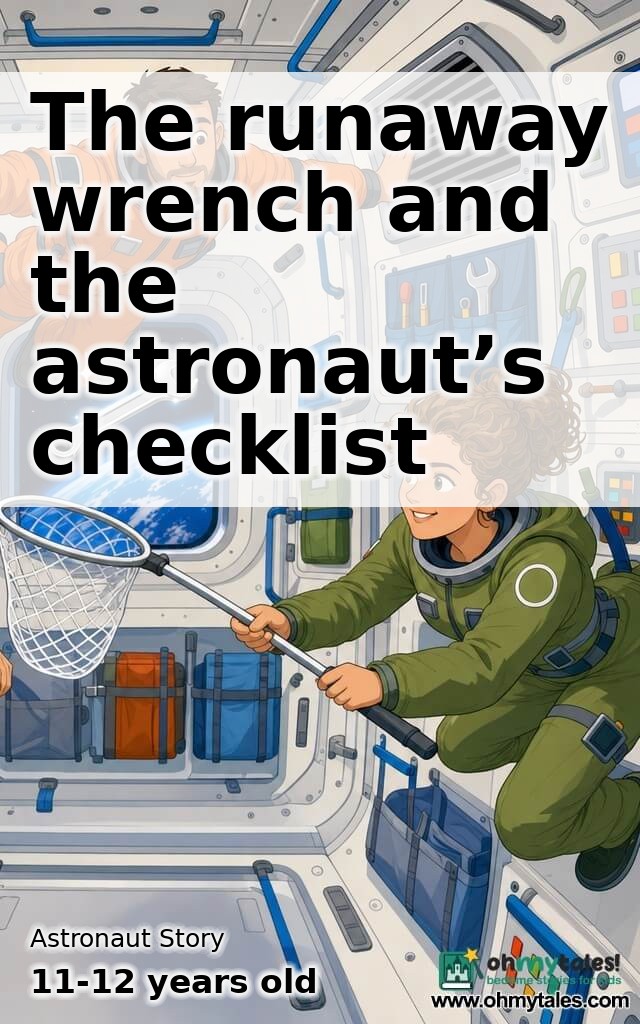
They moved like a practiced dance: Oleg positioned himself near a vent, arms spread like a goalie. Leon anchored his feet under a handrail and extended a soft capture bag on a pole. Keisha pushed gently off the wall, gliding toward the wrench.
“Easy… easy…” Keisha murmured, as if the wrench could hear.
The wrench rotated, shiny and smug.
Leon timed it. When the wrench drifted within reach, he slid the capture bag forward and—whoosh—caught it.
Oleg applauded quietly. “Captured the rogue wrench. Station saved.”
Leon exhaled. His heart had sped up, but his voice had stayed calm. He reattached the wrench properly, double-checking the clip.
“I should've checked the tether twist,” he said.
Keisha shrugged. “It happens. The important thing is: you reported it, you didn't panic, and you used the team. That's astronauting.”
Leon returned to the checklist. Valve closed. Pressure confirmed. Filter swapped.
When the system restarted, a green light blinked.
“Water recycler nominal,” Leon said, and it felt like saying, We can keep living up here a little longer.
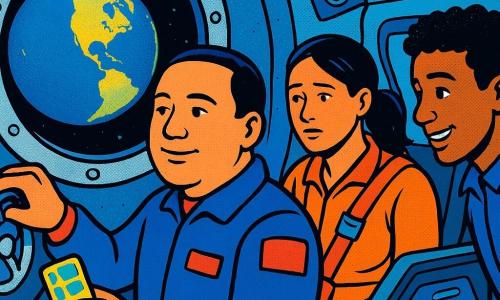
That evening, Leon floated to the cupola window. The Earth rolled below like a glowing marble—oceans, cloud swirls, golden city lights.
He pressed his forehead gently to the glass. “We have to take care of it,” he whispered.
Behind him, the station hummed on, organized and steady, a reminder that even in the stars, responsibility followed you.
Chapter 6: Homeward, and the Mirror Smile
The return day came with more checklists than Leon thought possible. Pack samples. Secure equipment. Clean sleep area. Confirm personal items.
Leon approached his sleeping nook and looked at the photos he had attached near his sleeping bag. For a moment, he didn't want to take them down. They had turned a metal corner of the station into something warm.
He peeled each photo off gently and slid them into his pouch: sister, Mara, friend, parents. He paused, then added a new photo Keisha had printed for him—a snapshot of the crew floating together, grinning like kids in a science museum.
Oleg drifted by holding a bag. “You got everything?”
Leon checked his pouch, then his checklist. “Almost. I'm missing my lucky pen.”
Oleg raised an eyebrow. “The pen you swore you didn't care about?”
Leon smiled sheepishly. “I care about it a normal amount.”
Instead of searching alone, Leon did what he always tried to do: he asked.
“Keisha,” Leon called over the comms, “have you seen a silver pen with a blue clip? Might be near the lab workstation.”
Keisha's voice came back. “Copy. I'll look.”
Two minutes later, she floated in holding it. “Found it stuck to a Velcro patch under a notebook. The station was trying to adopt it.”
Leon took it gratefully. “Thank you. Seriously.”
Keisha nodded. “That's why we don't do space alone.”
The crew strapped into the return capsule. The station hatch closed with a solid, final sound. After undocking, the capsule fired its engines to slow down just enough for Earth to catch them.
Re-entry was loud and fiery. The capsule shook, and the air outside turned into a blazing curtain. Leon focused on breathing and the calm voices in his headset.
“Trajectory good,” Mission Control said. “You're doing great.”
When parachutes opened, the jolt felt like a giant tug, then a gentle swing. The capsule descended through clouds into bright daylight and landed with a heavy thump.
After recovery teams arrived, Leon finally stepped out into fresh air. The ground felt oddly pushy under his feet, as if gravity was proud of itself.
Back at the facility, he showered, ate warm food, and changed into simple civilian clothes: soft pants, a plain shirt, sneakers. No helmet. No suit. Just Leon.
That night, he stood in front of a bathroom mirror. His hair was damp. His face looked tired, but peaceful. Behind his eyes was still the slow spin of Earth, the hush of the station, the runaway wrench, the photos by his sleeping bag.
Leon studied his reflection, then let a smile spread—small at first, then certain.
It wasn't the smile of someone who had done everything alone.
It was the smile of someone who had stayed organized, asked for help, and followed every careful step—so he could come home to the people in those photos, and to the bright, beautiful planet waiting outside the window.