Chapter 1: The Comfort of Checklists
Commander Leo Mercer liked space the way some people liked roller coasters—exciting, yes, but only if every bolt had been checked twice and the safety bar clicked into place with a solid, friendly clunk.
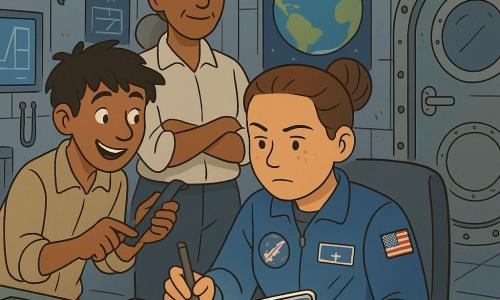
In the training center, his day began with a sound that felt like home: the sharp snap of a clipboard.
“Again?” asked Jada, one of the younger engineers, as Leo lined up three identical checklists on the table. “You already did the oxygen system this morning.”
Leo tapped the paper with his pen. “And I plan to do it again. Space is amazing, but it is not impressed by confidence. Space likes preparation.”
Jada grinned. “Space is a strict teacher.”
“A strict teacher with no office hours,” Leo said. He leaned closer, lowering his voice like he was sharing a secret with the universe. “If you forget your homework up there, the universe doesn't say, ‘Try again tomorrow.'”
A few seats away, Dr. Amari Chen, their mission specialist, looked up from a tablet. “He's right,” she said. “Repetition isn't boring. It's a seatbelt.”
Leo's mission patch sat on his shoulder like a promise: a small blue Earth, a silver station, and a thin line connecting them like a thread. Their job was to deliver a new water recycler to the orbiting space station—a machine that would help turn used water into clean drinking water. It wasn't as dramatic as fighting aliens, but it mattered.
“Let's run the emergency drill,” the instructor called. “Fire in the cabin.”
Leo's heart didn't jump the way it used to when he was a rookie. It steadied. He knew what to do because he had done it so many times that his hands almost thought on their own.
Mask on. Seal check. Call it out. “Oxygen mask secure.”
Jada did the same, quick and focused. Dr. Chen pointed to the extinguisher and counted the steps like a rhythm. “Pull, aim, squeeze, sweep.”
The instructor nodded. “Good. Remember: in space, you don't panic. You procedure.”
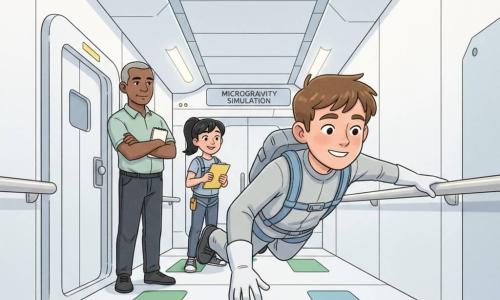
Later, Leo walked past a glass wall that looked into the simulator room. Inside, a fake capsule sat under bright lights. It smelled faintly of metal and new plastic, like a toy that had been unboxed carefully.
Leo rested his hand on the glass.
Somewhere beyond it, beyond the air and clouds and the blue curve of Earth, was the real thing—quiet, cold, beautiful. And waiting.
Chapter 2: A Rocket That Hates Surprises
The next day brought the “full mission rehearsal,” which everyone treated like the most serious game of pretend ever invented.
Leo climbed into the simulator capsule with Dr. Chen and Jada, who had come along to watch and learn. There were switches and screens and labels everywhere, each one speaking its own tiny language: PRESS, TEMP, VALVE, COMM.
“Okay,” Jada said, settling into the observer seat behind them. “So what's the most important button?”
Leo pointed at a switch that wasn't flashy at all. “This one.”
Jada squinted. “That says… ‘CABIN FAN.' That's the most important button? A fan?”
Dr. Chen chuckled. “In space, air doesn't rise. No hot air drifting up, no cool air sinking down. Without fans, you can end up with pockets of carbon dioxide—like invisible puddles.”
Leo nodded. “And nobody wants to accidentally breathe from a bad puddle.”
Jada wrinkled her nose. “Space puddles. Lovely.”
The instructor's voice boomed through the speakers. “Countdown begins.”
Leo's fingers moved with calm precision. He checked the communication link. “Ground, Orion-7, comm check.”
A crackle, then a voice: “Orion-7, loud and clear.”
He watched numbers on the screen. Fuel pressure. Battery power. Temperature. The rocket—at least the real one waiting outside the training center in its tall, white glory—didn't hate people. It hated surprises.
Dr. Chen leaned in. “Remember our science cargo, Leo: the water recycler. It's going to help reduce resupply needs. Less fuel burned, fewer launches, less waste.”
Leo felt a warm pride. “Saving trips to the grocery store, but the grocery store is Earth.”
“And your shopping cart is a rocket,” Jada added.
A simulated alarm beeped.
Jada's eyes widened. “What does that mean?”
Leo didn't flinch. “That means the simulator wants to see if we're paying attention.” He read the display. “Pressure drop in line B.”
Dr. Chen's voice was steady. “Procedure?”
Leo answered automatically. “Confirm with backup sensor. Switch to line A. Notify ground.”
He did each step, not rushing, not delaying. Like tying shoes: you didn't sprint through it, because tripping was never heroic.
“Orion-7,” ground said, “good work. You are go.”
When the rehearsal ended, Jada exhaled. “Okay, I get it now. You repeat so you can stay calm when everything beeps at you.”
Leo smiled. “Exactly. Fear is loud. Training is louder.”
On the way out, Jada pointed through the window toward the real launchpad in the distance. “Do you ever worry? Like, really worry?”
Leo stopped, choosing his words like careful steps. “I respect it,” he said. “Worry is what you feel when you don't have a plan. Respect is what you feel when you do.”
Chapter 3: The Letter Before the Sky
The night before departure, the astronaut quarters were unusually quiet. Even the vending machine seemed to chew its snacks softly.
Leo sat at a small desk with a sheet of paper. Real paper, not a screen. He liked the sound of a pen scratching lines into a page. It made the words feel anchored, like they couldn't float away.
He began his letter.
“Dear Maya and Dad,” he wrote. “By the time you read this, I'll be close to the launchpad, dressed like a very serious marshmallow.”
He paused, imagining his little sister Maya laughing. She always called his suit “the puffy costume.”
He continued. “I want you to know something important: I'm not brave because I don't feel nervous. I'm brave because I practice. We practice everything. How to breathe if a mask is needed. How to talk if the radio crackles. How to fix small problems before they become big ones.”
He heard Dr. Chen's earlier words—Repetition is a seatbelt—and wrote them down.
“Space is not a place for showing off,” he wrote. “It's a place for teamwork. Dr. Chen knows the science better than anyone I've ever met, and Jada and the engineers keep the rocket honest. We check and re-check, because safety isn't a mood. It's a promise.”
Outside his window, the sky looked like a dark ocean sprinkled with salt. Somewhere in that glitter was the station—a moving dot, a home that never stopped falling around Earth.
Leo wrote, “When I'm up there, I'll look down at our planet and remember your faces. Earth is like a beautiful, living spaceship we all share. That's why we take care: we don't leave trash, we plan our fuel, we reuse water, we learn how to be gentle.”
He chewed the end of his pen. He wanted to say something more, something that didn't sound like a textbook.
Finally he wrote, “If you feel worried, do what I do. Take a breath. Think of the checklist. One step, then the next. Dreams are built the same way. Step by step.”
He signed his name and added a final line: “P.S. If I bring you a star, it will be a sticker. The real stars stay where they are. That's their job.”
He folded the letter carefully and slipped it into an envelope. Tomorrow, someone on the ground team would deliver it to his family.
Leo stood and stretched. His muscles felt ready, but his mind needed one more thing: a walk.
In the hallway, he found Dr. Chen looking at a model of the station.
“Can't sleep?” she asked.
“Not yet,” Leo admitted.
Dr. Chen pointed to the model's solar panels. “Those are our power plants. They turn sunlight into electricity. No coal, no smoke. Just light.”
Leo traced the outline with his eyes. “It's like a tiny city that runs on sunshine.”
“A city where everyone shares everything,” Dr. Chen said. “Air, water, space. That's why cooperation matters up there. You can't slam a door and storm off.”
Leo laughed softly. “You can, but you'll bounce back.”
Dr. Chen smiled. “Exactly. So we talk, we listen, we teach. We pass knowledge like we pass tools.”
Leo felt the quiet settle in his chest, not heavy but steady.
“Thank you,” he said.
“For what?”
“For reminding me,” Leo replied. “We're not just going up to do a job. We're going up to learn—and bring the learning back.”
Chapter 4: The Loudest Elevator
Launch morning arrived smelling of strong coffee and warm electronics.
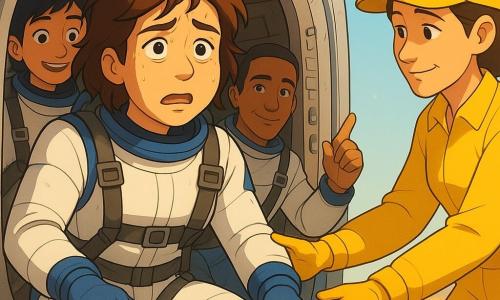
Leo's suit technicians helped him into his pressure suit, checking seals and connectors with the patience of people who knew that “almost” was not a word you used around rockets.
“Glove ring secure,” one technician said.
Leo repeated it back, as trained. “Glove ring secure.”
The suit felt snug, like a sturdy hug. He had practiced walking in it, sitting in it, eating in it (which was mostly squeezing applesauce from a tube and pretending it was gourmet). It still made him look like a heroic snowman.
Jada met them at the transport van, eyes shining. She wasn't flying today, but she was part of the team, and she carried herself like it.
“Commander Marshmallow,” she said, saluting.
“At ease, Engineer Giggle,” Leo replied.
Dr. Chen climbed in beside him, calm as a pond. “Remember,” she said, “breathe, check, communicate.”
The van rolled toward the launchpad. The rocket stood taller than any building Leo had ever visited, white and bright against the sky. It looked impossible—like someone had leaned a giant pencil against the heavens.
They rode the elevator up the tower. It was, Leo decided, the loudest elevator in the world. Fans roared. Machines clanked. The whole structure hummed with stored energy.
At the top, the air smelled sharp and clean. The hatch waited like an open mouth.
Leo paused before entering. He thought of his letter, folded and traveling toward home. He thought of Earth as a shared ship, carrying everyone he loved.
“Ready?” Dr. Chen asked.
Leo nodded. “Ready, because we practiced.”
Inside the capsule, they strapped in. The seat molded around him, firm and supportive. He ran through the checklist with the crew, each answer clear.
“Comm?” Leo asked.
“Green,” Dr. Chen said.
“Cabin pressure?”
“Nominal.”
“Fans?”
Dr. Chen lifted an eyebrow. “On.”
Leo felt a smile tug at his mouth. Good. No carbon dioxide puddles today.
The countdown voice began again, lower and steadier than in the simulator, like a drumbeat.
“Ten… nine…”
Leo held his hands lightly on the controls. Not gripping. Just ready.
“Three… two… one…”
The rocket ignited with a thunder that didn't just make noise—it made history in his bones. The capsule shook. The seat pushed him back as if a giant hand had decided to press him gently, firmly, into the sky.
“Liftoff,” Leo said, voice steady. “Orion-7 is flying.”
Earth fell away with surprising speed. The blue curve grew broader, like the edge of a glowing marble. Clouds swirled like white paint in water.
Dr. Chen whispered, almost to herself, “There it is.”
Leo couldn't help it. He laughed—quietly, in the mic—because wonder had found a way through all his procedures.
Chapter 5: Floating Lessons
A few minutes later, the shaking stopped. The silence that followed felt enormous, like the universe had turned down the volume.
Leo lifted his hand and watched it drift upward. Not falling, not rising—just floating.
“We're in microgravity,” Dr. Chen said. “We're still being pulled by Earth's gravity, but we're also moving forward so fast that we keep missing the ground. It's like… an endless gentle fall.”
Jada's voice crackled through the radio from mission control. “So you're basically falling around the planet?”
Leo grinned. “Exactly. The fanciest falling you can do.”
Dr. Chen began unpacking a small pouch. “First job: check the cabin and the cargo. Everything that's loose can become a hazard. In microgravity, even a pencil can turn into a tiny missile if it's moving fast.”
Leo secured a floating checklist to a Velcro pad. “Velcro is our best friend,” he said.
Jada laughed. “You're telling me the secret technology of space is… scratchy tape?”
Dr. Chen answered, “Also zip ties. Never underestimate the power of organized fastening.”
Leo moved carefully, using handholds. “Astronaut rule,” he said, “always keep one hand for yourself and one for the station—or the capsule—so you don't drift into trouble.”
He checked gauges, confirmed fans, verified oxygen levels. Then they turned to the precious cargo: the water recycler.
Dr. Chen ran her fingers over its casing. “This will help clean water from humidity, from used wash water, and—yes—even from urine.”
Jada made a dramatic gagging sound over the comms. “Please tell me you're joking.”
Leo kept his voice kind and practical. “Not joking. It's science and filters. On Earth, water travels through rivers and clouds. In space, we build a mini water cycle. We reuse what we have because we can't just open a tap connected to a giant lake.”
Dr. Chen added, “And the lessons help Earth, too. Better recycling systems, better ways to use resources. Space teaches us to be clever and careful.”
Leo pictured his sister brushing her teeth, the water running. He made a note to tell her: every drop mattered.
A light blinked on the panel.
Dr. Chen leaned in. “That's our rendezvous guidance. We're on track to meet the station.”
Leo checked the numbers, calm and focused. “We match speed and direction, slowly. Docking is like parking next to a moving friend without bumping them.”
Jada's voice came again. “And if you bump?”
Leo answered honestly, not to scare her, but to teach. “Then alarms yell, and we stop, and we try again. Safety first. Pride last.”
Dr. Chen floated a pen toward him. “Commander, you dropped your bravery.”
Leo caught the pen. “Nope. That's my pen. Bravery is clipped to the checklist.”
Chapter 6: The Shared Hatch
The station grew from a bright speck into a shape: modules like connected barrels, solar panels stretched wide like giant wings.
Leo's pulse quickened, but his voice stayed even. “Approaching at point two meters per second.”
Dr. Chen watched the alignment marks. “Hold steady. Tiny corrections.”
Leo used the thrusters in careful taps, like nudging a glass across a table without spilling anything.
In his headset, mission control guided them. Jada's voice joined in, excited but precise. “Your angle is good. Remember: relative motion. You're not aiming at where it is, you're aiming at where it will be.”
Leo smiled. Jada was learning fast—and sharing her learning in real time. That was the best kind of teamwork.
“Contact,” Leo said as the docking ring met the station's port with a soft, satisfying thump.
Then: “Capture confirmed.”
A cheer burst through the comms. Not wild shouting—more like proud, relieved applause you could hear even through static.
Leo let himself breathe. “We're attached.”
Dr. Chen's eyes shone. “Hello, space station.”
They ran safety checks before opening the hatch: pressure equalization, leak tests, valve positions. Leo repeated each step like a lullaby of responsibility.
“Pressure stable,” Dr. Chen confirmed.
“Hatch is go,” Leo said.
When the hatch swung open, the station's air drifted toward them, carrying a faint smell of metal, warm plastic, and something else—like a clean attic filled with sunlight.
A face appeared, upside down, smiling. “Welcome aboard!” said Captain Nia Okoye, the station commander. Her hair floated like a soft halo. “We have been waiting for our favorite delivery.”
Leo laughed. “We brought you a very expensive box of filters.”
Nia's eyes flicked to the water recycler. “Ah, the miracle machine. Come in. And remember: inside the station, we share space like we share snacks. Label your food, or it becomes ‘community mystery paste.'”
Dr. Chen drifted in after Leo. “Noted.”
They moved through the module, careful not to bump cables and floating tools. Leo noticed small details: handrails everywhere, Velcro patches, laptops tethered like loyal pets. A pouch of tortilla wraps hovered near a storage locker.
Nia pointed to a wall filled with photos. Families. Friends. Schools. A child holding a sign that read, WE BELIEVE IN YOU.
“We keep these to remember why we do it,” Nia said quietly. “Science, yes. But also people.”
Leo felt something settle inside him, warm as a blanket.
Later, as they installed the water recycler, Dr. Chen explained each connection to a curious station engineer. “This line carries the dirty water to the filter. This sensor checks the pressure. This part removes tiny particles. It's like making tea, but the tea is… the whole station's water system.”
The engineer blinked. “Please never call it tea.”
Leo chuckled. “Education includes knowing what comparisons not to use.”
When the machine powered on, a small light turned green.
Nia nodded. “First step toward more independence. Fewer resupply launches. Less fuel. Less waste. More respect for our home planet.”
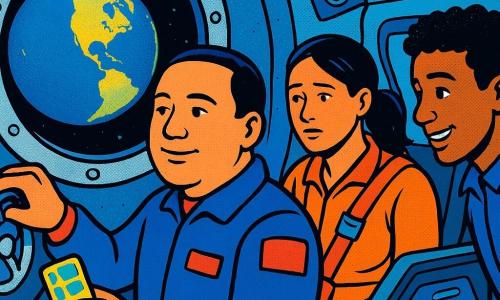
Leo looked out of the window. Earth rolled beneath them—blue, white, and unbelievably alive.
“We're all crew down there,” he said.
Dr. Chen glanced at him. “Say that again, but slower. That's worth sharing.”
So Leo did, speaking into the station's recorded log, knowing it would be heard by students, families, and maybe Maya. “Earth is our first spaceship. We're all crew. And crew members take care of their ship.”
Chapter 7: A Milestone Made Together
That evening—though “evening” was a tricky word when the sun rose and set every ninety minutes—Leo floated near a window with Dr. Chen and Captain Nia. Mission control called it a “crew rest period,” but it felt more like a calm pause in a very busy dream.
Jada's voice came through. “Commander Mercer, we delivered your letter. Your family says they're proud. And your sister says, and I quote, ‘Tell the marshmallow not to melt.'”
Leo laughed, the sound bouncing gently inside the module. “Copy that. Marshmallow remains solid.”
Dr. Chen added, “Please inform her that the suit has temperature controls.”
Jada said, “She also wants to know if you've seen aliens.”
Leo glanced at Nia, who put on her most serious face. “We have,” Nia said. “They are called ‘dust bunnies,' and they live behind the treadmill.”
Dr. Chen snorted. “And they multiply if you don't clean.”
Jada groaned theatrically. “That's the scariest alien story I've ever heard.”
Leo turned thoughtful, watching sunlight paint a bright ribbon across Earth's ocean. “Jada,” he said, “tell the students watching the livestream something for me.”
“Go ahead,” Jada replied. “You're on.”
Leo chose his words carefully, like placing stepping-stones across a stream. “Being an astronaut isn't just about floating. It's about learning the rules of a new place and respecting them. It's about practicing until calm becomes possible. It's about teamwork—engineers, scientists, pilots, doctors, and people who track the weather and the tiniest pieces of space junk.”
Dr. Chen added softly, “And it's about sharing what we learn.”
Leo nodded. “Yes. We learn up here so life down there can be safer, smarter, and kinder to Earth. Knowledge isn't a trophy. It's a tool we pass hand to hand.”
In the quiet, Nia pointed toward a faint shimmer on the edge of the planet. “Look,” she whispered. “Aurora.”
Green light rippled near the poles, like the sky had decided to dance in slow motion.
Leo felt his chest tighten—not with fear, but with wonder. He thought of all the repetitions, the drills, the checklists. They hadn't dulled the magic. They had protected it, like a glass case around something precious.
Dr. Chen floated a small pouch toward him. “We brought something for this moment,” she said.
Inside was a patch—an extra mission emblem, the same thread-bridge between Earth and station.
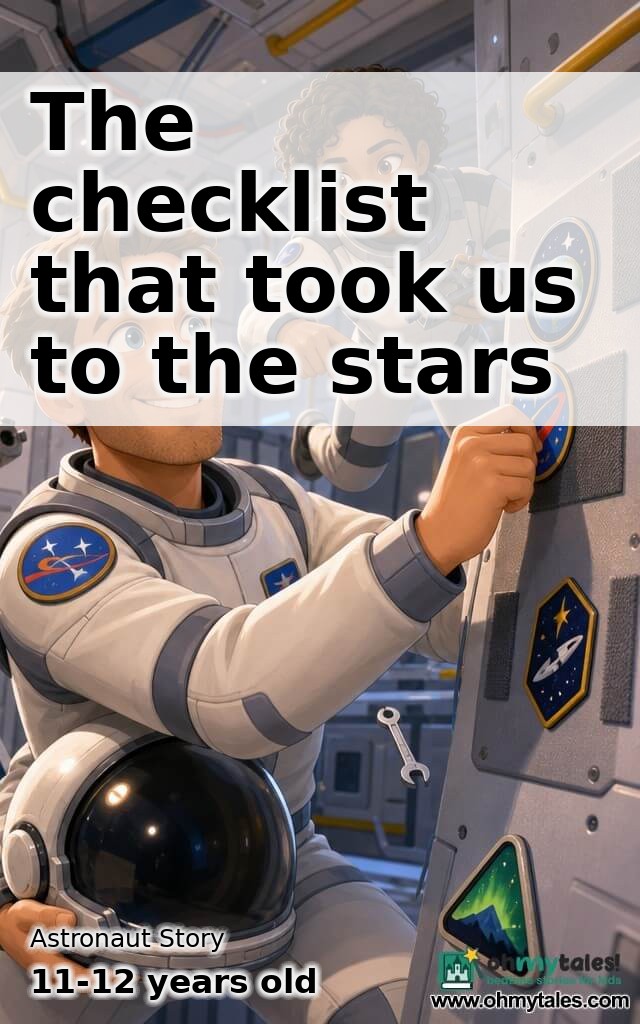
Nia held out a strip of Velcro on the wall. “A tradition,” she said. “When a crew completes their first major task together, we place the patch here. It marks a milestone.”
Leo looked at Dr. Chen, then at the window, then imagined Maya's face if she could see the aurora swirling like green paint in space.
He pressed the patch onto the Velcro. It stuck with a soft rip—a tiny sound, but it felt loud inside his heart.
“There,” Leo said. “Cap crossed.”
Dr. Chen smiled. “And not alone.”
From mission control, Jada's voice warmed the cabin like a lamp. “We see it on the camera. Congratulations, Orion-7. You did it together.”
Leo rested his forehead gently against the window. Earth turned beneath them, patient and bright.
Step by step, he thought. Checklist by checklist. Dream by dream.
And all of it—every careful action, every shared lesson—was a way of saying thank you to the blue world that made space possible in the first place.