Chapter 1: The Quiet After the Fire
The capsule had looked like a bright pebble falling through a black river. Now it sat on the ground, a little scorched, a little proud, surrounded by grass that bent in the wind.
Commander Maya Reyes blinked at the daylight. The hatch was open, and the world smelled like soil and sun-warmed metal. She had trained for this moment for years, yet her heart still thumped like a drum in a small room.
A voice crackled from outside. “Maya, can you hear us?”
“I can,” she answered, steady. Her voice sounded normal, which felt like a miracle.
Two recovery crew members helped her unclip, guide her feet, and stand. Standing was… strange. Her legs remembered gravity, but they also complained about it.
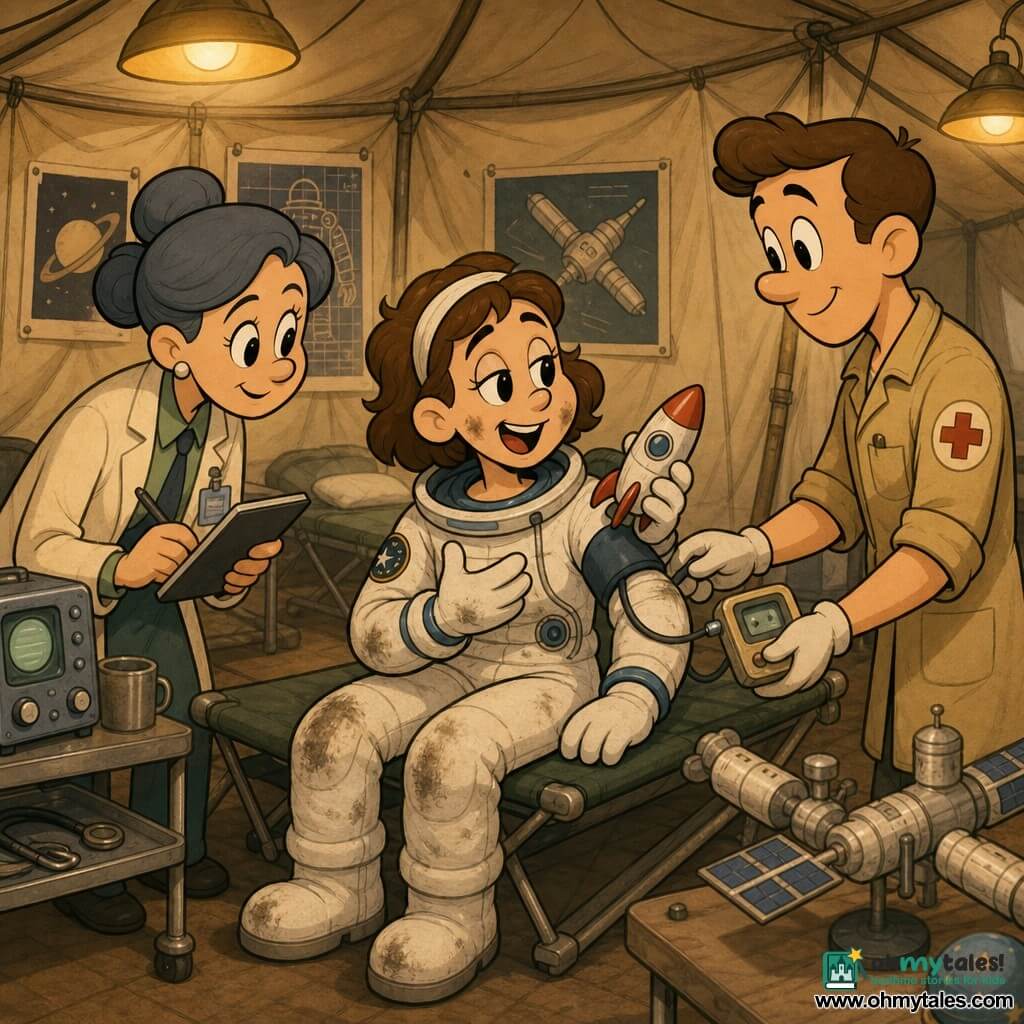
“Easy,” said Noura, the flight doctor, stepping closer with a warm smile and a serious clipboard. “Your body has been living in space for months. It needs a gentle reminder that Earth is home.”
Maya tried to joke. “My legs didn't get the message.”
“They'll read it,” Noura said. “Slowly.”
Maya took a careful step. The ground didn't float away. It stayed where it should, dependable and heavy. She glanced at the medical team—nurses, doctors, and a physiologist—each one watching her like she was a precious glass sculpture.
“Before we walk you to the medical tent,” Noura said, “tell me what you feel. Everything. Even the odd parts.”
Maya nodded. She could be dreamy about stars, but when it came to safety, she was precise. “Okay,” she said. “Let's do it right.”
Chapter 2: The Body That Forgot Down
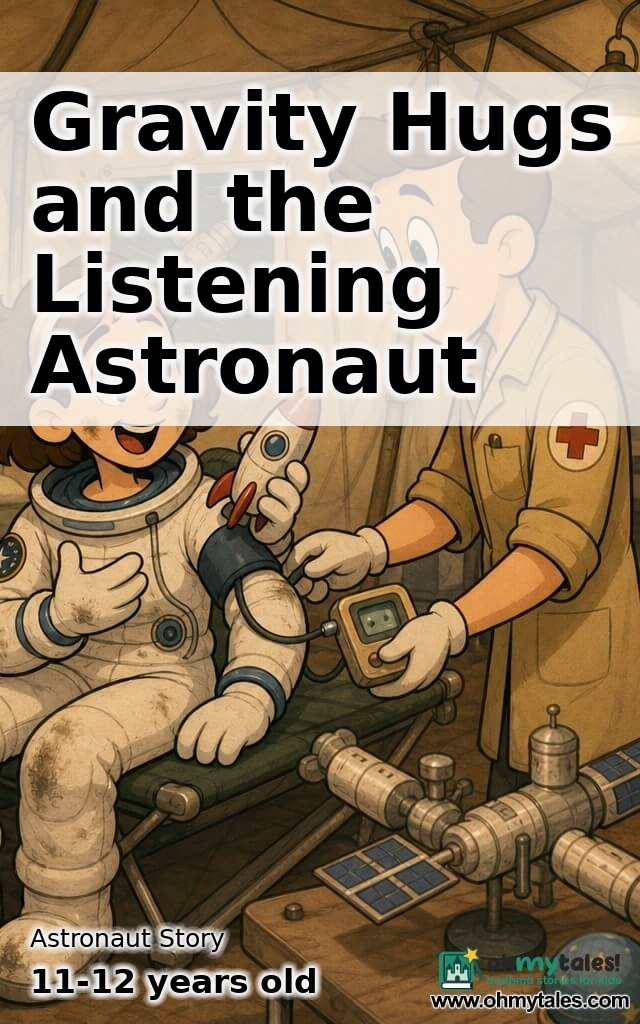
Inside the medical tent, the air hummed softly with machines. A blood pressure cuff hugged Maya's arm. Sticky sensors rested on her chest. Someone wrapped a blanket around her shoulders, even though she wasn't cold. It was comfort you could wear.
Noura pulled up a stool. “Start with your head.”
Maya closed her eyes for a second. “It feels… full,” she said. “Like when you hang upside down too long, except I wasn't upside down. In space, fluids float up toward your head. That's why our faces can look puffy.”
A nurse named Theo wrote quickly. “Head pressure, facial fluid shift,” he murmured.
“And my nose,” Maya added. “It's like having a stuffy cold without the cold. You can breathe, but it feels crowded.”
Noura nodded. “That's common in microgravity. No gravity pulling fluids down.”
Maya opened her eyes. “On the station, it was manageable. Coming back, it's the opposite. Now gravity pulls everything down again, and I feel… heavy. My stomach feels like it's remembering where it belongs.”
“Any dizziness?” Noura asked.
“A little,” Maya admitted. “When I turned my head outside, the horizon sort of tilted. My inner ear is confused. In space, there's no ‘up' or ‘down,' so the balance system gets lazy.”
Theo looked up. “Like a phone that forgot which way is portrait mode.”
Maya laughed, then stopped, checking herself. “Also—my muscles. They're not weak exactly, but they're surprised. In microgravity, you exercise a lot to keep muscles and bones strong. Treadmill, bike, resistance machines. Two hours a day. Still, Earth gravity is… bossy.”
Noura smiled. “Gravity has a confident personality.”
Maya leaned back against the chair, letting the team's calmness hold her steady. “My feet feel odd too,” she said. “On the station, you don't really walk. You push off, you glide, you hook your toes under straps. Now the soles of my feet feel like they're meeting the world again.”
Noura's eyes softened. “Thank you for describing it clearly, Maya. Your job isn't just to travel. It's to help us learn how humans can live and work safely beyond Earth.”
Maya nodded. “And to come back safely,” she added. “Always.”
Chapter 3: What Astronauts Really Do
Later, Maya lay on a narrow bed while a technician scanned her eyes with a small device.
“Still holding steady,” the technician said. “No worries.”
Maya turned her head carefully toward Noura. “Can I tell you something I wish people knew about astronauts?”
Noura's pen hovered. “Go ahead.”
Maya spoke as if she were talking to a kid in a classroom, the way she often did during live calls from the station. “People think we just float around doing flips and looking at stars. And yes, floating is amazing. But most of the time, being an astronaut is like being a very careful handyman in a very complicated house.”
Theo grinned. “A house where the tools can drift away.”
“Exactly,” Maya said. “Every day has a schedule. We check air filters, water systems, carbon dioxide scrubbers. We monitor electricity, batteries, solar panels. The station is a life-support puzzle, and we have to keep every piece working.”
Noura asked, “And the science?”
Maya's eyes brightened. “So much science. We grow plants to see how roots behave without gravity. We test how materials change in space. We study our own bodies—muscles, bones, sleep, vision—so future crews can go farther. And we do it all with teamwork. No one works alone up there.”
Theo tapped his notebook. “Tell us about safety routines.”
Maya's face grew serious. “We train for emergencies until it feels like breathing. Fire. Air leaks. Toxic spills. We practice using masks, sealing hatches, following checklists. In space, you respect tiny problems, because tiny problems can become big fast.”
Noura nodded firmly. “That's the seriousness I remember from your training.”
Maya sighed, the sound gentle. “You can be full of wonder and still be strict about safety. Wonder doesn't mean careless. Wonder means you pay attention.”
Outside the tent, wind brushed the fabric. Maya imagined the station—silent, shining, circling Earth every ninety minutes. She missed it already, but she also felt grateful to be back under a sky that didn't need a helmet.
Noura leaned in. “One more thing,” she said softly. “Emotionally. How are you?”
Maya blinked. “Happy,” she said. “Tired. A bit teary. When you see Earth from space, you don't just see countries. You see one home. It makes you want to listen better. To argue less. To protect more.”
Theo's pen paused. “That's… a good note.”
“It's true,” Maya said. “Up there, the planet looks like it's holding its breath. Down here, we should help it breathe.”
Chapter 4: The Listening Test
The next morning, Maya stood with support bars on either side of her, like a gymnast who had traded the stage for a hallway.
“Ready?” asked Pilar, the physiologist. Her voice was cheerful, but her eyes were sharp. She watched Maya's knees, shoulders, and breathing.
Maya held the bar and rose onto her toes. Her calves trembled. “Ready,” she said, even though her muscles whispered, Are you sure?
Pilar timed her. “Ten seconds.”
Maya made it to eight before wobbling. A nurse steadied her without making a big deal of it, like catching a falling book before it hits the floor.
“Good,” Pilar said. “No rushing. The goal is steady improvement.”
Maya exhaled. “In space, I could do a push-up with one finger,” she teased.
Theo snorted. “Sure you could.”
Maya laughed. “Okay, maybe not. But I could move myself with a gentle tap. Here, I feel like my bones are wearing heavy boots.”
Pilar adjusted the plan on her tablet. “That's why we listen,” she said. “Your body reports. We respond. You don't fight your body. You partner with it.”
Noura came in with a cup of water and a straw. “Tell us about re-entry,” she said. “What did you feel in your chest?”
Maya's smile faded into focus. “Pressure,” she said. “Like someone sitting on your ribs, not painfully, but firmly. During re-entry, you feel several times your body weight. Your heart works harder. Your breathing feels shorter. That's why we practice in centrifuges—to teach our bodies and minds to stay calm.”
Theo looked impressed. “So you're basically trained to be squished.”
Maya raised an eyebrow. “Professionally squished,” she corrected. “With checklists.”
Pilar laughed. “And communication.”
“That's the big one,” Maya said. “On the station, if I feel dizzy or tired, I tell the team. If someone else seems off, I ask. No guessing games. Listening keeps everyone safe.”
Noura leaned against the wall. “Can you give an example?”
Maya remembered instantly. “During a spacewalk practice in the pool, I once felt a sudden pinch in my glove. I almost ignored it because I didn't want to slow the team. But I said it out loud. The instructor checked and found a tiny fold that could have rubbed the material thin over time. A small thing, but we fixed it. Listening saved future me from a bigger problem.”
Theo whistled. “So the lesson is: speak up early.”
“And listen carefully,” Maya added. “Especially when it's boring. Safety can sound boring until it saves you.”
When the session ended, Maya sat down, sweaty and proud of her wobbly progress. She watched the medical team pack away equipment with smooth, practiced motions.
“You know,” she said, “this is teamwork too.”
Noura looked surprised. “What do you mean?”
Maya gestured around. “People cheer for the launch and the landing. But what you do—checking, asking, listening, adjusting—this is how explorers keep exploring.”
Noura's expression softened. “Then we'll keep listening,” she said. “And you'll keep telling us the truth.”
Maya nodded. “Deal.”
Chapter 5: Night Window
That evening, Maya lay in her room at the recovery center. The lights were low, the hallway quiet. Someone had left a small model of the space station on her table, as if to say, We know you miss it.
She opened the curtains a little. The night sky spread out like dark velvet. Stars winked. Somewhere above them, the station would pass, a moving dot of light—busy, steady, doing its endless lap around home.
Her communicator buzzed with a message from her crewmate, Jin, still in orbit.
—Heard you're walking like a newborn giraffe. Proud of you.
Maya typed back with a grin.
—Tell the station I said hi. Also, stop stealing my favorite screwdriver.
—It drifted into my hand. Very mysterious.
Maya set the device down and listened to the quiet. She noticed her body again: the gentle ache in her thighs, the odd tug in her lower back, the slow settling feeling in her head. Earth was rearranging her from the inside.
A soft knock came at the door. Noura stepped in, holding a folder.
“Sorry,” Noura said. “One last check-in. How's your sleep?”
Maya shrugged. “In space, we use sleeping bags strapped to the wall. You don't feel the mattress. Here, the bed feels like it's hugging me too much.”
Noura chuckled. “Gravity hugs are intense.”
“It's not bad,” Maya said. “Just… different. Also, I keep expecting my water bottle to float away.”
Noura sat in the chair by the bed. Her tone turned gentle. “You did well today, Maya. You told us exactly what you felt. That helps the next crew, the next mission.”
Maya looked at the folder. “What's that?”
“Your post-flight notes,” Noura said. “And a small request. Tomorrow, a group of students will visit the center. They're curious about space. Would you talk to them?”
Maya's tiredness lifted slightly. “Yes,” she said. “If I can sit.”
“You can sit,” Noura promised. “And you can remind them that astronauts are not fearless superheroes. We're trained, careful people who ask questions.”
Maya smiled at the ceiling. “And who listen,” she added.
Noura nodded. “And who listen.”
When Noura left, Maya lay still, letting the quiet wash over her. Her thoughts drifted like they used to in microgravity, slow and gentle. She pictured Earth again, blue and white and unbelievably delicate, like a marble you'd be terrified to drop.
“Goodnight,” she whispered to the planet, to the station, to the tired parts of herself.
Outside, the stars kept watch.
Chapter 6: The Toy Rocket in the Drawer
The next day's student visit went by in a blur of curious faces and eager questions.
“Did you eat ice cream in space?”
“No,” Maya said. “Crumbs float. Crumbs are trouble.”
“Did you ever get scared?”
“Yes,” Maya answered honestly. “But I didn't let fear drive the ship. I let training and teamwork drive it.”
“Do you miss it?”
Maya paused, then nodded. “I miss the view. But I'm happy to be back where trees grow and rain falls. Space teaches you to respect Earth.”
After the students left, Maya returned to her room, pleasantly worn out. She opened her suitcase, hunting for a clean shirt, when her fingers found something hard and familiar in a side pocket.
A tiny toy rocket.
It was old plastic, the paint chipped at the nose. She hadn't packed it on purpose. It must have slipped in months ago, maybe during the frantic days before launch, when her family visited and her niece played with her things.
Maya sat on the bed and turned the rocket in her hands. The toy was simple—no flashing lights, no moving parts. Yet it carried a whole universe of memory.
She saw herself at eight years old on a carpet, building “missions” out of couch cushions. She heard her mother's voice: “Tell me your plan.” She remembered explaining, very seriously, how her stuffed animals would share oxygen and take turns at the “control panel.”
Back then, she hadn't known the real words—microgravity, re-entry forces, carbon dioxide scrubbers. But she had known something important: that adventures work better when everyone listens to everyone.
A quiet knock sounded. Theo leaned in. “Noura says your vitals look good. You're officially improving.”
Maya held up the toy rocket. “Look what I found.”
Theo laughed. “Commander Reyes, is that your secret spacecraft?”
“Don't tell anyone,” Maya said, lowering her voice dramatically. “It's my backup vehicle.”
Theo stepped in, his grin softening. “It's kind of perfect,” he said. “You went to space, and you came back to… a toy that started it.”
Maya nodded, feeling a warm lump in her throat. “It reminds me that big dreams don't arrive all at once,” she said. “They start small. A question. A drawing. A toy. Then training. Then teamwork. Then listening—over and over—until the dream becomes something you can do safely.”
Theo's voice grew gentle. “And then you land and tell the medical team exactly how your legs feel.”
Maya laughed. “Exactly.”
She placed the toy rocket on the table beside the model space station. Two rockets—one pretend, one precise—standing together like old friends.
Maya lay back and listened to the steady sounds of Earth: distant footsteps, soft wind, the quiet creak of a building settling. She felt tired in a good way, the way you feel after finishing a long, careful project.
In her mind, she watched her younger self push the toy rocket across the carpet, whispering countdown numbers with great seriousness.
Maya closed her eyes, smiling.
This time, the landing was gentle, and she knew she wasn't alone.