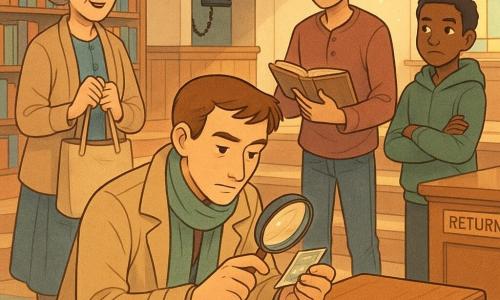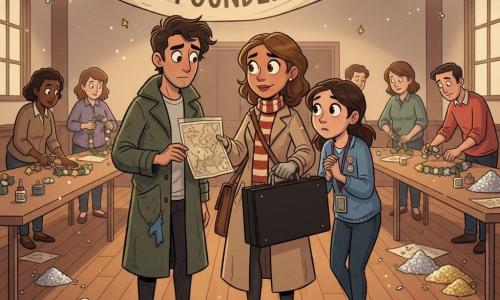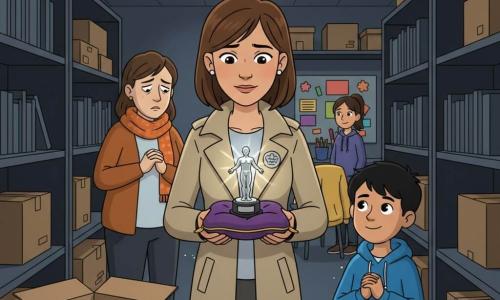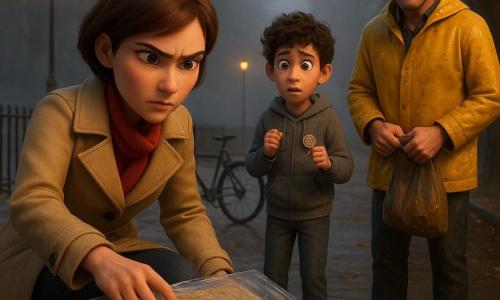
Chapter 1: The Missing Map
Rain threaded down the window of Mira Caldwell's office in thin, steady lines, like someone had drawn on the glass with a pencil that wouldn't stop. Mira liked rain. It made people hurry. It made details stand out.
She set her notebook on the edge of the desk—always the same place, always the same pen. Being careful wasn't just a habit for her. It was a method.
The bell above the door jingled. A woman in a damp yellow coat stepped inside, clutching a canvas tube to her chest.
“Ms. Caldwell?” she asked.
“Mira,” Mira said. “Sit. Tell me what happened.”
The woman lowered herself into the chair as if it might bite. “I'm Lena Hart. I work at the Briar Street Library. We were opening a donation box this morning. Inside was an old hand-drawn map. Beautiful. Local history. It looked… important.”
“And now it's gone,” Mira said.
Lena's eyes widened. “How—”
“People don't hire me to admire what they still have,” Mira replied gently. “When did you notice it missing?”
“An hour ago. I put it in the archive room. Locked the door. I went to help at the front desk for ten minutes. When I came back… the tube was still there, but the map was gone. Like someone slid it out and walked away.”
Mira leaned forward. “Why do you think someone wanted that map?”
Lena swallowed. “Because of what was written on the back. A note. In faded ink. It said: For the one who keeps the promise. And there was a little drawing of a bench.”
“A bench?” Mira repeated. She underlined the word in her notebook. “In what style?”
“Simple. Park bench. Like any other.”
Mira stood, taking her coat. “Let's go to the library. And Lena—don't tidy anything. A messy room tells the truth faster than a neat one.”
On the way out, Mira glanced through the rain-smeared glass. On the sidewalk across the street, an ordinary passerby—average height, plain jacket, grocery bag—paused as if listening. Their face was half hidden under a hood. Then they moved on.
Mira noted it anyway. Ordinary was sometimes a costume.
Chapter 2: The Quiet Archive
The Briar Street Library smelled of paper and warm dust, like time kept in shelves. Mira followed Lena past the whispering reading tables and into the staff hallway. The archive room door stood closed.
“It was locked,” Lena said. “I had the key the whole time.”
Mira crouched near the lock, careful not to touch the metal. “Then either the lock didn't do its job, or someone didn't need it to.”
She nodded toward the floor. “Do you see those faint marks? Like little commas?”
Lena squinted. “Scuffs?”
“Rubber,” Mira said. “From a cart wheel. Something rolled in here.”
Inside, the room was small and dim. Boxes sat stacked like silent bricks. On the center table lay the empty canvas tube.
Mira didn't rush. She looked the way some people listened—patiently, as if the room might confess.
“No broken window,” she murmured. “No forced door. That means someone had a key, or someone walked out with it in plain sight.”
Lena wrung her hands. “Only staff have keys.”
“How many staff?”
“Five. Me, Mr. Dobbins the head librarian, Kendra from archives, Omar at the front desk, and… Jonah. He's a volunteer. High school. He helps carry boxes.”
Mira lifted the tube with two fingers. “Was the map rolled tight?”
“Yes. Very.”
“And the note was on the back?” Mira asked. “Did you read all of it?”
Lena shook her head. “Just that line. I was going to show Mr. Dobbins.”
Mira opened the tube carefully. A few pale grains clung inside. She tapped them onto a sheet of scrap paper.
“Sand?” Lena guessed.
“Or something like it,” Mira said. “Do you have sand in the archive room?”
“No.”
Mira wrote: pale grit in tube. Then she asked, “Who knew the donation box contained a map?”
“Just me and Omar. We opened it together.”
“Omar,” Mira repeated, filing the name away.
A door clicked somewhere down the hall. Footsteps approached, brisk and confident. A man with silver hair and sharp glasses appeared.
“Mira Caldwell,” he said, smiling without warmth. “I heard we have trouble.”
“Mr. Dobbins,” Lena said quickly. “The map—”
“I know,” he cut in. “A ridiculous situation. We are a library, not a market stall.”
Mira studied him. His tie was perfectly straight. His shoes were too clean for a rainy day.
“Who has been in this room today?” Mira asked.
Dobbins lifted his chin. “Only Lena. I was in my office. Kendra is cataloging upstairs. Omar has been at the desk. Jonah… Jonah is probably late, as usual.”
Mira didn't argue. She asked one more question, soft as a page turning. “Do you know why the map might matter?”
Dobbins's smile thinned. “Old paper matters to people who have too much time.”
Mira heard the crack in that sentence. It wasn't anger. It was worry dressed as boredom.
She turned to Lena. “Show me the donation box. And the place you opened it.”
As they walked back through the library, Mira's gaze drifted to the front windows. Outside, across the street again, the same ordinary passerby stood near the bus stop. Hood up. Grocery bag dangling. Still. Watching the doors as if waiting for a specific person to come out.
Mira felt the familiar tug of a question. Why wait in the rain unless you needed to see something?
She didn't wave. She didn't stare. She simply memorized: plain jacket, dark sneakers, grocery bag with a green logo.
“Lena,” she said quietly, “does anyone in town collect old maps?”
Lena hesitated. “There's a man… Mr. Pike. He runs Pike's Antiques near the river. He loves anything old.”
Mira nodded. “Good. We'll visit him. But first, I want to understand something.”
“What?”
Mira looked back at the archive hallway. “Why steal the map and leave the tube?”
Lena frowned. “Maybe they panicked?”
“Or,” Mira said, “they wanted someone to think it was stolen quickly. Like a loud distraction.”
She turned to the reader—if you were there with her, she would have asked you directly:
If someone takes the map but leaves the tube, what does that tell you about how they carried it away?
Chapter 3: The Ordinary Passerby
Pike's Antiques sat by the river like it had been waiting for decades to be discovered. Its windows were crowded with lamps, postcards, and a stuffed owl that looked mildly offended. A bell chimed when Mira pushed the door open.
A man with a long gray beard peered over his glasses. “If you're selling, I'm buying. If you're browsing, don't touch the sword.”
“We're not here for swords,” Mira said. “We're looking for a hand-drawn map that went missing today. It may have a note on the back.”
Mr. Pike's eyebrows climbed. “A map, you say. How old?”
“Unknown,” Mira replied. “But it came in a donation box. And there was sand in the tube.”
“Sand?” Pike repeated, leaning closer, intrigued despite himself. “River sand or beach sand? Big difference.”
Mira held out the scrap paper with the pale grains. Pike pinched one between his fingers, rolled it, and sniffed. Mira watched him, unimpressed by the sniffing but attentive to the confidence.
“Not river,” Pike said. “Too light. This looks like the sand from the old playpit at Maple Park. They redid it years ago, but some corners still have that pale stuff.”
“Maple Park,” Mira echoed. Another underline in the notebook.
Pike's eyes narrowed. “If it's local history, you should talk to Kendra Vale.”
“Kendra?” Lena said. “She works in our archives.”
Pike nodded. “Her grandfather used to keep scrapbooks. Photos, notes, old town plans. Kendra grew up around that. If anyone recognizes a map, it's her.”
Mira didn't miss how Lena's mouth tightened. “Kendra didn't say anything.”
“Maybe she didn't have to,” Mira said.
Outside, the rain had eased into a mist. Mira and Lena stepped onto the sidewalk. The street smelled like wet stone and car exhaust.
Across the road, the ordinary passerby walked past them at a normal pace. Close enough now for Mira to see the grocery bag clearly. The green logo was a smiling pear—PearlMart, the discount store on the edge of town.
The passerby's hood slipped back for half a second. A plain face. Brown hair. No dramatic scar. No villain moustache. Just… ordinary.
But their eyes flicked toward Mira's notebook.
Mira stepped slightly to the side, blocking it without making a show. The passerby kept walking.
Lena whispered, “Do you think—”
“I think they want us to notice them,” Mira said. “Or they don't care if we do. Both can be useful.”
“Should we follow?” Lena asked.
Mira considered. Being careful meant choosing the right moment.
“Not yet,” she said. “First, we talk to Kendra. Then we decide if the ordinary person is truly ordinary.”
Back at the library, Kendra Vale was in the upstairs archive office, surrounded by folders and sticky notes. She wore a sweater covered in tiny embroidered constellations, as if she liked keeping track of patterns.
“Mira Caldwell,” Kendra said, smiling politely. “I've heard of you. You find things.”
“Sometimes,” Mira replied. “Do you know about the missing map?”
Kendra's eyes widened just the right amount. “Only that Lena mentioned it. A shame. Old items can be fragile.”
Mira set her notebook down, open. “Maps are also specific. What kind of map was it?”
Kendra hesitated. “I haven't seen it.”
Mira nodded as if she believed her. “Then tell me about Maple Park. Did you go there as a child?”
Kendra blinked. “Everyone did.”
“Did your family ever take photos there?” Mira asked.
Kendra's smile froze. “Why?”
Mira leaned back. “Because someone stole a map and left sand that matches Maple Park's old playpit. And because the note on the back mentioned a promise and a bench.”
Kendra's gaze shifted toward a filing cabinet behind her. Just a glance. Quick, nervous.
Mira didn't pounce. She let silence do the work.
Finally Kendra said, “I have old photos from my grandfather. Lots of them. But that doesn't mean I stole anything.”
“I didn't say you did,” Mira replied. “I'm asking because old photos can explain old promises.”
Kendra crossed her arms. “My grandfather died when I was ten. He loved this town. He… he believed people should keep their word.”
“Did he ever mention a bench?” Mira asked.
Kendra's jaw tightened. “Not to me.”
Mira stood. “Then I'd like to see those photos.”
Kendra exhaled sharply. “They're not here. They're at my apartment.”
“Then we go there,” Mira said.
Kendra's eyes flashed. “That's private.”
“So is stealing,” Mira said calmly. “And right now, a library's trust is at stake.”
Kendra looked between Mira and Lena. Lena's face was pale but firm. Cooperation wasn't always cheerful. Sometimes it was choosing to stand together when it felt uncomfortable.
Kendra swallowed. “Fine. But you're not rummaging through my drawers.”
“I don't rummage,” Mira said. “I observe.”
As they headed downstairs, Mira's phone buzzed. A message from an unknown number: STOP DIGGING.
Mira showed it to Lena, then tucked the phone away.
“Now,” Mira said softly, “we follow the ordinary passerby too.”
Chapter 4: The Old Photograph
Kendra lived above a bakery that smelled like cinnamon and melted butter. Her apartment was tidy in the way tidy people are when they want you to notice they're tidy. Mira's eyes moved from the clean counter to the clean floor to the one place that wasn't clean: a cardboard box under the coffee table, scuffed at the corners.
Kendra saw Mira looking. “Those are my grandfather's things.”
“May I?” Mira asked.
Kendra nodded, stiff.
Mira opened the box carefully. Inside were albums, envelopes, and a small stack of loose photographs. She didn't grab. She lifted one photo at a time, holding them by the edges.
Most showed boring, lovely town moments: a parade, kids with painted faces, a snowman with a crooked carrot nose.
Then Mira found it.
An old photograph, faded at the corners. Maple Park. A bench in the background, slightly tilted, its wood slats darker than the rest of the scene. In the foreground stood three people: two adults and a child, all smiling. One adult held a rolled paper—like a map—tied with string.
On the back of the photo, in the same faded ink Lena had described, were words:
For the one who keeps the promise.
Below the words was a small sketch of the same bench.
Mira's skin prickled. “This is connected,” she said.
Kendra's face changed. Not guilty, exactly. More like startled, as if a memory had popped up from under the floorboards.
“I've never seen that writing,” Kendra said. “I swear.”
Mira turned the photo over again. “Then someone added it later. Or you never looked closely.”
Lena leaned in. “Who are they?”
Kendra pointed. “That's my grandfather, Elias Vale. And… that's Ruth Penn. She used to run the community garden. The child… I don't know.”
Mira's mind clicked through options. “Ruth Penn,” she repeated. “Is she still alive?”
Kendra shook her head. “She moved away years ago. No one knows where.”
Mira studied the bench in the photo. Behind it, half-hidden by trees, was a little sign. The letters were blurry, but the shape was familiar.
“That's the old Lost & Found board,” Lena said suddenly. “Maple Park used to have a board where people pinned notes.”
Mira nodded. “A promise,” she murmured. “A bench. A map. This isn't random. It's a message.”
She turned to Kendra. “Did your grandfather ever talk about hiding something? Like a time capsule?”
Kendra's eyes darted away. “No.”
Mira waited.
Kendra's shoulders dropped. “Okay. Maybe. He used to tell a story when I was little. He said that when he was young, he and two friends made a promise to protect something important to the town. Something people would fight over if they knew. He said it was safer if it stayed… quiet.”
Lena whispered, “The map could lead to it.”
Mira nodded. “And someone wants to be ‘the one who keeps the promise.' Or wants others to think they are.”
She looked at Kendra. “Who else has seen this photo?”
Kendra frowned. “No one. I keep the box closed.”
Mira's gaze slid to the bookshelf. A fresh gap in dust where something had recently been moved. “You keep it closed,” Mira agreed. “But has anyone been here? Recently?”
Kendra's cheeks flushed. “Jonah came over yesterday. He's my cousin. He helped me carry groceries.”
Lena stiffened. “Jonah the volunteer?”
Kendra nodded, defensive. “He's not a criminal.”
Mira didn't argue. “What groceries?”
Kendra blinked. “Just bags. From PearlMart.”
Mira heard the click. Ordinary passerby. PearlMart bag.
She walked to the window and looked down at the street. A figure stood under the awning across the road, pretending to check their phone. Plain jacket. Hood. PearlMart bag.
The ordinary passerby looked up and met Mira's eyes for half a second.
Then they walked away.
Mira turned back. “We're going to Maple Park,” she said. “Now.”
Lena grabbed her coat. Kendra hesitated, then nodded.
“Cooperation,” Mira added, looking at both of them, “means we move together. No solo heroes. No secret side trips.”
Kendra's lips pressed into a line. “Fine.”
On the way out, Mira slipped the old photograph into an evidence sleeve. She didn't know yet who the thief was.
But she knew where the story began.
Chapter 5: The Map That Wanted to Be Found
Maple Park was quieter than the town streets, wrapped in damp leaves and the soft squeak of swings moving in the wind. The pale sand playpit lay near the center, exactly as Pike had described—lighter than the muddy paths around it.
Mira led them toward the benches.
There were three benches along the main path. One near the playground. One near the pond. One under a crooked oak tree.
Mira stopped at each, observing. Not just the bench, but the ground around it. The way the grass grew. The way people walked past.
At the bench under the oak, the earth looked slightly disturbed, as if someone had pressed their heel into it repeatedly. Near one bench leg, a thin line of pale sand ran like a trail.
Lena whispered, “Here.”
Mira crouched. “Don't touch.”
Kendra leaned over, hands tucked under her arms as if afraid her fingers might act on their own. “So the thief came here.”
“Or the map came here,” Mira said. “Maps don't steal themselves, but they do invite people to follow.”
Mira studied the bench. The wood slats were old, but one slat looked newer—slightly lighter, less weathered.
She tapped it lightly. The sound was different. Not hollow, but… wrong.
“Someone replaced that slat,” Mira said.
Lena's eyes widened. “Why?”
“To hide something,” Mira replied. She looked around. A few joggers passed. A dad pushed a stroller. A group of kids kicked a soccer ball, their laughter cutting through the damp air.
Mira kept her voice low. “We need to open it, but not in front of everyone.”
Kendra nodded. “There's a maintenance shed near the pond. The park worker has tools.”
Mira pointed. “You—Kendra—go ask for a screwdriver. Lena, stay with me. Watch the path.”
Lena's eyes sharpened. “For the ordinary passerby?”
“For anyone,” Mira said. “Mysteries don't always wear hoods.”
While Kendra hurried off, Mira stood beside the bench, pretending to check her phone. Her real attention stayed on reflections in the pond, on footsteps behind them, on the pattern of people moving.
A figure approached on the gravel path. Plain jacket. Hood. PearlMart bag.
Lena's breath caught. “That's them.”
The passerby slowed near the bench. Mira saw their hands flex, like someone about to make a decision.
Mira stepped forward, calm as a closed door. “Hello.”
The passerby froze.
“Can I help you?” Mira asked.
They hesitated. Then they forced a smile that didn't fit their face. “Nice day.”
“It's raining,” Lena said.
The passerby's smile twitched. “I meant… nice park.”
Mira held their gaze. “You've been near the library. Near Pike's shop. Now here. That's a lot of coincidence.”
The passerby swallowed. “I just… walk.”
Mira nodded. “What's in the bag?”
The passerby tightened their grip. “Groceries.”
Lena leaned slightly to the side. The bag didn't sag like groceries. It held something stiff.
Mira didn't grab it. She didn't shout. She used logic like a key.
“You stole the map,” she said quietly. “But you left the tube. That means you didn't carry it rolled. You carried it flat. You didn't want to crease it. You cared about it.”
The passerby's eyes flicked toward the bench.
Mira continued, steady. “You came here because the map led you here. You think you're keeping a promise. But you're not the only one who can keep it.”
At that moment Kendra returned, out of breath, with a screwdriver and a park worker behind her—broad-shouldered, wearing a green vest.
“What's going on?” the worker asked.
The passerby's face collapsed, like a mask slipping. They reached into the bag, not for a weapon, but for a rolled paper tied with string.
“I didn't steal it to sell,” they blurted. “I— I took it so nobody else could.”
Mira held out her hand, palm up. “Give it to me.”
The passerby hesitated. Then placed the roll into Mira's hand as if it weighed too much.
Mira looked at them. “Name?”
“…Omar,” they said, voice small. “Omar Rez. I work the front desk.”
Lena's eyes flashed. “Omar!”
“I saw the note,” Omar said quickly. “When we opened the donation box. And I remembered my grandma talking about a promise at Maple Park. She said people once hid something that belonged to everyone, but some rich guy tried to take it. She said, ‘If you ever see a bench drawn on old paper, you take it to the bench first. Don't trust offices. Don't trust suits.'”
Mira's mind flicked to Mr. Dobbins's too-clean shoes.
“So you took the map,” Mira said, “because you didn't trust the library.”
Omar nodded miserably. “I didn't want Mr. Dobbins to get it. He's… always asking about donations. Always checking what's valuable.”
Lena's anger wavered into something else. “You could've told me.”
Omar's eyes shone. “I panicked. I thought I was doing the right thing.”
Mira tightened her grip on the map. “Doing the right thing is rarely done alone,” she said. “That's why promises matter. They connect people.”
She turned to the park worker. “Can you help us remove that bench slat?”
The worker nodded. “If it's maintenance-related, sure.”
Mira looked at Lena, Kendra, and even Omar. “All of us,” she said. “We open it together.”
Chapter 6: The Bench in the Park
The park worker knelt and loosened the screws while Mira watched his hands, counting turns, noting how the newer slat lifted slightly. Beneath it was a narrow cavity, lined with waxed paper.
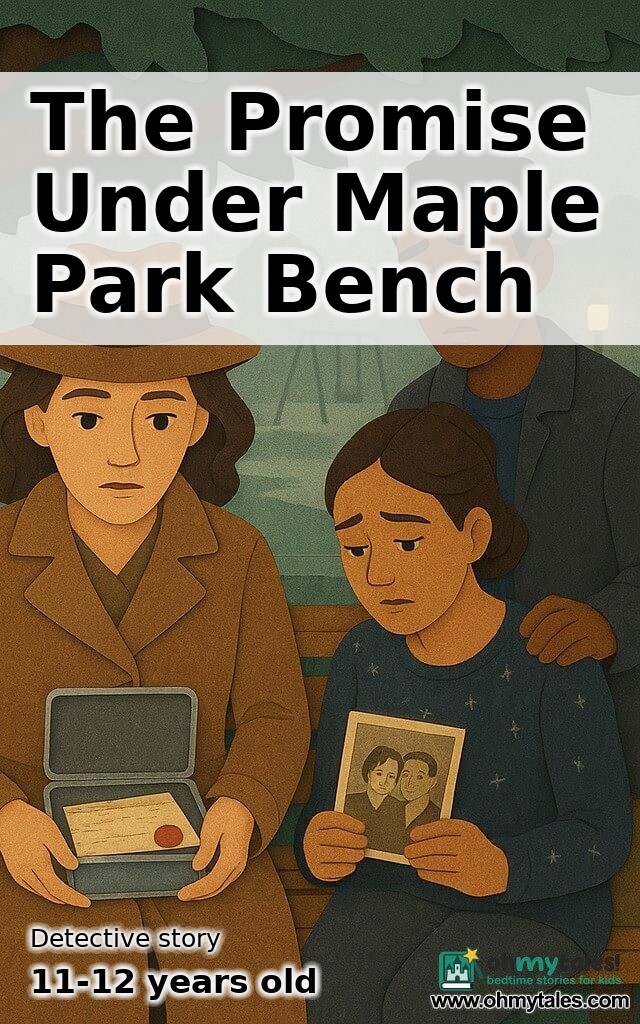
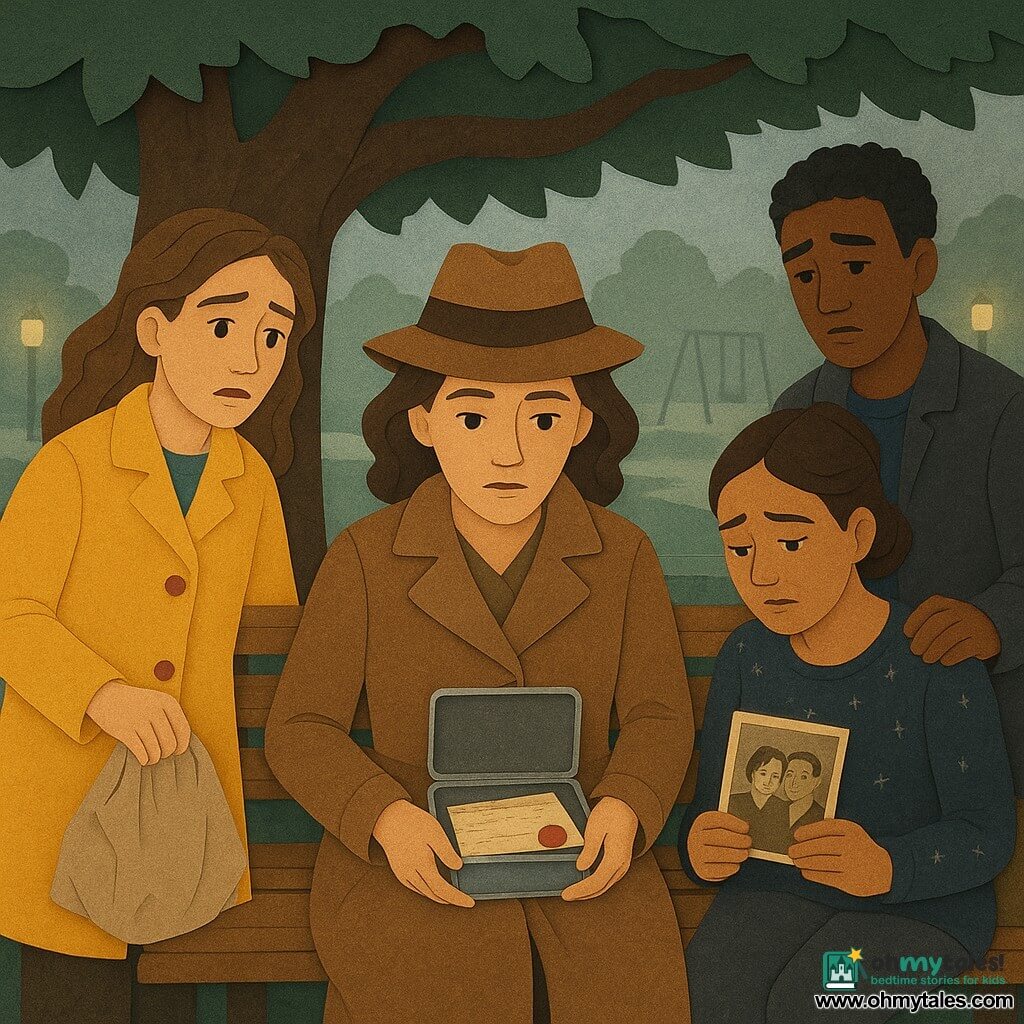
Inside lay a small metal tin, the kind people used for cookies long ago. The worker handed it to Mira, and Mira set it on the bench between them like it was a fragile truth.
“Ready?” Mira asked.
They all nodded—Lena anxious, Kendra pale, Omar tense.
Mira opened the tin.
Inside was an old envelope, thick and sealed with red wax. Next to it lay a photograph—another one—showing the same bench, the same three people, and the child holding a sapling. Written along the bottom in tidy handwriting: For Maple Park, for everyone.
Mira lifted the envelope. The wax seal was stamped with a simple image: an oak leaf.
Kendra whispered, “My grandfather…”
Mira broke the seal carefully and slid out the contents. Not money. Not jewels. Papers.
A deed. An agreement. A letter.
Mira read aloud, her voice steady over the rustle of leaves:
“This park land was nearly sold fifty years ago. Elias Vale, Ruth Penn, and Thomas Rez”—she glanced at Omar—“worked together to stop it. They raised funds, gathered signatures, and hid the final papers until the town council could be trusted again. If you are reading this, it means someone found the map. Remember: the park belongs to everyone. Protect it together.”
Omar let out a shaky breath. “Thomas Rez was my grandfather.”
Lena's hand went to her mouth. “So the promise was real.”
Mira nodded. “And the map was a test. Not to find treasure— to find the people willing to protect something without grabbing it for themselves.”
Kendra stared at the letter, eyes wet. “Why hide it under a bench?”
“Because benches are for waiting,” Mira said. “For thinking. For meeting. It's a simple place, and simple places are harder to suspect.”
Footsteps crunched on gravel behind them.
Mr. Dobbins's voice sliced through the park air. “Well. How charming. A little group outing.”
Mira didn't turn quickly. She turned smoothly, keeping her body between Dobbins and the tin.
Dobbins smiled, but his eyes fixed on the envelope. “I had a feeling you'd run straight to Maple Park. Old notes, old benches. So predictable.”
Lena stood up, anger returning. “You followed us?”
“I followed my library's property,” Dobbins corrected. “That map is valuable. Documents like these can be… leveraged. A proper institution could manage the park better than a messy town council.”
Mira heard it clearly now: not worry. Hunger. Controlled, polite, and sharp.
Mira held up the letter. “This isn't yours. It belongs to the town.”
Dobbins stepped closer. “Hand it over, Mira. I can make this easy.”
Mira's voice stayed calm. “Easy isn't the same as right.”
She looked to Lena. “Call the council office. Tell them we found the deed and the letter. Ask them to send someone.”
Lena pulled out her phone, hands steady now that the path was clear.
Dobbins's smile faltered. “You can't prove anything.”
Mira nodded toward Omar. “Actually, we can. Omar saw the note on the map. He panicked and took it. That's wrong—but it's honest. The rest is paper history, sealed and dated.”
Omar lifted his chin. “I'll tell them everything.”
Kendra added quietly, “And I'll bring my grandfather's photos. They match the letter.”
Dobbins's face hardened. He looked around, perhaps noticing the park worker standing nearby with crossed arms and a radio on his belt.
Dobbins took a step back. “This is ridiculous,” he muttered, already rearranging his story in his head like books on a shelf.
Mira watched him go, his shoes still too clean, disappearing down the path where wet leaves stuck to the soles of everyone else's.
When he was gone, the park seemed to exhale.
Mira sat on the bench—the bench—and set the tin beside her. The wood was damp, cool through her coat, solid under her weight.
Lena sat next to her. Kendra sat on the other side. After a hesitant moment, Omar sat too, clutching the now-empty PearlMart bag like a wrinkled flag of surrender.
They were quiet for a minute, listening to the faint squeal of swings and the distant shouts from the soccer field.
Mira tapped her notebook with her pen. “Let's finish this carefully,” she said. “We'll make copies of everything. We'll hand the originals to the council with witnesses. We'll report the map theft honestly. Omar, your reason matters, but actions have consequences. Lena, your caution mattered too—you brought help instead of hiding it. Kendra, your family's history connected the pieces.”
Omar nodded, swallowing. “I should've trusted you.”
“You don't need to trust one person,” Mira said. “Trust the process. Trust cooperation. That's what the promise was really about.”
Lena gave a small, tired laugh. “All this… because of a bench.”
Mira looked at the oak tree above them, its branches dripping like dark curtains. “Benches look ordinary,” she said. “So do people. That's why I pay attention.”
She glanced at the place where Dobbins had vanished, then back at the letter.
The mystery had started with a missing map, twisted with an ordinary passerby, and turned on an old photograph.
Now it ended where it had been waiting all along—on a simple bench in the park, with four people sitting close enough to share the weight of a promise.