1. The Vanishing Trophy
By the time Emma Cole reached the edge of the school field, the night had already swallowed the last bit of sunset. The floodlights around the running track hummed softly, throwing bright white circles on the red lanes and leaving everything beyond in heavy shadow.
The sports hall doors stood wide open like a silent shout.
Emma's trainers squeaked on the polished floor as she stepped inside. The smell hit her first: sweat, floor polish, and something else she couldn't name, sharp and metallic. The Year Nine Athletics Championship had ended an hour ago, and the teachers had gone to the staffroom for their meeting. The place should have been empty.
It wasn't.
Coach Bradley stood frozen by the trophy table, his face pale and shiny in the harsh light.
“Emma. Good. You're here,” he said, voice low and tight. “You're… good at puzzles. I need eyes on this.”
Emma's gaze travelled to the centre of the table.
There was an empty square of dust.
Four smaller silver cups gleamed in their places, but the big one, the city trophy—the one their school had finally won for the first time in ten years—was gone. Only a faint ring marked where it had stood.
Emma's mind began lining things up, like puzzle pieces.
“Who's been in here since the race ended?” she asked.
“Only the team, then a few parents, then I locked up.” Coach rubbed the back of his neck. “I went to check the store room. Came back, and…” He waved helplessly at the empty space.
“The doors?” Emma asked.
“Front doors were locked. Fire exit at the back is alarmed. No noise, no alarm.”
“So someone took it before you locked up,” Emma said. “Or they're still inside.”
The thought slid quietly into both their minds at the same time.
Emma turned slowly, scanning the hall. The basketball hoops hung like giant spiders. The climbing ropes twisted slightly in the air conditioning. Shadows puddled in the corners.
She spoke half to herself, half to the air. “Mysteries don't solve themselves. They leave crumbs.”
Her heart beat faster, not with fear, but with focus. This was what she liked best: when something didn't fit, and her job was to make it fit.
She stepped closer to the trophy table. A faint line of dust curved away from the empty square, like something heavy had been dragged a few centimetres and then lifted.
She knelt to look at the floor. No scratches. No marks.
“Think with me,” Emma murmured, as if talking to an invisible partner. “If you were a trophy and you wanted to disappear, where would you go?”
This was how she always started: imagine the object itself, imagine what it ‘wanted'. It helped her notice what was out of place.
She looked up again.
The school mascot banner, a giant blue falcon, hung lopsided above the doors. One corner had slipped free of its hook.
It bothered her. Not because it mattered, but because it was the only thing in the room that didn't look the way it should.
“Coach, who else knew the trophy was going to be here tonight?” she asked.
“Most of the school,” he said. “It was on every poster. ‘Come see Riverside win the city trophy.'” He sighed. “You think it's one of the kids?”
“I think,” Emma said slowly, “that someone tried very hard to make this look simple. And simple is suspicious.”
She straightened up.
“I'll need to talk to the team,” she said. “All of them. Before anyone goes home.”
2. Three Stories and a Lie
They gathered in the changing room: six athletes in various states of nervousness and sweat, sitting on the hard benches. Their sports bags slumped at their feet like guilty dogs.
Emma leaned against the row of lockers, arms folded. She wasn't a teacher. She was just… Emma. But most of the school knew she had a habit of noticing things other people missed. Teachers called it “observation”. Her mum called it “sticking your nose where it doesn't belong”. Emma called it “not being able to switch off her brain”.
“Okay,” she said. “The trophy disappeared in the last hour. That means someone in this building saw something strange. Even if you don't think it matters, I want to hear it. One at a time.”
She turned to the first person: Leo, the sprinter, still in his running vest, legs bouncing restlessly.
“I packed up my spikes, grabbed my phone from the bleachers, and went outside to call my mum,” he said quickly. “I was only gone like… two minutes. I didn't see anyone go near the table.”
“Where were you standing when you called her?” Emma asked.
“Near the bike racks.”
“Did you see the back fire exit?” she pressed.
He frowned. “From there? No. It's round the corner.”
Emma filed that away.
Next was Priya, the long-distance runner. Her hair was still damp from her quick shower, and she twisted the end of her ponytail around her fingers.
“I went to the office to see if my dad had arrived,” she said. “The trophy was still there when I left the hall. I remember because the light caught it, and I thought it looked like it was staring at me.”
“Trophies don't have eyes,” Leo muttered.
“Metaphor,” Priya snapped.
Emma smiled faintly. “How long were you gone?”
“Five minutes? Maybe six.”
“Did you see anyone in the corridor?”
Priya paused. “The caretaker. Mr Bennett. He was locking the music room.”
“Good. That's a detail,” Emma said. “Thank you.”
Next was Hannah, the high jumper, her plait fraying at the edges.
“I stayed in the hall the whole time,” she said. “I was filming Ed doing his victory dance. It was very bad.”
“It was iconic,” Ed protested from the other bench.
Emma turned to Hannah. “Did you film near the trophy table?”
“Kinda,” Hannah said. “From the side. I can show you.”
She handed over her phone. On the screen, Ed appeared, doing some kind of chaotic shuffling dance. The camera shook with Hannah's laughter. In the background, the trophy table was visible for a few seconds.
Big silver cup, exactly where it was supposed to be.
“Time stamp?” Emma asked.
“Seven forty-two,” Hannah said. “We finished at half seven.”
Emma's brain clicked quietly. “So the trophy was still there at seven forty-two. Coach, when did you go to the store room?”
“About ten to eight,” Coach said from the doorway. “Came back at eight on the dot. I looked at the clock.”
“Okay,” Emma said softly. “Ten minutes of mystery.”
She handed Hannah her phone back and turned to Ed, the “iconic” dancer.
“I was helping Coach stack chairs,” Ed said. “I didn't touch the trophy. Those things give me anxiety. Too much responsibility.”
“Did you see anyone go near the table?”
He thought about it. “No. But I did hear something. Like… a clink. Metal on… something. I thought it was just Coach moving stuff.”
Coach shook his head. “I didn't touch it after we took the team photos.”
“Which was at 7:30 exactly,” Priya added. “My dad texted me the photo, and I checked the time.”
Emma nodded, pleased. “Good. Times help. They're like the frame of a puzzle.”
Only two left: Noor, the shot-putter, quiet and usually unreadable, and Max, the reserve runner who always seemed half-asleep.
Max spoke first, dragged from his slouch by Emma's focus.
“I was in the changing room the whole time,” he said. “I pulled a muscle in the relay, remember? Coach said I could rest.” He pointed to his ankle, wrapped tightly in an elastic bandage.
Emma's eyes dipped to his shoe. Mud on the sole, dried and cracked. The field had been dry all day. The mud was old.
“I put ice on it,” he added unhelpfully.
“And you, Noor?” Emma asked.
Noor looked straight at Emma. Her eyes were dark, and her expression gave away nothing.
“I was in the stands,” she said. “My mum came to see me. We left together five minutes after the race. I didn't go near the table.”
Emma waited.
That was it. No extra detail. Nothing small and awkward to catch on.
She let the silence stretch, watching their faces. Someone swallowed. A bag strap creaked as hands twisted it.
Emma knew the trick: people tried to fill silence. To cover it. The one who stayed comfortable inside it often had the most to hide.
Noor didn't look away. Her gaze was steady, almost too steady, fixed on Emma's face. It felt like being examined in return.
A fixed gaze. Strong, unblinking. Emma felt a tiny prickle at the back of her neck.
Something passed between them. Not a threat. Not exactly. More like a question: How much can you see?
Emma broke the stare on purpose and turned to the whole room.
“Right,” she said. “We've got ten minutes where the trophy vanished. We've got people in the hall, in the corridor, outside, in the office, in the changing room. We've got a caretaker locking doors. We've got a coach in the store room. Somewhere in there, a detail is missing.”
She looked from face to face.
“Think back,” she said to them—and also, silently, to you. “Who walked where? What did you hear? What looked different, even for a second? You might have seen the one thing that doesn't fit yet.”
She gave them a moment to search their memories.
If you were there, what would you replay in your mind now? Who brushed past you? Which door creaked? Whose bag looked heavier when they left?
Emma's mind was already doing this for her. But she knew she was missing something small. Something almost invisible.
The missing detail was out there, hovering just out of reach.
And she hated that.
3. The Silent Confidant
Emma slipped out of the changing room and into the cooler corridor, needing space to think. The school at night felt wrong, a familiar face gone blank.
Her footsteps echoed as she walked past the trophy cabinet built into the wall. Rows of silver and gold cups, medals pinned on velvet, team photos with dates underneath. Riverside Primary Years fused into Riverside Secondary.
She paused.
Her reflection looked back at her in the cabinet glass: brown hair in a messy bun, school hoodie unzipped, eyes a little too serious for her age. Behind her reflection, in the glass, she could see the empty shelf where the new trophy should have joined its shining relatives tomorrow.
Emma stared at her own eyes, then beyond them, into the faint shadows in the cabinet.
“You'd have noticed something,” she said quietly to the trophies. “You're good at that.”
The cabinet was her silent confidant. It had no advice, no voice, but she felt oddly calmer talking to it than to most people. Maybe because it didn't interrupt. Maybe because everything inside it was about results, evidence, proof.
She leaned closer, letting her forehead rest gently against the glass.
“Okay,” she whispered, as if the trophies could hear. “Let's line this up.”
She went over the facts in her mind, like beads on a string.
Fact one: Trophy was on the table at 7:42. Video evidence.
Fact two: Coach left for the store room at 7:50. Trophy still present then, according to him.
Fact three: By 8:00, when Coach returned, trophy was gone.
Fact four: No alarms. Front doors locked, fire exit alarm would have sounded.
Fact five: At least one person claims to have been in every area of the building during those ten minutes. Hall, corridor, changing room, office, outside.
Too many witnesses. Too many places covered. So either someone was lying…
Or something was wrong with the map in her head.
Emma straightened and walked to the fire exit at the end of the corridor. She pushed it gently. It didn't move, solid as a wall. The little alarm box above it sat silent and smug.
She turned back, eyes scanning every door she passed: equipment cupboard, music room, staff toilet, office.
Outside the office, she stopped. The door was propped open with a heavy fire extinguisher. A faint smell of coffee drifted out.
Inside, Mrs Greene the receptionist was typing, the blue light of her computer painting faint shadows on her face. She looked up as Emma appeared.
“Everything all right?” she asked.
“Working on it,” Emma said. “Priya said she came here to find her dad. Did you see her?”
Mrs Greene nodded. “Yes. She popped her head in. Her dad was late, as usual. I told her to wait in the hall.”
“What time was that?”
Mrs Greene checked the little clock on her desk. “About quarter to eight.”
“So she was in the corridor close to the time the trophy went missing,” Emma said softly. “Did you see anyone else?”
“The caretaker. And Max limping past, going to the toilets.” She frowned suddenly. “Oh. And that boy who's new. What's his name? Lucas? He asked for directions to the bike racks.”
Emma blinked. “Lucas Brand? He's not on the team.”
“No, but he was here. Badge round his neck. ‘Riverside Sports Journalist Club' or something.” Mrs Greene smiled. “Very polite. Big notebook. You know the type.”
Emma definitely knew the type. She was the type.
And yet no one had mentioned him.
“Where did he go?” she asked.
“Outside, I think.”
Emma thanked her and went round the side of the building towards the bike racks.
The air outside was cooler, tinged with the damp smell of the river that curled past the back of the school. Clouds had rolled in, swallowing the stars.
By the racks, a row of bikes stood locked and waiting. One of them—bright red, too big for most Year Sevens—was half-hidden behind the others, chain still slightly moving as if it had only just been touched.
No one was there.
But there was a clue.
On the ground, near the drain by the wall, lay a crumpled piece of paper. Emma stooped and picked it up. The paper was stiff, like it had been folded and unfolded many times. On one side was the school newsletter logo. On the other, scribbled notes in quick sharp handwriting.
CITY TROPHY – HISTORY
INTERVIEW COACH BRADLEY
SHOT OF TEAM + CUP
SECURITY?
DOORS?
WHO HAS KEYS?
At the bottom, a question mark had been pressed into the paper so hard the pen had torn through.
JOURNALIST CLUB, Emma thought. Or: someone who wanted to look like one.
She felt a small, familiar thrill. This was the first piece that wasn't just someone's words. It was physical. Real. And physical things had the habit of telling the truth, even when people didn't.
She slipped the paper into her pocket.
“You saw something,” she murmured, turning back toward the hall. “Or you were something.”
The idea tickled her mind: a stranger moving around a building everyone thought they knew. Everyone else would have taken him for granted, let their eyes slide over him.
She didn't have a face for Lucas Brand in her memory, only a vague idea of a too-large lanyard and a notebook held like a shield. But someone else would. Someone like Noor, who noticed things, who had met Emma's gaze and refused to look away.
Emma stepped back into the building, the door thudding softly behind her. The corridor seemed narrower now, the light harsher. Somewhere, footprints echoed—a delayed memory of running feet.
Her brain began to reshuffle the puzzle pieces.
Maybe the missing detail wasn't a door or a sound.
Maybe it was a person.
4. The Fixed Gaze
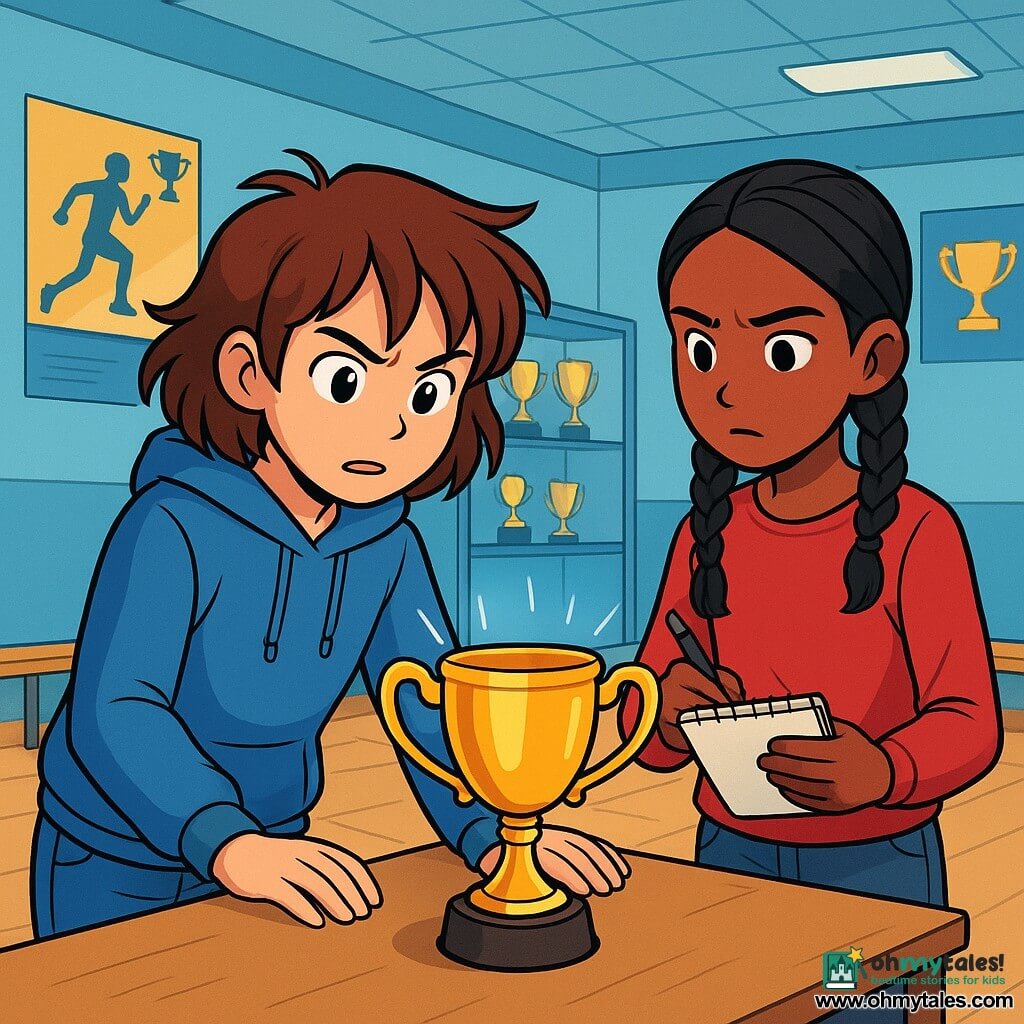
Emma found Noor alone in the hall, standing by the trophy table, staring at the empty space like she was trying to will the cup back into existence. The bright lights picked out a faint scar on her left wrist Emma hadn't noticed before.
“Everyone else has gone to the canteen for snacks,” Noor said without turning. “Coach said the police might come. He didn't want us hanging around.”
“And you stayed,” Emma said.
“I hate crowds.”
Emma moved beside her, leaving a careful distance. “I talked to Mrs Greene,” she said. “She saw Lucas Brand. New boy. Journalist club. You didn't mention him.”
Noor shifted her weight, just slightly. “I didn't think it mattered.”
“Everything matters,” Emma said. “You know that.”
Noor finally turned her head. Her eyes were deep and still, and again that fixed gaze locked onto Emma's. It wasn't cold. It was searching.
“You're not the only one who sees things,” Noor said quietly.
Emma's skin prickled.
“Then help me,” Emma replied. “We've got ten minutes with too many people in them. I'm missing something. I can feel it, right here.” She tapped her temple. “Like an itch I can't scratch.”
Noor looked back at the table.
“Lucas was here,” she said slowly. “He came in with a teacher I didn't know. He took photos of the trophy. He asked me to stand next to it. I said no.”
“Why?” Emma asked.
“I don't like cameras,” Noor said. “He took pictures of the crowd instead. Then he left.”
“What time?” Emma pushed.
Noor thought. “Before Hannah's video. I remember Hannah filming Ed, and Lucas wasn't in the background.”
“So he was gone before 7:42,” Emma murmured. “Too early to steal the trophy in our ten-minute window. Unless…” She frowned. “Unless the window is wrong.”
She paced a few steps, then stopped, facing the far wall. Her mind ran back over what everyone had said, trying to catch a snag.
Coach: “I left at ten to eight. Trophy was there.”
But that was only his memory. No photo. No witness.
Ed: “I heard a clink. I thought it was Coach.”
“What if it wasn't?” Emma whispered. “What if Coach just assumed he'd left later than he had?”
She turned back to Noor.
“Did you see the trophy at 7:50?” she asked. “Exactly then?”
Noor hesitated. “I… don't know.”
“There,” Emma said. “There's the gap. Everyone's stories make a wall around those ten minutes. But walls with no doors are suspicious. Where did Lucas really go? Where do the teachers keep spare keys? Why ask about security in his notes if he just wanted a photo?
“You found his notes,” Noor said.
Emma blinked. “How did you know that?”
“You've got paper sticking out of your pocket,” Noor said.
Emma looked down. The corner of the crumpled sheet poked out, traitorous.
“Right,” Emma said, a bit flat. “Observation club.”
Noor gave the tiniest ghost of a smile.
Emma unfolded the paper and smoothed it on the table. Noor leaned closer. Their heads almost touched.
“CITY TROPHY – HISTORY,” Noor read. “INTERVIEW COACH. SHOT OF TEAM + CUP. SECURITY. DOORS. WHO HAS KEYS.”
“Why worry about keys?” Emma said. “Unless you were planning to use them.”
Noor tapped the word SECURITY with one finger. “What if he wasn't worrying? What if he was checking?”
Emma's brain shifted. “You think he was testing the system?”
“Maybe for himself. Maybe for someone else,” Noor said.
Emma traced the faint ring where the trophy had stood. “Let's look at this like a race,” she said. “Starting gun: trophy on table at 7:30. First lap: photos, cheers. Second lap: Lucas moves around, asking about keys. Third lap: people start to leave, doors get locked, memories get fuzzy. Finish line: trophy gone at 8:00. Somewhere on that track, someone took a shortcut.”
Noor pointed to the lopsided mascot banner above the doors. “That's bothering you,” she said.
“You noticed that too?” Emma asked.
“I notice what you stare at,” Noor replied.
“The hook is bent,” Emma said. “Like it was yanked. And the banner covers the top of the trophy cabinet in the corridor when the doors are open.”
She stopped.
Her heart gave a short, hard thump.
“Wait,” she whispered. “The cabinet.”
A picture formed in her head: doors wide, banner flapping, someone slipping a trophy not out of the building, but into it.
“Noor,” she said softly, eyes widening. “What if the trophy never left the hall? What if it just… moved position?”
Noor's gaze sharpened. “You think it's in the cabinet already?”
Emma's body was already moving before her brain finished the thought. She strode to the hall doors, Noor at her side. She saw it now: with the doors pushed open, the top of the cabinet in the corridor was hidden from the hall entirely, shadowed by the hanging banner.
“Someone could stand on a chair,” Emma said quickly. “Lift the trophy, pass it over the top, slide it down behind the other cups. From the hall, no one would see. From the corridor, it would look like they were just… admiring the trophies. Unless you were paying attention.”
She yanked the doors shut.
The corridor sprang into view, bright and clear. And there, through the glass of the cabinet, she saw it.
A glint of silver, half-hidden behind an older rugby cup. Too big. Too new.
The missing city trophy.
Emma froze for one heartbeat.
Then another.
Then she laughed, a short burst of disbelief.
“Of course,” she said. “Of course.”
Someone had been clever. Put the trophy exactly where it was supposed to end up, just too early, hoping no one would check in the chaos.
The hairs on Emma's arms rose.
The puzzle image had finally sharpened.
Now she just needed the last piece.
“Who had time to do this?” she said aloud, mostly to herself, but also to Noor, and also—to you. “Who was in both places? Hall and corridor. Who had a reason to know about the cabinet, and keys, and timing?”
She let her mind run through the list again, faster this time.
Coach: hall, then store room. Too busy, too watched.
Priya: hall, then office. But she never mentioned Lucas, and she cared too much about the team's win.
Leo: outside, bike racks. No access to the cabinet in that window.
Hannah: filming in hall. Phone video proved her position.
Ed: stacking chairs, hall side.
Max: changing room, toilets, corridor.
Caretaker: corridor, keys.
Lucas: everywhere. Asking questions.
Emma's gaze slid to Noor instinctively. Noor, who saw what Emma saw. Noor, whose gaze never wavered.
“You know who it is,” Noor said calmly. It wasn't a question.
Emma nodded, slowly.
“I think so,” she said. “But I need to be sure. Logic, not guesses.”
“Then test it,” Noor said. “That's what you do, right?”
5. The Last Detail
They gathered everyone back in the hall: Coach, the athletes, even Mr Bennett the caretaker, keys jangling like a nervous soundtrack at his hip. Mrs Greene hovered in the doorway, curiosity winning over paperwork.
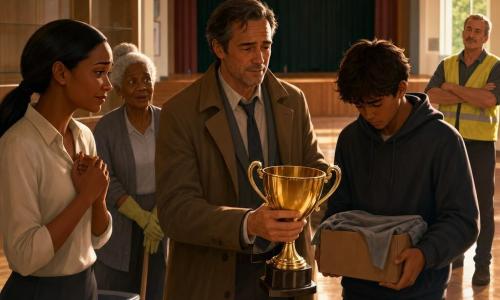
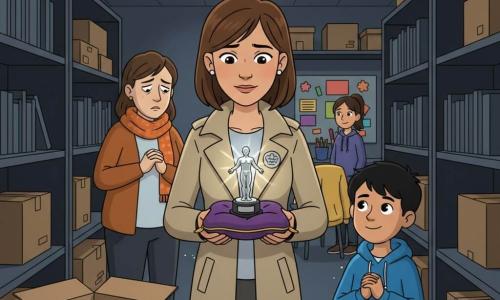
The trophy now stood back on the table, polished and gleaming, a little smug. Coach had nearly cried when Emma slid it gently out of the cabinet.
“Before anyone celebrates,” Emma said, standing beside the table, “we still have a problem. Someone hid this. That's almost as bad as stealing it.”
“Almost?” Ed muttered.
Emma ignored him.
“There are two ways to solve a mystery,” she said, letting her eyes move around the group. “You can wait for someone to confess. Or you can build such a strong chain of facts that the truth has nowhere else to go.”
She preferred the second way.
“In the ten minutes when the trophy vanished,” she continued, “everyone was somewhere. Most of you were exactly where you said you were. Hannah has video evidence. Priya is on the office computer log. Leo called his mum—phone records will confirm. Coach was in the store room—Mr Bennett saw him go in. Noor was in the stands with her mum—she can confirm. Mrs Greene saw Max limping past her to the toilets. Ed was stacking chairs where everyone could see him.
“That leaves two people with the freedom to move where they wanted. The caretaker, with keys to every room. And Lucas Brand, the ‘journalist', with a reason to talk to everyone and be almost invisible.”
She paused, watching faces.
“The caretaker has worked here for fifteen years,” she went on. “His job depends on the school's reputation. If he wanted to steal something, he wouldn't do it in a hall full of students and parents. And he didn't ask anyone about keys or security. Someone else did.”
She pulled the crumpled paper from her pocket and held it up.
“These are Lucas's notes,” she said. “He asked about security. About doors. About who had keys. He knew about the trophy cabinet because he asked to take photos of it earlier in the week. That's what Mrs Greene just told me.”
Mrs Greene nodded slowly. “He did,” she said. “Came at lunchtime. Very keen.”
Emma let the picture settle over them, like a transparent sheet over a drawing.
“If you're planning a theft,” she said quietly, “you don't guess. You test. You walk through the building, ask questions, see who answers. Tonight, Lucas walked around with his notebook, getting everyone used to seeing him. A boy with a lanyard and a pen is the safest person in the room.”
She turned the paper over. On the back was another scribble, almost hidden near the fold.
CABINET = SAFE ZONE
MOVE EARLY? CHECK TIME
“Lucas didn't have to sneak out with the trophy,” Emma said. “He just had to move it early, when no one was paying full attention, and hide it in plain sight. If someone noticed later that it was gone from the table, they would blame each other, not him.”
Leo looked furious. “So where is he now?” he burst out. “I'll—”
“Leo,” Coach warned.
Emma shook her head. “He's gone. Bike racks were still moving when I got there. He used the chaos. But we're not completely helpless.”
She looked at Noor.
“You saw him closer than any of us,” Emma said. “What did you notice?”
Noor lifted her chin slightly. “Left-handed,” she said. “He held his notebook in his right hand, pen in his left. His lanyard was upside down. And his school blazer didn't have our logo on the buttons. They were plain.”
Mrs Greene's eyes widened. “He wasn't from Riverside?”
“Maybe not from any school,” Emma said. “Just someone who bought a blazer and printed a fake ID. The easiest disguise in a building full of uniforms.”
She turned to you now, though no one in the hall noticed.
If you had been there, would you have spotted the upside-down lanyard? The wrong buttons? Or would you, like everyone else, have let your brain slide over him, filing him under “safe” because of his pen and his smile?
“Our brains love shortcuts,” Emma said aloud. “They say, ‘I've seen this kind of person before. I know what they are.' That's how thieves work. They count on our assumptions.”
She folded the note again. “But our brains can learn. Next time, we look twice.”
Coach cleared his throat. “We should call the police. Give them his notes. Maybe the CCTV from the front gate caught his face.”
“It's already being done,” Mr Bennett said quietly. “I checked the cameras when Coach panicked. I saw the boy leave. I've sent the footage to the headteacher.”
Emma nodded, satisfied. “Good. Then one more thing.”
She turned back to the athletes.
“When did you first realise the trophy was missing?” she asked.
Ed scratched his head. “When Coach shouted,” he said. “Before that, I wasn't really… looking.”
“Exactly,” Emma said. “The trophy was probably in the cabinet for at least ten minutes before anyone noticed. Lucas moved it, then left. He would have come back later, maybe in the dark, when the hall was empty, and taken it properly. But we interrupted his plan when Coach went to check the store room early.”
“So Coach's bad timekeeping saved the day,” Hannah said. “Miracles happen.”
Laughter rippled through the group, thin but real.
Emma let it run its course, then held up a hand.
“One last loose end,” she said. “Something that bothered me. Noor, you said you didn't think Lucas mattered. But you noticed him more than anyone. Why not say so earlier?”
Every head turned to Noor.
For the first time that evening, she looked away.
“I wanted to see if you'd catch him without me,” Noor said quietly. “Everyone always acts like you're the only one who can solve things. I wanted to know if… if I mattered. If what I saw could change anything.”
Emma studied her for a moment.
That fixed gaze from earlier—the one that had made her feel like the one being examined—made sense now. It hadn't been challenge. It had been something closer to… hope.
“You do matter,” Emma said simply. “You saw things I didn't. Left-handed. Buttons. Lanyard. Without you, the picture would've been blurrier.”
“Without you, I'd just be the weird girl who stares at people,” Noor muttered.
Emma's mouth twitched. “Welcome to the club.”
Something eased in Noor's shoulders, a tension Emma hadn't realised was there.
“Next time,” Emma added, “we say what we notice right away. Deal?”
Noor nodded. “Deal.”
6. Return to Calm
By the time the last parent's car had pulled away from the school gates, the night had softened. The floodlights around the track clicked off one by one, plunging the field back into darkness. The hall was shut, the trophy back in its usual place, locked securely in the cabinet with its metal brothers and sisters.
On the wall above it, the mascot banner had been rehooked properly, the falcon no longer drooping like a tired bird.
Emma stood alone in the corridor again, the hum of the vending machine and distant murmur of voices in the staffroom the only sounds.
She looked at the city trophy. It gleamed calmly, as if it had never been gone. Its blank face showed no guilt.
“You caused a lot of trouble for a piece of metal,” Emma murmured.
The trophies, her silent confidants, stared back at her. They glittered, but they didn't argue.
Behind the glass, her own reflection floated, faint and doubled. For a moment, it was two girls instead of one: Emma and Noor, side by side, both looking. Both noticing.
Her brain, finally, was starting to quieten. The missing detail that had nagged at her all evening had settled into place. She replayed the whole investigation in her head again, not searching for mistakes now, but checking the logic.
Identify the gap in time. Question every assumption. Follow the physical clues. Notice the person everyone else ignored. Test the theory. Confirm with evidence. Logical steps, one after another, like stones across a river.
Reasoning had brought them here. Not magic. Not luck. Just thinking carefully, again and again, even when it was tiring.
She wondered who Lucas really was. A bored teenager looking for excitement? Someone hired by a rival school? A kid who wanted proof that he was smart enough to beat a system?
Whoever he was, he'd left a trail. And trails had a habit of being followed.
Emma wasn't sure it was her job to follow this one any further. Adults with badges and files would take over now. That was okay. She'd done her part.
She glanced at the far end of the corridor. Noor stood there, leaning against the wall, waiting for her mum to finish talking to Coach. She caught Emma's eye and raised an eyebrow, as if to say: Well?
Emma tilted her head towards the cabinet.
“Want to help me check the other locks?” she called softly. “Make sure no one's hidden a championship netball in with the chess trophies?”
Noor's mouth curved at one corner. “You think that's likely?” she asked, walking over.
“Unlikely things happen all the time,” Emma said. “That's why we look.”
They moved together along the glass, testing each handle, each hinge. It was a pointless task, really. Mr Bennett had already checked them all. But it felt good, solid. Like closing a book properly instead of leaving it face-down and open.
As they worked, the school seemed to exhale. The echo in the corridor softened. The light felt warmer, less harsh.
“You know he might come back,” Noor said quietly. “Lucas.”
“I know,” Emma said. “If he does, we'll be ready.”
“We?”
Emma glanced at her. “You see things I don't. That means we're better together.”
Noor studied her for a second, then nodded, once, satisfied.
“Okay,” she said. “Next mystery, then.”
“Hopefully not tonight,” Emma said. “I'd like at least one calm evening before the world falls apart again.”
Noor snorted. “You think too much,” she said.
Emma smiled, small but real. “It's a habit.”
“Annoying habit,” Noor replied.
“Useful habit,” Emma countered.
They reached the end of the cabinet. Every lock was firm. Every trophy stayed where it should.
Outside, a car door slammed. Noor's mum called her name, voice drifting in along with a thread of cool river air.
Noor started to go, then paused.
“If you need a… whatever you call it. A second set of eyes. Tell me,” she said.
“I will,” Emma said.
Noor nodded and left, her footsteps fading.
Emma stayed a moment longer, just breathing. The puzzle was over. The picture was complete. The sharp urgency in her chest had faded to something gentler: a quiet, steady satisfaction.
She looked one last time at the city trophy, safe at last behind glass.
Then she turned off the corridor light, letting the trophies fall into darkness, and stepped out into the night, where the air was cool, the world was wide, and—for now—the only mystery was how many stars hid behind the clouds.