Chapter 1: The House of Clear Rules
In the town of Lumen, rules hung in the air like laundry on bright lines. You could almost read them when the wind was kind.
Rule One: Share the shade on hot days.
Rule Two: Return what you borrow before the moon is full.
Rule Three: When there is a question, go to the House of Clear Rules and ask the Lamp.
The Lamp was not a magic wand. It did not shout. It simply shone, warm and steady, over a round table where the town's small problems became small again.
On the evening this story begins, three children hurried along the cobblestones as the sky turned the color of peach skin.
Mina walked in front. She had a notebook full of lists and a brave way of holding her chin, like she was daring the world to be sensible.
Jules walked beside her, hands in his pockets, eyes curious, as if each stone might tell a joke.
And Noor followed with a quiet smile, carrying a little tin box that chimed softly when she moved.
They were eleven, almost twelve—old enough to notice that grown-ups could be strange, but young enough to forgive them.
At the door of the House of Clear Rules, a wooden sign creaked: TODAY'S JUDGE: MINA.
Mina stopped so fast Jules nearly walked into her.
“Me?” she whispered.
A messenger pigeon, plump as a proud letter, fluttered down and dropped a note into Mina's palm.
Mina read aloud, voice wobbling only a little: “By town custom, the judge is chosen by the Lamp's shadow. Today it pointed at you.”
Jules tilted his head. “Congratulations. You've been selected by… lighting.”
Noor peered past them into the hall. “Does the judge get a cape?”
“No capes,” Mina said. Then she swallowed. “But what if I have to judge a case that's… about me?”
As if the town had been listening behind its curtains, two adults stepped forward at once, both talking with their hands.
“Mina! Good, you're here,” said Mrs. Grell, who sold honey cakes and smiled like she had sugar in her cheeks.
“Mina,” said Mr. Venn, the baker, whose eyebrows always looked worried, even when his bread was not.
They spoke over each other until the words became a swarm.
Finally, Noor held up her tin box and let it chime once. The sound was small, but it made a space in the noise.
Mr. Venn pointed at Mrs. Grell. “She says Mina promised her our cart for the Lantern Parade.”
Mrs. Grell pointed back. “He says Mina promised him the cart for the Flour Festival.”
Mr. Venn huffed. “The same day!”
Mrs. Grell huffed louder. “The same cart!”
Mina's cheeks turned the color of the peach sky. “I… I did say yes to both.”
Jules let out a low whistle. “So you're the judge… and the knot.”
Mina looked toward the Lamp inside the hall, glowing patiently like an old friend waiting at the end of a long hallway.
“How can I be fair,” she whispered, “when my own words are on trial?”
Chapter 2: The Lamp That Listens
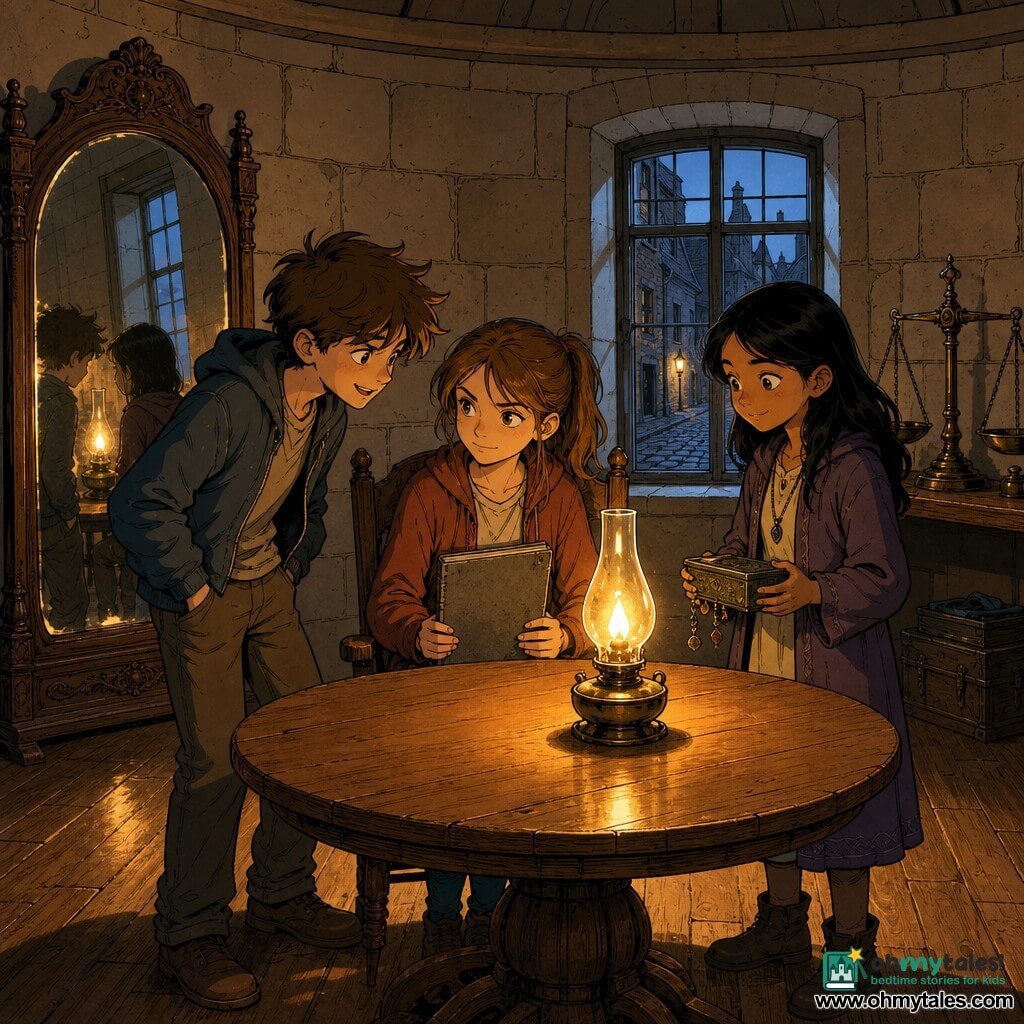
They entered the hall. The Lamp stood in the center of the round table. Its light was not blinding; it felt like a blanket you could see through.
Around the table sat a few townspeople, quiet as pages in a book. A clerk dipped a pen in ink and waited.
Mina sat in the judge's chair, which was only a chair, yet suddenly heavier than a sack of flour.
Mr. Venn and Mrs. Grell stood across from her like two weather clouds refusing to share the same sky.
The clerk cleared his throat. “Judge Mina, the question: who gets the cart?”
Mina's mouth went dry. Her promise had been made with good intentions. But good intentions could be slippery fish.
Jules leaned close and whispered, “Remember Rule Three. Ask the Lamp.”
Mina stared at the Lamp. Its flame was steady, like it trusted time to do its job.
“Lamp,” Mina said softly, feeling a little silly, “what do I do?”
Of course the Lamp did not speak in words. But its light fell on three things at once:
— a mirror hanging on the wall,
— a scale used for weighing bread,
— and a window opening to the street, where children were practicing parade steps, laughing in uneven rhythm.
Noor followed the light with her eyes. “A mirror… a scale… and the window. That's… poetic.”
Jules grinned. “Or confusing. Poetry can be both.”
Mina frowned, thinking. The mirror made her think of herself. The scale made her think of fairness. The window made her think of everyone else.
She took a breath. “If I only look in the mirror, I'll protect my pride. If I only look at the scale, I'll pretend I'm not part of this. If I only look out the window, I'll forget the two people right here.”
Mr. Venn crossed his arms. “So?”
Mina's fingers tightened around her notebook. “So I need help. I can't be the only judge if I'm also one of the causes.”
A murmur rippled around the table like wind through wheat.
Mrs. Grell's voice softened a little. “Are you saying you won't decide?”
“I'm saying I won't decide alone,” Mina answered. “I want a circle. A small one. Jules and Noor will be my two advisors. We will ask questions. We will listen. And I will accept whatever decision we reach together.”
Jules blinked. “Wait, I agreed to what?”
Noor smiled. “You agreed to opening your mind. It's a quiet kind of agreement.”
The clerk dipped his pen again. “Noted: the judge invites advisors when she is involved.”
Mina felt the chair become lighter. Not easy. But possible.
Chapter 3: The Three Questions
They moved to a smaller room beside the hall where the Lamp's glow still reached, thinner but present, like a thread of gold.
Mina faced Mr. Venn and Mrs. Grell. “I'm going to ask three questions. Please answer honestly. Not dramatically. The truth does not need a drum.”
Jules muttered, “Sometimes it likes one.”
Noor nudged him gently.
Mina raised one finger. “First: What do you need the cart for, exactly?”
Mr. Venn spoke first. “The Flour Festival is tomorrow. We deliver sacks to families who can't afford them. The cart carries the most. Without it, fewer people get flour.”
Mrs. Grell nodded slowly. “That's true. The Lantern Parade is also tomorrow night. We bring lanterns to the river and float them for the ones we miss. The cart carries the lantern frames and candles. Without it, fewer lanterns reach the river.”
Mina raised a second finger. “Second: Why did you ask me?”
Mr. Venn sighed, as if admitting a secret. “You're responsible. You remember details.”
Mrs. Grell said, “You're kind. You don't like to say no.”
Jules coughed a laugh. “Ah. A trap made of compliments.”
Mina's ears grew warm.
Mina raised a third finger. “Third: If you couldn't have the cart, what would you do?”
Mr. Venn looked down. “We'd carry bags by hand. It would be slower. Some people might go without.”
Mrs. Grell stared at her hands. “We'd carry lantern parts ourselves. Fewer lanterns. The river would look… emptier.”
Noor's eyes drifted toward the window. “Emptier is a heavy word,” she murmured.
Mina closed her notebook. “Thank you.”
When the two adults left to wait outside, Jules flopped onto a bench.
“So the cart helps hungry bellies and missing hearts,” he said. “Both important. Why do towns always schedule meaning on the same day?”
Noor opened her tin box. Inside were small folded papers, like tiny boats. She took one out and unfolded it carefully. It was blank.
“This is my favorite paper,” she said. “It hasn't decided what it will become.”
Jules leaned over. “That is… deeply annoying. In a wise way.”
Mina stared at the blank paper and the Lamp's thread of light. “I made the promises because I wanted everyone to be happy,” she admitted. “But happiness isn't a pie you can cut into perfect slices.”
Noor nodded. “Sometimes it's soup. It moves.”
Jules snapped his fingers. “Okay. If we can't split the pie, maybe we can… share the oven. Could the cart do both?”
Mina looked up. “Both… tomorrow?”
Jules sat up straighter. “Morning flour deliveries. Evening lantern parade. It's the same day, not the same hour.”
Noor tilted her head. “But is there time to clean the cart? Flour dust and candle wax don't always get along.”
Mina imagined it: the cart like a stage changing costumes. “We could recruit helpers to scrub it after the deliveries.”
Jules grinned. “A cart makeover. I can already hear it: ‘Who wore it best, the flour or the lanterns?'”
Mina smiled despite herself. Then the smile faded into seriousness.
“But what if something goes wrong? What if it's late? Then one side will blame the other. And they'll blame me.”
Noor placed the blank paper on the table like a gentle challenge. “Fairness isn't a shield that stops blame,” she said. “It's a bridge that lets people cross to each other.”
Mina breathed in. The Lamp's light seemed to warm her ribs.
“Then we build a bridge,” she said. “With clear rules.”
Chapter 4: The Cart Agreement
Back in the hall, the Lamp shone over the round table as if it had never worried a day in its life.
Mina sat again in the judge's chair. Jules and Noor stood behind her, not like guards, but like steady trees.
Mr. Venn and Mrs. Grell waited, tense as tied ropes.
Mina spoke clearly. “Here is the decision. The cart will be used for the Flour Festival in the morning. Afterward, volunteers will clean it together. Then the cart will be used for the Lantern Parade in the evening.”
Mr. Venn opened his mouth, then closed it. “And if the cleaning takes too long?”
Mina nodded, ready for that question. “Then the parade starts with a smaller cart-pull, and the rest are carried by hand, by anyone who can. Not only by your shop, Mrs. Grell. By all of us. We share the burden if the schedule slips.”
Mrs. Grell's eyebrows rose. “And if the deliveries take too long?”
“Then,” Mina said, “the lantern-building begins earlier, before the cart arrives. People can assemble frames at the riverbank. When the cart comes, it brings only candles and the last pieces.”
Jules whispered, “That's called a Plan B. Fancy.”
Noor whispered back, “It's called humility.”
Mina turned to the clerk. “Write it as a new town note: When a judge is involved, she must invite advisors. And the decision must create responsibility for many, not comfort for one.”
The clerk scribbled quickly.
Mr. Venn rubbed his chin. “So we all help. That feels… fair.”
Mrs. Grell looked at Mina, her voice softer than before. “You admitted your mistake. That's rare. Even for adults.”
Mina's throat tightened. “I wanted to be liked,” she confessed. “But being liked is a windy coat. It doesn't keep you warm when the storm comes.”
Jules added, “Also, it makes you look puffy.”
A few people chuckled. Even the worried eyebrows of Mr. Venn relaxed.
The Lamp's glow fell again on the mirror, the scale, and the window—only this time, the light seemed to stitch them together.
Mina felt something change inside her, like a door opening without squeaking.
Being fair, she realized, wasn't pretending she had no feelings. It was noticing them, naming them, and not letting them drive the cart.
Chapter 5: A Day Shared Like Bread
Morning arrived smelling of yeast and sun-warmed stone.
The cart rolled through town with sacks of flour stacked like pale pillows. Mina walked beside it with Jules and Noor, and with volunteers who had been “gently recruited,” as Noor put it.
Jules carried a sack that looked determined to become his new enemy.
“If I disappear,” he puffed, “tell my family I was eaten by kindness.”
Noor handed flour to an old man who bowed as if receiving treasure. “Thank you,” he said, and the word sounded like a small bell.
Mina watched faces soften when the flour arrived. It wasn't just food. It was proof that someone remembered them.
By noon, the sacks were gone and the cart looked like a ghost of itself, powdered white.
At the fountain, volunteers scrubbed the wooden boards. Water ran milky, then clear. Mina scrubbed too, her arms aching in a satisfying way.
Mrs. Grell arrived with cloths and a bucket of soapy water that smelled like lemons.
“I brought reinforcements,” she said.
Mr. Venn came right behind her with extra brushes. “And I brought an apology,” he added gruffly, then glanced at Mina. “For assuming you were trying to please my shop most.”
Mina blinked. “I was trying to please everyone.”
“That's the trouble,” Mrs. Grell said, smiling a little. “Everyone is a crowd.”
Jules flicked water at a stubborn patch of flour. “I vote we rename this the Flour-to-Flame Transformation Ceremony.”
Noor laughed, a quiet laugh that still managed to fill space. “Careful. Ceremonies tend to multiply.”
By afternoon, the cart was clean. The wood gleamed like a fresh page.
At the riverbank, lantern frames waited. Children ran around carrying thin sticks. The water moved slowly, reflecting the sky like it was thinking.
Mina helped tie candles into place. She noticed how different the work felt from the morning. Flour was for the body. Lanterns were for the invisible places.
Mrs. Grell held up a lantern and asked Mina, “Who do you miss?”
Mina hesitated. “My grandmother,” she said. “She used to tell stories that made my worries shrink.”
Jules said, “I miss my old dog. He understood me more than I deserved.”
Noor's eyes grew distant. “I miss a friend who moved away,” she said. “Not gone, just… far. Distance can be a kind of missing.”
They placed their candles gently, as if the wax could hear.
As evening fell, the parade began. The cart rolled again, now carrying lanterns that glowed like bottled fireflies.
People walked together, and Mina noticed something strange and lovely:
No one was arguing about who had “won.”
It felt less like winning and more like learning how to stand in the same room without stepping on each other's toes.
Chapter 6: The Quiet Verdict
Later that night, after the last lantern kissed the river and drifted away like a slow thought, Mina, Jules, and Noor returned to the House of Clear Rules.
The hall was empty. The round table waited. The Lamp still burned, its light softer now, like it was sleepy too.
Mina sat in the judge's chair one final time, though no one had asked her to.
She looked at the mirror on the wall and saw a girl with tired eyes and cleaner hands.
She looked at the scale and imagined fairness not as perfect balance, but as patient adjusting.
She looked at the window and saw the town settling, roofs dark, hearts a little lighter.
Jules stretched his arms. “So, Judge Mina. Did we solve the meaning of life today?”
Mina thought about flour and lanterns, about apologies that tasted like honest bread, about how admitting her mistake had opened a door instead of closing one.
“I don't think life is a riddle with one answer,” she said. “Maybe it's a question we carry. And we try to carry it without dropping it on someone's foot.”
Noor smiled. “A careful question. That sounds right.”
Mina turned to the Lamp. “Today I learned something,” she said softly. “When I'm part of the problem, I should invite more eyes, not fewer. I should listen for the needs under the words. And I should be ready to change my mind.”
Jules nodded. “Open-mindedness,” he said. “Like opening a window so your thoughts don't get stuffy.”
Noor added, “And like opening a hand so it can hold, not just cling.”
The Lamp's flame wavered, as if agreeing in its quiet language.
Mina stood. She reached for the Lamp's chain. In Lumen, the Lamp was never forced into darkness; it was thanked into rest.
“Goodnight,” Mina whispered.
She pulled gently.
The flame shrank, then vanished, leaving only a thin ribbon of smoke that curled upward like a peaceful sigh.
In the dark, the hall did not feel empty. It felt complete.
Outside, the river carried lanterns into the distance, and the town's rules hung in the air like calm stars—clear enough to follow, soft enough to question.
And in the House of Clear Rules, the Lamp was off, at peace.