Chapter 1: The Boy Who Lined Up the Stars
Milo liked straight lines.
He liked pencils sharpened to a brave point, shoelaces tied in equal bows, and Saturdays divided into neat squares on his planner. In his mind, the world was a big desk. If you pushed the mess gently to the side, you could find the middle.
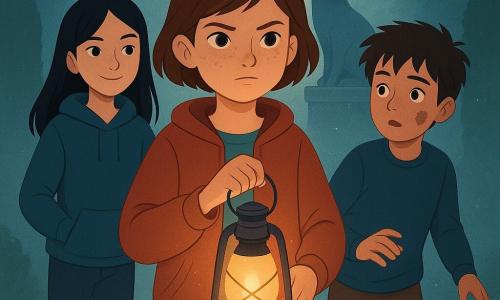
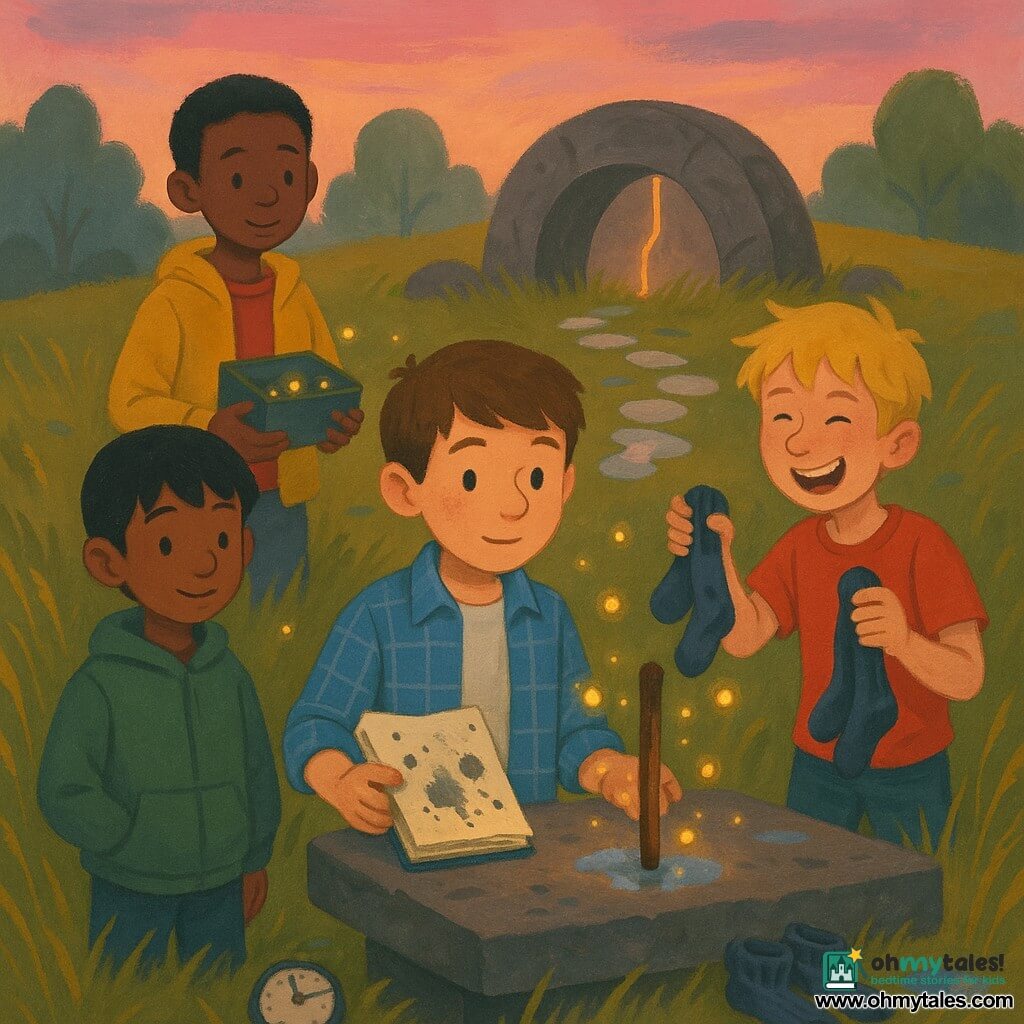
There were four of them, all about eleven, like four commas in the same sentence.
Milo was the organizer.
Jasper was the joker.
Theo was the quiet listener.
Arun was the question-collector, always saving “Why?” like marbles in his pocket.
They lived near a small hill where the wind smelled of grass and old stories. On that hill stood a peculiar thing: a stone arch, half buried, like a giant's broken doorway.
One evening, when the sun was folding itself into orange paper, Milo brought the others to the arch.
“I have a plan,” he said, opening his notebook as if it were a tiny stage.
Jasper peeked at the page. “Is it a plan to steal cookies from my kitchen? Because I support that plan.”
“It's a plan to connect two ideas,” Milo replied.
Theo blinked. “Ideas can't hold hands.”
“That's because no one teaches them how,” Milo said, very serious.
Arun tilted his head. “Which two ideas?”
Milo hesitated, then spoke softly, as if the hill might overhear his secret. “Order and wonder.”
Jasper whistled. “Sounds like a fancy sandwich.”
Milo ignored him. He traced the arch with his finger, the way you might trace the edge of a thought. “This place feels like a door. Maybe it leads somewhere between them.”
Between order and wonder, Milo imagined a bridge. He imagined a ribbon tied between two faraway balloons. He imagined himself standing in the middle, not falling.
A small sound came from the stones—like laughter trying not to be loud.
Theo leaned closer. “Did the arch just… chuckle?”
Arun touched the cool rock. “Why would a doorway laugh?”
Milo wrote in his notebook: DOORS KNOW THINGS.
Then the wind nudged them, gentle as a hand on the shoulder, and the arch seemed to breathe.
A thin line of light appeared in the crack where two stones met. It wasn't bright. It was patient.
Jasper stepped back. “Okay. That's new.”
Milo swallowed. “We go tomorrow. With snacks. And a map.”
Arun grinned. “And questions.”
Theo nodded. “And quiet.”
Jasper raised an imaginary sword. “And heroic bravery, also known as pretending we're not scared.”
Milo closed his notebook with a click that sounded like a promise.
That night, in his room, Milo lined up four flashlights on his desk. He lined up four granola bars. He lined up four names at the top of a page.
But in the middle of the paper he drew something that refused to be straight.
He drew a spiral.
Chapter 2: The Doorway That Didn't Hurry
The next afternoon, they returned to the stone arch.
Milo had a backpack packed with the seriousness of a ship captain: rope, water, bandages, compass, extra socks. He had even printed a little checklist.
Jasper stared at it. “Extra socks? What are we, going to the Sock Olympics?”
“Wet feet ruin courage,” Milo said.
Theo pointed at the light. “It's still there.”
It was. The crack glowed like a shy firefly hiding inside stone. When Milo stepped closer, the light widened, not in a burst, but in a slow unbuttoning.
A narrow opening appeared. On the other side was not darkness, but a pale, misty space that looked like morning before anyone wakes up.
Arun rubbed his hands. “Why is it waiting for us?”
Milo whispered, “Maybe it's polite.”
Jasper leaned in and called, “Hello, mysterious glowing rock door! We brought snacks!”
The opening widened a little more, as if amused.
Theo murmured, “It likes him.”
“No,” Milo said, but without anger. “It likes laughter.”
He checked his list. “Rule one: stay together.”
Jasper saluted. “Yes, Captain Socks.”
They stepped through.
The air changed. It smelled like paper and rain, like libraries after a storm. The ground under their shoes was smooth as a page. Above them, a sky the color of pencil lead hung low, as if the world was thinking.
They walked and walked, but the place didn't feel big. It felt close, like a secret held in two hands.
Then they saw the first symbol.
A lamppost stood alone in the mist, but it wasn't holding a lamp. It held a little glass jar. Inside the jar, a tiny whirl of glittering dust spun in circles.
Milo approached carefully. A label was tied to the jar with string. In tidy handwriting, it read:
CURIOSITY — PLEASE DO NOT SHAKE TOO HARD.
Jasper grinned. “Too late.”
He tapped the jar lightly. The glitter swirled faster, and suddenly the mist around them formed pictures—quick, bright snapshots. A fish flying like a kite. A tree with clock hands. A boy riding a question mark.
Arun's eyes widened. “That's… that's what my brain feels like.”
Theo's mouth lifted at the corners, barely. “It's busy.”
Milo looked at the jar and felt something loosen in his chest. Wonder, he realized, wasn't a wild horse you had to wrestle. It was a bird you had to let land.
He wrote in his notebook: WONDER IS NOT MESS. IT IS MOTION.
The jar's glitter settled again, as if it had said its piece.
Far ahead, in the mist, something rang.
Not a bell exactly. More like a spoon tapping the rim of a teacup.
“Do we follow the sound?” Jasper asked.
Milo checked his compass. The needle spun in circles like it was laughing.
Arun pointed. “We follow the question.”
Theo nodded. “And the sound is a question.”
Milo took a breath. The air tasted like new beginnings.
“Together,” he said.
They walked toward the ringing.
Chapter 3: The Clock That Forgot Its Job
They found the sound at a small square made of white stones. In the center stood a clock tower, but it had no hands. Its face was blank, like it had erased its own rules.
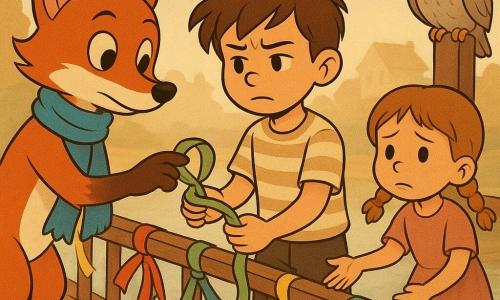
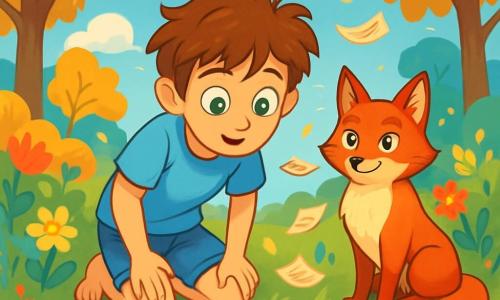
On the ground beside it sat a creature that looked like a fox made of folded paper. Its ears were sharp triangles. Its eyes were ink dots. It held a little hammer and was tapping the clock gently, as if trying to wake it without scaring it.
The paper fox looked up.
“Oh,” it said, in a voice like pages turning. “Visitors.”
Jasper whispered, “Did we just meet origami?”
The fox bowed. “I am Fold, Keeper of Small Repairs.”
Milo stepped forward, polite. “We didn't mean to interrupt.”
Fold's tail swished, making a soft papery sigh. “Interruptions are how lost things get found.”
Arun crouched. “Why is the clock blank?”
Fold tapped the tower again. Ting. “Because it got tired.”
Theo frowned. “Tired of telling time?”
Fold nodded sadly. “All day, every day, it told everyone what to do next. Hurry, hurry, hurry. One day it said, ‘I do not want to push anyone anymore.' So it let its hands fall off.”
Jasper looked impressed. “Mood.”
Milo felt a sting of recognition. He pictured his planner, his lists, his checkboxes lined up like little soldiers. He liked order. But order could become a whip if you held it too tightly.
Fold offered Milo the small hammer. “Would you like to help? Not to force it. Just to listen.”
Milo hesitated. “I don't know how.”
Fold's ink eyes softened. “Then you are already beginning.”
Milo took the hammer. He tapped the tower once. Ting. The sound traveled up through the stone and came back down into his bones.
He tapped again, lighter. Ting.
On the third tap, a faint line appeared on the clock face, like a crack in ice. Then another. The lines curved, not into hands, but into a drawing: a spiral, like the one Milo had doodled.
Arun pointed, delighted. “It's not a time clock. It's a thought clock.”
Fold clapped its paper paws. “Yes! Time is only one kind of order. There are other kinds.”
Theo asked softly, “What does it measure?”
Fold tilted its head. “It measures when you are ready.”
Jasper crossed his arms. “Ready for what?”
Fold smiled. “For continuing, of course.”
The mist around the square shifted. A path appeared, made of stepping-stones shaped like commas. Each one seemed to say, Not yet. Not yet. But soon.
Milo handed the hammer back.
“Thank you,” he told Fold. “I'm trying to connect order and wonder.”
Fold nodded as if Milo had said, I'm trying to tie the wind to a kite.
“A good knot,” Fold said, “is not too tight.”
Milo wrote: ORDER SHOULD BE A LANTERN, NOT A CAGE.
As they stepped onto the comma-stones, Theo glanced back. The clock tower's blank face now held that spiral, calm and steady.
Jasper nudged Milo. “Captain Socks, your clock friend is basically telling you to chill.”
Milo almost smiled. “It's telling me to… breathe.”
Arun bounced from stone to stone. “Why does breathing feel like a bridge?”
No one answered, but the question walked with them, light as a feather.
Chapter 4: The Garden of Bent Rules
The path led to a garden enclosed by a fence made of rulers. Not wooden rulers—real measuring rulers, long and pale, marked with numbers.
The gate was a protractor, curved like a grin.
Inside, plants grew in odd but beautiful ways. Vines curled into perfect question marks. Sunflowers faced not the sun, but each other, like friends refusing to stop talking. A small apple tree had apples shaped like tiny hearts.
A sign stood in the soil. It read:
WELCOME.
PLEASE DO NOT MEASURE THE FLOWERS.
THEY GET SHY.
Jasper put his hands behind his back. “I promise not to measure anything. I can't even measure my patience.”
Milo felt both thrilled and uncomfortable. Part of him wanted to line the rows up, to make the garden behave. Another part wanted to lie down in the grass and let the sky rearrange him.
In the center of the garden was a stone table. On it sat two objects:
A straight iron rod, cold and exact.
A small jar of fireflies, warm and restless.
Between them lay a piece of string.
Arun stared. “Is this a test?”
Theo whispered, “Or an invitation.”
Milo's heart beat a careful rhythm. He approached the table like it might bite.
The iron rod had a label: ORDER.
The jar of fireflies had a label: WONDER.
Milo swallowed. This was it. His secret dream, sitting like two shy guests at the same table, not talking.
Jasper leaned over Milo's shoulder. “Okay, so… you introduce them?”
Arun asked, “Why are they separated?”
Theo touched the string. “So someone can connect them.”
Milo reached for the string. His fingers trembled.
He tied one end around the iron rod. The knot was tight, neat, perfect.
Then he turned to the jar of fireflies. They bumped against the glass, their light flickering like giggles trapped in a classroom.
Milo tried to tie the other end to the jar, but the jar was smooth. The string slid down. He tried again. It slipped. Again. It slipped. The fireflies swirled, as if laughing politely.
Jasper chuckled. “Your knot is too fancy for a jar.”
Milo's cheeks warmed. He tried a different knot. It slid. He tried wrapping it twice. It slid harder, like the jar was made of stubbornness.
Arun leaned in. “Why not open the jar?”
Milo jolted. “No! They'll fly away.”
Theo said gently, “Maybe wonder is supposed to.”
Milo froze. His dream was to bring them together. But if wonder escaped, wouldn't that ruin everything?
He looked at the garden fence made of rulers. He looked at the sign asking him not to measure. He looked at the fireflies knocking softly at the glass, as if asking for air.
Milo's hands lowered. “If I can't tie it, I fail.”
Jasper's voice turned softer. “Or you learn.”
Arun said, “Why is letting go always part of holding on?”
Milo stared at the jar. The fireflies were like tiny thoughts. You could trap them and call it safety. But safety could become a small, dim room.
He took a slow breath. He loosened the tightness in his chest the way you loosen a too-tight shoelace.
Then he opened the jar.
The lid made a small pop, like a bubble bursting in a quiet pond.
The fireflies rose. Not in a stampede, but in a gentle drift, like golden snow. They floated around the iron rod, touching it with light.
And the iron rod—so cold, so strict—began to glow faintly, as if it was remembering it had always wanted to be warm.
The string lifted on the breeze of their wings. It wrapped itself around both, not in a hard knot, but in a loose loop, like an arm around a shoulder.
Milo's eyes widened. “I didn't do that.”
Fold's voice seemed to whisper from somewhere in the leaves: “You did. By not forcing.”
Theo smiled fully now, surprising everyone. “It's connected.”
Jasper clapped once. “Congratulations! You just invented… friendship between concepts.”
Milo laughed a small, shaky laugh. Relief and joy mixed inside him like paint in water.
But the garden trembled, just a little.
The ruler-fence clicked as if counting.
And the mist beyond the garden thickened, as if the world was taking a deep breath before speaking.
Chapter 5: The Storm That Spilled Ink
They left the garden carrying nothing, because the connection wasn't a thing you could put in a backpack. It was more like a new muscle inside Milo's ribs.
The path narrowed. The mist turned gray-blue. The air grew heavy, like a blanket soaked in rain.
Theo looked up. “Something's coming.”
A cloud rolled in, low and fast. But it wasn't a normal cloud. It looked like spilled ink, spreading across paper. Drops began to fall—dark, inky raindrops that splattered on the ground and made little blots.
Jasper held out his hand. A drop landed on his palm and spread into a tiny word: OOPS.
He snorted. “The sky is roasting us.”
Another drop hit Milo's shoulder. It bloomed into a word: PERFECT.
Then another: CONTROL.
Then another: TOO MUCH.
Milo's stomach tightened. The words weren't random. They felt like the secret fears he kept folded under his tidy lists.
The ink-rain fell harder. Words appeared everywhere—on stones, on shoes, on sleeves.
FAIL.
LATE.
WRONG.
WHAT IF?
Arun wiped a word off his arm. It smeared into nothing, but the feeling stayed. “Why are the drops saying mean things?”
Theo's voice was steady, though his eyes were wide. “Maybe the storm is made of thoughts.”
Milo tried to breathe, but the air felt like it had corners.
“I can fix it,” Milo said quickly. “We just need a plan. We need—”
He reached for his notebook.
The ink-rain soaked it instantly. Pages stuck together. His careful lists blurred into dark puddles. His neat handwriting melted.
Milo's throat tightened. “No.”
Jasper stepped closer, shielding Milo with his body as if jokes could be umbrellas. “Hey. It's just paper.”
“It's my order,” Milo whispered.
Another ink-drop hit his forehead and slid down like a cold finger. The word it left behind was: BREAK.
Milo's eyes stung. He wanted to push the storm back into the sky. He wanted to rewind time and keep the jar closed and the knots tight and the pages dry.
But the storm didn't care about wanting. It simply was.
Theo tugged Milo's sleeve. “Look.”
Through the ink-rain, they saw something: the fireflies.
A few golden sparks floated ahead, steady as tiny lanterns. They weren't trapped in a jar now. They moved freely, and yet they didn't disappear.
They waited.
Arun's voice was small. “Why are they still here?”
Jasper said, surprisingly quiet, “Because you didn't try to own them. You just… let them be.”
Milo stared at his ruined notebook. His lists were gone. His perfect lines had turned into rivers.
He felt like a house with its furniture floating.
Then he remembered Fold's words: A good knot is not too tight.
Maybe resilience wasn't about never getting wet.
Maybe it was about learning how to walk in the rain without shrinking into nothing.
Milo took off his soaked backpack. He pulled out the extra socks, now damp and useless. He almost laughed, but it came out as a sigh.
He looked at the others. “I'm… scared.”
Theo nodded. “Me too.”
Arun said, “Me three.”
Jasper lifted his chin. “Me four. But I'm also hungry.”
That made Milo's mouth twitch.
Milo held up his ruined notebook. “I can't read my plan.”
Arun shrugged gently. “Why not make a new plan with your feet?”
Theo said, “Step by step.”
Jasper pointed at the fireflies. “Follow the glow-bugs. They look like they know what they're doing. Or at least they're confident.”
Milo took a breath. He let the storm soak him. He let the words land and slide away.
He stepped forward.
The ink-rain didn't stop. But it mattered less, because Milo was moving.
The fireflies drifted ahead, their light stitching a path through the gloom.
Milo whispered to himself, “Order can be a lantern.”
And wonder, he realized, could be the flame inside it.
They walked, and the storm walked with them, and somehow they did not break.
Chapter 6: The Bridge Made of Questions
At last the ink-rain thinned, like a bad mood getting tired. The clouds lifted, leaving the air washed and quiet.
They reached a ravine that cut the land like a tear in a letter.
There was no wooden bridge, no stone bridge.
Only questions.
They hung in the air, glowing faintly, shaped like curved hooks. Each one was a sentence you could almost read. They formed a shimmering path from one side to the other.
Milo leaned forward and read the first:
WHAT DO YOU DO WHEN YOUR PLAN DISAPPEARS?
Arun breathed out, delighted even now. “A question bridge!”
Jasper squinted at the glowing words. “Do we… step on them?”
Theo tested one carefully with his shoe. It held, firm as a thought you truly mean.
Milo stepped onto the first question. It warmed under his foot.
He answered out loud, voice trembling but honest. “When my plan disappears… I ask for help.”
The question brightened.
They moved to the next:
WHAT IF YOU ARE NOT PERFECT?
Jasper stepped on it first. “Then I'm right on schedule.”
The question glowed brighter, as if it appreciated the joke.
Theo said softly, “Then you can still be good.”
Arun added, “Why do we think perfect is the only way to be safe?”
The bridge hummed, like a pleased teacher.
They reached another question:
WHAT DO YOU KEEP WHEN EVERYTHING GETS MESSY?
Milo looked at his friends. He thought of his notebook, ruined. His lists, melted. His careful control, washed away.
He thought of the fireflies still hovering nearby, faithful without being owned.
“I keep walking,” Milo said. “I keep laughing when I can. I keep… us.”
The question shone so brightly it lit the ravine walls.
Step by step, they crossed. Each question was a stone that asked them to be human in a gentle way.
Halfway across, Milo paused and looked down. The ravine wasn't bottomless. Far below, he could see a river, dark but moving, carrying leaves and twigs and a broken branch.
Even broken things, he realized, could travel.
On the final question, the words were simple:
CAN TWO IDEAS SHARE ONE HEART?
Milo stepped on it and felt something click into place, not like a lock, but like a rhythm.
“Yes,” he said. “If you don't squeeze.”
They reached the other side.
The mist thinned to reveal the stone arch again, waiting like an old friend. The light in its crack glowed softly, not demanding, not rushing.
Milo looked at the others. “We're going home.”
Jasper rubbed his stomach. “Please let home contain cookies.”
Arun asked, “Why does going back feel like going forward?”
Theo said, “Because we're different.”
Milo nodded. His clothes were stained with ink. His notebook was a soggy lump.
Yet inside him, something stood straighter than ever.
Not a rigid rod.
A resilient spine.
Chapter 7: Socks, Fireflies, and an Ordinary Laugh
They stepped through the arch and returned to the hill under a normal sky. The late sun was low, turning the grass into a sea of copper.
Everything looked the same.
And everything felt new.
Milo sat on the hill and opened his backpack. Water, rope, bandages… all damp. The extra socks were officially a sad joke.
Jasper pointed at them. “Captain Socks, your precious cargo is now soup.”
Milo stared at the socks. For a moment he felt the old urge to be annoyed, to fix, to control.
Then he remembered the clock that had refused to hurry. The garden that asked not to be measured. The storm that spilled ugly words and still couldn't stop their feet.
Milo held up the soggy socks like two defeated flags. “I prepared for everything… except wet socks.”
Theo's shoulders shook with a quiet laugh.
Arun giggled. “Why are wet socks the funniest tragedy?”
Jasper threw his head back. “Because your feet are like, ‘I did not sign up for this!'”
Milo tried to stay serious. He truly tried. He pressed his lips together the way he always did when he was being responsible.
But the wind brushed his face, and the hill smelled like warm earth, and his friends' laughter was a small campfire.
A laugh escaped him—short at first, then bigger, until it rolled out of him like marbles spilled across a floor.
The four boys laughed together, and the sound rang clear, like the opposite of the ink-storm.
When the laughter faded, Milo looked at the arch. The crack of light was gone, but he didn't feel lonely.
He looked at his ruined notebook. “I'll make a new one.”
Jasper raised an eyebrow. “With better waterproofing?”
“With room for spirals,” Milo said.
Arun nodded, pleased. “Why do spirals feel kinder than straight lines?”
Theo answered, simple as a stone in the palm. “Because they come back.”
Milo thought about that as the sun sank. Resilience, he realized, wasn't a shield. It was a way of returning—again and again—without becoming hard.
He stood and dusted grass from his knees. “Let's go home.”
Jasper grinned. “To cookies.”
Theo said, “To sleep.”
Arun said, “To questions.”
Milo added, softly, “To tomorrow.”
They walked down the hill, four small figures in a wide world, carrying nothing magical in their hands—only a bridge inside them, quietly holding.