Chapter 1: The Valley of Labels
In the Valley of Labels, every animal wore a little tag. Not a heavy tag—just a neat one, like a leaf pinned to a shirt.
“Swift,” said the hare's tag, bouncing as he bounced.
“Gentle,” said the deer's tag, swaying as she swayed.
“Brilliant,” said the crow's tag, shining as if it had been polished with moonlight.
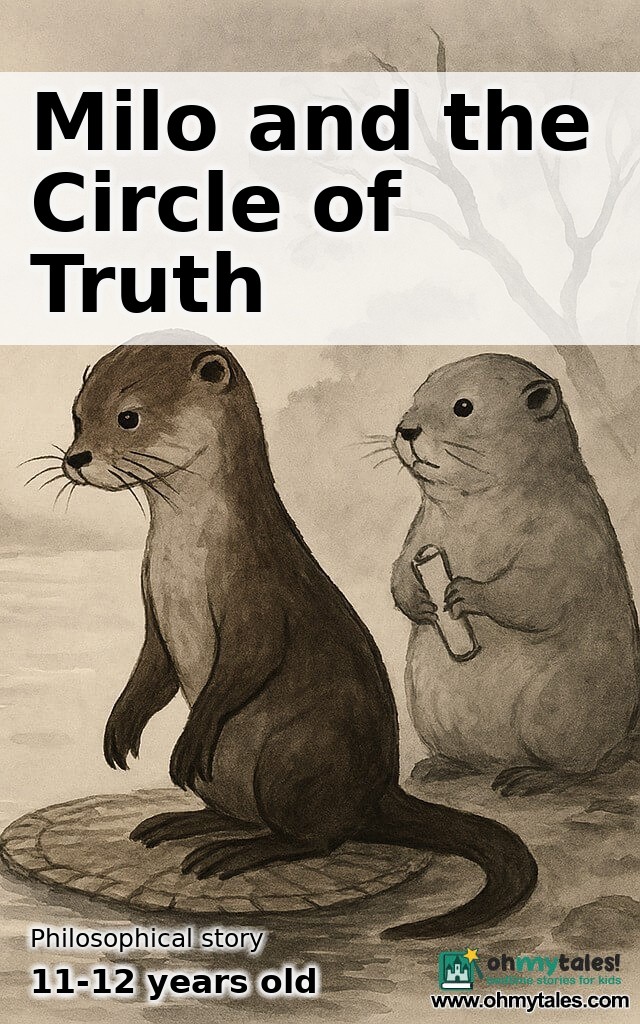
And Milo the otter? Milo's tag said, in tidy letters: “Logical.”
He did not mind being logical. Logic was a clean river. It had banks. It did not flood the room when you tried to think.
Still, Milo sometimes watched the others with a small itch behind his ribs.
Every morning, the animals lined up at the Sorting Stone, a smooth boulder that looked like it had been thinking for a thousand years. The Stone listened to their voices and nodded, as if it understood the secret music inside them. Then the Magistrate Marmot—a round, important marmot with a quill tucked behind his ear—would adjust their tags.
“Hmm,” the Marmot would say. “You are not only ‘Bold,' little fox. You are ‘Bold—Mostly.' And you, owl, are ‘Wise—With Mild Stubbornness.'”
The Valley loved these details. It compared, classified, and nuanced everything. Even the wind had a label: “Breezy—Occasionally Rude.”
Milo tried to be amused. He really did. But each time the Marmot added a dash or a footnote, Milo felt as if someone was drawing a fence around a piece of sky.
One evening, Milo sat on a stone by the river and watched his reflection break into wavy pieces.
“What am I,” he asked the river, “without a tag?”
The river burbled as if it were laughing at a private joke. Then it pushed a twig along, gently, like a quiet answer: you are still here.
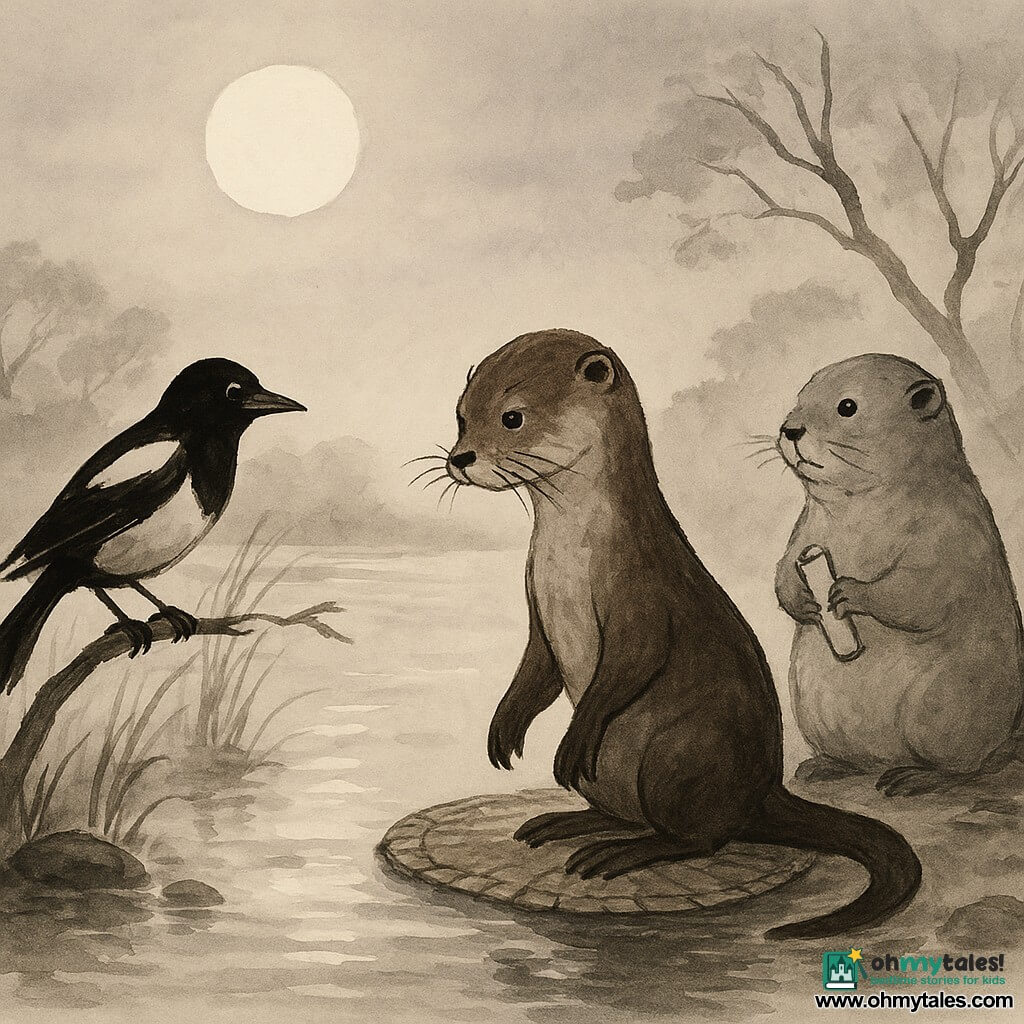
Milo's friend, Juniper the magpie, landed beside him with a dramatic flutter.
“Still staring at water like it owes you money?” Juniper asked.
“I'm thinking,” Milo said.
Juniper's eyes gleamed. “Careful. Thinking is how you fall into big questions. Big questions are slippery. Like eels.”
“I like eels,” Milo said.
“Of course you do,” Juniper replied. “You're logical. You'd probably organize eels by mood.”
Milo almost smiled. Almost.
That night, in his burrow, Milo kept his secret dream tucked under his pillow like a warm pebble: one day, he would decide how to use a power he had received.
He had never told anyone about the power. Not even the river.
Because the Valley of Labels had a habit of turning mysteries into categories. And Milo wanted his mystery to stay alive a little longer.
Chapter 2: The Gift Under the Reed Bed
Milo's power had come on a night when the stars looked unusually close, like curious eyes pressed to a window.
He had been small then. Smaller. His paws still felt new.
A traveling tortoise had appeared at the riverbank, wearing no tag at all. That was shocking in the Valley—like seeing a book with no cover, or a song with no melody.
The tortoise's shell was cracked in one corner, but the crack glowed faintly, as if a tiny sunrise lived inside it.
The tortoise watched Milo for a long moment.
“You are the kind who counts footsteps,” the tortoise said, voice slow and steady.
Milo blinked. “I do like to know how far I'm going.”
The tortoise nodded. “And you will want to know why you are going at all.”
Milo did not know what to say to that. So he said the truest thing he could think of.
“I'm hungry.”
The tortoise chuckled, a sound like pebbles gently tapping.
“Good,” the tortoise said. “Hunger is honest.”
Then the tortoise lifted one heavy foot and drew a circle in the damp sand.
“Inside this circle,” he said, “you may ask one thing of the world each day. Not for yourself—no snacks, no extra naps. But to bend a small piece of the day toward what is true.”
Milo stared. “How do I do that?”
“With your voice,” the tortoise said. “And with your courage to hear the answer.”
Milo, being logical, tried to test it.
He stepped into the circle and whispered, “Let the river tell me if it is cold.”
The river lapped at his paw. It was cold. Very cold. But the cold felt… clearer, as if it was not just coldness but the truth of coldness, sharp and sparkling.
Milo gasped.
The tortoise placed a small reed mat in Milo's paws. “This is your circle,” he said. “Hide it if you must. Use it if you dare.”
Then the tortoise turned and walked away, as if leaving gifts to strangers was normal, like leaving breadcrumbs.
Since then, Milo had kept the reed mat rolled beneath his bed, safe from curious eyes and the Marmot's quill.
Every day, he felt the power there, like a quiet lantern. He had used it only for small things: to make a lying echo sound thin; to help a lost duckling remember which way home smelled; to show himself, once, that his own excuse was not as solid as he wanted.
The power never shouted. It did not sparkle loudly. It simply nudged the world toward honesty, like a finger smoothing a wrinkle.
And still Milo wondered: when the day came, what would he choose?
Because a power is not just a tool.
It is a question.
Chapter 3: The Great Ranking Parade
In early spring, the Valley held its favorite event: the Great Ranking Parade.
The animals loved it the way some love thunderstorms—half afraid, half thrilled.
A long ribbon of chalk was drawn down the main path. Along it stood signposts: “Fastest,” “Kindest,” “Most Useful,” “Most Artistic,” “Most Reliable,” and many more.
Milo watched from near the river reeds as the Magistrate Marmot stood on a stump with a scroll.
“Citizens!” the Marmot announced. “Today we celebrate the splendid variety of you all. And we will also, for the sake of clarity, place you in a tidy order.”
Juniper leaned close to Milo. “Tidy order,” she whispered. “Because life is a sock drawer.”
“Sometimes sock drawers are helpful,” Milo whispered back.
Juniper snorted. “You would say that.”
One by one, animals ran, jumped, solved puzzles, told jokes, carried stones, recited poems. Each task earned points, and each point earned a new word on their tag.
A squirrel who had always been “Quick” became “Quick—Second Place.” His tail drooped as if someone had tied a pebble to it.
A beaver who had been “Strong” became “Strong—But Slow.” He stared at the “But” as if it had stolen his lunch.
Milo tried to see the humor. The Marmot's serious face was almost funny, like a potato pretending to be a king. But a tightness grew in Milo's chest.
Then came the “Truth Test,” a new contest, and the crowd hushed as if someone had pulled a blanket over the noise.
The Marmot raised a small bronze bell. “When the bell rings,” he said, “you must answer my question. The quicker you answer, the higher your score. Hesitation suggests confusion. Confusion suggests… an unhelpful personality.”
Milo's whiskers twitched. Truth, he thought, is not always quick.
The Marmot called up a young fox.
“What do you fear most?” asked the Marmot.
The fox's mouth opened. Closed. Opened again.
“Uh… nothing!” the fox blurted.
The bell dinged. The crowd clapped. The fox's tag gained a bright new label: “Fearless.”
Juniper muttered, “Sure. And I'm a tree.”
Next, the Marmot called on an old hedgehog.
“What do you regret?” asked the Marmot.
The hedgehog's eyes softened. “I regret—” he began, and then his voice trembled. “I regret that I pretended I didn't miss my brother.”
The bell dinged a little late. The crowd clapped less.
The hedgehog's tag gained: “Sensitive—Overly.”
Milo felt something in him tilt, like a boat taking on water.
The Marmot's voice rang again. “Milo the otter! Logical one! Step forward.”
Milo walked to the stump. The chalk line looked suddenly like a boundary around his own heart.
The Marmot smiled as if he were about to carve a statue. “What,” he asked, “is the purpose of your life?”
Silence spread. Even the river seemed to pause.
Milo knew many possible answers. To learn. To help. To survive. To be happy. To be remembered. To be good. To be safe. To be correct.
But the truest answer in that moment was smaller, and a little embarrassing.
“I don't know,” Milo said.
The bell dinged, very late.
A ripple of laughter moved through the crowd, not cruel exactly, but light and careless. Like leaves laughing at a stone.
The Marmot wrote quickly. Milo saw the quill scratch like a tiny claw.
When the Marmot turned the tag around Milo's neck, Milo read it.
“Logical—Uncertain.”
Juniper hopped up beside him afterward, puffing her feathers in outrage.
“Uncertain!” she squawked. “As if uncertainty is a stain. Honestly, Marmot is obsessed with neatness. He'd label a cloud ‘Temporary' and feel proud.”
Milo stared at his tag. The word “Uncertain” glimmered, not in a beautiful way, but in a sharp way.
All at once, Milo's secret dream felt heavier.
If the Valley could label his doubt, what would it do with his power?
Chapter 4: The Circle in the Moonlight
That night, Milo could not sleep. His thoughts marched in circles like ants carrying crumbs too big for them.
He slipped out to the riverbank with the reed mat tucked under his arm. The air smelled of damp earth and distant pine, like the world had just taken a bath.
Milo unrolled the mat and placed it on the sand. In the moonlight, the reeds looked like tall thin candles guarding a quiet altar.
He stepped into the circle and whispered, “Show me what is true about this Valley.”
The sand under his paws felt suddenly awake.
The river's surface smoothed, as if it were becoming a mirror on purpose. And in that mirror, Milo saw not his face but scenes—small and sharp.
He saw the squirrel practicing speed until his paws bled, afraid of becoming “Quick—Third Place.”
He saw the deer holding her tears in because “Gentle” did not seem to include “Angry.”
He saw Juniper, alone in a tree, rehearsing jokes, terrified that without laughter she would be labeled “Loud—Unnecessary.”
Milo's throat tightened. The truth was not a hammer. It was a lamp. It showed corners he had not wanted to see.
Then the mirror-river showed the Magistrate Marmot.
The Marmot was in his office, surrounded by tags like fallen leaves. He was rubbing his forehead.
“I have to keep things clear,” the Marmot murmured to himself. “If they're not clear, they'll be lost. If they're lost, it will be my fault.”
Milo blinked. The Marmot looked smaller there, without his stump and scroll. Like a creature trying to hold the whole sky with two paws.
So that was also true.
Milo stepped out of the circle, breathing slowly.
He realized something simple and strange: everyone was afraid of being mis-seen. Even the one who did the seeing.
Behind him, a twig snapped.
Milo spun around. Juniper stood there, eyes wide.
“You have a… a carpet?” Juniper whispered.
“It's not a carpet,” Milo said quickly. “It's a mat.”
Juniper took a step closer, head tilting. “Why is the sand inside it… brighter?”
Milo hesitated. His tag itched against his fur: “Logical—Uncertain.”
He could lie. He could say it was for picnics. He could hide the truth like a coin in his cheek.
But his power, his secret lantern, was made for truth. And truth, Milo was learning, was not a weapon. It was a way of standing without pretending.
“It's a circle,” Milo admitted. “A gift. It helps me ask for truth.”
Juniper stared, then let out a slow whistle. “So you can ask the world questions?”
“Yes,” Milo said. “One a day.”
Juniper's beak opened and closed once. “Could you ask… what the Marmot is really thinking?”
Milo looked at the river, then back at Juniper. “I already did.”
Juniper blinked. “And?”
“He's scared,” Milo said. “He thinks labels keep us from getting lost.”
Juniper's feathers fell into a softer shape. “Oh,” she said, quieter. “That's… annoyingly understandable.”
They sat together in the moonlight, listening to the river stitch its endless song.
Juniper nudged Milo with her wing. “Milo,” she said, “what are you going to do with that circle? You could ruin the Parade. Or fix it. Or… I don't know. Make everyone confess they stole snacks.”
Milo gave a small laugh. “I don't want to make anyone small.”
Juniper nodded slowly. “Then what do you want?”
Milo stared at the moon reflected in water, a coin that could never be spent.
“I want the Valley to stop confusing labels with lives,” Milo said. “But I don't know how.”
Juniper smirked. “Good. ‘I don't know' is your most honest hobby.”
Chapter 5: A Question for the King of Quills
The next day, Milo carried the reed mat rolled tight, hidden beneath a bundle of river reeds. He walked straight to the Magistrate Marmot's office.
The door had a sign: “ORDER IS COMFORT.”
Milo knocked.
“Enter!” barked the Marmot, as if the word had been sharpened.
Inside, shelves overflowed with tags sorted by color and mood. A jar labeled “HESITATION—MINOR” sat beside another labeled “HESITATION—CONCERNING.”
The Marmot looked up. His quill was indeed tucked behind his ear like a feather trying to be important.
“Milo,” the Marmot said, voice measured. “To what do I owe this… visit?”
Milo swallowed. Truth, he thought, can feel like walking barefoot on cold stones.
“I came to ask a question,” Milo said.
The Marmot brightened slightly. “Excellent. Questions lead to categories.”
Milo winced, then took a breath. “Not that kind.”
He unrolled the mat on the office floor. The Marmot stiffened.
“What is that?” the Marmot demanded.
“A circle,” Milo said. “It helps me ask for truth.”
The Marmot's eyes narrowed. “Truth is already handled by official processes.”
“Your processes are fast,” Milo said carefully. “But truth is not always fast.”
The Marmot opened his mouth, then closed it. A rare moment of silence. It was almost a miracle, like seeing a fish wink.
Milo stepped into the circle. His voice came out steady, though his heart bumped against his ribs like a small trapped bird.
“I want to use my one question today,” Milo said. He looked at the Marmot. “May I?”
The Marmot's paw twitched toward his scroll, then away. “Proceed,” he said, trying to sound in charge of the unknown.
Milo spoke to the air, to the room, to the hidden corners of the day.
“Show the Magistrate Marmot,” Milo said, “the truth of what labels do.”
The office grew quiet in a deeper way, as if the dust itself was listening.
Then the Marmot blinked—and his eyes filled, not with tears exactly, but with images. Milo could see it in the Marmot's face: something unfolding behind his stern look.
The Marmot's whiskers trembled.
He saw, as Milo had seen, the squirrel bleeding speed. The deer swallowing anger. Juniper rehearsing jokes alone. But he also saw something else.
He saw a younger Marmot, long ago, in a storm. He was small and lost, and no one knew where he belonged. Someone had finally found him and said, “There you are. Safe. Classified. Named.”
The Marmot's breath hitched.
Milo stepped out of the circle. The air felt lighter, like a window had been opened.
The Marmot stared at the tags on his shelves. “I…” he began, and his voice cracked like thin ice. “I thought I was helping.”
“You were trying,” Milo said gently. “Trying is not the same as truth.”
The Marmot's ears drooped. “If I stop labeling, won't everyone float away? Won't they become… nothing?”
Milo shook his head. “A name can be a lantern,” he said. “But a label can be a cage.”
The Marmot looked up, and for the first time he looked directly at Milo, not at the tag around Milo's neck.
“What do you suggest, Logical—Uncertain?” the Marmot asked, and there was a tired humor in it.
Milo smiled. “Just Milo is fine.”
The Marmot nodded, slowly. “Just Marmot,” he said, then sighed. “No, wait. That sounds like a band.”
Milo snorted a laugh despite himself.
Then Milo said, “Let's try something. At the next gathering, instead of ranking, ask one question. A real one. Not a quick one.”
The Marmot hesitated. Hesitation—Major, Milo thought, and almost smiled.
“What question?” the Marmot asked.
Milo looked at the reed mat. His power was warm beneath the room's worry.
“The question,” Milo said, “that doesn't turn people into points.”
Chapter 6: The Gathering Without Scores
On the following evening, the animals met by the Sorting Stone. The sky was lavender, and the first stars poked through like shy thoughts.
The crowd buzzed. Rumors flew faster than the hare.
“I heard the Marmot is banning ‘But' from tags,” said one badger.
“I heard everyone gets a trophy,” said a raccoon, hopeful.
“I heard the Stone is quitting,” whispered a mouse, dramatic.
Milo stood near Juniper, his tail swishing with nervous energy.
Juniper leaned in. “If this goes wrong,” she murmured, “I'm blaming your carpet.”
“It's a mat,” Milo whispered.
The Magistrate Marmot climbed onto the stump. He held no scroll. His paws were empty. That alone made the crowd gasp.
The Marmot cleared his throat. “Citizens,” he began. “Tonight, there will be no ranking.”
A stunned silence. Somewhere, a cricket forgot its line.
The Marmot continued, voice quieter. “I have been using labels like ropes. I thought I was pulling us to safety. But I see now ropes can also… tie.”
The animals shifted. Some looked relieved. Some looked angry, as if someone had canceled a game they were winning.
The Marmot raised one paw. “I will ask one question. You may answer slowly. Or not answer at all. No points. No tags added.”
Milo felt his chest loosen, as if someone had unknotted a string.
The Marmot took a breath. He looked at the crowd, and his gaze moved from face to face, not from tag to tag.
“What,” he asked, “is something true about you that no label has ever caught?”
The question hung in the air like a lantern.
At first, no one spoke. Then the old hedgehog stepped forward.
“I am brave,” he said softly, “when no one is watching.”
A young rabbit raised a paw. “I'm scared of thunder,” she admitted, “but I still go outside to smell the rain.”
The deer lifted her chin. “Sometimes I'm angry,” she said, and her voice did not break. “And it doesn't make me less gentle. It makes me real.”
Juniper surprised everyone by hopping onto a rock.
“I joke because I love you,” she said, then added quickly, “and also because silence is awkward.”
A ripple of laughter—kind this time—moved through the crowd.
Even the fox from the Parade swallowed and said, “I do fear things. I fear being laughed at. I just… hate how it feels.”
The Valley listened. The Sorting Stone sat silently, as if it approved of this new kind of sorting: not into piles, but into understanding.
Milo did not speak right away. He felt his own truth like a bird in his hands. He did not want to squeeze it.
Finally, he stepped forward.
“I am logical,” Milo said. “But logic isn't my whole life. Sometimes I don't know. And sometimes I choose not to know quickly, because I want the answer to be honest.”
The Marmot nodded slowly. “That,” he said, “sounds like wisdom.”
Milo's ears warmed. He glanced at Juniper, who gave him a look that said: Don't get used to compliments.
Then something changed in the crowd—not loud, not dramatic. More like snow melting. Comparisons still existed, of course. Animals still noticed who was faster, who was stronger, who could balance an acorn on their nose. But the noticing felt less like a courtroom and more like a garden.
The Marmot stepped down from the stump and walked to the Sorting Stone.
He touched it with one paw, almost shyly, and said, “Perhaps we have used you wrong.”
The Stone did not answer. It never had. But the wind moved through the trees with a gentler sound, like approval written in air.
That night, Milo walked back to the river with Juniper.
“Your plan worked,” Juniper said.
Milo shook his head. “Not my plan. The truth did most of it.”
Juniper tilted her head. “So what's the meaning of life, then, Logical—Uncertain?”
Milo looked at the water, at the stars scattered like spilled salt, at the reeds standing tall and ordinary and beautiful.
“I still don't know,” Milo admitted.
Juniper grinned. “Perfect.”
Chapter 7: The Note in the Quiet Notebook
Days passed. The Valley did not become perfect. It became real, which was better and messier.
Some animals still loved labels. They liked the comfort of a word they could hold. But now the words were offered more gently, like scarves in winter, not like collars.
The Marmot stopped adding “But” so often. He began asking, “Does this word help you? Or does it shrink you?”
Sometimes animals said, “It helps.” Sometimes they said, “It shrinks me.” Sometimes they laughed and said, “It depends on the day.”
Milo kept the reed mat, but he used it less. Not because it was less powerful, but because the Valley had begun doing something magical on its own: listening.
One evening, Milo found the Magistrate Marmot sitting by the river, feet in the water, looking suspiciously peaceful.
The Marmot glanced at Milo's tag—still reading “Logical—Uncertain”—and sighed. “You can change it,” he said. “If you wish.”
Milo touched the tag with a paw. He thought of the tortoise's crack of light, the circle, the mirror-river, the crowded Parade.
“I think I'll keep it,” Milo said. “It reminds me not to pretend.”
The Marmot chuckled. “Honesty as decoration. Bold choice.”
Milo sat beside him. The river made soft noises, like a story being told slowly.
Milo pulled out a small notebook he kept tucked in his fur. It was not official. It had no stamp. Its pages were slightly damp at the edges, because the river liked to be involved.
“What's that?” the Marmot asked.
“My idea book,” Milo said. “I write things down so they don't run away.”
The Marmot nodded. “Ideas are slippery creatures.”
Milo opened to a clean page and wrote carefully, as if the words mattered—which they did.
Then he tore out the page and held it up for the Marmot to read.
It was only one sentence:
Truth is not a label you earn; it is a light you choose to carry.
The Marmot read it twice, slowly, as if tasting it.
Then he said, very quietly, “I think… that might be the purpose of life enough for tonight.”
Milo leaned back and let the river's cool breath touch his whiskers.
In the dark, the stars did not rank themselves. They simply shone.