Chapter 1 — The Town Where Thoughts Become Soft
Frank was eleven and very sure of her own footsteps. She walked as if the path owed her an explanation.
In her town, thinking made things gentler.
It was not a rule written on posters. It was simply how the air behaved. When someone paused to wonder instead of rushing to argue, the wind loosened its tight fists. Street corners stopped feeling sharp. Even the old stones in the walls seemed to sigh and settle, like tired shoulders.
Frank noticed this the way you notice a blanket has slipped off during the night.
If a baker frowned and counted coins with angry fingers, the bread came out crusty and stubborn. If he stopped and asked himself, “What is enough?” the loaves cooled like warm pillows, and people's voices softened around them.
Frank liked the softness. She just did not trust it.
“Soft can be slippery,” she told her friend Mina, who was twelve and laughed the way a bell laughs when the door is opened.
“You sound like my grandpa,” Mina said. “He mistrusts anything that's comfortable. Even chairs.”
Frank's mother, who repaired clocks, used to say, “A clock is honest. It shows you what it shows, and it doesn't pretend.” Frank liked that. She liked things that clicked and proved themselves.
Lately, though, Frank had a question that ticked louder than any clock.
What makes someone worthy of trust?
She asked the question to her mirror. The mirror showed her freckles like scattered cinnamon and her eyes like two dark marbles. The mirror did not answer.
So she went out into the town, where thoughts made the world soft, and decided to test trust the way you test the ground before stepping onto ice.
Chapter 2 — The Map That Changed Its Mind
At the edge of the market, a thin man sold maps. He had a hat so tall it looked like it was trying to escape his head.
“Maps for every kind of traveler!” he cried. “Maps for the brave, the shy, the hungry, the lost!”
Frank picked up a rolled map and unrolled it carefully. The paper smelled like dust and peppermint. Tiny roads curled like noodle strings. A river glittered in pale ink.
“Does this map tell the truth?” Frank asked.
The map-seller placed a hand on his chest as if offended by his own heart. “My maps are the truest maps.”
Frank watched his eyes. They darted like fish.
She pointed to a hill drawn as a little triangle. “What's this place?”
“The Hill of Perfect Answers,” he said quickly. “Climb it and you'll never be confused again.”
Frank snorted, because even she knew that perfect answers were like soap bubbles—pretty, round, and gone when you touch them.
Mina leaned over her shoulder. “I've never heard of that hill.”
The man smiled too hard. His smile had corners like pins. “Not many have. That's why it's special.”
Frank kept looking. As she stared, the lines on the map trembled. A road that had been straight began to curve. The river slid sideways, as if shy.
Frank blinked. The map had changed.
“Did you see that?” she whispered.
Mina nodded. “The paper is… squirming.”
The map-seller laughed. “Ah! That means you are a deep thinker. In this town, thoughts make things soft. Your thoughts are softening the map. It's a feature!”
“A feature,” Frank repeated. The word tasted like a trick.
She rolled the map up and set it down. “If a map changes when I look at it, I can't trust it.”
The man's tall hat wobbled. “Trust is flexible!”
“No,” Frank said. “Trust is steady.”
She walked away. Mina followed, bouncing.
“You're going to make enemies,” Mina said.
“I'm going to make sense,” Frank replied. But her question followed her like a small shadow that refused to sit.
Chapter 3 — The Fountain of Promises
In the square, there was a fountain shaped like a giant ear. Water spilled from its curved rim, listening as it fell. People tossed coins in and made promises out loud.
“I promise I'll visit Aunt Lila.”
“I promise I'll stop interrupting.”
“I promise I'll try again.”
Each promise shimmered briefly above the water like a dragonfly.
Frank stood at the edge and watched.
A boy about her age leaned over and whispered, “I promise I'll never lie again.” His words glittered, then dropped into the water with a soft plop.
He looked relieved, as if the fountain had swallowed his guilt.
Frank frowned. “That was easy,” she said.
Mina nudged her. “Maybe easy is good.”
Frank crouched and stared into the fountain. Beneath the surface, coins lay like little moons. Promises drifted down too, thin as onion skin, piling up in pale layers.
An old woman sat nearby, knitting with blue yarn. The yarn looked like a river that had been persuaded to behave.
Frank approached her. “Do promises make people trustworthy?”
The woman lifted her gaze. Her eyes were clear and sharp, like polished glass. “Promises are seeds,” she said. “Some people water them. Some people leave them in their pockets.”
Frank looked back at the boy. He was already running, laughing, and bumping into a smaller child without apologizing.
Mina raised an eyebrow. “Maybe he forgot the ‘try' part.”
Frank returned to the edge. She spoke toward the ear-shaped fountain, not loudly, but firmly. “I promise to find what makes trust real.”
For a moment, her words hovered—quiet silver. Then they sank.
Nothing magical happened. No thunder. No applause from pigeons.
Frank felt oddly glad. If the fountain had cheered, she might have distrusted it too.
As they left, Mina asked, “So what's your plan, Captain Serious?”
Frank thought. Thinking made the air gentler around her ears, like a scarf.
“My plan,” she said, “is to find someone who doesn't just sound true. Someone who is true when no one is watching.”
Mina smiled. “Good luck. Even my cat acts innocent only when she thinks I'm asleep.”
Chapter 4 — The Lantern Keeper on Quiet Street
They turned onto Quiet Street, where the houses leaned close like gossipers but never spoke. At the end stood a small booth filled with lanterns. Each lantern glowed with a different kind of light: honey-gold, winter-white, blueberry-blue.
A woman sat inside, polishing the glass of a lantern with a cloth. She hummed a tune that sounded like someone walking home.
A sign read: LANTERNS FOR NIGHT WALKERS. PAY WHAT YOU CAN. RETURN WHEN YOU'RE DONE.
Mina lifted a lantern that glowed green as pond water. “This one makes my hands look like frog hands.”
Frank picked up a lantern that glowed steady and warm, not too bright. It did not flicker. It did not show off.
The lantern keeper looked up. Her hair was braided into a long rope, and her face was lined like a well-loved book.
Frank asked, “How do you know people will return them?”
The woman smiled, but not too hard. “I don't know,” she said. “I choose to believe. I also make it easier to do the right thing than the wrong one.”
“How?” Frank demanded, because she could not help it.
The lantern keeper tapped the sign. “Pay what you can. Return when you're done. No complicated rules to hide behind.”
Frank frowned. “That sounds… risky.”
“Yes,” the woman said. “Trust is a bridge. Someone has to lay the first plank.”
Frank looked at the shelves. Some lantern hooks were empty. Others held lanterns that had come back, slightly scratched, still shining.
“What happens if someone steals one?” Frank asked.
“I make another,” the keeper said. “And I remember that one stolen lantern does not prove the whole town is thieves. It only proves one person was having a small, dark day.”
Frank's chest tightened. She wanted trust to be a lock with a key, not a bridge in the fog.
Mina whispered, “She's kind of brave.”
Frank turned the lantern in her hands. The light spilled onto her fingers, making her skin look like it had sunlight inside.
“May I borrow this?” Frank asked.
The keeper nodded. “Of course.”
Frank hesitated. “What should I pay?”
The keeper leaned forward. “Pay attention,” she said softly. “That's a good beginning.”
Frank almost laughed, but it came out as a breath. She took the lantern and stepped outside.
The light did not make the street softer. It made it clearer.
As they walked, Mina said, “Maybe trust is just… borrowing a lantern and bringing it back.”
Frank did not answer. Her thoughts were busy, like birds rearranging twigs.
Chapter 5 — The Test in the Fog Garden
Beyond Quiet Street was the Fog Garden, a small park where mist gathered even on sunny days. People said the fog was made of old doubts that had nowhere else to go.
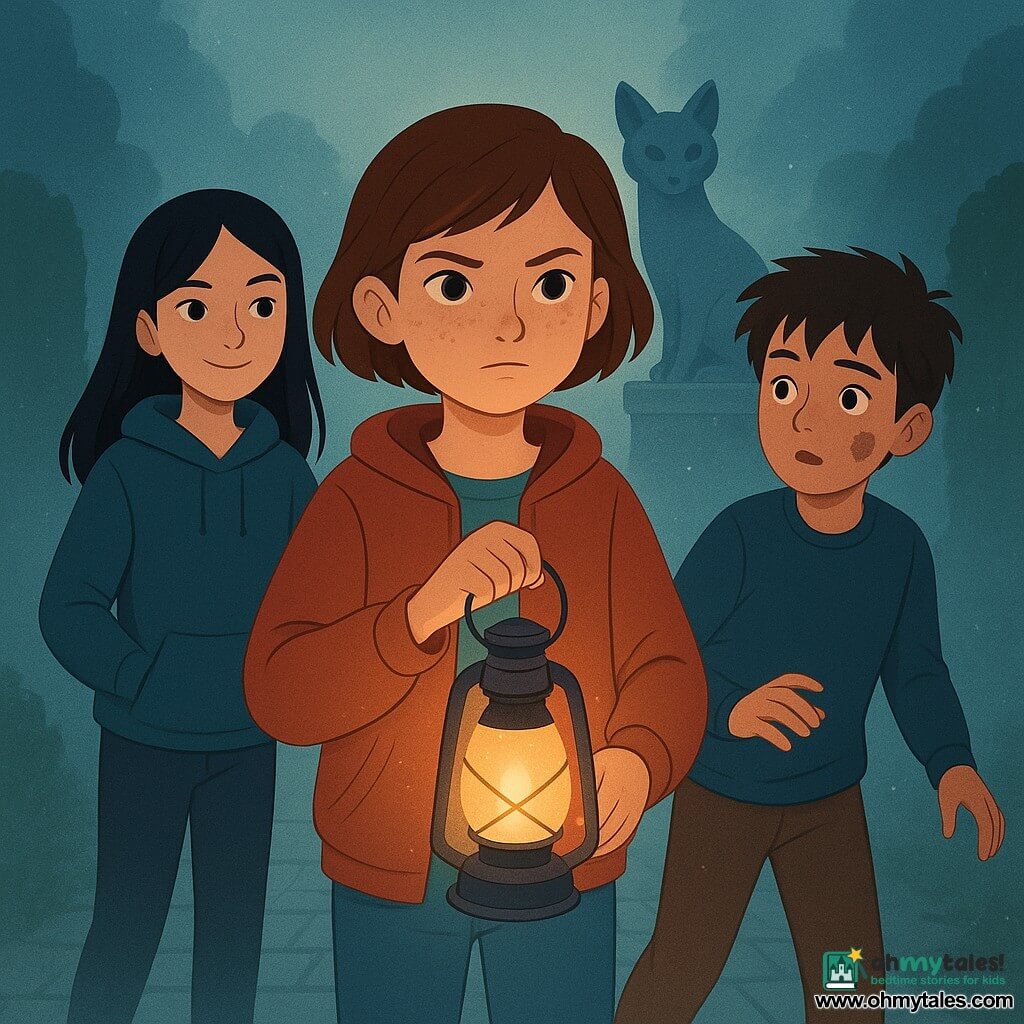
Frank entered with her lantern held high. The mist curled around her ankles like a shy pet.
In the center of the garden stood a statue of a fox. Its stone eyes seemed to ask questions without moving its mouth.
A voice came from behind a hedge. “Psst! Over here!”
A boy stepped out. He was the same one from the fountain. He had a smudge of chocolate on his cheek and a grin that made trouble look friendly.
“Nice lantern,” he said. “Where'd you get it?”
“From the lantern keeper,” Frank replied.
He leaned closer. “Those lanterns are worth money. My cousin sold one once.”
Frank's grip tightened. “Then why does she lend them?”
“Because she's soft,” he said, shrugging. “People who are soft get stepped on.”
The fog thickened. Frank felt it press gently against her thoughts, like a hand on her shoulder.
She looked at the boy's face. It was open, careless. He reminded her of a dog that runs off with a shoe and honestly doesn't understand why you're upset.
The boy pointed toward a narrow path. “There's a shortcut out of the garden. But it's only for people who know. I can show you. You just have to give me that lantern for a second.”
“For a second,” Frank repeated.
“Yeah,” he said. “I'll carry it. The fog's creepy.”
Mina, who had been silent, muttered, “My grandma says ‘for a second' is how thieves measure time.”
The boy rolled his eyes. “You two are impossible.”
Frank lifted the lantern closer to her chest. The warm light painted a small circle on the mist. Inside that circle, everything looked honest, even the fox statue.
Frank thought of the keeper's empty hooks. She thought of the sign: RETURN WHEN YOU'RE DONE. No threats. No guards. Just a simple request, like a hand held out.
She looked at the boy and said, “If you want light, walk beside me.”
He scoffed. “So you don't trust me.”
Frank's voice stayed calm. “I don't know you well enough. And you've promised big promises before.”
His cheeks reddened. “I did promise! That should count!”
“Promises count,” Frank said, “when you carry them even when no one claps.”
The boy stared at the lantern. For a moment, his grin slipped. He looked younger.
“My dad says people only do good stuff when they get something,” he said quietly. “So I figured… why not get something first.”
Frank's thoughts slowed. The fog softened around them, as if it was listening too.
“What if,” Frank asked, “someone did good because it makes their inside quieter?”
The boy blinked. “Inside quieter?”
Frank nodded. “Like this fog. It's loud when you're scared. But it gets softer when you think.”
Mina added, “And when you stop being a giant ham.”
“I am not a ham,” the boy protested, but his voice wasn't sharp anymore.
Frank held out the lantern—not to him, but between them. “Walk with us,” she said. “No shortcuts. Just the path.”
The boy hesitated, then stepped into the circle of light. The fog around his shoes thinned, like it had been holding its breath.
They walked together. The fox statue watched, stone-still, as if approving without saying so.
At the garden's edge, the boy stopped. “I'm… sorry about the fountain,” he mumbled. “I bump into people. I don't always mean to. I just forget to slow down.”
Frank nodded. “Slowing down helps,” she said. “In this town, it even makes the air softer.”
He glanced at the lantern. “So… you're going to bring it back?”
“Yes,” Frank said.
He shoved his hands in his pockets. “Good,” he said, almost grumpy. “Because if you didn't, then… it would prove my dad right.”
Frank looked at him. “Maybe,” she said, “you can help prove him wrong.”
The boy gave a small, surprised laugh. “Maybe.”
Chapter 6 — Returning the Light
Night fell the way a curtain falls—quietly, without asking permission.
Frank and Mina returned to the lantern booth. The keeper was there, humming, as if time had been sitting politely beside her.
Frank placed the lantern on the counter. The hook it belonged to waited like an empty smile.
“I brought it back,” Frank said, as if she had been carrying more than glass and flame.
The keeper nodded. “I see.”
Frank watched her hands. The keeper did not snatch the lantern like a worried person. She did not count it like money. She simply hung it up, gently, as if it were a sleeping bird.
Frank took a breath. “How do you decide who to trust?”
The keeper paused, cloth in hand. “I don't decide all at once,” she said. “Trust grows in small, ordinary moments. A returned lantern. An honest ‘I don't know.' An apology that isn't dragged by the ear.”
Mina said, “Like homework.”
The keeper chuckled. “Yes. Like homework. Small, repeated, and strangely powerful.”
Frank leaned forward. “But what if someone lies?”
The keeper's eyes softened, not in a weak way, but in a deep way, like soil. “Then I adjust,” she said. “I don't call lies truth. I don't pretend I wasn't hurt. Wisdom is not letting your heart become a locked room just because one guest stole a spoon.”
Frank pictured her heart as a house. She had been building walls inside it, brick by brick. Maybe she didn't need walls. Maybe she needed doors that opened wisely.
Frank asked, “So what makes someone trustworthy?”
The keeper took a long moment, as if she was tasting the question the way you taste soup.
“Someone trustworthy,” she said, “tries to match their words to their footsteps. Not perfectly. Just honestly. And when they can't, they tell you. They don't make you chase them through fog.”
Frank felt her question settle, like snow resting on a branch.
She smiled a little. “I think I understand.”
Mina yawned dramatically. “I understand that bedtime exists.”
The keeper pointed to the sky beyond the booth's window. “Before you go,” she said, “look.”
Chapter 7 — A Window on the Stars
Behind the booth was a small room with one square window. The keeper opened the door and let them in.
The room was plain: a chair, a shelf, a kettle. But the window was extraordinary. It framed the night like a painting, and the stars looked close enough to be freckles on the sky's face.
Frank stood very still. The stars did not flicker like nervous promises. They shone steadily, far away and faithful, as if they had been keeping an appointment for centuries.
Mina whispered, “Do you think the stars trust us?”
Frank thought about it. Thinking made her insides softer, like a clenched fist opening.
“Maybe they don't have to,” she said. “Maybe they just… keep shining.”
The keeper stood behind them, her voice low and warm. “Stars are not interested in being believed,” she said. “They are interested in being themselves.”
Frank pressed her palm against the cool window. The glass separated her from the sky, but it also invited her to look.
She remembered the map that wriggled, the fountain full of floating promises, the fog garden, the boy's sudden honesty, the lantern's steady glow.
Trust, she realized, was not a magic stamp you placed on someone's forehead. It was more like learning the constellations. You watched over time. You noticed patterns. You checked again and again. And you accepted that sometimes clouds came, but the stars were still there.
Mina leaned her head on Frank's shoulder. “So, Captain Serious,” she murmured, “what's the meaning of life?”
Frank almost laughed, but kept it gentle, because it was night, and the stars were listening in their quiet way.
“I don't know,” Frank said. “But maybe it's like this. To keep your light steady. To walk with others through fog. To return what you borrow. And to ask questions that make the world softer.”
The keeper's hand rested lightly on Frank's shoulder, as if placing a small lantern inside her chest.
Outside, the town slept. Inside, the window held the stars like a promise that didn't need shouting.
Frank watched them a little longer. Then she let the night settle around her, wise and calm, as if the universe itself were whispering, “Take your time.”