Chapter 1: The Arrival in the Clouded Valley
Once upon a time, in a town where the rooftops whispered secrets and the streets hummed with the footsteps of hurried people, there lived a boy named Eliot. He was eleven, with curious eyes the color of stormy skies and hair that stuck up like wild grass after a summer rain. Eliot often sat by his window, gazing at the clouds and wondering what lay beyond them—beyond the edge of the ordinary world, where grown-ups seemed to have misplaced their wonder.
One evening, as the sun tipped the horizon with gold, Eliot noticed a peculiar shimmer in the air. The trees outside his window appeared to sway with a rhythm only they could hear. A breeze, gentle as a whisper, crept into his room and tugged at his sleeve.
“Come along, Eliot,” it seemed to murmur. “Adventure awaits.”
Eliot hesitated only for a moment before slipping out of his window and into the garden, where the moonlight painted silver trails on the grass. There, beneath the old willow tree, he discovered a path that had never been there before—a path woven of mist and moonbeams, winding deep into the shadows.
He stepped onto the path and felt the world tilt beneath his feet. The garden dissolved into swirling colors, and the air thickened like honey. Eliot's heart fluttered with excitement and a pinch of fear. In a blink, he found himself standing in a strange, luminous valley shrouded in clouds.
The valley was filled with impossible things: trees with golden leaves that chimed softly in the wind, rivers that flowed with starlight, and hills that rolled like the backs of sleeping giants. Above all, the clouds hung low, swirling in shapes that almost seemed to watch him.
Eliot felt both tiny and enormous, as if he had stepped inside a painting painted by dreams. He took a breath—the air tasted like hope and curiosity.
“Am I dreaming?” Eliot wondered aloud.
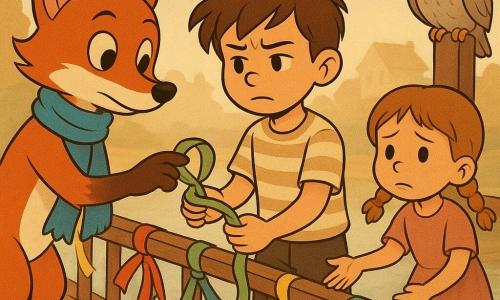
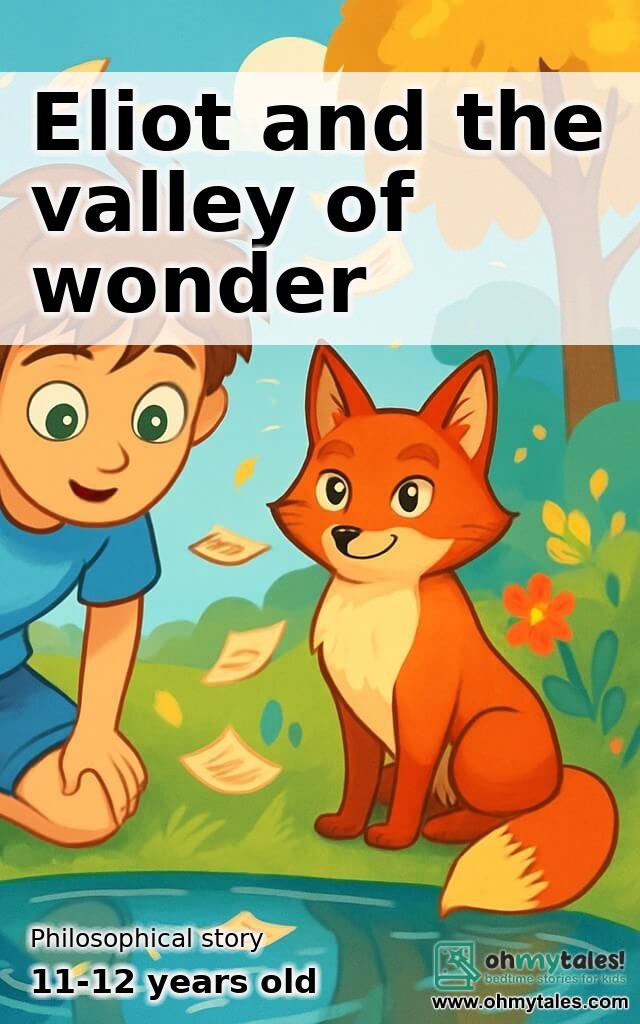
“No one truly knows,” answered a voice as gentle as dew. Eliot turned and saw a figure standing nearby. It was a fox, but not an ordinary fox—a fox with fur the color of embers and eyes that glowed like lanterns.
“I am Fenn, the Fox of Questions,” the creature said, bowing. “You've crossed the threshold into the Clouded Valley, where things are not always as they seem.”
Eliot smiled, feeling a spark of courage. “Why am I here?”
Fenn's tail flicked, trailing sparks. “To seek, to wonder, to learn. But beware: every answer here leads to another question.”
The valley buzzed with invisible secrets, and Eliot felt the first tingling thrill of discovery.
Chapter 2: The Clockmaker Who Counts the Stars
Fenn led Eliot along a winding path lined with luminous stones. The air was thick with the scent of pine and possibility.
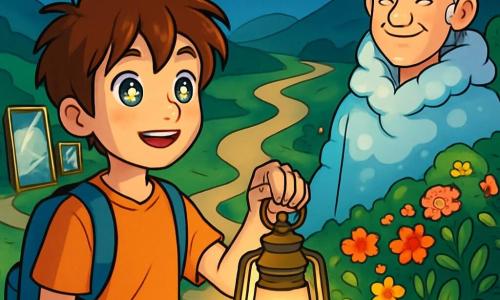
Soon, they reached a curious cottage. Its walls were made of polished mirrors, reflecting the sky and the clouds. Inside, a hunched figure sat at a table cluttered with cogs, gears, and tiny silver stars. The figure wore spectacles so large that his eyes looked like twin moons.
“Welcome, young traveler,” said the clockmaker, his voice echoing like the ticking of a thousand clocks. “I am Master Tock. I build clocks that measure more than time—they measure moments, dreams, and memories.”
Eliot watched as Master Tock spun a silver cog between his fingers. “What is time, really?” Eliot asked.
Master Tock smiled, folding his hands. “Time is the river that carries us forward, yet it's also the ocean in which we swim. Some try to trap it in clocks, but time is a trickster—it slips away when you chase it, but lingers when you forget.”
Eliot pondered this. “Can we stop time?”
“You can't stop it,” Master Tock replied, “but you can fill it. Moments filled with laughter, kindness, or wonder stretch time, while moments wasted shrink it to a blink.”
Fenn nodded. “Many people in your world chase after time, always running, never resting.”
Eliot thought of his own days, packed with tasks and hurry. “What if I do nothing?”
“Ah!” Master Tock exclaimed, spinning in his chair. “Doing nothing is sometimes the best way to do everything. In stillness, the greatest ideas are born.”
Eliot watched as Master Tock set a tiny clockwork bird free. It soared up, leaving a trail of silver dust. Eliot felt the lesson settle in his heart: time is not to be feared or hoarded, but lived.
“Thank you,” Eliot said softly.
“Remember,” Master Tock said, “the present is a gift. Don't forget to open it.”
They left the cottage, Eliot glancing back at the clockmaker, who waved with a smile as wide as the crescent moon.
Chapter 3: The Town of Masks
The path led Eliot and Fenn to a bustling town. Here, everyone wore a mask—some glittering, some plain, some carved into permanent smiles or frowns. The marketplace was alive with color and music, but Eliot felt a strange heaviness in the air, as if the joy was painted on the walls but not in the hearts of the people.
A masked merchant beckoned Eliot to his stall. “Try a mask, boy! Masks are what we wear to be seen!”
Eliot hesitated. “Why do you all wear masks?”
The merchant shrugged. “To hide our fears, our doubts. To be who others want us to be. Without masks, we are invisible.”
Eliot watched the crowd. He noticed a girl with a mask shaped like a butterfly, her eyes darting nervously. Nearby, a man's mask was cracked, and sadness oozed from the edges.
Fenn whispered, “People in every world wear masks—some you can see, some you cannot.”
Eliot picked up a mask and held it to his face. Instantly, the world changed. People smiled at him, and he felt a rush of approval. But inside, he felt hollow, like a tree with no roots.
He took off the mask and handed it back. “I'd rather be seen for who I am, even if it's scary.”
A hush fell over the crowd. Slowly, one by one, people began to remove their masks. Some faces were marked by tears, others by laughter, but all were real.
The girl with the butterfly mask smiled at Eliot. “Thank you. I forgot what my real face looked like.”
As Eliot and Fenn left the town, Eliot realized that hiding who you are is like covering a lantern with a blanket—the world is dimmer for it.
Chapter 4: The Mirror Lake
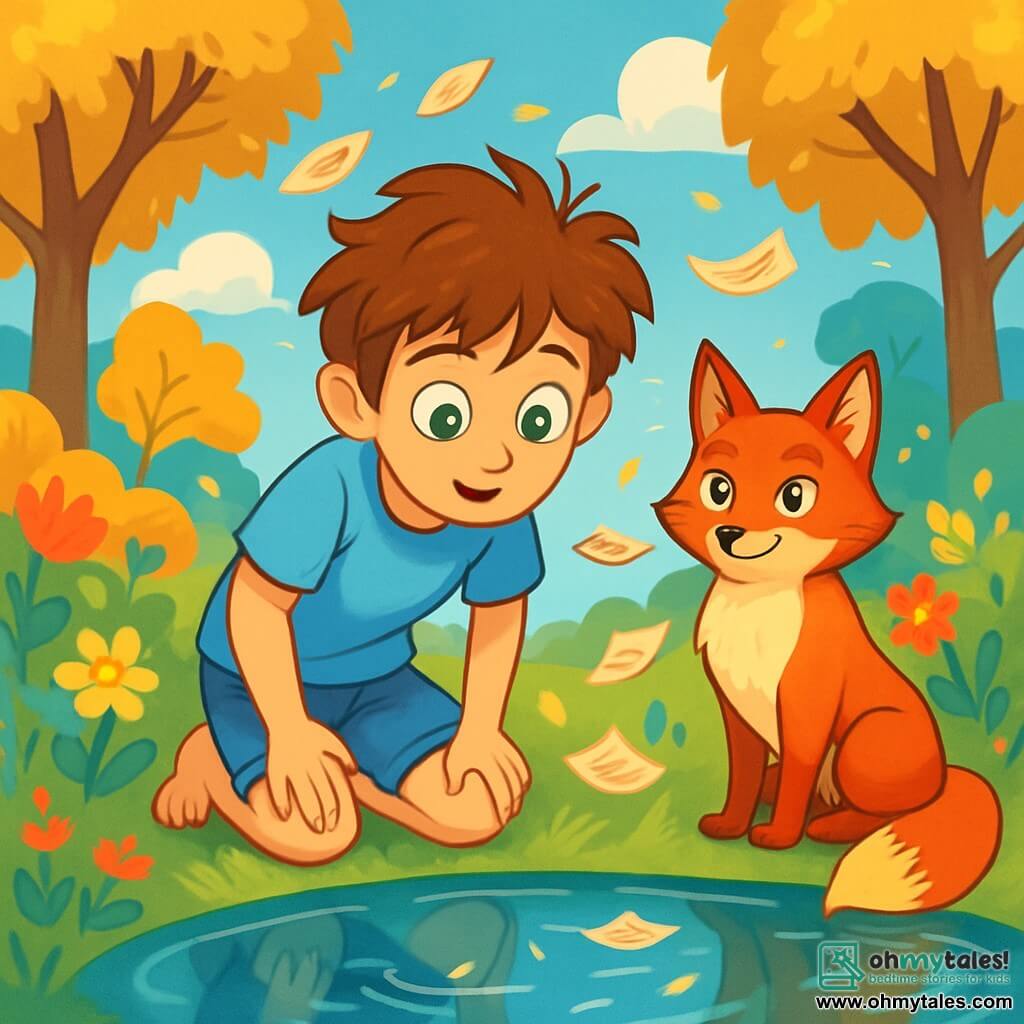
They wandered on until they reached a lake as smooth as glass, bordered by tall reeds whispering secrets to the wind. The water reflected the sky and clouds so perfectly that it was hard to tell where the world ended and the reflection began.
Eliot knelt by the shore and gazed into the lake. At first, he saw only his own face, but then the image rippled and shifted. He saw himself as he wished to be—braver, stronger, wiser. Then, the image changed again, showing his fears and doubts, the parts of himself he tried to hide.
“Who am I, really?” Eliot whispered.
Fenn sat beside him. “You are many things. To know yourself, you must see all your reflections—the bright and the shadowy.”
Eliot watched the water. The reflections danced and mingled, none more real than the other. He realized that he was a patchwork of dreams and worries, hopes and regrets.
“Is it wrong to be afraid?” he asked.
“Fear is the lantern that shows us where we must go,” Fenn replied. “To be brave is not to have no fear, but to walk forward in spite of it.”
Eliot touched the water, sending ripples out across the lake. The images shattered and reformed, reminding him that identity is never fixed but always changing.
They sat in silence, watching the sky melt into the lake, until Eliot felt a new sense of peace inside him.
Chapter 5: The Land of Lost Words
Further on, the landscape changed. The air thickened with silence, and words hung in the trees like forgotten fruit. The ground was littered with letters, and sentences blew by like tumbleweeds.
A great library rose from the mist, its doors heavy and ancient. Inside, shelves stretched up to the clouds, filled with books that whispered when Eliot passed.
A librarian—an owl with spectacles and a voice like rustling parchment—greeted them. “Welcome to the Land of Lost Words. Here, all the words unspoken, unread, or forgotten find their rest.”
Eliot wandered the aisles, running his fingers over spines. He found a tiny book, no bigger than his palm, titled “The Unsaid Apology.” Another, “Dreams Never Shared.” He opened one and felt a sadness, as if he were hearing a song that had never been sung.
“Why are so many words lost?” Eliot asked.
The owl sighed. “People fear to speak their truth. They swallow their words, thinking it safer to be silent. But lost words pile up, heavy as stones.”
Eliot thought of things he wished he'd said—thank you, I'm sorry, I love you. He realized that words are bridges between hearts, and without them, we become islands.
“Can the lost words be found again?” he asked.
The owl nodded. “With courage, yes. Speak what matters, and the lost words will find their way home.”
Eliot left the library with a promise to himself: to use his words, not hide them.
Chapter 6: The Paradoxical Garden
The next place Eliot and Fenn visited was a garden where the impossible grew. Trees bore fruit that tasted sweet and sour at once. Flowers bloomed in the shade and wilted in the sun. Rivers flowed uphill, and birds sang songs that sounded like laughter and tears mixed together.
At the center of the garden sat a philosopher, a tortoise with a shell painted with riddles. He greeted Eliot with a slow nod.
“Welcome to the Paradoxical Garden, where nothing is as it seems,” he said. “Here, opposites dance together.”
Eliot sat on the grass, puzzled. “How can things be both true and untrue?”
The tortoise smiled. “Life is full of paradoxes. To be free, we must accept limits. To understand, we must admit ignorance. Light cannot exist without shadow.”
Eliot's mind spun like leaves in a storm. “That's confusing.”
“Confusion is the first step to wisdom,” the tortoise said. “Certainty is a closed box, but doubt is an open door.”
Eliot looked around. He noticed that the strangest things in the garden were also the most beautiful. He realized that contradictions were not mistakes, but patterns in the tapestry of life.
He thanked the tortoise and left with a new understanding: sometimes the world makes the most sense when it doesn't make sense at all.
Chapter 7: The City of Shadows
Eliot's journey led him to a city built of shadow and light. Towers loomed, their shapes shifting with every step. The citizens moved quickly, their shadows stretching far behind them, while their faces remained hidden.
As Eliot wandered, he met a shadow who introduced itself as Echo.
“I am the memory of all things forgotten,” Echo said, its voice a soft sigh. “In this city, people chase after light but fear their own shadows.”
Eliot watched as people hurried, afraid to look back. He saw that the more they ran from their shadows, the longer those shadows grew.
“Why do people fear their shadows?” Eliot asked.
Echo replied, “Because they believe shadows are bad. But shadows are proof of the light. Without them, we would be invisible.”
Eliot turned and faced his own shadow. It was long, stretching and bending, but it was his. He waved, and the shadow waved back.
“I accept you,” Eliot whispered. Instantly, the city brightened. People stopped running and turned to greet their own shadows, finding peace in acceptance.
Eliot understood that to embrace your darkness is to let your light shine brighter.
Chapter 8: The Bridge of Belief
At the edge of the city, Eliot found a great chasm, too wide to cross. Across it, he could see the path home, shimmering like a promise.
A sign read: “To cross, believe.”
Eliot hesitated. “But how can I cross if there's no bridge?”
Fenn smiled. “Sometimes, you must believe before you see.”
Eliot took a trembling step into the void. As his foot touched the air, a bridge of light appeared beneath him. He took another step, and another, each one fueled by faith in the unseen.
He realized that belief is not always about seeing what is there, but trusting in what could be.
On the other side, Eliot felt lighter, as if he had shed a heavy cloak.
“Belief is the key that unlocks the impossible,” Fenn told him.
Chapter 9: The Return
With Fenn beside him, Eliot followed the path that wound back to the willow tree. The clouds thinned, and the valley faded into mist. Eliot felt a pang of sadness at the thought of leaving, but also a warmth, as if he carried a piece of the valley inside him.
At the edge of the path, Fenn turned to Eliot. “Every journey changes us. What will you do with what you've learned?”
Eliot thought of the clockmaker and the masks, the mirror lake and the lost words, the paradoxes and the shadows. He realized that the world was full of questions, and the answers were not always simple. But that was what made life beautiful.
“I'll try to live bravely, to speak my truth, to accept my shadows, and to believe in what I cannot see.”
Fenn nodded, his eyes glowing. “That is the beginning of wisdom.”
The path shimmered, and Eliot found himself back in his garden, beneath the willow tree. The sun was rising, painting the world with gold.
He climbed back through his window and watched the clouds drift by. The town was the same, but Eliot was different.
He knew now that the world was full of wonder, that truth was a journey, and that the greatest adventure was the one inside his own heart.
And so, Eliot greeted the new day with a smile, ready to live, to learn, and to wonder—always.