Chapter One: The Water That Remembers
Mira kept a question as other children kept marbles. It rattled in her pocket and rolled in her thoughts. It was a soft question, but it did not let go: What is life for? She was twelve, and she wanted an answer that felt right in her chest and made sense in her head. She liked both: the clear line of reason, like a riverbank, and the warm pull of the heart, like a lantern at dusk.
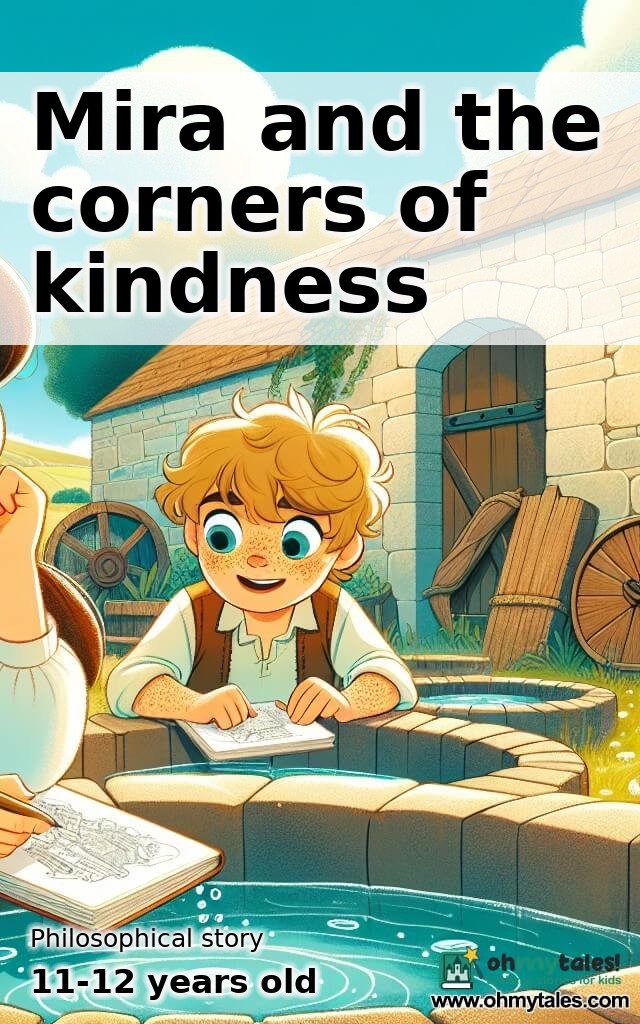
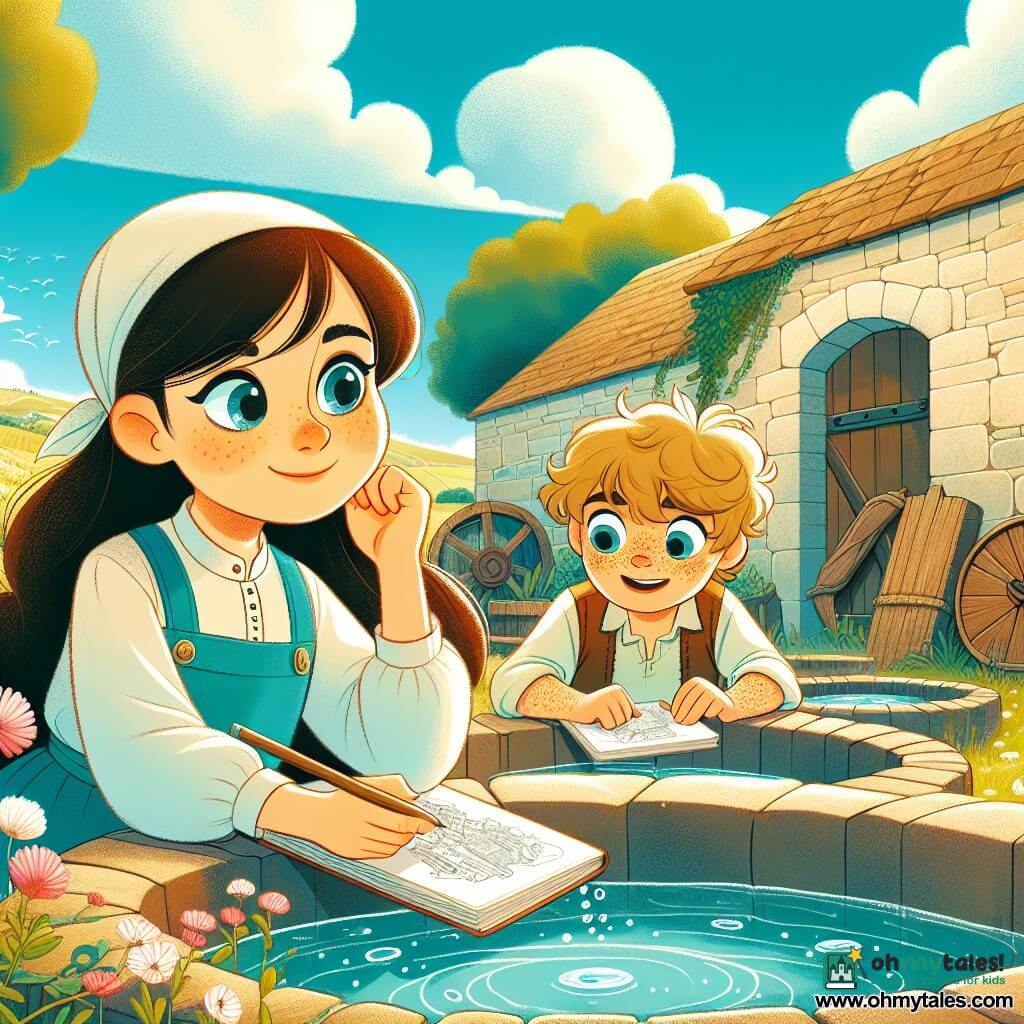
Her town sat by a stream that braided itself into winter and untied itself in spring. At the edge of the stream stood the old washhouse. It was kept cleaner than a schoolroom and always smelled faintly of soap and sunshine. Stone basins held water as clear as glass. People came to rinse small troubles from clothes and sometimes larger ones from their faces. Words drifted off the water like steam. The washhouse did not gossip. It only remembered. It remembered hands, laughter, quiet tears, songs, and the brief hush after a joke, when everyone looked at the water to calm their smiles.
Mira liked that hush. She would sit on the low wall with her notebook and draw the ripples. Each ripple looked like a path going out and coming back. There, she thought, perhaps the answer is a circle.
She had a mother who baked bread on weekends and tied her hair with the gentlest knots. Mira had a small room with a window that faced east. Mornings were white and quick there. She liked mornings because they began with a clean page. But questions didn't wait for mornings.
One afternoon, when the sky was the color of a clean sheet, she went to the washhouse with her question. She carried two pebbles in her pockets. One was smooth and cool, shaped like a half-moon. That was reason, she decided, the pebble that points. The other was warm and rough with tiny sparkles in it, like a crumb of daylight. That was heart, the pebble that glows. She wanted them to balance. When she stood very still, she imagined a quiet scale inside her, steadying the two.
At the washhouse, women leaned in over the basins, sleeves rolled, hands moving in a rhythm older than clocks. Someone had left a sprig of rosemary on the ledge. Swallows dipped and wrote their fast commas in the air. Mira sat on the wall, toes pressed into the warm stone, and listened.
“Mira,” her mother said from the doorway, “are you walking with a question again?”
“Yes,” Mira answered, “it keeps ticking like a watch in my pocket.”
“Bring it back before supper,” her mother said. “Questions eat as much as children.”
“I will,” Mira said. “I'll wash it a little, and maybe it will shrink.”
The women laughed softly. One of them, an old washer with hands that knew stories, looked up and smiled. “If you wash a question, it becomes honest,” the woman said.
“What does honest feel like?” Mira asked.
“Clean water on tired skin,” the woman replied.
Mira thanked her and took her notebook out. She wrote in it, but not much. Writing did not always catch a question where it lived. She set the notebook down by the rosemary and leaned over the basin. Her reflection looked like a coin, then like a cloud. She could see the two pebbles in her pockets in her mind. The world, she thought, was full of pairs: left foot, right foot; day, night; question, answer. But she also knew pairs held hands. They didn't fight; they danced.
Sometimes children came to splash in the shallow trough. Mira would move her notebook so it wouldn't get wet, and she would smile at them. Everything felt lighter at the washhouse, like shirts on a line in a wind that meant no harm.
Across from the basins, there was a small door people never used. It had a simple bronze handle and a peeling blue coat. It was always closed. Mira had never tried it. Closed doors, she thought, are like commas. They ask you to stop and breathe. She breathed. The question in her pocket ticked.
A crow landed on the roof and tilted its head. It seemed to be studying everyone. Mira wondered what life meant to a crow. Perhaps life was air, the space between beats of a wing. To her, sometimes life felt like the space between beats of a heart and beats of a thought. When they matched, she felt calm, like a river after rain.
She dipped her fingers in the basin. The water did not argue. It accepted and returned. Was that a lesson? She smiled because the idea was simple. She liked simple things that opened into deep ones, like closets that hid secret doors.
An old man came in with a small bundle of cloth. He was too careful, as if the cloth was more memory than cotton. The women made space for him. He rinsed the cloth and did not speak. Mira watched his hands. They trembled, but with purpose. The washhouse took his silence and gave back a clean square that dripped and shone. He pinned it on the line outside, and the sun held it till it stopped weeping. In that moment, Mira felt a tug in her chest, the little lantern of her heart. It said, be gentle with other people's bundles.
She wrote that down.
“Mira,” her mother called again, later, from outside the door, “you'll be late for bread.”
“I'm coming,” Mira said.
“When you come,” her mother added, “bring some rosemary. It makes the kitchen feel thankful.”
Mira plucked the sprig from the ledge and slipped it into her notebook. She took one last look at the basins, at the blue door that kept its breath, at the crow washing its beak in a puddle. Life, she thought, is a place that remembers. On her walk home, she held both pebbles in one hand. One cool, one warm. Her fingers were the bridge.
Chapter Two: The Librarian of the Quiet Steps
The town library had windows that blinked like slow eyes and shelves that rose like trees. Its floor was worn into gentle hollows by thousands of feet that had come with a question and left with a story. On the door, a brass plate read, “Come in with your hands open.” Mira liked that. She went in with both hands open, palms up, as if to show she had nothing to hide—even that her question was a bird she would not squeeze.
Inside, the air held a peaceful hush, the kind that makes you aware of your own breathing. Dust floated like slow snow. The librarian's desk was set back near a window. Plants reached for her, as if she were sunlight.
The librarian's name was Oriel. She was small and quick, with eyes that seemed to be searching for hidden commas in the air. She had an apron with many pockets. Sometimes a pencil peeked out. Sometimes a feather. Once, a seashell.
“You've brought your question,” Oriel said, before Mira could speak.
“How did you know?” Mira asked, startled and pleased.
“Questions hum,” Oriel said, tapping one ear. “Yours is a steady hum, like a kettle that wants attention.”
“Do you have a book for it?” Mira asked.
“I have many books,” Oriel said, “but your question might like a map at first.”
“What kind of map?” Mira asked.
“A map of quiet places,” Oriel said. “You can only read certain maps by feeling.”
“Is there a map that balances reason and heart?” Mira asked.
“If there isn't,” Oriel said with a smile, “you could draw one.”
Mira followed Oriel into the maze of books. The shelves made a tunnel with a soft roof of words. Oriel walked with steps that were almost silent, as if she didn't want to wake anyone. They stopped at a table where a big book lay open. Its pages were thick and almost smooth.
“How do I begin?” Mira asked.
“Begin with your pockets,” Oriel said.
“I have two pebbles,” Mira said. “One is the mind, one is the heart.”
“Good,” Oriel said. “Put them on the page.”
Mira set the pebbles on the paper. They made two quiet islands. Oriel poured a little circle of sand from a small tin and drew a line between them with her finger. It curved slightly, like a smile turned sideways.
“That is a bridge,” Oriel said softly. “People try to make straight bridges between head and heart, but curves are kinder.”
“What goes on the bridge?” Mira asked.
“Footprints,” Oriel said. “Yours, and those of others you meet.”
“Who should I meet?” Mira asked.
“Start with the washhouse,” Oriel said. “Water has a memory of balance.”
“I go there,” Mira said. “It keeps secrets.”
“It remembers,” Oriel corrected. “Remembering is gentler than keeping.”
Mira glanced toward the back of the library. There was a corridor with a door at the end. The door was painted the exact blue of the washhouse door. She felt her question twitch.
“Is that door always closed?” Mira asked.
“Doors are like eyelids,” Oriel said. “They open and close for reasons.”
“What reason does that one have?” Mira asked.
“For now,” Oriel said, “it has the reason of later.”
Mira ran a hand over the big book one more time. The paper felt like a table made of quiet. She collected her pebbles, tucking warm and cool into the same pocket. She liked the way the difference warmed her hand.
She moved to leave. Oriel handed her a small card. On it was written, in tiny neat script: Listen twice, decide once.
“Is that a rule of the library?” Mira asked.
“It's a kindness,” Oriel said.
“Is life about kindness?” Mira asked.
“It is at least about corners of it,” Oriel said.
Mira nodded. The card felt like a thin stone. She wanted to keep it near the pebbles. She tucked it carefully away. As she left, she watched Oriel return to the desk. The librarian's pockets rustled with mysteries. It felt good to walk out with more questions that were less heavy.
Outside, the light had thinned to the color of wet lemons. The washhouse called to her, not with words, but with that faithful hush. She walked, and with each step she tried to let reason and heart take turns. Left foot: think. Right foot: feel. It made a kind of music in her mind, a rhythm that kept the day steady.
Chapter Three: The Lavoir's Clear Song
There was a day when the sky was a fresh sheet stretched smooth, when a small wind turned the leaves into green hands clapping. Mira returned to the washhouse. Someone had scrubbed the stone floor until it shone. The basins were full and still, like eyes open in wonder.
She had brought a scarf from home, not because it was dirty, but because water tells truth to cloth. She wanted to rinse it in the lavoir's memory. She set the scarf on the edge, rolled up her sleeves, and slid it into the basin. The water held it without complaint. Bubbles rose like little opinions and then went quiet.
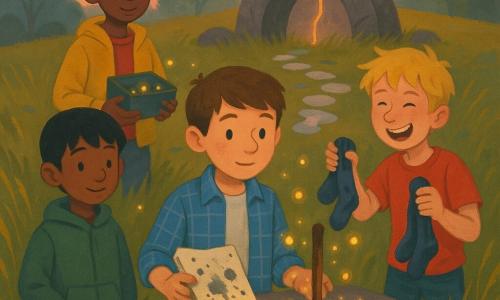
“Cold?” a boy asked, wandering in with a pair of socks and a grin.
“A little,” Mira said. “It wakes my hands up.”
“Why do you wash a scarf that looks clean?” he asked.
“To see if it can remember more than I do,” Mira said.
“Can scarves remember?” he asked, half laughing.
“They can hold the shape of your neck,” Mira said. “That's a kind of memory.”
The boy shrugged and slapped his socks against a washboard. The sound was a pleasant drum. Mira worked the scarf and watched the ripples run away and come back. There were flowers in the cracks of the stone. Tiny white faces, brave and busy. A snail moved up the wall near the door, carrying its whole house like a quiet traveler.
A woman sang softly. Someone else hummed. The old man from the other day came and pinned a handkerchief to the line, careful and proud. The washhouse seemed to breathe. Mira followed along.
“I like your notebook,” the old washer said, appearing at Mira's elbow.
“Thank you,” Mira said. “I draw ripples.”
“What do they say today?” the woman asked.
“They say, ‘Begin small,'” Mira said. “They say, ‘Be a bridge.'”
“Wise ripples,” the woman said.
“How do you listen to someone when your own thoughts are loud?” Mira asked.
“Open your heart the way you open your hands to water,” the woman said.
Mira nodded. She wrung the scarf gently. The water that fell back into the basin was no longer cold. It had lived on the cloth and become soft. She thought about how that worked. She thought about her two pebbles. Then she noticed the snail again. It had found a small leaf and was trying to pull it over a tiny crack. The leaf slipped, again and again.
“If I help, does that make me kind or impatient?” she whispered to herself, half smiling.
“If you help and watch,” said a voice. It was Oriel, who had come in quietly, a book under her arm.
“I didn't expect you,” Mira said.
“Libraries and washhouses are cousins,” Oriel said. “Both clean things. Both hold whispers.”
“You came to wash a book?” Mira asked, joking.
“I came to look at a reflection,” Oriel said. She went to the basin and tilted a page over the water, careful not to let it touch. “Words like to check their faces.”
“Do you ever feel pulled between your head and your heart?” Mira asked.
“Every day,” Oriel said. “It's like walking with two friendly dogs who want to sniff different flowers.”
“What do you do?” Mira asked.
“I let them take turns,” Oriel said.
“Can I help this snail?” Mira asked.
“Help,” Oriel said, “as if you are learning, not leading.”
Mira knelt. She put her finger next to the leaf so the snail could climb on. It did, slowly, trusting the new path. It moved across her skin like a thought going from one side of her mind to the other. When it reached the small crack, Mira set her finger to make a bridge. The snail crossed and continued its clean, purposeful journey. Her chest felt full and light at once.
“Thank you,” she said to the snail, softly.
“You're welcome,” Oriel said, pretending to be the snail, and they both laughed.
The blue door watched. It had a way of being part of the washhouse, of receiving and holding, of asking for nothing and offering a frame to think against. Mira looked at it with new interest. It reminded her of the door at the library. Doors liked to rhyme.
The afternoon deepened. The scarf hung on the line, looking like a flag of a small country that believed in warmth. Mira gathered her notebook and pebbles. She felt closer to her answer. She felt that life was for leaning toward others the way water leans toward what enters it. The scarf would remember her neck. The washhouse would remember her question. She walked out with Oriel, both of them breathing the clean, soapy air that made thoughts simple again.
Outside, swallows wrote fast commas above the road. Commas, Mira thought, save sentences from running into walls.
Chapter Four: The Door That Didn't Move
The next day, clouds climbed in from the west like careful sheep. The library was warm, but the light had that rainy patience that makes you want to find corners and small lamps. Mira went in and felt at home among the shelves. Her pebbles were in her hand today, weighing and warming her palm. She liked the shared work of them. She liked being the person who held the balance.
She walked toward the back, to the corridor with the blue door. The brass knob blinked. It was probably locked. The closer she came, the more the air felt as if it had chosen silence on purpose.
She reached the door and put her ear to it. She heard nothing. The handle was cool and smooth, and when she turned it, it did not turn back. She waited. She held her breath, then released it slowly, counting. One. Two. Three. The door held its breath, too. Mira smiled. She had come to like this kind of standoff. It was like two friends who love each other and are not sure who will speak first.
She sat down on the floor, back against the wall, knees up. Her question sat next to her, invisible and present. Footsteps came, quiet as a moon. Oriel appeared around the corner and stopped. She could see the scene the way a painter sees light: girl, door, question.
“It won't open?” Oriel asked.
“No,” Mira said. “But I don't think it's being unfriendly.”
“What do you think it's doing?” Oriel asked.
“Teaching me to wait,” Mira said.
“What happens when you wait here?” Oriel asked.
“I hear my own thoughts go past, like a small parade,” Mira said.
“And if you listen past them?” Oriel asked.
“Then I hear other people's,” Mira said.
“Good,” Oriel said. “That door might be your kind of teacher.”
Mira closed her eyes. She tried to listen past the parade. At first she heard the rustle of pages, the whisper of a shoe, a cough in the distance, a pencil deciding where to land. Then she heard something else, a small, sniffling sound, not from behind the door, but from the low corner near the radiator. She opened her eyes. A boy sat there, half hidden by the shadow of a shelf. He held a sort of map made from torn notebook paper, and his eyes were red like a morning after too little sleep.
Mira slid along the floor to be near without being a storm. She saw the map was drawn with fierce pencil lines. There were arrows and boxes and the word “home” scratched three times, each in a different place.
“Do you want someone to sit with you?” Mira asked.
He nodded. She sat, not too close, not too far. The closed door made a small stage of everything. Her pebbles rested in her palm. The cool one reminded her to think. The warm one reminded her to feel.
“Is your map lost?” Mira asked.
“It doesn't know where to go,” he said, voice rough.
“Maps like being asked,” Mira said. “We could ask.”
“How?” he asked.
“We can listen to your feet,” Mira said, “and your chest.”
“Why my chest?” he asked.
“Because it knows what matters,” she said.
“I can't go home,” he said. “It's loud there.”
“That hurts,” Mira said. “Do you want quiet now?”
“Yes,” he said.
“Then this corner is good,” she said.
“What about later?” he asked.
“Later is not here yet,” she said. “We can pack later, but not carry it.”
They sat for a while, saying nothing. The door did not open. It did not need to. It held the space. It kept out all the later. It made a pocket that could hold one hour safely.
Oriel returned with two small apples and a folded paper napkin. She set them down like gifts that required no thanks and no debt. Mira took one apple and gave the other to the boy, whose hand was too tired for a steady grasp but strong enough for an apple. The napkin was thin and clean, like a quiet thought.
She thought of something Oriel had said: Listen twice, decide once. She listened: to the boy's breath, the crunch of the apple, the door's stillness. Then she decided: kindness first, advice later.
The boy traced one of the map's arrows with his fingertip, slow and deliberate. Mira watched. She didn't fix it. She followed it in her mind, and then followed his face, which had softened. He finished the apple and put the core on the napkin. He folded the napkin around it as if it were fragile.
“Thank you,” he said.
“We can draw a new map tomorrow,” Mira said.
“Maybe,” he said.
He stood and went. He didn't look like someone who had found “home,” but like someone who knew that tomorrow could be gently escorted in. That was enough for now.
Mira stayed by the door a little longer, leaning back against the wall. The door had helped by not opening. It had taught her to pause, to make space, to let the heart go first and the head mark the path, to wait for the other rhythm. When she finally stood, the air released her with a small sigh.
As they walked back toward the front, Oriel took her elbow, a touch light as a moth landing. The shelves seemed to nod. The library had witnessed both thinking and feeling. It had made room. That, Mira learned, was half the meaning of anything good.
Chapter Five: A Corner of Kindness
Mira started a new practice. She chose corners. Corners in the library. Corners in the washhouse. A corner is where two lines meet and decide to be more together than alone. She picked one by the low shelf near the children's books. She put a small sign in careful letters: Corner of Kindness. Beneath it, a basket with folded paper and pencils. She added a glass jar where people could leave small, clean things. A button. A ribbon. A smooth stone. A note with a good word for someone. Oriel looked at the basket and nodded the way trees nod in good weather.
At the washhouse, Mira cleaned a corner near the rosemary ledge. She placed a little tin, the kind that smelled of mints long ago. On the tin, she taped one of her map cards with the words Listen twice, decide once. She did not expect anything. Expectations have sharp corners. She preferred soft ones.
People noticed in the way they notice a new bird at a feeder. A girl left a yellow hair tie in the basket. Someone wrote, “Your sweater is the color of hope.” The old man pinned a note that read, “Thank you for giving me space to breathe.” The washhouse learned a new kind of memory. It remembered words that were gifts and didn't need to be returned.
On a day when clouds were play-actors, Mira walked between her corners. She carried her pebbles always now. Sometimes she switched pockets to remind herself that balance is a moving thing. In the washhouse, the blue door watched. It felt less like a wall and more like a quiet member of the group. The basins hummed. The rosemary let its little forest smell free.
The boy with the map returned to the library. He carried an apple for Oriel and a dull pencil. He gave the apple to Oriel, who placed it gently on a stack of returns as if they were all part of the same basket. Then he sat in the corner of kindness and began to draw, not arrows, but lines that curved and changed their minds and came together again. He put a small dot and wrote “now.” He looked up at Mira, and she made a dot on her own paper, mirroring his. It felt like being seen on the inside.
“Is your corner for anyone?” he asked.
“For everyone,” Mira said.
“Can I leave this?” he asked, holding up a tiny eraser in the shape of a star.
“It will be happy there,” Mira said.
“Is kindness heavy?” he asked.
“It's light to carry and heavy to miss,” Mira said.
“What do I do when my chest feels like a fist?” he asked.
“Open it a little,” Mira said, “like a hand.”
The washhouse had its own news that day. A small bird darted in under the eaves, surprised by its own courage. It skittered along the beam, then out into the clean air. A woman rinsed a shawl that had more threads than stories, and she told a new one to the girl beside her—a story about a time she didn't know if she would be enough and was, because someone looked at her and saw that she was doing her best. Mira listened without staring. She felt the warm pebble glow. Empathy, she thought, is seeing someone else's inside world and not needing to take it, only to understand.
The blue door remained closed, but doors were no longer signs for “stop” in her mind. They were pauses that could hold kindness. The library door had held space for a boy's quiet. The washhouse door held space for the town's breathing. The corners she had made collected small brightness, like dew.
At home, Mira told her mother about the corners. Her mother cut bread and spread jam and listened. Mira's words came like beads, not too fast, each one touching the next.
“Can kindness be a place?” her mother asked.
“It can be a corner,” Mira said.
“Then the world must be a room with many corners,” her mother said.
“We can make more,” Mira said.
“Yes,” her mother said. “We can.”
They laughed. The house felt deliberate and sweet with bread. Mira went to her room and lined her pebbles on the windowsill. The evening light touched them both, making the smooth one shine and the rough one sparkle. She tried an experiment. She put them on the scale of her palms, one in each hand. If she held them close to her heart and then close to her head, together, it felt like music.
She thought of all the people she had met in the last days: the old washer with hands that knew stories; the boy with his trembling map; Oriel with pockets full of useful mysteries; the women who sang while the water lived and returned clean; the man who pinned his bundle to the wind and let the sun hold it while it wept; the snail who trusted her finger as a bridge; even the crow. Each one had a small lantern inside, she could see that now. Each lantern lit a piece of the answer. Life is for keeping those lanterns safe and shining, including your own. It is for making corners where a light can be set down without fear.
At the washhouse one afternoon, when a fine rain made the air taste like grey pearls, Oriel stood by the door and watched Mira look after the corner tin. People were learning to use it. A child left a drawing of a boat with a smile. A teenager left a note that said, “I'm sorry,” with no name, and someone else wrote under it, “You're forgiven,” with no name either. That made the air warm.
“Do you still want your question to be smaller?” Oriel asked.
“I want it to be kinder,” Mira said.
“Has it learned?” Oriel asked.
“It knows how to listen,” Mira said.
“And what is life for?” Oriel asked, not expecting a finished answer.
Mira thought. She touched both pebbles at once. She watched her reflection in the basin, her face edged by sky and stone.
“For meeting,” she said at last. “For meeting yourself and others, with your heart and your head holding hands. For making corners where kindness sits and grows brave.”
Oriel nodded as if she had been given a cup of clear water.
The sky opened then, just a little, and the rain lightened. Sun slid in along the edges of clouds. The washhouse brightened as if someone had said its secret name. The blue door, damp now, looked almost new, its paint richer, its patience freshly painted on. Mira went to it and ran her fingers along the edge, not to make it open, just to say thank you for being what it was.
She left the washhouse and walked to the library, then from the library to the square, where a bench soaked up light. She watched people crossing and re-crossing the town, each with their own bundle. She listened. She noticed. A girl dropped a glove, and a man picked it up without making a speech out of it. Two friends parted and looked back at each other twice, as if promises had tails that wagged. A dog sat in the shade and sighed. The world seemed full of small bridges being laid down and walked across.
She went back to her corner of kindness and added one more thing: a small mirror on the wall with a word at the top, written in a careful hand. The word was “Welcome.” She saw herself there, and behind her the shelves, and in the corner of the glass, a boy with a map that had grown kinder lines.
The next time she returned to the washhouse, she brought a second tin. She set it in the corner and wrote on it: For stories that need to be carried by more than one. People would know what to do. Some stories are too heavy to carry alone. That is what towns and friends and corners are for.
Rain or shine, Mira kept her pebbles. She turned them in her fingers all day long, the way people turn thoughts when they are working them to a shine. She did not mind if the answer changed its clothes. Some days it wore a feather and loved. Some days it wore a compass and understood. Most days it wore both and was not afraid to be both.
And when the day was closing and the sky went the color of washed-out blueberries, Mira would sit by her window and think of the washhouse. In the clean quiet of her room, she could still hear the basins murmur. She could still see the blue door, its quiet refusal making a shelter for those who needed to pause. She could still feel the small weight of her pebbles and the way her heart had learned to count before speaking. She had learned to step softly yet surely, to hold both lantern and map. She had learned that empathy is a bridge you can build at any size, with any material at hand: a look, a note, a corner, a finger steadying a snail.
The story of her days was still being washed and rinsed and pinned. But when she lay down and let sleep walk toward her, she knew the town had corners where kindness lived. She knew she could be one. And that thought shone like a small, steady star above her pillow.