Chapter 1: The Notebook With Straight Lines
Mira was twelve, and she liked things that knew where they were going.
Her pencils lined up like polite soldiers. Her homework was stacked like neat little buildings. Even her thoughts, when she could manage it, marched in tidy rows.
On the first cool evening of autumn, she sat on the windowsill with her notebook and wrote a list:
1. Speak more clearly.
2. Run faster in gym.
3. Stop interrupting.
4. Be better.
She stared at the last line. “Be better,” she whispered, as if the words might sprout roots and grow into instructions.
Her grandfather, who lived in the small room downstairs and smelled faintly of peppermint tea, looked up from his chair.
“Better at what?” he asked.
Mira's pencil hovered. “Better… at being me.”
He didn't laugh. He didn't say she was already perfect. He only nodded, slowly, like someone listening to a faraway bell.
“That's a brave question,” he said. “Sometimes ‘better' is a map. Sometimes it's a mirror.”
“A mirror can't tell you where to go,” Mira said.
“No,” he agreed. “But it can show you how you stand while you're walking.”
Outside, the moon hung over the street like a quiet lantern. Mira felt a little annoyed with the moon for being so calm. She wished it would point somewhere, like an arrow.
That night, when she climbed into bed, her list lay on the blanket beside her. The last line kept staring up at her.
Be better.
Mira closed her eyes and tried to fall asleep.
Somewhere between one breath and the next, her room loosened its edges. The dark became softer, like velvet. The moonlight slid across the floor and gathered into a thin silver path, as if it had been waiting for her.
A small voice, polite and curious, spoke from the path.
“Excuse me,” it said. “Are you the one looking for ‘better'?”
Mira sat up. “Who are you?”
The voice seemed to belong to a figure no taller than a chair, made of pale shimmer and shadow, like a thought in a glass of water.
“I'm a Listener,” it said. “We don't pull. We don't push. We just… hear. Would you like to ask your question out loud?”
Mira swallowed. “What does it mean to improve?”
The Listener tilted its head. “Let's go meet a few answers. Not the loud ones. The quieter ones.”
Mira hesitated. Her blanket felt safe and warm. But her question was heavier than the blanket, and it tugged at her like a small, stubborn stone in her pocket.
So she stepped onto the silver path.
It held her weight like a promise.
Chapter 2: The Mirror That Wouldn't Praise
The path led to a garden that didn't belong to any house. It grew under a sky sprinkled with sleepy stars. The grass looked combed. The flowers stood at attention.
In the middle of the garden stood a tall mirror with a wooden frame carved with tiny ears.
Mira approached. “Is that… you?” she asked the Listener.
The Listener shook its shimmering head. “No. That's the Mirror of Measuring.”
The mirror's surface rippled. It showed Mira exactly as she was: her tangled hair, her slightly crooked smile, her pajama sleeves pushed up to her elbows.
“Hello,” said the mirror, in a voice that sounded like a teaspoon tapping a cup. “Do you want a score?”
Mira stiffened. “A score?”
“I can rate your posture, your manners, your speed, your popularity, your grades,” the mirror said briskly. “I can rank you against others your age within a two-mile radius.”
“That sounds useful,” Mira admitted, even though her stomach tightened.
“Stand still,” the mirror ordered.
Mira stood still. She tried to stand the way her teacher liked: shoulders back, chin up, like a flagpole with good intentions.
The mirror hummed, as if calculating. Then it said, “Average. With potential. Also: you frown when you think, which makes people assume you're judging them.”
“I'm not judging,” Mira protested. “I'm just… organizing.”
“Your face doesn't tell the difference,” the mirror replied. “Would you like tips to appear kinder?”
Mira's cheeks warmed. “Yes. No. Maybe.” She turned to the Listener. “Is this what improving is? Getting a higher score?”
The Listener's glow dimmed, as if it was considering its words carefully. “Sometimes measuring helps. It can show you a loose shoelace before you trip. But measuring can also become a cage.”
Mira looked back at her reflection. The mirror showed her frown again, and it seemed bigger now, like a storm cloud trying to live on her forehead.
The mirror cleared its throat. “You may try smiling more. Smiling is universally considered an improvement.”
Mira tried. The smile felt pasted on, like a sticker on a cracked mug.
The mirror brightened. “Better!”
But Mira felt worse. The word “better” sounded thin, like paper.
She stepped away. “Thank you,” she said, because she was taught to respect even things that annoyed her.
The mirror sniffed. “Politeness: above average.”
The Listener led her onward. As they left, Mira glanced back. The Mirror of Measuring stood proud and upright, but its carved ears looked tired.
Mira wondered, for the first time, if even mirrors needed someone to listen to them.
Chapter 3: The River That Learned Slowly
The silver path thinned into a ribbon and slipped down to a riverbank. The water moved with a sound like pages turning.
On a flat stone sat an old turtle. Its shell was patterned like a worn library floor. It blinked as Mira approached, very slowly, as if blinking was a decision that required a meeting.
“Good evening,” Mira said.
“Good evening,” said the turtle. Its voice had the calm of deep water. “Are you in a hurry?”
“Yes,” Mira answered, honest as a bell. “I want to improve.”
The turtle nodded. “Ah. Improvement. People throw that word around like bread to ducks. Everyone wants a quick bite.”
Mira sat on a rock, hugging her knees. “Is there a faster way? A trick?”
The turtle chuckled. It sounded like pebbles gently knocking. “There are tricks. But tricks are like fireworks. Bright, quick, and then only smoke.”
The Listener stood beside Mira, saying nothing, being a quiet lamp.
The river gurgled, and the turtle pointed a claw toward it. “Watch.”
Mira watched. The river curved around stones, slipped under a fallen branch, and carried a leaf as if it were a small boat.
“It never stops,” Mira said.
“It stops sometimes,” the turtle corrected. “In winter, it slows. In summer, it swells. It meets mud and learns patience. It meets rocks and learns shape. It doesn't shout at itself, ‘Be better!' It just keeps going, and it pays attention.”
Mira frowned. “But the river doesn't have homework. Or friends. Or people who expect things.”
The turtle's eyes softened. “The river has banks. The banks expect it to stay a river. But it still changes. Not to please the banks. To find the sea.”
Mira thought of her list. Speak more clearly. Run faster. Stop interrupting. Be better.
“I want to be better without being mean to myself,” she said quietly, surprising herself.
The turtle nodded as if this sentence had been waiting in the world and had finally arrived. “Then begin with respect,” it said. “Respect is a bridge. It carries you over the loud parts of you.”
“Respect for who?” Mira asked.
“For others,” said the turtle. “And for your own learning, which is younger than you are. Don't yank it by the arm.”
The river moved on, patient and shining.
Mira listened. The river didn't rush her. The turtle didn't rush her. The Listener didn't rush her.
And Mira, who usually hurried her thoughts into straight lines, felt them loosen into something gentler—like a kite string held carefully, not pulled.
Chapter 4: The Talking Bench in the Noisy Square
The path led to a town square that seemed to be made from murmurs. Voices floated like soap bubbles: pop-pop-pop, each one wanting to be first.
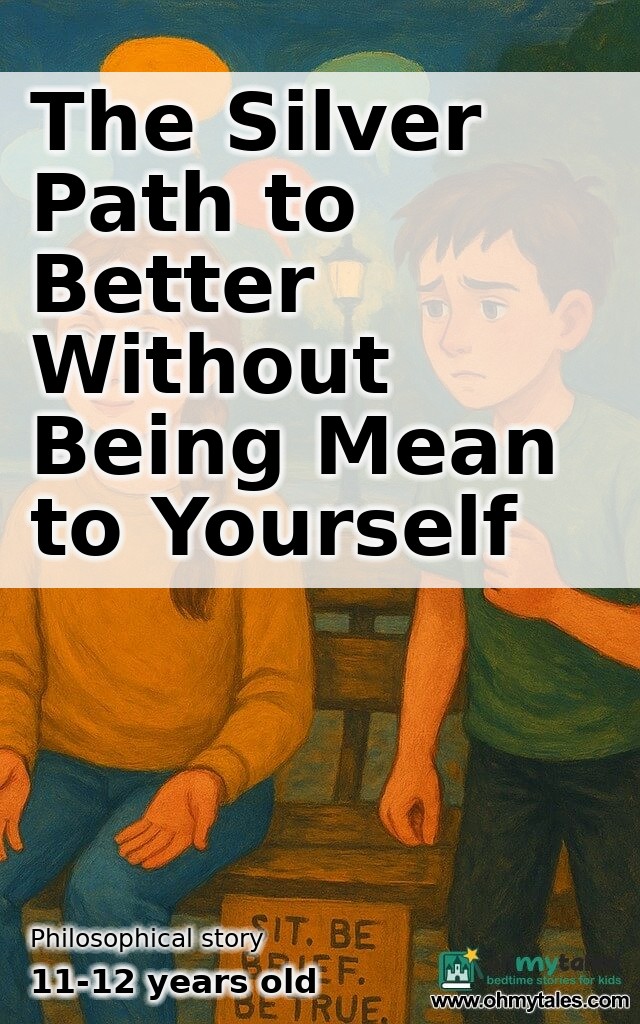
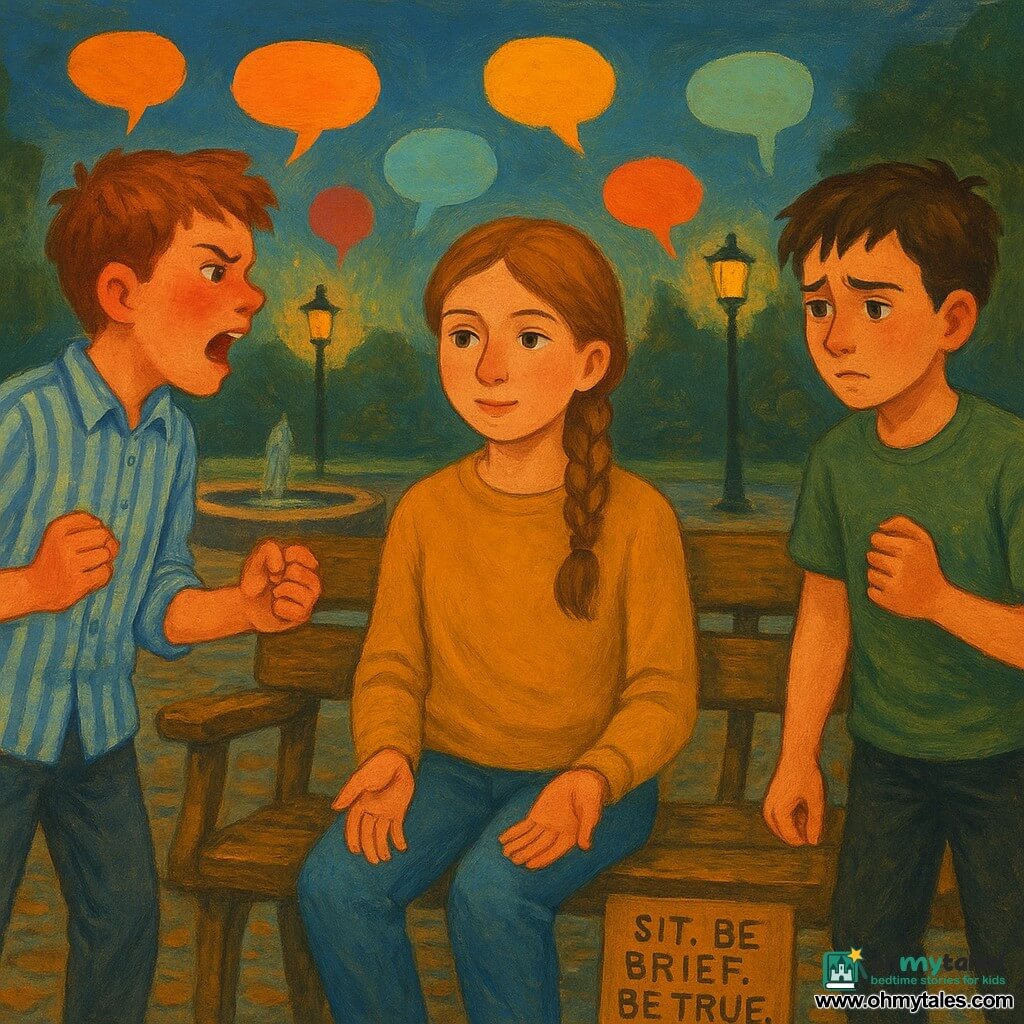
In the center stood a wooden bench. It had a chipped armrest and a small sign carved into its back:
SIT. BE BRIEF. BE TRUE.
Mira sat. The bench creaked like an old joke.
“Hello,” the bench said. “You look like someone carrying a backpack full of ‘should.'”
Mira blinked. “Benches talk here?”
“Only when someone sits with an honest spine,” said the bench. “What are you improving?”
Mira glanced around. Two kids argued near a fountain. Their words slapped the air. A woman scrolled on a glowing screen, her face tight as a knot.
“I'm trying to be better,” Mira said, “but I don't know how without turning into… a sort of machine.”
The bench hummed. “Machines aren't the worst. They're excellent at toast. But humans are made for listening.”
Mira watched the arguing kids. One boy's face was red. The other's hands were shaking. Mira felt a familiar itch in her chest—the itch to jump in, correct, fix, win.
“I would tell them to calm down,” she said.
“Would you?” the bench asked. “Or would you tell them to be quiet so you can feel comfortable?”
Mira opened her mouth, then closed it. The bench's question landed softly, but it landed.
The Listener leaned closer, like a candle leaning away from wind.
Mira tried again. “I think… I want to help. But also, I hate chaos.”
“Ah,” said the bench. “Chaos is just a room where everyone speaks at once. Respect is knocking before you enter.”
Mira stood and walked toward the arguing kids. She felt her heart beat like a drum practicing for a parade.
She stopped a few steps away. Instead of speaking, she listened.
The words weren't just words. They were worry wearing costumes.
The red-faced boy said, “You always take over!”
The shaking-handed boy said, “Because if I don't, everything goes wrong!”
Mira understood that feeling too well.
She cleared her throat. “Hey,” she said, gently. “Do you want me to hear both sides, or do you want space?”
Both boys paused. It was as if her sentence had opened a window.
The red-faced one shrugged. “Both sides, I guess.”
The other nodded, relieved, like someone setting down a heavy box.
So Mira listened. She didn't interrupt. She didn't correct. She asked small questions like stepping-stones: “What did you mean when you said…?” and “What were you afraid would happen?”
The argument didn't vanish like magic. But it softened, like bread dunked in soup. The boys' shoulders lowered.
When they finally walked away, not exactly friends but no longer enemies, the bench called out, “Not bad, Backpack-of-Should.”
Mira returned and sat again, feeling strange. Not proud like a trophy. More like… clean, the way the air feels after rain.
“Was that improving?” she asked.
The bench squeaked thoughtfully. “You didn't become taller. You didn't become faster. But you became roomier. People can breathe in roomier places.”
Mira smiled, and this time the smile felt real.
Chapter 5: The Workshop of Unfinished Things
The silver path took Mira to a small workshop lit by lanterns that looked like captive fireflies. Inside, shelves held half-carved wooden birds, lopsided bowls, and drawings with erased corners.
A woman sat at a table, sanding a piece of wood. Her hair was tied back, and her hands moved with calm certainty.
She looked up. “Welcome,” she said. “I'm the Maker.”
Mira's eyes widened. “Are you… in charge of improving?”
The Maker laughed, a warm sound, like a blanket landing on your shoulders. “In charge? No. Improvement doesn't take orders. It takes practice.”
Mira pointed to the shelves. “Why is everything unfinished?”
“Because finishing is only one kind of success,” the Maker said. “Unfinished things are honest. They say, ‘I'm still becoming.'”
Mira stepped closer to a wooden bird with one wing slightly larger than the other. “Is it wrong?”
“It's learning,” the Maker corrected, and tapped the bird's beak. “It is the symbol of trying. Trying is a brave little animal.”
Mira thought of school, where red marks looked like tiny scoldings. She thought of sports, where missing a catch felt like dropping a piece of yourself.
“How do you improve without hating mistakes?” Mira asked.
The Maker set down her sandpaper. “You treat mistakes with respect. Not with applause, but with attention.”
“Attention?” Mira repeated.
“Yes,” said the Maker. “A mistake is a door that didn't open. You don't punch the door. You check the key.”
Mira laughed. “I punch doors in my mind all the time.”
“We all do,” said the Maker. “But respect says, ‘Let's try again—gently.' Respect says, ‘You are not your error.'”
The Listener stood quietly, as if it were holding Mira's words in its hands so they wouldn't fall.
The Maker handed Mira a small piece of wood and a pencil. “Draw a bird,” she said. “Any bird. Even a ridiculous one.”
Mira drew. The bird came out with legs like noodles and a head like a pear. It looked surprised to exist.
Mira started to apologize. “It's bad—”
The Maker held up a finger. “Try a different sentence.”
Mira took a breath. “It's… a first try.”
The Maker nodded, pleased. “That sentence respects the road you're on. It doesn't pretend you're at the finish line.”
Mira looked at her silly bird and, to her amazement, felt affection. It was clumsy, but it was hers. It was proof that she had begun.
Outside the workshop, the night felt softer, as if it had been listening too.
Chapter 6: A Question to Carry Home
The silver path returned Mira to her room as quietly as a cat. The moon still hung in the same place, but it looked different now—less like an arrow, more like a companion.
Mira's notebook was on her bed. Her list waited.
The Listener stood at the foot of the bed, small and shimmering.
Mira picked up her pencil. She read her last line again: Be better.
She didn't cross it out. She didn't underline it harder. She simply wrote beneath it:
Be better—without disrespect.
Be better—by listening.
Be better—by trying again gently.
Then she paused and added one more line, because her mind felt braver now, and braver minds ask braver questions:
What kind of “better” makes more room for others?
Downstairs, she heard her grandfather cough softly, the sound of a page turning.
Mira looked at the Listener. “Will I see you again?”
The Listener's glow flickered like a wink made of light. “Whenever you ask with patience,” it said. “Whenever you listen before you measure. Whenever you respect the river-speed of learning.”
Mira lay back under her blanket. The blanket felt like a small, safe ocean.
She thought of the mirror that wanted scores, the turtle that loved slow rivers, the bench that taught knocking, the Maker who respected mistakes.
Improving, Mira realized, might not be climbing a ladder while kicking everyone else down.
It might be becoming a lamp instead of a spotlight.
Before sleep took her hand, Mira whispered into the dark, not as a demand but as an invitation:
“Tomorrow, I'll practice being roomier.”
The night didn't answer with rules.
It answered with quiet. And the quiet left space—wide, gentle space—for Mira to keep becoming.