Chapter 1: The Valley of Clear Mist
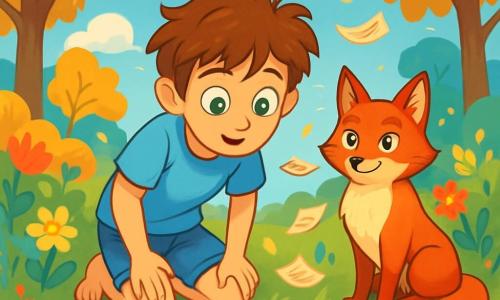
In a valley where the air was always bright and blurry at the same time, a young fox named Saffron woke each morning as if inside a pearl. Light poured everywhere, but it never stopped moving. It softened the edges of stones. It painted trees with gentle confusion. Even the river looked like a ribbon of glass being slowly breathed on.
Saffron liked this place. It made ordinary things feel like questions.
He padded to the hill behind his den and watched the village below. Houses were small and pale, like shells left by careful waves. People walked as if they were inside a dream they had agreed to share.
Saffron had a problem that followed him like a shadow that couldn't decide its shape.
When should you oppose?
Not “How do you win?” Not “How do you roar?” But simply: When do you stand against something—like a tree against the wind—and when do you bend?
He asked the mist, because the mist seemed wise. The mist answered by doing what it always did: it floated.
Saffron sighed. “You are very poetic,” he told it, “but you're not helping.”
A little laugh came from the grass. A beetle rolled a tiny round seed pod as if it were a cart.
“You ask the sky for directions,” the beetle said, “and you're surprised it doesn't point.”
“I'm not asking for directions,” Saffron replied. “I'm asking for meaning.”
“Oh,” said the beetle. “Meaning. That's heavier than my cart.”
Saffron grinned. “Then I should push it with my nose.”
He started down the hill. The light-mist brushed his fur like a soft hand. In it, the world was kind, but not clear. And Saffron felt that kindness and clarity were not the same thing.
At the edge of the village, a wooden sign leaned to one side. Someone had carved words into it long ago. The letters were filled with fog, but Saffron could still read them:
LISTENING HALL.
Underneath, in smaller writing: Bring your questions. Leave with quieter ones.
Saffron's ears flicked. “A hall for listening,” he murmured. “Finally, a place that admits it doesn't talk.”
He stepped closer. The door was open, as if it had been waiting for him for years.
Chapter 2: The Hall That Didn't Argue
Inside the Listening Hall, there were no benches, no stage, no big important chair. There were only cushions arranged in a circle, like a ring of friendly stones.
In the center sat an old owl with feathers the color of moonlit smoke. The owl was not speaking. He was simply there, like a lamp that doesn't have to shout to be bright.
Saffron cleared his throat. “Hello.”
The owl turned his head slowly. His eyes were round and calm, like two patient ponds.
“Hello,” the owl said. “You are a fox. You have arrived with your whole face full of thoughts.”
Saffron sat down, trying not to look like he was about to bite an idea in half. “I have a question.”
The owl nodded. “Most creatures do. Some wear theirs like hats.”
Saffron's tail swished. “When should I oppose? The valley is gentle, but sometimes gentleness hides mistakes. Sometimes people follow rules that feel wrong. Sometimes they laugh at someone small. Sometimes they waste food. Sometimes—”
“Sometimes,” the owl said softly, “you feel the itch of a storm under your skin.”
“Yes!” Saffron exclaimed. “Exactly.”
The owl folded his wings tighter, as if hugging a secret. “Opposition can be a lantern,” he said, “or it can be a torch thrown into dry grass. The question is not only when, but how.”
“But how do I know?” Saffron asked. “The mist makes everything unclear.”
The owl looked up. Light trembled in the air like a shy song. “Then we will use what is unclear,” he said, “to learn what is true.”
Saffron blinked. “That sounds like something a teacher says before giving homework.”
The owl's beak curved, almost a smile. “Wisdom often looks like homework at first.”
He stood and hopped to a small side door. “Come. The valley offers lessons without charging coins. It only asks for attention.”
Saffron followed. His paws made no sound. The hall felt like a promise: no one would force him to be loud here.
Outside, the owl paused at the threshold. “Today,” he said, “you will meet three situations. In each one, you will feel the urge to oppose. Listen first. Then decide.”
Saffron lifted his chin. “I can do that.”
The owl gave him a long look. “Most think they can,” he said gently. “That is why the world gets so much practice at arguing.”
Chapter 3: The Wind and the Ribbons
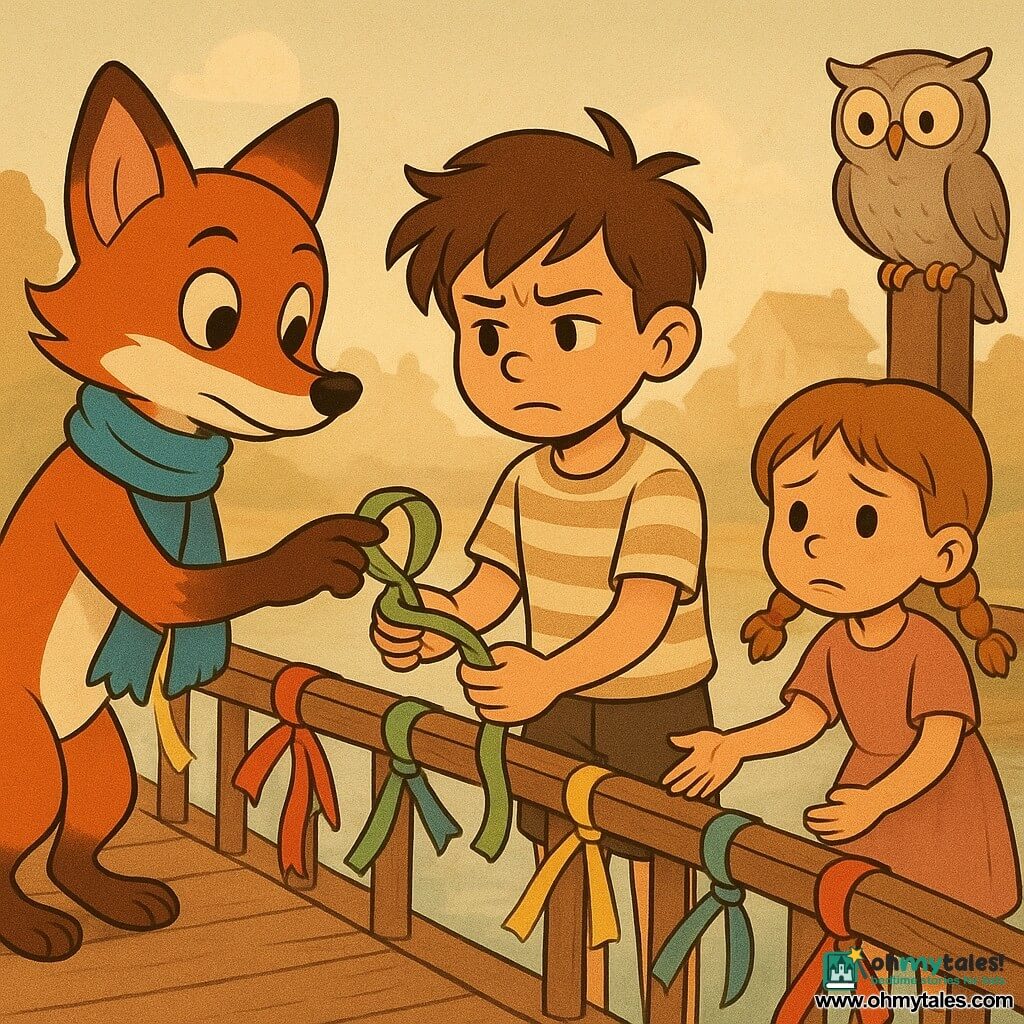
They walked to a narrow bridge over the river. Children had tied ribbons to the rails. The ribbons fluttered and snapped, bright as candy. Each ribbon carried a wish written in ink: “Be brave.” “Find my dad.” “Let me pass my exam.” “Make my sister stop borrowing my socks.”
Saffron sniffed. “A bridge of wishes. That's sweet.”
Then he saw it: a boy tearing ribbons down, laughing. The wishes fluttered to the water like startled birds. A smaller child reached up, helpless, as her ribbon disappeared.
Saffron's chest tightened. His mind turned into a clenched paw.
He marched toward the boy. “Stop!”
The boy spun around, surprised to be commanded by a fox. “Why should I?”
“Because those ribbons matter,” Saffron said, pointing with his nose. “You're throwing away someone's hope.”
The boy rolled his eyes. “They're just pieces of cloth. Wishes aren't real.”
Saffron felt heat behind his teeth. The mist around them brightened, as if listening too. He could taste the moment before a fight—sharp, metallic, thrilling, dangerous.
Then he remembered the owl's voice: Listen first.
Saffron forced himself to ask, “Why are you doing it?”
The boy hesitated. His grin slipped. “Because… everyone keeps tying ribbons. The bridge looks like a baby's hair bow. And… I wrote a wish once.” He kicked a stone. “It didn't happen.”
Saffron's anger softened, not into weakness, but into shape. “What did you wish for?” he asked.
The boy's shoulders rose like shields. “Doesn't matter.”
“It matters,” Saffron said quietly. “To you.”
The boy's eyes darted to the river. “I wished my mom would come back. She didn't. So the ribbons are stupid.”
The smaller child sniffed, hugging herself. “My ribbon was for my cat,” she said. “He's lost.”
The boy looked at her, suddenly unsure what to do with his hands.
Saffron breathed in. The air smelled of wet wood and ink. “Opposing you with teeth won't bring your mom back,” he said. “But it might make you feel powerful for a minute. Like a wind that knocks things down.”
The boy frowned. “So what? Power is better than crying.”
Saffron nodded slowly. “Power can be a coat,” he said, “but it can also be a cage.”
He turned to the smaller child. “What was your wish?”
“That my cat hears me,” she whispered.
Saffron faced the boy again. “Help us tie a new ribbon,” he said. “Not because it's magic. Because it's a way to speak when words feel too small.”
The boy stared. The wind tugged at the remaining ribbons. They fluttered like patient tongues.
Finally, the boy muttered, “Fine. Give me one.”
They found spare ribbon in a basket near the bridge. The boy tied it clumsily. His fingers shook a little, like leaves in a shy wind.
“What did you write?” Saffron asked.
The boy didn't answer right away. Then, in a voice that sounded like someone opening a door a crack, he said, “I wrote: ‘Let me remember her laugh.'”
Saffron didn't smile, because this was not a moment for smiling. He simply nodded.
As they walked away, the owl said, “You opposed him.”
“I did,” Saffron said. “But not in the way I wanted.”
The owl's eyes gleamed. “Good,” he murmured. “Your first victory is over your own first impulse.”
Chapter 4: The Market of Loud Certainties
In the village market, stalls stood close together like old friends gossiping. The air smelled of apples and soap and warm bread. Voices bounced around, bright and busy.
At one stall, a vendor sold jars of “Fog-Cutting Drops.”
“Two drops and you'll see the truth!” the vendor shouted. “No more confusion! No more doubt!”
People gathered. Doubt, after all, is uncomfortable. It is a pebble in the shoe of the mind.
Saffron watched a woman hand over coins. Her hands were tired hands. She looked as if she had been carrying invisible baskets for a long time.
Saffron's ears flattened. “That's a trick,” he whispered to the owl. “He's selling certainty like candy.”
The owl said nothing, which was his way of sharpening Saffron's thoughts.
Saffron stepped forward. “Those drops don't cut fog,” he said. “They're just water and mint.”
The vendor's smile stayed, but it became thin. “A talking fox!” he announced. “Friends, the valley has sent you entertainment.”
A few people laughed. Someone tossed a peanut. Saffron ignored it.
“You're taking their money,” Saffron said. “You're promising them ‘the truth.'”
The vendor spread his arms. “Who doesn't want the truth? The fog makes people anxious. I give comfort.”
“Comfort isn't always truth,” Saffron replied.
The vendor leaned closer. His voice dropped, sweet and sharp like syrup with glass in it. “And your truth is better? You're a fox. You steal chickens. Should we trust you about truth?”
A murmur ran through the crowd. It was easy, Saffron realized, to make a story about someone. Stories can be nets.
Saffron felt his paws curl. He could snap back. He could argue until the market rang like a bell. He could make the vendor smaller by being louder.
Then he looked at the woman with tired hands. She wasn't smiling. She wasn't laughing. She was simply… hoping.
Saffron turned to her. “Why do you want the drops?” he asked.
She blinked, startled to be asked instead of sold to. “My son,” she said. “He asks me why things happen. Why some people are unkind. Why we work so hard and still worry. I don't know what to say.” Her voice trembled. “I want something clear to give him.”
Saffron's heart softened again, like bread warmed near a fire.
He looked at the jar. It caught the light, making the liquid inside seem like captured morning. A symbol, he thought, can be pretty even when it lies.
Saffron faced the vendor. “Tell them what's in it,” he said. “Truth can handle ingredients.”
The vendor chuckled. “It's a trade secret.”
The owl spoke at last, his voice calm as a slow river. “Secrets can be useful,” he said, “but not when they wear the mask of honesty.”
The crowd grew quieter. Not silent, but attentive. Even the apples seemed to listen.
Saffron said to the vendor, “If you sell comfort, call it comfort. Don't call it truth.”
The vendor's eyes flicked around. Some people were frowning now. Doubt had returned, and it was doing its pebble job.
The vendor lifted his chin. “Fine,” he snapped. “It's mint water. It freshens your mouth. It doesn't change your life. Happy?”
The woman with tired hands let out a breath that sounded like a knot loosening. She put her coins back in her pouch.
Saffron didn't feel triumphant. He felt steady.
As they walked away, the owl said, “You opposed again.”
“Yes,” Saffron admitted. “But I tried not to humiliate him.”
The owl nodded. “Opposition without cruelty,” he said. “That is rare as a quiet drum.”
Saffron tilted his head. “A quiet drum?”
The owl blinked. “A heartbeat,” he said.
Chapter 5: The Rule of the Painted Stones
At the far end of the village, children played a game with painted stones. Each stone had a color and a rule. Red meant “Run.” Blue meant “Freeze.” Yellow meant “Sing.” Green meant “Laugh.”
It looked harmless, a silly orchestra of chaos.
Then Saffron saw a gray stone with no color at all. A boy stood near it, holding his hands behind his back. The other children circled him.
“What does gray mean?” Saffron asked a girl.
She shrugged. “Gray means ‘Don't play.' It's for Milo.”
Milo's face was blank, but his eyes were not. They were full, like cups held too long.
Saffron's tail stiffened. His question became a flame. This time, it wasn't a vendor's trick or a boy's anger. This was a rule made to bruise someone.
He stepped forward, voice firm. “That rule is mean.”
A taller child, Lena, crossed her arms. “It's just a game.”
“It's not a game to him,” Saffron said, nodding at Milo.
Lena rolled her eyes. “Milo always messes up the rules. He doesn't listen.”
Milo stared at the ground. “I do listen,” he whispered. “But it's like everyone speaks through water.”
Saffron's ears lifted. The valley of clear mist suddenly felt like Milo's own head.
The owl stood behind Saffron, silent again, as if he wanted Saffron to walk this part alone.
Saffron knelt so he was closer to Milo's height. “What helps you listen?” he asked.
Milo shrugged. “When someone shows me. Or when they say one thing at a time. Or when they don't laugh if I get it wrong.”
Saffron stood. He faced Lena and the others. “You made a gray stone so you don't have to be patient,” he said. “That's not a rule. That's a door slammed in someone's face.”
Lena's cheeks reddened. “We're not mean! We just want it to work.”
Saffron took a breath. He could feel the urge to punish them with words. It fluttered in him like a trapped bird. But he remembered the bridge. The market. Listen first.
“What do you want to work?” he asked.
Lena blinked. “The game. So it's fun.”
“And is it fun when you're leaving someone out?” Saffron asked.
A smaller boy muttered, “Not really. It's kind of… yucky.”
Saffron nodded. “Then oppose the yucky,” he said. “Not Milo.”
He picked up the gray stone. In the misty light, it looked like a little moon with no name. Saffron dipped it in a pot of green paint and held it up.
“Green means laugh,” he said. “But not the sharp laugh that bites. The laugh that invites. The laugh that says, ‘Come back in.'”
He handed the stone to Milo. “Want to be the one who holds the stones today?”
Milo's mouth opened slightly. “Me?”
“Yes,” Saffron said. “You can set the pace. One rule at a time.”
Lena shifted her feet. “Okay,” she said, a little stubbornly, a little honestly. “But if the game gets slow—”
“Then we practice patience,” Saffron replied. “Patience is just time with good manners.”
That made one of the kids snort with laughter. Even Lena's lips twitched.
Milo held the stones like they were fragile planets. “Red,” he said carefully. “Run.”
The children ran. Not too fast. As if they had learned that winning a game wasn't worth losing a person.
As Saffron walked away, the owl spoke softly. “This time, you opposed a rule.”
Saffron's throat felt tight. “Some rules are just fear wearing paint,” he said.
The owl nodded. “And you,” he said, “were brave enough to wash the paint off.”
Chapter 6: The Question That Wouldn't Sit Still
Evening came, and the valley's light became honey-colored. Mist turned golden, like a lantern wrapped in cloth. Saffron and the owl sat on a quiet slope above the Listening Hall.
Below them, the village sounded gentle—distant laughter, a pot being stirred, footsteps settling into home.
Saffron's mind was still busy. It ran in circles like a dog chasing its own tail, except Saffron was a fox, and he liked to pretend he was more dignified.
“I opposed the ribbon boy,” he said. “I opposed the vendor. I opposed the gray stone rule.”
The owl waited.
“But I still don't know the answer,” Saffron admitted. “When do you oppose? I did it three times, and it feels like I only collected three different kinds of ‘maybe.'”
The owl's gaze drifted into the glowing mist. “Life is not a door with one key,” he said. “It is more like a path in fog. You walk, and the path appears under your feet.”
Saffron flicked an ear. “That sounds suspiciously like the mist's advice.”
The owl's beak curved. “The mist is wiser than it looks. It never insists on being solid.”
Saffron lay down, his chin on his paws. “I'm scared of opposing too much,” he confessed. “Becoming sharp. Becoming someone who fights because fighting feels… important.”
The owl nodded. “A sword can start to believe it is the hand,” he said.
Saffron stared at his own paws. They looked soft. They could dig and run and hold stolen berries. They could also scratch.
“And I'm scared of opposing too little,” Saffron continued. “Becoming quiet in the wrong way. Letting people get hurt while I stay polite.”
The owl's eyes softened. “Silence can be a blanket,” he said, “or it can be a blindfold.”
Saffron groaned. “Everything can be two things.”
“Yes,” said the owl. “That is why you must listen. Listening helps you tell blankets from blindfolds.”
Saffron turned his head toward the Listening Hall. “So the answer is… listen first?”
“Listen first,” the owl agreed. “Then oppose if your heart is trying to protect, not to prove.”
Saffron rolled onto his back and stared up at the glowing blur of sky. “Protect, not prove,” he repeated.
The owl added, “And oppose in a way that leaves a door open. Not everyone is ready to walk through, but the door should exist.”
Saffron let the words settle. They felt heavy, but in a good way—like a warm stone in a pocket, something to hold when the world got cold.
Still, one question wiggled like a fish: “How do I know if I'm protecting or proving?”
The owl leaned closer. “Listen to the sound inside you,” he said. “Proving is loud. Protecting is clear.”
Saffron smiled faintly. “Clear in the fog,” he said.
“Exactly,” the owl replied. “Clarity is not the absence of mist. It is the presence of attention.”
Chapter 7: The Joy of Listening
That night, the Listening Hall filled with quiet people. Some came with big problems. Some came with tiny ones that still felt sharp. A baker came, smelling of flour. A girl came with muddy knees. Milo came, clutching a green-painted stone in his pocket like a lucky charm. Even the ribbon boy came, hands shoved deep in his sleeves.
Saffron sat in the circle too. He was surprised by how good it felt to be simply one cushion among many.
The owl did not begin with a speech. He did not clap his wings for attention. He only said, “Who would like to share a question?”
The baker cleared his throat. “My bread keeps failing,” he said. “It's like the dough refuses to rise.”
A few people chuckled kindly.
The girl with muddy knees said, “My best friend is mad at me, and I don't know why.”
The ribbon boy stared at the floor. “Sometimes I feel angry for no reason,” he muttered, “and then I make reasons.”
Saffron listened. He listened so carefully that his thoughts stopped elbowing each other. One by one, the questions floated into the air, and no one tried to shoot them down. They were held there, like lanterns carried together.
People answered sometimes, but gently, as if offering bread rather than throwing stones. Often, they didn't answer at all. They simply nodded, and their nods said: You are not alone in your fog.
Saffron felt something surprising bloom in his chest. It wasn't excitement. It wasn't victory. It was quieter and brighter.
Joy.
The joy of listening.
It felt like sitting beside a river and realizing the river has been talking all along, not with words, but with patience.
At the end, the owl looked around the circle. “Tonight,” he said, “did anyone win?”
Silence. Then the girl with muddy knees said, “No.”
The baker rubbed his chin. “But I feel… lighter.”
Milo nodded. “Me too.”
Saffron raised his paw slightly. “I think we did oppose something,” he said. “We opposed loneliness.”
The owl's eyes shone. “Yes,” he said. “And how did you do it?”
Saffron swallowed. He could still taste the old urge to be impressive. He let it go, like releasing a ribbon to the wind.
“By listening,” he said.
After the hall emptied, Saffron stepped outside into the valley. Mist curled around him, luminous and gentle. It no longer felt like a problem to solve. It felt like a reminder: you will not see everything at once, and that is okay.
The owl stood beside him. “So, fox,” he asked softly, “when should you oppose?”
Saffron thought of the boy on the bridge, the vendor with his shiny jars, the gray stone painted green. He thought of his own heart, sometimes loud, sometimes clear.
He answered slowly, as if placing each word carefully on the ground.
“When something hurts the small,” he said, “or steals hope, or sells lies as truth… I should oppose. But first I should listen, so I don't fight the person when I'm really fighting their pain. And when I oppose, I should leave a door open.”
The owl nodded, satisfied, as if Saffron had finally tuned an instrument.
Saffron looked into the glowing blur of the valley and felt a new kind of bravery.
Not the bravery of sharp teeth.
The bravery of steady ears.
And in that soft, clear mist, he walked home, carrying his questions like lanterns—bright enough to guide him, gentle enough not to burn.