Chapter One: The Train to Harbor Lane
By the time the train rolled into Wickham-by-Sea, the sea mist had crept in like a gray cat and wrapped itself around the station lamps. I stepped onto the platform, my bag on one shoulder and my coat buttoned up tight. Harbor Lane was a short walk away, a neighborhood of tiny shops, pebble gardens, and one bronze fox that everyone loved.
Except the fox on the square was not bronze.
“Detective Hart?” A woman waved from the edge of the platform. She wore a bright scarf, anxious eyes, and a smile she wasn't sure she should trust yet. “I'm Lina Arroyo. I run the Harbor Lane Community Center.”
We shook hands. “You said the statue was swapped out,” I said.
She nodded, chewing her lip. “The Watchful Fox. Someone took the real one last night and left a copy. The thing is, it's good. Too good.”
We walked to the square. The copy sat on its stone base, tail curled, head cocked as if listening. The plaque read: The Watchful Fox, E. Harrow, 1963. Children had tied ribbons on the tail. Someone's puppy sat underneath, pretending to be the fox's guardian.
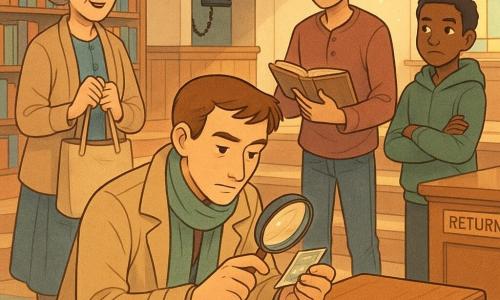
I walked around the statue slowly. My travel case held a notebook, a magnifier, and three sharpened pencils. When I work, I play a game. I call it Spot the Difference, and I never pretend it's easy.
I checked the old photograph Lina had sent me of the real fox. In the photo, a little notch chipped the left ear tip. The tail curled like a question mark. The base had a hairline crack near the back paw. The sculptor's initials—EH—had a certain slant.
“Can you see it?” Lina whispered.
“Maybe,” I said. “Maybe not yet.”
Around us, Harbor Lane fussed. The baker across the street kept peering out between trays of cinnamon buns. A boy in a red beanie skated past, wheels crackling over the cobbles. A gardener in a big hat watered planters overflowing with nasturtiums. Curious eyes everywhere. The statue's empty look bothered me most. It was almost right. Almost.
“Who knew the fox well?” I asked. “Who had reason to study it closely?”
“Half the street,” Lina said. “But no one would upset the neighborhood. Not on purpose.”
“Call me Miles,” I said. “And don't worry about purpose yet. We'll start with the differences.”
I took a breath of the sea air. It tasted like salt and the start of a long puzzle.
Chapter Two: The Copycat Fox
I crouched to see the fox's paw. The base felt too clean. Too even. I tapped it with my knuckle. A soft sound, not the ringing hum of bronze. The skin on the statue's shoulder had tiny ridges, almost like brush strokes.
“Lina,” I said, “did you move anything since this morning?”
She shook her head. “We roped it off. That's all.”
I leaned closer to the tail. In the old photo, the tail curled clockwise. Here, the curl went the other way, like a mirror image caught in a puddle. The notch on the ear was on the right, not the left. The signature—EH—looked almost right but leaned the wrong way.
“The copycat gave themselves away,” I murmured. “See? The differences are all about direction.”
“Is that important?” Lina asked.
“Important enough to be a clue,” I said. “But it raises a question: who would do such careful work and get the direction wrong?”
The boy in the red beanie had stopped his board and was watching us. “You're a detective?”
“I am,” I said.
“I'm Jax,” he said. “My mum says detectives always carry magnifying glasses and serious eyebrows. You've got the eyebrows.”
“Lucky me,” I said. “Did you see anything last night?”
Jax tucked his board under his arm. “I was up late. Skating. I know I shouldn't. The wind was loud. I saw a person, maybe midnight? Tallish. They rolled something on a cart. It squeaked. Then I smelled mint. It could've been gum. I didn't tell the police because it sounded dumb.”
“Nothing is dumb in a mystery,” I said. “Was the person heavy or light on their feet? Coat color? Hat?”
“Gray coat,” he said. “Hands in pockets. They had a strap across their chest. Like a bag. Or tools?”
“Tools,” I echoed. “Useful word.”
The gardener tipped her hat. “You're blocking the path, Mr. Detective,” she said, smiling. “I'm Ivy. I keep the square tidy.”
“Did you notice anything unusual?” I asked.
“Only the weather,” she said. “It screamed all night. And my ankles hurt. But that's not a crime, is it?”
The baker leaned out. “Mrs. Kettle,” she called. “I baked an extra batch. For stress.” She had flour on her cheek and fierce warmth in her eyes. “No one steals from Harbor Lane.”
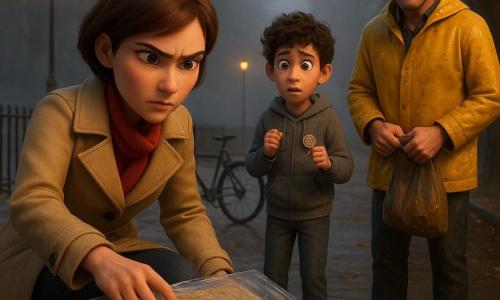
Inside the ropes, a tiny thread of gray dust had caught on a bolt of the base. I took out my envelope and coaxed the dust inside with the edge of a business card. The dust felt fine, like flour, but not snapped bread flour. It clung to my fingertips.
“Lina,” I said, “does the community center have a clay room? Or art classes?”
She nodded. “Yes. Pottery on Tuesdays. Mira runs it.”
We walked to the edge of the square. At the corner, a narrow alley led behind the buildings to the community center. A metal handcart leaned against the wall. Its wheel squeaked when the wind pushed it a few centimeters.
“Jax,” I said, “between the squeak and the mint, which sticks in your head more?”
“The squeak,” he said. “Mint's everywhere. Lots of people chew gum.”
I glanced at Ivy. She dipped her hands into her pocket and winced. “Eucalyptus cream,” she said. “My hands crack in the wind. It smells minty. Don't look at me like that.”
“I look at everyone like that,” I said.
“Comforting,” she said, with a sour smile.
I tucked the gray dust envelope into my notebook. “Here's an idea for anyone who likes puzzles,” I said, not just to them but to the street itself. “If a copy is a mirror, and the differences all bend to the left instead of right, what does that tell us about the person who made it?”
No one answered. But Lina's eyebrows drew together, thinking hard.
Chapter Three: Desks and Dust
The community center was warm and smelled like paint, paper, and a thousand cups of tea. Children's drawings covered the walls in a riot of color. Past the reception was Lina's office. Two mugs sat on the windowsill, steam curling like cats' tails. Two desks faced each other, one neat, one a little less so. The less-so desk had a plant with cheerful leaves drooping in rebellion.
“You didn't tell me you had company,” I said, setting my bag down.
“Oh,” Lina said, surprised. “You mean—well, yes. Gregor. He's new. Program coordinator. He does sets for our plays. He shares my office three days a week.”
She called out, “Gregor?”
No answer came back. But his desk told its own story: a spool of fishing line, a tape measure, a half-empty packet of resin hardener, a folded green lanyard with HLCC stitched in silver on it. On the back of his chair, a gray coat hung. Left sleeve had a faint graze of slate-colored dust near the cuff. The kind of dust that looked like the powder I had collected at the statue. I touched it lightly with a clean tissue. The smear came away on the tissue like a shy confession.
“We've had a lot of sets to build this month,” Lina said. “Do you… do you think I should call him?”
“We will, but not yet.” I looked around. On the shelf was a sculptor's loop tool, the kind used to shave clay. Beside it, a notebook with swatches of paint, all shades of bronze: antique, weathered, sea-kissed. Whoever had sat here had been thinking in bronze.
“When did Gregor start?” I asked.
“Three weeks ago,” she said. “He came with a good reputation. Quick, friendly. Helpful with kids and press releases. He even fixed a jammed door.”
“Does he chew gum?” I asked without looking at her.
She laughed. “I have no idea. Ask me something I might know.”
“Does he use his left hand?” I asked.
She blinked. “Yes, actually. He signs in with his left. Why?”
“Because sometimes a mirror shows a hand,” I said.
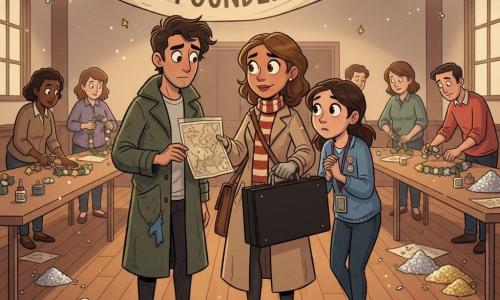
In the hall outside, a group of kids clattered past, their voices bouncing. I stepped into the pottery room. The kiln squatted in the corner like a sleeping monster. The shelves were crowded with bowls that listed to one side and cups with handles too proud for their own good. Mira Vale, the pottery teacher, stood by the sink, sleeves rolled up, hair pinned with a pencil.
“Can I help you?” she asked.
I showed my card. “We're missing a fox.”
“You and me both,” she said. “Mira. Don't look at my bowls, please. They're all disasters until the third firing.”
“Did you use the kiln last night?” I asked.
“It was on for a glaze test,” she said. “But no clay went in. Glaze smells different. Sweet metal and hope. Clay smells like earth.”
On the workbench lay a mold map for making a cast: numbers matched to parts, arrows showing directions. She shoved the papers together when she saw me look. “I was teaching how a mold works. For a class project. Nothing dangerous.”
“Left-handed or right-handed?” I asked, watching her pick up a mug.
“Right,” she said. “Very right. The left hand is for applause.”
“Good,” I said. “Applause is important.”
On my way out, I picked up the green lanyard in the office. The metal clip clinked softly. I pictured Jax's tall figure, a strap across a coat. Maybe a bag. Maybe a lanyard. Maybe both.
“We'll need to talk to Gregor,” I said to Lina. “Soon. But first I want to hear Jax's story again.”
“You already heard it,” she said.
“People's stories are like clay,” I said. “They take shape the more you work with them.”
Chapter Four: The Testimony Sharpens
The wind had dropped, and the square seemed to hold its breath. Jax was sitting on the low wall by the baker's window, his board beside him, cheeks pink from the cold. He didn't look surprised when I joined him.
“I thought you'd come back,” he said.
“I always do,” I said. “Tell me about the squeak again.”
He frowned, peeling the edge of a sticker off his board. “Okay. It wasn't the cart out back, I don't think. That squeak is high. This one was… lower. Older. Like the handcart Mr. Trent uses at the end of Pier Street. But the person didn't go that way. They went toward the community center.”
“You're sure?” I asked.
He nodded, slow. “I filmed a trick last night,” he admitted. “Don't tell my mum. I watched it back today. I caught something in the puddle.” He handed me his phone, thumb shaking with the thrill of being useful. The video showed wheels and wet stone, a blur of motion, and a flash: something green across a gray coat. A lanyard clip flashed silver when a streetlamp caught it.
“Green,” Jax said. “Like Lina's lanyards. And the mint smell wasn't gum. I smelled it again this morning when Ivy watered the planters. Euca—eucalu—”
“Eucalyptus,” I said.
“Right,” he said. “So maybe the person wore the cream. But the hands—this is weird—I noticed the person pulled the tarp off with the left hand. Don't ask me how I know. It's just a thing. My coach is left-handed, and he always grabs and turns and lifts differently. It's like a mirror.”
He looked up at me, nervous. “Does that help?”
“It helps a lot,” I said. The wind flicked the corner of the video, and I pressed pause on the lanyard flash. A little detail, sharp as a new pencil. The turning point of a story can be as quiet as a reflection.
Across the square, Mr. Trent, who ran the little scrap yard, pushed his old handcart with a wheel that groaned like a grumpy tuba. He waved. “You looking at me like I'm a suspect?” he called. “I was home with my cat. The cat will vouch for me. Though she's a liar.”
The square laughed. Not just at him, but at the way we all wanted to be part of the mystery. I didn't laugh. I was thinking about green lanyards, resin on a desk, a left-handed loop tool, and a fox whose ear notch had moved from left to right. Every clue turned toward a single person, and I didn't want to be wrong.
“Jax,” I said, “you did good. Very good. Now keep your eyes open, but don't put yourself in the middle. That's my job.”
He saluted with two fingers. “I'm not dumb,” he said. “I'm curious.”
“That's the best kind of not dumb,” I said.
Chapter Five: The Meeting
Lina agreed to a small, quiet meeting at the community center later that afternoon. The sea mist had burned off, and the sky was a washed-out blue. We sat around a table that had been painted so often the wood had lost count. I sat where I could see everyone's hands.
“Thank you for coming,” Lina said, voice steady. “I, um, thought it best to talk face to face. We all care about Harbor Lane.”
Gregor Hale came in late with apologies. He was tallish, gray coat, green lanyard clipped to his pocket, a smile that waited for approval before it settled. He took the chair nearest the window and warmed his hands around a mug Lina offered. His left hand, I noticed, had a nick on the knuckle.
Mira Vale sat with clay on her cuticles and a pencil in her hair. Ivy folded her hands in her lap, the air around her smelling gently of eucalyptus. Mr. Trent leaned his elbows and tried not to bump the tea.
“We're here for facts,” I said. “Not faces. Let's keep it simple.”
I laid out on the table: a photograph of the original fox, a photograph of the copy from this morning, the tissue with slate-gray smear, and the little envelope of gray dust. I placed Mira's loop tool beside them, and then, finally, the packet of resin hardener from Gregor's desk.
“Once upon a time,” I said softly, “someone made a careful copy of a statue. They forgot that a mirror turns left into right. The ear notch jumped sides. The tail curl turned clockwise into counter-clockwise. The artist's initials leaned with the wrong slant. That copy was installed last night.”
“Installed is a fancy word for ‘stolen,'” Mr. Trent muttered.
“Sir,” I said, “people who mean well sometimes make bad choices. People who mean badly sometimes make clever ones. Our job is to sort them.”
I turned to Mira. “Your kiln was on last night, but no clay was in it,” I said.
“True,” she said. “Anyone could smell it.”
I looked at Ivy. “You use eucalyptus hand cream,” I said.
“Also true,” she said, meeting my gaze. “My hands say thank you.”
I turned to Gregor. “You work with sets,” I said. “Props. You have resin on your desk, a loop tool on your shelf. You wear a green lanyard. You're left-handed.”
Gregor's jaw tightened. Lina sat very still.
“And there's something else,” I said. “To remove the heavy bronze fox, the person needed keys to the square's chain and the community center's back door. They needed a handcart close by. They needed a place to hide the statue where it would be safe until they decided what to do. The community center's store room behind the stage is large. It's also, if I remember the hall, where you fixed a jammed door.”
Gregor's eyes were on his cup. The left sleeve of his gray coat had a faint dust mark near the cuff, almost invisible. As he realized I was looking at it, he folded his arms tight, but too late. Mr. Trent's eyes darted to me, then back to him.
I slid the tissue across the table. “Same color,” I said. “Same fine texture. And this, too.” I pulled out a receipt I had found tucked under a stack of flyers on Gregor's desk. “East Wharf Supplies,” I read. “Bronze coating kit. Purchased two nights ago. Paid cash.”
Gregor swallowed. He didn't argue. He didn't even deny it. He just closed his eyes for a second too long, as if he might wake up to find the fox back in place and the square full of laughter, not questions.
“What did you do with the original?” I asked, quietly.
“In the store room,” he said, just as quietly. “Under the old stage flats. I didn't damage it. I swear.”
Lina's breath left her like a balloon deflating. “Why?” she asked, her voice small and enormous at once.
Gregor's answer climbed out of a maze of bad plans and good intentions. “I heard a rumor,” he said. “At a council meeting. A developer wanted to ‘refresh the square.' They talked about moving the fox to a private garden. I wanted to protect it. I thought if I made a copy and hid the original—just for a little while—people would notice. They'd be angry. They'd fight to keep it. Then when the council saw everyone cared, they'd give up the idea. Then I'd put the real one back. No harm done.”
“No harm?” Ivy said, incredulous. “You scared half the neighborhood.”
“I know,” he said. “I know. I didn't think it would feel like… stealing. It was stupid. I was sure I could fix it.”
“Crime is often confident,” I said. “But there's something else that tells on you besides the resin and the mirror mistakes and the lanyard. The base of the copy had tool marks that flow left to right. That's the way a left-handed person pulls a loop tool. Mira pulls the other way.”
Mira gave a short, surprised laugh. “He got caught because of a habit. My students will love that.”
Gregor looked at his hands. He had clever hands, the sort that can build a scene out of scraps and paint and hope. They trembled now.
“Where is it?” Lina asked. Her voice had steadied again. “Take us there.”
He nodded, and we stood as one body, the community center's mismatched chairs scraping like a small parade.
Chapter Six: Peace on Harbor Lane
The store room behind the stage was a dark forest of plywood trees and cardboard rocks. Dust lay on everything like snow that forgot to melt. Gregor pulled back canvas flats carefully, one by one. There, under a gray tarp, was the real Watchful Fox. Bronze, heavy, its left ear chipped just so, tail curling the right way. My shoulders relaxed for the first time since I stepped off the train.
Lina touched the statue's shoulder. “You should have told me,” she whispered to Gregor. “We could have—”
“I thought telling would ruin it,” he said. “I was wrong.”
“Completely wrong,” she said. “But not unforgivable.”
We moved the bronze fox slowly, using three people, the handcart, blankets, and care. Jax arrived with Mrs. Kettle, who claimed her buns were an essential part of any rescue mission. Mr. Trent held the door as if he were hoisting a sail. Even Ivy, worried about her ankles, rolled up her sleeves and got under the weight.
When the fox was back on its base, a cheer went up from the people gathered at the ropes. It wasn't wild. It wasn't messy. It was steady, like a held note. Lena stood with her hand on the fox, proud and tired and a little teary.
“What about me?” Gregor asked, low. “Do I get reported? Fired?”
“That's for the grown-ups to work out,” I said. “But I think you need to apologize to the square. Not with words. With work.”
He nodded. “Every lock on the square. New cameras that don't feel like jail. I'll do it. I'll fix what I broke.”
“Fixing is a beginning,” Lina said. “Not an end.”
I turned to Jax. “And you,” I said. “What do you see now that you didn't see before?”
He tilted his head like a fox listening for mice. “I see left and right,” he said. “I see little marks that tell you which hand. I see that sometimes people mess up because they care too hard, in the wrong way.”
“Keep that,” I said. “It's a good lens.”
He grinned, then grew solemn. “Will you teach me your spot-the-difference game?”
“It's easy,” I said. “Look at two things that should be the same. Find what isn't. Decide if it matters. Then ask why.”
“Why,” he said, trying the word out. “Because why is the key.”
We watched the neighborhood put itself back together. The copycat fox was wheeled to the community center to be used in plays and festivals, where it could pretend to be a fox without pretending to be the fox. Gregor scrubbed the last gray smear from his sleeve and made a plan with Lina and the council to secure the statue from rumors and from hands that think their ideas are smarter than anyone else's.
In the afternoon, the sky shifted into sun. Harbor Lane thawed. Children played around the base, careful not to climb. Ivy watered the nasturtiums, smiling at the way they flared orange in the light. Mrs. Kettle passed out small buns that somehow tasted like relief. Mr. Trent repaired his handcart wheel with a flourish, as if closing a case of his own. People walked a little slower past the fox, looking twice, then again, making sure the notch was on the left and the tail curled the right way.
Peace in a neighborhood isn't loud. It murmurs. It settles into corners. It grows from curiosity, from the willingness to notice, from the courage to ask why and then do something about it. It doesn't mean nothing ever goes wrong. It means when something does, people show up.
At the station, later, the mist tried to creep back in. I got on the train and took out the old photo of the fox and the new one. I played Spot the Difference one more time, just to feel the game under my fingers. Left ear, right curl, true initials. Small marks that say, “I am what I am.”
When the train pulled out, I saw Jax on the platform, waving his board in the air like a flag. I lifted my notebook in salute. Behind him, on Harbor Lane, the Watchful Fox listened to the town it loved and kept watch, exactly where it belonged.