1. The Missing Compass
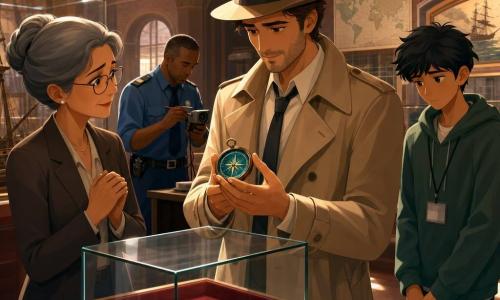
The compass had been a small, bright thing, older than the town hall and shinier than the mayor's teeth when he smiled for photographs. It sat beneath glass at the Maritime Room of Greyhaven Museum, a brass circle with a needle that never lied. On the morning of the Fishermen's Festival, the glass case was empty and the town felt hollow as a bell.
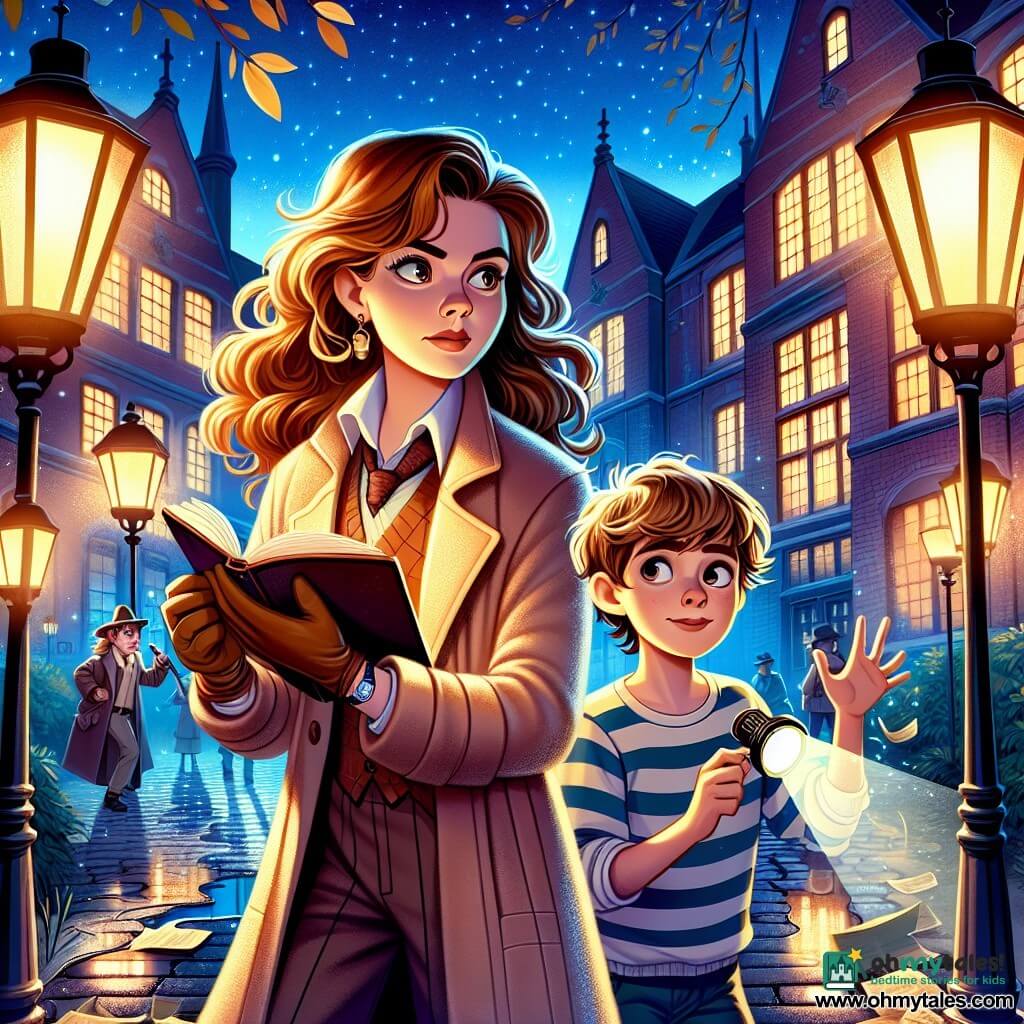
Detective Nora Hale arrived with her coat buttoned to her chin, the sea wind turning her hair into a halo of restless lines. She took one long look at the empty pedestal, the scattered velvet lining, the crooked placard that read: "The North Star Compass — Gift of Captain Ames," and she began to listen.
Mrs. Grover, the museum director, folded her hands until the knuckles went white. "I locked up at seven. I left the front light on. When I came at eight—gone. The alarm—" She stopped. "It didn't go off."
Nora walked the room in deliberate steps. There had been no forced entry at the back doors, no broken pane at the front. The alarm, a ribbon of red light over the case, showed no sign of tampering. She crouched and examined the velvet. No fingerprints. But near the pedestal, there was a thin smudge of brown on the floor—like dried mud on the sole of a shoe.
She made notes, precise and patient, in a little lined notebook that lived in her coat pocket. "Witnesses," she said aloud, as if listing pieces on a table. "Who saw what? When did anyone leave? Who else could enter with a key?"
"Harold, the night watch, he does rounds," Mrs. Grover said. "Also the maintenance man — Theo. And last night we had a contractor looking at the heating. And… there's that boy—Tommy Lark. He's been in here before, but he's a prankster, nothing more."
Nora listened to the names and added them. Then she did something she always did: she read all the statements again, aloud, as if the words were maps. Patterns emerged when she reread them—small echoes and odd repetitions that had been invisible at first.
On the page, Harold's note said: "Around 2:10 I heard a soft whistling near the South Window. Thought it was the tide. Checked the courtyard. Nothing. Clock tower chimed two." Tomo—the contractor—had written: "I left at 7:45. Boiler fixed. No one else here." Theo's scrawl: "Keys with me. Locked up. Saw footprints by the storage gate."
It was a collection of ordinary things—times, noises, locks. Nora placed the notebook on the pedestal where the compass used to sleep, and she let the room do the rest of the talking.
2. Footprints and Fragments
Outside the museum, the cobbles still held the memory of the night. Nora crouched and traced the path of a print with her gloved finger. It was smallish, narrow, with a worn inner arch. Someone had trodden in thin mud and then stepped lightly across the steps so the heel left only a whisper.
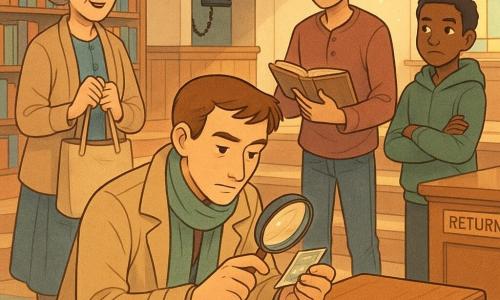
At the storage gate, someone had tugged at the latch from the inside. The metal showed a scratch, narrow and hurried. Near the alley wall a fragment of paper fluttered on the ground, jagged as if torn from a map. Nora picked it up. On one edge, a smudge of ink formed the curve of a letter—an R or perhaps a P.
"Tommy Lark?" Mrs. Grover asked again, hopeful and anxious. "He—he's always been curious about the old sailors' things."
Nora did not dismiss the boy; curiosities often lead to trouble. "We should talk to him," she said. "And to Harold. And the contractor. And the dealer who's been asking about that compass for years." She listed them, letting the possibilities line up like dominos. Dominoes needed a nudge, a pattern.
They visited Harold first. The night watch was a thin man, his beard peppered, his eyes quick as gulls. He remembered the whistle. "It was soft," he told them. "Like someone practicing a tune. Three short notes, then a longer one. It came from the direction of the docks."
Three short notes and a long one. Nora wrote it down again. Rhythm. Repetition. Whoever whistled had a habit.
At Tommy Lark's house, the boy was less prankster than apprentice to mischief. His scrape of honesty was clumsy and tender. "I was near the museum," he admitted. "I like the compasses. But I swear I didn't take it. I heard someone whistle by the lamppost. It sounded like—like when my dad hums that sea-song. He hums it when he mends nets."
Nora's pen hovered. That was another voice on the page—the repairman's song, carried on the wind. She reread the statements she had already written, lining the whistled pattern beside Harold's notes and Tommy's memory. The dockside was a chorus of hands and voices—fishermen, cafe owners, the man who polished brass. All of them could carry a tune.
The torn paper, however, had a different language. It was a page from a log, Nora realized, when she smoothed it out. There were numbers and the faint stamp of a seal—a ship's registry. Someone had been here looking not just for the compass, but for the compass's story.
3. The Sound in the Dark
That evening Nora decided to stand where Harold had stood. The night pressed in like a dark velvet cloak. The museum's windows caught the streetlamps like a scatter of dull stars. She talked in short sentences to herself while she waited: "Listen. Time. Pattern."
Just after midnight, when the tide slid in and out like the town breathing, a sound came—a soft whistle, three quick notes, then a held, low note. It folded around the corner of a building and came from the direction of the old clock tower. Nora walked the route her ears suggested, moving lightly, a shadow among shadows.
She passed the cafe where Mrs. Patel was sweeping. He was at the counter, coaxing a kettle into song. She paused and listened. The kettle sang a thin shriek that imitated the whistle—three quick huffs followed by a longer sigh. For a moment Nora wondered if the town itself was giving her the clue she needed: rhythm was everywhere.
Near the clock tower a figure hunched over a bicycle. The silhouette had the slouch of someone used to carrying small things. Nora approached and said quietly, "Evening. Whistling late in the night?"
The figure turned—it was Theo, the maintenance man. He seemed calmer than she expected, the bicycle lying on its side as if waiting to be ridden away. "Needed to clear my head," he said. "I whistle sometimes. It's silly. Old habit." He mimicked a few notes. Nora listened. The ending note was wrong—higher, quicker. Not the long low note Harold remembered.
So the whistle alone would not do. Nora mentally stacked the sounds with the footprints and the torn map. Her habit of rereading proved useful: the contractor's claim of leaving at 7:45 meant someone had hours to move. The clock tower chimed two, Harold heard the whistle at 2:10, Tommy heard something by the lamppost. A timeline pieced itself together like a puzzle.
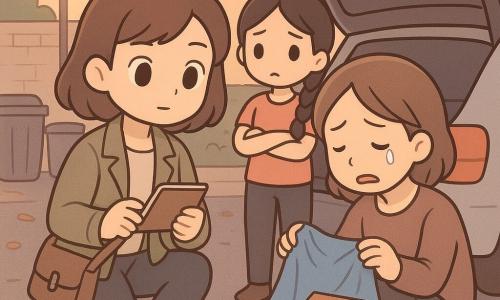
She walked the waterfront. Crates lay as if asleep, and a rope smelled of salt and rope oil. Behind a blue tarpaulin Nora found a shoe—only the right one—mud-streaked and narrow. It matched the print. Someone had lost it in a hurry.
She pocketed it. "This fits," she told herself. "Now who fits?"
4. Threads and False Trails
By daylight the town was a map of suspects. There was the antiquarian, Mr. Lenton, who had been haunting the museum for years with polite questions and eager eyes. He kept a ledger of local heirlooms, he said; he collected histories. He had no alibi for the night.
There was Tommy's father, a man who mended nets and whose hands were always brown with tar and patience. He hummed sea songs; he owned a pair of boots with narrow soles.
And then there was Marina Patel, the cafe owner, who had recently complained about the museum not promoting the festival enough. Nora listened to each explanation as if it were a small boat docked at a busy quay. Every voice had a reason, every gesture could be both honest and misleading.
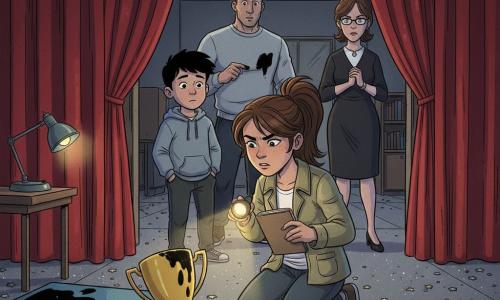
She gathered the group into the museum's back room: Harold, Theo, Mr. Lenton, Tommy, Marina, and the contractor, Tomo. They sat in a circle like a jury of neighbors. Nora put the notes on the table and read the facts once more. She read them slowly, deliberately, encouraging cooperation. "We all want the same thing," she said. "Help me find the compass. Tell the truth you know."
Mr. Lenton's hands fluttered like moths. "I asked because I hoped to buy it," he admitted. "But I would never steal. I spoke to the curator in the afternoon. I left at six."
Tommy's father, a sturdy man with knuckles like hinges, said, "I was mending the net at the pier. I didn't leave until well after midnight. Ask Marina; I stopped for a cup." Marina nodded. "He was here. The kettle was on, but I stepped out to lock the back door around eleven."
The contractor had a receipt from a hotel showing he had checked in before midnight; his tools were chained in his van. Theo said he had been home by one. The timetable was slow and thin.
But then Harold's eyes caught the torn map fragment on the table. "That stamp," he said. "You found it near the storage gate. That's from the registry of the schooner Aurora. Captain Ames sailed her before he gave the compass."
Nora listened. Someone had traced the history of the compass and perhaps followed the path of the Aurora to learn where it would be at its most valuable. Mr. Lenton had the knowledge, and old papers in his possession would have let someone work out when the festival would make the compass most crowded and thus easiest to carry away.
Gently, Nora questioned each person about singing or whistling. Tommy hummed, his chin dropped in embarrassment. Lenton cleared his throat. "I hum when I read, yes. Old songs help me think." Theo said his tunes were mechanical—taps and whistles while he worked. An honest murmur of cooperation filled the air. Everyone shared what they knew, and with each small truth the fog thinned.
Nora felt the story shifting from a tangle to a braid. The thief, she thought, had to be someone who knew the museum's layout, knew the compass's worth, and could move silently with small footprints. The whistle was a cover, not a clue—someone used it to blend into the soundscape of the harbour.
Yet one piece remained stubborn: why was a page from the ship registry torn and left behind? Its stamp meant something. Someone had been looking up Captain Ames's voyages. Someone who wanted not only the compass but the story attached.
5. The Trap of Three Notes
Nora had an idea that felt like a careful lock and key. They would use the sound itself as a test. She asked Marina if her kettle could manage the three-note pattern and the lower ending—it could, if she managed the pressure. Nora set up a quiet plan: they would place a dummy compass in a decoy case with an alarm that clicked on a softer volume, the kind that could be turned off gently. They would watch.
They arranged the scene. Tommy volunteered to stand at the lamppost for a look-out because he liked to help and he liked to be useful. Harold would keep his post as night watch. Mrs. Grover would stay in the safe room with tea, and Nora would be ready in the shadows. They had one evening to catch a thief who thought they could steal a history without an audience.
At one in the morning a whistle lifted into the dark. Three short notes and a long, low one—so like Harold's memory that Nora felt her heart tilt. Under the streetlamp a figure slipped from the shadow of the clock tower and moved like a cat between the parked boats. It was small, narrow-shouldered. The footsteps matched the print. The thief's hand paused at the museum window, then reached for a side latch.
Tommy gave the signal. Nora stepped from the shadows with a steady voice. "Stop."
The figure froze. Nora moved closer, exposing the person to the lamplight. It was not the antiquarian, nor the contractor, but someone less expected: Marina's assistant, a slight young woman with a smudge of grease on her sleeve and a secret in her eyes.
"Please," Nora said, gently. "We need to talk."
The woman's breath came in quick, frightened bursts. She looked not like a criminal mastermind but like a person who had misread a map: eager, misguided. "I meant to take it," she whispered. "Not to keep it. I—my brother's ship—he's in debt. He used to work on the Aurora. He says the compass is worth enough to buy him time. I didn't want to sell it; I thought… I thought I could hide it, keep it safe, then return it after. I only wanted to hold it until he was alright."
Nora listened. The three-note whistle had been an inherited habit—an old sea chant Theo didn't own, but something learned and passed along in the docks. The assistant had used it on the night because she had heard it from sailors and thought the sound would make her move belong to the wind.
"There was a torn page because I read the registry," she said. "I wanted to know what it meant. I was trying to find where Captain Ames kept it, the stories he told. I thought the compass belonged to the sea, not a glass case."
Nora's eyes softened. This was not a theft driven by greed but by fear and love twisted in the dark. She considered the law—the museum's loss, Mrs. Grover's sorrow—but also the reasons for theft. The town listened; the night air held the city's judgement like a breath.
"We must do the right thing," Nora said, "and fix this together." She asked the woman to show where she had hidden the compass.
With the group cooperating, the assistant led them to a shed behind the fishermen's cooperative. It was damp with salt smell, tucked with tarps and coils of rope. There, beneath a stack of old charts, the compass lay wrapped in oilcloth. It gleamed in the lantern light, small and unimpressed by everything it had stirred.
Nora handled the compass with reverence. The needle pointed steadily north as if it had guided them all back to a fair course. She made notes, careful and clear, writing down the chain of events: found missing, hidden by an assistant trying to help her brother, motive explained. She listened to the assistant's story and then, with the cooperation of the town and the museum, they agreed on a solution.
6. Back on the Pedestal
The compass returned to its glass case with a small ceremony that was more neighborly than solemn. Mrs. Grover polished the pedestal and allowed the assistant to clean the brass with a cloth that smelled of lemon. The town gathered: fishermen, shopkeepers, children with damp hair from the tide, and the people who had helped solve the mystery. Tommy stood close to Nora, proud and small.
Nora read aloud the facts to the group one last time, not to punish but to teach. "We found a torn page from the Aurora registry, small muddy footprints, a single shoe, and a whistle pattern that led us to the docks. We followed the timeline: the contractor left early, Harold heard the whistle at 2:10, and the compass was hidden in the fishermen's shed. It took cooperation to put these pieces together."
There was a hush, then a round of quiet agreement. They had all played a part. The assistant, helped by the museum and the community, agreed to a plan: she would return the compass officially, work off hours at the museum arranging exhibits, and her brother's situation would be looked into by the town committee—a small council of neighbors helping neighbors, practical and kind.
Mrs. Grover smiled, fragile and real. "We make mistakes," she said. "Sometimes we make them with love. We can fix things better when we help each other."
Nora found, as she always did, that the most helpful thing was to read what people had said and to ask them to tell the truth again, together. Details — a whistle, a scrap of paper, a shoe in the mud — had opened the case. But it was the town's willingness to help that closed it. The compass pointed north; the town steered by a shared moral compass.
When the festival came, the Compass lay beneath its glass, the needle turning to the hum of the crowd. Children crowded the room, eyes wide. Mrs. Patel made small pastries with stars on the sugar for the event. The assistant, working now in the museum's back room, told stories of Captain Ames to children who asked for the sea's secrets. Tommy showed Nora a new map he had drawn, one with dotted lines for hidden things and notes that said, "Ask first."
As the evening folded into the festival lanterns, Nora sat on the museum steps with her notebook closed. The town sounded gentle—voices braided with the tide, laughter like ropes thrown to the moon. She thought of the whistle, soft and human, and how a detail heard could change the shape of a mystery.
She had reread the statements more than once; she had listened until the town's ordinary noises formed a sentence. The solution had not been sudden as a lightning strike but patient as a tide. Cooperation had built the bridge between suspicion and understanding. People had listened, confessed, and worked to mend what had been broken.
Nora smiled, not because the case was perfect, but because it was honest. The compass stayed where it belonged, and the town had, just for a while, steered toward one another.