Chapter 1
On the third floor of Marigold Court, Detective Mara Quinn liked quiet cases: missing keys, mysterious scratches on mailboxes, a cat that seemed to teleport between balconies. Quiet meant you could hear the truth.
This morning wasn't quiet.
“Someone stole the Maple Medal,” Mr. Hargreaves puffed, clutching the railing as if the stairwell might run away. “Right out of the community room display case. It's… it's tradition!”
The Maple Medal wasn't gold, but it was shiny enough to catch everyone's eyes. Every year the building gave it to someone who'd helped the community most—fixed leaky taps, shoveled snow, taught chess to bored kids. It sat in a glass case beside a scrapbook of photos and a little brass plaque.
Now the case door hung open, the velvet stand bare as a missing tooth.
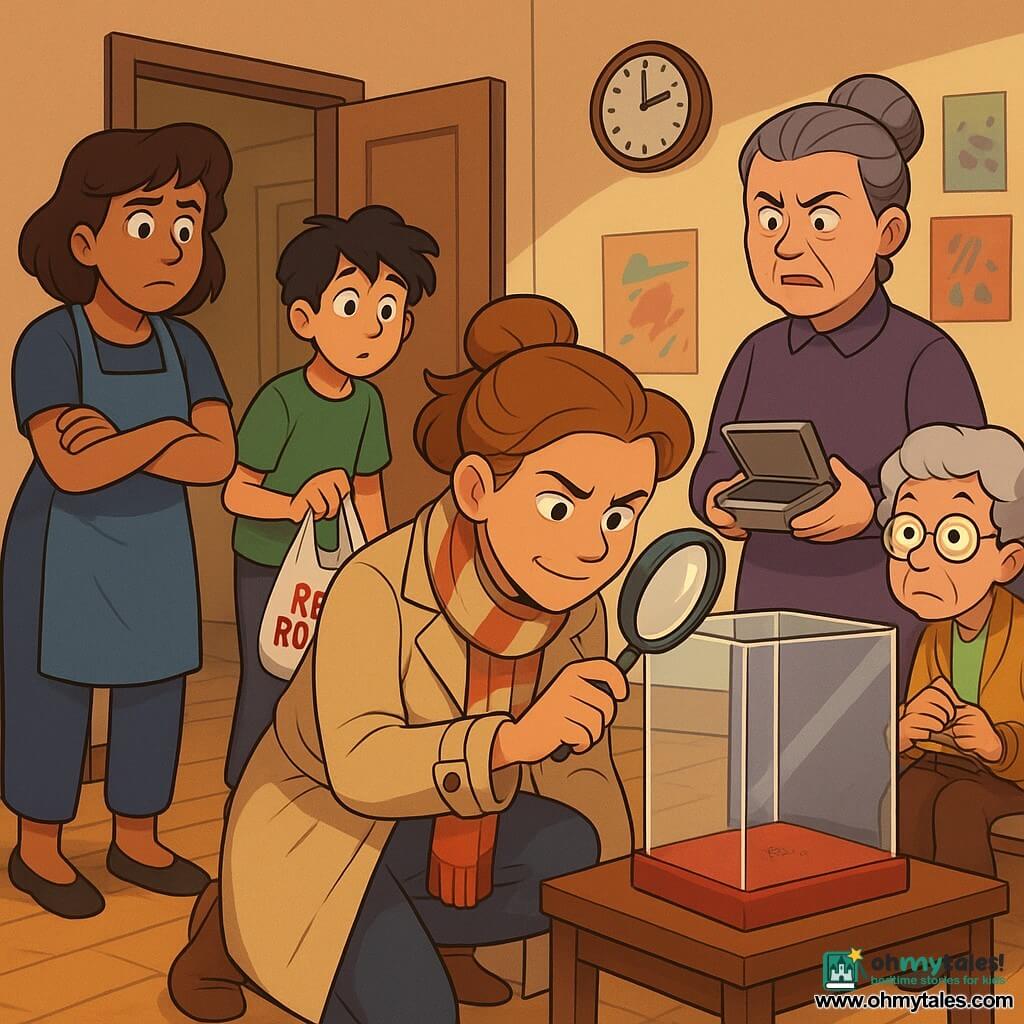
Mara crouched in front of the display. The lock wasn't broken. No splinters, no scratches. She leaned close and sniffed. The air smelled faintly of lemon cleaner.
“You cleaned this?” she asked.
Sonia Patel, the building caretaker, lifted her chin. “Yesterday evening. I always do before the monthly meeting. Lemon spray, soft cloth. No fingerprints. I'm proud of that.”
Mr. Hargreaves pointed at the empty stand. “That medal was here at nine last night. I showed it to my nephew. And this morning—gone!”
Mara straightened slowly. Her eyes moved over simple things: the hinge screws, the dust line where the medal had rested, the way the velvet was slightly pressed down on one side, as if something had been set there briefly and lifted again.
A version of events was already forming in her mind. Someone with a key. Someone who knew the medal mattered. Someone who wanted people to panic.
She wasn't ready to accuse anyone. She needed to confirm the version.
“Who has keys to the community room?” she asked.
Sonia counted on her fingers. “Me. Mr. Hargreaves. And Ms. Lark on floor two, because she runs the book swap. That's it.”
Ms. Lark. Mara pictured her: sharp cardigan, sharper opinions, a laugh like a stapler. Not impossible.
From the hallway, a door clicked. Mrs. Bibi, the neighbor across from the community room, peeked out. She was small and quick, with curious eyes that never missed a delivery slip or a new haircut.
“What's all this?” Mrs. Bibi whispered, already leaning forward as if the secret would fall into her pocket.
Mara smiled politely. “A little mystery. Did you notice anyone coming in late last night?”
Mrs. Bibi's eyes brightened. Attentive neighbor, Mara thought. The kind who could be helpful… or complicated.
“I hear everything,” Mrs. Bibi said proudly. “At ten thirty, footsteps. Soft ones. Not Mr. Hargreaves—he stomps like a marching band. And at eleven, someone hummed. A tune. Very cheerful for such a late hour.”
“A tune?” Mara asked.
“Yes. ‘Twinkle, Twinkle,' but wrong notes. Like someone who pretends to know it.”
Mara thanked her and stepped back into the community room. The medal was missing, but the room had left behind small, honest clues. The lemon smell. The unbroken lock. The pressed velvet.
She pulled out her notebook and wrote three lines:
1) No forced entry.
2) Someone cleaned recently.
3) Someone entered late with soft steps and a humming mistake.
Then she looked up at the open case and added a question for the reader, as if the room itself were asking:
If the door wasn't forced, what does that suggest about the thief?
Chapter 2
Mara treated suspects like puzzle pieces—she didn't jam them into place. She turned them, checked their edges, and waited until they fit.
First, Sonia Patel.
Sonia led Mara into the caretaker closet, a skinny room full of mop handles and labels. Everything had a place, and everything was facing forward like it wanted to behave.
“I didn't take it,” Sonia said before Mara could speak. “I'm not even interested in medals. My reward is when the boiler stops making that dying-whale sound.”
Mara held up a small spray bottle from the shelf. “Lemon cleaner?”
Sonia nodded. “Exactly.”
Mara examined the nozzle. A tiny crack ran down the side, taped neatly. “You've had this one a while.”
“Two months. It keeps working.”
Mara clicked the nozzle once. A fine mist came out—light, almost too light.
“Do you always clean the display case?” Mara asked.
“Yes. And I always lock it after. I'm careful.”
Careful people were often innocent. Careful people also knew how to hide mistakes.
Mara's next stop was Mr. Hargreaves' apartment. The old man's living room was stuffed with framed photos and teacups shaped like animals. He offered Mara a fox-shaped cup and watched her like she might vanish.
“You said you showed the medal to your nephew at nine,” Mara said. “Where was Sonia at that time?”
“Cleaning the lobby,” Mr. Hargreaves said. “She waved at me. Very polite.”
“And Ms. Lark?” Mara asked.
Mr. Hargreaves' face tightened. “Probably reorganizing the book swap to match her mood. She likes control.”
Control. Keys. Tradition. Ms. Lark was climbing higher on the list.
On floor two, Ms. Lark opened her door a careful amount, as if air itself could be suspicious.
“Detective Quinn,” she said. “I was expecting you. People always blame the organized woman.”
“You have a key,” Mara replied.
“Yes. For the book swap. Because without me, the room would be chaos. And I don't steal. I donate.”
Mara's eyes drifted past Ms. Lark's shoulder. Inside, the apartment was tidy, but not warm. Books were stacked by color, pencils sharpened to identical points. On a side table sat a small metal box with a keyhole.
Ms. Lark noticed Mara looking. “That's my cash box for the charity bake sale. Nothing to do with your silly medal.”
“Where were you last night at ten thirty?” Mara asked.
“At home. Reading. In silence.”
“In silence?” Mara repeated.
Ms. Lark's mouth twitched. “Some of us enjoy it.”
Mara thanked her and stepped away. In the hallway, she paused. Mrs. Bibi's door was slightly open—an eye could fit through the gap.
Mara turned and walked straight toward it.
The door swung wider, as if surprised. Mrs. Bibi stood there holding a dish towel, wearing the innocent look of someone who had never listened to anything in her life.
“I was just… drying,” Mrs. Bibi said.
Mara lowered her voice. “You were listening.”
Mrs. Bibi didn't deny it. She tilted her head. “Detective work is exciting. Also, Ms. Lark talks loud when she thinks she's talking quiet.”
Mara held Mrs. Bibi's gaze. “Last night, you said you heard humming. Can you show me where you were standing?”
Mrs. Bibi's eyes sparkled. “Of course.”
She led Mara to her entryway, then pointed to a tiny peephole in the door. “I look here. Like a lighthouse keeper.”
Mara leaned closer. The peephole gave a fish-eye view of the hallway—doors bending at the edges, the carpet pattern turning into a maze.
“If someone walked past, could you tell who it was?” Mara asked.
Mrs. Bibi hesitated, just a beat too long. “Sometimes. Depends on hats.”
“Hats,” Mara repeated. She wrote it down. Then she asked the reader another question, the kind that turned a mystery into a game:
If someone wants to be seen as “soft footsteps,” what might they wear—or avoid wearing?
Chapter 3
Mara went back to the community room to look again. Not because she expected the medal to return out of guilt, but because rooms told different stories at different times of day.
Sunlight slanted in through the windows, turning dust into drifting stars. The empty velvet stand seemed to sulk.
Mara studied the glass case door. The lock clicked smoothly. Too smoothly. She ran her finger along the inside edge and felt something sticky.
Tape residue.
Not much—just a thin line that caught slightly on her fingerprint.
Someone had tampered with the lock, not by breaking it, but by tricking it. Mara imagined a strip of tape pressed over the latch so the door could be opened without the key, then closed again to look locked. A simple trick. The kind people used on lunchboxes and pranks.
Now she wanted to confirm her version: that the thief didn't have a key at all.
She needed one more check.
Mara called Sonia into the room. “When you lock this case,” Mara asked, “do you pull the door hard?”
Sonia nodded. “Always. Otherwise it doesn't catch.”
Mara pulled the door gently. It clicked shut. She pulled it harder. It still clicked. Then she pressed the latch with her fingernail—an easy press, as if the latch had been softened by something.
“Could cleaning spray make the latch slippery?” Mara asked.
Sonia frowned. “Not like that.”
Mara held up her fingertip. Sticky.
Sonia's eyes widened. “Tape. Someone used tape.”
“Or glue,” Mara said. “But tape is faster.”
From the doorway, a voice said, “Tape? I have tape.”
It was Kian, a sixth-grader from apartment 3B, clutching a backpack that looked heavier than he was. He hovered in the doorway like he wasn't sure if he was allowed to enter the adult mystery.
“I use it for model planes,” he added quickly. “Not for stealing. My mom would turn into a dragon.”
Mara smiled. “Thank you, Kian. Don't worry—everyone has tape. Not everyone uses it for trouble.”
Kian stepped closer, eyes on the empty stand. “The Maple Medal is like… the building's big deal. My friend said it's worth money.”
“Is it?” Mara asked.
Kian shrugged. “Shiny stuff is always worth money, right?”
Mara tilted her head. “Sometimes shiny stuff is worth attention.”
She asked Kian what he'd been doing last night.
“Homework,” he said, as if the word tasted bad. “Then I went to get water at ten-ish. I saw someone carrying a bag. Like a grocery bag, but stiff.”
“Did you see their face?” Mara asked.
“No. They had a hoodie up. But they hummed.” Kian paused. “Badly.”
Mara's gaze flicked to Mrs. Bibi's door across the hall. The attentive neighbor would have heard that too. Maybe she already had, and maybe she'd kept something back.
Mara walked straight across and knocked once.
Mrs. Bibi opened the door immediately, like she'd been holding the handle.
“You heard Kian talking,” Mara said.
Mrs. Bibi lifted her hands. “Walls are thin. I can't help my excellent ears.”
Mara kept her voice calm. “You said you heard humming at eleven. Kian says ten-ish. Are you sure about your time?”
Mrs. Bibi's eyes darted to the hallway clock above the community room door. “Clocks can be wrong.”
Mara followed the glance. The clock showed 2:17. Mara checked her watch: 2:11.
Six minutes fast.
An object, slightly wrong.
Mara stepped closer to the clock. The frame was crooked, as if it had been bumped and put back quickly. She reached up and straightened it. Dust fell in a thin line—fresh.
Someone had moved the clock.
She turned slowly. “Why would someone move a clock?”
Mrs. Bibi's face tightened, the curious sparkle dimming.
Mara spoke to the reader as if they were standing beside her in the hall:
If the clock was moved, what else might be wrong about the timeline?
Chapter 4
Mara didn't accuse Mrs. Bibi. Not yet. She kept her questions sharp but her tone soft, like folding paper without tearing it.
“Mrs. Bibi,” Mara said, “you said you noticed soft footsteps. And humming. That's helpful. But the time matters.”
Mrs. Bibi adjusted the dish towel in her hands. “Time is a slippery eel.”
“Not if you pin it down,” Mara replied. “When you heard humming, what were you doing exactly?”
Mrs. Bibi sighed as if giving away a secret recipe. “I was watching my show. The detective one. The episode where the jewel goes missing.”
Mara nodded. “What time does your show start?”
“Nine thirty,” Mrs. Bibi said. “But I record it and watch later. Sometimes.”
“Sometimes,” Mara echoed.
Mrs. Bibi's shoulders lifted. “Fine. I watched it at ten. Happy?”
Mara's notebook snapped open. Ten matched Kian's estimate. So why had Mrs. Bibi said eleven?
Because she wanted the thief to seem later. Or because she wanted herself to seem asleep earlier.
Mara glanced at Mrs. Bibi's entryway table. There were three items lined up neatly: a bowl of mints, a stack of mail, and a small notebook with a pen clipped to it.
“What's the notebook for?” Mara asked.
Mrs. Bibi's chin rose. “For building notes. Deliveries. Visitors. If someone leaves trash in the wrong bin.”
Mara leaned in. The notebook was open to last night's page. In quick, tidy handwriting were times and names.
10:02 — “hoodie person” to community room
10:06 — “hoodie person” back, carrying bag
10:07 — clock crooked (??)
Mara looked up.
Mrs. Bibi gave a tight smile. “I like details.”
“You changed your story,” Mara said.
“I didn't want trouble,” Mrs. Bibi snapped. Then, quieter: “People get mad at the messenger.”
Mara's voice stayed even. “Details don't cause trouble. Trouble causes trouble. Details help solve it.”
Mrs. Bibi's eyes softened, just a little. “I didn't see the face. But the hoodie was… green. And the bag had red letters. Like from a shop.”
Mara thanked her and stepped into the hall, thoughts lining up like footprints in snow.
Green hoodie. Bag with red letters. A moved clock.
The clock mattered most. Someone had bumped it at 10:07. Why? If you didn't want accurate time, you'd move it. If you wanted an alibi, you'd confuse the hallway witness.
Mara walked down to the lobby where a small bulletin board held flyers. On the table below it, someone had left a shopping bag from “Red Robin Market”—white plastic with bold red letters.
Sonia was mopping nearby. “That bag's been there since this morning,” she said. “I was going to toss it.”
Mara touched the bag. It was clean, too clean. No groceries, no crumbs. And stiff, like Kian said.
“Who shops at Red Robin?” Mara asked.
Sonia shrugged. “Lots of people. Ms. Lark likes their fancy tea. Mr. Hargreaves buys biscuits. Mrs. Bibi—well, she buys gossip.”
Mara's phone buzzed. A message from Mr. Hargreaves: MEETING TONIGHT. MUST HAVE MEDAL.
Mara stared at the bag, then at the elevator doors that reflected the lobby like dull mirrors. The thief wanted attention before the meeting. They wanted the building to talk about them.
She wrote one more prompt for the reader:
If you had a green hoodie and a Red Robin bag, who in the building would you check first—and why?
Chapter 5
Mara decided to check the simplest thing: green fabric.
In Marigold Court, laundry day was a parade. People's clothes hung on balcony rails, fluttering like flags of personality. Mara walked the courtyard, looking up.
On 2C, a green hoodie hung from a chair. On 3A, another. Green was common.
But on 2B—Ms. Lark's apartment—there was no laundry at all. Not a sock. Not a towel. As if mess had been banned.
Mara knocked.
Ms. Lark opened the door wearing a cardigan the color of cold oatmeal. “Back so soon?”
“I'm checking a detail,” Mara said. “Do you own a green hoodie?”
Ms. Lark looked offended. “A hoodie? No.”
Mara nodded, as if that settled it, and glanced down.
By Ms. Lark's shoe rack sat a pair of trainers with green laces. On the laces was a tiny smear of clear sticky stuff, catching the light.
Mara crouched. “What's this?”
Ms. Lark's voice tightened. “Probably glue from a craft table. The book swap has posters.”
Mara stood. “Did you go to the community room last night?”
“I told you—home. Reading. In silence.”
“In silence,” Mara said again. “Mrs. Bibi heard humming.”
Ms. Lark's eyes flashed. “That woman hears her own thoughts and calls them evidence.”
Mara didn't argue. She took a step back, letting space do its work.
As Mara turned to leave, she noticed something on Ms. Lark's entryway wall: a framed photo from last year's Maple Medal ceremony. Mr. Hargreaves was handing the medal to… Sonia Patel. Sonia looked surprised, proud, and a little teary. In the background, Ms. Lark stood clapping, but her smile looked thin.
“Interesting photo,” Mara said.
Ms. Lark's hand moved automatically to straighten the frame, even though it was already straight. “I keep it to remember community spirit.”
Mara's eyes narrowed slightly. “Do you want the medal?”
Ms. Lark laughed once, sharp. “Want? It's a trinket. People act like it's a crown.”
“Sometimes,” Mara said, “people steal crowns to prove they can.”
She left before Ms. Lark could answer, and headed upstairs to 3B.
Kian's mother answered, wiping her hands on a towel. “If he's in trouble—”
“He's not,” Mara said. “I just need to ask about shopping bags.”
Kian appeared behind his mom, hopeful. “Am I a witness again?”
Mara smiled. “Maybe. Does anyone in your home shop at Red Robin Market?”
Kian's mom nodded. “I do. I went yesterday after work.”
“What time did you get home?” Mara asked.
“About nine forty-five,” she said. “Why?”
Mara glanced at Kian. “Did you see your mom come in with the bag?”
Kian nodded. “Yep. She brought apples.”
Mara's version shifted slightly. Bags could be borrowed. Or planted.
As Mara stepped into the hallway, she saw Sonia Patel coming up the stairs carrying a toolbox. The metal clinked softly.
“Sonia,” Mara called. “Can you come here a moment?”
Sonia stopped, wary.
Mara held up her fingertip, still faintly sticky from the case. “Have you used tape or glue on the display case recently?”
Sonia frowned. “No. Why would I?”
“Because someone did,” Mara said. “And because the hallway clock was moved.”
Sonia's eyebrows lifted. “Moved? That clock? It's been wrong for weeks.”
Mara blinked. “It has?”
Sonia nodded. “I keep meaning to fix it. It runs fast. And sometimes it… sticks. You have to tap it.”
Tap it. Like bumping it.
The clock might not have been moved on purpose. It might have been bumped because someone rushed past. Or because someone reached up to tap it.
Mara felt the case tightening. This wasn't about fancy tricks. It was about someone moving fast, trying to control what others saw.
She turned to the reader with a final mid-mystery nudge:
What matters more here—the hoodie color, the bag, or the clock? Which clue feels most solid?
Chapter 6
That evening, the community room filled with residents and the low buzz of impatience. Folding chairs scraped. Someone opened a bag of crisps too loudly. Mr. Hargreaves paced like a worried rooster.
Mara stood near the empty display case, watching faces.
Ms. Lark sat with perfect posture, hands folded, eyes forward. Sonia hovered near the back, arms crossed. Mrs. Bibi sat on the aisle, ready to swivel her head in any direction. Kian sat beside his mom, trying to look serious and failing.
Mr. Hargreaves cleared his throat. “We can't begin without the Maple Medal.”
“We can begin,” Mara said, stepping forward. “But first, we'll solve a small problem together.”
The room quieted. Even the crisps stopped rustling.
Mara held up a strip of clear tape inside a small evidence bag. “This was on the display case latch. It let someone open the case without a key.”
Ms. Lark lifted her chin. “So the thief didn't need a key. Wonderful. Anyone could be guilty.”
“Not anyone,” Mara said. “Someone who knew the medal would be there, and who expected the room to be empty at the right time.”
She turned to Mrs. Bibi. “You took notes. Thank you for that. Your notes show the person went in at 10:02 and out at 10:06.”
Mrs. Bibi looked both proud and worried, like a cat caught enjoying praise.
Mara continued. “Kian saw a stiff shopping bag with red letters. A Red Robin Market bag. And we have the lemon cleaner smell—fresh from Sonia's cleaning.”
Sonia stiffened. “I cleaned. That's my job.”
“And you did it well,” Mara said. “So well that the glass had almost no prints. Which means the thief needed to avoid leaving obvious prints too.”
Mara paced once, slow. “Now, here's the object that changed everything.”
She pointed to the hallway clock above the door. Sonia had fixed it earlier; it now matched Mara's watch.
“That clock used to run fast and sometimes stick,” Mara said. “If you wanted to know the exact time, you'd tap it. If you were rushing, you might bump it. But if you wanted to confuse a witness, you might… rely on it being wrong.”
Ms. Lark's eyes narrowed. “What are you implying?”
“I'm implying,” Mara said, “that the thief didn't plan to be seen by Mrs. Bibi. But they were. And then they tried to turn the timeline into fog.”
She faced the room. “So let's test a simple thing. Mrs. Bibi, in your notes, you wrote: 10:07 — clock crooked. That means you noticed it right after the person returned.”
Mrs. Bibi nodded.
“Which means,” Mara said, “the person was close enough to the clock to affect it.”
She looked at the residents, one by one. “Who is tall enough to reach the clock without stretching?”
Several people glanced around. Mr. Hargreaves was short. Mrs. Bibi was shorter. Kian was… definitely not.
Sonia was tall.
Ms. Lark was tall.
Mara lifted the Red Robin bag from the table. “This bag was found downstairs, clean. Too clean. Someone wanted us to focus on Red Robin. But bags travel. People reuse them. They can be borrowed—or planted.”
She set the bag down and held up another item: a small roll of clear tape. “Found in the book swap supply drawer. Lots of people use that drawer.”
Ms. Lark scoffed. “You found tape in a supply drawer. Shocking.”
Mara nodded. “Tape isn't the point. The point is who knew how to make the case look locked. Who knew the latch could be tricked. And who had a reason.”
She turned to Sonia. “You won the Maple Medal last year. Tonight you were supposed to hand it over to the new winner.”
Sonia blinked. “Yes. And I was excited for them.”
“You cleaned the case,” Mara said. “Meaning you saw the medal up close. You know it's not valuable in money. But it is valuable in feeling.”
Sonia swallowed. “Of course.”
Mara's eyes slid to Ms. Lark. “You run the book swap. You love order. You love tradition—your kind of tradition.”
Ms. Lark's lips pressed together. “Say it.”
Mara didn't raise her voice. She didn't need to. “You didn't steal it to sell it. You stole it to stop the meeting, to make the building depend on you, to make everyone look at the empty case and feel wrong. And you planned to ‘find' it later, so you could be the hero who restored order.”
A hush fell like a blanket.
Ms. Lark stood abruptly. “That is ridiculous.”
Mara held her gaze. “Then show us your hands.”
Ms. Lark hesitated. Just a fraction.
Mara stepped closer. “Clear tape leaves a fine sticky shine. You can wash it off, but not always from under your nails.”
Ms. Lark's hands tightened into fists.
Sonia spoke, incredulous. “Ms. Lark…?”
Ms. Lark's face flushed. “Everyone applauds the caretaker, the old man, the children. No one applauds the person who keeps things running smoothly.”
Mara nodded once. “So you tried to manufacture applause.”
Ms. Lark's shoulders sagged. The fight drained out like air from a punctured ball. “It's in my metal cash box,” she admitted, voice smaller. “I was going to bring it out. After the panic. After—”
“After the attention,” Mara finished.
Mr. Hargreaves exhaled loudly, as if he'd been holding his breath all day. “Well. That's… dramatic.”
Ms. Lark fetched the small metal box. Her hands trembled as she unlocked it. Inside, wrapped in a tea towel, lay the Maple Medal, still shining, still ordinary, still powerful in the way symbols can be.
Mara took it carefully and returned it to the velvet stand. The room seemed to relax, like a song returning to its right key.
Ms. Lark looked at Mara, eyes bright with frustrated tears. “How did you know?”
Mara's voice softened. “Because you tried to control the story instead of letting the truth be simple. And because the smallest details—tape residue, a crooked clock, a careful notebook—added up.”
She turned to the room. “Curiosity isn't just poking at things. It's paying attention, asking honest questions, and not giving up when answers feel slippery.”
Mr. Hargreaves cleared his throat again, but this time he smiled. “Detective Quinn… I think we should applaud.”
For a second, nobody moved. Then Kian started clapping, loud and delighted. Sonia joined in. Mrs. Bibi clapped too, cheeks pink. Even Mr. Hargreaves clapped, his fox teacup forgotten.
The sound grew until it filled the community room—warm, steady, deserved.
Mara nodded once, accepting it the way she accepted solved puzzles: calmly, gratefully, already looking for the next small detail that might matter.