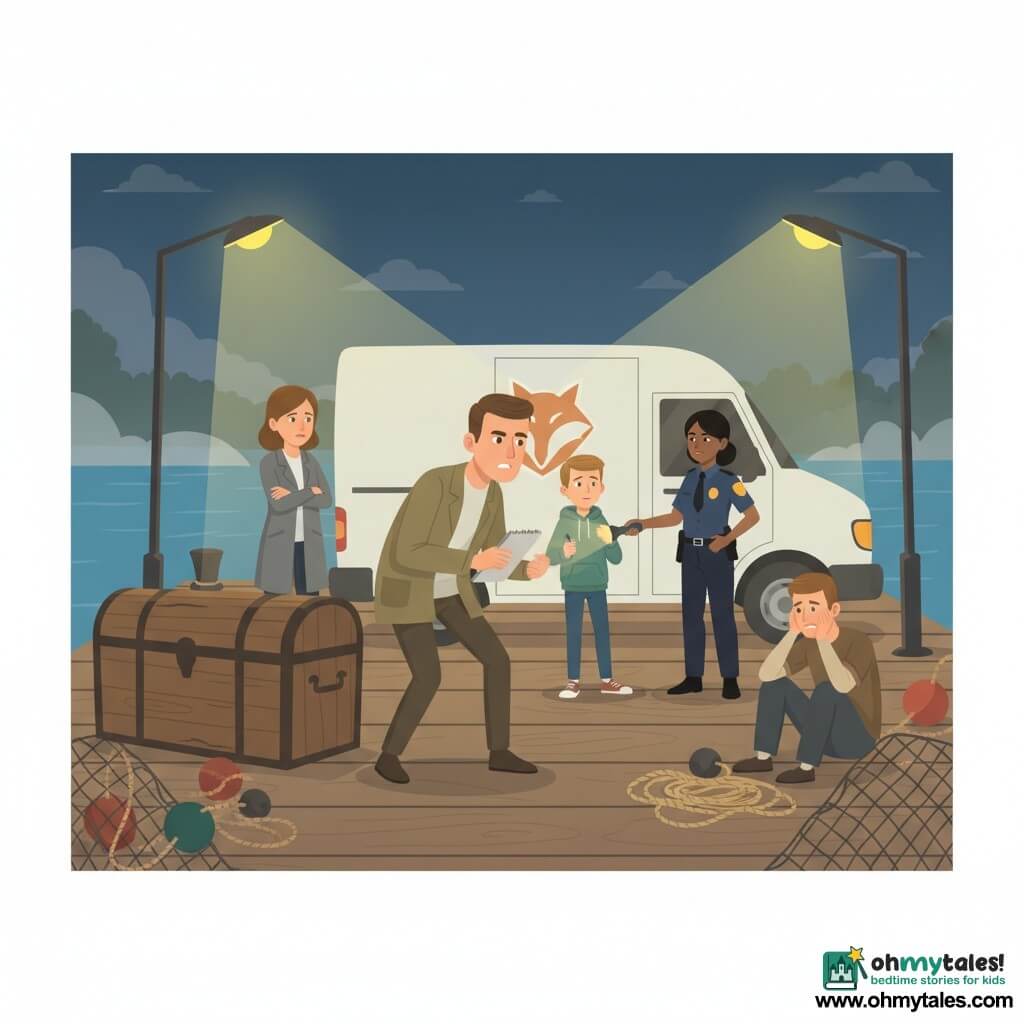
Chapter 1: The Empty Bay
Jonah Reed didn't look like the kind of person who solved mysteries. He wasn't tall enough to loom, and he didn't wear a coat dramatic enough to flap in the wind. He wore a plain jacket, scuffed sneakers, and a notebook that had seen better days.
That was the point. People forgot you were watching when you looked ordinary.
The call came in after school, while Jonah was finishing paperwork at the small insurance office above Patel's Pharmacy.
“Jonah,” said Ms. Sato, his supervisor, brisk as a stapler. “We've got a claim from Mr. Hargreaves. Car crash last night. He swears the engine was destroyed. The mechanic says the engine is… missing.”
“Missing as in stolen?” Jonah asked.
“Missing as in there's an empty space where the engine should be,” Ms. Sato replied. “Go. Take pictures. Ask questions. Don't get hurt.”
By the time Jonah reached Hargreaves Auto Repair, evening had soaked the street in orange streetlight. The garage smelled like oil, rubber, and old coffee. A radio murmured from somewhere behind a stack of tires.
Mr. Hargreaves, a broad man with gray eyebrows like two angry caterpillars, led Jonah to a silver hatchback parked in Bay Three.
“Look,” he said, throwing his arms wide.
Jonah leaned in. The hood was propped open. Wires dangled like vines. The engine bay yawned, hollow and wrong.
“That's not ‘destroyed,'” Jonah said quietly. “That's ‘removed.'”
“I told the owner!” Hargreaves huffed. “I said, ‘Someone took it.' He says nobody touched it. Then he asks if I'm trying to cheat him. Me! In my own shop!”
Jonah took photos from different angles, then crouched, careful not to smudge anything. The bolts around the mounts were cleanly loosened, not snapped. Whoever did this had time.
“Who had access?” Jonah asked.
Hargreaves scratched his cheek. “My guys. Me. The owner, Leo Brannick, when he came by this morning. And… a kid.”
“A kid?” Jonah's pen paused.
Hargreaves nodded toward the office window. “He was out front earlier, pretending to wait for someone. Skinny. Hoodie. About… ten? Eleven? Kept staring at the car like it owed him money.”
Jonah straightened. “Did he come inside?”
“No. But when I stepped out to chase him off, he ran.” Hargreaves lowered his voice. “And then I found this.”
He held out a folded scrap of paper, greasy at the edges. On it, someone had written in blocky letters:
BAY 3 — 7 STEPS LEFT — UNDER THE RED CAN
Jonah didn't smile, but something in him clicked into place like a lock turning.
“May I keep it?” he asked.
Hargreaves hesitated, then handed it over. “If it gets my name cleared.”
Jonah slid the note into an evidence sleeve. “Let's see what's under the red can.”
In the corner, a battered red gas can sat beside a toolbox. Jonah counted seven steps left from Bay Three, then crouched by a shelf.
Under the red can was a second note, cleaner, like it had been placed carefully.
THIS IS NOT AN ACCIDENT.
Jonah read it twice. The garage suddenly felt too quiet, as if the radio had lowered its voice to listen.
He glanced at the hatchback again. A crash, a missing engine, and a message that sounded like a warning.
“Mr. Hargreaves,” Jonah said, “tell your staff not to touch anything else. I'm going to talk to the owner. And if that kid shows up again—don't chase him. Call me.”
Hargreaves blinked. “Why not chase him?”
Jonah tucked his notebook away. “Because he might be trying to help. Or he might be trying to lead us somewhere.”
Outside, the air was cool and sharp. Jonah looked down the street, imagining a skinny boy in a hoodie slipping through shadows.
Two notes. One engine gone.
And a mystery that didn't want to stay quiet.
Chapter 2: The Boy in the Hoodie
Leo Brannick lived in a narrow house behind the old train tracks, where the weeds grew tall and the wind carried the metallic scent of rails. Jonah knocked, listened to footsteps, and watched the curtain twitch.
Leo opened the door with a face that tried to look calm and failed. He was in his twenties, with tired eyes and hands that couldn't stop moving.
“You're from insurance?” Leo asked.
Jonah showed his badge. “Jonah Reed. I'm investigating the claim. Your engine is missing.”
Leo swallowed. “The crash messed it up.”
Jonah held his gaze. “The bolts were unscrewed. That's not crash damage.”
Leo's jaw tightened. “So what, you think I stole my own engine?”
“I think someone removed it,” Jonah said. “And someone left notes in the garage. Do you know anything about that?”
Leo's eyes flicked away. “No.”
Jonah let the silence sit. Silence was useful. People rushed to fill it, and sometimes they filled it with truth.
Finally Leo exhaled. “Look… I crashed because a truck cut me off. I swerved, hit a barrier. I was lucky. That's all.”
Jonah took out the first note but didn't show it yet. “Do you know a boy—around eleven—skinny, hoodie?”
Leo stiffened. “No.”
Jonah watched the reaction carefully. Not surprise. More like… fear of saying the wrong thing.
“Leo,” Jonah said, keeping his voice even, “if someone is threatening you, this is your chance to tell me.”
Leo's shoulders sagged a fraction. “Nobody's threatening me.”
Jonah didn't argue. He simply asked, “Where were you between midnight and two a.m.?”
Leo blinked, caught off guard. “At home.”
“Alone?”
Leo's mouth opened, then closed. “Yes.”
Jonah nodded slowly and left, but the conversation stuck to him like grease.
As Jonah walked back toward town, he took the long route past the crash site. The barrier had fresh scrapes. Bits of shattered plastic glittered in the grass like hard candy.
And there, wedged under a bent signpost, was something bright: a small strip of yellow tape, torn from a caution roll. On it, someone had written a single number in marker:
13
Jonah pocketed it.
On the way back, he stopped at a corner store for a bottle of water and, more importantly, information. The cashier, Mrs. Dalloway, knew everybody's business the way a lighthouse knows ships.
“You're Jonah Reed,” she said, not asking. “The one who finds out who stole the mayor's garden gnome.”
“It wandered home,” Jonah said. “I just asked the right questions.”
Mrs. Dalloway chuckled. “So what's the right question today?”
“Have you seen a skinny boy in a hoodie hanging around the garage district?” Jonah asked.
Her eyes narrowed thoughtfully. “You mean Milo.”
“Milo?” Jonah repeated.
“Milo Finch. Lives with his grandma near the river. Smart kid. Too smart sometimes. He's always scribbling codes on the backs of receipts.” She leaned closer. “He's been asking about car parts.”
Jonah's pulse quickened, but he kept his face calm. “Did he say why?”
“Something about ‘proving it,'” Mrs. Dalloway said. “He bought a pack of gummy worms and asked if I had any cardboard. I told him to take a box. He wrote on it like it was treasure.”
Jonah thanked her and stepped out, the evening breeze tugging at his hair.
Milo Finch. Coded messages. A note hidden under a gas can.
Jonah headed toward the river neighborhood, where narrow streets sloped down and the houses leaned together like they were sharing secrets.
He found Milo on a low stone wall, legs swinging, hoodie up even though it wasn't that cold. He was watching the water like it might confess something.
Jonah didn't approach like a hunter. He approached like someone who might listen.
“Milo Finch?” Jonah asked.
The boy's head snapped around. His eyes were sharp, quick. He looked ready to bolt.
“I'm not in trouble,” Milo said immediately.
“That depends,” Jonah replied. “Do you know anything about a missing engine?”
Milo's gaze flickered to Jonah's badge, then to Jonah's notebook. “If I say yes, do you promise you won't tell my grandma I was near the garage?”
Jonah considered. “If you tell me the truth and nobody's hurt, I won't drag your grandma into it.”
Milo studied him as if weighing a coin for fakes. Then he reached into his pocket and pulled out a folded piece of cardboard.
On it were scribbles: letters, arrows, and numbers. Milo tapped one line.
“Leo didn't crash by accident,” Milo said quietly. “Someone made him.”
Jonah's throat tightened. “How do you know?”
“Because I saw the truck,” Milo said. “And because I saw what they did after.”
“Who are ‘they'?” Jonah asked.
Milo hesitated. “Two men. One had a fox logo on his jacket. They argued with Leo earlier this week. I heard them. I was behind the vending machine at the garage.”
Jonah kept his voice steady. “Why were you behind the vending machine?”
Milo's cheeks reddened. “I dropped my drone there. It got stuck. Don't laugh.”
“I won't,” Jonah said. He meant it. “What happened after the crash?”
Milo swallowed. “I followed the truck on my bike. It went to the old loading yard by the warehouses. And later, I saw a van at the garage, late at night. The same fox logo.”
Jonah took out the yellow tape with 13. “Do you know what this number means?”
Milo's eyes widened. “Where'd you get that?”
“Near the crash site,” Jonah said. “Tell me.”
Milo drew a breath. “It's a locker number. In the loading yard. They have metal lockers for workers. My cousin used to work there.”
Jonah looked toward the dark line of warehouses in the distance, like a row of sleeping giants.
“You've been leaving notes,” Jonah said. It wasn't a question.
Milo nodded, small. “I didn't know how to tell anyone. Cops don't listen to kids. But you're… you're an investigator. And you solved the gnome thing.”
Jonah almost smiled. Almost.
“Okay,” he said. “Here's the deal. You and I are a team, but only if you follow my rules.”
Milo's shoulders lifted, hopeful. “Rules?”
“No following criminals on your bike,” Jonah said. “No sneaking into places alone. And no more notes that make people touch evidence.”
Milo winced. “Sorry.”
Jonah held out his hand. “We do this carefully. Agreed?”
Milo shook Jonah's hand, his grip surprisingly firm.
“Agreed,” Milo said. “So… what's next?”
Jonah looked at the number again.
“We go to Locker Thirteen,” he said. “And we see what someone wanted to hide.”
Chapter 3: Locker Thirteen
The loading yard sat behind a chain-link fence topped with loops of wire. Jonah and Milo approached in daylight the next afternoon, when people were around and secrets were harder to keep.
Jonah had called Ms. Sato to report the new angle—possible tampering, possible theft ring. She'd told him to be careful, then added, “And Jonah? No hero stunts.”
Now Jonah walked with steady steps, scanning the yard. Shipping pallets were stacked like wooden cities. Forklifts beeped in the distance. A security booth sat near the gate, glass smudged with fingerprints.
A guard stepped out, chewing gum with the determination of a machine.
“Can I help you?” the guard asked.
Jonah showed his badge. “Insurance investigator. We're checking a lead related to a vehicle theft. I'd like to look at the employee lockers.”
The guard eyed Milo. “Who's the kid?”
“My assistant,” Jonah said smoothly.
Milo's eyebrows shot up, but he stayed quiet.
The guard snorted. “That's a new one.”
Jonah didn't argue. He waited. Waiting was another tool. After a moment, the guard shrugged. “Fine. Five minutes. Don't touch anything you shouldn't.”
They crossed the yard to a row of dented metal lockers bolted to a wall. Most were rusted, some with broken latches. Locker 13 had a shiny new padlock.
“New lock,” Jonah murmured. “Interesting.”
Milo leaned in. “So how do we—”
“We don't break it,” Jonah said. “We find who has the key.”
Milo frowned. “That could take forever.”
Jonah pointed at the padlock. “Look closely. What do you notice?”
Milo squinted. “There's… paint? Like a smear of blue.”
Jonah nodded. “Blue paint. Fresh. Now look at the wall beside it.”
Milo followed his gaze. A small patch of the wall had a streak of the same blue, like someone had brushed against it.
“Someone carried something painted blue and bumped the locker,” Milo said.
“Or wore paint on their sleeve,” Jonah added. “Either way, it's recent. Now—who around here would have blue paint?”
Milo's eyes darted around. “Maintenance workers? The forklifts?”
Jonah watched a forklift pass. Its body was bright yellow, chipped. Not blue.
Then Jonah noticed a man near a stack of pallets, rolling blue paint onto a metal beam. His overalls were flecked with the same shade.
The man glanced their way—too quickly—and turned his back.
Jonah took a step forward. The guard's “five minutes” suddenly felt short.
“Stay beside me,” Jonah told Milo.
They approached the painter. Jonah kept his voice polite, ordinary.
“Afternoon,” Jonah said. “Quick question. Do you have access to the lockers?”
The man kept rolling paint. “No.”
Jonah angled his notebook. “Because Locker Thirteen has a new padlock with blue paint on it.”
The roller paused. The man's shoulders tightened.
Milo whispered, “That's a yes.”
Jonah raised his voice slightly. “I'm investigating stolen car parts. If you can help, it'll go better for you.”
The man set down the roller too carefully. “I don't know anything.”
Jonah looked at the man's pocket. A key ring bulged against the fabric. Jonah didn't grab it. He didn't have to.
Instead he said, “What's your name?”
The man hesitated. “Curtis.”
Jonah nodded. “Curtis. I'm going to ask you something, and you can choose how this goes. Who told you to lock that locker?”
Curtis's eyes flicked toward the warehouses—toward a van parked half-hidden between two containers. On the side was a faded fox logo.
Milo sucked in a breath.
Jonah saw it too. “Milo, remember the rules,” he murmured.
Milo nodded, jaw tight.
Curtis's voice dropped. “I didn't steal anything. They paid me. Just to hold it. That's all.”
“Hold what?” Jonah asked.
Curtis swallowed. “An engine. In a crate.”
Jonah's stomach sank and lifted at the same time. A lead, solid at last.
“Open it,” Jonah said.
Curtis looked past Jonah again, fear sliding across his face like oil on water. “I can't. They'll—”
Jonah stepped closer, lowering his voice. “Listen. If those men caused a crash, this is bigger than you. Help me, and I can report you as a cooperating witness. Refuse, and you're involved.”
Curtis's hands trembled. Then he pulled out his key ring.
“Fine,” he muttered. “Quick.”
Curtis unlocked Locker 13. The metal door creaked open.
Inside was a wooden crate the size of a dishwasher. Stenciled letters read: FARM EQUIPMENT.
Jonah tapped the crate's edge. “Not farm equipment.”
Milo leaned forward, eyes bright. “Open it!”
Curtis pried the lid with a screwdriver. The wood squealed, then gave.
Inside, wrapped in oily cloth, was a car engine. Even Jonah, who wasn't a mechanic, recognized the shape and the weight of it, like a sleeping beast.
“There,” Curtis said, voice thin. “That's all I know.”
Jonah took photos, then spotted something wedged between the cloth and the engine: a small waterproof bag.
He pulled it out carefully. Inside were printed pages, covered in numbers and letters.
Milo peered over Jonah's shoulder. “That's a code sheet.”
Jonah's mind clicked again. Missing engine. Crash not an accident. Coded messages.
This wasn't just theft. It was a plan.
And now Jonah had evidence—if he could get it out safely.
From across the yard, an engine rumbled. A van door slammed.
Milo's voice went tight. “Jonah… fox logo.”
Jonah shut the locker calmly, like he was just checking supplies, and turned to Curtis.
“Curtis,” Jonah said, “walk away. Now. And don't look back.”
Curtis didn't argue. He vanished behind the pallets.
Jonah slipped the waterproof bag into his jacket and nodded at Milo.
“Time to leave,” Jonah said.
They walked—not ran—back toward the gate, while Jonah's ears tracked every sound behind them. The van engine started again, a low growl that felt like a warning.
Milo's hands were clenched. “Are they following us?”
Jonah didn't answer until they were outside the fence, on the public sidewalk.
Then he said, “I think they know someone is getting close.”
Milo swallowed. “What do we do with the code sheet?”
Jonah looked down at the bag in his jacket, feeling its weight like a heartbeat.
“We read it,” he said. “And we figure out what they were planning next.”
Chapter 4: The Messages That Don't Want to Be Read
Jonah chose the town library for their decoding session because the library had three important things: quiet, cameras, and Mrs. Kline, the librarian, who could silence a room with a single raised eyebrow.
They sat at a table near the back, beneath a poster that said: ASK QUESTIONS. FIND ANSWERS.
Milo laid out the printed pages. Each page had rows like this:
A3 = 19
B1 = 4
C2 = 15
And at the bottom, a line of letters separated by dashes:
B1 - A3 - C2 - C2 - D4
Milo chewed the end of a pencil. “It's a substitution code. Like… each box equals a letter.”
Jonah nodded. “But we need the key.”
Milo flipped the pages. “Maybe the key is the grid itself. Like A, B, C are rows and numbers are columns.”
Jonah scanned the paper. “Do you see any grid?”
Milo's eyes darted. “No. Just equations.”
Jonah leaned back, thinking. “These pages were hidden with the engine. So they're connected to moving the engine, or selling it.”
Milo tapped the first note Jonah had found: BAY 3 — 7 STEPS LEFT — UNDER THE RED CAN.
“That note was like directions,” Milo said. “Maybe the code is directions too.”
Jonah slid the yellow tape with 13 onto the table. “And this number led to the locker.”
Milo's eyes widened as understanding flickered. “So the codes point to places.”
Jonah pointed at the line: B1 - A3 - C2 - C2 - D4.
“If each part is a location, what kind of place has sections labeled with letters and numbers?” Jonah asked.
Milo's face lit up. “A map grid. Like… the town map in the newspaper! Or—wait—the warehouse yard has rows labeled A, B, C.”
Jonah nodded. “And the library has shelves labeled with letters and numbers.”
Milo looked around, suddenly excited. “Oh. Oh! Like Shelf B, Row 1.”
Jonah stood. “Let's test it. We'll use the library's shelf labels.”
They moved carefully through the stacks. Shelf B, Row 1 held mystery novels and dusty atlases. Milo ran his finger along the spines.
“Which one?” he whispered.
Jonah scanned for something out of place: a book pushed too far back, a spine too clean, a bookmark that didn't belong.
There—a thin atlas with a slightly torn corner. Jonah pulled it out. Something fell from inside and fluttered down like a leaf.
A small envelope.
Milo caught it, eyes wide. “It worked.”
Jonah opened the envelope. Inside was a single flash drive and a note:
NEXT: A3
Milo whispered, “A3 is another shelf.”
Jonah hesitated, then nodded. “We keep going.”
At Shelf A, Row 3, Milo found a paperback shoved behind a dictionary. Inside: another note.
MEET 9:00 — PIER 4
Milo's breath caught. “They're meeting tonight.”
Jonah pocketed the notes and the flash drive. His mind arranged the pieces: the crash forced Leo's car off the road. The engine was removed and stored. Codes were used to pass instructions without obvious texts.
Now: Pier 4. A meeting. Probably a handoff.
Milo looked up at Jonah, nerves and excitement mixed together. “We can stop them.”
“We can,” Jonah said. “But we do it smart.”
Milo lowered his voice. “Like… call the police?”
Jonah considered. “Yes. But we need the right information. And we need it in a way they can act on quickly.”
Milo's shoulders drooped a little. “So we just… wait?”
Jonah shook his head. “We prepare. And you help me think.”
They returned to the table. Jonah took out his notebook.
“Reader's job,” Jonah said, glancing around as if the library itself were listening. “If you were moving a stolen engine, why meet at a pier?”
Milo answered immediately. “Because boats. You can ship it out.”
“Good,” Jonah said. “And if you're shipping something heavy, what else do you need?”
“Equipment,” Milo said. “A cart. A crane. A truck.”
Jonah nodded. “So we watch for a van with a fox logo and maybe a dolly or winch.”
Milo leaned in. “And the flash drive—what's on it?”
“We can't plug it into a public computer,” Jonah said. “Too risky. But we can hand it to police.”
Milo gnawed his lip. “What about Leo? He's involved?”
Jonah thought of Leo's frightened eyes. “Maybe he's trapped. Maybe he was paid. Maybe he was threatened. But he's connected.”
Milo looked down. “I feel bad.”
Jonah's voice softened. “Feeling bad means you're paying attention. But we don't guess. We prove.”
He wrote three names in his notebook: LEO, CURTIS, FOX MEN.
“Now,” Jonah said, “we need one more thing: a way to tie the crash to the theft.”
Milo snapped his fingers. “The truck! If we can find the truck that cut him off—”
Jonah nodded. “And the fox logo suggests it's their vehicle. If it has paint scratches from the barrier, that's proof.”
Milo's eyes darted to the window as if he could already see it. “So at Pier 4, we look for that truck too.”
Jonah closed his notebook with a quiet thud. “Exactly.”
He stood. “We call the police now. We give them Pier 4, nine p.m., and the evidence about Locker 13. Then we stay nearby—with adults and cameras around—and observe. No hero stunts.”
Milo lifted a hand like he was swearing an oath. “No hero stunts.”
Jonah almost smiled again.
Outside, clouds gathered over the river, turning the water dark and secretive.
Night was coming, and with it, the meeting that might unravel everything.
Chapter 5: Pier Four at Nine
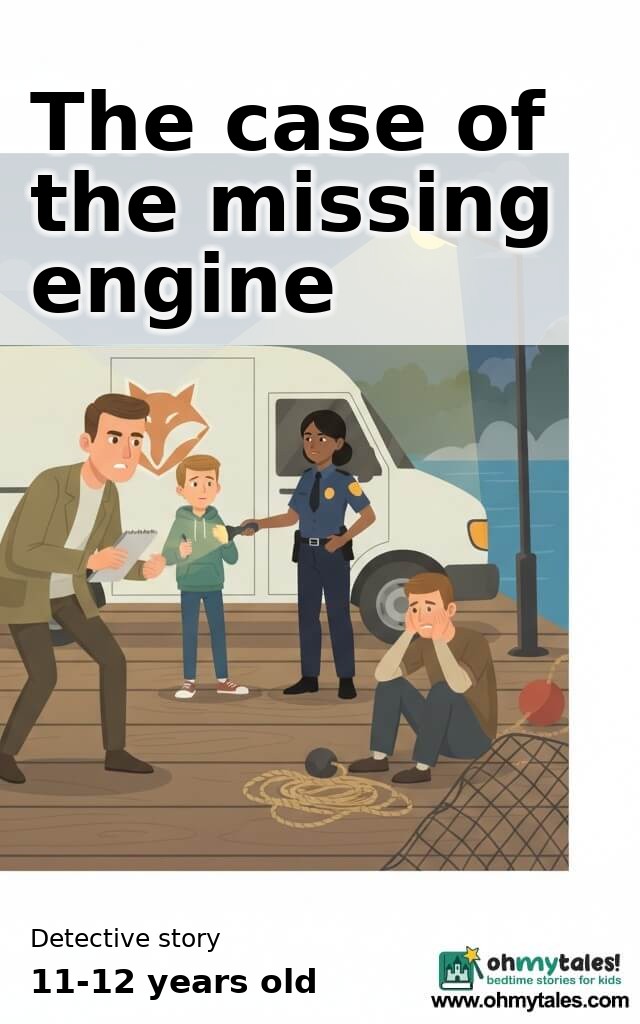
Pier 4 smelled like river mud, old rope, and fried food from a nearby kiosk. Jonah arrived with Milo and, importantly, Officer Ramirez, who had kind eyes and a very serious flashlight.
Two other officers waited in an unmarked car. Ms. Sato had also shown up—she claimed she was “just making sure Jonah didn't do anything foolish,” but Jonah noticed she stood where she could see everything.
“You did well calling,” Officer Ramirez told Jonah quietly. “We'll observe first. If we confirm the handoff, we move.”
Milo stood a little behind Jonah, hood down now, hair ruffled by wind. He looked nervous but proud to be there.
At 8:55, a van rolled into the parking area. Faded fox logo on the side.
Jonah's muscles tightened. “That's them.”
The van parked near the pier entrance. Two men stepped out. One wore a jacket with the fox emblem. The other had a cap pulled low. They looked around, slow and practiced.
Then a second vehicle arrived: a pickup truck. Its front bumper had fresh scratches, silver paint caught in the grooves.
Milo whispered, “Barrier paint.”
Jonah nodded. Evidence.
A third figure appeared from the shadows by the pier office: Leo Brannick.
Leo's shoulders were hunched. He walked like someone heading into a dentist appointment they couldn't cancel.
The fox-jacket man spoke first. Jonah couldn't hear the words, but he saw Leo's hands shake as he gestured.
Officer Ramirez murmured into her radio. “We have the driver. Confirmed. Stand by.”
The cap man opened the back of the van. Inside was a heavy crate—similar size to the one in Locker 13.
Jonah's mind raced. So there were more engines. Or they had moved it again.
Leo took a step back, as if the crate smelled dangerous.
Milo tugged Jonah's sleeve. “He doesn't want to do it.”
Jonah's voice was low. “That doesn't make him innocent. But it might make him scared.”
The fox-jacket man shoved something into Leo's hand—an envelope, maybe. Leo flinched like he'd been slapped.
Jonah saw it then: the cap man had a phone out, recording Leo.
Blackmail, Jonah thought. Make him look like the thief.
Officer Ramirez's jaw tightened. “That's enough.”
She raised her hand. The unmarked car's door opened silently. Officers moved in, brisk and calm, like chess pieces finally advancing.
“Police!” Officer Ramirez called out. “Step away from the vehicles!”
For one second, everything froze. Then the cap man bolted toward the pier, shoes slapping wood. The fox-jacket man lunged for the van door.
Leo stood frozen in the middle, eyes wide.
Milo sucked in a breath. “He's running!”
Jonah grabbed Milo's shoulder. “We stay here.”
Officer Ramirez sprinted after the cap man. Another officer cut toward the van.
The fox-jacket man slammed the van door and jumped into the driver's seat. The engine roared. The van lurched forward—
—and stopped.
Because Jonah had noticed something earlier: a heavy chain looped loosely around a bollard, the kind used to tie boats. Someone—probably the pier worker—had left it there.
Ms. Sato, quick and practical, had stepped on the loose end the moment the van moved, jamming it under the tire. The van's wheel spun, squealing.
The driver swore. The officer yanked the door open and hauled him out.
Milo stared at Ms. Sato. “Did you just… stop a getaway van with a chain?”
Ms. Sato's eyebrows rose. “No hero stunts,” she said. “Just office instincts.”
At the edge of the pier, Officer Ramirez cornered the cap man against a stack of nets. He slowed, panting, then raised his hands.
Minutes later, the scene was contained. Leo sat on a curb, head in his hands. An officer spoke to him gently.
Jonah approached Leo, keeping a respectful distance.
Leo looked up, eyes red-rimmed. “I didn't mean for the crash,” he blurted. “I swear. They said if I didn't cooperate, they'd… they'd ruin my mom's business. They had recordings. They had… everything.”
Jonah's voice stayed calm. “Tell the truth now. That's how you fix this.”
Leo nodded shakily. “They sell engines. Stolen ones. They wanted mine because it was new. They paid me to bring the car in, then said they'd ‘handle' it. I tried to back out. Then the truck… the crash… I thought it was a warning.”
Milo stood behind Jonah, listening, his face serious. No smirking. No “I told you so.” Just focus.
Officer Ramirez joined them. “We found the crate in the van. Another engine. And we'll check the flash drive you found.”
Jonah handed over the drive. “It should connect their codes and locations. We also have photos of Locker 13 and the engine inside.”
Officer Ramirez nodded. “That's solid work.”
Milo let out a breath like he'd been holding it all day. “So… we solved it?”
Jonah looked at the river, dark and moving, carrying secrets away.
“We uncovered it,” Jonah said. “Now we make sure it sticks.”
Chapter 6: Proof, Not Guesswork
Two days later, Jonah sat in the police station's interview room with Officer Ramirez, Ms. Sato, and Milo—who had permission from his grandmother, mostly because Officer Ramirez had politely promised, “We will keep him safe, ma'am.”
On the table lay printed photos: the empty engine bay, the locker crate, the fox-logo van, the scratched pickup bumper. There was also a transcript from the flash drive: messages, dates, payment records, and a neat list of coded drop points.
Milo traced a line on the paper. “So the shelf code wasn't just for the library. It was their system everywhere.”
Officer Ramirez nodded. “Warehouses, lockers, even public places. It let them pass instructions without saying ‘engine' or ‘pier' in a text.”
Ms. Sato looked at Jonah. “And Jonah figured it out because he asked what kind of place uses letters and numbers.”
Jonah shrugged slightly. Praise was fine, but it wasn't the goal.
Officer Ramirez turned to Milo. “And Milo brought the most important thing: eyewitness information. The truck. The logo. The pattern.”
Milo sat up straighter. “I also… maybe… left notes in a garage.”
Officer Ramirez's eyes softened. “You did. And next time, tell an adult directly. But you were trying to help. That matters.”
Jonah slid his notebook forward and opened it to a page where he'd written three questions in bold.
1) What do we know for sure?
2) What are we guessing?
3) What can we test?
He pointed to the first question. “This is what kept us from getting lost.”
Milo read the questions slowly, then nodded. “It's like… building a bridge. You don't step on the part you haven't built yet.”
Ms. Sato's lips twitched. “That's surprisingly poetic for someone who buys gummy worms for dinner.”
Milo grinned. “It was a stakeout snack.”
Officer Ramirez stood and gathered the papers. “The men are being charged. Leo is cooperating. Curtis too. That helps.”
Milo's grin faded. “Leo's not going to jail?”
Officer Ramirez chose her words carefully. “He'll face consequences. But cooperation and truth matter. The law isn't only about punishment. It's also about fixing harm and stopping worse harm.”
Jonah added, “And Leo's statement connects the crash to the theft ring. That was your missing piece.”
Milo looked at Jonah. “So if I hadn't—”
Jonah interrupted gently. “If you hadn't, we would have found another path. But it might have taken longer. And they might have hurt someone else. You sped up the truth.”
Milo swallowed, then nodded, satisfied in a quiet way.
As they left the station, the winter sun glanced off the river. The town looked normal again—shops open, bikes rattling, people arguing about nothing important.
Milo walked beside Jonah, hands in pockets. “So… what happens now?”
Jonah looked ahead. “Now the insurance company pays for what's fair. The police keep digging. And you go back to being a kid who does homework.”
Milo groaned. “Harsh.”
Jonah's mouth curved, finally, into a small smile. “Mysteries are exciting. But most days, the best skill is patience.”
Milo considered that, then nudged Jonah's shoulder lightly. “Still. If there's ever another case…”
Jonah glanced at him. “If there's ever another case, you tell me directly. No hiding notes under gas cans.”
Milo held up his hands. “Deal.”
They reached the corner where their paths split. The wind carried the smell of coffee and cold metal, and Jonah felt that familiar, steady satisfaction: not the thrill of danger, but the calm of answers earned.
Behind them, Pier 4 stood empty, just wood and water and sunlight—like it had never held a secret at all.