Chapter 1
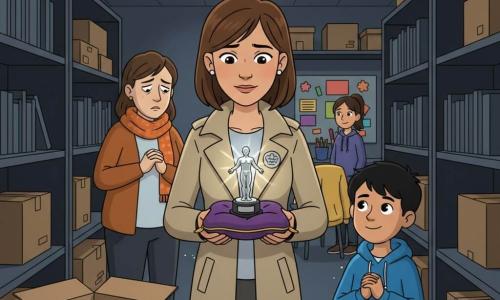
Mara Venn didn't look like the detectives in movies. No dramatic coat flapping in the wind, no loud speeches. She wore a plain gray jacket, kept her hair tied back, and carried a small notebook that never left her pocket. She preferred listening. People revealed more when they tried to fill silence.
The Maplebridge Community Center smelled like lemon cleaner and old wood. A banner for the annual “Spring Fair” hung crookedly above the entrance, and the hallway buzzed with worried voices.
Jules, the center's manager, spotted Mara and hurried over. His lanyard bounced against his chest like it was trying to escape. “Thank you for coming. It's… it's embarrassing.”
“What's missing?” Mara asked.
Jules swallowed. “The mayor's ceremonial badge. Solid brass, engraved. He's supposed to open the fair tomorrow. He left it in the trophy case after last year's photos, and we've kept it here, locked, ever since. This morning the case was open. The badge was gone.”
Mara's eyes moved, slow and careful, taking in the room without looking like she was taking anything in.
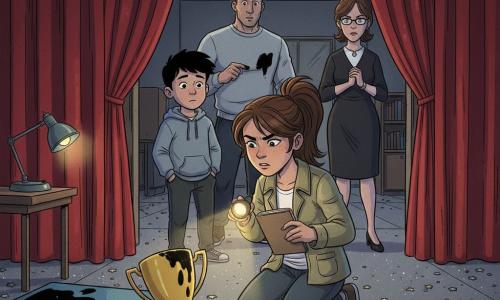
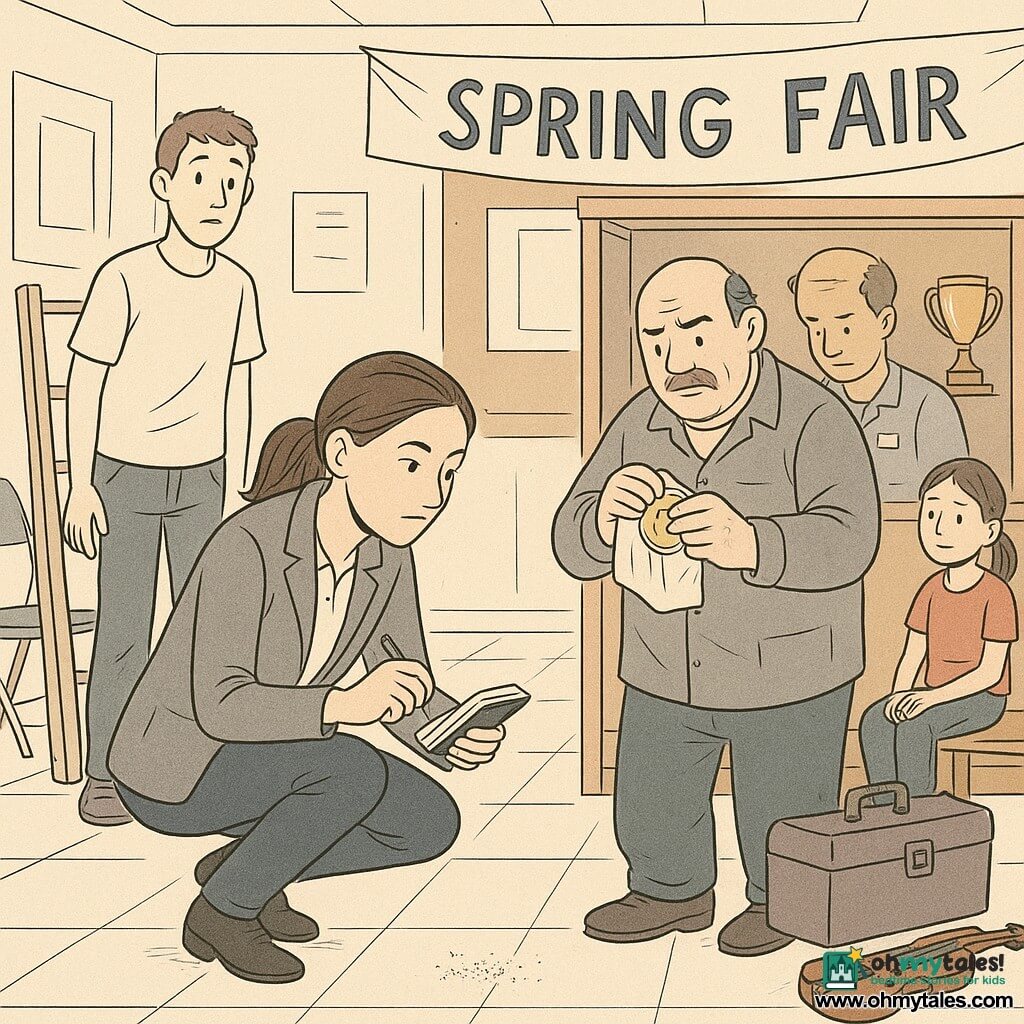
A trophy case stood against the far wall. Its glass door hung slightly ajar. Inside, a few plaques and dusty cups sat untouched, but the velvet stand in the center was empty. A pale rectangle showed where something had been resting for a long time.
“Who has keys?” Mara asked.
“Me. Lani, the custodian. And Mr. Pike from maintenance.” Jules rubbed his forehead. “But the door wasn't forced. The case wasn't smashed. It's like someone simply… opened it.”
Mara crouched and studied the base of the case. The dust was disturbed in a narrow arc, like a hand had brushed it. There were also faint smudges on the glass—fingerprints, maybe, but the center was busy, and everything had been handled by someone at some point.
A girl with a violin case paused nearby, watching. A boy in a red hoodie leaned against the wall, pretending not to listen while listening very hard.
Mara stood and turned slightly so she could see Jules and the corridor at once. “Tell me what happened between last night and this morning. Slowly.”
Jules took a breath. “Last night we hosted the chess club in Room Three, the drama rehearsal in the hall, and the bake sale committee meeting in the kitchen. I locked up at nine. This morning, Lani opened at seven and found the trophy case door unlatched.”
“Any alarms?” Mara asked.
“Only on the outside doors. Nothing inside.”
Mara nodded. She wrote two words in her notebook: timeline, access.
She didn't say it out loud, but she thought it clearly: If there's no forced entry, then it's either someone with access, or someone who found a way to look like they had access.
She lifted her eyes to the empty velvet stand and let the silence stretch. It made the hallway sounds sharper: the squeak of sneakers, a laugh from somewhere, the clink of keys.
A laugh—bright, quick, and then cut off like someone had bitten it back.
Mara turned her head toward the sound.
Chapter 2
The laugh came from a door that was almost closed—the supply closet near the gym. Mara walked toward it without hurrying. Quiet movements made people underestimate her. Underestimation was useful.
As she reached the door, it swung open a crack. A young man—maybe seventeen—stood inside, holding a box of paper cups. His smile was half-hidden, but his eyes were still amused, as if he'd just heard a joke he didn't want to share.
Mara didn't accuse. She simply waited.
The young man cleared his throat. “Uh. Sorry. I… I was just thinking about something.”
“Something funny?” Mara asked.
He shrugged. “Not funny. Just—people panicking over a shiny badge. Like it's magic.”
It was an odd reaction. Not guilt, necessarily, but distance. Mara noted it anyway.
“What's your name?” she asked.
“Ethan. I help with events. Set up chairs, carry stuff.” He shifted the cups from one arm to the other. “Jules told me not to touch anything. I'm not touching anything.”
“I see that,” Mara said. “Where were you last night?”
“In the hall. Drama rehearsal. I was moving the lights. We finished at eight-thirty, maybe. Then I left.”
“Did you go near the trophy case?” Mara asked.
Ethan's eyebrows lifted. “Why would I? It's dusty. And Jules yells if you breathe near it.”
Mara nodded once. “Who else passed through the hallway last night?”
Ethan thought. “Drama kids. Chess club people. Lani was mopping. Mr. Pike came by with a toolbox. He always looks mad, but I think that's just his face.”
Mara wrote: Ethan—laugh, distance. Pike—toolbox.
She walked back toward the trophy case. The boy in the red hoodie was still leaning on the wall, now chewing the end of a pencil. The girl with the violin case hovered like she was waiting for permission to speak.
Mara didn't call them “kids,” even in her mind. People aged eleven or twelve could be sharp observers, and sharp observers were valuable.
“You were watching earlier,” Mara said to the girl with the violin case. “Did you see anything this morning?”
The girl straightened, relieved to be asked. “I'm Noor. I got here at seven-ten for practice. The front doors were open. Lani was already inside.”
“What did you notice?” Mara asked.
Noor shifted her violin case. “The trophy case door was… like that. Not wide open, but not shut. And I saw a little bit of… glitter? On the floor.”
“Glitter,” Mara repeated. She crouched near the case and examined the tile. Tiny sparkles clung to the grout line, barely visible unless the light hit just right.
“That's new,” Mara murmured.
The boy in the hoodie spoke without moving from the wall. “Glitter gets everywhere. That doesn't mean anything.”
Mara turned to him. “And you are?”
“Cal,” he said. His voice was casual, but his shoulders were tight. “I'm here for the robotics club. We meet in the basement.”
“Were you here last night?” Mara asked.
Cal's pencil stopped. “No. Mondays. Today's Tuesday.”
Mara looked back at the glitter. It was silver, fine, the kind used in crafts. The community center had plenty of craft supplies. But glitter had a habit of sticking to sleeves, to hair, to shoes. It traveled with people like a stubborn rumor.
Mara stood. “Jules,” she called softly.
He hurried over. “Yes?”
“Don't clean the hallway yet,” Mara said. “And please ask everyone who was here last night to stay available for a few minutes.”
Jules nodded, pale with relief that someone sounded like they knew what to do.
Mara's mind began to build a simple frame: last night's groups, keys, and now glitter.
She asked Noor, “Do you know where the craft room is?”
“Second floor,” Noor said. “Across from the library.”
Mara's eyes lifted to the staircase. “Then that's where we start.”
Before she moved, she glanced once more at Ethan by the supply closet. He was gone.
Chapter 3
The stairs creaked under Mara's careful steps. Upstairs, the hallway was quieter, lined with bulletin boards and faded posters. The craft room door stood open a few inches, and the air smelled like paint and glue.
Inside, tables were cluttered with ribbons, paper, and jars of glitter. A poster on the wall read: “Measure twice, cut once.” Mara approved. It sounded like a detective's motto.
A woman in a floral apron looked up from a box of markers. Her hands were stained blue. “Can I help you?”
“Mara Venn,” Mara said. “I'm looking into the missing badge.”
The woman's mouth formed a small “oh.” “I'm Tessa. I run the craft committee for the fair. We were here last night making decorations.”
“Were you using silver glitter?” Mara asked.
Tessa nodded quickly. “Yes. Stars for the stage backdrop. It gets in everything. Sorry.”
“Did anyone leave the room carrying glitter?” Mara asked, voice calm.
Tessa hesitated. “Everyone had glitter. We were all sparkly. But… Ethan came in.”
Mara's pen paused. “Ethan was in here?”
“Briefly,” Tessa said. “He brought in cardboard. Asked if we needed more tape. He was in a hurry.”
Mara pictured Ethan's amused face in the closet. Not a thief's panic, but someone thinking ahead, maybe. Or someone amused by everyone else missing the obvious.
Mara scanned the room. On a chair lay a roll of wide, clear tape. On the floor, a small ladder. On one table, a pair of scissors shaped like a stork.
She said, “Where did you keep the glitter?”
Tessa pointed to a shelf. “There. But it's always there.”
Mara walked to the shelf and looked closely at the jars. One jar of silver glitter had a smudge of dust around its lid, as if it had been opened, then wiped with a sleeve. Another jar—gold—looked untouched.
“Who locked this room last night?” Mara asked.
Tessa frowned. “We don't lock it. The door sticks sometimes, but it's usually open. It's a community center.”
Mara wrote: craft room—open access.
On her way out, she met Mr. Pike on the stairs. He was a wide man with a permanent scowl and a ring of keys that jingled like armor. He held a toolbox, and a faint line of silver sparkled on his sleeve.
Mara didn't comment on the glitter yet. She let him speak first.
He grunted. “If you're looking for someone to blame, don't look at me. I fix things. I don't steal them.”
“Were you here last night?” Mara asked.
“Of course I was here. The stage lights were acting up. Jules called me.” He shifted the toolbox. “Came in at eight. Left at nine.”
“Did you go near the trophy case?” Mara asked.
Mr. Pike snorted. “Why would I go stare at trophies? I went from the hall to the electrical closet. That's it.”
Mara's gaze settled briefly on his key ring. “You have keys to the trophy case?”
“Maintenance has a master,” he said. “But I didn't touch it.”
Mara nodded. She didn't argue. People argued when they wanted to win, not when they wanted to know.
As Mr. Pike stomped down the stairs, Mara noticed something else: on the back of his toolbox, a strip of clear tape was stuck, wrinkled, as if torn off in a hurry.
Tape. Glitter. A case that was unlatched, not smashed.
Her thoughts lined up like dominoes. You could open a locked glass door without breaking it if you could reach the latch from inside—if you could slip something through a small gap. Tape could hold a thin tool in place. Or tape could be used to lift fingerprints away. Or tape could catch glitter and carry it elsewhere.
Mara stopped halfway down the stairs and looked through the railing at the hallway below.
Cal was there now, pretending to examine a poster while watching everyone. Noor sat on a bench, her violin case by her feet. Jules paced, his shoes squeaking in short, frantic loops.
Mara walked down with steady steps and said, “Jules, where is the stage backdrop being made?”
“In the main hall,” Jules said. “Craft committee is setting it up today.”
Mara's eyes narrowed slightly. “Then I want to see it. Right now.”
Chapter 4
The main hall looked like a storm of preparations. Folding chairs were stacked like towers. Strings of paper flowers draped across the ceiling. A half-finished backdrop leaned against the stage: a black sheet covered in silver glitter stars.
Tessa stood on the ladder, pressing a star into place. Ethan held the bottom of the ladder, looking bored in an exaggerated way. When he saw Mara, his boredom flickered.
Mara walked slowly across the polished floor. The smell of sawdust mixed with glue.
“Ethan,” she said, not loudly. “Can we talk?”
He stepped away from the ladder. “Sure.”
Mara led him a few steps aside, near the edge of the stage where the light was dimmer. She kept her voice low. “You laughed earlier.”
Ethan's lips pressed together. “Did I?”
“You did,” Mara said. “It sounded like you thought everyone was missing something.”
Ethan glanced at the busy hall, then back at Mara. “People always miss something,” he said. “They look at the big, shiny problem, not the small parts.”
Mara held his gaze. “Like glitter?”
His eyes flicked—just once—to her notebook. “Glitter is obvious.”
“Then tell me what isn't,” Mara said.
Ethan exhaled. “Fine. Last night, when I was packing up after drama, I saw Mr. Pike by the trophy case.”
Mara didn't react quickly. Quick reactions made people shut down. She kept her face neutral. “What exactly did you see?”
“He was standing close to it,” Ethan said. “Like, really close. He had his toolbox open. I thought he was fixing the hinge or something.”
“Did he notice you?” Mara asked.
“I don't think so. He was sort of blocking the case with his body. I didn't want him to snap at me, so I walked away.”
Mara nodded. “Why didn't you tell Jules?”
Ethan's mouth twisted. “Because Jules would freak out and start accusing him with no proof. And Mr. Pike… he scares people. Plus, maybe it wasn't a big deal.”
Mara glanced at the stage. The backdrop glittered under the lights, bright as a winter night. “And you came into the craft room.”
“To get tape,” Ethan said. “For the lights. The drama director always needs tape.”
Mara wrote a line in her notebook: Pike near case; toolbox open; tape; glitter transfer.
Then she asked, “Did you see anything on the floor near the trophy case?”
Ethan frowned. “Maybe… a small piece of clear plastic? Like from packaging. But it was tiny.”
Mara's mind clicked. Clear plastic. Tape. A latch.
She stepped away and scanned the hall's edges: a trash bin by the stage steps, filled with scrap paper and torn tape. A second bin near the doors, mostly empty.
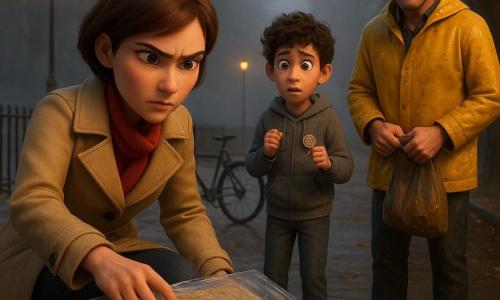
Mara approached the emptier bin and looked inside. At first, nothing but a crumpled flyer. Then she saw a sliver of clear plastic, curled like a fingernail clipping. She lifted it carefully with the corner of her notebook and set it on a clean sheet of paper.
It was thin and stiff—like the clear plastic from a badge holder. Except the mayor's ceremonial badge was brass, not a card. Why would plastic matter?
Unless someone used a strip of plastic as a shim, sliding it into the gap to push the latch from the inside.
Mara's pulse stayed calm, but her thoughts sharpened. This wasn't random. It was planned.
She returned to Jules. “I need everyone who had keys or was near the trophy case last night. Jules. Lani. Mr. Pike. Ethan.”
Jules gulped and nodded.
Within minutes they gathered near the stage. Lani arrived with a mop and a suspicious look. She was small, quick-eyed, with her hair wrapped in a scarf. Mr. Pike arrived last, scowling as if the very idea of standing in a group offended him.
Mara held up the sliver of plastic on the sheet of paper. “Does anyone recognize this?”
Lani squinted. “Looks like from packaging.”
Tessa, still on the ladder, called down, “We had badge sleeves in the office for volunteers. Clear plastic ones.”
Mr. Pike crossed his arms. “So what? Plastic exists.”
Mara looked at him, still calm. “Mr. Pike, show me your master key.”
His scowl deepened. “I'm not giving you my keys.”
Mara didn't push. She simply said, “Then show me your toolbox.”
He shifted. “No.”
Silence spread. People stopped moving. Even the paper flowers seemed to hang still.
Mara turned slightly to Jules. “Jules, do you have the authority to request cooperation in an investigation involving the mayor's property?”
Jules swallowed. “Yes.”
Mr. Pike's jaw worked. He set his toolbox on the floor with a heavy thud and flipped it open like he was daring anyone to look.
Inside were screwdrivers, pliers, wire, and—taped to the inside lid—a small brass object wrapped in a cloth.
Jules made a strangled sound. Lani's mop clattered against the floor.
Mara didn't reach for it. She let the moment settle, then said, “Unwrap it.”
Mr. Pike's face was red now, but he yanked the cloth away.
The mayor's ceremonial badge caught the light. Brass, heavy, engraved with the Maplebridge crest.
Mara watched the room, not just the badge. People's reactions mattered. Jules looked sick. Lani looked furious. Ethan looked relieved, as if a knot had finally loosened.
Mr. Pike lifted his chin. “I was going to bring it back.”
“Why take it at all?” Mara asked.
Mr. Pike's eyes darted toward the stage backdrop and away. “Because I was tired of being invisible,” he snapped. “Do you know what it's like fixing everyone's mess and getting blamed when anything breaks? They parade the mayor around with a badge, like he built the place with his bare hands. I wanted them to feel what it's like when something important disappears.”
Mara's voice stayed even. “So you planned a disappearance. Not a theft.”
Mr. Pike hesitated. That hesitation was the new clue Mara needed—not about the badge, but about intent. If he wanted panic, he would have hidden it somewhere it could be “found” dramatically. But he had taped it inside his toolbox, close to him, as if he couldn't let it out of reach.
He wasn't trying to sell it. He was trying to control the story.
Mara pointed gently at his sleeve. “The glitter on your arm. It came from the craft room, didn't it? You used tape for the shim, and glitter stuck to it. You went to the trophy case while everyone was busy. You opened it quietly and left the door slightly unlatched, so it looked like carelessness, not skill.”
Mr. Pike's shoulders sank a fraction. “You can't prove—”
“I don't need to guess,” Mara said. “Your toolbox holds the badge. The plastic shim is here. Ethan saw you. Noor saw glitter by the case early in the morning. And you have the keys.”
Mr. Pike stared at the floor. The hall's sounds returned slowly: a chair scraping, a distant door closing, a bird tapping at the window.
Jules looked at Mara with watery eyes. “What do we do?”
Mara said, “We fix this the right way. With rigor. Step by step.”
Chapter 5
Mara guided the group into Jules's office, away from the crowded hall. The office was small and smelled like coffee and printer ink. A framed photo of last year's fair sat on the desk. In it, the mayor grinned, holding the badge high like a trophy.
Mara placed the badge—still wrapped in its cloth—on the desk without touching the brass. She asked Jules for a pair of clean gloves from the first-aid drawer, and he handed them over with shaking hands.
Mara put the gloves on. “Mr. Pike, you will sit,” she said, pointing to a chair.
He sat heavily, eyes fixed on a spot on the carpet as if he could burn a hole through it.
Lani stood with her arms crossed. “He thinks he can just scare everyone and then—what? Get thanked?”
Mr. Pike flinched.
Mara didn't raise her voice. “Lani, I need your memory. Last night, when did you mop the hallway?”
“After eight,” Lani said. “Drama kids were still here. Chess people too. I mopped around the trophy case last, because it's a pain.”
“Did you see the case then?” Mara asked.
“Door was closed,” Lani said. “Locked.”
Mara nodded. “And this morning you found it unlatched.”
“Yes,” Lani said. “And I thought, ‘Jules will faint.'”
Jules managed a weak, unhappy laugh.
Mara turned to Ethan. “You saw Mr. Pike by the case. About what time?”
“Around eight-fifteen,” Ethan said. “Maybe twenty. I was coiling cables.”
Mara wrote times in her notebook, aligning them carefully: Lani mopped after eight, case locked; Ethan saw Pike near case around eight-fifteen; Jules locked up at nine.
The logic held. It wasn't a wild story or a lucky guess. It was a chain.
Mara looked at Mr. Pike. “You had access, a reason, and opportunity. But I also want to know your method. Not because I admire it—because I need to make sure no one else can do it again.”
Mr. Pike's mouth tightened. For a second he looked like he might refuse, but Mara stayed quiet, giving him space to decide.
Finally he muttered, “I used a strip of plastic from a volunteer badge sleeve. Slid it in at the edge. The latch isn't complicated. I didn't even need the key.”
Jules's face drained. “So the case isn't secure at all.”
“It can be,” Mara said. “If you fix the latch and add an interior lock. Also, stop leaving valuable items in public display cases without proper protection. Rigor isn't just for math class.”
Noor, standing by the door, raised her hand slightly. “So… the glitter mattered because it traveled?”
Mara looked at her, and her expression softened just a little. “Exactly. Small traces are honest. People can lie. Glitter can't.”
Cal, who had slipped into the doorway, said, “So if I see glitter in the robotics room, should I call you?”
Ethan snorted, and even Jules gave a brief smile.
Mara removed one glove and tapped her notebook. “If you want to help solve mysteries, practice three things: observe, record, and connect. Observation gives you pieces. Recording keeps them from changing in your head. Connection turns pieces into answers.”
Jules looked at the badge. “The mayor is coming this afternoon for a meeting. We have to give it back.”
Mara nodded. “We will. Properly. With an explanation. And Mr. Pike will also explain. Because taking responsibility is part of fixing what you broke.”
Mr. Pike's shoulders sagged further. “I didn't mean to ruin the fair.”
“Meaning isn't the same as result,” Mara said. “But you can still choose what happens next.”
The office fell quiet. In that quiet, Mr. Pike's scowl faded into something tired.
“I'll return it,” he said. “And I'll… I'll apologize.”
Mara opened the cloth and inspected the badge. No scratches. No dents. Then she wrapped it again and placed it in a small padded envelope Jules had in a drawer, sealing it with tape—carefully, neatly, with the kind of precision that made mistakes less likely.
She stood. “Let's do it.”
Chapter 6
The mayor arrived at three, escorted by the soft clatter of shoes and the smell of cold air. He was a tall man with kind eyes and a voice trained for microphones. When he entered Jules's office, his smile faltered at the tense lineup: Jules, Mara, Mr. Pike, Lani, Ethan, and—because they had refused to miss it—Noor and Cal in the hallway, peeking like cautious cats.
Jules began, words stumbling, but Mara stepped in gently. “Mayor Halden, your badge was taken last night from the trophy case. It has been recovered, undamaged.”
She placed the padded envelope on the desk and opened it. The brass badge gleamed warmly under the office light.
The mayor exhaled, relief softening his face. “Thank goodness. This badge is tradition. My father wore it when he opened the fair. I… I was worried.”
Mara turned slightly toward Mr. Pike. “Mr. Pike has something to say.”
Mr. Pike looked as if the chair were glued to him, but he stood. His hands were rough, with small cuts that came from working with tools. He stared at the badge, not at the mayor.
“I took it,” he said, voice low. “Not to sell it. Not to keep it. I wanted people to notice what I do. That's not an excuse. It was wrong. I'm sorry.”
The mayor's eyebrows rose. For a moment, the office held its breath.
Then the mayor said, “I appreciate the honesty. But you frightened a lot of people. You also put the center's reputation at risk.”
Mr. Pike nodded once, stiff. “I know.”
Mara watched the mayor's face. Anger was there, but also something else: understanding that people sometimes did foolish things for complicated reasons.
The mayor lifted the badge carefully, feeling its weight. Then he did something unexpected—he looked at Mr. Pike and said, “You are not invisible. The lights work because of you. The doors lock because of you. I should have said that before. Still, you must repair the damage you caused.”
“I will,” Mr. Pike said, voice rough.
Mara spoke, precise. “We will also repair the trophy case latch and add a secondary lock. And we'll review who has access. This doesn't happen again.”
The mayor nodded. “Good. Rigor. That's what I want to hear.”
He turned to Mara. “And you. Thank you.”
Mara simply inclined her head. She didn't soak up praise. Praise was loud. Solutions were quiet.
Jules's shoulders finally dropped from around his ears. Lani's stern face eased, just a little.
In the hallway, Noor whispered to Cal, “See? Glitter can't lie.”
Cal whispered back, “I still hate glitter.”
Ethan, catching their whispers, muttered, “Everyone hates glitter. That's how you know it's powerful.”
The mayor walked toward the door, the badge now secure in his hand. At the threshold he paused, as if remembering something.
He turned back and extended the badge slightly, then pulled it close again, almost like a test of trust. Finally, he held it out properly—toward Mara.
“Would you do the honor,” he said, “of returning it to me officially? So we can start tomorrow with the truth, not rumors.”
Mara accepted the badge with gloved hands and placed it into the mayor's palm, closing his fingers around it. The metal made a soft, final click against his ring.
“Returned,” Mara said.
The word felt solid.
As the mayor left, the community center seemed to breathe again. Preparations for the fair resumed with new energy, like someone had turned the lights back up.
Mara slid her notebook into her pocket. She looked at the hallway—at Noor's thoughtful eyes, at Cal's sharp gaze, at Ethan's relieved grin, at Lani's steady stance. A web of people, each with their own motives, each leaving traces.
Rigor, Mara thought, wasn't about suspicion. It was about care. About checking what you think you know. About respecting small facts.
She stepped out of the office into the bright, busy hall, and listened.