Dawn at the High Lake
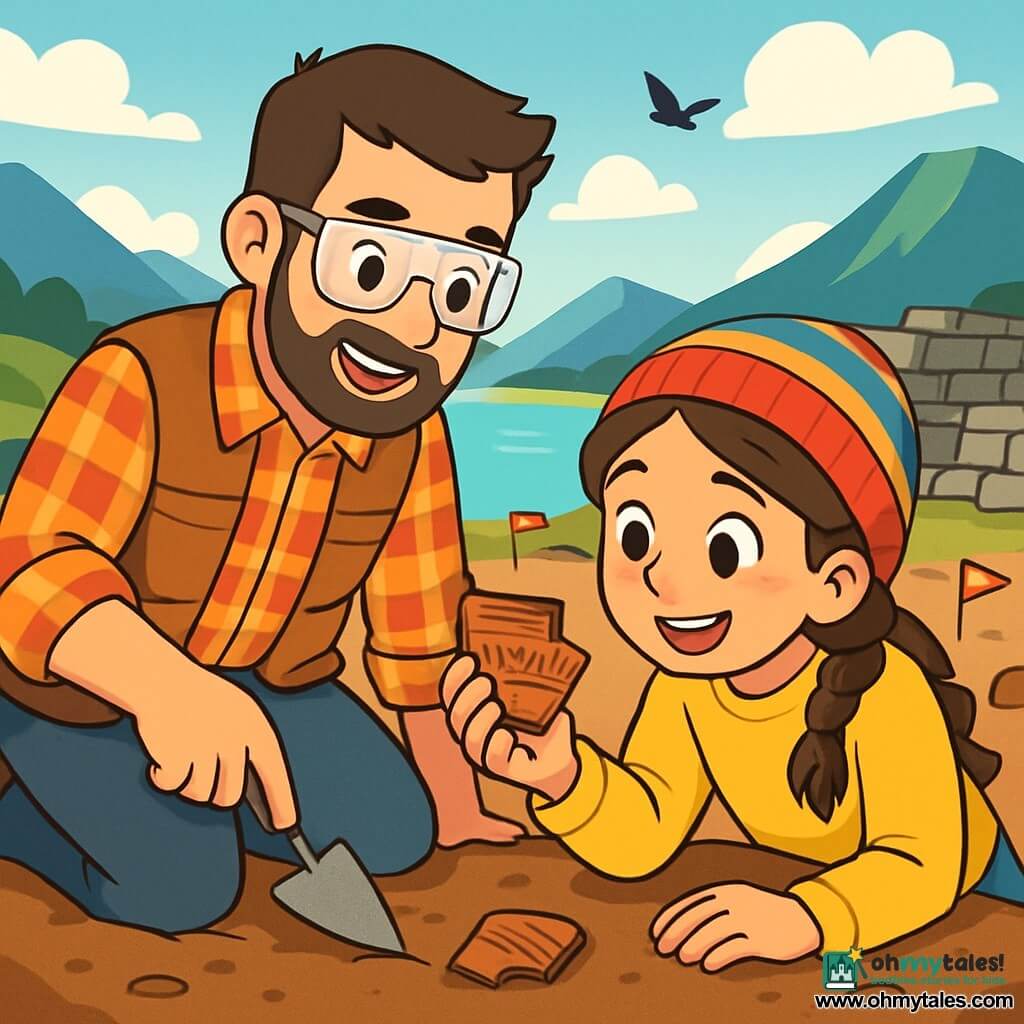
At daybreak the lake breathed mist, and the stones of Tiwanaku held the night's chill. Dr. Tomás Quispe stood still and let the thin air settle in his chest. He always did that at the start of a day—standing very still, listening. He was patient, patient as a stone that waits. The mountains were blue shadows, the water high and silver, and the ancient walls around the sunken court looked like quiet giants waking up.
He unrolled a tape, clicked open a small compass, and ran his gloved thumb along the edge of a trowel. His kit was never glamorous: brushes with soft bristles, pencils, a notebook that filled with careful boxes, a Munsell soil chart that looked like a paint store fan. Archaeology, he knew, was not about quick secrets. It was about small truths that took time. He was here to test his ideas—hypotheses, he'd say to his team. “A hypothesis is a careful guess you can check,” he liked to explain. Today, he wanted to see if the flat space by the low wall had been a kitchen long ago, or a ceremonial place where people shared food during festivals.
“Breathe slowly,” Tomás said to himself.
Amaya, his assistant, a student with bright eyes and a knitted hat with tassels, stood by the string grid they had set yesterday. Thin white lines crisscrossed the earth like a notebook drawn on the ground. Every square had a name: H14, H15, G14, G15. Tiny flags marked previous finds. A north arrow lay on the soil for photographs, pointing to true north as surely as a bird.
“Which square first, Dr. Tomás?” asked Amaya.
“Square H14,” he said, checking the day's plan. “We'll go slow. Remember, layers tell the story. The top is the newest; below is older, like a cake. Don't mix the icing with the sponge.”
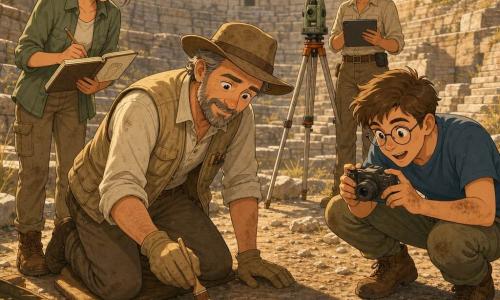
They knelt. The sun lifted a small warmth. A lark made a circle against the brightening sky. Tomás shaved the soil in thin curls, the trowel whispering, the grit singing softly against steel. Archaeology was as much listening as looking. He listened for the change when the blade met a different layer, a denser feel, a darker color. He was careful with every scrape, every brush. He paused often, wrote notes, drew lines, took pictures.
“The stones are cold,” Amaya murmured.
“Stones are patient,” Tomás smiled. “We learn from them how to wait.”
He marked a tiny change in the soil—slightly darker, a shadow of a shadow. He measured its depth. He labeled a bag for the crumbs of charcoal in the layer. He did not hurry. If the place had been a kitchen, there would be ash, food scraps, broken pots. If it had been ceremonial, there might be special deposits: offerings, neat arrangements, unusual plants. He had a hunch—an idea like a bird fluttering in his ribs—but he did not let it fly too fast. He would test it, and let the ground speak slow.
They worked until the lake shone like a mirror, until the wind flicked at the strings of the grid and made them hum like thin strings of a quiet harp.
Signals in the Soil
By midmorning the sun was bright but gentle. The ground in H14 was smooth as a calm brow. Tomás brushed and brushed, lifting dust like cinnamon from a cake. A shard of pottery peeped out, curve and red slip like a smile. He left it where it sat for a photograph, put the color chart beside it, took notes on its layer. He did not pluck it like a berry. He knew that context—the exact place, depth, and neighbors of an object—gave it meaning, like the words around a word in a poem.
“Stop,” Tomás whispered.
Amaya froze. There, in a small pocket of soil, was something black and tiny. It looked like a burnt seed, or two.
“Seeds?” Amaya breathed.
“Maybe,” he said, not blinking. He teased them out with the tip of a brush, set them on a small tray. A thin thread of ash ran beneath them, a stripe through the earth, like a memory. Under the ash, more soil. Under that, a paler layer. Layers like time stacked up quietly.
“Call Dr. Pilar?” Amaya asked, eyes bright.
“Yes,” Tomás nodded. “Tell her to bring the flotation kit.”
He could taste the salt of the air, the sweetness of the sun on the stones. Across the site, other students mapped and measured. A tripod held a total station, a green-eyed instrument that could see distances and angles better than any owl. It pinged points into a digital notebook, drawing a skeleton map of the day's work.
Nearby, a line of stones made a gentle curve like the edge of a pool. He had noticed that yesterday. If there was a drain beneath, it might have carried water out—a clue that large gatherings were held here, with water to wash hands and bowls. Or it might have channeled rain. A hypothesis, he reminded himself. Checkable. Not a boast to nail down, but a door to open carefully.
He bagged the seeds in paper, not plastic—the seeds were charred, and charred things were delicate. He wrote their context number on the bag and on his sheet, drew a neat diagram: square H14, layer 3, feature 2, tiny flecks like stars sketched in pencil. He was a collector of notes more than objects. That, he knew, was the heart of his work. He was not a treasure hunter. He was a story catcher, and the story lived in careful lines and quiet facts.
A breeze brought the smell of the lake—wet reed, clean and soft. Far out, a fisherman in a totora reed boat slipped across the glitter. A woman walked by the fence with a basket of round bread. A kid waved. Tomás waved back, and kept scraping slowly, hearing the trowel's whisper, the note that said the soil had shifted. He paused again. There was a small bone, pale as milk, as thin as a twig. Camelid, likely—llama or alpaca, soft-footed, still part of lives up here in the high light.
He breathed. His idea fluttered again. Food, fire, a drain. Perhaps not a kitchen only for a few. Perhaps a place where many ate together, during the sun's big days. He sat back on his heels, let the thought perch quietly. He would wait for the seeds to speak. He would wait for his friend to arrive, with her buckets and her kind smile.
Seeds of a Story
The truck rattled in near noon, a small cloud of dust skipping over the grass. Dr. Pilar Soria climbed down, her scarf flapping, her eyes bright as the lake. She carried a bucket, strainers, zip bags, and a little handheld microscope that made surprised children say wow. She was an archaeobotanist, a plant detective of the past, and her laugh warmed the air like tea.
“What a sky,” Pilar said, and hugged Tomás with a corner of her elbow, careful of the dust and tools.
“We think we found charred seeds,” Tomás said, pointing to the tray and the neat bags.
“Let's float the soil,” Pilar grinned, setting the bucket near the trench.
Amaya watched eagerly as they poured soil from the ash layer into water. The water browned. Tiny flecks rose like sleepy insects. The seeds floated up, bringing with them a soft smell like dry bread. Pilar scooped them gently with a mesh, spread them on muslin to dry. She fished out minuscule black commas and small round dots. There were also plant bits that were not seeds: brittle stems, husks, maybe tiny wood fragments.
“Like magic,” Amaya laughed.
“It's method,” Pilar said, but her eyes sparkled. “Flotation helps the light things float and the heavy things sink. Charred seeds float; stones and sand stay below. Then we can look and listen. Plants from this high place keep secrets in their shapes.”
She slid the microscope over a seed. The lens showed a rough surface like a moon. “Quinoa,” she murmured, and then louder, “Quinoa, definitely. See this ring? And the size? The people who lived here, they loved quinoa. It's a high-altitude hero.”
Tomás nodded. He took notes, made a gentle tick next to the hypothesis of “kitchen or ceremonial.” Quinoa could be both. The smell of the water was like soil after rain.
“And look,” Pilar said, brow tilted. “These might be maize bits. Corn. That's interesting.”
“Maize here?” Amaya said.
“Not impossible,” Pilar said. “Maize grows better lower down, warmer, softer air. If maize is here, maybe it came from visitors, or trade, or a festival where people brought food from different valleys. Look at these pollen grains,” she added, and showed them a slide. Pollen looked like tiny planets. “We can study pollen too. And phytoliths—little plant stones that stay when the plant rots. Plants leave more than crumbs. They leave stories in their shapes.”
“Our idea might change,” Tomás said gently. “Maybe it's not a daily kitchen. Maybe it's a place where people shared special meals after ceremonies. Maybe the drain carried clean water for hands.”
He sketched the drain stones again and made a small note about the solstice. He had noticed, yesterday, the line of the stones and the way the sun rose through a gap between far hills. Tiwanaku's old architects loved alignments. Big stones here leaned into the sky like doorways. The Gate of the Sun at the site's heart caught light like a song. This small space might echo a bigger pattern.
Pilar collected more soil from each layer, bagged and labeled them. She worked slowly, like Tomás, like a stone would work if stones had hands. She told them about radiocarbon, about how charred seeds were tiny clocks. “When a plant grows, it takes in carbon,” she said. “When it burns, that clock stops. In a lab, we can read the stopped clock and estimate how long ago it burned. Not exact like a watch, but close. Another piece of the story.”
As they worked, two elders from the town came by, in hats and warm woven jackets, and rested by the fence. Tomás lifted his hand. He had met them last week when he had shown his permit and his plan at the community hall. He had told them what he hoped to learn, and asked what they wanted to know. He had promised to present his findings to the town, to use Aymara place names, to keep fragile things safe.
“We are guests,” he had told his team then. “We study what belongs to the people who live here. We treat places and things as if they were our aunties and uncles. Kindly. Carefully. With permission.”
Now he waved to the elders, and one of them smiled and said, in warm Spanish, that the lake had slept well. Tomás felt the air around him soften, as if the lake itself had nodded.
By afternoon, Pilar's drying seeds were tiny black stars on white cloth. The wind made them whisper like paper. The lake shone. The blue was endless. The story was still a soft outline, like a shape drawn in breath on a window. He was content. A day could hold a question and still be complete.
Cameras in the Wind
It was late afternoon when a white van pulled up by the entrance, its door sliding open with a friendly thonk. Two reporters from the local press stepped out, a woman with a clipboard and a man with a camera, wearing sunhats and big smiles. They had heard there was news at the dig. There are always whispers, Tomás knew. A bird flies, and people say the sky is moving. He wasn't worried. He liked visitors. He liked questions. Questions were bridges.
“Dr. Tomás, can we film?” asked the reporter, a woman with a sun-freckled nose.
“You can watch,” he said, standing, brushing dust from his knees. “If you stand back and let the stones breathe.”
“Any treasure?” the cameraman joked, aiming his lens at the trench.
“Knowledge is our treasure,” Tomás answered, placid as the lake. “We measure, we listen, we learn. Sometimes we find beautiful things. But the most beautiful thing is understanding. A seed that tells a story can be as precious as gold.”
They filmed the grid, the strings singing in the wind; they filmed Pilar's floating seeds, which looked like tea leaves in a pot. You could hear the water's whisper and the mesh's soft scrape. The reporter leaned forward, curious and careful, her pencil making loops.
“Why keep the map secret?” the reporter asked after a while. “People like coordinates.”
“To protect the site,” Tomás said. He chose his words like stones of a path. “If we share exact spots before we finish, people might come at night, without permission. Curious hands can hurt a place even without meaning to. We share with the community first. Then we explain carefully. We help everyone understand why a tiny find belongs to the story where it was found, not to a shelf in a stranger's house.”
Pilar showed them the charred quinoa, looked up with a soft pride. “Quinoa burns and keeps a memory,” she said. “Like toast you forgot and found later. It tells us about meals, seasons, harvests.”
The cameraman zoomed in on the little bone. He filmed Amaya's gloved hands as she held the trowel in the three-fingered grip that didn't bite the soil. The reporter asked if the stones in a curve were a wall.
“Maybe a drain,” Tomás said. “We're checking. The stones tip slightly toward a low spot. The trench will tell us if water ran there. We expect to find pebbles smoothed by flow, or a thin layer of silt, or even plant bits that like wet feet.”
As they worked, the wind rose, tugging at hats and notes, playful as a puppy. Laughter bounced off stones. The camera blinked and blinked. The lake flashed a thousand coins of light, but none of those coins could be spent, which felt right.
By the time the sun leaned toward evening, the reporters had a story: not of glittering masks or buried kings, but of seeds and patience, of questions that did not grab and clutch but opened their palms. Tomás invited them to return when the lab results came in. “We'll share what we learn,” he said. “You can help us carry it to the town.”
They nodded. They liked that. Stories were their work too. Words that held light, images that held time. The van door slid shut with its friendly thonk and trundled away, a small white pebble rolling toward the road.
What We Keep, What We Share
Evening came like a blue fold laid over the day. The lake turned the color of a held breath. The wind calmed, as if listening. Tomás and his team tidied the trench and wrapped the seeds against the night, tucked labels into bags like blankets. He felt the soft ache of good work in his hands. He looked at the neat line of stones, the dark ash seam, the gentle scoop where the drain might be.
“Look,” Pilar pointed, her finger a steady compass. “Here's a pollen grain that looks like maize, from the wet layer by the drain. Not many, but present. And in the seeds we floated, two little pieces that could be maize kernels, charred. Quinoa is the star, but maize glitters like a guest.”
“Maize here means visitors,” Tomás said softly. “From lower valleys. People coming together. Bringing gifts, bringing tastes. Sharing.”
They stood on the edge of the trench and watched the light change. Above them, the big stones at the center, far inside the site, made quiet shapes against the sky. Long ago, builders had turned rock into lines that caught the sun's steps across the year. The solstice came through certain gaps. Shadows moved like clocks. People gathered to watch and wonder. Perhaps they ate and sang. Perhaps they listened to reeds whisper. Perhaps they told their children about the lake's breath and the mountain's gentle watch.
“Feasting, not a kitchen,” Amaya whispered, almost to herself, spreading her hands over the space like a blessing. “Not daily soup, but holiday stew.”
“We'll share this with the community,” Tomás said, heart peaceful. “Not as final trumpets. As a careful melody, with notes we can hum together. We'll say: We think this, and we'll say why. And we'll listen to stories the elders tell us, and maybe our idea will become something richer. Open eyes. Open hands. Open minds.”
They packed their tools. The total station clicked off. The strings of the grid fell still. The lake held the last light like a bowl. Across the grass, the elders raised a hand. The smell of cooking rose from the town—onions, broth, something sweet.
Pilar scribbled a last note. “Radiocarbon will give us a date range,” she said. “We'll know if these seeds burned in the time of a certain ruler, or in a quieter year. And I'll check phytoliths. If we find maize phytoliths too, our little guests were definitely here.”
“Thank you for coming,” Tomás said. “Your bag of tricks is really a bag of patience.”
Pilar laughed softly. “Your trench is a slow question. My bucket is a slow answer. We make a good team.”
They clasped forearms, dust and effort between them like a promise. The press would return. The lab would whisper numbers. The community hall would fill with faces and tea. Questions would float like seeds in water. Some would rise. Some would sink. All would matter.
“See you next season,” Pilar smiled, stepping toward the truck.
He watched her go, her scarf a bright line against dusk. He stood a little longer, listening to the wind's small feet. He closed his eyes and saw the day: the square H14 like a soft window, the tiny stars of seeds, the smile of a pottery curve, the curve of stones that perhaps had channeled water for clean hands. He saw Amaya's careful trowel, the reporter's thoughtful pen, the cameraman's quiet nod, the elders' wave. He felt how the work was a braid: science and story, past and present, earth and sky.
On the walk back to the small house where the team slept, the ground was springy, full of roots and small lives. A dog trotted beside him, then veered away to chase a moth. He could smell wood smoke, hear a lullaby from a doorway. The high lake hummed; the mountains watched; the stones said nothing and everything.
At the door, Amaya paused, cheeks pink from the cold. “Dr. Tomás,” she said. “Today, when the press asked about treasure… I liked your answer.”
He smiled. “Treasure glitters,” he said. “But light lives in lots of things. A method is a lantern. It lets us see what's really there. Patience is the handle. And openness is the flame.”
She nodded. “I used to think archaeology was like movies,” she said. “Now I think it's like listening to a friend who speaks softly.”
“Exactly,” he said. “And sometimes your friend tells you something you didn't expect. Then you change your mind, and your mind gets bigger.”
He poured hot water into cups. They sat and sipped, legs tired, hearts easy. The map lay on the table, dotted with points. The notebooks were fat with today's thoughts. Tomorrow would be another slow song. They would rise with the lake's mist and test their guesses again. They would watch the soil's colors shift and whisper. They would try not to hurry. The seeds would keep their tiny clocks until the lab read them. The drain would yield its quiet truth. The sun would find its lines among the stones, as it always did, as it always would.
When he turned off the lamp, the window held a slice of the dark outside. In that slice, the stars were bright, near as breath. Tomás lay down with a warm blanket and a smile he did not try to hide. He felt the day like a pebble in his palm—small, smooth, significant. He felt open. He felt steady. He felt the calm of work done kindly.
He thought of goodbyes that were really beginnings. He thought of tomorrow's hello. He thought, with gratitude, of every patience the world had taught him: stones that wait; seeds that float; people who listen. He closed his eyes, and in his gentle dark, the lake was a heartbeat, the stones a promise, and the story—always—the story kept growing.