Chapter 1: The Quiet Line in the Sand
The coral beach looked as if someone had sprinkled it with crushed moonlight. Bits of pale pink and white coral crunched softly under boots, and the sea kept breathing in and out—shhh, shhh—as if it were trying not to wake anyone.
Mara loved that sound. She loved mornings before the sun became bossy, before the wind started tugging at hats, before people talked too loudly.
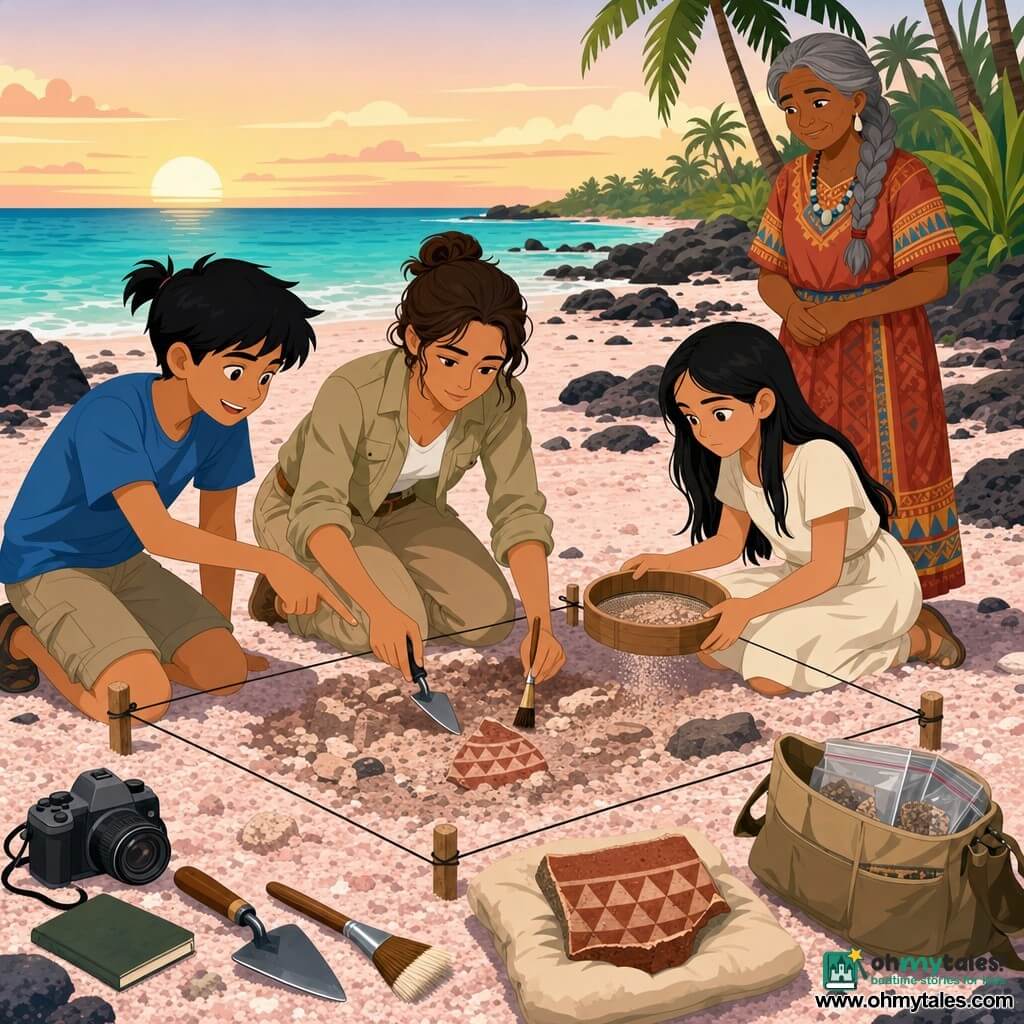
She knelt beside a square of sand marked with string. The square was only two meters wide, but to Mara it felt as wide as time.
“Remember,” she said to the two students hovering nearby, “this isn't a treasure hunt. We're not trying to win. We're trying to understand.”
Kio, who was twelve and already as curious as a kitten, nodded so hard his ponytail bounced. “So we go… slow?”
“Slow,” Mara agreed, smiling. “And we listen to the ground.”
Tala, who was eleven and serious in a way that made her look older, asked, “How do you listen to sand?”
“With your eyes, your hands, your notebook… and your patience,” Mara said. “The past whispers. We just have to be quiet enough to hear it.”
Mara picked up a wooden peg and pressed it into the sand at the corner of the square. Then she used a marker to draw a thick black line on the peg, halfway down.
“This mark,” she explained, tapping it lightly, “is the limit. When I use my trowel, I do not go past this depth until we've recorded everything above it. Crossing the line too soon is like skipping pages in a story.”
Kio leaned in. “So the peg is like a bookmark.”
“Exactly,” Mara said. “And the trowel is our reading finger—gentle, steady, never ripping.”
Beside them, the rest of the team was unpacking equipment: measuring tapes, clipboards, small brushes, bags for samples, and a camera wrapped in a towel to protect it from salt spray. Dr. Sato, the oldest member of the group, was already checking the site map. Lani, the community guide, watched with calm eyes that seemed to notice everything.
Lani pointed toward the palm trees behind the beach. “This place used to be a village,” she said. “My grandmother told stories of people who traveled far over the ocean and made their homes here.”
Mara's chest warmed at the thought. “Lapita people,” she said. “Sailors and potters. Some of the earliest ancestors of many Polynesian cultures.”
Tala looked at the empty beach, puzzled. “But there's nothing here.”
Mara ran her fingers over the sand inside the square. “There's always something,” she said softly. “You just can't see it yet.”
The sea kept breathing. The coral sand waited. And Mara—young, steady, and full of careful excitement—lifted her trowel like a promise.
Chapter 2: A Shard with a Pattern
The first layer was mostly wind-blown sand, sprinkled with tiny shells. Mara showed Kio and Tala how to scrape the surface with the flat of the trowel, not the tip.
“Think of it like shaving chocolate for hot cocoa,” she told Kio.
Kio grinned. “So… archaeology is delicious?”
“Only if you don't eat the evidence,” Mara said, and Tala actually giggled, which felt like a rare and precious sound.
They worked in short, careful strokes. After every few minutes, Mara stopped them.
“Pause,” she said. “Look. What changed?”
Tala squinted. “The sand is darker here.”
Kio pointed. “And there's… a little line?”
Mara nodded. “That's a layer boundary. A different moment in time. A storm, a new floor, a fire, a season of living.” She opened her notebook and drew a simple sketch. “We record it, because once we dig, we can't put it back.”
That was one of the strangest truths of archaeology: digging was also destroying. Mara always wanted the students to understand that respect came first.
A few inches down, Kio's trowel clicked.
He froze as if the sand had bitten him. “I hit something!”
“Good listening,” Mara said. She slid in beside him and switched to a small brush. With gentle sweeps, she uncovered a curved edge—reddish-brown, like baked earth.
“A pot?” Tala whispered.
“A pottery shard,” Mara said. “Just a piece. But pieces can tell big stories.”
She held it in her palm. The shard was cool and rough, with tiny grains embedded in the clay. Along one side, there was a pattern: small, repeated triangles, like shark teeth marching in a line.
Tala's eyes widened. “It's decorated.”
“Yes,” Mara said. “Lapita pottery often had stamped designs. People used tools—sometimes comb-like stamps—to press patterns into wet clay.”
Kio leaned closer. “Why triangles?”
“Maybe they liked the look,” Mara said. “Maybe it had meaning—family, ocean, protection. We don't guess too fast. We collect clues.”
She set the shard on a foam pad and called over Dr. Sato. He adjusted his glasses and gave a satisfied hum.
“Nice find,” he said. “We'll photograph it in place first.”
Lani stepped closer, respectful. “If it is Lapita,” she said, “it connects to old journeys.”
Mara nodded. “And to ordinary days, too—cooking, sharing food, sitting together. Archaeology isn't only about kings and battles. It's about people.”
Kio looked suddenly worried. “Are we allowed to take it?”
“We're allowed to study it,” Mara said. “But we don't ‘take' like pirates. We document, we conserve, and we work with the community. Heritage belongs to people, not to pockets.”
Tala traced the air above the pattern, careful not to touch. “So we're… borrowing a story.”
Mara smiled. “Yes. And we have to return it in a good way—through care and sharing.”
They photographed the shard, measured its position, wrote notes, and placed it in a labeled bag. On the bag, Mara wrote the site code, the square number, the layer depth—stopping at the peg's black mark as their guide.
When the sun climbed higher, the coral beach sparkled brighter. But inside Mara's small square, time had already begun to open like a book.
Chapter 3: The Day the Wind Tried to Steal the Notes
After lunch, the breeze grew playful. It tugged at hats, flipped a corner of Tala's notebook, and sent a rogue snack wrapper racing across the sand like it had an important appointment.
Kio chased it and returned, panting. “The wind is a criminal.”
“The wind is a reminder,” Mara said, placing a small stone on her field forms. “On sites like this, we protect our work from weather, and we protect the site from us.”
Dr. Sato called everyone together for a short meeting. “We've reached a sensitive layer,” he said. “Dark soil, more charcoal. Possible cooking area or hearth. Mara, you and the students will slow down even more.”
Mara's voice stayed calm, but her heart beat faster. Charcoal meant fire, and fire meant activity: cooking, warmth, maybe ceremonies. It also meant there might be fragile remains—fish bones, seeds, tiny clues that could crumble if rushed.
She crouched by the square and pointed to the peg with the black line. “We are still above our limit,” she reminded. “We keep the floor level, we don't dig holes, and we always clean the edges so the layers are visible.”
Tala nodded. “Like making a neat slice of cake.”
“Exactly,” Mara said. “Except we don't lick the frosting.”
Kio pretended to look disappointed. “Unfair.”
They used brushes and small wooden picks. The soil smelled different here—earthier, older, like rain caught in a jar. Mara showed them how to sieve soil through a mesh screen, shaking gently so small objects didn't break.
“Why do we sieve?” Kio asked, watching grains tumble.
“Because our eyes miss things,” Mara said. “And small things matter. A fish bone can tell us what people ate. A seed can tell us what plants grew here. The past is often tiny.”
In the sieve, Tala spotted something pale. “Bone?”
Mara leaned in. “Possibly,” she said. “We'll bag it carefully for analysis. At the lab, specialists can identify species by shape and texture.”
Tala looked impressed. “Like bone detectives.”
“Exactly,” Mara said. “Archaeology is teamwork across many skills. We have surveyors, conservators, lab analysts, historians, and, just as important, community knowledge.”
Lani, listening nearby, added, “My uncle knows old fishing spots. Sometimes the stories tell you where to look.”
Mara turned to the students. “That's why we practice listening,” she said. “Not only to soil, but to people.”
A sudden gust made Kio's drawing paper flap wildly. He grabbed it with both hands. “I'm listening! The wind is shouting!”
Everyone laughed, even Dr. Sato. The laughter felt good—soft, shared, and not too loud for the sleeping past beneath them.
Then Mara's trowel scraped something smooth.
She stopped instantly. “Hold,” she said.
Under the soil, a curve appeared, pale and glossy, like a shell but thicker.
Dr. Sato knelt beside her. “Could be a shell bracelet fragment,” he murmured. “Or a tool.”
Mara didn't pick it up. She photographed it, measured it, and drew it in her notebook.
Tala watched, fascinated. “Why so many steps?”
“Because memory is slippery,” Mara said. “Photos, drawings, measurements—together they keep the truth steady. If we ever have to explain our work, we can.”
Kio swallowed. “So it's like… proving you did your homework.”
Mara nodded. “And making sure future archaeologists can learn from us without digging again.”
They ended the day by covering the square with protective fabric and sandbags. The site looked untouched again, as if nothing had happened.
But Mara knew better. The past had offered them a few careful words, and they had written them down before the wind could steal them.
Chapter 4: The Coral Beach, the Old Ocean Road
That evening, the team gathered near the edge of the beach where the coral sand met darker rock. The sun slid toward the sea, turning the waves orange and gold. Someone boiled tea on a small stove, and the smell drifted through the salty air.
Mara sat with Kio and Tala, and Lani joined them, folding her legs easily.
“Tell us about Lapita,” Kio asked, blowing on his tea as if it might reveal secrets in the steam.
Mara looked out at the horizon. “Imagine the ocean as a road,” she said. “Not empty water, but a path. Lapita people traveled that path in canoes, carrying plants, tools, families, and ideas. They settled islands, shared skills, and made pottery with distinctive stamped patterns.”
Tala frowned thoughtfully. “So they weren't lost?”
“No,” Mara said. “They were skilled navigators. They read stars, waves, clouds, and birds. They planned. They adapted.”
Lani added softly, “And they respected the sea. If you don't listen to it, it will teach you the hard way.”
Mara nodded. “That's another lesson archaeology gives us: humans have always depended on nature. We learn how they lived with it—sometimes wisely, sometimes not.”
Kio asked, “How do we know it's Lapita and not, like… someone's old lunch?”
Mara chuckled. “Good question. We look at context. The layer, the style of pottery, the way the site is arranged. We can date charcoal using radiocarbon dating—measuring how carbon changes over time. And we compare findings with other sites.”
Tala's eyes shone in the sunset light. “So the beach is like a library.”
“Yes,” Mara said. “But a library where books are buried, fragile, and easily damaged. That's why we protect sites from careless digging, construction without surveys, and souvenir hunting.”
Kio looked guilty. “I once kept a cool shell from the beach.”
Lani smiled gently. “A shell on the surface is part of nature's gift. But taking from a protected site is different. Here, objects are clues. If you remove them, you tear a page out.”
Mara leaned closer. “The best souvenir is understanding. And maybe a sketch.”
Kio perked up. “I can do that. I draw better than I carry wrappers.”
Tala nudged him. “The wind still thinks you're slow.”
They all laughed again, and the laughter felt like a campfire—warm without burning.
When the sky darkened, Mara walked back to the tents. She felt tired in her bones, but it was the good kind: the kind you earn from careful work.
In her mind, she pictured the peg in the sand with its black mark. A simple line, but it held a promise: We will not rush. We will not take more than we can understand. We will listen.
Chapter 5: The Moment of Patience
The next morning, the sea was calmer, as if it had decided to cooperate. Mara arrived at the square early. She brushed away the protective sand and fabric, revealing the neat grid lines again.
Dr. Sato handed her a clipboard. “We're close to your marked depth,” he said. “Keep the profile clean. If you see a change in the soil, stop.”
Mara breathed in. She loved this part—the moment right before a new layer, when the ground felt full of possibility.
Kio and Tala joined her, quieter than usual. Even Kio seemed to sense that today required extra care.
They worked down toward the black line on the peg. Mara kept checking the depth with a ruler, measuring from the string line.
“Twenty-two centimeters,” she murmured. “Twenty-three… and stop.”
Her trowel hovered just above the mark. The black line on the peg looked bold, like an eyebrow raised in warning.
Kio whispered, “So we don't cross it.”
“Not yet,” Mara said. “First we document this layer completely. Photographs, drawings, soil samples.”
Tala asked, “What happens if someone crosses it by accident?”
Mara didn't scold. She simply spoke honestly. “Then we lose information. Sometimes we can recover. Sometimes we can't. That's why we work as a team: we watch out for each other.”
Dr. Sato nodded approvingly from nearby, as if he liked the word “team” best.
They began recording. Tala drew the wall of the square—the profile—showing the layers like stripes: pale sand, darker soil, a thin charcoal line. Kio took photos with the scale marker beside features. Mara filled sample bags, labeling each one neatly.
Then, in the corner near the peg, Mara noticed a cluster of tiny, sharp-edged fragments—more pottery, but thinner.
She called Lani over. “Would you like to see?” she asked.
Lani came and crouched beside her. “I would,” she said quietly.
Mara pointed without touching. “Here. The texture is different. Finer clay.”
Lani's gaze softened. “My grandmother used to press patterns into bread dough for festivals,” she said. “She said it made food feel like a gift.”
Mara listened, letting the words settle. “That's a beautiful connection,” she said. “And it reminds us that patterns aren't only decoration. They can be care, identity, celebration.”
Tala looked from Lani to the pottery. “So archaeology isn't just about objects. It's about people's feelings.”
Mara smiled. “Exactly.”
After the last photo and the last note, Mara finally allowed herself to scrape the soil just below the peg's mark—slowly, evenly.
A new color emerged, a lighter brown mixed with coral grit. And then something else: a line of stones arranged in a curve, like part of a circle.
Dr. Sato hurried over. “That could be a post hole ring,” he said. “Or a house edge.”
Mara's pulse fluttered. A structure meant a place where people had stood, laughed, argued, cooked, listened to the ocean—right here on this coral beach.
But she didn't shout. She didn't dig faster. She simply looked, and then she said, steady as the sea's breath:
“Let's record it properly.”
Kio exhaled like he'd been holding his breath for a century. “Patience is hard.”
Mara nodded. “It is. But it's also powerful.”
Chapter 6: Sharing the Past Without Taking It
Two days later, the team set up a small community evening near the beach. Not a big event with spotlights or dramatic reveals—just a few tables, a poster board, and objects laid out safely in clear boxes.
Mara stood beside her notes and drawings. Kio and Tala had helped make a display: sketches of pottery patterns, a diagram of the dig square, and a “Do and Don't” list written in bright marker.
DO: Ask questions.
DO: Respect the site.
DO: Tell others what you learn.
DON'T: Dig without permission.
DON'T: Pocket artifacts.
DON'T: Make up stories when you don't have evidence.
Kio added at the bottom, in smaller writing: “DON'T fight the wind. You will lose.”
People arrived in small groups—families, elders, teenagers pretending not to be interested but leaning in anyway. Lani greeted them, speaking in the local language, and Mara felt grateful again for guidance that wasn't found in textbooks.
A little boy pointed at the pottery shard with triangles. “Is that treasure?”
Mara crouched to his level. “It's more like a message,” she said. “A clue about people who lived here long ago.”
An older woman asked, “Will it be kept here?”
Dr. Sato answered carefully, “We will work with the community and the heritage office. Some items may be stored safely in a local museum or cultural center. Our goal is protection and access—not secrecy.”
Mara showed the students' drawings. “We also share through records,” she said. “Even when an object must be stored for safety, the knowledge can stay with everyone.”
Tala spoke up, voice steady. “We learned that digging is also destroying, so you have to write everything down.”
A teenager raised an eyebrow. “That sounds boring.”
Kio shrugged. “It's not boring if you like stories. The sand is basically a slow storyteller.”
Someone laughed, and the teenager's face softened, just a little.
Mara explained how they marked the digging limit on the peg and why. She demonstrated the gentle trowel technique in a tray of sand, showing how to keep the surface flat. She talked about sieving and why tiny bones mattered. She explained radiocarbon dating in simple terms—like a clock inside charcoal.
Most of all, she talked about listening: to layers, to evidence, to the people whose ancestors shaped the place, and to teammates who might notice what you missed.
When the evening ended, the beach grew quiet again. The sea kept breathing, patient and steady.
Mara helped pack the boxes. Her arms ached, but her mind felt light.
Dr. Sato clicked his pen closed. “Good work,” he said.
Lani nodded. “You shared gently,” she told Mara. “That matters.”
Mara watched Kio and Tala walking ahead, still talking—arguing, actually, about whether triangles looked more like shark teeth or mountain peaks.
“Both,” Mara called, and they turned, laughing.
As the team headed back toward camp, Mara glanced at the dark line of palms and the moonlit edge of coral sand. The past was still there, safe for another day of careful questions.
At the entrance to the tents, everyone paused, as if the night itself had asked them to be quiet.
Mara met Dr. Sato's eyes first, then Lani's, then the students'. No one needed to say anything. Their tired faces held the same calm pride: they had listened well, worked together, and protected something fragile.
In the soft light, the team shared a quick, knowing look—an almost-secret smile passed from one to another—before they slipped into their tents and let the ocean's steady breathing guide them toward sleep.