Chapter 1: The Quiet Stones
Dr. Lina Hart liked mornings when the world still whispered.
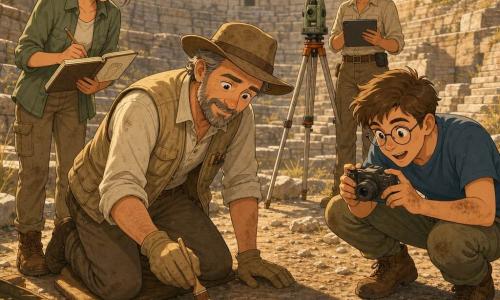
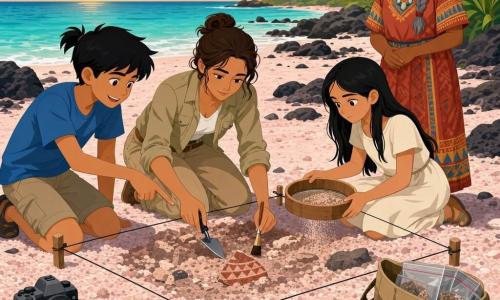
The dig site lay in a wide, sandy valley where low hills held the heat like sleepy animals. Tents stood in a neat line. Clipboards waited on a folding table. A square grid of string and wooden stakes stretched across the ground, turning the earth into careful little boxes.
Lina knelt at the edge of Square C7 and pressed her palm to the soil. It was cool, even after sunrise. “Good morning,” she murmured, as if the ground could hear.
To be honest, sometimes she spoke to stones because they didn't interrupt. Stones didn't laugh if you got something wrong. Stones simply stayed silent, holding their stories tight.
Around her, the rest of the team began to arrive. Boots crunched. A kettle hissed. Someone yawned like a lion.
“Morning, Dr. Hart,” called Malik, the site assistant, balancing a crate of tools. “Your trowel is still the sharpest on site. Should we be worried?”
Lina smiled. “Only if you're planning to steal it.”
Professor Sato, their project director, appeared with a rolled map under one arm. He was calm in a way that made everyone else calmer too. “Today,” he said, “we work slowly. The goal is not to win. The goal is to understand.”
Lina nodded. That was exactly why she loved archaeology.
She slipped on gloves and picked up her trowel—a small, flat blade that looked too ordinary to open any secrets. Then she started shaving thin layers of soil, as gently as if she were peeling an apple.
Scrape. Brush. Look. Record.
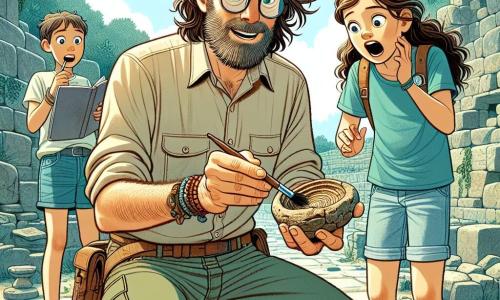
Next to her, a new volunteer named June crouched, eyes wide. June was eleven or twelve, with a notebook almost as big as her face.
“So… do we find treasure?” June asked, half hopeful, half shy.
Lina didn't roll her eyes. She remembered being that age, imagining golden crowns and cursed tombs.
“Sometimes we find objects that are valuable,” Lina said, “but the real treasure is information. A broken pot can tell us what people ate. A burned seed can tell us what they grew. Even the dirt tells a story.”
June blinked. “Dirt tells stories?”
“If you know how to listen,” Lina said. She held up a small bag. “We collect soil samples. Later, scientists can look for tiny bits—pollen, charcoal, insect parts. It's like reading a book written in crumbs.”
June's mouth made a soft “oh,” like a door opening.
Lina's heart warmed, and then—just as quickly—felt that familiar tug of loneliness. She loved the past so much that sometimes the present felt thinner, like paper.
She set her trowel down and looked across the grid. The squares lay quiet and patient. It was easy to imagine the people who once stood here—cooking, arguing, laughing, dropping things, losing things, living.
“Ready?” Lina asked June.
June nodded fiercely. “Ready.”
“Then we're a team,” Lina said, and for the first time that morning, the stones didn't feel quite so silent.
Chapter 2: Lines, Layers, and a Little Laughing
By midday, the sun was high enough to make the air shimmer.
Lina and June worked beside each other in C7, moving like a careful dance: trowel, brush, pan, bag. Every few minutes Lina paused to write notes on her recording sheet.
Date. Square. Depth. Soil color. Texture. Finds.
June copied her, tongue stuck out in concentration. “So I write… ‘brown sandy soil, small pebbles, two snail shells'?”
“Perfect,” Lina said. “And add the depth in centimeters.”
June measured with a ruler like it was a sacred object. “Eight centimeters!”
“Great. Archaeology loves details,” Lina said. “Details stop us from making up stories.”
Across the site, Malik called, “Lunch break! Come rescue the sandwiches before the ants do!”
June's eyes lit up. “Ants can't have our lunch. That's a crime.”
“It's a small crime,” Lina said, standing and stretching her back. “But we can still prevent it.”
They sat under the shade awning with the others. Water bottles clinked. Someone told a joke about a mummy who was bad at keeping secrets because he kept getting “wrapped up” in gossip. It was groan-worthy, and everyone groaned, and then they laughed anyway.
June chewed thoughtfully. “So if it's not treasure hunting… why do movies show archaeologists running from boulders?”
“Because running from boulders is exciting to watch,” Malik said. “But if I ran from a boulder, I would trip over a clipboard and die in a very unheroic way.”
Lina laughed. “Real archaeology is more like this,” she said, tapping her notebook. “Measuring. Comparing. Asking questions.”
Professor Sato nodded. “And working with the community,” he added. “We have permission to dig here because the local council agreed. This place matters to people today, not just people long ago.”
After lunch, Lina walked June over to the site board where a big plan of the valley was pinned up.
“See these lines?” Lina said, pointing. “We map everything—where walls are, where pits are, where we find objects. That way, even after we put the soil back, the information remains.”
“We put the soil back?” June sounded startled.
“Most of it, yes,” Lina said. “We're guests here. We don't leave a mess. And we don't take things that don't belong to us.”
June's eyebrows rose. “But… what happens to the objects?”
“Some stay in a local museum. Some go to a conservation lab so they don't fall apart,” Lina explained. “And everything is recorded so other researchers can learn too.”
June held her notebook closer. “So it's sharing.”
“It should be,” Lina said, feeling a calm certainty settle in her chest. “Sharing knowledge is part of respecting the past.”
Back in C7, June brushed soil from a small patch that looked darker than the rest. “Dr. Hart?”
“Call me Lina,” Lina said. “We're colleagues on this square.”
“Okay, Lina,” June said, voice trembling with excitement. “There's… something.”
Lina leaned in. A curve. A smooth edge. Not stone—ceramic.
“Good eyes,” Lina said softly. “Now we go even slower.”
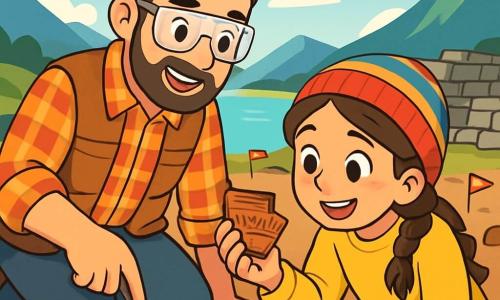
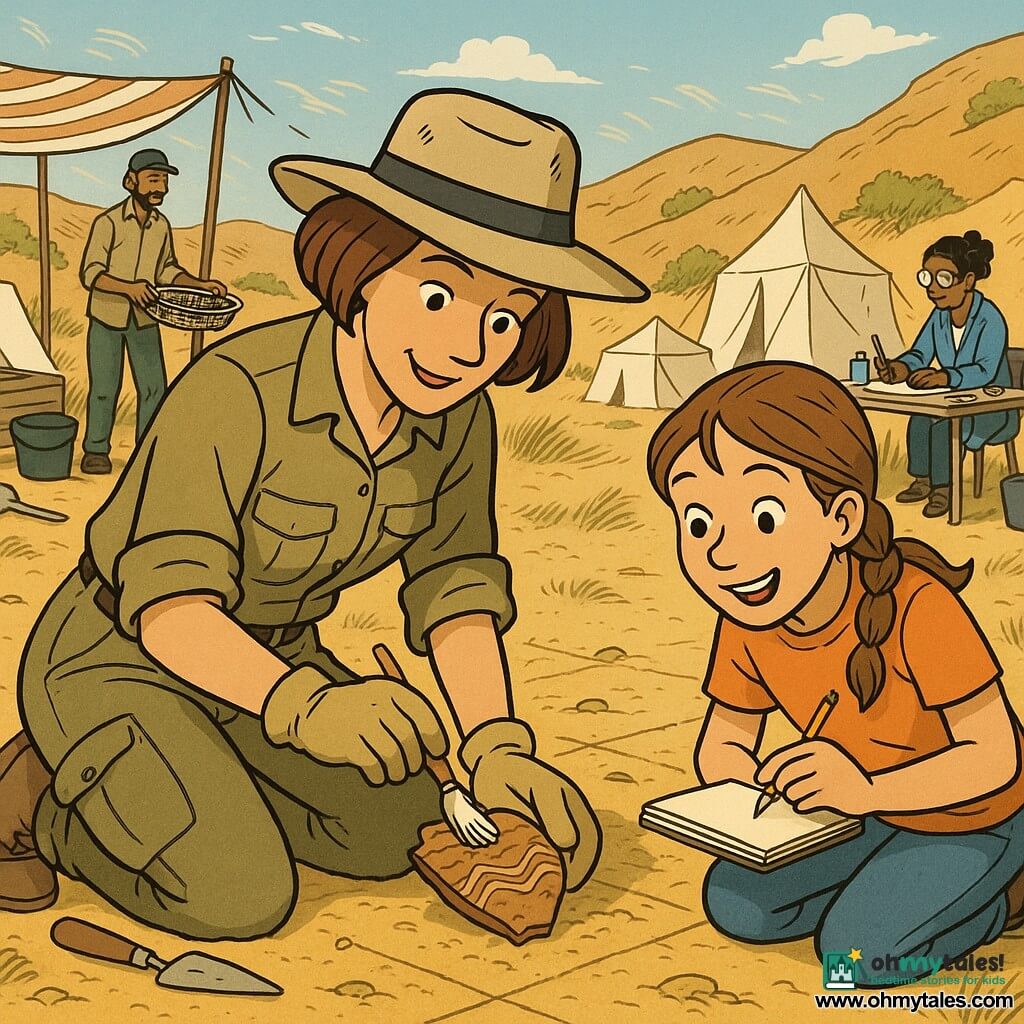
They worked together, brushing away soil grain by grain, until a piece of pottery emerged—broken, yes, but beautiful, with a faint pattern like waves.
June whispered, “It's like it's waking up.”
Lina swallowed. “Or like we're meeting it properly,” she said.
She lifted the sherd only after photographing it in place and noting its exact spot. The fragment fit in her palm, warm from the sun, and suddenly Lina didn't feel as alone. The object wasn't speaking, exactly—but it was answering.
Chapter 3: The Jar That Remembered
That afternoon, the wind changed. It brought the smell of dry grass and distant rain, even though the sky stayed clear.
Lina placed the pottery sherd in a labeled bag: Site, Square, Layer, Date. Labels were not glamorous, but they were a promise that the past would not be scrambled like pieces of a puzzle dumped on the floor.
June stared at the pattern. “Do you know what it is?”
“Not yet,” Lina said. “We make careful guesses, and then we check them.”
They carried the find to the small field office tent where tables held trays of discoveries: animal bones, stone flakes, tiny beads, bits of charcoal. Each item sat like a clue waiting patiently for the detective to arrive.
Lina showed June how to fill out the finds register. “This is how we keep track,” she said. “Otherwise, objects become lonely too. They lose their context. And context is everything.”
June nodded slowly. “So if someone just grabbed it… it would be like ripping a page out of a book.”
“Exactly,” Lina said, pleased. “A page without the chapter doesn't make sense.”
Professor Sato joined them. “The pattern is interesting,” he said, peering through his glasses. “Wavy lines like this were common in the river settlements two thousand years ago. It might mean people here traded with communities far away.”
June's eyes widened. “So this valley wasn't empty?”
Lina shook her head. “It was full of lives. We're just seeing the quiet parts now.”
As they spoke, Malik stuck his head into the tent. “Lina, we're setting up the sieves. Want to show June how we do it?”
Outside, two large mesh screens were propped over buckets. A third sieve had finer mesh, like a metal net.
Lina scooped a bucket of excavated soil—soil from a specific layer, kept separate on purpose. “We don't just throw dirt away,” she told June. “We sift it, because tiny things hide.”
They poured the soil onto the sieve and shook gently. Grains fell like sand through an hourglass. Small stones rattled. A few pieces stayed behind.
June picked out something pale. “A bone?”
Lina examined it. “A small animal bone, yes. Maybe from a meal.”
June made a face. “Ew.”
Lina chuckled. “History is not always clean. But bones can tell us what people ate, how they cooked, even what season it was. Sometimes we can see cut marks from tools.”
June held it more respectfully after that, as if it had become a message rather than an “ew.”
As the afternoon cooled, Lina found herself staring at the valley again. It was beautiful, but it could also be lonely. The past was endless. Lina was only one person with one trowel.
June nudged her elbow. “Do you ever feel… weird?” she asked. “Like you're listening to people who can't talk back?”
Lina blinked, surprised by the question's accuracy. “Yes,” she admitted. “Sometimes I feel like I'm walking through a library where all the books are locked.”
June thought. “But you're unlocking them.”
“Not alone,” Lina said. She gestured to Malik, to Professor Sato, to the other students, to June. “We unlock them together. And we're careful not to break the covers.”
June smiled, and it was small but steady. “Then the stones aren't that silent,” she said.
Lina felt the words settle inside her like a warm pebble. “No,” she agreed. “Not today.”
Chapter 4: The Conservation Lab Next Door
The next morning, Professor Sato announced, “We'll take some finds to the conservation lab.”
June bounced on her toes. “A lab? Like… microscopes and stuff?”
“Exactly like microscopes and stuff,” Malik said. “And also tiny brushes that make your eyelashes look huge.”
The conservation lab was in a low building beside the site, close enough that the past didn't have to travel far. Inside, the air smelled faintly of soap and clean water. The lights were bright and steady, without the sun's glare.
Shelves held trays lined with foam. A sink waited with basins. Labels were everywhere. It felt like a hospital for fragile objects.
A conservator named Amara greeted them. She wore a blue apron and had calm hands, the kind that could soothe a nervous kitten.
“Welcome,” Amara said. “What have you brought me?”
Lina set the bagged pottery sherd on the table. “This, from C7. The edges look delicate.”
Amara nodded. “We'll see what it needs. Conservation isn't about making things look new,” she told June. “It's about keeping them stable, so they can be studied and cared for.”
June leaned in. “How do you clean it?”
“Very carefully,” Amara said, as if that was the most important rule in the world. She put on magnifying goggles and lifted the sherd onto a padded stand. “First we examine it. Any cracks? Any salt crystals? Any paint that might flake?”
She pointed to the faint wavy pattern. “If there's pigment, we avoid water until we test.”
June whispered, “Test?”
Amara showed her a tiny cotton swab and a drop of distilled water. She dabbed an unseen corner gently. “We check if anything lifts. If it does, we stop.”
Lina watched, impressed as always. Archaeologists uncovered objects; conservators helped them survive. It was teamwork across time.
Amara handed June a soft brush. “Want to try brushing some loose dirt? Only the dry parts.”
June's hand trembled. “What if I break it?”
“You won't, if you listen with your fingers,” Amara said. “Light touch. No rushing.”
June brushed. Dust drifted away like a sigh.
Lina felt something loosen in her own chest. The lab was quiet, but not lonely. The quiet here was shared. It was the kind of quiet you find in a room where everyone is focused, respectful, and present.
At another station, a microscope was set up over a tray of soil. Amara adjusted the focus and invited June to look.
June gasped. “It's… tiny seeds!”
“Or maybe charcoal,” Lina said, peering too. “We can send samples for analysis. Sometimes you can learn what plants grew nearby, or what people burned for fuel.”
June pulled back, eyes shining. “So even crumbs matter.”
“Especially crumbs,” Malik said. “Crumbs are honest. They don't pose for photos.”
Amara laughed softly. “And every honest detail helps us tell a fair story.”
Lina looked at the pottery sherd again. Now that it was cleaned a little, the wave pattern seemed clearer, like water under moonlight.
She imagined the hands that had shaped the clay, painted the lines, carried the jar. Ordinary hands, like hers. Not heroes. Not villains. People.
She spoke quietly, almost to the sherd. “We're trying,” she said. “We're trying to understand you without taking you away from yourself.”
June heard her and didn't tease her. Instead, she said, “It's like… being polite to history.”
Lina smiled. “Exactly.”
Chapter 5: A Map of Many Voices
That evening, the team held a small meeting under the awning. A few local visitors came too—members of the community council, a teacher, and some curious kids.
Lina stood near the site board with the big map. Her stomach fluttered, even though she'd spoken to crowds before. She always worried about saying the wrong thing—about turning real lives into a simple story.
Professor Sato began. “We'd like to share what we've learned so far,” he said. “And we'd like to hear your questions.”
Lina was grateful for the second part. Questions meant conversation, not a lecture.
June sat in the front, notebook ready like a reporter.
Lina stepped up and pointed to the grid. “This is how we excavate,” she explained. “Square by square, layer by layer. We record where every item comes from. The location helps us understand what was happening in different areas—cooking, making tools, building shelters.”
A council member asked, “Will you take everything away?”
Lina shook her head. “No. Most finds will stay under local care. Some need conservation first, and then they can return for display or safe storage. We also share copies of our records and maps, so the information belongs here too.”
The teacher raised a hand. “What can children learn from this?”
June shot her hand up too, as if she couldn't help it. “That archaeology isn't about grabbing stuff,” she blurted. “It's about… context!”
Malik pretended to wipe away a tear. “She grows up so fast.”
Laughter rippled through the group, warm and gentle.
Lina continued, “Archaeology shows us that people have always been creative and connected. Even in places that seem quiet today, there were communities—trading, farming, telling stories, making art on jars.”
A younger child asked, “Did they have games?”
Lina's eyes softened. “Almost certainly,” she said. “We find small objects that might be game pieces. But even if we don't, we know humans like to play. It's one of the ways we learn.”
After the meeting, the sky turned deep blue. Stars appeared like tiny holes punched in velvet.
June walked beside Lina back toward the tents. “You weren't nervous at all,” June said.
“I was,” Lina admitted. “My voice just pretended it wasn't.”
June laughed. “Your voice is brave.”
Lina looked up at the constellations. “Sometimes I feel small,” she said. “History is huge. The stones are old. And I'm just… me.”
June kicked a pebble. “But you have a team,” she said. “And you have… all of us listening.”
Lina stopped walking for a moment. The site behind them was quiet, yes, but it wasn't empty. Not with people caring for it.
“You're right,” Lina said. “When we share what we learn, the past feels less lonely. Like the stories have somewhere to go.”
June grinned. “To notebooks!”
“And to museums,” Lina added. “And to classrooms. And to conversations like this.”
They reached the tents. The night air was cool, and the valley seemed to breathe slowly.
Lina thought of the jar fragment in the lab, safe on its padded tray. She thought of the soil samples labeled and waiting. She thought of all the careful hands—hers, Amara's, Malik's, June's—working not to steal, but to understand.
For the first time in a long while, Lina felt a quiet happiness that didn't depend on finding something. It depended on belonging to a careful, respectful circle.
Chapter 6: The Wish Beneath the Stars
On the final day of the week's work, Lina returned to Square C7 at sunrise.
She didn't speak to the stones right away. She listened.
The site had its own sounds: distant birds, the soft shush of wind, the faint clink of tools being set down. It wasn't silence. It was patience.
June arrived with her notebook and a serious expression. “I brought extra pencils,” she said. “In case history is… a lot.”
“History is always a lot,” Lina said, accepting the pencils like a gift of courage.
They spent the morning finishing the layer they'd been working on. More pottery appeared—small pieces, not dramatic, but each one a thread. Lina explained how they might later try to match fragments, not to create a perfect jar for a shelf, but to learn about shapes, sizes, and uses.
“Like… was it for water?” June asked.
“Or for storing grain,” Lina said. “Or for cooking. Sometimes soot marks show it sat near a fire.”
At midday, Amara came from the lab with good news. “The wave-pattern sherd is stable,” she told Lina. “No flaking pigment. We can safely photograph it in high detail. Maybe we'll compare it with designs from nearby regions.”
June clasped her hands. “So it might prove trading!”
“It might suggest it,” Lina corrected gently. “We have to be careful with conclusions.”
June sighed. “Science is patient.”
“Science is patient,” Lina agreed, smiling.
Later, the team packed tools and covered the open squares with protective sheets. They would return, but for now the site needed to rest. The earth didn't belong to them; they had borrowed a small piece of time.
As the sun began to lower, Professor Sato gathered everyone. “Before we go,” he said, “I want each of us to name one thing we learned.”
Malik spoke about stone tool flakes and how the angles showed skilled knapping. Amara spoke about salts in pottery and how moisture could damage ancient surfaces. June spoke about context, loudly and proudly.
When it was Lina's turn, she looked at the valley—at the grid lines, the careful notes, the shared work.
“I learned,” Lina said, voice steady, “that the past feels less silent when we treat it with respect and share its lessons. Not as trophies, but as connections.”
Professor Sato nodded once, satisfied.
That night, before sleep, Lina stepped outside her tent. The stars were bright again, and the valley lay dark and peaceful.
June's voice came from the neighboring tent flap. “Lina? Are you awake?”
“Yes,” Lina said.
June shuffled out, wrapping a jacket around herself. “I was thinking,” she said. “If people in the past could see us… would they be mad?”
Lina considered. “If we were careless, maybe,” she said honestly. “If we broke things, or took them away, or told unkind stories about them.”
June looked worried.
“But if we are careful,” Lina continued, “if we ask permission, if we protect what we find, and if we share what we learn with the people connected to this place—then I hope they would feel… honored. Like we're listening.”
June let out a breath. “Good. Because I like the idea of them not being lonely either.”
Lina's throat tightened. “Me too,” she said softly.
They stood together under the wide sky. Lina thought about all the cultures on earth—past and present—each with its own ways of living, cooking, building, singing, praying, joking, and dreaming.
“I have a wish,” Lina said.
June tilted her head. “Tell me.”
Lina looked up at the stars, as if they were listening too. “I wish that what we learn from the people who came before us helps everyone today respect all cultures—especially those different from our own. Because every human story deserves care.”
June nodded, very serious. “I wish that too,” she said.
The valley stayed quiet, but it felt like a friendly quiet now—full of shared promises, gentle hands, and knowledge meant not to divide, but to connect.