Chapter 1: The Hill That Kept Secrets
Dr. Marcus Reed liked quiet places where the wind had time to think.
On this late-afternoon drive, the sun lay low and honey-colored over the countryside. A limestone hill rose ahead, and on its side sat an abandoned ancient quarry—like a bite taken out of the earth long ago.
In the back seat, two students bounced with energy. Lina held a notebook so tight her knuckles looked pale. Jay had a camera and the confident grin of someone who thought archaeology was mostly about “cool finds.”
Marcus pulled the van to a stop. “All right,” he said, stepping out and breathing in the warm, dusty air. “Welcome to Stone-Scar Quarry.”
Jay stared up at the cut rock walls. “So… people carved a whole hill?”
“Not all of it,” Marcus said. He pointed to the straight edges and tool marks faintly visible in the stone. “But yes. A long time ago, workers cut blocks from here to build walls, roads, maybe even a bathhouse in the town below. This place supplied a city.”
Lina's eyes widened. “Like a giant ancient hardware store.”
Marcus chuckled. “Exactly. Except the shelves were cliffs.”
Tessa, the team's surveyor, arrived in her small truck with a box of equipment. “Ready to be patient?” she called.
Marcus tipped an imaginary hat. “Always.”
They hiked up a narrow path. The quarry opened into a wide bowl, ringed by pale rock. Scrubby grass grew in cracks, and little lizards flicked their tails along the stones. Everything seemed still, but Marcus could almost hear the past: chisels tapping, carts creaking, workers calling out warnings.
He knelt and pressed his palm to the ground.
“This,” he said softly, “is not a treasure hunt.”
Jay sighed dramatically. “You say that every time.”
“And every time it's true,” Marcus replied. “Archaeology is more like listening than grabbing. We listen to the soil, the stones, and the tiny clues people left behind.”
Lina flipped open her notebook. “Then what do we do first?”
Marcus stood, his boots dusty. “We make a plan. We measure. We map. And we promise the hill we'll treat its secrets gently.”
Chapter 2: Lines, Squares, and Serious Knees
The next morning, the quarry felt cooler. Shadows leaned against the rock walls. The team set up a small base: a table with clipboards, bags for samples, a first-aid kit, and a water jug that looked like it could save lives.
Marcus handed out bright string and wooden stakes. “We're laying a grid.”
Jay raised an eyebrow. “Grid… like graph paper?”
“Exactly,” Marcus said. “If we find something, we need to know where it was. Not ‘over there by the big rock.' We record its location so another archaeologist could understand our work years from now.”
Tessa unfolded a tripod and set up her total station—an instrument that looked like a robot eye. “With this,” she said, patting it, “we can measure distances and angles very precisely.”
Lina whispered, “It's like archaeology has its own magic.”
“It's math magic,” Jay said, but he sounded impressed.
By mid-morning, neat squares marked the ground. Marcus crouched inside one, trowel in hand. His movements were slow and careful, like he was peeling an orange without tearing the fruit.
“Why not just dig with a shovel?” Jay asked, already holding one.
Marcus smiled. “We do use shovels sometimes, but gently, and only for top layers. Here we might have fragile remains—charcoal, pottery crumbs, even footprints hardened in soil. A shovel can slice through history like it's butter.”
Jay lowered the shovel as if it had suddenly grown teeth.
Lina leaned closer, watching Marcus's trowel scrape thin layers. “It's like shaving the ground.”
“Yes,” Marcus said. “We remove soil in controlled levels. And we keep notes on everything: soil color, texture, small stones, shells, roots. Even smells can matter.”
“Smells?” Jay repeated.
Marcus nodded. “Burnt layers can smell different. Wet clay smells different from dry sand. It helps us understand what happened here.”
Hours passed with the soft sounds of careful work: scrape, brush, sigh, and the occasional “Ow” when someone discovered that kneeling is a serious sport.
Jay suddenly called out, “I found something!”
Marcus and Lina hurried over. In Jay's square, a small piece of red-brown pottery peeked out.
Marcus's voice stayed calm, but his eyes brightened. “Good spot. Don't pull it.”
Jay froze, hands hovering. “But it's right there!”
“And we want it to stay right there for one more minute,” Marcus said. “First we photograph it in place. Then we draw it. Then we lift it.”
Lina scribbled in her notebook. “Context before object.”
Marcus gave her a pleased look. “Perfect.”
They worked together: photo, sketch, measurements. Only then did Marcus slide the shard free and set it in a labeled bag.
Jay stared at the label. “Square B3, Level 2, 10:42 a.m.”
“It sounds like a spaceship coordinate,” he said.
Marcus grinned. “Every good story needs a setting.”
Chapter 3: The Quarry's Quiet Clues
After lunch, Marcus led them deeper into the quarry, where the walls rose higher and the rock looked smoother, as if thousands of hands had rubbed it.
He stopped at a carved step cut into stone. “See this?”
Lina ran her fingers just above it, not touching. “A staircase?”
“Maybe,” Marcus said. “Or a working platform. Quarry workers needed safe paths to move blocks. They also needed places to wedge tools.”
Jay pointed to a thin groove. “That line… like a crack?”
“It's a tool mark,” Marcus explained. “A chisel or pick left that groove. Over time, wind and rain soften it, but it's still there. These are fingerprints made of stone.”
They followed the wall until they reached a flat area where the ground was darker. Tessa knelt and sifted a handful of soil through her fingers.
“Charcoal,” she said. “Tiny bits.”
Marcus nodded. “A fire was here. Maybe workers cooked food or warmed themselves. Or maybe they used fire to help crack the rock—heating it and then cooling it quickly.”
Jay's eyes lit up. “So they basically made the hill sweat?”
Marcus laughed softly. “Something like that.”
They returned to the grid. The team was not large—just four people and a quiet determination—but the work felt like a small orchestra. Tessa measured and recorded. Lina drew profiles of soil layers. Jay photographed and learned to be gentle. Marcus moved between them, offering tips and questions, like a conductor who preferred whispers.
Late in the afternoon, Lina sighed. “I wish we could meet the people who worked here.”
Marcus paused, trowel resting in his hand. “We can't meet them, but we can meet their choices. That's what archaeology gives us—human decisions, frozen in small things.”
Jay held up a pottery shard they had already recorded. “This used to be someone's cup.”
“Or someone's jar,” Marcus said. “Maybe they carried water up this hill. Maybe they shared it. Maybe they argued about whose turn it was.”
Lina smiled. “Even ancient people probably complained.”
“Almost certainly,” Marcus said. “Complaining is timeless.”
As the sun lowered, the quarry filled with long shadows. Marcus looked at the neat squares and the careful notes stacked on the table. He felt the familiar warmth of gratitude—the kind that came from doing work slowly, properly, and together.
Then Tessa's radio crackled. “Marcus? Come here. You'll want to see this.”
Her voice had a new edge—alert, excited, but still controlled. Marcus set down his trowel and walked quickly toward the far end of the quarry.
The hill, it seemed, had decided to speak a little louder.
Chapter 4: The Empty Patch That Mattered
Tessa stood beside a shallow depression near the quarry wall. It wasn't dramatic. No glittering treasure. Just a patch where the soil looked oddly smooth, like it had been disturbed long ago and then settled again.
“I scanned this area with the metal detector,” Jay said, holding the device proudly. “Nothing.”
Lina blinked. “So… nothing happened?”
Marcus crouched and examined the surface. “Not exactly.”
Jay frowned. “But the detector didn't beep. Isn't that the point?”
Marcus brushed away a thin layer of dust with a soft paintbrush. “Sometimes the most important discovery is what isn't here.”
Lina tilted her head. “How can nothing be a discovery?”
Marcus glanced at all three of them. “Because absence is information. If we expect something and it's missing, we have to ask why.”
He drew a small square in the dirt with his finger. “Think about it: a quarry is a workplace. If people ate here, we might find broken pottery, animal bones, charcoal. If they repaired tools, we might find metal flakes. If they lived nearby, we might find lots of household debris.”
Jay crossed his arms. “And if we find… none of that?”
“Then maybe this area was kept clean on purpose,” Marcus said. “Or maybe it was a path that people walked on so much that nothing could settle. Or maybe later someone scraped it down to reuse the space.”
Tessa added, “This soil is compacted, like it's been pressed.”
Marcus nodded. “Exactly. And we write that down.”
Jay looked surprised. “We write down that we didn't find anything?”
“Yes,” Marcus said firmly. “We record negative evidence. If we don't, someone later might dig here again, waste time, or misunderstand the site. Our notes are part of protecting the heritage.”
Lina wrote quickly. “Negative evidence: absence that helps explain how people used a space.”
Marcus smiled. “Perfect wording.”
Jay scratched his head. “So archaeology is like… doing a puzzle, but you also keep track of which pieces are missing.”
“Excellent,” Marcus said. “And you don't force the missing pieces to exist just because you want the picture to look exciting.”
The team marked the smooth patch on the map. They photographed it, measured its edges, described the soil, and noted the metal detector results.
The work felt strangely satisfying. The quarry was teaching them a lesson in honesty: don't invent, don't rush, don't ignore quiet clues.
As they packed up for the day, a breeze swept through the stone bowl, stirring dry leaves. For a moment, Marcus imagined it carrying old voices—not shouting, not dramatic, just ordinary life.
He looked at the hill and whispered, “We're listening.”
Chapter 5: A Footprint in the Dust
On the third morning, the air smelled like rain that hadn't arrived yet. Clouds drifted over the hill like slow sheep.
Marcus assigned tasks. “Jay, photos and finds log with Lina. Tessa, mapping. I'll continue in C2.”
Jay saluted. “Yes, Captain of Dirt.”
Marcus laughed. “Captain of Carefully Documented Dirt.”
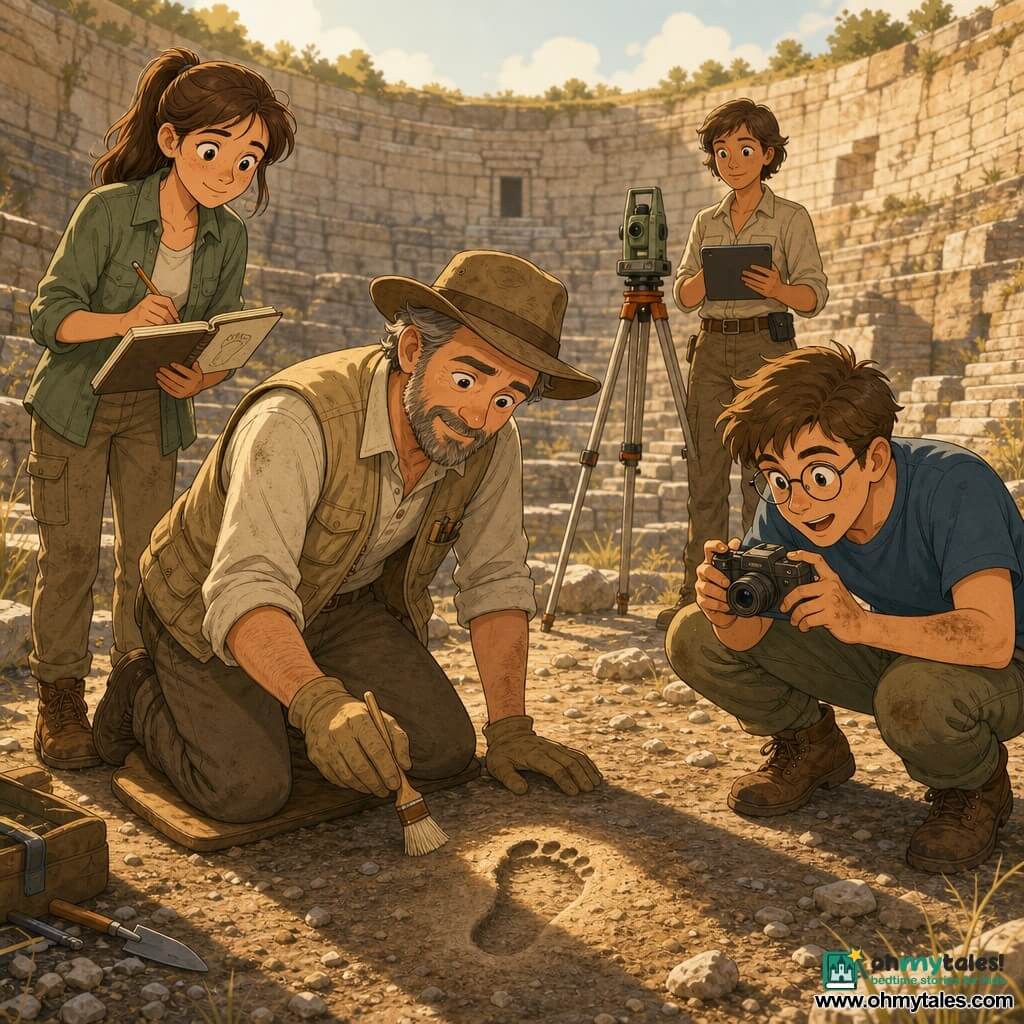
In square C2, the soil changed color—slightly darker, with fine grit. Marcus slowed even more. He switched to a smaller tool, a wooden pick that wouldn't scratch anything delicate.
A shape began to appear: a shallow oval with a faint ridge along one side.
Marcus's heart gave a small, steady thump. He called softly, “Lina? Jay? Come over, please.”
They approached, trying not to step near the square's edge.
“What is it?” Jay asked, peering down.
Marcus didn't answer right away. He brushed carefully, the dust lifting in tiny sighs. The oval shape became clearer, and then the ridge looked like a worn outline of toes.
Lina's voice dropped. “Is that… a footprint?”
“It might be,” Marcus said. “If this soil dried quickly after someone stepped here, it could have held the shape. Or it could be a natural hollow. We must be cautious.”
Jay looked amazed, as if he'd suddenly remembered that people in the past had actual feet.
Marcus continued gently. “If it is a footprint, it's not ‘a cool thing.' It's a moment. Someone walked here. Maybe carrying a heavy block. Maybe hurrying because someone shouted a warning. Maybe just walking to lunch.”
Tessa arrived with a measuring frame. “We can do a photogrammetry set,” she said. “Lots of photos from different angles. Then we can make a 3D model.”
Jay's grin returned, but softer now. “Like making the footprint into a digital ghost.”
Marcus nodded. “A respectful ghost.”
They worked quietly, taking careful photographs, placing a scale beside the print, recording the depth and soil layer. Marcus explained each step.
“We document first,” he said, “because digging destroys the layers. Archaeology is a careful kind of destruction—we remove soil to learn, but we can't put it back exactly as it was. That's why records matter.”
Lina looked thoughtful. “So our notebooks are like time machines for future researchers.”
“Yes,” Marcus said. “And for the community too. These traces belong to everyone, not just us.”
When they were finished, Marcus covered the footprint area with protective material. “We'll report it,” he said. “The heritage office may decide to conserve it or display the model in the local museum.”
Jay glanced around the quarry, suddenly respectful. “This place isn't empty. It's just… quiet.”
Marcus stood and stretched his aching back. “Quiet places are often full. They just need patience to be heard.”
Chapter 6: Sharing the Hill's Story
On the final day, the team invited a small group from the nearby town: a teacher, two park volunteers, and three curious kids who asked questions at the speed of popcorn.
Marcus spoke with calm enthusiasm, standing beside the grid like it was a classroom drawn on the earth.
“This quarry helped build your town,” he explained. “The stones in old walls may have started right here. Archaeology helps us understand the work behind those buildings—the workers, their skills, their routines.”
One of the younger kids pointed at Jay's camera. “Did you find treasure?”
Jay opened his mouth, then paused. He glanced at Marcus and smiled. “We found stories,” he said. “And one possible footprint.”
The kid looked disappointed for half a second, then curious. “A real footprint?”
“A real human moment,” Lina said, showing her drawings. “And we also found pottery pieces, charcoal bits, and tool marks.”
Marcus added, “And we found an area with almost nothing—an empty patch that taught us how the space was used.”
The teacher frowned. “You record empty patches?”
“We do,” Marcus said. “Because archaeology is about truth, not excitement. When we note what we didn't find, we protect the site from misunderstandings. We respect the people who lived before us by not making up a story they didn't leave.”
The visitors listened as Marcus showed them labeled bags, maps with coordinates, and soil drawings with careful layers. He explained how artifacts were cleaned with soft brushes, how everything was stored, and how reports were shared with museums and local authorities.
Tessa demonstrated the total station, and the kids gasped when numbers appeared like secret codes.
Before the visitors left, Marcus led them to the edge of the quarry. The view spread wide—fields, rooftops, a ribbon of road. The hill held them all like an open palm.
Marcus felt the familiar end-of-project mixture: relief, pride, and a gentle sadness.
As the group headed back down the path, Lina lingered beside him. “Do you ever feel… grateful?” she asked. “To the ground?”
Marcus looked at the pale stone wall, the tiny plants growing in cracks, the layers of soil that had guarded fragile clues for centuries.
“Yes,” he said quietly. “Very grateful.”
Jay came up behind them, unusually serious. “Thanks for not letting me yank that pottery out like a pirate.”
Marcus snorted. “You're welcome. Pirates are terrible at paperwork.”
They laughed, and the sound bounced once off the quarry wall before fading.
At sunset, the team packed the last crate into the van. Marcus walked back alone to the center of the quarry. He stood where workers had once stood, where a footprint might have pressed into damp soil, where an empty patch had taught a lesson.
He placed his hand on the ground again.
“Thank you,” he whispered, not to the stones alone, but to the earth beneath them—patient, protective, and strong. “Thank you for keeping these traces safe for so long. We'll take care of what you shared.”
The wind moved through the quarry like a slow breath, and Marcus felt, for a moment, that the hill was breathing back.