Chapter 1: The Old Landscape in My Head
The morning air tasted like rain that hadn't decided to fall yet. Theo stood at the edge of the town square where traffic usually hummed and people hurried with coffee and backpacks. Today, the square was fenced with bright tape, and the ground was open like a book with a few pages carefully lifted.
Beyond the fences, there were layers—brown soil, then paler sand, then a darker stripe like a shadow from another century. Theo's hard hat felt too ordinary for a place that suddenly seemed full of invisible stories.
He closed his eyes for a second and pictured what used to be here. Not cars. Not concrete. Maybe a muddy track. Maybe smoke from cooking fires. Maybe a hall where people argued, laughed, and warmed their hands by a long hearth.
“Dreaming again?” called Mara, the site supervisor, from the tool table. Her voice was teasing but kind.
Theo opened his eyes and smiled. “Researching with my imagination.”
Mara walked over, boots crunching on gravel. “Imagination is welcome. As long as your trowel does the real work.”
Theo held up his small notebook—his field journal—and the stack of printed forms clipped inside. “And my forms. I'm ready.”
“That's the spirit,” Mara said. “Remember: we're not hunting treasure. We're rescuing information.”
Theo nodded. He liked that sentence. It made the day feel steady and important.
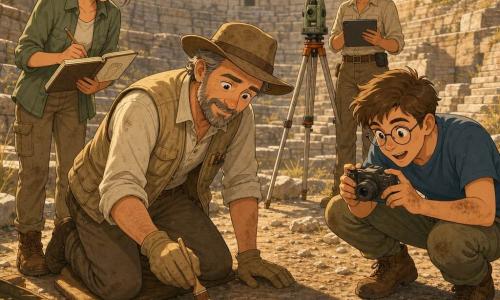
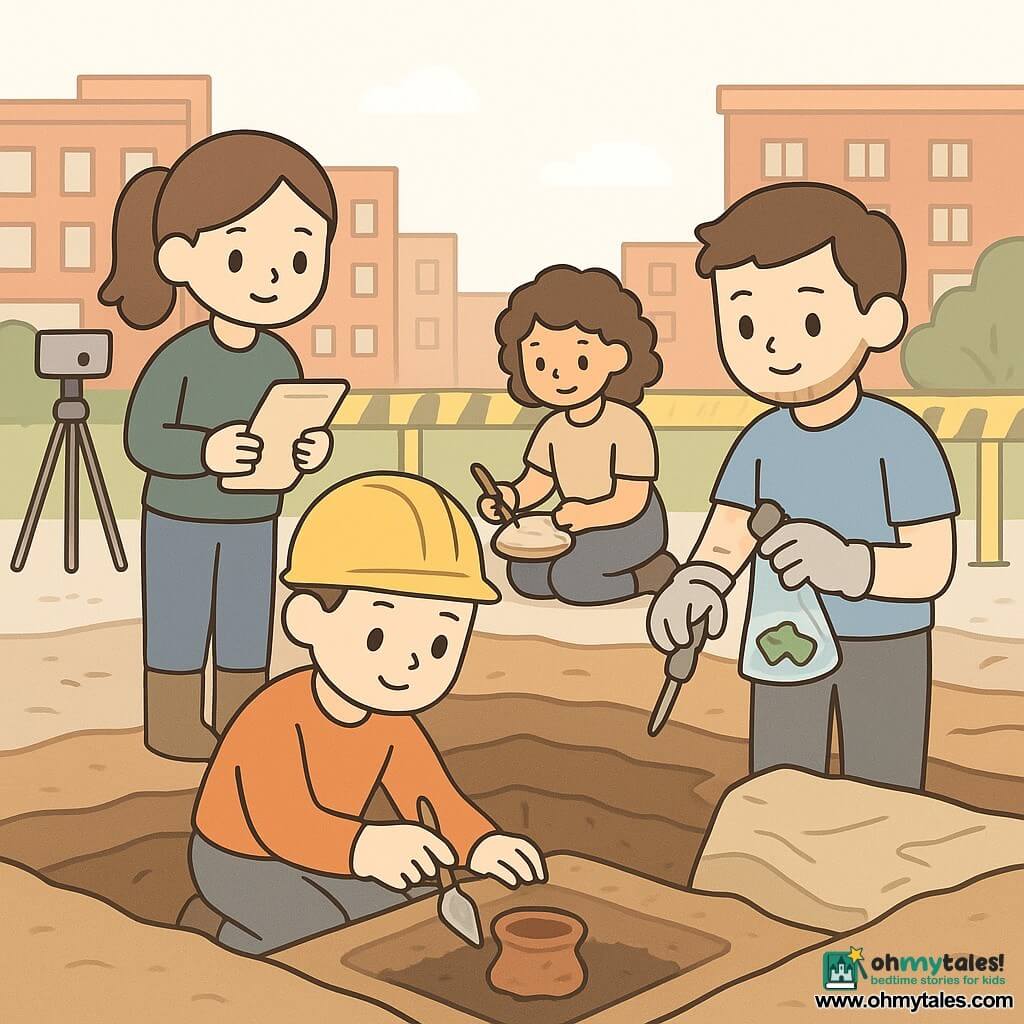
A few meters away, the rest of the team was already moving into their jobs like parts of a calm machine. Lina set up the total station—an instrument on a tripod that measured exact points so every find could be mapped. Hasan checked labels and zip bags. Two students, Jules and Rosa, practiced scraping soil with flat trowels, trying not to gouge the ground like impatient gardeners.
Theo stepped into the trench. The earth smelled cool and honest. He knelt, brushed the surface lightly, and whispered, “All right. Let's listen.”
Chapter 2: The First Find and the First Form
The first hour was mostly quiet work: scrape, brush, pause, look. Archaeology had a rhythm that felt like a slow song. Theo liked that you couldn't rush it. Rushing was how you broke things—objects, and also trust.
His trowel clicked against something firmer than soil.
Theo froze. He didn't pry. He didn't yank. He leaned closer and used a soft brush, sweeping away grains like he was uncovering a tiny sleeping animal.
A curved edge appeared—reddish, with a thin line of darker glaze.
“Pottery,” Theo murmured.
Rosa popped her head over the trench edge. “Did you find a crown?”
Theo chuckled. “Unless medieval kings wore bowls on their heads.”
Mara came over, crouched beside him, and nodded. “Nice. Don't lift yet. Let's photograph it in place.”
Theo signaled to Lina, who came with a camera and a small scale ruler. The photo snapped with a quiet click, as if the past didn't want too much noise.
“Context first,” Mara reminded.
Theo pointed to the soil layer around it. “It's in that darker band.”
“Good,” Mara said. “Record it.”
Theo slid his notebook open and pulled out a field record sheet. On the top he wrote in neat letters:
Object Number: 001
Type: Pottery sherd (rim)
Material: Ceramic
Color: Red-brown with dark glaze line
Location: Trench A, square 3, layer 4 (dark silt)
Depth: 1.2 m
Description: Curved rim fragment, likely bowl or jar
Condition: Stable, minor chips
Associated Finds: None visible yet
Notes: Photograph taken before lifting; keep orientation
As he wrote, he felt a gentle thrill—not the kind you got from roller coasters, but the kind you got when a mystery became slightly less fuzzy.
Hasan leaned in. “Label ready,” he said, holding a small bag with a tag.
Theo carefully loosened the soil around the sherd with the trowel, then slid his fingers underneath. The pottery felt cool, even though it had been buried under a warm town for hundreds of years.
He placed it in the bag, label facing out. “Object 001,” Theo said softly, like a promise.
“Good rescue,” Mara said. “Now we keep it safe, and later we let it speak—through study.”
Theo looked at the square above them, where shoppers would return once the work was done. It felt strange and comforting at the same time: two worlds sharing the same space, separated by patience.
Chapter 3: Lines in the Earth
By midday, the trench had changed. Soil that had looked like a plain brown carpet now showed patterns: a line of darker earth, a small patch of stones, and a long rectangle of compacted clay.
Theo wiped his forehead with his sleeve. “This isn't random,” he said, half to himself.
Jules climbed down beside him, eyes wide. “Is it… a wall?”
“Maybe,” Theo replied. “Or a floor. Or both.”
Mara joined them, hands on hips, gaze focused. “What do you see, Theo?”
Theo pointed. “The clay is smoother, like it was pressed. And that line—see how it runs straight? People make straight lines. Nature usually doesn't bother.”
Mara nodded. “Good observation. Let's clean it back gently. Brushes, not picks.”
The team spread out, each person working a small section. The brushes made faint, sandy shushing sounds. As the soil thinned, the rectangle became clearer. Along one edge, stones sat like teeth in a jaw.
Hasan held the measuring tape while Lina recorded points with the total station. “It's important,” Hasan said, “because if we remove anything, the map is what remains.”
Theo liked that: the idea that careful notes could outlive the hole they came from.
A shout rose from Rosa, but it was excited in a controlled way—like she'd remembered her manners in a library.
“I found metal!” she said.
Mara's head turned sharply. “Stay still. Don't wiggle it.”
Theo hurried over, heart thumping. A thin greenish line peeked from the soil, the color of old pennies.
Theo's voice dropped automatically, as if the object needed peace. “Copper alloy, maybe.”
Mara handed him the brush. “Document, then lift if it's safe.”
Theo took another field record sheet.
Object Number: 002
Type: Metal pin or buckle fragment
Material: Copper alloy (suspected)
Color: Green patina
Location: Trench A, near stone edge of compacted surface
Depth: 1.18 m
Description: Narrow strip, slightly curved, possible fastening item
Condition: Fragile; patina flaking
Associated Finds: Pottery nearby; compacted clay surface
Notes: Keep damp? Consult conservator; photograph before lifting
He photographed it with the scale ruler, then eased it out with a thin wooden tool, not metal on metal. It came free with a whisper.
Jules stared. “So people wore this?”
“Someone did,” Theo said. “They probably never imagined it would be seen again.”
Mara straightened up and looked around the trench, the lines growing clearer. “I think,” she said, “we're standing on something bigger than a floor.”
Theo felt his imagination rise again, not wild but bright. A hall. A gathering place. A room where footsteps were once ordinary.
He swallowed, steadying himself. “A medieval hall under a modern square,” he said.
Mara smiled. “Let's earn that idea. Slowly.”
Chapter 4: The Hall Beneath the Square
In the afternoon, the weather softened. Clouds slid across the sky like slow ships. The team worked with a careful kind of excitement, as if they were unwrapping a gift they didn't want to tear.
As more soil was removed, the shape made sense: a long rectangular space, with thicker stone lines that looked like foundation edges. Near the middle, a dark oval stain appeared, surrounded by reddened earth.
Theo knelt near it, eyes narrowing. “Burning,” he said.
Hasan nodded. “Hearth?”
Mara crouched and pressed her gloved fingers lightly to the red soil. “Heat-altered clay. Yes. This could be the central hearth.”
Theo's chest warmed, as if the hearth was still doing its job. He imagined people crowded around it, telling stories on winter nights. The hall didn't feel like a palace. It felt like a place where ordinary life happened—which made it more precious.
Rosa leaned over the hearth stain and whispered, “It's like a ghost campfire.”
Theo grinned. “A polite ghost. It doesn't smoke.”
Mara pointed to the edges of the hall. “We need to protect what we expose. Geotextile and sandbags tonight. The weather might change.”
Theo helped lay down protective fabric on the areas already cleaned. The cloth looked plain, but Theo knew it was a shield. Archaeology, he thought, was full of humble shields—labels, maps, careful handling, patience.
Near the hearth, Theo found another object: a small piece of bone, smoothed and carved, with two tiny holes.
He didn't touch it at first. He called, “Mara? Possible worked bone.”
Mara came over. “Good catch. This could be personal—like a button or a needle case.”
Theo filled out another sheet, writing slowly to keep his excitement from turning his handwriting into a scribble.
Object Number: 003
Type: Worked bone piece (button/fastener)
Material: Bone
Color: Pale cream
Location: Trench A, inside hall area, near hearth stain
Depth: 1.15 m
Description: Small carved piece with two holes, smoothed edges
Condition: Stable; slightly brittle
Associated Finds: Charcoal flecks in nearby soil
Notes: Bag separately; avoid pressure; possible clothing item
He lifted it with a small spatula onto a foam pad, then into a labeled container.
Jules watched. “You act like it's… alive.”
Theo considered. “Not alive,” he said. “But it belonged to someone alive. It had a job. It mattered. We should treat it like it still matters.”
Mara's eyes softened. “That's respect,” she said. “And it's the core of this work.”
Above them, faintly, the sounds of town life floated—distant footsteps, a bicycle bell, a dog barking. Theo loved the contrast: the modern world moving on, while here they listened to an older one, patiently.
Before leaving the trench for a short break, Theo looked around the hall outline. It felt like standing inside a memory that didn't quite know it was being remembered.
Chapter 5: Sharing the Past Without Stealing It
Late afternoon brought visitors—carefully managed ones. The town had arranged a small viewing area beyond the fence, and a few schoolkids clustered there with their teacher, peering down like curious pigeons.
Mara called Theo over. “Want to explain what we're doing? Keep it simple, keep it honest.”
Theo swallowed. He liked the past, but the present was full of eyes.
He approached the fence and spoke clearly. “Hi. I'm Theo. We're archaeologists. That means we study human life from long ago by looking at what people left behind.”
A boy raised his hand. “Did you find gold?”
Theo smiled. “Mostly we find things that look ordinary: pottery, bones, bits of metal. But ordinary objects can be the best teachers. A broken bowl can tell us what people ate, how they cooked, and where they traded.”
A girl pointed. “What's that big rectangle?”
“That,” Theo said, “is the outline of a medieval hall. It was likely a large building where people gathered—maybe to eat, to meet, to stay warm. We can't rebuild it like a movie set, but we can record it carefully so the town can understand what was here.”
The teacher leaned closer. “How do you make sure you don't damage it?”
Theo gestured toward Lina's equipment. “We map everything. We photograph finds before lifting them. We write field records for every object. And we protect exposed areas with fabric so weather doesn't ruin them. Also—” he lifted a finger “—we don't take things home. Everything belongs to the public. It goes to specialists and museums or archives, so everyone can learn.”
The boy who asked about gold frowned. “So you don't get to keep anything?”
Theo chuckled. “What we keep is knowledge. And sometimes a sore back.”
A few kids laughed. Theo felt his nerves loosen.
Mara joined him. “Also,” she told the visitors, “archaeology is teamwork. No one does this alone.”
Theo glanced at Hasan labeling bags, at Rosa brushing soil with fierce concentration, at Jules measuring with the tape, at Lina checking the map points. It was true. The past was too big to carry by yourself.
After the visitors left, Theo returned to the trench for one more careful sweep near the hall's edge. His trowel revealed a scatter of charcoal and tiny burnt seeds, like black crumbs.
He called Hasan. “Sample?”
Hasan nodded. “Good for flotation. We can wash the soil and see what tiny plant remains float up. It tells us about food and crops.”
Theo filled out another record, for the soil sample as if it were an artifact with a different kind of voice.
Object Number: 004
Type: Soil sample (charcoal and seeds)
Material: Sediment with charred botanical remains
Color: Dark with black flecks
Location: Trench A, hall edge near hearth
Depth: 1.14 m
Description: Concentrated charcoal, possible burnt food waste
Condition: N/A
Associated Finds: Hearth stain; worked bone nearby
Notes: Bag in sample container; send for flotation and dating
Theo set the sample container in the designated crate. It wasn't shiny. It wasn't impressive. But it might tell a story about bread, stew, or a burnt supper centuries ago.
As the sky dimmed, the hall beneath the square seemed to settle into itself again, patient as stone.
Chapter 6: Closing the Field Journal
Evening arrived gently, like a blanket being pulled up. The team cleaned tools, stacked buckets, and checked that every bag had a label that matched the records. Mara walked the trench edge one last time, making sure no exposed feature was left unprotected.
Theo helped lay geotextile over the hall's outline. The fabric draped across the stones and the hearth stain, hiding them without erasing them.
“Sleep well,” Rosa whispered to the covered ground, then coughed as if embarrassed. “I mean—uh—see you tomorrow.”
Theo smiled. “It's not a bad idea,” he said. “Places deserve kindness too.”
Mara locked the storage box and looked at Theo. “How many records today?”
Theo flipped through his clipboard. “Four: pottery sherd, metal fragment, worked bone, and a soil sample.”
“Good work,” Mara said. “Your notes will help tomorrow's decisions. Archaeology is a chain. If one link is weak, the story breaks.”
Theo felt pleasantly tired, the kind of tired that made thoughts slow down in a friendly way. He sat on a bench near the fence, where the town square lights were beginning to glow. For a moment he watched people passing at the edge of the site—quiet silhouettes, unaware of the medieval hall tucked beneath their feet.
He opened his field journal one last time and reread his entries. The words looked calm and solid on the page. Object numbers. Locations. Descriptions. Notes. A small, careful bridge between then and now.
He added a final line at the bottom of the day's page:
Daily Reflection: The hall is not a secret to keep—it's a story to share respectfully.
Theo closed the journal, pressing the cover shut with both hands as if sealing the day inside. The sounds of the town softened. The sky deepened. Somewhere under the fabric and soil, the outlines of the hall waited without hurry.
Theo stood, shouldered his bag, and followed the team toward the gate. Behind him, the site rested—protected, recorded, and understood a little more than it had been that morning.
Tomorrow, they would listen again. Tonight, it was enough to let the past sleep.