Chapter 1: Dust on the Wind
The prairie looked endless, like the whole world had been poured out flat and painted gold. Heat shimmered over the grass. A hawk circled high above, calm as a thought.
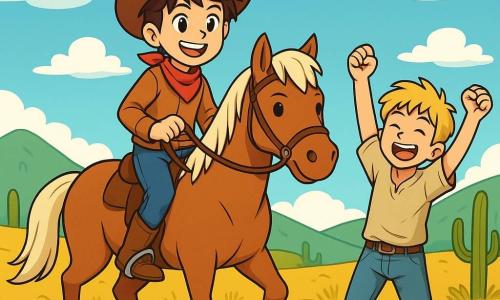
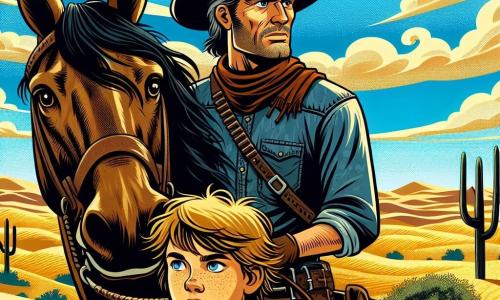
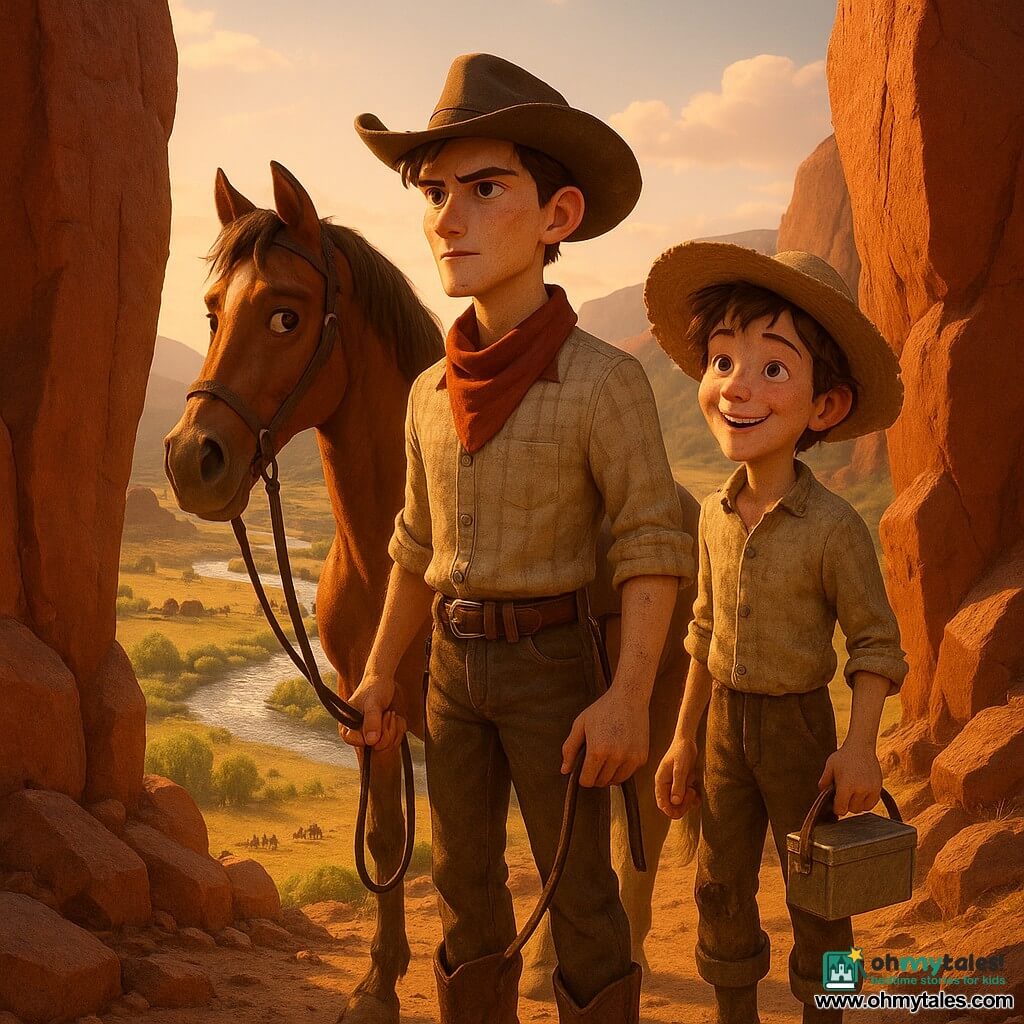
Cal Mercer rode alone, his horse Copper stepping steady through the dust. Cal was sixteen—old enough to work cattle, young enough for people to still call him “kid” when they wanted to feel taller. He wore a sun-faded hat, a red neckerchief, and the kind of stubborn expression you got from being told “no” too many times.
Ahead, a thin ribbon of smoke twisted into the sky.
Copper's ears flicked forward. Cal patted his neck. “Easy, boy. We're not looking for trouble.”
But trouble had a way of finding the open range.
As Cal crested a low rise, he saw the remains of a camp: a broken wagon tongue, scattered tin cups, and a circle of blackened stones. The fire was fresh. Too fresh.
Then he saw boot prints—dozens of them—stomping the ground like an angry dance. Mixed in were hoofprints from at least two different herds.
Cal slid off Copper and crouched, brushing the dirt with his fingertips. “Two outfits,” he muttered. “And neither one felt friendly.”
A dry laugh came from behind a mesquite bush. “You talk to dirt often, or only when you're lonely?”
Cal's hand shot to the revolver at his hip, but he didn't draw. A boy stepped out—about Cal's age, wiry as a fence post, with a straw hat and a grin that looked too big for his face. He held up his hands like a peace flag.
“Name's Milo Crane,” the boy said. “And before you go acting heroic, I'm not the one who made that mess. I was hiding. Like a sensible person.”
Cal studied him. Milo's shirt was dusty, his elbows scraped, and his eyes sharp.
“Cal Mercer,” Cal replied. “Who was here?”
Milo tilted his head toward the west. “The Tanner outfit and the Rusk boys. They met here and—well—talked loud. Real loud. Then they left, both madder than hornets.”
Cal's stomach tightened. Tanner and Rusk. Two ranches fighting over the same creek water, the same grazing land, the same thin slice of peace. And Cal's own ranch sat right between them, like a biscuit on a plate being argued over.
“Any shooting?” Cal asked.
Milo shook his head. “Not yet. But it's coming. You could smell it. Like lightning before a storm.”
Cal looked toward the distant line of cottonwoods where the creek ran. If the creek turned into a battlefield, every ranch in the valley would suffer. And if it got worse, it wouldn't just be fists and bullets. It would be families.
Cal swung back into the saddle. “I'm heading to Red Bluff. Need to talk to Sheriff Alder.”
Milo trotted alongside Copper, then grabbed the saddle horn and hauled himself up behind Cal without asking.
Cal stiffened. “Hey—”
Milo settled in like a barn cat. “You'll want a witness. Also, I'm bored. Also, I'm trying not to get trampled by angry ranchers.”
Cal sighed. “Fine. But if you fall off, I'm not turning back.”
Milo leaned close. “Deal. And if you get shot, I'll tell people you died looking handsome.”
Cal snorted despite himself, and Copper broke into a faster trot.
The wind carried the smell of smoke and dry grass. Somewhere ahead, Red Bluff waited with its wooden sidewalks and crooked smiles. And somewhere behind them, a fight was crawling out of the dirt, hungry for daylight.
Chapter 2: The Sheriff's Bad News
Red Bluff was a small town with big opinions. Its main street was packed hard by wagon wheels, and the buildings leaned slightly as if they were tired of standing up. The saloon doors swung like they were whispering secrets.
Cal and Milo rode in under a sky so blue it looked freshly scrubbed. People paused to watch them pass. A few nodded at Cal. More stared at Milo like he'd wandered in from a circus.
They tied Copper outside the sheriff's office. Sheriff Alder sat inside with his boots on the desk, reading a newspaper that looked like it had been chewed by a goat.
He lowered it and squinted. “Cal Mercer. You here to tell me your fence got knocked down again?”
Cal stepped forward. “No, sir. I found a camp spot where Tanner and Rusk met. Looks like they're gearing up.”
Sheriff Alder's mouth pulled into a line. He took his boots off the desk, slow and heavy. “I was afraid of that.”
Milo leaned into the doorway. “I saw it too. Lots of shouting. No bullets yet, but plenty of hate.”
Sheriff Alder's eyes flicked to Milo. “And you are?”
“Milo Crane,” Milo said brightly. “Professional not-getting-shot person.”
Sheriff Alder grunted like that explained everything. He rose, walked to the window, and looked out at the town. “Tanner claims the Rusks are stealing water from Coyote Creek. Rusk claims Tanner's men are cutting their cattle out of the herd. Truth is, both sides are half right and fully angry.”
Cal felt the familiar burn of frustration. Adults acted like pride was worth more than peace.
“What can we do?” Cal asked.
Sheriff Alder turned back, his face creased with worry. “There's a meeting tomorrow at Dry Gulch. A ‘talk,' they call it. More like a match held over a barrel of oil. I'm supposed to be there, but they don't respect my badge when they're riled.”
Cal's heart thumped. Dry Gulch was a narrow canyon with high rocks and one way out. A perfect trap if things went wrong.
“Then don't go,” Milo whispered.
Sheriff Alder gave Milo a tired look. “If I don't go, they'll say I chose a side. And if I do go, they might shoot me for standing in the wrong patch of shade.”
Cal took a breath, tasting dust. “Let me go.”
The sheriff blinked. “You?”
Cal stood straighter. “I'm not Tanner or Rusk. My ranch sits between them. If they fight, we all lose. Maybe they'll listen to someone who's not trying to win, just trying to stop the bleeding before it starts.”
Sheriff Alder rubbed his jaw. “Cal, you're brave, but brave doesn't stop bullets.”
“It can,” Cal said quietly, “if it stops hands from pulling triggers.”
Milo nodded as if he'd been hired to agree. “And he's got me. I'm excellent at running away while shouting helpful advice.”
Cal shot him a look. Milo smiled innocently.
Sheriff Alder walked to a cabinet and pulled out a folded paper. “There's something else.” He opened it on the desk. It was a rough map—canyons, a creek, and a marked spot near Dry Gulch.
“Alder,” Cal said, “what is that?”
“A route,” the sheriff answered. “Old trail through Split Rock Pass. If your talk goes sour, you'll need a way out that isn't the gulch mouth. Most folks don't know it. It's steep, narrow, and… not friendly.”
Milo's eyes lit up. “Secret escape route. Love those.”
Sheriff Alder folded the map and pressed it into Cal's hand. “Listen close. You want to negotiate a truce, you do it like you're carrying a bucket of water through a fire. Slow. Careful. No sudden moves. And you remind them what they're really protecting.”
Cal swallowed. “Their land?”
“Their people,” Sheriff Alder said. “And the chance to sit down to supper without counting the empty chairs.”
Outside, a wagon rumbled past, creaking like an old complaint. Cal tucked the map into his vest and nodded once.
“Tomorrow,” he said. “Dry Gulch.”
Sheriff Alder sighed. “May the morning be calmer than the men.”
Milo tipped his hat. “If it's not, we'll just borrow the calm ourselves.”
Cal stepped back into the sunlight. The town looked the same as always—quiet, dusty, ordinary. But Cal could feel the future tugging like a rope. He mounted Copper, and Milo hopped up behind him again, like he belonged there.
As they rode out, Cal's jaw tightened with determination.
He wasn't going to let the valley become a graveyard for pride.
Chapter 3: The Canyon of Echoes
Dawn came sharp and pale, like the world had been washed in cold water. Cal and Milo reached Dry Gulch before the sun climbed high. The canyon walls rose on both sides, red rock streaked with shadows. Every sound seemed louder here—hoofbeats, coughs, even the rustle of a lizard in the sand.
At the gulch's center was a flat patch of ground where two groups faced each other.
On one side, the Tanner outfit: broad-shouldered men in dusty coats, their horses restless. On the other, the Rusk boys: leaner, darker-eyed, hands too close to their holsters.
Between them stood a lonely barrel and an empty crate, like someone had tried to set a stage for a play nobody wanted to watch.
Cal rode forward slowly. Milo stayed behind him, quiet for once.
A tall man with a gray beard stepped out from the Tanner side. His eyes were hard as sun-baked clay. “That's Mercer's boy,” he growled. “What's he doing here?”
A man from the Rusk side spat into the dirt. “Probably here to pick scraps when we're done.”
Cal's throat tightened, but he kept his voice steady. “I'm here to talk.”
Laughter bounced off the canyon walls.
“Talk?” someone echoed. “We talked plenty.”
Cal lifted both hands, palms out. “Talking is different from shouting.”
A rough voice cut in. “And you think you can teach us the difference?”
That voice belonged to Jeb Rusk, the rancher himself. He rode forward, his hat low, his eyes bright with anger.
Cal met his gaze. “I think you both know it already. You've just forgotten.”
The Tanner leader—Hank Tanner—nudged his horse forward too. The two ranchers were close enough to smell each other's sweat.
“You stealing my water,” Tanner snapped.
“You poisoning my name,” Rusk shot back.
Cal slid off Copper. He felt very small under the canyon walls, but he forced his boots to stay planted. “If you fight here, it won't end here. It'll spread. Sons and brothers will get pulled in. Your hands will start shaking every time you reach for a coffee cup, because you'll remember what else you've held.”
For a moment, the gulch was quiet except for the wind.
Milo cleared his throat. “Also, bullets are expensive.”
Cal almost groaned, but a few men on both sides chuckled despite themselves. The humor didn't fix anything, but it cracked the ice a little, like a boot heel on frozen mud.
Tanner's eyes narrowed. “What's your offer, Mercer?”
Cal took out the sheriff's map but didn't open it. Instead, he looked at the men's faces—weathered, tired, suspicious. “A truce. Three days. No riding onto each other's land. No cutting cattle out of herds. No messing with the creek. Three days to figure out what's true and what's rumor.”
Rusk scoffed. “And who checks the truth? You?”
“No,” Cal said. “All of us. Together.”
That made them uneasy. Working together sounded too much like trusting.
Cal kept going, his voice stronger now. “We'll meet at the creek with just a few men each. We'll measure the flow. Check the banks. Find where it's being diverted—if it is. And we'll do it in daylight, where lies have nowhere to hide.”
Tanner's jaw worked. Rusk's hand hovered near his holster, not drawing, but not relaxing either.
Then a shout rang from the canyon mouth. A rider came thundering in, wild-eyed, waving his arms.
“Ambush!” he yelled. “Shots fired at Coyote Creek—someone hit Amos!”
Instantly, hands went to guns. Horses screamed and shifted. The air changed—thicker, sharper.
Tanner's men glared at the Rusk boys. The Rusk boys glared back like coiled snakes.
Cal felt the moment slipping, like trying to hold water in your fists. He shouted, “Stop! Nobody knows who fired!”
But fear is louder than reason.
A gunshot cracked—whether accidental or not, Cal couldn't tell. The echo bounced around the gulch like a drumbeat. That was all it took.
Men surged forward.
Milo grabbed Cal's sleeve. “This is the part where we leave!”
Cal's mind snapped to the sheriff's warning. Split Rock Pass. Secret route.
He whistled sharply. Copper lunged toward him. Cal swung into the saddle. Milo climbed behind with a grunt.
Cal didn't run away from the problem. He ran to keep it from getting worse.
He turned Copper toward the canyon wall, where a narrow crack between boulders marked the hidden trail.
Behind them, the gulch exploded into chaos—shouts, hooves, and another shot that punched the air.
Cal leaned low over Copper's neck. “Come on, boy. Find the path.”
The trail up was steep, rocky, and barely wide enough for a horse. Copper's hooves slipped once, scattering pebbles into the gulch below. Cal's stomach flipped.
Milo clung to Cal's waist. “Next time you say ‘let's talk,' remind me to bring a table and cookies.”
Cal barked a tight laugh. “Hold on!”
They climbed higher, the gulch noise fading into distant, angry echoes. The wind up here smelled different—cleaner, colder.
At the top, Split Rock Pass opened like a doorway between two towering stones. Beyond it lay a narrow ridge that overlooked Coyote Creek.
Cal reined Copper in, chest heaving. He could see the cottonwoods below, the silver thread of water, and tiny figures moving like ants near the bank.
If someone had fired at the creek, the truce would die before it ever took its first breath.
Cal's fingers tightened on the reins.
“We're not done,” he said.
Milo swallowed. “Nope. We're just getting started.”
Chapter 4: The Truth at Coyote Creek
They rode down from the ridge cautiously, keeping to brush and shadow. From above, the creek had looked peaceful. Up close, it was tense as a held breath.
A man lay on the ground near the water, holding his arm. Blood darkened his sleeve. Two others hovered over him, arguing in panicked whispers.
Cal recognized the wounded man—Amos Tanner, Hank Tanner's nephew. His face was pale, eyes squeezed shut.
Cal slid off Copper and approached with his hands visible. Milo stayed close, scanning the cottonwoods like he expected them to bite.
One of the men snapped, “Stay back!”
“It's Cal Mercer,” Amos rasped, opening one eye.
The guard hesitated. Cal knelt beside Amos. The bullet had grazed his upper arm—painful, but not deadly. “Who shot you?” Cal asked.
Amos swallowed. “I don't know. I heard a crack. Felt fire. Thought it was Rusk men.”
Milo crouched, peering at the bank. “Or someone wanted you to think that.”
Cal looked around. The creek bent here, with reeds and mud along the edge. Then he noticed something that didn't fit: a set of boot prints leading away from a thicket, lighter than a cowboy's heavy tread. And beside them—drag marks, like something had been pulled.
He followed the prints with his eyes. They led to a spot where the bank had been cut and patched with fresh mud.
Cal pressed his fingers into it. The mud was still damp.
“Someone's been here recently,” he said.
Milo sniffed. “And they weren't fixing it out of kindness.”
Cal stood and moved along the creek, careful not to slip. He found a shallow trench running away from the water, hidden under reeds. It led toward a low hill where a small pond had formed—an artificial catch, stealing the creek's flow.
“Diversion,” Cal said.
Milo whistled softly. “So the water really is being taken. But by who?”
A twig snapped behind them.
Cal spun. A man stepped out from behind a cottonwood, rifle in hand. He wore no ranch colors—just a dusty coat and a mean smile.
“Well,” the stranger drawled, “look what the creek coughed up.”
Milo's voice went tight. “That's Wade Lannick.”
Cal didn't know the name, but he knew the type. Wade's eyes were greedy. Not angry like Tanner and Rusk—hungry.
Wade flicked his rifle toward them. “Back away from my trench.”
“Your trench?” Cal said, stalling. His mind raced. If Wade was diverting water, he could sell it, or force ranchers to pay. A man like that didn't care who got hurt as long as his pockets got heavy.
Wade shrugged. “I improved the land. That's what folks do out here. Improve it until it's yours.”
Milo lifted his chin. “You shot Amos.”
Wade's smile didn't reach his eyes. “Grazed him. Needed a spark. Ranchers are like dry grass—takes almost nothing.”
Cal's anger rose hot, but he kept his voice even. “You're playing with lives.”
Wade's rifle lifted higher. “And you're standing too close to my game.”
Cal's hand hovered near his own revolver. He didn't want a gunfight. He wanted proof.
His gaze darted—rope coil on his saddle, Copper's steady stance, the creek mud.
He made a decision in a heartbeat.
Cal took a small step sideways, as if nervous, and let his boot slide into the damp mud by the patched bank. He stomped—hard.
The patch crumbled. Water surged through, eager as a freed animal. The trench began to collapse, the creek reclaiming itself with a gurgling roar.
Wade shouted, furious, and swung his rifle toward the bank.
That was the opening.
Milo grabbed a handful of creek mud and flung it straight into Wade's face. “Pocket sand's cousin!” he yelled.
Wade cursed, blinking and wiping.
Cal lunged, grabbing the rifle barrel and yanking it down. The weapon fired into the dirt with a loud thud, spraying dust.
Copper danced sideways, snorting.
Wade slammed his shoulder into Cal, knocking him back. Cal fell hard, the world flashing white. Wade raised the rifle like a club.
Milo sprang in, swinging a stick at Wade's wrist. It wasn't heroic-looking, but it was brave. Wade yelped, his grip loosening.
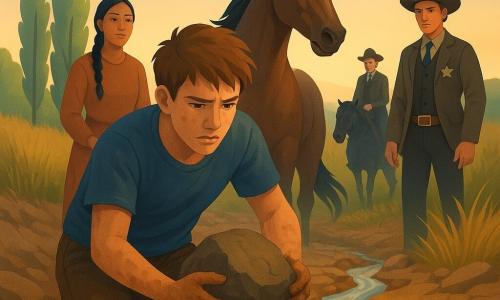
Cal rolled, snatched up a fallen stone, and threw it—not at Wade's head, but at the rifle stock. The crack startled Wade. The rifle flew from his hands and splashed into shallow water.
For a second, everything froze.
Then hoofbeats thundered from the trees—men arriving, drawn by the gunshot and shouting.
Tanner riders burst out on one side. Rusk riders on the other. They skidded to a stop, guns out, eyes wild.
Wade backed up, hands raised, mud dripping off his face. “Now hold on,” he said quickly, voice slick. “They did it. They broke the bank. They—”
Cal stood, chest heaving, and pointed at the collapsed diversion trench. “That was stealing the creek. He made it. He shot Amos to blame the Rusks.”
Men stared. Some lowered their guns slightly, confused.
Rusk rode forward, eyes narrowing as he saw the trench. “That's not our work.”
Tanner arrived behind him, face stormy. He looked at Amos's bleeding arm, then at Wade. “You.”
Wade swallowed. His bravado shrank like a shirt in hot water.
Cal raised his voice so it carried. “You want truth? Here it is. The creek was being diverted. Not by Tanner. Not by Rusk. By him.”
Silence settled, heavy and stunned.
Then Milo, muddy and panting, added, “Also, he's got the personality of a rattlesnake in a bad mood.”
A few men snorted. Even in tension, a little humor could keep a finger off a trigger.
Sheriff Alder rode in last, face grim. He took one look at the trench and Wade's muddy face. “Wade Lannick,” he said. “You're under arrest.”
Wade tried to bolt, but a dozen ropes seemed to appear at once, and he was yanked off his feet in a tangle of curses.
The ranchers stared at each other across the creek. Their anger didn't vanish, but it had nowhere clean to land anymore.
Cal stepped between them again, voice steady. “Now can we talk? Really talk?”
Tanner's shoulders sagged a fraction. Rusk's jaw unclenched.
Sheriff Alder nodded. “Three-day truce,” he said loudly. “And I'll enforce it with the full weight of my tired patience.”
Milo whispered to Cal, “That's the heaviest kind.”
Cal didn't smile much, but relief loosened something in his chest.
The creek flowed stronger now, glinting in the sunlight—free again, at least for the moment.
Chapter 5: Supper Under the Cottonwoods
By late afternoon, the wounded arm was bandaged, Wade was tied up like a bad decision, and the ranchers had agreed—grudgingly—to meet on neutral ground.
Neutral ground, Cal decided, should include food.
They gathered under the cottonwoods by the creek, where the shade danced and the air smelled of water and green leaves. Cal's ranch hands arrived with a wagon of supplies: beans, biscuits, coffee, and a pot big enough to bathe a small dog.
Milo hovered near the food like it was a treasure chest. “Negotiations,” he said, “are improved by butter.”
Tanner and Rusk stood apart at first, like two magnets refusing to touch. Their men watched each other, wary. But hunger is persuasive, and the smell of warm biscuits has a way of making even enemies remember they're human.
Cal carried a tin plate to Hank Tanner. “Here,” he said.
Tanner eyed it suspiciously. “You feeding me so I'll go soft?”
Cal shrugged. “I'm feeding you because you're standing under my trees, and my ma raised me right.”
Tanner grunted, but he took the plate.
Cal did the same for Jeb Rusk. Rusk's eyes flicked over Cal's face, searching for tricks. Then he accepted the food with a stiff nod.
Milo wandered between groups, offering biscuits like a traveling peace salesman. “Try one,” he urged a Rusk rider. “If you hate it, you can go back to hating Tanner too. No extra charge.”
A young Tanner cowboy—barely older than Cal—laughed and called, “Got any for folks who hate everybody?”
Milo tossed him a biscuit. “You need two, friend.”
The laughter that followed was small, but real. It drifted through the cottonwoods like a soft breeze.
Sheriff Alder sat on an upturned bucket, watching the men eat. “Sharing food doesn't fix everything,” he said quietly to Cal.
“No,” Cal agreed. He looked at the creek, glittering in late light. “But it reminds people what they're fighting to keep.”
As the meal went on, Cal kept the talk moving. He had them discuss the creek's flow, the trench Wade had dug, and the damage done. They argued, of course—sharp words, stubborn stares—but now the argument had a different shape. Less like a duel. More like a knot being worked loose.
A Rusk rider admitted he'd cut a few Tanner cattle by mistake during a storm drive. A Tanner hand confessed he'd moved a boundary marker “just a touch” last spring.
Each confession landed like a stone dropped into water—ripples spreading, uncomfortable but honest.
Cal spoke last. “You don't have to be friends,” he said. “You just have to stop trying to ruin each other. There's enough hard days out here without making more.”
Rusk stared at the ground for a long moment. Then he extended his hand toward Tanner. “Three days,” he said. “We check the creek together.”
Tanner hesitated. Pride wrestled inside him like a stubborn bull. Finally, he took Rusk's hand. “Three days,” he echoed. “And no shooting.”
The handshake wasn't warm, but it was something. A bridge made of rough wood, not pretty, but strong enough to step on.
Milo leaned toward Cal and whispered, “You did it.”
Cal watched the men begin to talk in smaller groups, still cautious, but no longer snarling. He exhaled slowly. “We started it,” he corrected.
The sun lowered, turning the canyon walls in the distance a deep orange. Somewhere, a coyote yipped, like it was laughing at the day's drama.
Sheriff Alder stood, stretching his back. “Cal,” he said, “you've got nerve.”
Cal looked at the creek again, then at the people eating and talking under the cottonwoods. “Nerve isn't enough,” he said. “You need a reason.”
Milo raised his coffee tin. “Reason: biscuits.”
Cal finally smiled—small, tired, real.
And as the first stars pricked the sky, the valley felt a little less like a powder keg and a little more like a place where tomorrow might be possible.
Chapter 6: A Path Without Fear
On the third day of the truce, Cal rode alone to Split Rock Pass.
He didn't go because he expected trouble. He went because he wanted to remember what courage felt like when it wasn't mixed with panic.
The pass stood quiet, two great stones framing the sky. Below, the creek ran steady again. Tanner and Rusk men had worked side by side to fill in Wade's trench, hauling rocks and packing mud. It hadn't been friendly at first—more grunts than greetings—but by the end, someone had shared a canteen, and someone else had told a joke bad enough to make everyone groan.
Sharing, Cal had learned, didn't always start with open arms. Sometimes it started with a simple, stubborn choice: I won't let you carry this alone.
Copper picked his way up the trail. Cal's hands rested easy on the reins now. He could still hear the gunshot echoing in his memory, still feel the rocky ground when he'd fallen. But those memories didn't own him.
At the top, Cal dismounted and walked to the edge of the ridge. Wind tugged at his neckerchief. The world spread out wide—prairie, creek, ranchlands, distant blue hills like sleeping giants.
Footsteps crunched behind him. Cal turned to see Milo, huffing as he led a borrowed horse up the trail.
“You said you were riding alone,” Cal called.
Milo wiped sweat off his brow. “And miss a dramatic overlook? Never.”
Cal folded his arms. “Did you follow me?”
Milo shrugged. “Sort of. Also, Sheriff Alder told me to keep an eye on you. His exact words were, ‘That boy's got a brave streak and a habit of standing in the middle of problems.'”
Cal stared out at the land. “He's not wrong.”
Milo joined him at the edge. For a moment, neither spoke. The silence wasn't awkward. It was the kind you earned.
Down below, a small group moved along the creek—Tanner and Rusk riders together, checking the banks, measuring flow, talking. Not friends, maybe. But not enemies today.
Milo nudged Cal with his elbow. “So what now, peacemaker?”
Cal took a slow breath. “Now we keep walking the path we started. Even when it's steep.”
Milo grinned. “Like this pass.”
Cal nodded. “Exactly like this.”
A gust rose, stronger than before, and Cal felt it push against him. Three days ago, he would've braced like he was about to be knocked over. Now he leaned into it, steady.
Fear still existed. It always would. But it wasn't the boss of him.
Cal stepped forward onto the narrow ridge trail that ran beyond Split Rock, a line of stone and sky. Copper followed, calm and sure-footed. Milo came after, talking as usual.
“Just so you know,” Milo said, “if you plan on negotiating peace for the rest of your life, you're going to need better snacks.”
Cal glanced back. “You're volunteering?”
Milo put a hand to his chest in mock pride. “I accept this noble duty.”
Cal laughed, and the sound flew out over the valley, light and clear.
They walked on, the trail narrowing, the wind rising, the world wide open.
It wasn't a trail without danger. It was a trail without fear—because they had learned how to face the hard ground together, how to choose truth over rumor, and how to share what they had, even when it would've been easier to keep it for themselves.
Ahead, the ridge led into bright distance, and Cal kept moving, one steady step at a time.