Chapter 1: Dust on the Ledger
The sun climbed over the prairie like a coin rising out of a pocket—bright, hard, and unavoidable. It painted the wagons in gold and turned every tin cup into a small mirror.
Mae Calder stood with a rolled map in one hand and a pencil behind her ear. She was grown—old enough to have scars that meant something, young enough to keep earning new ones. Her hat was plain, her boots were honest, and her eyes missed very little.
A caravan was waiting on her decisions: six wagons, twelve people, two dozen oxen, three horses that knew more bad language than prayers, and one skinny dog that belonged to everyone and nobody.
“Mae,” called Mr. Harlan, the caravan boss, holding a leather book like it was fragile. “We got flour, nails, lamp oil, and enough beans to make the angels weep. But we ain't got time to waste. Fort Clay is three days if we take the river bend.”
Mae squinted at the horizon. The land was wide enough to swallow a person's worries whole, but it didn't. It just stretched them out so you could see them better.
“The river bend is quicker,” Mae said, “and that's why it's risky.”
A boy with freckles and a too-big coat hovered near the first wagon wheel. Eli, eleven and trying hard to look like he wasn't. He held a slingshot like it was a badge.
“What's risky mean?” he asked.
“It means the world might test you,” Mae said, and tapped the map. “And it means we'll pass.”
A laugh came from the back—short and sharp. That was Lottie Quinn, who drove the supply wagon and claimed she could steer better with one hand than most men could with two.
“Mae's got that ‘duty face' on,” Lottie said. “The one that says she'd march through a bee nest if the job asked for it.”
Mae didn't deny it. She walked down the line of wagons, checking the cinches, the axles, the water barrels. She ran a hand along a wheel spoke and felt for cracks like she was reading a secret message. The wood was sound.
At the last wagon, she found Mrs. Sato tying a cloth bundle with a knot so neat it looked like a little promise.
“You doing all right?” Mae asked.
Mrs. Sato nodded. “My hands are steady when my heart is not.”
Mae understood that. “Keep your bundle close. We travel as one, but everyone carries their own hope.”
A voice whined from under a wagon. “Hope and a hammer,” grumbled Jonah Pike, the wagon mender, rolling out with his beard full of dust. “Anybody can hope. Only fools forget the hammer.”
Eli leaned closer to Mae. “Is he always like that?”
“He's like weather,” Mae said. “You don't argue. You just prepare.”
She mounted her horse, Juniper, a sturdy mare with a thoughtful stare. Mae lifted her arm, the signal they'd agreed upon at dawn.
“Wheels up!” she called.
Oxen grunted. Harnesses creaked. The caravan lurched forward, and the prairie began to slide past like a slow river of grass.
As they moved, Mae rode along the left flank, counting heads, listening to the rhythm of hooves and wheels. Duty wasn't a word she said often. It was a weight she carried, like a canteen on a long day. Heavy—but necessary.
Eli jogged beside Juniper for a moment, breath puffing. “Mae? Why do you do this? Leadin' folks, I mean.”
Mae watched the wagons, the families, the nervous smiles, the tight grips on reins. “Because somebody has to,” she said. “And because if I say I'll get you there, I mean it.”
The boy's eyes widened. “Even if it's hard?”
“Especially if it's hard.”
Behind them, their starting town shrank until it was just a smudge. Ahead, the land waited—quiet, vast, and not at all impressed by human plans.
Chapter 2: The River Bend's Teeth
By noon the heat had grown teeth. It bit at the back of the neck and made the air shimmer. The river bend finally appeared as a ribbon of green and silver, but it wasn't the friendly kind of ribbon. The banks were steep, and the water ran fast, tugging at branches like it wanted to steal them.
Mae reined Juniper in and rode down to the edge. She watched the current. She watched the rocks. She watched the way the water darkened in the center.
Lottie came up beside her, eyes narrowed. “That crossing looks like it's in a sour mood.”
Jonah spat into the dust. “Water's always in a sour mood. It's why it keeps movin'.”
Mr. Harlan clutched his ledger. “If we don't cross here, we lose a day. Maybe two.”
“We lose more than days if we rush,” Mae said. She swung down and knelt, scooping a handful of wet sand. It was gritty, but it held together. “The bottom's firm near the shallows. We'll cross there. One wagon at a time. Rope the wheels. No heroics.”
Eli tried to look brave and failed in an interesting way. “What's ‘rope the wheels'?”
Mae pointed. “We tie a line from the wagon to a team on the bank. If the current pulls, the rope argues back.”
Lottie grinned. “I'd like to see a rope argue with water.”
“It'll be a short debate,” Jonah said. “But we'll win if we're smart.”
They worked fast. Mae's hands moved without wasted motion—knot, pull, check. She placed Eli with Mrs. Sato and two other kids on the high bank, away from hooves and panic.
“No running,” Mae told them. “And no standing where you can get stepped on. A wagon wheel doesn't apologize.”
Eli saluted with his slingshot. “Yes, ma'am.”
The first wagon creaked into the water. The oxen leaned forward, muscles bunching like ropes. The current grabbed at the wheels, and for a moment the wagon tilted, the canvas top snapping in the wind.
“Steady!” Mae shouted. She held the rope with Lottie and Jonah, digging her heels into the mud. Her arms burned, but she didn't let go.
“Feels like the river's got a personal grudge!” Lottie yelled, laughing through clenched teeth.
“That's just water bein' water!” Jonah barked. “Pull, you fool optimists!”
The wagon righted itself. The rope held. The oxen pushed on, hooves slipping, then finding purchase. Slowly, stubbornly, the wagon crawled up the far bank like a beetle climbing out of a jar.
One down.
The second wagon went smoother. The third, too—until a sharp crack echoed. A front wheel spoke snapped, and the wagon sagged.
“Stop!” Mae shouted.
The driver froze, eyes wide. The oxen kept straining, confused.
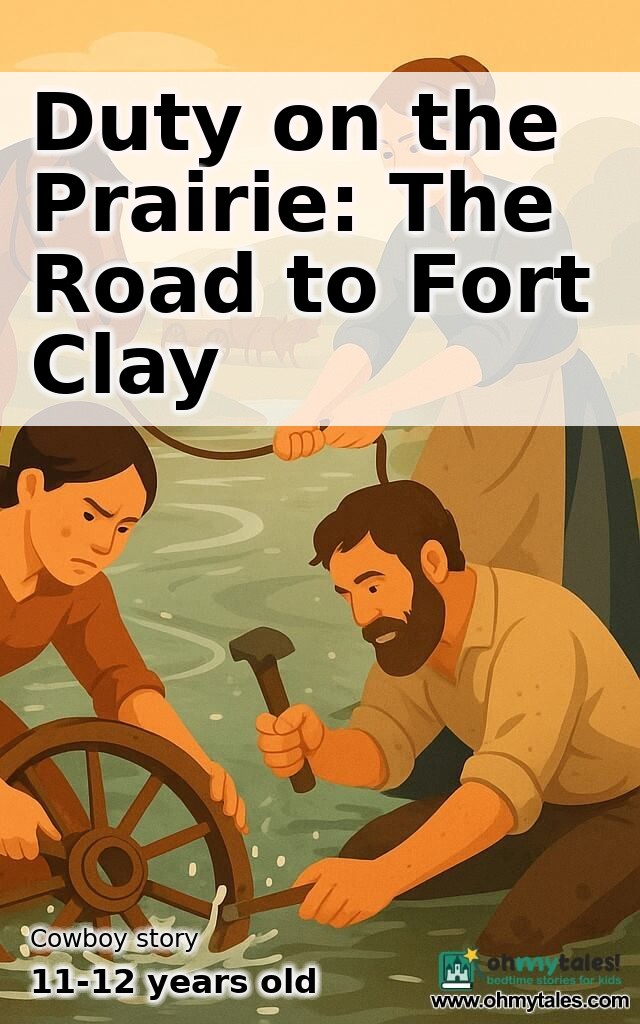
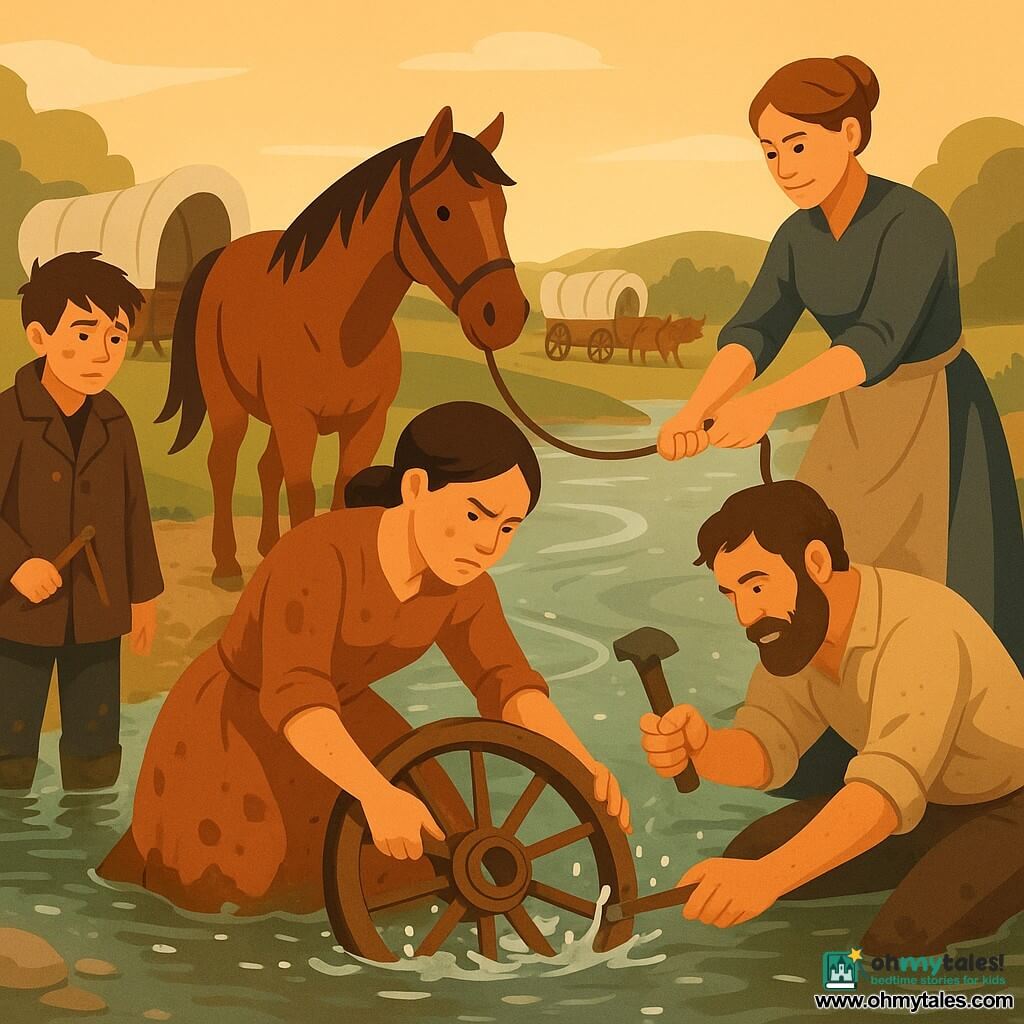
Mae splashed forward, water soaking her skirt and boots. The current tugged at her like a hand trying to pull her under, but she planted her feet and reached the wheel. The broken spoke jutted like a broken finger.
Jonah waded in after her, grumbling. “Ain't even crossed and already we're feedin' the river our lumber.”
Mae looked at the angle. “If we keep pushing, it'll collapse.”
Mr. Harlan's voice trembled. “We can't lose this wagon. It's tools. Nails. Spare iron.”
Mae nodded once. “Then we don't lose it.”
She glanced back at the bank. “Lottie! Bring the jack and the spare spoke. Eli—stay put!”
Eli's voice floated down, thin with worry. “I'm stayin'! I'm stayin'!”
The jack came. Mae and Jonah wedged it under the axle while Lottie braced the wheel. The river shoved at them, cold and angry.
Mae's fingers were numb, but her mind stayed sharp. “Lift slow. If it slips, we'll be fish food.”
Jonah snorted. “I'd rather be coyote food. At least coyotes don't splash.”
They lifted. The wagon rose an inch, then two. Lottie slid the spare spoke into place, hammering with quick, sure strikes. Mae held the wheel steady, teeth clenched so hard her jaw ached.
Finally, the repair held.
“Now,” Mae said. “Easy pull. No jerking.”
The oxen leaned in again. The wagon shuddered, then rolled forward, climbing out of the river as if it had simply decided to cooperate.
On the far bank, the caravan cheered—half relief, half disbelief.
Eli ran to Mae as soon as she stepped onto dry ground. He stared at her soaked boots. “You didn't even look scared.”
Mae wrung out her sleeve. “I looked at the problem. Scared doesn't fix a wheel.”
He nodded like he'd just been handed a secret.
That night, they camped under cottonwoods. The river hissed nearby, still annoyed it hadn't won. Mae sat by the fire, oiling Juniper's tack, while Lottie passed around a tin cup of coffee strong enough to stand up by itself.
Mr. Harlan approached, his ledger tucked away for once. “Thank you,” he said quietly. “For not lettin' us rush into trouble.”
Mae watched the flames. “Trouble always offers a shortcut,” she said. “Duty says you take the long way if it keeps folks alive.”
The stars came out, sharp as nails hammered into the sky.
Chapter 3: Smoke in the Afternoon
The next day began peaceful—too peaceful, in the way a room gets quiet right before someone breaks a plate.
The prairie rolled on, dotted with sage and wildflowers stubborn enough to bloom in dust. The wagons creaked, a familiar song. Eli rode in the back of Lottie's wagon, trying to carve a whistle from a stick. The dog—everyone's dog—trotted beside Mae, tongue lolling like it was smiling at the world.
Then Mae smelled smoke.
Not campfire smoke. Not cooking smoke. This was sharp, wild, and wrong.
She lifted her head and scanned the wind. A faint gray smear rose far ahead, like a bruise on the sky.
“Fire?” Lottie called from her seat, seeing Mae's face change.
“Maybe,” Mae said. “Or something burnin' on purpose.”
Mr. Harlan rode up, alarmed. “If there's a grass fire—”
“We don't outrun it with wagons,” Mae cut in. “We outthink it.”
The smoke thickened as they crested a low ridge. Beyond it, a line of blackened ground crawled across the prairie, and thin flames licked at the grass, eating the wind.
The fire was moving sideways—fast.
Eli's voice cracked. “It's comin'!”
Mae's mind clicked through options like a well-worn lock. “Circle the wagons,” she ordered. “Tight. Jonah—get shovels. Lottie—wet blankets and canvas. Mr. Harlan—move the oxen inside the ring.”
“What about the fire?” someone cried.
“We make a break,” Mae said. “A fire can't eat what ain't there.”
They worked like their lives depended on it, because they did. Men and women scraped at the ground with shovels, clearing a rough circle of dirt. Kids carried canteens, splashing water onto blankets until they were heavy and dripping.
Mae moved among them, voice steady as a fence post. “Keep scraping. Wider. Don't stop when you're tired—stop when it's done.”
Eli ran up with his canteen, panting. “Mae! I can help more. I can—”
“You can,” Mae said, crouching to meet his eyes. “Bring water to Mrs. Sato. Then bring more. That's your job.”
Eli swallowed, then nodded hard. “Yes, ma'am.”
The circle of bare earth grew. The fire hissed closer, a sound like a giant snake. Heat pressed against their faces. The sky dimmed, and ash began to drift down like dirty snow.
Lottie tied a wet canvas sheet over the nearest wagon. “If I wanted a hot bath, I'd have stayed in town!” she shouted.
Jonah, sweat streaking through the dust on his face, jabbed his shovel into the ground. “Quit talkin' and dig!”
The fire arrived like an angry crowd. Flames ran along the grass, whipping and snapping, trying to jump the bare dirt. But when they hit the scraped ring, they faltered. They searched for fuel and found only earth.
Still, sparks leapt. One ember landed on a wagon skirt and started to glow.
Mae lunged, slapping the spot with a wet blanket. The ember died with a tiny sigh.
“Keep those blankets ready!” she called. “Eyes open!”
Minutes dragged like hours. The ring held. Smoke stung their eyes, and the heat made the air wobble. The oxen lowed, frightened, bumping shoulders. Mae stood by them, hand on Juniper's neck, murmuring low words she wasn't sure the mare understood—but Juniper's breathing slowed anyway.
Finally, the fire moved past, sliding along the edge of their circle, frustrated. It ran onward across the prairie, hungry for easier meals.
When the worst of the heat faded, people sagged where they stood. Someone laughed—half relief, half disbelief. Someone else started coughing, then laughing too.
Eli stumbled up to Mae, his face streaked with soot. “We… we did it.”
“We did,” Mae agreed. She handed him a cloth. “Wipe your face before you scare the dog.”
Eli wiped, then grinned. “Do I look like a chimney?”
“You look like you wrestled one and won,” Lottie said, ruffling his hair.
Mr. Harlan approached, voice unsteady. “Mae, that was… I don't know what that was.”
“That was work,” Mae said. “Hard work done fast.”
She looked at the blackened strip of prairie where the fire had passed. The land would heal—grass would return, flowers would fight their way back. But only if the people stayed alive long enough to see it.
That night, the camp felt closer. People shared biscuits and stories, and even Jonah Pike offered Eli a piece of dried apple without pretending it was an accident.
Mae sat a little apart, sharpening her knife, listening. Warmth mattered. It reminded you what you were protecting.
Duty wasn't just a promise to reach a place. It was a promise to keep hearts beating along the way.
Chapter 4: The Canyon That Lied
On the third day, the world changed its shape.
The prairie broke into rough hills, and then into stone that looked like it had been cracked open by lightning. A canyon split the land ahead—deep, narrow, and shadowed at the bottom like a secret.
Mr. Harlan rode up with his map held upside down, as if that might fix it. “The trail's supposed to skirt the canyon,” he said. “But I don't see the marker rock.”
Mae studied the cliffs. A path did appear—thin and pale, winding down and up the other side. It looked like the kind of trail that smiled at you while it planned your fall.
Lottie whistled. “That trail's got more switchbacks than a nervous rabbit.”
Jonah frowned. “Wheels don't like switchbacks.”
“No,” Mae agreed. “But neither do delays. If we go around, we lose time and water.”
She rode forward to the trailhead. The ground was littered with loose stones, and a wind rose from the canyon, cool and smelling faintly of damp rock.
Eli trotted up, keeping a careful distance. “Are we goin' down there?”
Mae looked at him. “Only if we can go down and come back up.”
“How do you know?”
Mae pointed to the trail's edge. “See those hoof marks? Somebody came through recently. And see the dust? It's not washed away. No rain. That means the path's been holdin'.”
Jonah grumbled. “Or it means the last fool's bones ain't had time to settle.”
Mae gave him a flat look. “You want to take the long route?”
Jonah sighed as if the world was personally inconvenient. “No. I want the trail to behave.”
“We all do,” Lottie said. “But it's a trail. It's got opinions.”
Mae organized the descent with strict rules. “One wagon at a time. Chock the wheels. Rope the back. No yelling unless it's an order or a warning.”
Mr. Harlan swallowed. “And if a wagon slips?”
Mae's eyes didn't flinch. “Then we stop it. That's why we rope.”
The first wagon started down, wheels creaking, oxen bracing. Men held the rope behind it, boots digging into dirt. The wagon slid a few inches, then caught. It kept moving, slow as a thought.
Halfway down, a rock shifted under a wheel and clattered into the canyon, the sound bouncing like laughter.
Eli whispered, “I hate that sound.”
Mae nodded. “So do I.”
By the time the third wagon began its descent, the sun had tilted, and shadows filled the canyon like water. Mae rode alongside the wagon, close enough to grab the rim if she had to.
That's when the trail lied.
A section that looked solid gave way with a sudden crumble. The wagon's right wheels slipped toward the drop. The oxen bellowed and surged, panicking, and the wagon tilted at a sickening angle.
“Hold!” Mae shouted.
Rope snapped tight. Men strained. Jonah cursed inventively. Lottie's face went pale but determined.
Mae didn't waste a second on fear. She lunged to the oxen's lead, grabbed the reins, and pulled them toward the uphill side.
“Easy!” she commanded, voice cutting through panic. “Easy, boys! Step left—left!”
The oxen hesitated, confused by the pressure, then shifted. The wagon rocked, threatening to slide again.
Mae's boots slipped on gravel. Her heart hammered, but her hands stayed steady. She could not let go. If she did, the wagon would drag the team, and the whole mess would tumble into the canyon.
“Jonah!” she yelled. “Wedge rocks under the downhill wheel! Now!”
Jonah threw himself to the ground, shoving fist-sized stones into the gap, working like a machine powered by anger. Lottie and two others hauled on the rope, arms shaking.
Eli's voice rang from above, high and terrified. “Mae!”
“Stay back!” Mae snapped, not looking up. “Do not come down!”
For one breathless moment, the wagon hung between disaster and stubbornness.
Then the rocks held. The rope held. The oxen, calmed by Mae's voice, took one careful step, then another, pulling the wagon back onto the safer part of the trail.
A long, shaky exhale moved through everyone at once, like the canyon had breathed out.
Lottie let out a laugh that sounded like she'd just met her own ghost. “Well,” she said, wiping sweat from her brow, “I didn't need my knees anyway. They were overrated.”
Jonah climbed to his feet, dust coating him. “Trail's a liar,” he muttered. “I told you.”
Mae stroked Juniper's neck with a hand that trembled only now that it was over. “You were right,” she admitted. “But we can still beat a liar if we don't listen to it.”
They finished the descent and climbed the far side by late afternoon. The wagons crested the rim one by one, battered but intact.
At the top, Eli stood waiting, eyes wide. “I thought… I thought—”
“I know,” Mae said softly. She crouched, placing a hand on his shoulder. “Courage ain't not bein' scared. It's doin' what needs doin' while scared.”
Eli blinked hard and nodded.
Mr. Harlan came over, voice rough. “Mae, you saved that wagon.”
Mae looked at the tired faces, the scraped hands, the determined set of shoulders. “We saved it,” she corrected. “That's how caravans work.”
That evening, they camped on higher ground. The wind was cleaner up there, and the sky felt closer, full of stars bright enough to guide a person if they believed in guidance.
Mae sat with her back against a wagon wheel, listening to the quiet. The land still had miles left to test them, but the caravan had learned something important: panic was loud, but teamwork was louder if you chose it.
Chapter 5: The Night Riders
The fourth night was the kind that made every sound matter.
The camp was settled in a shallow valley, tucked between low ridges. The fire burned low to save wood. People slept close to their wagons, wrapped in blankets, dreams stitched tight.
Mae didn't sleep much on caravan duty. She took the first watch, walking the perimeter with Juniper's reins looped over her arm. The dog padded beside her, ears pricked.
The night smelled of sage and cold dirt. Somewhere far off, a coyote yipped, lonely or brave.
Then Juniper's ears flicked forward.
Mae stopped. The dog froze, a low growl rumbling in its chest.
At first Mae heard nothing—just the blood in her own ears. Then she caught it: the faintest jingle of tack. A soft hoofbeat, careful and slow.
Not a deer. Not a stray horse. Horses didn't move like that unless someone asked them to.
Mae crouched and slipped toward the nearest wagon. She whispered, “Lottie.”
A shape shifted in the darkness. Lottie's voice came, sleepy but sharp. “If this is about coffee, I'm armed.”
“Riders,” Mae murmured. “Quiet.”
Lottie sat up instantly. “How many?”
“Don't know.” Mae glanced toward the ridge. Shadows moved against the sky—too smooth, too deliberate.
Mae moved to Mr. Harlan's wagon and tapped the side twice, their agreed signal. Inside, someone stirred. A baby whined, then quieted.
Mae didn't want a gunfight. A caravan wasn't a fort. It was families, tools, hopes—too much to lose over pride.
She scanned the camp supplies and spotted the spare pots and pans stacked near the cook wagon. An idea sparked, quick and risky.
Mae whispered to Lottie, “Take Eli and the other kids to the center wagon. Keep ‘em down. If I say ‘storm,' you bang those pans like thunder.”
Lottie's eyebrows rose. “That's your plan? Make noise?”
“It's part of it,” Mae said. “Trust me.”
Lottie didn't argue. She slid away into the darkness.
Mae moved to Jonah Pike, who slept like a rock until you kicked the rock. She nudged him with her boot.
Jonah's eyes snapped open. “If the world's endin', tell it to wait—”
“Riders,” Mae whispered. “Get the men ready, but no shooting unless I say.”
Jonah's face tightened. He nodded once and rolled to his feet, silent for the first time in his life.
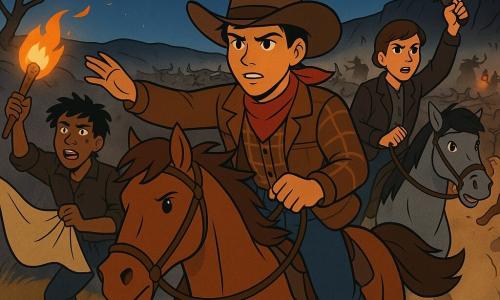
The riders drew closer. Mae stepped out into the open, making herself visible against the fire's faint glow. She held her hands away from her sides, not reaching for her gun, but letting them see it was there.
A horse snorted. A figure on the ridge called down, “Evenin', ma'am.”
His voice was polite in the way a wolf might be polite to a lamb.
Mae lifted her chin. “Evenin'. You lost?”
A chuckle. “Just passin' through. Saw your wagons. Thought we'd ask for water.”
Mae kept her voice steady. “Water's for travelers. Travelers come in the daylight.”
The rider urged his horse forward a few steps, still staying high. “Daylight's when folks can see us comin'.”
“That's the point,” Mae said.
Another voice, lower. “We ain't here for trouble.”
Mae believed that was true. They were here for taking.
She stalled, thinking fast. Their ridge position was good. If they rushed, they could scatter the oxen, steal a horse, grab supplies. But if they thought the caravan was better guarded than it looked, they might decide it wasn't worth the effort.
Mae raised her voice just a little, as if calling to a larger camp. “Jonah! How many on the north line?”
Jonah, catching on, shouted from the dark, “Plenty!”
Mae called again, “Lottie! You set?”
From the center of camp, Lottie answered, loud and fearless, “All set, Mae!”
Mae didn't smile, but her eyes sharpened. “You still want that water?”
The lead rider hesitated. Mae could almost hear him counting shadows, guessing at numbers. The camp was quiet, too quiet—like a trap.
Mae added, calm as dust, “We've got families here. If you come down, you'll be explaining yourself to every soul with a rifle and a temper.”
A long pause.
Then Mae said one word, clear as a match strike: “Storm.”
Lottie and the hidden helpers slammed pots and pans together in a sudden crash—metal thunder rolling across the valley. Someone shouted. A dog barked. Jonah and two others fired one shot into the air, not at the riders, just into the sky, the sound snapping like a whip.
The riders' horses spooked, dancing sideways. The men swore, trying to steady them.
Mae stepped forward, voice hard now. “Move on.”
For a heartbeat, Mae thought the lead rider might push it anyway. Then he spat into the dark.
“Not worth it,” he muttered, and wheeled his horse around.
The shapes retreated, dissolving into the night like smoke pulled by wind.
When the hoofbeats faded, the camp exhaled.
Eli popped up from behind a wagon like a prairie dog. “Did we scare ‘em off?”
“We convinced ‘em,” Mae said, and finally allowed herself a small grin. “There's a difference.”
Lottie came over, holding a pan like a shield. “I always said my cooking could start a war.”
Jonah snorted. “If they come back, I'll feed ‘em my stew. That'll finish the job.”
People laughed—quietly at first, then stronger. The warmth of it spread through the camp like a blanket.
Mr. Harlan approached Mae, eyes bright in the firelight. “You didn't shoot at ‘em.”
“Didn't need to,” Mae said. “Duty ain't about proving you're the toughest. It's about keepin' folks safe.”
She walked the perimeter again after that, listening to the night. It stayed dark and wide, but it felt a little less hungry now.
Chapter 6: Fort Clay and the Far Horizon
Morning arrived cool and clean, as if the world had decided to behave for a change.
The caravan moved out early, wheels turning with a steadier confidence. The land began to change again—more trees, then the faint outline of buildings in the distance, low and square against the sky.
Fort Clay.
Eli spotted it first and whooped so loud a bird launched itself from a branch in surprise. “There! I see it!”
Mrs. Sato pressed a hand to her mouth, eyes shining. Mr. Harlan's shoulders sagged with relief, like he'd been carrying the fort on his back the whole way.
As they approached, the fort's palisade walls rose clearer—rough logs sharpened at the top, a watchtower, a gate that looked sturdy enough to argue with anything.
A guard at the entrance lifted a hand. “Hold! Who comes?”
Mr. Harlan rode forward. “Harlan caravan. Supplies and families. We're expected.”
The guard's gaze swept over the wagons, the oxen, the tired faces. It lingered on Mae a moment—on her wet-stained boots, her dust-caked hat, the calm way she sat her horse.
“Gate!” the guard called.
The wooden doors creaked open, and the caravan rolled in. Inside, the fort smelled of horses, smoke, and something like safety. People stepped down from wagons on legs that wobbled, laughing and crying at once. A few hugged their own shoulders, as if reminding themselves they were still whole.
Mae guided Juniper to the side and dismounted. She watched as families were directed to temporary shelters, as supplies were counted, as children ran a few steps and then stopped, unsure what to do with the sudden absence of danger.
Eli ran up to her, cheeks flushed. “We made it,” he said, like he couldn't quite believe it.
Mae nodded. “You did.”
Eli frowned. “You mean ‘we.'”
Mae's mouth twitched. “We.”
Lottie leaned against a post, stretching her back with a groan. “If anyone asks, I heroically endured three separate disasters and one of Jonah's speeches.”
Jonah walked past, carrying a crate. “My speeches are educational.”
Lottie snorted. “They educate people about boredom.”
Mae let their voices wash over her. The warmth of the fort was real, but so was the knowledge that another caravan would need leading, another trail would need choosing, another night would need watching.
Mr. Harlan approached, holding his ledger like it was lighter now. “Mae Calder,” he said, voice thick with feeling he didn't quite know how to handle, “you kept your word.”
Mae looked at the people unloading, at Eli helping Mrs. Sato carry a bundle, at Lottie joking with a soldier, at Jonah already inspecting a broken hinge like it had insulted him personally.
“It wasn't my word alone,” Mae said. “But I did swear it.”
Mr. Harlan nodded slowly. “Folks like you keep the West from swallowin' people whole.”
Mae didn't answer right away. She walked to the edge of the fort yard where the land opened beyond the walls. From here, the prairie stretched out, rolling and endless, sunlight spilling across it like a promise and a warning at the same time.
The horizon lay far off, thin as a drawn line, daring anyone to chase it.
Eli came to stand beside her, quieter now. “What happens next?” he asked.
Mae rested a hand on the top rail of the fence. The wood was rough under her palm—real, solid. “Next,” she said, “you live the life you worked to reach. And when it's your turn to carry someone else's load, you don't drop it.”
Eli nodded, thoughtful. “Like duty.”
“Like duty,” Mae agreed.
A breeze moved through the grass beyond the walls, bending it in waves that looked almost like motion—like the land itself was traveling.
Mae lifted her gaze, meeting the open sky. The West was still out there, wide and wild, full of challenges waiting in the distance.
And she looked toward the horizon as if she could already see the next trail.