Chapter 1: Dust on the Wind
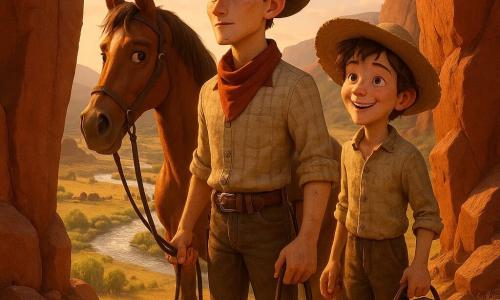
The prairie looked like an ocean made of gold—tall grass rolling and bowing under a steady wind. Above it, the sky stretched wide and bright, so big it made sixteen-year-old Luke Mercer feel both tiny and strangely brave at the same time.
He rode his bay gelding, Comet, along the edge of Dry Willow Creek. The creek was supposed to be a ribbon of water, cold and clear. Today it was a cracked ditch with a few muddy puddles clinging to life.
Luke slid down from the saddle and knelt by one puddle. The mud smelled sour, like old boots left in the rain. He dipped two fingers in, then rubbed them together. Grit. Sand. Not much water at all.
“Come on,” he muttered. “Don't do this now.”
Comet snorted and nudged Luke's shoulder with a warm, impatient nose.
“I know, boy. You're thirsty. We all are.”
A shadow moved across the ground. Luke looked up and saw three riders approaching—slow, careful, like they didn't want to stir up trouble but were ready if trouble came anyway. Their horses were thin. Dust coated their pant legs. The front rider was a woman with her hair tied back in a dark braid, eyes sharp as flint.
Luke recognized her. He'd seen her in town once, trading beadwork for flour.
She raised a hand. “Peace,” she called.
Luke stood, keeping his palms open where she could see them. “Peace.”
The riders stopped a few yards away. The woman's gaze flicked to the creek bed, then to Luke's canteen hanging from his saddle horn.
“I'm Luke,” he said, because silence could turn into suspicion out here. “Luke Mercer. I work the Bar M ranch.”
The woman nodded. “I am Aiyana. My people camp beyond the cottonwoods. The water that ran to us… does not run now.”
Luke swallowed. “Dry Willow's been shrinking for weeks.”
Aiyana's jaw tightened. “Someone changed it. There is a new ditch cut above the bend. The water goes east now—into the ranchers' troughs.”
Luke felt heat rise in his face. He knew what she meant. Everyone did, even if they pretended not to. Over the past month, men had been whispering about a new boss with money and muscle—Mr. Hargrove—buying land and “improving” it. Improving, meaning taking.
Aiyana leaned forward in her saddle. “Children are sick. Elders cannot walk far. We do not ask for gifts. We ask for what was ours.”
Luke's throat went tight. His pa used to say the West was big enough for anybody with grit. But when water went missing, the West suddenly got small.
“What do you want me to do?” Luke asked, and the question surprised him as much as it did Comet, who flicked an ear like, Now we're talking.
Aiyana studied Luke for a long moment. Wind tugged at her braid. Finally she said, “You ride between worlds. You speak their words. You can carry a message—one they cannot ignore.”
Luke's stomach fluttered, half fear, half something like purpose. “A message to who?”
“To the county office in Red Mesa,” Aiyana said. “There is a paper—an agreement. Long ago, it was signed. It says this water must run.”
Luke had heard of those papers, the ones men waved around like they were shields. Some papers were real. Some were tricks. Either way, a paper could be stronger than a fist if the right people believed in it.
He nodded slowly. “If you have that agreement, I can help.”
Aiyana reached into her saddlebag and pulled out a folded piece of worn cloth. Inside it, wrapped carefully, was a sheet of paper with faded ink and a stamp that still looked official.
Luke took it as gently as if it were a baby bird. “I'll get this to Red Mesa.”
Aiyana's eyes softened, just a little. “The road is not kind. Men who steal water do not enjoy being watched.”
Luke tried for a grin, though it came out crooked. “Then they better get used to being uncomfortable.”
Comet snorted again, as if laughing.
Aiyana's riders turned their horses. Before she left, she said one more thing, quiet enough that Luke had to lean in.
“Courage is not loud,” she said. “It is steady.”
Luke watched them disappear into the grass, then looked at the dry creek bed like it had betrayed him. He tucked the agreement inside his shirt, close to his heart where sweat and fear couldn't reach it.
“All right,” he told Comet, swinging into the saddle. “Red Mesa it is.”
The wind pushed against them as they rode out, and Luke felt the West watching—wide, wild, and waiting to see what kind of boy he'd choose to be.
Chapter 2: The Ditch of Thieves
Luke didn't head straight for Red Mesa. Not yet. If he carried a complaint without proof, the county clerk might yawn and call it “ranch business.” Luke needed to see that ditch with his own eyes.
By late afternoon the sun hung low and mean, turning the land copper. Luke rode along a fence line until he found the place the creek should have turned. Instead, a fresh-cut trench sliced into the earth like a knife mark. Water—thin, precious water—trickled east, guided by stacked stones and stakes.
Luke stared. Someone hadn't just borrowed the creek. They'd kidnapped it.
He dismounted and crouched beside the trench. The ground around it was stamped with hoofprints—plenty of them. And boot marks too, deep and straight, the kind made by heavy men who liked to feel important.
A voice drawled from behind him. “Admiring the craftsmanship?”
Luke froze. Slowly, he rose and turned.
Two riders sat on the bank above him. One was tall and bony with a mustache that seemed to hate his own face. The other was shorter, rounder, and smiling like he'd found a loose dollar on the ground.
Luke recognized them from town: Hargrove's hands. Everyone called them Chet and Mullins. They were the sort of men who could make “How do you do?” sound like a threat.
Luke lifted his chin. “Didn't know this was private land.”
Chet tipped his hat with no warmth. “It is now.”
Mullins leaned forward. “You lost, kid? Bar M's west.”
Luke's brain raced. He could try to ride away, but Comet was down by the trench, and these men were already between Luke and the easiest path out. He could fight—two against one, which wasn't brave so much as dumb. Or he could talk, and talking was a kind of riding too: you had to keep your balance.
Luke shrugged like he didn't care. “Just checking the creek. My pa sent me. Cows don't drink dust.”
Chet's eyes narrowed. “Your pa talk to Hargrove?”
“He talks to whoever's got ears,” Luke said. He forced a laugh. “Pa can complain a mule into tears.”
Mullins chuckled, though it sounded practiced. “This ditch is legal. Mr. Hargrove bought rights.”
Luke kept his face calm, but inside, anger sparked. Bought rights. Like you could buy the rain.
He nodded. “Well, I'll tell Pa you say it's legal. He'll be thrilled.” He started to step toward Comet.
Chet's hand lifted slightly, and Luke stopped. Chet wasn't touching his gun, but he didn't need to. His voice was enough.
“Before you go,” Chet said, “you seen any Injuns around?”
Luke felt the word like a slap, but he didn't let it show. “I've seen folks traveling,” he said evenly.
Mullins' smile thinned. “Mr. Hargrove don't want trouble. Those people got no claim here.”
Luke met Mullins' eyes. “Water doesn't belong to one man.”
Chet's mustache twitched. “Careful, boy.”
Luke knew that tone. It meant: One more step and we'll make you regret breathing.
He lifted his hands again, friendly and empty. “No trouble. I'll be on my way.”
Chet watched as Luke walked to Comet. Luke kept his movements slow. He swung into the saddle like he'd done it a thousand times—which he had—and turned Comet without showing hurry.
As he rode away, he felt their stares burning holes in his back. The ditch gurgled softly, like it was ashamed.
Luke didn't stop until the land dipped and the trench disappeared behind a rise. Then he leaned low over Comet's neck and whispered, “We're going to Red Mesa tonight.”
Comet pinned his ears and surged forward, hooves thudding like a drumbeat.
Behind them, the sun slid down, and the shadows grew long enough to hide men and their bad ideas.
Chapter 3: Night Riders
The trail to Red Mesa was a pale scar under moonlight. Sagebrush released its sharp, clean smell each time Comet's hooves brushed it. Luke's eyes watered from the wind, but he didn't slow. He kept one hand on the reins and the other pressed against his shirt, where the agreement lay folded like a secret.
Around midnight, Comet's ears snapped forward. Luke felt it too—a change in the air, as if the night itself had started holding its breath.
He reined in and listened.
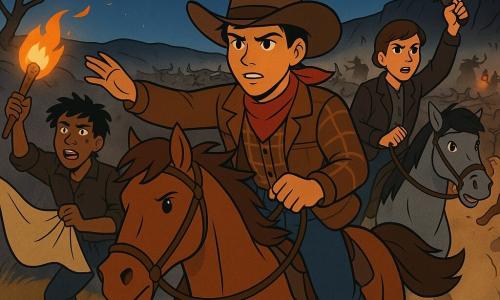
Somewhere behind, hoofbeats. Not coyotes. Not stray cattle. Riders.
Luke urged Comet off the main trail and into a shallow wash lined with scrub. They crouched there, half hidden. Luke's heart hammered so hard he worried it might echo.
Two shapes appeared on the trail, then three. Moonlight glinted on metal—spurs, maybe a rifle barrel.
Luke recognized the way one rider sat his horse, stiff and confident. Chet. And beside him, Mullins, round as ever. A third rider rode slightly behind, carrying a lantern low, its light hooded.
“They went this way,” Mullins' voice floated back, distorted by distance.
Chet answered, colder. “He's got something. I saw it in his eyes.”
Luke's stomach dropped. They weren't following him for fun.
Comet shifted, hooves scraping stone. Luke tightened his grip, whispering, “Easy, boy. Easy.”
The riders slowed, scanning the ground. The lantern light swept, a pale finger searching. Luke pressed himself against the dirt bank, willing his breathing to quiet.
Then Comet sneezed.
It was a tiny sound, the kind that usually made Luke laugh. Tonight, it felt like a gunshot.
Chet jerked his horse. “There!”
Luke didn't think. He moved.
“Go!” he hissed, and Comet exploded forward, leaping out of the wash like a thunderbolt. Luke ducked low as the lantern swung wildly behind him.
“Stop him!” Mullins shouted.
A rifle cracked. Dirt kicked up near Luke's boot. Comet veered, muscles bunching, and Luke clung tight, his teeth rattling.
The land ahead dropped into a maze of gullies. Luke aimed for the darkest line—shadow meant depth, and depth meant cover. Comet slid down a slope, hooves skidding on loose gravel. Luke's stomach floated, then slammed back into place as they hit the bottom.
Behind them, the riders hesitated at the edge.
“Too steep,” Mullins called, his voice nervous now.
Chet's voice snapped like a whip. “Then find another way!”
Luke didn't wait to see if they did. He guided Comet through the gully, where the walls rose high enough to swallow moonlight. The air smelled damp, a promise of water that wasn't quite real.
At a narrow point, the gully split. Luke chose the left path at random, then immediately regretted it when it ended in a wall of rock.
“Great,” he panted. “Real smart, Luke.”
Hoofbeats echoed somewhere above. Chet and Mullins weren't far.
Luke's eyes darted. The rock wall had a crack—just wide enough, maybe, for a person, not a horse. He could hide himself, but Comet would be trapped.
Comet turned his head and blew out a breath, as if saying, Don't even think about leaving me.
Luke swallowed hard. “All right. We don't split up.”
He grabbed the reins, backing Comet up as quietly as possible. The horse moved with careful steps, trusting Luke even when the darkness pressed close.
The hoofbeats grew louder, then faded, then returned—circling.
Luke waited, counting his breaths. When the sounds drifted toward the other branch, Luke acted. He nudged Comet forward again, back the way they'd come, and took the right split this time.
The gully widened and rose into open ground. Ahead, a line of cottonwoods stood like black flames against the stars. Beyond them—Luke hoped—was the road to Red Mesa.
As they burst into the open, Luke heard Chet shout behind him, furious. “He's out!”
Another shot rang out. The bullet whined past Luke's ear like an angry hornet.
Luke didn't look back. He leaned forward and spoke into Comet's mane. “Run, boy. Run like the devil's late for supper.”
Comet ran.
The cottonwoods rushed up, branches whipping at Luke's shoulders. He ducked and pushed through, then found the hard-packed county road on the other side.
Red Mesa was still miles away, but Luke had something stronger than distance now: proof that he mattered enough to be chased.
And he wasn't about to quit.
Chapter 4: Paper and Promises
Red Mesa greeted the dawn with smoke from chimneys and the smell of frying bacon. Luke rode in on a tired Comet, both of them dust-streaked and wide-eyed. The town was waking up slow—storekeepers unlocking doors, a dog stretching in the street, a rooster somewhere yelling its opinion at the world.
Luke swung down, knees wobbly. He patted Comet's neck. “You did good. I owe you an apple the size of a wagon wheel.”
Comet flicked his tail, clearly expecting the apple immediately.
Luke headed for the county office, a square building with peeling white paint and a flag that snapped in the breeze like it was trying to escape.
Inside, the air was stale and smelled of ink. A ceiling fan turned lazily, doing almost nothing. Behind a counter sat a clerk with tiny glasses and a mustache that looked like it had been brushed with a ruler.
He didn't look up. “Fill out a form.”
Luke stepped closer. “I need to speak to the county commissioner.”
The clerk sighed like Luke had asked him to wrestle a bear. “Commissioner's busy.”
“This is about water rights,” Luke said, and slid the folded agreement onto the counter.
That got the clerk to look up. His eyes moved over Luke—young, dusty, tired—then down to the paper. His expression shifted, just a notch, from bored to cautious.
“Where'd you get this?” the clerk asked.
“From the people it belongs to,” Luke said. “Dry Willow Creek's been diverted. There's a ditch cut above the bend.”
The clerk's lips tightened. “That's a serious accusation.”
Luke leaned in, lowering his voice. “Men followed me last night. They shot at me.”
The clerk's face paled. “Good heavens.”
Luke didn't let up. “If you want forms, fine. I'll fill out every form you've got. But if someone's stealing water that's protected by agreement, you need to do something before folks start getting hurt.”
The clerk swallowed and picked up the paper carefully, like it might bite. He read, eyes scanning the faded ink. Then he stood.
“Wait here,” he said, and vanished through a back door.
Luke waited, tapping his boot. Minutes crawled by. A woman came in to pay taxes, glanced at Luke like he was a stray coyote, and left again. Luke's stomach growled. He ignored it.
Finally the back door opened and an older man stepped out with the clerk. The man wore a neat vest and had silver hair combed back. His eyes were tired but sharp.
“I'm Commissioner Hale,” he said. “You're the one raising a stir this early.”
Luke straightened. “Yes, sir. Luke Mercer.”
Hale took the agreement and read it, slower than the clerk, like each word mattered. When he finished, he exhaled through his nose.
“This is a recognized document,” Hale said. “It states water access for the Willow Band is guaranteed along Dry Willow Creek.”
Luke felt a rush of relief—then worry. “Then you'll make Hargrove open the creek?”
Hale's mouth twisted. “Mr. Hargrove claims he purchased adjacent land and improved irrigation. He'll argue the creek ‘naturally' shifted.” He looked at Luke. “Men with money can make a lie wear a fancy coat.”
Luke's hands clenched. “So what do we do?”
Hale glanced toward the window, where the street was brightening. “We investigate. I'll send a deputy with you to see the diversion.”
Luke blinked. “With me?”
Hale nodded. “You've already seen it, and you've already been threatened. That makes you either foolish… or committed.”
Luke let out a breath that was almost a laugh. “I'm working on being committed.”
A deputy was fetched—a broad-shouldered woman named Deputy Sloane with a hat brim low over keen eyes. She looked Luke up and down.
“You the kid who got shot at?” she asked.
“Only a little,” Luke said. “They missed.”
“Rude of them,” Sloane replied, deadpan. Then her mouth twitched. “All right. Saddle up. And try not to be brave in a stupid way.”
Luke met her gaze. “I'll do my best.”
They rode out with the morning sun at their backs, the agreement now tucked safely in the commissioner's pocket. Luke wished it were still against his own heart, but he reminded himself: the goal wasn't to keep the paper. The goal was to make it mean something.
As the town fell behind, Deputy Sloane said, “You helping the Willow Band because it's right… or because you want to pick a fight with Hargrove?”
Luke thought of Aiyana's steady eyes and the dry creek bed like a wound.
“I'm helping because a promise is a promise,” he said. “And because kids shouldn't have to watch their water disappear.”
Sloane nodded once. “Good answer.”
The prairie opened ahead, bright and unforgiving. Luke's fear was still there, but now it had company: determination, riding beside him like a second horse.
Chapter 5: The Standoff at Dry Willow
They reached the diversion by midday. The trench gleamed with a thin ribbon of water, sparkling like it was proud of itself.
Deputy Sloane dismounted and examined the stakes, the stones, the fresh shovel marks. Her jaw set harder with every step.
“This isn't a natural shift,” she said. “This is theft with mud on its boots.”
Luke pointed. “The creek's supposed to run that way.” He gestured west, toward the cottonwoods where Aiyana's camp lay.
Sloane stood and dusted her hands. “All right. Let's pay Mr. Hargrove a visit.”
They didn't have to go far. A rider appeared on the rise—Chet—watching them like a hawk watches a field mouse. A moment later Mullins joined him. And then, from behind them, more men rode in, fanning out.
Luke's mouth went dry. “That's… a lot of friends.”
Sloane's hand rested near her holster, but she didn't draw. “Stay close,” she murmured.
A larger group crested the rise from the east. At the center rode a man on a glossy black horse, dressed too clean for real work. His hat was fine. His boots shone. His smile was small and sharp.
Mr. Hargrove.
He tipped his hat at Deputy Sloane. “Deputy,” he said smoothly. “Didn't expect company.”
Sloane's voice was calm, but it carried. “This ditch is an illegal diversion of Dry Willow Creek. You'll remove it.”
Hargrove's smile didn't move. “That's a strong claim.”
“It's a true one,” Sloane replied.
Hargrove glanced at Luke, and something cold flickered in his eyes. “And this is…?”
“Citizen witness,” Sloane said. “He reported threats and gunfire.”
Mullins let out a laugh that didn't reach his eyes. “Gunfire? Folks shoot at jackrabbits all the time.”
Luke felt anger rise, hot and dangerous. He spoke before he could stop himself. “I'm not a jackrabbit.”
Chet's hand twitched near his gun. “You're close enough.”
Sloane lifted a warning finger, like a schoolteacher who'd had enough. “No one's drawing today.”
Hargrove sighed dramatically. “Deputy, you're making a mess over a trickle of water. My ranch needs it. My cattle need it.”
“And the Willow Band?” Luke blurted. “Don't they need it too?”
Hargrove's gaze slid over Luke like grease. “They can move. That's what people do out here. Adapt.”
Luke heard Aiyana's voice in his memory: Courage is not loud. It is steady.
He forced himself to breathe. “They did adapt,” Luke said. “They hunted, they traded, they survived winters that would freeze your fancy boots solid. But you can't adapt to someone stealing what's promised to you.”
Hargrove's smile sharpened. “Promised by whom? Dead men with ink?”
Sloane stepped forward. “Promised by the county. By law.”
Hargrove tilted his head. “Law is… flexible, Deputy. Especially when there's money to grease it.”
Luke saw Sloane's eyes narrow. The air felt stretched tight, like a rope about to snap.
Then, from the west, came a new sound: hoofbeats. Many hoofbeats.
Aiyana and several riders emerged near the cottonwoods, approaching at a steady pace. They didn't rush. They didn't shout. They simply came, like the tide.
Hargrove's men shifted nervously. Chet spat into the dirt.
Aiyana rode to the edge of the creek bed and dismounted. She looked at the ditch, then at Hargrove.
“This water was shared,” she said, her voice even as stone. “You took it without asking.”
Hargrove spread his hands. “Business.”
Aiyana's eyes flashed. “Life.”
Deputy Sloane lifted her voice. “Mr. Hargrove, I'm placing you under order to restore the creek. Refusal will result in seizure of the diversion work and charges for intimidation and unlawful alteration of a waterway.”
Hargrove's black horse stamped, impatient. Hargrove looked around—at Sloane, at Aiyana's riders, at Luke. His smile wavered for the first time.
“You think you can make me?” he asked quietly.
Luke felt the weight of the moment. He was sixteen, dusty, and scared. But he was also here. He was still sitting in the saddle.
He swung down and walked to the ditch. He took out his pocketknife—small, ordinary, the kind used for cutting rope and whittling sticks. His hands trembled, but he kept moving.
Chet barked, “Don't you—”
Sloane's voice snapped. “Back off.”
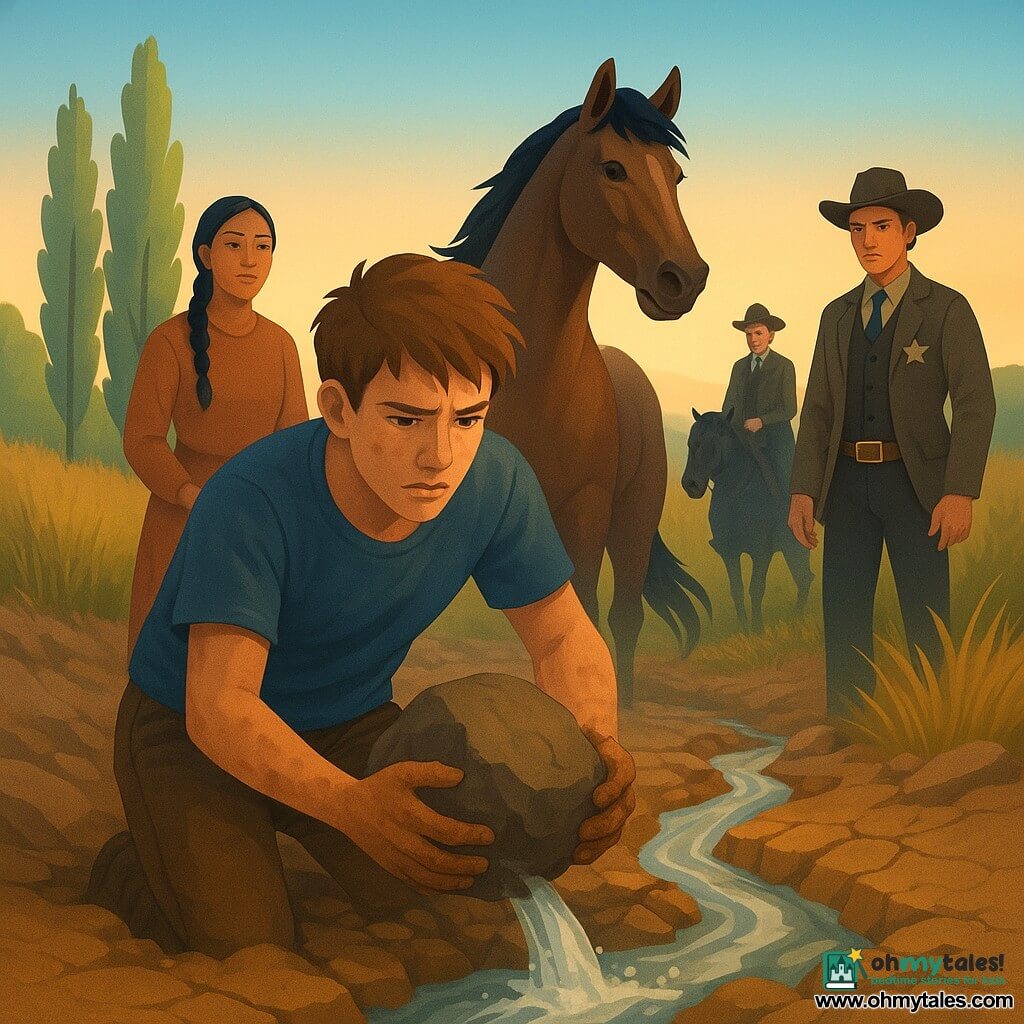
Luke knelt by the stones that guided the water east. He pried at the stacked rocks, one by one. The water pushed against his fingers, cold and eager.
Hargrove's face darkened. “Stop him.”
No one moved.
Luke removed the last stone. Water surged, spilling out, seeking its old path like a dog running home. It flowed west, into the dry bed, filling cracks, darkening dust.
For a second, everything was quiet except the sound of water returning.
Aiyana's shoulders dropped slightly, as if she'd been holding up the sky. One of her riders let out a breathy laugh, half relief, half disbelief.
Hargrove's men looked at each other, suddenly unsure.
Deputy Sloane stepped beside Luke. “This diversion is now under county control,” she announced. “Any attempt to rebuild it will be treated as a criminal act.”
Hargrove's smile was gone. “You'll regret this,” he said, but his voice lacked its earlier certainty.
Luke stood, mud on his hands, and met Hargrove's eyes. “Maybe,” Luke said. “But I'd regret it more if I did nothing.”
Hargrove turned his horse sharply and rode off, his men following in a scattered, angry line.
When they were gone, the prairie seemed to exhale.
Luke looked at the water running again—still not much, but real. He felt shaky, like after a storm. He wiped his hands on his pants and tried to grin.
“Well,” he said to Comet, “I guess we just argued with a river and won.”
Comet snorted, clearly taking full credit.
Chapter 6: A Steady Kind of Courage
The next days weren't easy. Fixing a creek wasn't like fixing a fence. Deputy Sloane posted notices and returned with workers hired by the county to break down the trench and smooth the land. Hargrove grumbled, argued, and sent letters that smelled like expensive ink. But every time his men tried to linger near the creek, Sloane was there, watching like a storm cloud that knew exactly where to strike.
Luke rode back and forth between the Bar M and the cottonwoods, carrying messages, sharing news, helping where he could. Sometimes that meant hauling water barrels until his arms burned. Sometimes it meant listening to Aiyana's people tell stories by the fire, their voices weaving past and present together like threads in a blanket.
One evening, Luke sat near the edge of the Willow Band camp, warming his hands by the flames. The night smelled of woodsmoke and damp earth—because the creek was running again, and the ground remembered.
Aiyana sat across from him. The firelight painted copper on her cheekbones.
“You did not quit,” she said.
Luke poked the fire with a stick, watching sparks leap up like tiny stars. “I wanted to. At that gully, when they were chasing me… I thought, ‘Why me?'”
Aiyana nodded, as if she'd expected that. “And what did you answer?”
Luke shrugged. “I didn't have an answer. I just… kept going.”
Aiyana's eyes softened. “That is perseverance. Not a feeling. A choice you make again and again.”
Luke gave a tired smile. “Feels a lot like being stubborn.”
Aiyana's mouth curved. “Stubborn can be useful.”
Across the camp, children ran along the creek bank, shrieking with laughter as they dared each other to hop stones without slipping. A little boy splashed too hard and soaked his own boots, then stared at his feet like they'd betrayed him.
Luke called, “You're supposed to splash the water, not wear it!”
The boy looked up, startled, then giggled. “I'm practicing for a flood!”
“Ambitious,” Luke said.
Deputy Sloane arrived the next morning with Commissioner Hale. Hale dismounted, looked at the restored creek, and nodded slowly.
“It's not perfect,” he said, “but it's flowing where it should.”
Luke stood beside Comet, feeling sun on his face. “Hargrove won't try again?”
Hale's expression was honest. “He might. Men like him don't enjoy losing.”
Sloane added, “But now the county's watching. And a lot of people saw what happened out here.”
Luke glanced toward Aiyana and her riders. “And they're watching too.”
Hale turned to Luke. “You did a difficult thing, son. You stood up when it would've been easier to look away.”
Luke felt his ears warm. Praise made him squirm worse than cactus needles. “I just—”
Hale held up a hand. “No false modesty. The West is full of folks who talk about fairness. Not many ride for it.”
Luke swallowed and nodded, because he didn't trust his voice to sound steady.
Later, as the sun lowered and turned the creek into a ribbon of firelight, Luke prepared to leave. Comet shifted under the saddle, ready for the road.
Aiyana approached. In her hands she held a small strip of leather braided with blue thread.
“For your bridle,” she said. “A reminder.”
Luke accepted it carefully. “Thank you.”
Aiyana looked toward the water, then back at Luke. “When the wind changes, people can change too,” she said. “Remember that.”
Luke tied the braid to Comet's bridle. The blue thread fluttered like a tiny flag.
He mounted up, then paused. The camp was behind him, the open prairie ahead. For once, the space didn't feel empty. It felt connected—by water, by promises, by choices.
Luke lifted a hand, palm open, the way he had at the creek that first day.
“My sincere salute to you and your people,” he said, voice clear. “May the creek keep running, and may your rights be respected.”
Aiyana returned the gesture. “Ride steady, Luke Mercer.”
Luke clicked his tongue, and Comet stepped forward onto the trail. Hooves thudded softly. The wind carried the sound of laughter and running water behind him, and Luke rode on—tired, proud, and more grown than he'd been a week ago, choosing perseverance with every mile.