Chapter 1: The Colors in a Tin
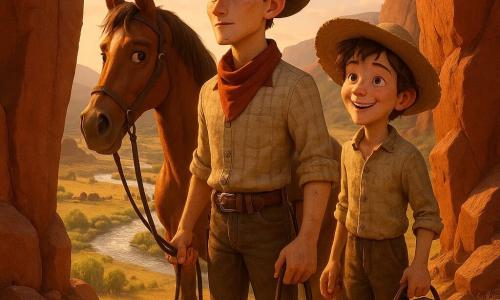
Juniper “June” Hale liked mornings best—when the desert still held a little coolness, and the sky looked scrubbed clean, like someone had wiped it with a damp cloth. She stood outside the chuckwagon at Sagebrush Ranch with a tin of paint in one hand and a brush in the other, watching sunlight creep across the corrals.
The tin held three colors, carefully wrapped in rags: canyon red, sunset gold, and a bold, brave blue. Those were the ranch colors—stitched on blankets, stamped on crates, and painted on the long sign that faced the trail.
Today, June was supposed to bring those colors to Cottonwood Crossing for the Founders' Day rodeo. The ranch had been invited to march in the parade, and old Mr. Rusk, the ranch owner, wanted their banner looking sharp.
“You're sure you can manage this?” Mr. Rusk asked from the porch, squinting under his hat. He wasn't unkind—just worried in the way of people who'd seen too many things go wrong in wide-open country.
June tucked a loose curl under her bandanna. “I can manage paint and a trail. I'm not planning to wrestle a thunderstorm.”
Slim, the cook, leaned out of the chuckwagon and waved a ladle. “Don't let the paint freeze overnight. And don't let any varmints steal my biscuits, neither!”
June grinned. “If a coyote takes your biscuits, Slim, it'll regret it.”
Her horse, Pepper, tossed his head as if he agreed. Pepper was a rangy bay with a smart eye and a habit of huffing when people acted foolish.
June slid the tin and brush into her saddlebag and patted Pepper's neck. She liked the quiet duties at the ranch—mending tack, brushing horses, checking fence lines—jobs that needed patience. Calm was a tool out here, as useful as a rope.
But calm didn't mean dull.
The sky was huge, the land even bigger, and somewhere between Sagebrush Ranch and Cottonwood Crossing, trouble could sprout like a cactus: sharp and unexpected.
As June swung into the saddle, her friend Eli jogged over from the barn. He was two years younger, all elbows and freckles, with a grin that usually meant he'd been up to something.
“You're really going alone?” he asked.
June raised an eyebrow. “I'm not hauling a piano.”
Eli pointed at her saddlebag. “You're hauling the ranch's pride. Colors matter. Folks see 'em and they know who you are.”
June nodded. She understood that. The colors were more than paint; they were a promise. Sagebrush Ranch didn't sneak around. They showed up.
Mr. Rusk cleared his throat. “Take the long way by Coyote Ridge. The creekbed's been acting tricky since that last rain.”
“Long way it is,” June said.
She clicked her tongue, Pepper stepped forward, and Sagebrush Ranch fell behind her like a story closing its first page.
Chapter 2: Wind, Rattles, and a Bad Sign
The trail to Coyote Ridge rolled through grasslands that smelled like sun-warmed sage. Prairie dogs popped up to stare, then vanished. A hawk circled overhead, riding the wind like it owned the whole sky.
June rode with her shoulders loose and her eyes open. Calm wasn't closing your eyes and hoping. Calm was noticing things early.
Around midday, the wind changed. It came from the east, hot and dry, and it carried a sound that didn't belong—metal clinking, faint at first, then sharper.
Pepper's ears pricked.
June slowed him and listened. The clinking came again, like a chain bumping against a wagon. She slid off Pepper and led him behind a low rise where the grass grew thick and tall.
From there, she saw the source: two men near a broken-down wagon on the trail ahead. One was bent over a wheel. The other stood with hands on hips, scanning the land as if searching for something.
June's first thought was simple: travelers. Her second thought was sharper: why stop right in the open, where a working wheel could be fixed off the trail?
Pepper shifted his hooves, restless. June rubbed his neck. “Easy.”
She watched a moment longer. The standing man turned his head, and sunlight flashed on something at his belt—metal, but not a buckle.
A revolver.
June's pulse tried to jump, but she held it down the way you hold down a lasso loop so it doesn't tangle. No panicking. Panicking was just getting lost inside your own head.
She backed Pepper away and turned toward a shallow gully that cut along the side of the ridge. If those men were harmless, she could swing wide and no one would care. If they weren't harmless, being unseen would feel like a gift.
She guided Pepper into the gully. The air down there smelled damp, like old mud and hidden springs. Rocks clicked under hooves. June kept moving, careful and steady.
Then Pepper stopped hard.
June looked ahead and saw why: a rattlesnake, coiled on a warm stone, its tail buzzing a warning that seemed to fill the whole gully.
Pepper snorted and tried to leap back. June tightened the reins and whispered, “Hold. Hold, boy.”
The snake wasn't attacking. It was saying, I'm here. Don't be stupid.
June's mind raced, but her hands stayed calm. She eased Pepper sideways, slow as a drifting cloud. The snake watched with flat patience, then slipped off the rock and vanished into a crack as if it had never existed.
June let out a breath she didn't know she'd been holding.
“Thank you,” she murmured to the empty stone.
She continued through the gully until it bent toward a stand of scrubby junipers. From there, she could climb out and rejoin the main trail farther on, past the wagon.
As she did, she heard voices—closer now.
“Someone's out here,” a man said.
June froze. Pepper's muscles tensed under her knees.
Another voice, rougher: “Probably just a cow-girl. Keep your eyes open. The Hale ranch don't like strangers.”
So they knew her ranch.
June's fingers brushed the saddlebag where the paint tin rested. Her mission suddenly felt heavier. Ranch colors. Ranch pride. Ranch trouble.
She angled Pepper toward the junipers, using the trees as cover, and rode without a sound.
Chapter 3: The Banner That Couldn't Wait
By late afternoon, June reached a small line shack used by cattle hands. It was one-room, with a slanted roof and a door that complained loudly when you opened it, as if it wanted attention.
June tied Pepper to the porch post and stepped inside. Dust motes floated in sunbeams. A cot sat in one corner. A crate served as a table. On the wall hung a faded sketch of a longhorn with horns like a question mark.
June set down her saddlebag and listened.
Nothing but wind.
She poured water into a tin cup and drank slowly. Calm again. Calm didn't mean nothing bad was happening. Calm meant you were choosing not to let fear drive the wagon.
She needed to decide: keep on to Cottonwood Crossing before dark, or rest here and ride early? The men on the trail worried her. If they were waiting for someone, being on the road at night would be like volunteering to be a shadow.
But waiting could be risky too. If those men were after the ranch colors—after the banner and sign—then time mattered.
June opened her saddlebag and pulled out the paint tin. The red, gold, and blue looked bright even in the dim shack. They made her think of Sagebrush Ranch at sunrise: red earth, gold light, blue sky.
Eli's words came back: Folks see 'em and they know who you are.
June made up her mind. She'd move at dawn, but she wouldn't waste the evening. The parade banner still needed painting, and the line shack had a plank of wood leaning against the wall—leftover from some forgotten repair.
She smiled. “Good enough.”
She set the plank on the crate and began sketching the ranch symbol: a simple sage sprig inside a circle. Her brush moved in steady strokes. Red for the circle, gold for the sprig, blue as a border that made it pop.
Outside, Pepper stamped once, then settled.
June worked until the last light turned the shack's window into a dull orange. When she finished, the sign looked proud and clean.
She leaned back and admired it. “Not bad for a day's ride and a rattlesnake conversation.”
A sudden sound snapped her attention: hoofbeats, far away.
June blew out the lantern and pressed herself against the wall, listening. The hoofbeats grew louder, then slowed near the shack.
A voice floated through the dark. “You sure she came this way?”
“Trail says yes,” another answered. “Keep quiet.”
June's mouth went dry. They were tracking her.
Pepper huffed softly, as if offended.
June had no time for angry thoughts. She slipped to the back of the shack where a small window sat just above the ground. It was more a suggestion of a window than a real one, but it would do.
She eased it open. The night air crawled in, cool and sharp.
Outside, the men's boots crunched gravel on the porch.
June whispered, “Pepper, hush.”
The door creaked.
A lantern's glow spilled through the cracks. A man muttered, “Empty.”
Another voice: “Look again.”
June slid out the window, belly to the ground. The dirt smelled like crushed weeds. She crawled toward Pepper's tether, keeping low.
Inside the shack, someone knocked the crate over. “What's this?” a man said, sounding pleased. “Colors.”
June's heart punched. They'd found the painted plank.
She reached Pepper, untied him with trembling fingers, and led him away without mounting. A horse's back was higher, easier to spot against moonlight. On foot, she was a shadow.
The men came out, their lantern swinging. “She's here,” one hissed. “Tracks fresh.”
June moved faster, guiding Pepper into the gully she'd traveled earlier. The ground dipped and swallowed them.
Behind her, a man shouted, “There!”
A gunshot cracked the night. The sound slapped the rocks and made Pepper jump.
June grabbed Pepper's mane and hissed, “Run.”
Pepper didn't need asking twice.
They thundered down the gully, hooves striking sparks off stone.
June leaned low and kept her voice steady. “Easy, boy. Straight. Straight.”
Fear tried to climb her throat, but she pushed it down. Panic would make her yank the reins, and yanking would send them into the gully wall.
Behind them, the hoofbeats of pursuit echoed, uneven but gaining.
June spotted a fork in the gully ahead—one branch narrow and twisting, the other wider and clear. The wider path would be faster. It would also be obvious.
June chose the narrow one.
Pepper squeezed between rocks, shoulders brushing stone. June ducked low. A branch scraped her hat right off her head. She didn't stop for it.
The gully tightened. The moon disappeared behind cliffs. The sound of the pursuers faded.
June let Pepper slow only when she was sure they were alone.
She pressed her forehead against Pepper's neck. “Good thinking. Good legs.”
Pepper flicked an ear like he was accepting praise politely.
June checked her saddlebag. The paint tin was still there. The brush too. But the plank—her freshly painted sign—was gone.
The ranch colors were still with her, but now someone else had a copy.
And that meant Cottonwood Crossing might not be safe.
Chapter 4: A Town With Too Many Eyes
At dawn, June rode out of the gully and onto open land. The sky turned pale pink, then brightened to clear blue. In the distance, Cottonwood Crossing sat like a cluster of toy blocks: a few false-front buildings, a water tower, and the thin line of the main street.
June approached carefully. A town could be friendly one minute and strange the next, depending on who was watching.
As she neared the livery stable, she saw parade posters tacked to a post: FOUNDERS' DAY! RODEO! PARADE AT NOON!
She swallowed. It was already morning. Not much time.
June tied Pepper and walked toward the general store, her boots tapping the boardwalk. She kept her face calm, like she had nothing to hide and nothing to fear—even though her nerves buzzed like that rattlesnake tail.
Inside the store, barrels of flour and beans lined the walls. A fan turned lazily. Behind the counter, a woman with silver hair and sharp eyes looked up.
“Morning,” the woman said. “You look like you argued with the night and barely won.”
June gave a tired smile. “That obvious?”
“I'm Mrs. Calder,” the woman said. “And you are… Hale, by the look of those saddle stitches. Sagebrush Ranch, yes?”
June's shoulders loosened a little. “June Hale.”
Mrs. Calder nodded. “The rodeo folks are expecting your ranch banner. They've been asking.”
“I brought the paint,” June said, lowering her voice. “But someone's following me. They stole a painted plank from a line shack last night.”
Mrs. Calder's eyes narrowed, sharp as a needle. “Stole? For what?”
“To fake our colors,” June guessed. “Or to shame us in front of everyone.”
Mrs. Calder leaned closer. “We've had trouble with a pair of men lately. Calling themselves the Quill Brothers, though I doubt their mama named them that. They've been trying to sell fake ‘ranch goods'—cheap rope, watered-down whiskey, forged brands. The sheriff chased them out, but I suppose they came slinking back.”
June's stomach sank. “They know Sagebrush Ranch.”
“Of course they do,” Mrs. Calder said. “A honest ranch is a bright target for dishonest men.”
June's hands curled into fists. Then she forced them open. Anger could be useful, but only if you held it like a knife by the handle.
“What do I do?” June asked.
Mrs. Calder tapped the counter thoughtfully. “First, breathe. You can't think if your mind's bucking like a bronc.”
June took a slow breath, then another.
Mrs. Calder continued, “Second, don't go straight to the parade ground waving your paint tin like a flag. If those men want to cause a scene, they'll do it where people gather.”
June nodded. “So we move quiet.”
Mrs. Calder's mouth twitched. “Exactly. The rodeo office has a back entrance. And the sheriff—he's been fixing the hitching rail outside the saloon. He owes me a favor. He'll listen.”
June hesitated. “If I bring the sheriff, they'll run.”
“Let them run,” Mrs. Calder said. “A skunk always runs when it smells trouble.”
June couldn't help a small laugh. “You're good at this.”
“I'm good at staying alive,” Mrs. Calder replied. “Now, here.”
She reached under the counter and pulled out a roll of cloth—thick canvas, clean and pale. “For your banner. Paint it quick. Dry it by the stove in the rodeo office. The parade's at noon, but a calm hand can do a lot in a short time.”
June's eyes widened. “I can't take this.”
Mrs. Calder waved her off. “It's not charity. I want that parade to look decent. Besides, if those Quill Brothers disgrace Sagebrush Ranch, they disgrace the whole town.”
June held the canvas carefully, like it was fragile.
Mrs. Calder added, “And June?”
“Yes?”
“If you feel fear, that's normal. Just don't let it drive.”
June nodded. “I won't.”
Outside, the town was waking up—wagon wheels groaning, people calling greetings, a dog barking at nothing important. Somewhere, a piano tried to remember a song.
June kept her steps steady and led Pepper around behind the rodeo office. The building smelled of sawdust and sweat, even from the outside.
She slipped in the back door.
Inside, a young clerk looked up from a stack of papers. “Can I help—”
June lifted a finger. “Quiet, please. I need a place to paint a banner. And I need to do it fast.”
The clerk blinked. “Uh. Sure. There's a stove in the next room.”
June unrolled the canvas on the floor, set her paint tin nearby, and started.
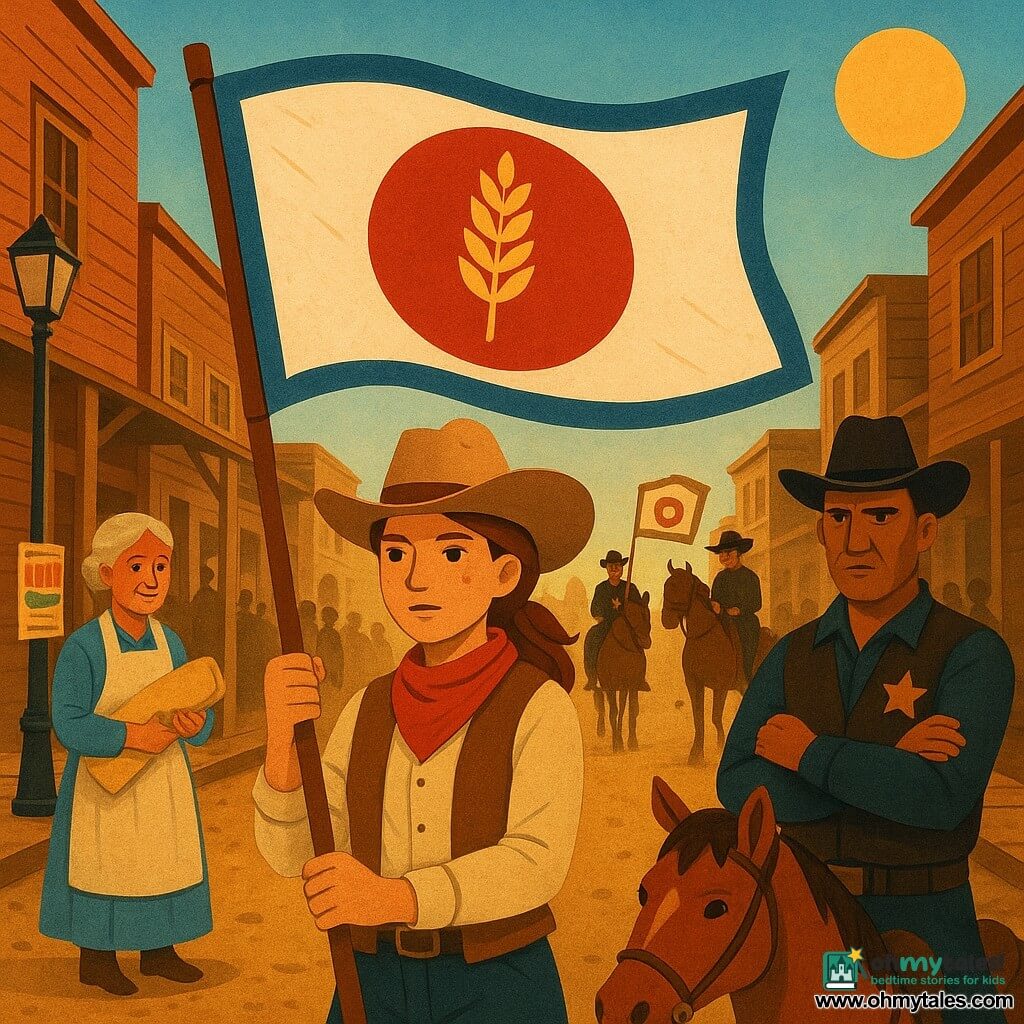
Her brush moved like a dancer—swift, controlled. Red circle. Gold sage sprig. Blue border. The colors sang against the pale cloth.
As she painted, she listened. Every creak outside could be boots. Every laugh could hide a threat. Still, she kept her hand from shaking. A steady line was a kind of courage.
Halfway through the blue border, the back door creaked again.
June's heart jerked.
Mrs. Calder's voice whispered, “It's me. And I brought the sheriff.”
A tall man with a star badge stepped in, hat in hand. His face was lined like dry creekbeds, but his eyes were alert.
“Miss Hale,” he said. “Mrs. Calder tells me someone's aiming to cause trouble.”
June didn't stop painting. “Two men. They tracked me from the trail. They stole a painted plank with our colors.”
The sheriff frowned. “Quill Brothers, likely.”
“I think so,” June said. “They might try to show up with our colors and claim to represent Sagebrush Ranch. Or make it look like we cheated.”
The sheriff scratched his jaw. “Folks in parades like to believe what they see.”
June dipped her brush in blue. “Then we make sure they see the truth.”
Chapter 5: Noon Dust and False Colors
By noon, Cottonwood Crossing was buzzing like a kicked beehive. People lined the street. Kids waved paper flags. Horses pranced and snorted, bothered by the noise and proud of it at the same time.
Behind the rodeo office, June held up the finished banner. The colors were bold and clean. The sage sprig looked like it could rustle in a breeze.
Mrs. Calder nodded approval. “Now that's a promise you can see.”
June ran her fingers over the dry paint. “Ready.”
The sheriff stepped outside first, scanning the crowd. “Stay close to me.”
June followed, banner rolled under her arm. She felt the heat of the sun, the grit of dust on her lips, the weight of eyes turning as they noticed the ranch colors.
A sudden shout rose from farther down the street.
“There!” someone yelled. “Sagebrush Ranch!”
June's stomach tightened.
Two men rode into view, holding up a wooden plank painted with a red circle, gold sprig, and blue border. It looked like June's work from last night—because it was. The paint was sloppier in daylight, but from a distance, it could fool folks.
The riders wore big smiles that didn't reach their eyes.
One called out, “Make way! Sagebrush Ranch has arrived!”
People cheered, confused but excited.
June stepped forward before the sheriff could speak. Her voice carried, clear and calm. “That's not Sagebrush Ranch.”
The nearer man laughed. “Now who are you to say?”
June unrolled the real banner with a snap. The canvas caught the sun, and the colors flared bright as a sunset after rain.
“I'm June Hale,” she said. “And these are our true colors.”
The crowd's murmur turned into a wave of whispers.
The Quill Brother on the left squinted. “Well, ain't that convenient. Anyone can paint a pretty cloth.”
June kept her chin level. “Anyone can steal a plank too.”
“Ooh,” a kid whispered loudly, and someone shushed him, which somehow made it funnier.
The sheriff stepped up, voice like a gavel. “Quill Brothers. You're under arrest for theft.”
The men's smiles vanished. The one holding the plank jerked his horse's reins. “You got no proof!”
June raised her brush hand—not waving it wildly, just lifting it like a teacher pointing at a lesson. “Look at the red circle on your plank. There's a drip on the bottom left. That drip happened when I painted it in the line shack. I tried to wipe it, but it smeared.”
She pointed to the same spot on the plank. The drip was there, unmistakable.
The crowd leaned in. Even the horses seemed to hold still, ears forward.
June continued, “And you didn't even finish the blue border. You stole it before I could.”
The sheriff reached for his handcuffs. “That's plenty.”
The Quill Brothers exchanged a quick look—panic, then decision. They kicked their horses and tried to bolt through the crowd.
For a second, the street became chaos: people shouting, stepping back, a hat tumbling into the dirt.
June's mind went sharp and cold. If the brothers escaped, they'd keep causing trouble—maybe worse trouble—on the trail. And if they knocked someone down, someone could get hurt.
She didn't chase in a wild sprint. She moved with purpose, slipping to the side where Pepper was tied near the hitching rail. Pepper recognized her urgency and swung his head, ready.
June vaulted into the saddle and rode not straight after them, but ahead—cutting the angle.
The brothers headed toward the open end of the street, aiming for the brush beyond town. June knew the land better than they did; she'd smelled the wind and watched the gullies.
She steered Pepper toward a narrow alley between the saloon and the blacksmith. The alley spat them out behind a stack of lumber near the edge of town—closer to the escape route.
The brothers burst into view, galloping hard.
June raised her voice, steady as a bell. “Stop! You'll ride straight into the wash!”
They didn't listen. Their horses thundered on.
Ahead of them, the ground dipped into a dry wash that looked shallow but wasn't. Last month's rain had eaten it deep, leaving steep sides like a trap.
June kicked Pepper forward and cut across the brothers' path, not to crash into them, but to force them to slow. Pepper slid in the dust, hooves digging in.
The lead horse balked, startled by Pepper's sudden presence, and the Quill Brother yanked back hard. The second rider swerved too late and skidded toward the wash's edge.
For a breath, it looked like horse and rider would tumble.
June's stomach dropped, but her hands stayed calm. She leaned toward the second horse and called, “Easy! Whoa!”
Maybe the horse heard the steadiness in her voice. Maybe it just didn't want to fall. It planted its hooves and stopped, chest heaving.
The first brother tried to turn, but the sheriff and two townsmen were already closing in from behind.
In moments, the brothers were hauled off their saddles, cursing like they'd invented the words.
The crowd erupted—not in fear now, but in relief and excitement. Someone yelled, “Good riding!” A kid tried to imitate Pepper's skid in the dust and nearly sat down hard.
June guided Pepper away from the wash and patted his neck. “You did good,” she whispered.
Pepper flicked his ears as if to say, Of course I did.
The sheriff tipped his hat to June. “You kept your head. That saved a horse—and maybe a person.”
June swallowed, feeling the shakes arrive late, like thunder after lightning. “I was scared,” she admitted.
The sheriff nodded. “Bravery ain't the absence of fear. It's not letting fear steer.”
June looked back at the parade crowd, at Mrs. Calder holding the banner like a proud sail.
“Let's show them who we are,” June said.
Chapter 6: A Quiet Ending, Neatly Put Away
The parade began again, slower at first, like a wagon starting uphill. Then it gathered confidence.
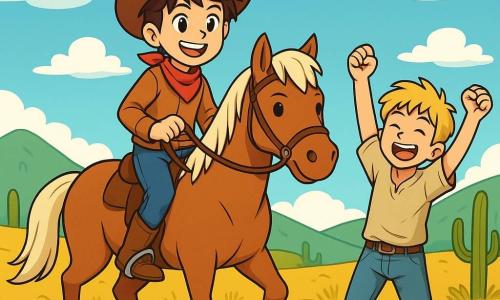
June rode Pepper at a steady walk, holding the banner high. The canvas fluttered in the warm breeze, and the red, gold, and blue gleamed under the sun. People cheered, not because June had chased down trouble—though they did talk about that—but because the banner looked like belonging.
As they passed the general store, Mrs. Calder gave June a small, satisfied nod.
Eli was there too—he must have ridden in with other ranch hands that morning. He waved both arms like a windmill. “June! I heard you—”
June cut him off with a grin. “Not now. Parade face.”
Eli tried to look serious for about two seconds, then failed. “Yes, ma'am.”
After the parade, June helped hang the banner near the rodeo gate. The clerk thanked her three times, each time sounding more amazed, like he couldn't believe paint could be this important.
Later, the sheriff returned the stolen plank to June. The Quill Brothers had been locked up, and the town finally breathed again.
June looked at the plank's smeared drip and laughed softly. “Well,” she told it, “you caused more trouble than you're worth.”
Mrs. Calder leaned on the rodeo fence beside her. “Trouble shows up whether invited or not. What matters is how you greet it.”
“With calm,” June said.
Mrs. Calder smiled. “With calm.”
The sun slid toward the horizon, turning the world coppery and soft. June rode back toward Sagebrush Ranch with Pepper's hooves tapping a steady rhythm. Her muscles ached, and her eyelids felt heavy, but her mind was quiet in a good way—like a creek that had settled after a storm.
When the ranch buildings came into view, Eli ran out to meet her, nearly tripping over his own feet.
“You're back! Mr. Rusk's been pacing like a caged bobcat,” he said. “Did you—did you get the colors there?”
June swung down from Pepper and handed Eli the plank. “They tried to steal our name. Didn't work.”
Eli stared at the plank, then at her. “You stopped them?”
“I slowed them down,” June said. “The sheriff did the stopping.”
Eli looked impressed and a little scared. “I would've— I don't know what I would've done.”
June touched his shoulder. “You would've breathed first. That's where it starts.”
Mr. Rusk appeared on the porch, relief loosening his posture. “June.”
June nodded. “Banner's up. Colors are seen.”
Mr. Rusk's eyes softened. “Good. Come eat.”
Night settled over Sagebrush Ranch, cool and wide. After supper, June walked to the barn with Pepper, lantern swinging. The familiar smells welcomed her—hay, leather, horse sweat, the comforting dusty sweetness of a place that worked hard and rested harder.
June lifted Pepper's saddle off his back and set it on the rack. She checked the straps, smoothed the worn leather, and placed the saddle blanket neatly beneath it.
She paused, hand resting on the saddle horn.
Out there, the West could be loud—gunshots, shouting, hooves pounding. But here, in the steady hush of the barn, June felt something better than excitement.
She felt settled.
June hung Pepper's bridle, latched the stall, and set the lantern on its hook. The saddle sat tidy on the rack, waiting for the next ride, as calm as a promise kept.