Chapter 1: The Empty Rope
The morning was the color of old tin—bright in places, dull in others—when Mae Calder swung down from the corral fence and landed in a puff of dust.
“Count 'em again,” said Hank, the ranch foreman, leaning on the gate like it was holding him up.
Mae wiped sweat from her brow with the back of her glove. “I already did. Twice. We're short one calf.”
Hank spat a sunflower seed shell into the dirt. “Which one?”
Mae walked along the bawling line of cows. Hooves thudded, tails flicked, flies hummed like tiny saws. She stopped at a red cow with a white blaze on her forehead. The cow's eyes were wild, and she kept turning her head toward the open range as if she could see through miles.
“That one's got an empty look,” Mae murmured. “Her calf—little brindle fellow, black legs, white ear tip.”
Hank frowned. “The storm last night must've spooked him.”
Mae bent, picked up a length of rope, and ran it through her hands. She liked tools and tricks—anything that could be fixed, tied, or tinkered with. That was her way: keep your hands busy and your head steady.
“I'll bring him back,” she said.
Hank lifted an eyebrow. “Alone?”
Mae gave him a dry grin. “You got someone better at crawling into trouble?”
Hank's mouth twitched. “Just don't go actin' like you're ten feet tall.”
Mae's grin faded a bit. That was Hank's way of warning her: pride could be as dangerous as a rattler.
“I won't,” she said, and meant it.
She packed light: canteen, jerky, a small wrench and wire (because something always broke), a blanket roll, and her compact tool pouch. Her horse, Juniper, stood patient as a post, ears flicking forward whenever Mae spoke.
Mae swung into the saddle. The ranch behind her looked sturdy, like it could push back against anything—wind, wolves, bad luck. But out past the last fence, the land opened wide and hungry.
A calf alone out there didn't have long.
“Come on, Juniper,” Mae said. “Let's go find a little troublemaker.”
Juniper snorted, and they rode into the sea of grass.
Chapter 2: Tracks in the Dust
By midday, the sun had burned the tin sky into bright brass. Heat shimmered over the plains like invisible fire. Mae slowed Juniper near a muddy patch where last night's rain had pooled.
“If I were a scared calf,” Mae said, talking mostly to herself, “I'd run until my legs felt like noodles. Then I'd hide.”
Juniper's ears flicked left. Mae followed her gaze. There—hoofprints, small and skittery, pressed into the drying mud. A set of bigger prints circled them: coyotes, maybe. Or a lone wolf.
Mae slid off the saddle and crouched. The calf tracks were fresh enough to still have crisp edges.
“Good,” Mae whispered. “You're not too far.”
A sharp sound made her freeze—like a stick snapping, quick and mean.
Juniper shifted, restless.
Mae eased her hand toward her holster, then stopped. Gunfire wasn't always the answer. Sometimes it only made a worse problem.
The sound came again, closer. Mae crept forward, boots quiet in the grass. She pushed aside a clump of sage.
A jackrabbit burst out, sprinting like it had stolen something. Mae let out a breath she hadn't realized she was holding.
“Don't do that,” she muttered, then laughed at herself. “You about made me shoot my own shadow.”
The laughter felt good—small, but real. Out here, you had to keep your courage fed, the way you fed a fire.
She followed the tracks into low hills dotted with scrub and rock. The wind carried a distant cawing and the smell of wet earth.
Then she found something that didn't belong: a broken bit of fence wire snagged on a thorn bush. Mae plucked it free and examined it.
“Barbed wire,” she said. “Not ours.”
So the calf hadn't just wandered. It had crossed someone else's boundary. That meant trouble—angry ranchers, traps, maybe worse.
Juniper stamped once, impatient.
“I know,” Mae told her. “We'll be polite. Mostly.”
Mae pulled a small spool of wire from her pouch and twisted the broken piece into a neat coil. It wasn't much, but she couldn't stand leaving a mess. Besides, someone else's fence was still someone else's fence.
As they climbed the next rise, Mae spotted a thin ribbon of smoke far off, curling into the blue like a question mark.
“Camp,” she said. “Or a brush fire.”
Juniper's ears pinned forward.
Mae tightened her grip on the reins. “Let's hope it's friendly.”
Chapter 3: The Stranger's Snare
The smoke led them to a shallow draw where cottonwoods clung to a trickle of water. A small camp sat tucked against the bank: a low fire, a coffee pot, and a man squatting by a coil of rope.
Mae approached slow, hands visible, posture easy. She'd learned that the quickest way to start a fight was to look like you expected one.
The man glanced up. His hat brim shadowed his face, but Mae caught the glint of watchful eyes.
“Afternoon,” Mae called. “Mind if I water my horse?”
He shrugged. “Water don't belong to anybody.”
Mae guided Juniper to the stream. While Juniper drank, Mae's gaze swept the camp. Bedroll. Tin plate. A long rifle resting against a log. And—Mae's stomach tightened—a snare line tied to a bent sapling, stretched across a game trail.
The man followed her eyes and smirked. “Rabbit's hard to catch with empty hands.”
“That snare could catch more than rabbit,” Mae said. “Could catch a calf.”
He stood, slow as a cat. “Maybe I like calf.”
Mae kept her voice steady. “A calf's missing from our herd. Brindle. White ear tip.”
The man's smile didn't reach his eyes. “Plenty of calves in the world.”
Mae took a step closer, not threatening, just firm. “If he wandered into your snare, he's scared and hurt. I want him back.”
The man spat near the fire. “And I want a hot meal that ain't beans.”
Mae could feel Juniper tense beside her, like the horse knew the shape of danger. Mae forced herself to breathe. Anger was easy. Smarter was better.
“Look,” Mae said, “I'm not here to make you feel small. I've been hungry too. But taking someone's calf isn't a meal. It's a fight.”
The man's eyes narrowed. “You think you can talk your way out of a problem, cowgirl?”
Mae's cheeks warmed. Cowgirl. She was a ranch hand, a fixer, a rider. Labels didn't matter. Getting the calf back did.
“I think,” Mae said, “that if you help me, I'll trade you something better than a stolen bite.”
He gave a short laugh. “Like what? Your smile?”
Mae snorted. “You wouldn't know what to do with it.”
For the first time, he looked surprised. Then he chuckled, a rough sound. “All right. Trade me.”
Mae tapped her tool pouch. “Your snare line is tied wrong. The knot's sloppy. It'll slip when it matters. If you're going to use rope, at least respect it. I'll fix that and give you a pouch of jerky. In return, you tell me if you saw the calf.”
The man studied her, then the pouch. Hunger argued with pride in his face.
Finally, he nodded once. “Name's Lyle.”
“Mae.”
Lyle pointed with his chin toward the hills. “Saw a little brindle dart through this draw early. Didn't catch in my snare—too quick. Ran up toward the red rocks.”
Mae's heart lifted—then dipped. The red rocks were cut with narrow gullies. A calf could get trapped in there. Or worse, fall.
Mae opened her pouch and tossed Lyle the jerky. Then she crouched by the snare line. Her fingers moved fast, sure. She retied the knot clean and strong, and added a small twist of wire to keep it from chafing.
Lyle watched, grudging respect on his face. “You're handy.”
Mae tightened the final loop. “Handy keeps you alive.”
She stood and dusted her hands. “Thank you for the direction.”
Lyle shrugged. “Don't thank me. I didn't do it for kindness.”
Mae met his eyes. “Doesn't matter why you did it. It matters that you did.”
Lyle looked away, as if that answer annoyed him.
Mae swung into the saddle. “If I find him hurt, I'll need to carry him. That'll slow me down.”
Lyle lifted his chin. “Then you'd better be quick.”
Mae tipped her hat. “Working on it.”
And she rode hard toward the red rocks, where the land rose sharp and stubborn.
Chapter 4: Thunder in the Gulch
The red rocks were like old teeth biting the sky. Wind funneled through their cracks, whistling a high note that made Mae's skin prickle.
Juniper picked her way along a narrow path. Loose stones clattered into the gulch below.
Mae kept her eyes on the ground—tracks, scuffs, anything. She spotted them soon enough: the calf's small prints, now mixed with sliding marks.
“Easy,” Mae whispered. “You're in a bad spot.”
The trail dipped into a gully where the walls closed in, tall and close, blocking the sun. The air smelled cooler here, damp with hidden shade.
Then Mae heard it: a thin, trembling bawl, like a question that didn't expect an answer.
Mae swung down and tied Juniper to a scrubby juniper tree. “Stay,” she told her. “And if you see a mountain lion, you kick it in the face.”
Juniper flicked her tail as if to say, That's the plan.
Mae crept deeper into the gully. The ground turned slick with mud from a hidden seep. Her boot slid; she caught herself on the rock wall, palm scraping gritty stone.
The bawl came again—closer.
Around a bend, she found him.
The brindle calf lay on his side, legs tangled in a loop of rope half-buried in mud. His white-tipped ear twitched weakly. His eyes rolled toward Mae, wide and terrified.
“Oh, buddy,” Mae breathed. “You've had a day.”
The rope wasn't ranch rope. It was thinner, rougher, like something cut in a hurry. Maybe from a traveler. Maybe from someone trying to catch easy meat.
Mae knelt beside him, keeping her movements slow. “I'm Mae. I'm not here to eat you. I know, I know—that's not very convincing coming from someone who chews jerky.”
The calf gave a shaky huff.
Mae examined the rope. The loop had tightened around his front legs and rubbed them raw. Mud suctioned the rope deeper every time he struggled.
Mae pulled her small wrench and a short length of wire from her pouch. She could cut rope with a knife, sure—but one wrong slice and she could nick skin, or startle him into thrashing.
“Okay,” she murmured, thinking fast. “We do this smart.”
She slid a flat rock under the rope, between it and the calf's leg, like a shield. Then she used the wire to pry the knot's twist loose, inch by inch. Her fingers shook—not from fear of the rope, but from the knowledge that time mattered.
Above, thunder rumbled—distant but growing.
Mae glanced up. The sky over the rocks had darkened, the bright day swallowed by bruised clouds.
“A storm,” Mae muttered. “Of course.”
A sudden gust funneled down the gulch, carrying grit and the first cold drops of rain.
The calf tried to kick. Mae pressed a gentle hand to his shoulder. “Hey. Don't fight me. Fight the rope.”
He stilled, trembling.
Mae worked the knot again. The wire creaked. Mud sucked and slurped. Rain began to patter against the rock walls like thrown pebbles.
Thunder cracked, closer now, and the gully seemed to shiver.
Mae's jaw tightened. Flash floods could roar through places like this without warning. A dry trickle could become a charging river.
“Almost,” she said, voice tight. “Almost.”
The knot finally gave with a wet pop. Mae pulled the loop free and tossed it aside like a snake.
The calf's legs were shaky, but free.
“There,” Mae said, exhaling hard. “Now we move.”
She slid her arms under his chest. He was heavier than he looked—solid, warm, stubborn. Mae grunted. “You've been eating your greens, huh?”
The calf wobbled, tried to stand, and nearly fell again.
“Nope,” Mae said. “Not walking today. You're riding.”
Rain turned to a sharp, steady sheet. The mud beneath them began to quiver, water gathering in little streams.
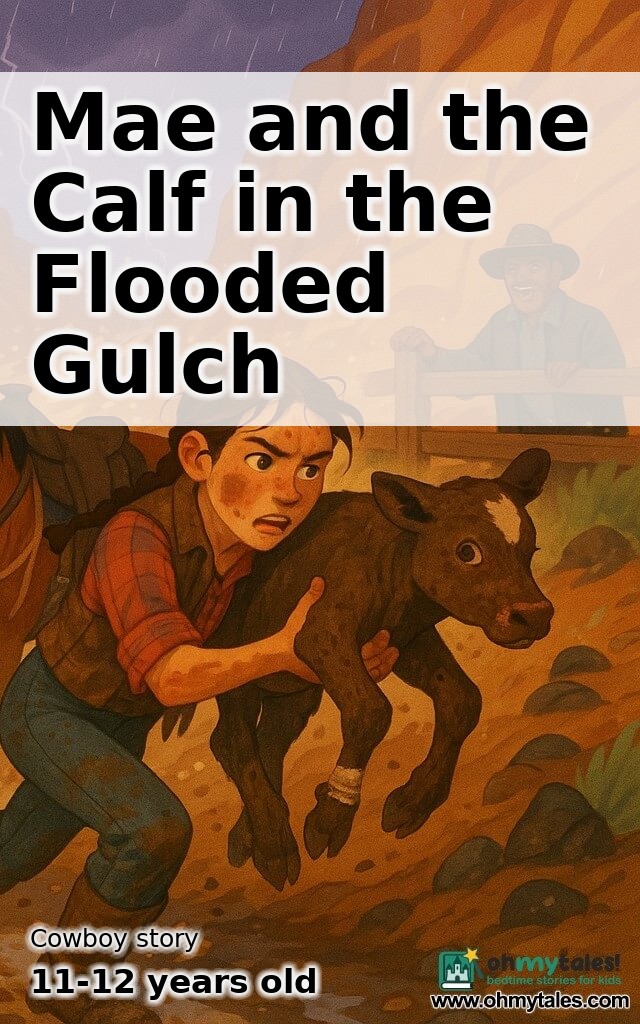
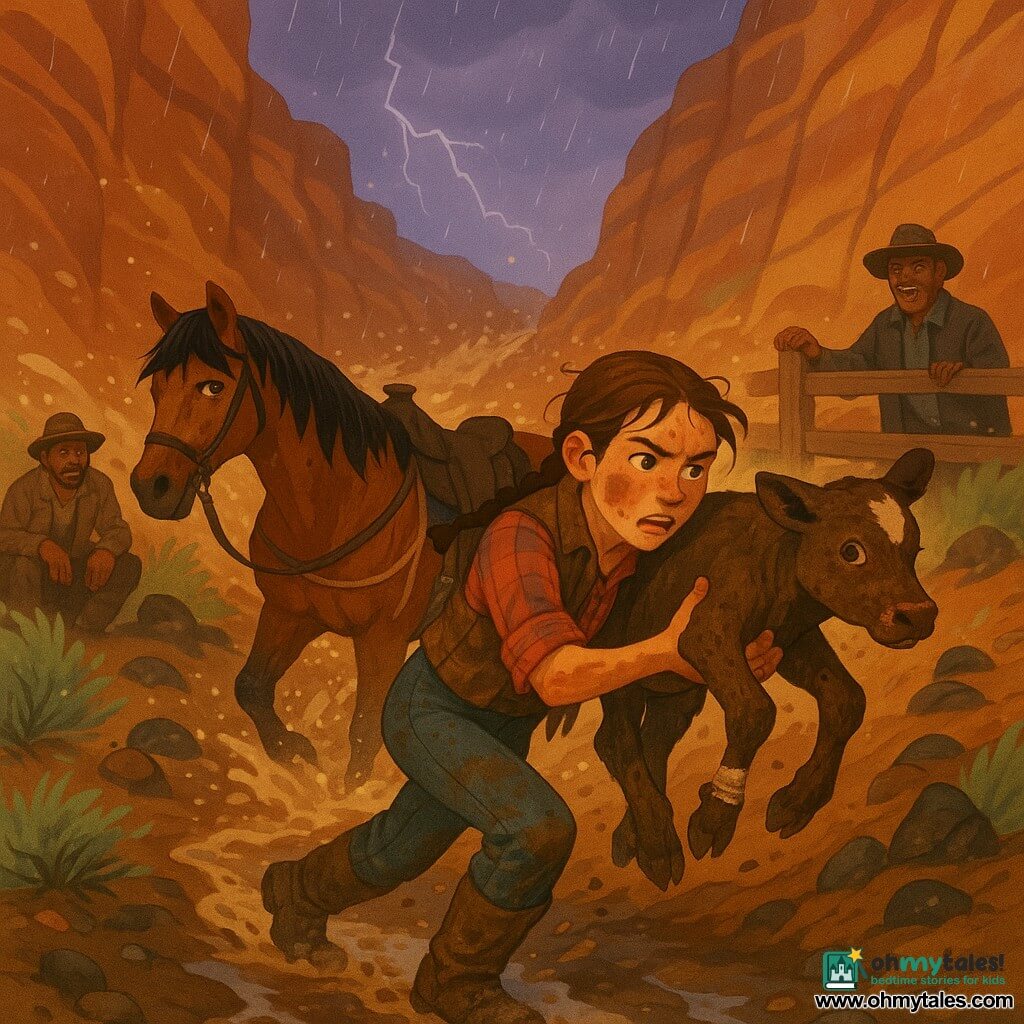
Mae hoisted the calf, muscles straining, and half-carried, half-dragged him toward the bend where Juniper waited.
Behind them, a deep rushing sound rose, like an angry crowd.
Mae didn't look back. She didn't need to.
She ran.
Chapter 5: The River That Wasn't There
Mae burst around the bend, soaked through, calf clutched against her like an oversized sack of trouble. Juniper whinnied, eyes wide.
“Yeah,” Mae panted. “I know. I'm a mess.”
The rushing sound grew louder, fast.
Mae untied Juniper with fingers that felt clumsy and cold. Then she faced the hardest part: getting the calf onto the horse without spooking either of them.
Juniper danced sideways. Mae grabbed her reins. “Juniper. Look at me. We've done harder things than carry a baby cow.”
Juniper snorted as if arguing: We have?
Mae swallowed. Her pride wanted to pretend this was easy. It wasn't. The smart move was to admit that and adjust.
“Okay,” Mae said, thinking. “We need a sling.”
She yanked her bedroll straps loose, then looped her rope around Juniper's saddle horn and cinch, making a crude cradle. Her hands worked fast, rain slicking the leather. She threaded the straps through, pulled them tight, tested the hold with a sharp tug.
“Please don't fall apart,” she muttered. “I fixed your water pump last month; you can repay me by staying together.”
Juniper tossed her head like she was laughing.
The roar behind them became a thunder of water. Mae glanced down the gulch and saw a wall of brown floodwater rounding the bend, foaming with sticks and stones.
“No time,” Mae snapped.
She lifted the calf—every muscle in her arms screaming—and slid him into the sling against Juniper's side. The calf bleated, panicked.
“Shh,” Mae said. “You're okay. You're okay. Just… be a little brave. I'll do the same.”
She swung into the saddle, grabbed the reins, and kicked Juniper forward.
They climbed the narrow path as the flood hit the spot where they'd been standing. Water slammed into the gully walls, spinning debris like it was in a blender.
Juniper scrambled, hooves slipping on wet rock. Mae leaned forward, low, whispering fiercely. “Climb, girl. Climb!”
At the steepest part, the path crumbled under Juniper's back hoof. For one sick moment, they slid.
Mae's heart lurched. She could almost feel the flood's cold fingers reaching.
Then Juniper found a grip—one hard, determined step—and surged upward. Mae laughed, breathless and wild.
“That's it!” she shouted into the rain. “Show that river who's boss!”
They reached higher ground just as the gully below filled completely, a muddy torrent racing through the slot like it had been waiting all day for permission.
Mae slowed Juniper under a leaning rock overhang. The calf shivered in the sling, eyes blinking rain away.
Mae stroked his neck. “You and me, we're not so fancy,” she said softly. “But we're stubborn. That counts.”
The storm eased into a steady drizzle. The clouds still hung low, but the worst of the anger had passed.
Mae checked the calf's legs. Raw, but not broken. She tore a strip of her bandanna and wrapped it around the worst rub, tying it with a careful knot.
“You'll have a story,” she told him. “And I'll have sore arms.”
The calf let out a small, tired sigh.
Mae looked out across the soaked land. The grass shone dark and clean. Far off, she could see the line of the ranch—tiny, but real.
“Home's that way,” she said. “Let's not pick another fight with the weather.”
Juniper stepped out from under the rocks, and they started the long ride back.
Chapter 6: A Lesson in Dust and Light
By late afternoon, the storm clouds had broken into torn ribbons, and sunlight spilled through in bright, slanting beams. The world steamed gently, like a kettle cooling down.
Mae rode slower now. The calf's weight pulled at the sling, and Juniper's sides heaved with tired breaths. Mae kept checking the knots, tightening them when the leather stretched.
As they crossed a shallow flat, a figure on horseback appeared ahead—Hank, riding out with two ranch hands.
Mae raised a hand. “Over here!”
Hank spurred closer, then slowed when he saw the calf. His stern face cracked into a relieved grin. “Well, I'll be—Mae, you found him.”
Mae nodded, throat suddenly tight. “He was tangled in a rope in the red rocks. Flood nearly got us.”
One of the ranch hands whistled. “You're lucky.”
Mae looked down at Juniper, who flicked an ear like she knew she'd been praised. “Luck helped,” Mae admitted. “But Juniper did the heavy lifting.”
Hank rode alongside, eyes scanning Mae's soaked clothes, the scraped knuckles, the calf's bandaged legs. “You hurt?”
“Just my pride,” Mae said, then added, “and my arms.”
Hank chuckled. “That'll heal.”
They headed back together. The ranch came into focus: fences, roofs, a windmill turning slow and steady. As they neared the corral, the red cow with the white blaze began to bawl, pacing the fence line.
Mae swung down carefully and loosened the sling. The calf slid to the ground, wobbly but standing. He blinked, then tottered toward his mother.
The cow pressed her nose to him, snuffling, as if counting every piece of him. The calf answered with a soft bleat, and the sound made something warm settle in Mae's chest.
Hank clapped Mae on the shoulder—hard enough to sting. “You did good.”
Mae looked at the calf, then at the rope burns, then at her muddy boots. She thought of the flood, the slippery path, the moment Juniper nearly fell.
“I did what needed doing,” Mae said. “But I didn't do it alone.”
Hank studied her, then nodded, like he approved of that answer more than any brag.
Mae glanced toward the bunkhouse, where a few hands had gathered, curious. Someone called out, “Mae, you wrestle that river into behaving?”
Mae snorted. “If I could wrestle a river, I'd charge admission.”
Laughter rolled across the yard, easy and bright.
Mae walked to Juniper and rubbed her neck. “You hear that? They think I'm the hero.”
Juniper bumped Mae lightly with her nose, nearly knocking her off balance.
Mae laughed. “All right, all right. We'll share the fame.”
As the day leaned toward evening, the air cooled and smelled of damp hay and coffee. Mae sat on the corral fence with a tin cup in her hands, listening to the steady, ordinary noises—cows shifting, men talking, tack creaking.
Hank came up beside her, quieter now. “You ever think about slowing down?” he asked.
Mae watched the calf nuzzle his mother, safe at last. “Sometimes,” she said. “But today reminded me. The world's bigger than my plans. Bigger than my pride.”
Hank grunted, which for him was nearly a speech. “Good. Pride makes a poor saddle.”
Mae sipped her coffee. It tasted like smoke and comfort.
Out beyond the ranch, the sun sank low, spreading gold across the wet plains. The puddles caught the light and turned into scattered mirrors. The red rocks far away glowed like embers, calm now, as if they'd never tried to drown anyone.
Mae rested her elbows on her knees and watched the sky deepen into orange and purple.
Juniper stood nearby, tail swishing, breathing easy. The calf lay in the grass beside his mother, finally still.
Mae let the quiet fill her, the kind that comes after hard work and close calls. She didn't feel ten feet tall. She felt small in the best way—part of a wide, tough land, and lucky to have a place in it.
The last slice of sun slipped behind the horizon, and the West caught fire with color—then cooled into twilight.
Mae tipped her hat toward the fading light. “Evening,” she whispered.
And the day ended in a long, gentle sunset.