Chapter 1
Dust rolled across the prairie like a slow, tan tide. It slid under boots, climbed wagon wheels, and clung to eyelashes until everyone looked half-made of sand.
Mara Hale didn't mind. She'd ridden through worse than dust. She'd ridden through hail that bit like marbles, through heat that made the air shimmer like a mirage, through nights so cold the stars seemed to crack.
She pushed her hat back with one finger and guided her mare, Juniper, along the rutted trail toward Red Willow Crossing. A small town, the kind that tried hard to be tough. Wooden buildings stood with their shoulders squared, as if daring the wind to knock them down.
Beside Mara's saddle hung a canvas satchel. Inside it, wrapped in cloth, were brass tools—tiny, careful things for fine work. Not hers. They belonged to Mr. Timmons, the watchmaker, who had written to her with shaky ink.
They're taking our work. They say we don't deserve to keep it. Please.
Mara's jaw tightened. A rancher could lose a calf to wolves and call it bad luck. But stealing a person's craft? That was a different kind of hunger.
She rode into town to the sound of hammer taps. On the porch of a small shop, a girl about twelve was trying to keep a sign straight while an older man held the other end.
“Hold it steady, Lottie,” he grunted.
“I am holding it steady,” the girl snapped, then nearly toppled when the wind shoved the board.
Mara swung down and caught the sign before it smacked the porch. The paint read: TIMMONS WATCH & CLOCK REPAIR.
The older man blinked up at her, surprised, then relieved. He had silver hair and fingers stained with oil.
“Ma'am—are you—” His eyes flicked to the satchel. “Miss Hale?”
“Mara,” she said. “You wrote to me.”
Mr. Timmons swallowed like he had a rock in his throat. “Thank the Lord. And thank you.”
Lottie peered around him, suspicious but curious. “Are you a bounty hunter?”
Mara smiled. “No.”
“A sheriff?”
“No.”
“A villain?”
“Definitely not.”
Lottie looked disappointed. “Then what are you?”
Mara tilted her hat. “A cowgirl who doesn't like bullies.”
Mr. Timmons let out a shaky laugh that turned into a cough. “They're coming again. The Hollow Fork boys. They took my best tools last week. And Mrs. Inez's bolts of cloth. And Mr. Song's carved signs—”
“—and they laughed,” Lottie cut in, her cheeks going red. “They said artisans are just fancy hands and don't matter.”
Mara's eyes sharpened. “Artisans build the world people live in,” she said quietly. “A town without them is just a camp with delusions.”
The wind carried a distant shout from the far end of the street. A pair of men stumbled out of the saloon, wrestling and laughing. Red Willow Crossing smelled like horses, spilled beer, and sun-warmed pine.
Mr. Timmons pulled Mara closer, voice low. “Sheriff Culver… he says the Hollow Fork boys are ‘just rowdy.' He won't stir trouble with their boss.”
“Who's their boss?” Mara asked.
Mr. Timmons hesitated. “Boss Darnell. He runs cattle north of here. Big spread. Big temper.”
Mara looked up and down the street—wagon ruts, scattered chickens, a dog gnawing something that had once been a boot. This town wasn't rich, but it was proud.
And it was being peeled apart, piece by piece.
Mara rested a hand on Juniper's neck. The mare flicked her ears, listening.
“Alright,” Mara said. “Show me what they've taken. And tell me where they ride from.”
Lottie's eyes lit up. “Oh, this is going to be good.”
Mara glanced at her. “It's going to be careful,” she corrected. “Courage is fine. But courage without brains is just a fast way to get hurt.”
Lottie sighed dramatically. “Fine. Careful courage.”
Mr. Timmons's shoulders eased, just a little. The sound of his hammer resumed, steady as a heartbeat.
Chapter 2
Mara walked the town with Lottie as her guide. The sun leaned west, turning everything gold and sharp-edged.
They visited Mrs. Inez at the tailor shop. Empty shelves yawned where colorful cloth should've been.
“They took my good calico,” Mrs. Inez said, hands clenched in her apron. “The kind that makes a child feel brave just by wearing it.”
At Mr. Song's sign shop, half-carved boards lay abandoned like unfinished promises. Mr. Song ran a thumb along a gouge in the wood.
“They broke the ‘O' in ‘HOTEL',” he said softly. “As if letters are not worth respect.”
At the blacksmith's forge, the anvil was cold. The blacksmith, a broad man named Ezra, stood with soot on his cheek and worry in his eyes.
“They didn't steal from me,” Ezra admitted, voice rumbling. “Not yet. But they told me I'd ‘better remember who owns the road.'”
Mara listened. She didn't interrupt. She let their words stack up like stones in her mind. Each story carried the same shape: laughter, threats, a quick snatch, and the slow shrinking of a person who used to stand tall.
Outside the general store, they found Sheriff Culver leaning against a post, chewing a toothpick like it was his greatest responsibility.
Mara stopped a few feet away. “Sheriff.”
He squinted at her. “You passin' through?”
“Not today.”
“Town can handle its own troubles.”
Lottie muttered, “Like a chicken can handle a coyote.”
Mara shot her a look—gentle, but firm. Lottie pressed her lips together.
Mara faced the sheriff again. “The artisans are being robbed.”
Culver shrugged. “Boys will be boys.”
Mara's voice stayed calm, but it rang like a clear bell. “Boys will be held accountable.”
Culver's toothpick paused. “You lookin' for a fight, ma'am?”
“I'm looking for safety,” Mara said. “And I'm not interested in your excuses.”
His eyes narrowed, then slid away. “Boss Darnell keeps the peace. He doesn't like folks stirring mud.”
Mara nodded slowly. “Then maybe it's time someone stirred mud until the snakes show themselves.”
Culver spat the toothpick into the dust. “Don't say I didn't warn you.”
Mara watched him saunter off. Lottie exhaled as if she'd been holding her breath.
“You really talk like that to sheriffs?” Lottie asked.
“I talk like that to anyone who forgets they work for people,” Mara said.
They returned to Timmons's shop as the first evening shadows stretched long. Mr. Timmons had set out a tin pot of coffee and three chipped mugs.
“I don't have much,” he apologized.
Mara took a mug anyway. “It's enough.”
Lottie sipped, then grimaced. “This coffee tastes like someone boiled a saddle.”
Mr. Timmons chuckled. “That's because I did. Accidentally.”
Mara laughed, and for a moment, the fear in the room loosened.
Then a thud hit the door.
All three of them froze.
Another thud—harder. The door shuddered in its frame.
A voice outside called, sweet as poisoned honey. “Evenin', Timmons! We're here for a little… donation.”
Mara set her mug down without a sound. She drew her revolver halfway, not aiming—just ready. Her eyes met Mr. Timmons's.
“Back room,” she mouthed.
Lottie's face went pale but stubborn. “I'm not going—”
Mara's gaze pinned her. Not angry. Just certain. “Back room,” she whispered again.
Lottie swallowed and slipped behind the counter with Mr. Timmons.
The door crashed open. Three riders swaggered in, spurs jingling. They smelled of sweat and cheap whiskey.
Their leader, a narrow-faced man with a scar on his chin, noticed Mara at once. He stopped like he'd walked into an unexpected wall.
“Well now,” he drawled. “Who's the pretty stranger?”
Mara's voice was cool. “Someone who pays for what she takes.”
He laughed. “That so? We don't take much. Just what's owed.”
“Who owes you?” Mara asked.
He tilted his head, as if she'd asked what the sky was. “Everybody.”
Mara's hand hovered near her gun. “You're in the wrong shop.”
He stepped closer, smiling wider. “You gonna stop us, ma'am? With manners?”
“No,” Mara said. “With planning.”
She moved, sudden and smooth, kicking the door shut behind them. The bell above it jingled wildly.
The men tensed.
Mara reached up and yanked the hanging lantern chain. The shop plunged into dimness as the lamp swung, throwing shadows like leaping animals.
In the confusion, she snapped her revolver up and fired—not at them, but at the plank above the door. The bullet splintered wood, and the “OPEN” sign dropped on a string, slapping the scar-chinned man right in the face.
Lottie, from the back room, muffled a startled laugh.
The man staggered, cursing. “You—!”
Mara's voice cut through the dark. “Leave. Now.”
One of the other men drew his gun. Mara fired again—into the floor between his boots. Dust puffed up. He jumped back as if the boards had bitten him.
Outside, Juniper whinnied, sharp and angry. Mara had tied a tin pan to the saddle horn. The mare's movement made it clatter, adding chaos to the moment.
The men hesitated. They weren't used to resistance that didn't come in a straight line.
Scar-chin touched the fresh red mark on his nose from the sign's slap. His eyes burned. “This ain't done,” he hissed. “Boss Darnell will hear.”
Mara didn't blink. “Make sure he hears it clearly.”
They backed out, stumbling over each other in the doorway, pride tangled with fear. When they were gone, the shop's silence roared.
Mr. Timmons emerged, trembling. Lottie followed, eyes shining.
“That,” Lottie breathed, “was the smartest shooting I've ever seen.”
Mara exhaled slowly. “That was the easy part.”
Chapter 3
The next morning, Mara met the artisans behind Ezra's blacksmith shop, where the smell of coal and iron made the air feel serious.
Mrs. Inez came with a measuring tape around her neck like a badge. Mr. Song held a mallet. Mr. Timmons carried his small tool chest close, as if it were a child. Ezra leaned on a hammer the size of a small canoe.
Lottie darted between them, eager as a sparrow.
Mara spread a rough map on a barrel. “They said Boss Darnell will hear. Good. I want him listening.”
Ezra frowned. “We can't outgun him. He's got riders.”
“We won't outgun him,” Mara said. “We'll outthink him.”
Mr. Song's eyes lifted. “How?”
Mara tapped the map. “The Hollow Fork boys ride in from the north trail. They cross Willow Gulch, pass the cottonwoods, and come in loud so everyone can feel scared before they even arrive.”
Mrs. Inez whispered, “It works.”
“It works because fear travels faster than facts,” Mara said. “We're going to slow fear down.”
Lottie raised a hand as if they were in school. “With what? Rope? A wall?”
“With a story,” Mara said.
They stared.
Mara continued, “Darnell wants this town to believe he owns the road. But if the road becomes… unreliable, his men will look weak. And a boss hates weak.”
Ezra scratched his chin. “Unreliable how?”
Mara's eyes glinted. “A stampede.”
Lottie gasped. “We don't have cattle.”
Mara nodded toward Ezra. “But we have tools, brains, and a creek.”
Ezra's brows rose slowly. “You mean—”
“We make noise and movement,” Mara said. “Not to hurt anyone. To scare the thieves off and draw them where we can corner them without bullets.”
Mr. Timmons swallowed. “I don't like scaring people.”
Mara's voice softened. “Neither do I. That's why we do it with care. No one gets trampled. No one gets shot. We're protecting what's yours without becoming what we hate.”
Mrs. Inez looked down at her hands. “They laughed at me. I wanted to throw a pot at their heads.”
Mara nodded. “Anger is a normal visitor. But you don't have to let it move in.”
The plan formed with the clink of Ezra's tools and the rustle of fabric. Mr. Song provided blank boards and paint. Mrs. Inez stitched strips of cloth into long fluttering banners. Ezra bent thin sheets of metal into clappers that would rattle like thunder. Mr. Timmons adjusted old springs and gears so certain traps would snap shut with a loud click—nothing sharp, nothing cruel.
Lottie's job was the most important: running messages, keeping count, noticing everything. She took it like a general.
By late afternoon, they set their creation along Willow Gulch: a narrow stretch where the trail hugged a slope on one side and dipped toward brush on the other. From a distance, it looked ordinary.
Up close, it was a clever machine made of simple things.
Mara tested the first line. A tug on a hidden rope made cloth banners leap up like startled ghosts. Metal clappers banged together, echoing off the rocks. A barrel lid rolled down the slope, crashing and booming.
Lottie clapped her hands over her ears. “That's magnificent and horrible!”
“That's the idea,” Mara said.
As they finished, Mara noticed Mr. Timmons watching the trail, worry creasing his face.
“You're thinking about Darnell,” she said.
He nodded. “He isn't… just a bully. He's the kind who enjoys it.”
Mara looked out at the open land beyond the gulch, where grass rippled like the fur of some giant animal. “Then we don't just stop his boys. We show the town it can stand up together.”
Lottie peered up at Mara. “Are you scared?”
Mara didn't pretend. “Yes.”
Lottie's eyes widened.
Mara crouched so they were face to face. “Being scared means your mind is awake. Courage is what you do with the fear.”
Lottie considered that, then nodded slowly. “Okay. My mind is very awake.”
Mara almost smiled. “Mine too.”
They rode back toward town as the sky turned pink, then purple, then deep blue. Coyotes yipped far away.
Behind them, Willow Gulch waited.
Chapter 4
The Hollow Fork boys arrived the next day like a storm with spurs.
Mara watched from the shade of the cottonwoods above Willow Gulch, Juniper tied nearby. Lottie lay beside her, trying very hard not to wiggle.
Down the trail came four riders this time. Scar-chin was in front, his hat tipped low like he was ashamed of the sky.
“Remember,” Mara whispered, “we want them to run, not fight.”
Lottie whispered back, “Running is my favorite sport.”
The riders entered the gulch. The air felt tight, like it was holding its breath.
Mara tugged the rope.
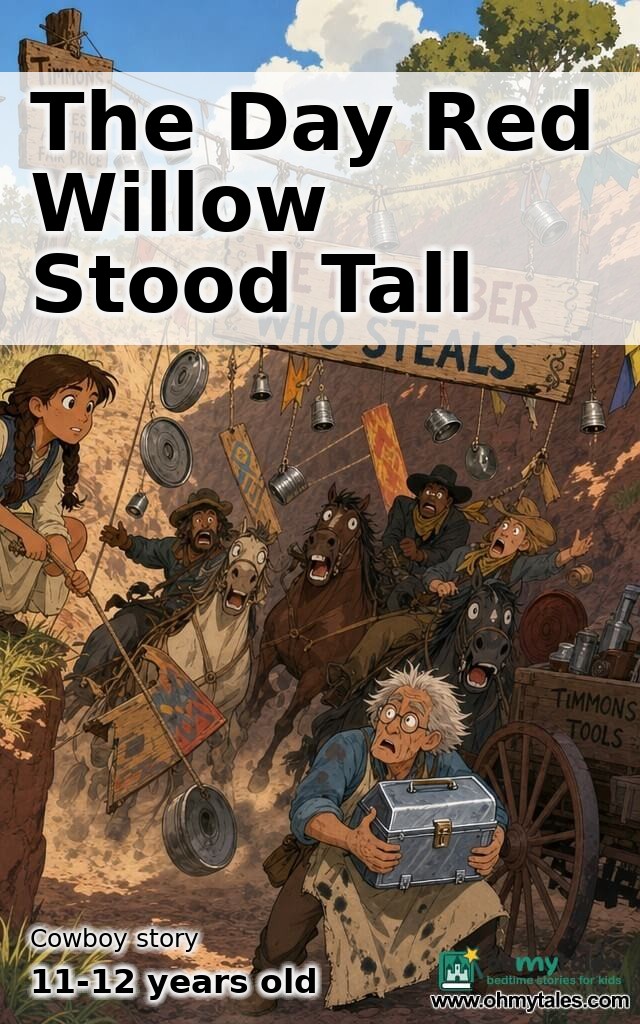
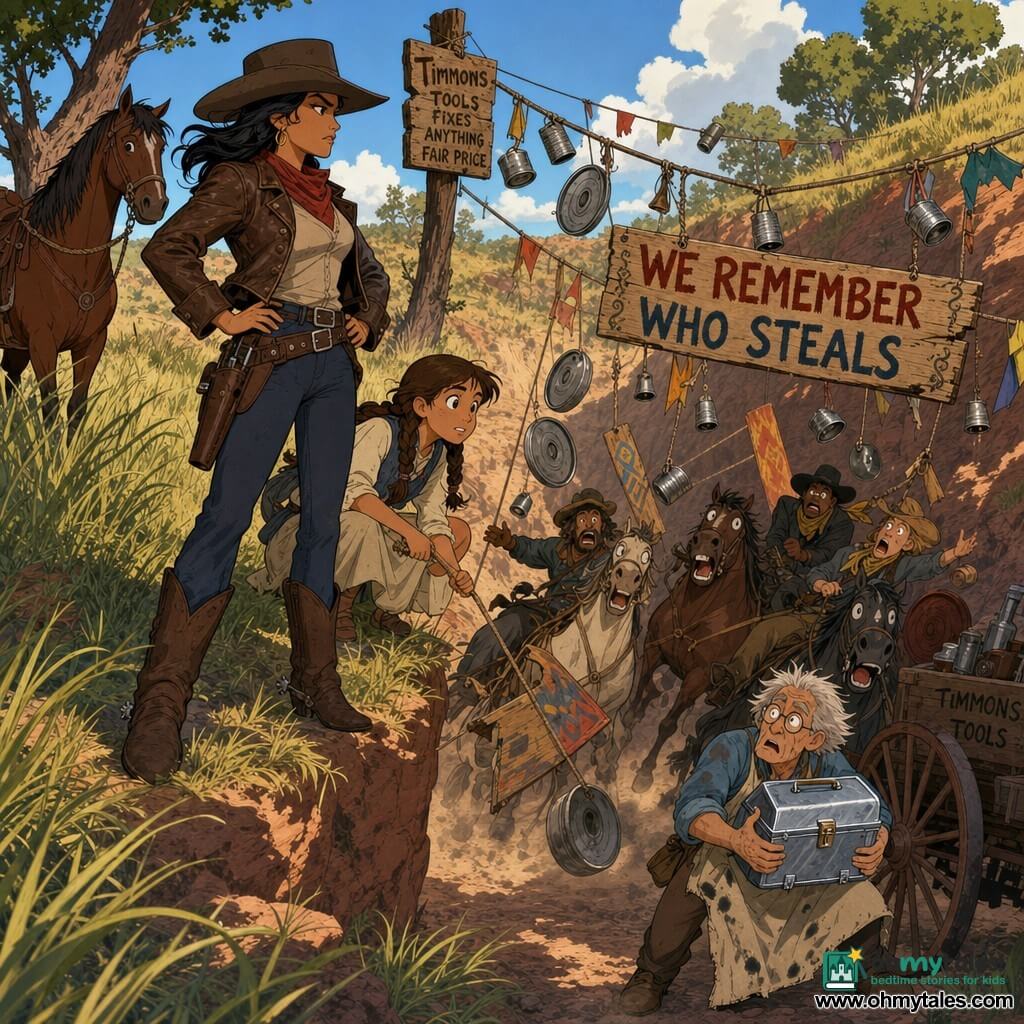
Banners snapped up. Metal clappers exploded into noise. The barrel lid thundered down the slope like a rolling cannonball. Mr. Song's painted boards—set on hinges—flipped and flashed words in bright white: TURN BACK. TURN BACK.
The horses below spooked, rearing and sidestepping. The riders yelped, grabbing reins.
“What in blazes—?” Scar-chin shouted.
Another rope jerked. A line of old tin cups, strung between bushes, began to rattle like a hundred laughing ghosts.
One rider fired into the air. The shot echoed, then vanished into the wide sky, useless as a thrown pebble.
Mara stayed still, letting the noise do the work.
Scar-chin's horse bolted sideways. The rider cursed and fought for control. The others scrambled, tangled, terrified of an enemy they couldn't see.
“Ambush!” someone screamed.
Good, Mara thought. Let them believe the land itself is against them.
The riders turned, trying to flee the way they'd come—but behind them, Ezra's “gate” swung down: a heavy log tied with rope, dropping across the trail with a dull, final thump.
They were trapped in the gulch.
Mara stood up, visible now on the ridge, revolver holstered. She didn't need it.
“Easy!” she called. “No one's here to hurt you.”
Scar-chin looked up, face twisted in rage and fear. “You!”
Mara kept her voice steady. “You've been taking tools and cloth and work. You're going to return it.”
One of the riders shouted, “We can't! Boss Darnell—”
Mara cut in. “Boss Darnell doesn't get to eat other people's lives.”
A new sound rose: hoofbeats, many of them, coming fast.
Mara's stomach dropped. That wasn't part of the plan.
From the north end of the gulch, a larger group of riders appeared, filling the trail like a moving wall. At their center rode a man with a broad hat and a red neckerchief. He sat his horse like a throne.
Boss Darnell.
He reined in, eyes flicking over the trapped men, the fluttering banners, the hidden ropes. A slow smile crept across his face.
“Well,” he drawled, voice deep and amused. “Red Willow's gotten creative.”
Scar-chin blurted, “Boss, she—she set a trap!”
Darnell's gaze climbed to Mara. It felt like a hand trying to squeeze her lungs. “You the one making trouble?”
Mara's fear tried to crawl up her throat. She swallowed it down.
“I'm the one stopping it,” she replied.
Darnell chuckled. “A cowgirl playing sheriff. That's charming.”
Mara lifted her chin. “Call it what you like. Those men stole from artisans. From people who make things. People your ranch depends on, even if you pretend it doesn't.”
Darnell's smile thinned. “Depends on? I've got cattle. I've got guns. I've got land.”
“And who fixes your saddle when it breaks?” Mara shot back. “Who repairs your pocket watch so you can pretend you're on time? Who nails shoes on your horses? Who stitches your shirts when you tear them showing off?”
For a moment, the gulch was quiet except for the banners snapping in the wind.
Darnell's eyes narrowed. “You got a mouth on you.”
“And a point,” Mara said.
Darnell leaned forward in his saddle. “You think words can stop me?”
Mara glanced down toward the trapped Hollow Fork boys, then toward Darnell's line of riders. She couldn't outshoot them. She knew it. They knew it.
So she did what she'd promised: planned.
She raised her voice. “I don't need to stop you with bullets,” she said. “I just need Red Willow to see you clearly.”
At that, Lottie—hidden behind a rock—pulled a final rope.
From above Darnell's men, a sheet of bright cloth unfurled, painted in bold letters by Mr. Song:
WE REMEMBER WHO STEALS.
The message hung over them like a banner in a parade they hadn't agreed to join.
Darnell's riders shifted uncomfortably. They weren't scared of gunfire. But they were wary of being seen, named, remembered.
Mara pointed down the gulch. “Return what you took. Pay for what you broke. Or this story rides farther than you can.”
Darnell's jaw worked. His pride wrestled with his sense. He looked at his own men, then at the trapped boys, then up at the banner again.
His laughter was short and sharp. “You're dangerous,” he said, not as an insult—almost as respect.
Mara didn't soften. “I'm responsible.”
Darnell's eyes went to Scar-chin. “You hear that? Responsible.” He spat the word like it tasted strange. “Alright. Give back the goods.”
Scar-chin's face fell. “Boss—”
Darnell's voice snapped like a whip. “Now.”
The Hollow Fork boys cursed under their breath, but fear of their boss was stronger than their hunger for easy stealing. They nodded, defeated.
Mara's muscles unclenched a fraction. She wasn't safe yet, but the direction had shifted.
Darnell tipped his hat at her. “This ain't the end,” he said.
Mara met his gaze. “No,” she agreed. “It's the beginning.”
He turned his horse and rode out, his men following like a dark river moving away.
When the sound faded, the gulch seemed to breathe again.
Lottie popped up beside Mara, grinning shakily. “Did we just win?”
Mara let out a long breath. “We just earned tomorrow.”
Chapter 5
Earning tomorrow turned out to be hard work.
Boss Darnell sent a wagon two days later, piled with returned items: bolts of cloth, carving tools, tins of nails, spools of wire, and Mr. Timmons's missing watchmaking kit. The goods looked scuffed and dusty, but they were back.
With the wagon came a note, written in clumsy handwriting:
Paid. Don't push.
Mara snorted when she read it. “He writes like his pen is afraid of him.”
Lottie leaned over her shoulder. “What does it mean?”
“It means he's not sorry,” Mara said. “But he's cautious.”
The artisans gathered in the street as the wagon arrived. Mrs. Inez pressed her cloth to her cheek like it was precious. Mr. Song inspected his tools, then nodded once, solemn and grateful. Ezra lifted a bundle of horseshoes and grinned like a sunrise.
Mr. Timmons opened his tool chest with hands that shook. Inside, the tiny brass pieces gleamed. He blinked fast, then looked at Mara.
“I don't know how to—”
“Use them,” Mara said gently. “Make something.”
That afternoon, Red Willow felt different. Not perfect. But taller.
Sheriff Culver strolled by, trying to look as if he'd arranged the whole thing. Mara didn't bother arguing with him. Pride like his was a cheap coat—easy to rip, not worth wearing.
Instead, she helped Mrs. Inez hang new curtains in her shop. She held boards steady for Mr. Song as he fixed his broken letters. She stood with Ezra at the forge while he heated iron until it glowed orange, then hammered it into shape with ringing blows.
Lottie followed her everywhere, carrying nails, fetching water, asking questions that bounced like bullets.
“Why did Darnell back down?” Lottie asked as Mara tightened a strap on a repaired saddle.
“Because he cares what people think,” Mara said. “Even if he pretends he doesn't.”
Lottie frowned. “But he's mean.”
“Mean people still want to be admired,” Mara replied. “That's why stories are powerful.”
Later, as the sun sank, Mr. Timmons invited everyone into his shop. The air smelled of oil and old wood. He'd fixed the town clock, and now it ticked with a steady, comforting rhythm.
He set a small object on the counter. A pocket watch, polished and bright, with a new engraving on the back.
For Mara Hale, it read. Time is kinder with you here.
Mara's throat tightened. “Mr. Timmons, I can't—”
“You can,” he said firmly, surprising them both. “You gave us more than tools back. You gave us… spine.”
Lottie nodded so hard her hat nearly fell off. “And you taught me that courage has brains.”
Mrs. Inez smiled. “And that empathy has fists—metaphorical fists.”
Ezra laughed. “Speak for yourself. Mine are real.”
They all laughed then, the kind of laughter that scrubs fear off the walls.
That night, Mara walked alone to the edge of town where the grass began. Juniper grazed nearby, calm.
The horizon was wide and dark, the stars bright enough to feel close. Somewhere out there, Boss Darnell was still Boss Darnell. Somewhere out there, trouble always waited.
But here, in Red Willow Crossing, hands would keep making things. Cloth would become shirts. Wood would become signs. Iron would become shoes. Time would keep ticking.
Lottie approached quietly, holding two tin cups of that terrible coffee. “For the road,” she said.
Mara took one. “It still tastes like saddle.”
Lottie grinned. “A comforting tradition.”
They stood side by side, watching the town's lanterns flicker like low, friendly stars.
After a while, Lottie spoke softly. “Will you stay?”
Mara listened to the night: crickets, distant owls, Juniper's slow chewing. She thought of the artisans' faces when their tools returned. She thought of the banner in the gulch, the way a town had stood up together.
“I'll ride in the morning,” Mara said. “But I'll come back if you need me.”
Lottie nodded, accepting it. “Okay.”
They didn't say much after that. They didn't have to.
The clock in town ticked on. The prairie wind softened. Even the dust seemed to settle.
And in the space between one breath and the next, Red Willow Crossing held a silence that felt happy—like a promise kept, quiet and warm as a hand in yours.