Chapter One — The Whisper on the Wind
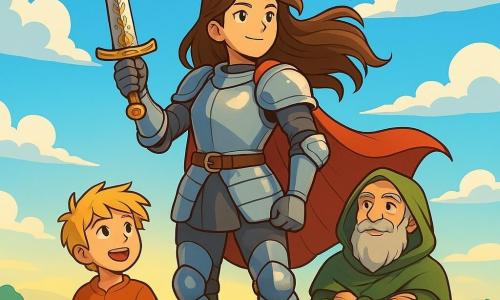
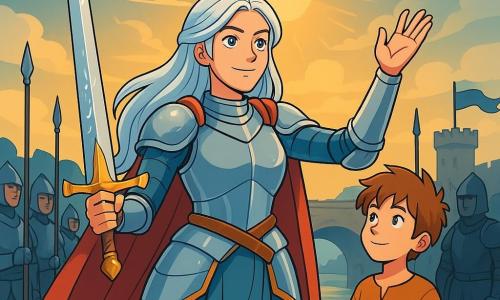
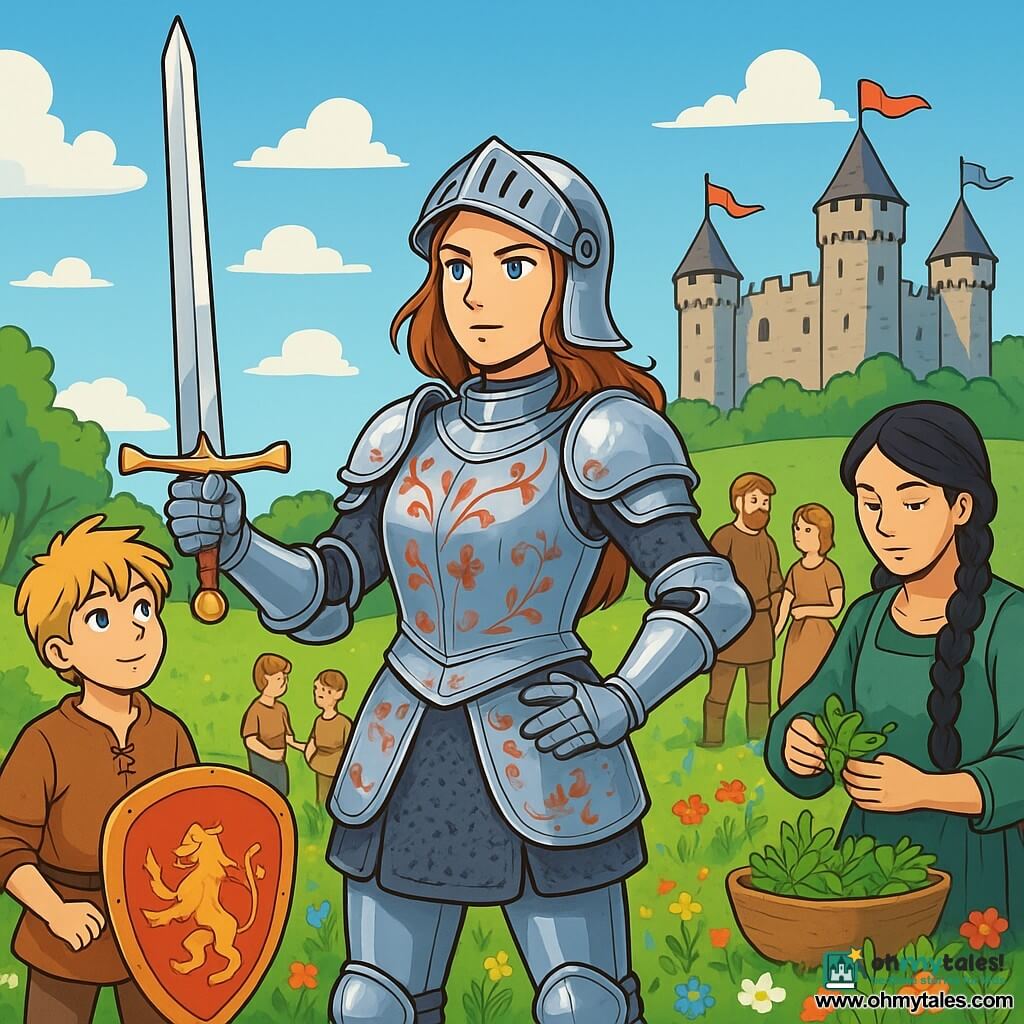
Lady Elin of Aldermoor stood beside the castle wall, her gauntleted hand resting on the hilt of a sword whose steel had seen more dawns than most men in the village. The morning mist rolled off the river like a slow sigh, and gulls cried across a sky the colour of pewter. She was a knight not merely by oath but by choice—wise beyond the usual measure, patient as a winter pond and stubborn as ivy.
A travelling seer had come the week before, wrapped in a cloak the blue of deep water. In the great hall, by torchlight, she had placed a small silver token into Elin's open palm and spoken in a voice that trembled like an old harp. "Follow the prophecy," the seer had said. "Where the three stones shadow the moon, there the path of peace or war will be revealed."
Elin had looked at that token for hours. It was a disc engraved with three tiny stones and a crescent moon. Many knights would have hung a banner, sharpened a spear and declared their mission. Elin let thought be her first weapon. "A prophecy," she told her squire Tomas. "Is it fate or a map? Either way, it asks something of us."
Tomas shrugged and grinned. "As long as it asks for dragons," he said, trying to lighten the weight of it.
Elin smiled but did not answer. Knights must be brave and bold, but first they had to be wise.
Chapter Two — The Broken Bridge
The first clue came sooner than expected. A messenger arrived at dawn with news: the village of Brackenford had been cut off. The great stone bridge over the Mirefen had crumbled, its arches like broken teeth. No trade wagons could pass, and the villagers were hungry and afraid. They whispered that raiders from the north, the Grey Wolves, had been seen near the marsh.
Elin rode out with a small company—Tomas, a healer called Maela, and two loyal men-at-arms. The ground smelled of wet earth and peat. When they reached Brackenford, children stared from behind patched curtains. Farmers bowed awkwardly, their hands raw from hard work.
"Lady Elin," the mayor said, worry knotted into every word. "We are cut off, and the Wolves come at night."
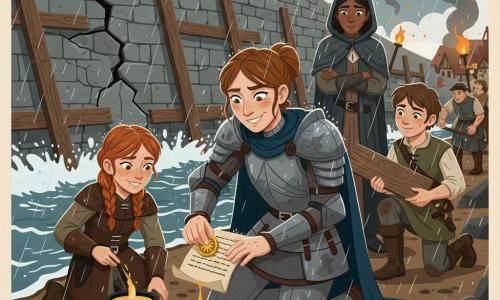
Elin examined the broken bridge, then paced along the riverbank. The arches had been sabotaged from the centre. It was not mere happenstance. She looked at the sky, the shape of the river, and then at the three stones—those carved on the silver token that lay heavy in her pouch. "We will set a watch," she said. "And we will mend what we can. But I will also seek the source of this trouble."
That night under a bruise of inked cloud, the campfire's flame skated over Elin's helmet. Tomas whispered, "The prophecy says three stones and the moon. Everything here has stones and the sky. How will we know?"
Elin dipped her hand into the pouch and felt the cool metal. "A prophecy is not a riddle you solve by chance. You must go where it points and be brave there."
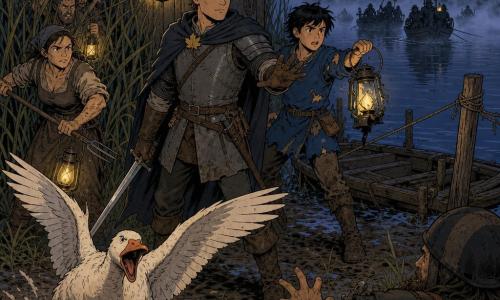
When the Grey Wolves made their move, they were not wolves at all but men in grey cloaks with masks shaped like snarling beasts. They came to take the villagers' food. Elin met them at the ruined bridge, steel bright in moonlight.
"Leave them," she commanded. She did not raise her voice because knights did not need thunder to be heard. The Wolves struck fiercely, but Elin's sword was patient and her mind quicker than their fury. She fought not for glory but for protection, moving with clever feints that confused the attackers. Tomas and the men-at-arms drove the raiders back; Maela tended the wounded. In the end, three raiders lay bound, and one of them whispered that their orders came from a banner with a silver crescent.
Elin's heart hit a rhythm like a drum. She thought of the token and the moon. This was a thread she had to follow.
Chapter Three — The Map in the Marsh
Following the trail of the raiders led them into the Mirefen, where willows wept and insects hummed like soft bells. The raiders had camped near three standing stones that jutted from the peat—moss-covered and strange, each with carvings that matched the token. The stones stood in a triangle and when moonlight touched them, a dark shadow fell between, as if they cast a secret of their own.
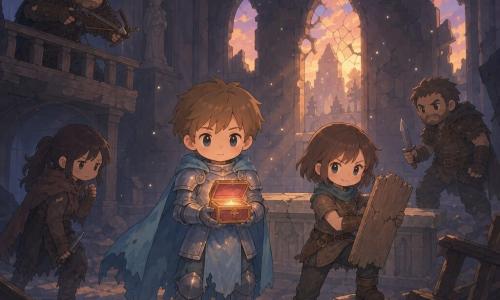
Elin studied the stones for hours, tracing the marks with gloved fingers. She discovered a shallow hollow on the largest stone, the kind of place weather might hide a thing. Inside lay a scrap of parchment, old and damp but legible: a map. The map showed a road to the north, ending at a fortress called Lornhold, and beside it a note in a hand both bold and tentative: "The moon divides the crown. Choose the peace."
"A choice," Tomas breathed. "Peace or war. Which does that mean?"
Elin folded the map and looked out at the marsh. "It means we must decide as we go. A prophecy gives a path, but not the answers. Courage will be needed, but so will judgment."
They rode north, following a path the map suggested. The countryside changed from bog to oak to high moor. On the third day they met a traveller, a woman with a cart of bright cloth and a face like worn leather. She greeted them with a knowing glance.
"You're bound for Lornhold, aren't you?" she said. "Many paths lead there. Some with swords and banners; some with words."
"Who sends the Grey Wolves?" Elin asked.
The woman shrugged. "Power tries to move itself into every corner. Lornhold holds a lord who fears he will lose his claim. He has sent men to make mischief where fear can be sown. But why does he fear the moon?"
Later, under a sky peeled thin by stars, Elin pinned the map to the saddle and spoke softly. "If the lord of Lornhold thinks he can force the crown, then the realm will be set against itself. I will not let fear and greed choose for us."
Maela touched Elin's sleeve. "You carry more than a sword, Lady. You carry the hopes of people who cannot plan wars."
Elin's jaw tightened. "Then we plan a different kind of battle."
Chapter Four — Trials of Lornhold
Lornhold rose like a dark crown on a bluff, its grey towers gleaming when the sun dared to peek. The drawbridge was down as if in welcome. Banners flew—one bearing a silver crescent.
They entered the fortress not as invaders but as petitioners. Elin requested an audience with Lord Rowan of Lornhold, a tall man whose beard had white in spots from stress. He received them in a hall built for speeches and echoes.
"Lady Elin," he said before she spoke. "I know of your deeds in Brackenford. You are a knight of reason as well as blade. Tell me why you come."
Elin stepped forward and set the silver token on the table between them. "There is talk of raised hands and hidden orders. Messages came to villages; men were frightened into giving their grain and their tools. The people whisper that Lornhold stands ready with an army. I ask you now: do you seek war?"
Rowan's eyes flicked to the token. "We seek only security. The border lords threaten us. If we do not prepare, we will be swallowed."
"This is the same fear that makes warm bread burn," Elin said quietly. "Preparedness is wise, Lord Rowan. But when servants go to the moors to threaten the innocent, you feed a war made of small cruelties."
Rowan leaned back, wounded and tired. "You propose peace with those who would steal our lands."
"Peace is not weakness," Elin replied. "It is a harder thing than war because it requires more courage. I ask you to consider the prophecy's words: 'Choose the peace.'"
The lord's unease twisted. "And what if the prophecy is false?"
"Then you have lost nothing but the chance to be remembered as a lord who chose mercy," said Elin.
They argued like clashing swords, each point ringing. But arguments need action. Lord Rowan proposed a test: a set of challenges to prove whether Elin's counsel could be trusted and whether the lord's defenders could stand firm without sowing fear. He appointed three trials: the Trial of Courage, the Trial of Wit, and the Trial of Heart. If Elin and her companions could meet them, Rowan promised to halt aggressive raids until talks of reconciliation could be held.
Elin accepted. Courage was something she had in abundance; wit was her steady blade; heart she had proven in Brackenford. The trials, however, were designed to be more than feats—they were designed to reveal character.
The Trial of Courage sent Elin into an old labyrinth beneath the keep to retrieve a banner damaged by time. In the dark she felt her way along cold walls. Strange voices—echoes, but like whispers of doubt—caressed her mind. She shoved fear aside and followed the warmth of a torch left by a careful hand. She found the banner, wrapped it in her cloak and emerged with mud on her knees and a steadier breath.
The Trial of Wit set before her a council of riddles about the map and the moon. It was here she used not brute strength but careful thinking, showing that violence could be sidestepped with clever words. She reasoned with the council and solved puzzles that made the room click like gears.
The Trial of Heart asked her to sit among a group of Lornhold's older soldiers who had seen their families leave and their fields burned. Elin listened while they spoke of loss. She could have lectured; instead, she shared stories of villages she had defended and asked what each man missed most. She did not hand out orders; she offered understanding. By the end, rough hands had rested on her shoulders, and one old soldier muttered, "You would fight for us. You would also hold us if we fell."
Rowan watched and, though his pride bristled, he found himself moved. He had expected confrontations; he had not expected to feel the steady pull of conscience. When the trials concluded, he bowed his head.
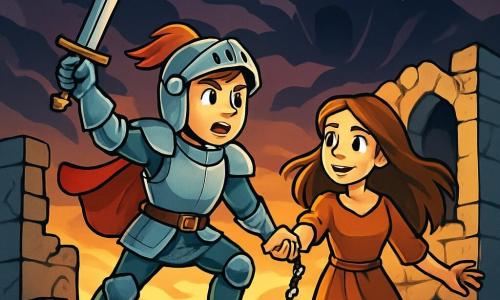
"Your wisdom is clear," he said. "I will call off raids sent to the border villages. I give you this pledge." He clasped her wrist in a knightly grip. "We will parley. We will try words before steel."
Elin accepted this, but she also asked for something else: that the prisoners taken by the Grey Wolves be freed and brought home. Rowan agreed.
Chapter Five — The March of Two Banners
News of Lord Rowan's pledge spread like the warm smell of baking. Elin encouraged the people of Lornhold and the border villages to gather representatives for a parley—that stubborn thing called negotiation. They would meet at the place the map marked: a field of wildflowers beneath a sliver of hill and under a moon that was only part-full, a valley where stones marked the earth like ancient teeth.
On the morning they were to travel, a rider arrived in haste. "A force from beyond the eastern ridge," he panted. "A stranger with a banner of black and stars, and he brings men. He claims the crown should be split and promises lands to those who join him."
Elin looked at Lord Rowan and saw the old fear threatening to return. "We will not let new fear unmake us," she said. "We must show that courage, wit and heart can build something steadier than the promise of land."
They set forth with two banners: Lornhold's silver crescent and Elin's plain white shield. On the road, they encountered bands of villagers and farmers, some armed with pitchforks, others only with old sorrow. At a ford, a patrol of the black-banner men tried to stop them, demanding they disperse. Elin rode forward alone, as a sparrow might fly into a storm.
"Why do you march?" the black-bannerman asked. His voice had the soft cruelty of men used to commanding others.
"To speak," Elin answered. "To choose whether we want peace or the kind of promise that is paid for in blood."
The man sneered. "Words will never stop us. Power answers power."
"Then try answering with the power of people." Elin's hand rested on her sword, not to draw but to show readiness. "If you want land and claim, prove your case at the council. If you want war, you may find that the people do not want what you offer."
For a moment, neither side moved. Then Tomas stepped forward and set down a small bundle of bread and cheese, laying it between the two groups as if it were a truce-lamp. People watched. Hunger is a quiet language that speaks of needing one another.
To everyone's surprise, the black-banner leader lowered his spear. "We do not want your crumbs," he said. "We want crowns."
Elin shook her head. "A crown built on theft will slide from fingers. Let us instead hear what men want. We will settle by talking, not by battle."
It was bold, dangerous counsel. But a sudden thing can be contagious. One of the black-banner's men, a youth with eyes too old for his face, muttered that he had a mother in Brackenford who needed grain. A Lornhold archer remembered a brother captured by raiders. Faces softened. By the time they reached the field beneath the moon, many were exhausted and yet oddly hopeful.
Chapter Six — The Choice Beneath the Moon
The stone circle waited like an audience. Between the three standing stones, the moon's sliver cast a thin silver line across the grass. People set themselves in two circles: Lornhold and its followers on one side, villagers and free knights on the other. The black-banner men stood like a third hope, their leader watching.
Elin stepped into the centre, token in hand. Her voice was steady. "A prophecy asked us to come here. It did not tell us what to do, only to decide. Today we decide."
She spoke of the cost of war—fields ruined, children hungry, songs forgotten. She spoke of courage that chooses to protect the weak, of wit that unties knots instead of cutting them, and of heart that listens before it strikes. She proposed a plan: a ring of mutual defence where Lornhold would protect border villages in exchange for fair taxes and shared councils where grievances could be aired. In return, the villagers would give supplies to Lornhold's weaker farms in times of need. It was not a plan of perfect peace but a pact: a promise to try.
Lord Rowan stood and added, "We will open our storehouses in winter. We will free those taken. We will not send raiders."
The black-banner leader scoffed, then found his voice softer. "And what of the crown?" he asked. "My men want land."
Elin looked him straight in the eye. "Land is not the only way to care for people. Be part of this council. Help rebuild what you took. If you will not, then we will hold you accountable."
There was a murmur, like wind through reeds. The leader hesitated. Then an old soldier from Lornhold—one of those who had rested a rough hand on Elin's shoulder—stepped forward. He offered the leader a cup of water and spoke of his own youth, of times he had stolen and regretted it. The leader listened. He had a face like a map of storms, but he also had a human heart.
In the end, it was a small gesture—a soldier handing a cup to an enemy—that proved greater than any sword. The black-banner leader agreed to lay down hostile plans and to join the council on probation. It was not victory in the dramatic sense; it was something quieter, more honest. People agreed to try. Children laughed in the margins of the circle, and for a while, the world felt as if it might bend toward better things.
Elin kept the silver token in her palm until the pledge was made. When it was done, she placed it on the earth between the stones and spoke softly. "A prophecy asked us to choose. We have chosen peace, though imperfect. Let this be the promise kept."
As the moon slipped behind a thin cloud, Lord Rowan walked to Elin and, in a gesture that surprised many, took off his heavy gauntlet and extended his bare hand. He did not kneel; he reached out as one human to another. He picked up the token, set it with both hands, and placed a small loaf of bread beside it—an offering for shared table and accord.
Elin looked at the loaf, then at the gathered faces. "Let it be a symbol," she said. "A reminder that peace is fed by small, brave acts."
Tomas laughed with a wet joy. "You see, Lady? No dragons. Just bread."
Elin smiled. "Bread can stop more wars than a blade, sometimes."
As dawn broke the next day, Lornhold's men helped rebuild Brackenford's bridge. The Grey Wolves were found to be a small band of desperate folk, not monsters. Many joined the new councils. It would take time for wounds to heal; not every heart would be won. But the pact was real. Rowan's men and the villagers worked side by side, and even the black-banner leader took an oath to protect the trade routes he had once menaced.
When the travellers left the stone circle, the token was gone from the hollow. The three stones remained, but now the grass around them had footprints of many people who had chosen to meet as humans rather than enemies.
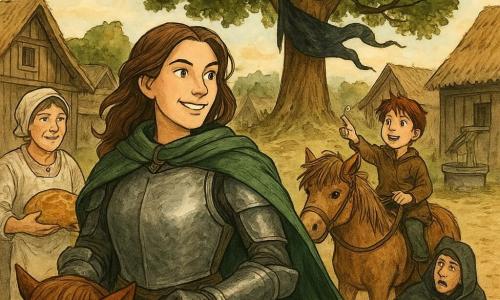
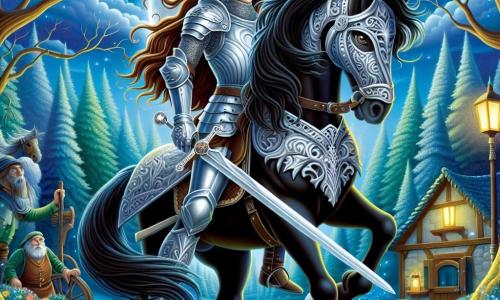
Elin mounted her horse and looked to the road ahead. The prophecy had been a whisper that asked for courage and judgement. She had followed it, not because fate demanded it but because she chose to. She rode with the satisfaction of a task done and the knowledge that peace required constant tending.
As the castle of Lornhold sank behind a bank of mist, Elin felt something quiet and wide within her—an answering echo to the seer's words. She had been astute and brave; she had used word and sword when each was needed. Above, the moon, third-quarter now, watched like a silver guardian.
"Will you stay?" Tomas asked, hopeful, as they rode toward the next place that might need them.
Elin tightened her grip on the reins and smiled. "There will always be places that need courage," she said. "But today we have given people a chance to keep the peace themselves. That is the kind of victory worth riding for."
They rode on, the horizon brightening, carrying the weight of the token only in memory. Behind them, at the stone circle, a small loaf lay beside the three stones—simple, warm, and offered as the first promise of a new beginning.