Chapter 1: The Bread and the Daydream
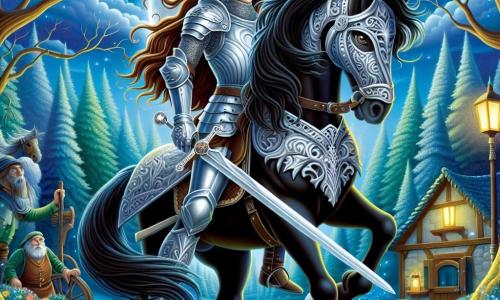
Sir Alder of Brambleford was the kind of knight who could stare at a puddle and imagine it was a lake where dragons went to drink. His armor was polished, his manners even more so, and his head was often full of bright, impossible scenes—banners snapping like thunder, heroes riding into songs.
But this morning, the grandest thing in his hands was a warm loaf of bread.
The castle kitchens had been busy since dawn. The bakers had pulled crusty rounds from the ovens, and the smell had filled the corridors like a friendly spell. Alder had asked for three loaves, not for a feast in the great hall, but for the bodyguard at the outer gate.
“They've been standing in the wind all night,” Alder had said, watching a baker dust flour off her sleeves. “And their breakfast is usually whatever courage tastes like.”
The head baker, Mistress Olla, had squinted at him. “Courage tastes dry.”
“Exactly,” Alder replied, and smiled as if he'd just discovered a new star.
He tucked the loaves into a cloth sack. The knot was neat, the fabric clean. A small kindness, but in Alder's mind it was a quest: Bread for the Guard, a mission of comfort for those who kept watch while others slept.
Outside the kitchen doors, his friend and squire, Tamsin, nearly collided with him. She was eleven—almost twelve—and already carried herself like she had a map of the world in her pocket.
“Sir Alder,” she said, breathless, “you're supposed to be at practice. Captain Rusk is sharpening his disappointment.”
Alder lifted the sack. “I'm on urgent knightly business.”
Tamsin peered inside. “Is that… bread?”
“Not just bread,” Alder said solemnly. “Warm bread. For the guard.”
Tamsin blinked. “That's the strangest quest I've ever heard.”
Alder stepped closer, lowering his voice like a storyteller at a campfire. “Every epic begins with something simple. A ring. A letter. A loaf. Besides, the guard have been extra tense. You can feel it in the air.”
“Or that's just the wind,” Tamsin said, but she fell in beside him anyway. “Fine. I'm coming. Someone has to keep you from trading your helmet for a poetic cloud.”
They walked through the inner courtyard, where banners hung heavy in the cold. The sky was pale and sharp. Alder imagined it as a blade being drawn.
Near the armory steps, a messenger sprinted past, face flushed. “Riders spotted on the ridge!” he shouted. “Unmarked!”
Tamsin stopped. “Unmarked means trouble.”
Alder held the bread sack tighter. “Then the guard will need it even more.”
“Sir Alder,” Tamsin said, “please tell me your daydreams include running fast.”
Alder's eyes brightened. “Oh, they do.”
And together they hurried toward the outer gate, where bravery stood in a line and the wind tried to steal it.
Chapter 2: The Gate of Wind and Worry
The bodyguard at the outer gate looked like statues carved from stubbornness. Their cloaks snapped, their boots were dusted with frost, and their hands never strayed far from spear or sword.
Sergeant Brann, a broad-shouldered veteran with a scar that curved like a crescent moon, spotted Alder first.
“Sir Alder,” Brann called, voice gravelly. “If you've come to recite a ballad, pick a shorter one. The ridge is restless.”
“No ballads,” Alder said, lifting the sack. “Bread.”
The line of guards stared.
Then, as if admitting it might be treason, one of them whispered, “Is it still warm?”
Alder handed the sack over. “Warm as a hearth. And there's enough to share.”
Brann's hard face softened by half a breath. “That's… decent of you.”
Tamsin leaned toward Alder. “Careful. If he smiles, the whole gatehouse might collapse from shock.”
Brann ignored her and broke a loaf cleanly. Steam rose, a tiny ghost of comfort. The guards tore pieces and ate quickly, as if afraid kindness could be confiscated.
Alder watched, heart tugged tight. He noticed the smallest things: a guard with cracked lips, another whose gloves were patched twice, and the youngest, whose hands shook—not from cold, but from fear carefully hidden.
Alder stepped closer to the young guard. “You've been up all night?”
The boy swallowed. “Yes, sir.”
“What's your name?”
“Pell.”
“Pell,” Alder said, gentle as a cloak. “You did well. No one sees the hours you keep, but the castle sleeps safely because you stand here.”
Pell's shoulders lifted, just slightly, as if the words were bread too.
A horn sounded from the watchtower—one sharp note, then another. The guards snapped into readiness.
Brann pointed toward the distant ridge. Tiny dots moved against the sky.
“Riders,” he said. “They're too bold to be lost merchants.”
Tamsin squinted. “No banners. No colors.”
Alder's daydream tried to paint them into heroes, but the shapes stayed wrong. He forced his imagination to listen instead of decorate.
Brann turned to Alder. “We need eyes on them. The captain is gathering men, but it'll take time. If they're scouts, we should know before they reach the gate.”
Tamsin's gaze slid to a narrow postern door set in the stone wall, half-hidden behind barrels. “There's the old path along the outer ditch. You can reach the ridge overlook faster than a mounted patrol.”
Brann looked down at her. “That path's broken. Slippery. Dangerous.”
Tamsin met his stare. “So is waiting.”
Alder felt the weight of his sword and the lighter weight of his breadless sack. His dreamer's heart thumped like a drum.
“I'll go,” he said.
Brann's eyebrows rose. “You? Alone?”
Alder glanced at Tamsin. She already had her small pack in hand, as if she'd been born ready.
“Not alone,” Alder said. “A knight and his squire. We'll see what we can and return with the truth.”
Brann hesitated, then thrust a short signal whistle into Alder's palm. “If you spot them turning for the gate, blow once. If they're too many, twice. And if you're in trouble—”
“Three times,” Tamsin finished. “We know.”
Brann grunted, almost approving. “Go, then. And may your courage be louder than your boots.”
Alder bowed. “And may your breakfast be less like dust.”
For a heartbeat, Brann's mouth twitched. Not a full smile—more like the memory of one.
Alder and Tamsin slipped through the postern door and into the cold, where the stones of the castle fell behind them and the world grew wide and watchful.
Chapter 3: The Ditch Path and the Listening Stones
The old path along the outer ditch was a thin ribbon of packed earth between stone and slope. One side was the castle wall, cold and towering. The other dropped away into brambles and pale rocks, where a twisted stream muttered to itself.
“Wonderful,” Tamsin said, stepping carefully. “It's like walking on a frowning knife.”
Alder tested each step before trusting it. His armor was lighter than most—he preferred speed to clanking glory—but even so, metal had a talent for pulling a person toward trouble.
“Stay close,” he said. “If you slip, grab the wall.”
Tamsin snorted. “If you slip, I'll write a ballad about it. ‘Sir Alder and the Great Fall of Dignity.'”
Alder's laugh puffed white in the air. “Make me sound heroic.”
“Oh, I will,” she said. “I'll say you fell bravely.”
They moved in a rhythm: step, check, breathe. The wind tried to pry secrets from their cloaks. Somewhere above, crows argued in sharp voices.
As they neared the ridge overlook, the ground changed. Flat stones jutted out like uneven teeth, slick with frost. Alder crouched and pressed his gloved hand to one.
“The stones are colder here,” he murmured.
Tamsin raised an eyebrow. “That's how stones work.”
“No,” Alder said, listening with his whole body. “Colder than they should be. Like something's been shading them.”
They crept forward. The overlook was a narrow shelf behind a clump of thorn bushes. From there, they could see the ridge road—an old track that ran like a scar across the hills.
The riders were closer now. Six of them. They rode in a tight group, heads lowered, cloaks dark. No banners, no bright paint, no cheerful jingling of trade bells.
Tamsin whispered, “Six. That's not a war party.”
“Not a peace party either,” Alder replied.
One rider tugged back his hood. Even at a distance, Alder caught the glint of something pale—bone beads braided into hair. Bandit signs, the kind that turned villages quiet.
Alder's stomach tightened. If these were the Ashridge Cutters, they were known for quick raids and quicker disappearances. They didn't attack walls; they attacked what moved outside them—messengers, farmers, lone travelers.
“They're heading toward the river bend,” Tamsin said, tracing the path with a finger. “They could circle behind and watch the gatehouse. Or pick off anyone coming or going.”
Alder's mind raced. He thought of Pell at the gate, of the tired guards chewing warm bread with grateful hands. He thought of the bakers, of Mistress Olla's flour-dusted sleeves. He thought of everyone who trusted the walls.
“We need to warn Brann,” he said.
Tamsin nodded. “And we should figure out why they're here.”
The riders slowed near a stand of rocks. One dismounted and crouched, inspecting the ground.
“They're tracking,” Alder breathed.
Tamsin's eyes widened. “Tracking what?”
Alder scanned the hillside. There—faint marks in the frost, leading away from the castle, down toward the old supply road.
“Someone left the castle,” he said. “Recently.”
Tamsin's face pinched. “A messenger?”
“Or someone sneaking,” Alder said. “If the Cutters catch them, it won't end kindly.”
Tamsin looked at Alder, and for once her jokes didn't leap to her lips. “We can't fight six riders.”
“No,” Alder agreed. “But we can outthink them.”
He drew the signal whistle, but hesitated. One blast would warn the gate, yet it wouldn't help the person being tracked.
Alder's dreamer heart tried to turn fear into a story where the hero always arrives in time. His sensible heart reminded him that heroes arrived because they chose hard paths.
“We'll split their attention,” he decided. “We'll make them think the trail goes somewhere else.”
Tamsin's eyes sparked. “A false trail?”
Alder nodded. “You're quick. Can you run back and warn Brann?”
“And you?” Tamsin asked, already knowing.
“I'll make the trail,” Alder said, steadying his voice. “And then I'll follow the real one. Quietly.”
Tamsin grabbed his sleeve. “That's risky. Very risky.”
Alder met her gaze. “Empathy is risky. Caring means you don't get to look away.”
Tamsin swallowed, then nodded sharply. “Fine. Don't die. It messes up my schedule.”
Alder almost smiled. “Go.”
Tamsin darted back along the ditch path, swift as a thought. Alder waited until she vanished behind the wall's curve. Then he loosened his cloak clasp and wrapped the fabric around his boots.
“If I'm to be a shadow,” he murmured, “I should stop sounding like a pot being kicked down stairs.”
He edged down from the overlook and toward the frost-marked trail, while above him the riders began to move again, following trouble like hungry dogs.
Chapter 4: The False Trail and the Quiet Chase
Alder's plan was simple, which didn't mean it was easy. He found a patch of soft ground near the rocks and pressed his bootprints deep, then scuffed them sideways. He broke a twig and dragged it along, making the trail look fresh and hurried.
Then he did something that felt slightly ridiculous, but knights in legends often did ridiculous things before the clever part worked.
He took a small piece of bread crust left in his sack—he'd saved it without thinking—and crumbled it near the false trail.
“May the birds be my allies,” he whispered.
Alder had seen ravens gather over crumbs faster than gossip spreads in a courtyard. If birds fussed and fluttered here, it might look like someone had paused, eaten, and run on.
He finished the false trail by leading it toward a patch of thicker brush, where the ground turned muddy. Plenty of confusing footprints could be made there by anyone with patience.
Then, staying low, he returned to the true trail—the faint marks leading toward the old supply road.
He moved with care, letting the landscape teach him. A bent blade of grass, a broken bit of frost, a scuffed stone. Someone had gone this way in a hurry, but not in panic. Their steps were long and steady.
“Someone determined,” Alder murmured.
The wind carried distant sounds: the faint clop of hooves, the creak of leather. The riders were not far.
Alder slid into a shallow dip between rocks and waited. His heart hammered, but he forced his breath to slow, as Captain Rusk had taught: “Fear is loud. Make your thinking louder.”
The riders appeared at the rock stand, scanning, muttering. Alder pressed himself against stone, feeling its cold seep into his armor.
One rider pointed toward the false trail. Another dismounted to examine it. Alder held still, imagining he was one of the stones: ancient, patient, impossible to bully.
A raven swooped down to peck at the bread crumbs, then another, and another. They cawed and jostled, wings beating.
The rider swore. “Someone stopped here.”
They followed the false trail.
Alder waited until their hoofbeats faded. Only then did he rise, careful and quick.
He followed the true trail along the supply road, which dipped into a thin woodland of bare trees. The branches scratched the sky like quills. The world smelled of damp earth and old leaves.
Ahead, a figure stumbled between trunks.
Alder's hand went to his sword, then paused. The figure was small—no bandit. A child? No, older. A young person in a plain cloak, limping.
Alder hurried forward, staying quiet until he was close enough to speak without shouting.
“Hold,” he said softly. “I'm not here to harm you.”
The figure spun, revealing a girl about Tamsin's age, cheeks smudged, eyes wide. She held a small satchel to her chest as if it contained her heart.
“Don't tell them,” she blurted.
Alder kept his voice calm. “Tell who?”
“The Cutters,” she said, trembling. “They saw me leave the castle. I— I didn't mean to cause trouble.”
Alder noticed the crest stitched on her sleeve: the castle's armory mark, a hammer over crossed swords.
“You're an armorer's apprentice,” he guessed.
She nodded fast. “My name is Lysa. The guard's shields—some of them are cracked. And the armory's been… wrong.” Her words tumbled out. “Captain Rusk wanted repairs, but the steel stores are low. I heard there were old ingots hidden in the river shed, from before the last war. I went to fetch them. I thought I could fix everything before anyone noticed.”
Alder's mind clicked pieces together. A secret trip. A trail. Riders hunting.
“Your courage is real,” Alder said, “but it brought danger behind it.”
Lysa's eyes shone with tears she refused to drop. “I just wanted to help them. They always stand there. Always. Like they're made of stone. But they're not.”
Alder felt a fierce warmth in his chest. Empathy recognized empathy.
“We're alike,” he said. “I brought bread to the guard this morning.”
Lysa stared. “Bread?”
Alder nodded. “Not as heroic as steel, but just as needed.”
A branch snapped nearby.
Alder's head snapped up. Hoofbeats, closer than they should be.
His false trail had not held them long enough.
Alder grabbed Lysa's arm—not hard, just guiding. “Can you run?”
She swallowed. “Yes. I can try.”
“Try like your life is a story you still want to finish,” Alder said. “This way.”
They plunged deeper into the woodland, the trees closing around them like a whispered secret.
Chapter 5: The Hollow Oak and the Bravery to Wait
Running in armor was like trying to outrun a bell. Alder's breath burned, and his joints complained. Lysa's limp made her stumble, but she bit back any sound and kept going.
They reached a massive oak split by age. Its trunk was hollow, a dark doorway big enough for two.
Alder pushed Lysa gently inside. “In. Quiet.”
She slid into the hollow, pressing against the inner wood. Alder followed, crouching so low his knees screamed in protest. The inside smelled of old sap and damp darkness.
Outside, hoofbeats thundered, then slowed.
Voices drifted through the trees.
“Trail ended,” one rider growled.
“Not ended,” another snapped. “Hidden. Search.”
Alder's hand tightened around his sword hilt. Drawing it would be loud. Fighting would be louder. He could perhaps take one by surprise, maybe two, but not all six. Not without getting Lysa hurt.
He looked at her. Her eyes were wide as moons, fixed on his face as if it was the only steady thing left.
Alder placed a finger to his lips, then pointed upward, toward the oak's thick roots that formed a half wall around the hollow opening. If they stayed still, shadows would do the work.
A rider's boots crunched nearby. A blade scraped a tree trunk.
Lysa's breath hitched.
Alder leaned closer and whispered, so softly the words barely existed. “Count with me.”
Her gaze flicked to his.
“Four breaths in,” he mouthed. “Four out.”
They breathed together, slow and controlled, as if they were practicing in the training yard. Alder felt his heartbeat steady. He felt Lysa's trembling lessen.
This, he thought, was a different kind of bravery—the bravery to wait when your muscles begged you to run, the bravery to stay quiet when panic wanted to shout.
A shadow fell across the hollow opening. A bandit face appeared, eyes narrow.
Alder didn't move. He let his body become part of the oak, and in his mind he pictured himself as a knight carved into a pillar—still, watchful, unblinking.
The bandit sniffed, spat, and moved on.
Alder's lungs ached from holding breath, but he didn't release it until the boots retreated.
Then—three clear whistle blasts rang out, distant but unmistakable.
Tamsin. The signal for trouble.
The riders cursed. “Castle patrol!”
Hooves turned. The bandits crashed away through the brush, retreating like a storm pulling itself back into the sky.
Alder finally exhaled. Lysa sagged against the oak wall.
“We're alive,” she whispered, sounding surprised.
Alder's lips quirked. “It's a good habit.”
Outside, footsteps approached—lighter, faster.
“Tamsin?” Alder called quietly.
Her face appeared between branches, fierce with worry. “Sir Alder! I thought you'd turned into a heroic smear on the landscape.”
Alder crawled out of the oak hollow, helping Lysa. “Not today.”
Tamsin's gaze snapped to Lysa. “Who's—”
“Lysa,” Alder said. “Armory apprentice. She was trying to help the guard.”
Tamsin's expression softened. “Right. Because everyone in this castle is determined to help in the most dangerous way possible.”
From the trees behind Tamsin came more movement—Sergeant Brann and three guards, weapons drawn, eyes sharp.
Brann's stare landed on Alder. “We heard the whistles. Report.”
Alder spoke quickly, clearly: the six riders, the tracking, the false trail, Lysa, the ingots.
Brann's jaw worked as if chewing on the information like hard bread. At last he looked at Lysa.
“You ran out alone?” he demanded.
Lysa flinched. “I—I thought I could fix the shields. And the armory racks are old—some are rotting. Swords fall. It's dangerous.”
Brann's expression shifted. Anger, then something tired underneath it. “You should have asked.”
Lysa lifted her chin, voice shaking but stubborn. “You should have listened.”
Silence snapped between them like a banner in wind.
Alder stepped forward, not with steel, but with words. “Sergeant, she meant well. And she's right. If the armory is unsafe, it endangers everyone. Especially the guard.”
Brann looked away, eyes hard. “We'll escort her back. The Cutters fled, but they may circle.”
Alder nodded. “And the ingots?”
Lysa clutched her satchel. “I found them. They're heavy, but—”
Brann grunted. “Good. Then we'll turn this mess into something useful.”
They started back toward the castle, moving in a tight group. Alder stayed beside Lysa, matching her slower pace. Tamsin hovered on the other side, sharp-eyed.
“You did a brave thing,” Alder told Lysa. “Next time, do a wise thing too. Bring help.”
Lysa managed a small, embarrassed smile. “Next time I'll bring a knight with bread.”
Alder chuckled. “An excellent combination.”
Chapter 6: The Armory That Changed
The castle gates welcomed them with groaning hinges and the familiar smell of smoke and stone. Guards on the walls called down updates. The tension eased, though it did not vanish—danger rarely left politely; it simply waited elsewhere.
Sergeant Brann took Lysa straight to Captain Rusk. Tamsin marched with them as if she was personally responsible for the truth being delivered properly.
Alder followed, and together they entered the armory.
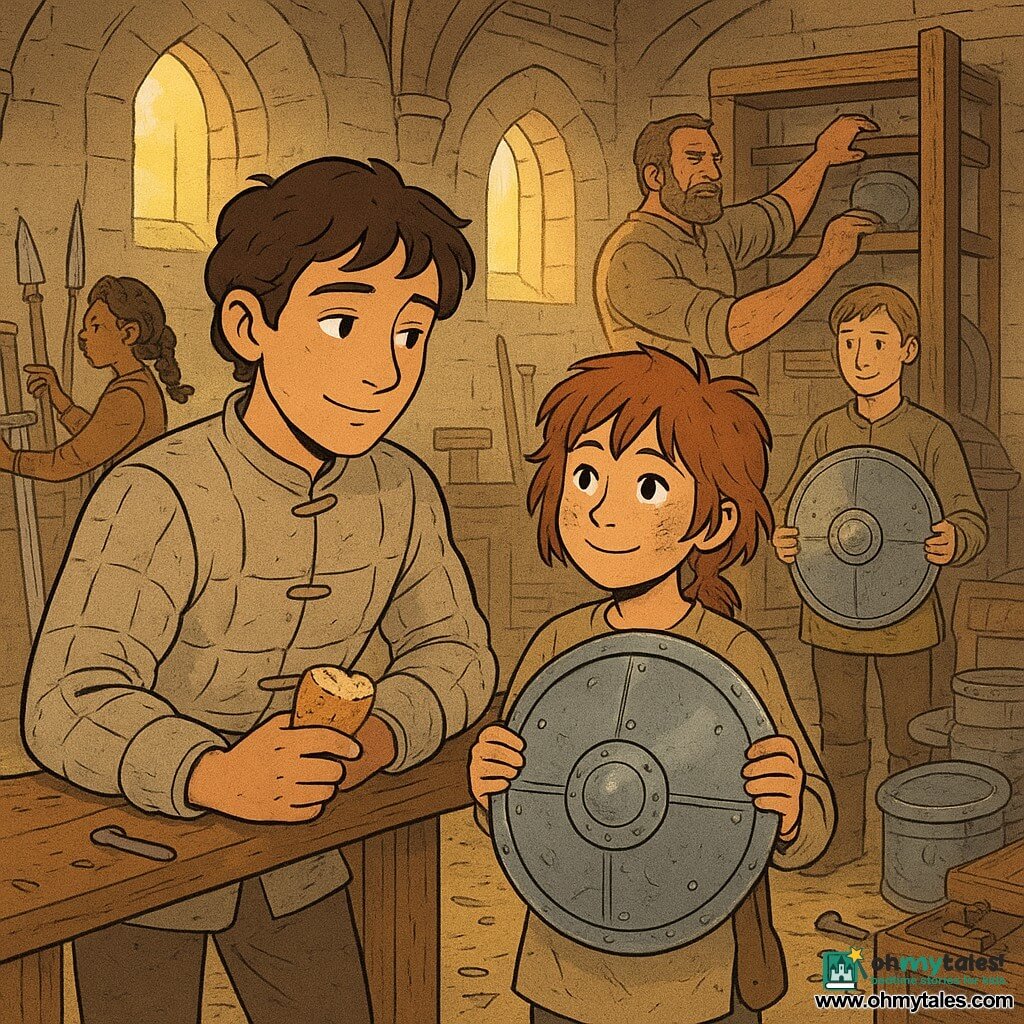
It was a long room lit by narrow windows. Weapons lined the walls, but not neatly. Spears leaned at odd angles. A rack of swords sagged in the middle. Shields were stacked like tired plates, some with cracks that looked like spiderwebs.
Alder's dreamer mind saw what it could be: a hall of shining order, where every blade rested ready, where courage had a home. What he saw now was something neglected—like a promise that hadn't been kept.
Captain Rusk stood at the far end, arms crossed, face set like a locked door. “Report,” he demanded.
Brann spoke. Tamsin filled gaps, quick and exact. Lysa held out her satchel of ingots as if offering proof of her intentions.
Rusk's gaze moved over the cracked shields and sagging racks, and something in his eyes shifted. Not softness—captains rarely had time for that—but recognition.
“We've been patching the visible holes,” Rusk said slowly, “and ignoring the quiet ones.”
Alder stepped forward. “Sir, the guard stand in the wind so the rest of us can stand in warmth. If their shields crack and their blades fall, we fail them.”
Rusk looked at Alder. “You risked yourself for an apprentice?”
Alder answered honestly. “I risked myself for someone who cared. Caring is contagious, sir. It spreads faster than fear if we let it.”
For a moment, the armory was still. Then Rusk gave a short nod.
“Brann,” he ordered, “double the gate watch until we know the Cutters are gone. And assign two guards to escort messengers for a week.”
Brann snapped a salute.
“Lysa,” Rusk continued, “you will not sneak out again. But you will lead repairs—under supervision. We will restore this armory properly. No more rotting racks. No more cracked shields hidden behind others. Understood?”
Lysa's eyes widened. “Me? Lead?”
“You saw the problem,” Rusk said. “You cared enough to act. Now act with the castle beside you.”
Lysa swallowed hard. “Yes, Captain.”
Rusk turned to Alder and Tamsin. “And you two—since you enjoy unusual quests—you will help.”
Tamsin grinned. “Sir Alder will be thrilled. He loves anything that involves dramatic meaning.”
Alder placed a hand over his heart. “Steel and bread, Captain. Both can hold a kingdom together.”
Work began at once. It wasn't the kind of battle sung about by bards, but it had its own rhythm: hammer strikes like drumbeats, the scrape of whetstones like whispered promises.
Alder helped carry beams to replace the sagging rack supports. Tamsin organized weapons by type and size, muttering, “If I ever see another spear, I'll start using them as laundry poles.” Lysa, focused and fierce, directed the placement of new supports and inspected shields with a steady eye.
Even Sergeant Brann returned, surprising everyone by rolling up his sleeves.
He lifted a cracked shield and frowned. “This could have failed in a fight.”
Alder watched him, then said quietly, “It's hard to ask for help when you're used to being the help.”
Brann's eyes flicked to him. “Are you lecturing me, Sir Dreamer?”
Alder shrugged. “Just noticing.”
Brann huffed, but his grip on the shield eased. “Pell nearly dropped his spear last night. His hands were numb. I told him to stop trembling. He said he wasn't trembling from cold.”
Alder's voice softened. “What did you do?”
Brann stared at the shield's cracked rim. “Nothing. I didn't know what to do.”
Alder nodded slowly. “Today you're doing something. You're making their tools safer. Next time, you can also make their hearts safer.”
Brann looked away, then grunted. “Maybe.”
By evening, the armory looked different. Not perfect—perfection took time—but changed. New wooden supports stood firm. Swords hung straight, each in its own slot. Shields were sorted: sound ones ready, damaged ones set aside for repair. A clear walkway ran through the center so no one would trip over hidden clutter.
Captain Rusk walked the length of the room, boots thudding like an approving drum. “Better,” he said. “This is what preparedness looks like.”
Alder leaned on a newly set beam, sweat on his brow, arms aching. The ache felt honest.
Tamsin nudged him. “So. Your epic quest was… bread and carpentry.”
Alder smiled, eyes bright. “And keeping people from being hunted.”
“And not getting turned into a smear,” she added.
“That too,” Alder said.
Lysa stepped up, holding a repaired shield. Its crack had been bound with a steel strip, riveted tight. She turned it so the light caught the metal.
“This one belongs to Pell,” she said. “He won't have to worry about it splitting.”
Alder pictured Pell's shaking hands and the way his shoulders had lifted when spoken to kindly. “Good,” he murmured. “He deserves to stand with confidence.”
The armory doors opened, and a guard entered—Pell himself, cheeks red from cold, eyes cautious. He stopped when he saw the room.
“It's… different,” he said.
Brann stepped beside him. “It is. And your shield will be repaired properly. We should have done this sooner.”
Pell blinked, clearly startled by the sergeant's tone. “Thank you, Sergeant.”
Brann cleared his throat. “Eat something warm before watch. There's bread in the guardroom. Sir Alder started a dangerous tradition.”
Pell glanced at Alder, a shy smile forming. “Bread tastes like… being remembered.”
Alder felt something steady settle in him—like a sword finally resting in the right sheath.
As night fell, the armory stood strong and orderly, ready for whatever the world sent. And in the quiet between hammer strikes and distant horns, Alder understood that the greatest legends were not only about slaying monsters.
Sometimes they were about noticing tired hands, sharing warmth, and rebuilding the places where courage lived.