Chapter 1: The Patrol Journal
Sir Rowan of Wrenford was a knight in training, which meant his cloak was a little too long, his sword belt sat a little crooked, and his dreams were far too big for the courtyard.
He also had a mission that no one else seemed to understand.
A patrol journal.
Not a poem. Not a love letter to a heroic destiny. A proper journal, with dates, routes, weather, and anything “unusual, suspicious, or mildly interesting,” as Captain Brine had said while handing him a plain leather book.
Rowan loved the book immediately. The pages smelled like oak and promises.
That morning, he perched on the castle wall with a quill, watching mist roll over the valley like spilled milk.
“Day Twelve of Autumn Patrol,” he whispered as he wrote. “Sky: pear-gray. Wind: restless. Mood: brave, with a small wobble.”
Below, the other squires were laughing, tossing pebbles at a target painted on a barrel. Rowan smiled, but he stayed with his page. The journal mattered. It was proof that a person could be heroic by being careful.
Captain Brine's voice boomed from the gatehouse. “Rowan! Boots on! You're riding with the patrol today.”
Rowan's heart performed a swift cartwheel. “Yes, Captain!”
As he hurried down, he nearly tripped over his own cloak. He caught himself, tried to look dignified, and failed in a way that made the stable boy snort.
“Careful, Sir Dreamy,” the boy teased.
Rowan climbed onto his pony—Maple, small and stubborn—and tucked the journal safely inside his satchel. If he was going to be a true knight, he would need courage for danger, intelligence for puzzles, and resilience for… well, for Captain Brine's opinions.
At the gate, Captain Brine waited with three riders. There was Dame Elowen, calm as a stone in a river. There was Squire Jory, who grinned like trouble had written him love notes. And there was Old Marn, the scout, whose eyes always looked as if they had already seen tomorrow.
Captain Brine pointed down the road. “The Westwood track. The old bridges. The boundary stones. Write what you see. And Rowan—”
Rowan sat straighter.
“Try not to write what you imagine.”
Rowan blinked. “But… imagining is part of seeing, sir.”
Captain Brine groaned as if someone had stepped on his favorite boot. “Just ride.”
The patrol set off, hooves tapping a steady rhythm. The castle shrank behind them, and the world widened—fields turning gold, hedges heavy with berries, and crows drifting above like scraps of dark cloth.
Rowan opened his journal as Maple walked. His handwriting wobbled with the pony's steps, but he kept going anyway.
“Noted: a scarecrow with a missing hat,” he wrote. “Also: the scent of apples, which suggests harvest nearby.”
Jory leaned over. “Write this: Jory the Brave spotted a dragon in the clouds.”
Rowan glanced at the sky. “That's a sheep-shaped cloud.”
“A dragon disguised as a sheep,” Jory insisted.
Dame Elowen's voice was gentle but firm. “Rowan records truth. Jory records nonsense. Both have their uses, but only one is reliable.”
Jory placed a hand on his chest. “I am wounded.”
Rowan tried not to laugh. He wanted to be serious. A patrol journal was a knight's promise to notice.
And then Old Marn raised a fist.
They halted.
On the road ahead, half-hidden in a ditch, was a broken shield—painted with the crest of House Wrenford.
Rowan's dreams went quiet, as if listening.
Dame Elowen dismounted and inspected it. “Splintered. Recent.”
Captain Brine's jaw tightened. “Bandits?”
Old Marn touched the earth. “Many feet. Heavy boots. Not farmers.”
Rowan swallowed. His courage did a small wobble again. But he pulled out the journal and wrote:
“Unusual: broken shield bearing our crest found on Westwood track. Possible threat. Proceed with caution.”
The words looked steady on the page. That helped his spine feel steadier too.
They rode on, slower now, eyes searching the shadows between trees.
Somewhere ahead, something had happened.
And Rowan intended to record it—and survive it.
Chapter 2: The Whispering Bridge
Westwood thickened into a tunnel of branches. The leaves rattled like coins in a beggar's cup, and the road grew narrow and damp.
Rowan kept glancing at his satchel, as if the journal were a tiny shield of its own.
Jory broke the silence. “Maybe it's nothing. A traveler dropped it.”
Captain Brine's stare could have sharpened a spoon. “Travelers don't drop shields.”
They reached the first old bridge: two stone arches over a fast stream. The locals called it Whispering Bridge because water hissed through cracks in the stones, making it sound like the bridge was gossiping.
Rowan leaned close and listened.
“Did it say anything?” Jory asked.
Rowan frowned. “It sounds like… ‘Wait.'”
“It says ‘wet,'” Captain Brine corrected. “Because it's water.”
Dame Elowen's lips twitched, almost a smile. “Still, we wait. Patience keeps bones unbroken.”
They dismounted. Old Marn walked first, light as a cat, testing each stone with his staff. The bridge looked sturdy, yet something about it felt wrong—like a grin with one tooth missing.
Rowan's mind started stitching clues together: the broken shield, the tracks, the bridge's cracked stones.
He stepped closer and saw it.
A thin line, almost invisible, stretched across the bridge's center—twine, tied to a peg hammered between stones.
“A trip line,” Rowan whispered.
Captain Brine halted so quickly Maple bumped his leg. “Good eyes.”
Old Marn followed the line down the side of the bridge. “Leads to that shrub.”
Dame Elowen drew her sword, not flashy, just ready. “Jory, circle left. Rowan, stay behind me.”
Rowan's mouth went dry. He was not fond of being behind anything in a story, but he was very fond of being alive.
Jory crept around the shrub. “I see a box,” he hissed. “Wooden. Like… like a little chest.”
Old Marn's voice was a soft growl. “Trap chest. Pull the line, and something falls.”
Captain Brine nodded toward Rowan. “Journal it.”
Rowan's fingers shook, but he wrote anyway.
“Threat: trip line across Whispering Bridge, connected to concealed box. Possible falling stones or arrow mechanism. Avoided due to observation.”
It felt strange to write about danger while standing inside it, but the journal made him focus. It turned fear into facts.
Dame Elowen sheathed her sword. “We'll disarm it.”
Rowan watched them work: Captain Brine holding the line steady, Old Marn loosening the peg, Jory lifting the box with the careful seriousness of someone holding a sleeping hornet.
Inside were rocks and a crude sling—meant to whip stones into anyone who tripped the line.
“Bandits,” Captain Brine muttered. “They want to break ankles, slow patrols, steal horses.”
Jory lifted a rock and whistled. “These would've bruised the pride right off me.”
Dame Elowen looked at Rowan. “What else do you notice?”
Rowan scanned the trees. A dark smear on a trunk. He rode closer and saw dried mud mixed with… something shiny.
“Boot polish,” he said. “Fancy kind. Like guards use.”
Captain Brine's brow furrowed. “Bandits with polish?”
Old Marn's eyes narrowed. “Or someone wanting to look like guards.”
Rowan's thoughts raced. A stolen crest shield. Traps. Polished boots. Someone pretending.
His dreamer heart wanted to declare: A traitor lurks! A secret order! A shadowed knight with a scar!
But his journal demanded patience.
Rowan wrote: “Clue: boot polish found on tree near trap. Suggests disguised attackers.”
They remounted and crossed the bridge safely. The stream below chattered as if laughing at their narrow escape.
Beyond the bridge, the road forked: one path climbed toward the boundary stones; the other dipped toward the ruins of an old watchtower.
Captain Brine pointed to the ruins. “We check there.”
Rowan swallowed. Ruins were the kind of place legends loved.
So did bandits.
Chapter 3: The Watchtower Ruins
The watchtower had once guarded the valley. Now it was a cracked stump of stone wrapped in ivy, like an old soldier wearing a green cloak to hide his scars.
They approached quietly. Even Maple seemed to understand, stepping softly as if the grass were sleeping.
Rowan's mind tried to run ahead, imagining torches, hidden passages, a captive prince.
He forced himself to look instead.
Near the tower, the grass was flattened. Wagon tracks cut deep into the mud.
Old Marn crouched. “Fresh. Two days.”
Jory peered through a gap in the stones. “I see… shadows.”
Captain Brine signaled. “Dame Elowen, left. Marn, right. Rowan—stay back and watch the horses.”
Rowan's cheeks warmed. “Sir, I can—”
“You can write,” Captain Brine said. “Do it well.”
Rowan wanted to protest. But patience, he reminded himself, was not just waiting. It was choosing the right moment.
He nodded and pulled out the journal.
“Location: watchtower ruins. Signs of wagon activity. Patrol splitting to investigate.”
From where he stood, Rowan could see the tower's dark doorway. His ears strained for voices.
He heard a clink. Then a laugh—low, rough.
Bandits.
Then, a new sound: a faint metallic squeal, like a hinge complaining.
Rowan's eyes darted to the tower wall. Vines hid a narrow door, half-buried.
A secret exit?
He bit his lip. If bandits ran out that way, the patrol might miss them.
Rowan looked at Maple. Maple looked back with the stubborn expression of a pony who had never been impressed by heroics.
“All right,” Rowan whispered. “We'll be sensible heroes.”
He slipped down, staying behind a fallen block of stone. He inched toward the vine-covered door, keeping his breathing slow. Patience again: not rushing, not panicking.
The squeal came again. The door shifted.
Rowan's heart hammered. He opened his journal, not because it helped him write now, but because it steadied him. Facts, not fantasies.
Then the door creaked open.
A man stepped out—helmet on, cloak pulled high. In his hand was a bundle of arrows. He moved like someone who thought he owned the forest.
Rowan noticed the boots.
Polished. Not bandit boots. Guard boots.
The man turned his head, and Rowan saw the crest on his shoulder: House Wrenford.
But it was stitched crooked, as if sewn in a hurry.
Disguise.
Rowan's courage rose up, shaky but determined. He could shout, but that might send the man running. He could attack, but he was one knight-in-training with a pony and a journal.
Intelligence, then.
Rowan scanned the ground and spotted a loose stone near the man's foot. Rowan picked up a pebble, aimed, and flicked it—hard enough to clack against the stone wall on the opposite side.
Clack!
The disguised man froze. “Who's there?”
Rowan ducked. He flicked another pebble farther left.
Clack!
The man turned, moving away from the secret door, stepping toward the sound.
Rowan held his breath and slid to the door. It wasn't locked. He slipped inside.
A narrow passage ran through the tower's thickness, damp and cold. The air smelled of mold and old smoke.
He crept forward until he could see into the tower's main chamber.
Two men sat at a crude table with a map. A sack of coins lay open, glinting. A third man sharpened a knife. They wore mismatched armor pieces—stolen, patched, ugly.
And above the table hung a shield—whole, not broken—painted with House Wrenford's crest.
Rowan's stomach flipped. They weren't just stealing. They were framing the castle's guards, making it look like Wrenford's own men had turned bandit.
He needed to tell Captain Brine. Now.
Rowan backed away—
—and bumped into something.
A barrel.
It rolled. Slowly at first.
Then faster.
“Hey!” one bandit shouted. “What was that?”
Rowan bolted through the passage, out the secret door, and straight into the forest.
Behind him, angry footsteps pounded.
Rowan ran until his lungs burned. Maple was still by the horses, thank goodness. Rowan vaulted onto the pony with more panic than grace.
“Maple!” he gasped. “Please, just this once—be heroic!”
Maple, perhaps surprised by the word “please,” sprang forward.
Rowan yelled, “Captain Brine!”
The patrol whirled. Bandits burst from the tower's side door, and the disguised man appeared too, sprinting.
Dame Elowen's sword flashed like a strip of lightning. Old Marn's staff cracked against a knee. Jory whooped, then yelped, then recovered and tackled someone into the grass.
Rowan skidded to Captain Brine, breathless. “They have our crest. They're disguising as guards. There's a map—routes—coin—”
Captain Brine's face hardened. “They're planning raids.”
Rowan nodded. “And traps. Whispering Bridge.”
Captain Brine barked orders. “Elowen! Secure the entrance. Marn! Track the runner. Jory—stop shouting and start tying!”
Jory, sitting on a bandit's back, grinned. “I can do both!”
Rowan opened his journal with trembling hands and wrote, even as the fight calmed into captured groans and rope knots.
“Engagement at watchtower. Bandits captured. Evidence: Wrenford crest used to frame guards. One disguised runner escaped north.”
Captain Brine glanced at him. “Good work. Risky, but good.”
Rowan's pride warmed him, but he kept his voice steady. “We should follow the runner. He'll lead us to the rest.”
Old Marn nodded slowly. “He ran toward the boundary stones.”
Dame Elowen wiped her blade clean. “Then that is where our courage goes.”
Rowan shut the journal, feeling its weight like a promise.
The adventure was not finished. It was only changing shape.
Chapter 4: The Boundary Stones
They rode hard, following Old Marn through narrow deer paths and bramble-choked lanes. The forest thinned into rocky hills, where the wind was sharper and the clouds moved like an army.
Rowan's legs ached from gripping the saddle. His hands smelled of ink and sweat.
But he stayed alert.
The boundary stones stood in a line across the hilltop—ancient pillars carved with faded symbols. They marked where Wrenford's land ended and the wild moors began.
Old Marn dismounted and studied the ground. “He came through here.”
Captain Brine scanned the horizon. “If they cross into the moors, we'll lose them.”
Rowan stared at the stones. Something tugged at his memory—an old lesson from the castle library. Boundary stones weren't only markers. They sometimes hid messages, carved deep and covered with lichen.
He slid from Maple and approached the nearest pillar. He brushed away moss. Underneath, letters appeared.
Not the crest. Not a prayer.
Numbers.
Rowan frowned. “Captain… look at this.”
Captain Brine leaned in. “Coordinates?”
Dame Elowen traced them with a gloved finger. “A meeting point.”
Jory squinted. “Or a recipe for stew.”
“Quiet,” Captain Brine snapped, but his eyes were bright with interest.
Rowan looked to the next stone. More numbers. The third stone had a carved arrow pointing east, toward a low ridge where a cave mouth yawned like an open jaw.
Rowan's dreamer mind wanted to call it the Dragon's Throat. He swallowed the name and wrote the truth instead.
“Discovery: numbers carved beneath moss on boundary stones; likely meeting signal. Arrow points east to ridge cave.”
Captain Brine nodded, impressed despite himself. “Smart. That's why we keep records.”
They approached the cave carefully. The air smelled like wet stone and old fires. At the entrance lay a pile of ashes, still dark, with a few warm spots.
“Recent,” Old Marn murmured.
From inside came voices—several.
Captain Brine signaled them to spread out. Rowan's pulse thudded in his ears. He wasn't the strongest. He wasn't the fastest. But he could notice.
He noticed, for example, that the cave entrance was too quiet for a gang. No clinking armor. No arguing. The voices were calm, almost rehearsed.
He noticed a thin cord stretched low across the ground—another trip line, this one aimed at anyone charging in.
Rowan whispered to Dame Elowen, “Trap.”
She nodded and lifted her foot over the cord, motioning the others to follow.
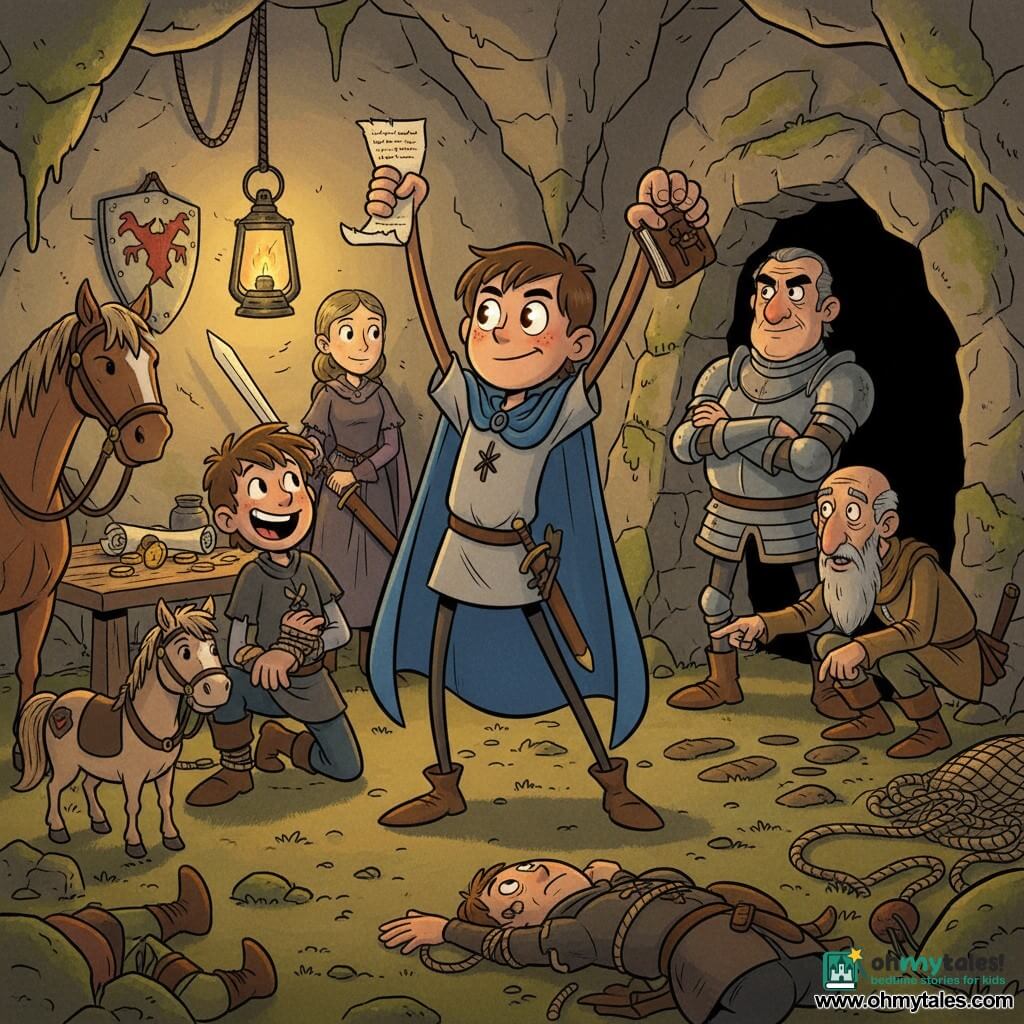
They slipped inside, hugging the walls. The cave widened into a chamber lit by lanterns.
There were six men. Two wore polished boots and crooked crests. The others wore scavenged armor.
In the center, a tall man held a sealed letter. His voice was smooth. “When the patrol finds the traps, they will blame the guards. When the villagers complain, the lord will punish his own men. Wrenford will weaken itself.”
Captain Brine's face went storm-dark.
Rowan's mind worked quickly. The bandits weren't just stealing. They were trying to poison trust.
The tall man lifted the letter. “This goes to the neighboring baron. He will ‘help' with soldiers. He will take our land as payment.”
A plot.
Rowan felt fear surge, but he also felt something steady beneath it: the journal. The habit of being careful. The patience to wait for the right move.
Captain Brine whispered, “We need that letter.”
Dame Elowen's eyes were calm. “We take it.”
Jory grinned. “With style.”
Rowan whispered, “With patience.”
They waited as the tall man approached a saddlebag near the back, where a messenger's cloak hung. He set the letter down for a moment to tighten a strap.
That moment was their doorway.
Old Marn hurled a small stone into the far corner. It clattered loudly.
“What was that?” a bandit snapped.
Heads turned.
Captain Brine stepped out like thunder given a human shape. “In the name of House Wrenford, drop your weapons!”
The chamber erupted. Steel rang. Lanterns swung, throwing wild shadows on the walls.
Rowan stayed near the entrance, as ordered, but his eyes locked on the letter. If it left the cave, the whole valley might burn with suspicion.
The tall man grabbed it and ran toward a side passage.
Rowan's chance.
He sprinted, Maple's training giving him quick feet even without the pony. The side passage was narrow. The tall man was faster, but he carried armor and pride.
Rowan saw the earlier trip line cord, trailing into the passage like a snake.
An idea sparked—risky, but clever.
Rowan dove, grabbed the cord, and yanked.
A net dropped from above, weighted with stones.
The tall man looked up, startled. “What—”
The net slammed down, tangling his arms and pinning him to the ground with a humiliating thud. The letter flew from his hand and skidded across the stone.
Rowan snatched it, hands shaking. His heart banged like a drum in a parade.
He ran back into the chamber holding the sealed letter high.
“I have it!” he shouted.
Captain Brine's sword halted inches from a bandit's throat. The bandit froze. One by one, weapons lowered. Even thieves understood when the game was lost.
Dame Elowen tied knots with practiced speed. Jory, panting, said, “Rowan, that was… actually heroic.”
Rowan tried to sound calm. “It was mostly pulling a string.”
Old Marn chuckled, the sound like dry leaves. “Most victories are.”
Rowan wrote in his journal while the lanterns steadied.
“Confrontation in ridge cave. Leader captured. Letter intercepted—evidence of plot to weaken Wrenford by framing guards. Trap used against enemy.”
Captain Brine took the letter and tucked it safely away. He looked at Rowan, and for once his voice held no grumble.
“Your journal won't just record bravery,” he said. “It will protect the realm.”
Rowan's chest filled with something bright and quiet.
Patience had not been waiting for adventure.
Patience had been holding steady until he could act wisely.
Chapter 5: Ink and Honor
They returned to the castle at dusk, riding under a sky painted with red and violet streaks. The towers of Wrenford rose ahead like giant candles against the darkening hills.
Villagers gathered near the gate when they saw the captured bandits. Murmurs rippled through the crowd.
“Were the guards really—?” someone began.
Captain Brine raised the sealed letter. “No. Someone tried to make you doubt your own protectors. We have proof.”
The crowd quieted, as if a heavy cloak had been lifted from their shoulders.
Rowan felt a small glow of satisfaction. Not because he wanted applause—though he wouldn't refuse a polite amount—but because the valley felt safer when people trusted each other.
Inside the castle, the lord's steward summoned them to the hall. The great room smelled of firewood and polished stone. Banners hung like frozen waves.
Captain Brine presented the evidence: the crooked-stitched crests, the map from the watchtower, and the intercepted letter.
The steward's face tightened as he read. “So the neighboring baron planned to ‘assist' us into weakness.”
Dame Elowen's voice was steady. “We stopped the message.”
Old Marn added, “And caught the messenger.”
Jory bowed dramatically. “You're welcome.”
Rowan stood quietly until the steward turned to him. “And you, Sir Rowan. I hear you kept careful notes.”
Rowan's throat tightened. “Yes, sir.”
“May we see them?”
Rowan hesitated. The journal was private in a way—his handwriting, his small wobbles, even that first note about his “mood: brave, with a small wobble.” But this was bigger than embarrassment.
Patience again: endure a little discomfort to protect something important.
He handed it over.
The steward flipped through the pages, eyes moving quickly. “Dates. Locations. Descriptions. Clues.” He paused at Rowan's careful note about boot polish. “This is good work.”
Captain Brine cleared his throat, as if the words “good work” tasted strange. “I told him not to write what he imagines.”
Rowan couldn't help it. “I only imagined one thing, sir.”
Captain Brine's eyebrow rose. “What was that?”
Rowan smiled. “That you might say ‘well done' without sounding like you were being attacked.”
A few knights in the hall snorted. Even Dame Elowen's calm mask cracked into a grin.
Captain Brine stared. Then, very quietly, he said, “Well done.”
Rowan blinked, because it had actually happened.
The steward returned the journal. “Keep writing, Sir Rowan. Records are a kind of armor. They help us remember what is true.”
That night, Rowan sat in the quiet of the barracks, candlelight trembling on the page. Outside, rain began to tap at the window—soft, patient, steady.
He wrote the final entry for the day:
“Outcome: bandit plot ended. Evidence delivered. Trust restored. Lesson: patience is not slow—it is strong.”
He paused, then added one more line, because some truths deserved to be simple.
“Everything is fine.”
He set down the quill. The candle's flame leaned, straightened, and burned on.
In the great world beyond the walls, there would be other patrols, other mysteries, other moments when courage wobbled.
But tonight, the journal was full, the valley was safe, and all was well.