Chapter 1: A Missing Footprint
Sir Aldren of Willowmere was the sort of knight who could stare at a cloud and see a sailing ship, a dragon, or a castle floating upside down. Other knights sharpened swords; Aldren sharpened daydreams. Yet when the horn of the keep sounded—three urgent blasts—his mind snapped back like a bowstring.
In the courtyard, banners slapped the air. Horses stamped. A drizzle turned the cobblestones glossy as river stones.
Lady Marwyn, captain of the guard, stood with her cloak pulled tight. Her eyes were storm-grey, the kind that missed nothing. “Sir Aldren,” she said, “we've lost an squire.”
“A squire?” Aldren repeated, already imagining a small figure swallowed by a dark forest like a pebble in a pond.
“Finn Harrow,” she said. “Quick hands, quick mouth. He was sent with a message to the river watchtower. He never arrived. His knight is away on patrol, so the duty falls to us.”
Aldren's cheeks warmed. “To me?”
Lady Marwyn's gaze softened by half a grain. “You're clever. And you listen. Those are rarer than sharp steel.”
From behind a cart of apples, a boy's voice piped up, “Finn's mouth is so quick it probably ran away without him.”
Aldren glanced over. A kitchen boy with a flour-smudged nose grinned at his own joke. Aldren managed a small smile, then bowed to Lady Marwyn.
“I'll bring him back,” Aldren said. “Alive, preferably. And still attached to his mouth.”
Lady Marwyn handed him a small leather pouch. “For supplies. And take this.” She pressed a simple bronze brooch into his palm: a willow leaf, the mark of Willowmere.
“It's… plain,” Aldren said before he could stop himself.
“It's humble,” Lady Marwyn corrected. “Wear it. Remember who you are when stories try to make you taller than you truly stand.”
Aldren pinned it to his cloak. The metal was cool, like a calm thought.
He crossed the courtyard to his horse, a sturdy chestnut named Bramble. Bramble snorted as if to say, Finally, an excuse to leave the smell of boiled cabbage.
At the gate, the old porter lifted the bar. “If you find the lad,” he muttered, “tell him the world's big enough without him trying to swallow it.”
Outside the walls, the road stretched between wet fields, and the wind carried the scent of woodsmoke and distant pine.
Aldren rode only a little way before he saw the first sign: a footprint in the soft mud beside the path. Small, hurried. Next to it, something else—drag marks, as if someone had pulled a sack or a stubborn goat.
Aldren slid from the saddle and crouched. “Finn,” he murmured, as if the name itself might echo back an answer.
Bramble lowered his head and huffed at the ground.
Aldren followed the prints to the edge of the road, where tall grass bent into a narrow trail. It led toward the treeline, dark with rain and secrets.
He stood, tightened his cloak, and set his jaw. Dreamer or not, he was a knight of Willowmere.
And someone out there was missing.
Chapter 2: The Forest That Listened
The forest greeted Aldren like an old book snapped shut—suddenly quiet, heavy with damp leaves and the creak of branches. Rain clung to everything. A crow watched from a high limb, head tilted, judging.
Aldren guided Bramble carefully along the thin trail. “No heroic galloping,” he whispered. “Heroic galloping is how you end up heroic and broken.”
Bramble flicked an ear, unimpressed.
The footprints reappeared now and then, but the ground changed from mud to a carpet of needles, and the trail became guesswork. Aldren slowed, studying bent ferns, snapped twigs, and the way moss had been scraped from a stone.
He felt a familiar tug in his mind—his imagination, eager to turn every shadow into a monster.
Aldren forced himself to breathe. “Courage,” he told himself, “is not pretending you aren't afraid. It's keeping your feet moving while you are.”
A sudden snap sounded ahead.
Aldren froze. His hand went to his sword hilt, though he knew steel was only one kind of answer.
“Finn?” he called. His voice sounded too loud, like a dropped pan in a quiet kitchen.
No reply.
He pushed through a curtain of wet leaves and found—nothing dramatic. Just a narrow stream and, beside it, a torn strip of blue cloth snagged on a thorn bush.
Aldren lifted it. Blue—like a squire's training tabard.
“Good,” he muttered. “He exists.”
On the far bank, the ground was churned. Hoofprints. Not Bramble's—these were narrower, sharper. A riding horse, moving fast.
Aldren's heart thudded. “Someone took him.”
He could chase the hoofprints, yes. But the forest was thick, and the tracks tangled with others—deer, fox, maybe a cart. Aldren's eyes drifted to the stream. Water carried stories too: broken twigs downstream, muddied eddies, crushed reeds.
He knelt and saw it: a small boot print in the soft silt where someone had slipped. Next to it, a smear as if hands had grabbed at the bank.
“Finn fought not to fall,” Aldren said. “Or tried to run.”
He straightened and listened, truly listened. Wind. Water. A distant woodpecker. And then—faint, like a thread pulled tight—metal clinking.
Aldren turned his horse toward the sound, weaving between trees. The clinking grew clearer: a chain, a buckle, something dragged.
At last he saw a half-hidden clearing. In its center sat an overturned wagon. Two men in dull leather were rummaging through sacks, arguing in sharp whispers. Their horses stood nearby, tied to a tree.
And by the wagon wheel, hands bound, mouth gagged with a rag, lay Finn Harrow. His eyes were wide and furious, like a cat trapped in a basket.
Aldren's first thought was a glorious one: charge in, sword flashing, cloak billowing.
His second thought was wiser: you are one knight, and there are two men, and Finn is tied up like a roast chicken.
He backed Bramble behind a thick oak and considered. The men were focused on the wagon. They hadn't seen him. If Aldren rushed, they might grab Finn, or worse.
He scanned the clearing. A low branch hung over the tied horses. A wasp nest—grey and papery—clung to that branch like a clenched fist.
Aldren's lips twitched. “Not a sword,” he whispered, “but it will do.”
He slid down, crept along the underbrush, and found a stone the size of his fist. He weighed it, then aimed—careful not to hit a horse.
He tossed.
The stone struck the branch with a thud. The wasp nest shuddered, then dropped like a bad decision.
Wasps poured out in an angry cloud.
The tied horses leapt. One screamed. The men spun around.
“What in—?” one yelled, swatting at his face.
The other cursed and ran for the horses, arms flailing.
In the chaos, Aldren sprang from cover, ran to Finn, and cut the rope with a single swift stroke. He yanked the gag free.
Finn sucked in air. “About time!”
Aldren raised a finger. “Shh. Heroic rescues require silence.”
Finn blinked. Then, unbelievably, he grinned.
They bolted into the trees as the men shouted behind them, and Aldren felt the fierce, bright spark of adventure catch fire in his chest.
Chapter 3: The River's Trick
They ran until their lungs burned and the shouting faded into the forest's damp belly. Aldren slowed first, leaning on his knees. Finn paced in tight circles, like a kettle about to boil.
“You threw wasps at them,” Finn said, half accusing, half admiring.
“I persuaded wasps to do their civic duty,” Aldren replied between breaths.
Finn let out a laugh—quick and surprised. Then his face sobered. “They weren't just thieves.”
Aldren straightened. “How do you know?”
Finn lifted his wrists, red where the rope had bitten. “They asked about the message. About the river watchtower. One of them had a ring—black iron, with a carved eel.”
“The Eel Clan,” Aldren said quietly. Bandits who haunted waterways, slipping in and out like shadows in water. “If they wanted your message, then it matters.”
Finn patted his tunic, then winced. “They took my satchel. The seal's gone.”
Aldren felt the weight of responsibility settle on him like wet armor. “Then we must reach the watchtower ourselves.”
Finn's chin lifted. “I can still run.”
“I can still dream,” Aldren said, “but both of us need a plan.”
They moved carefully now, following the stream they'd crossed earlier. Water was a guide that didn't lie, though it could hide truths under its surface.
After an hour, the forest thinned. The land dipped, and the sound of a larger river grew—deep and constant.
They reached a wide bend where the river foamed over rocks. The watchtower, a slim stone finger, stood on the far side, its banner limp with rain.
Between them and safety: the river, swollen and fast.
Aldren stared at it. His dreams wanted a bridge to appear, carved by ancient heroes.
Reality offered cold water and sharp stones.
Finn stepped forward, peering. “We can swim.”
Aldren imagined Finn's thin arms fighting the current. “We can also juggle knives,” he said. “But that doesn't mean we should.”
Finn kicked at a pebble, annoyed. “Then what?”
Aldren studied the bank. A fallen tree lay upstream, partly lodged against rocks, its trunk stretching toward the far side but not quite reaching. It was slick with moss. Dangerous, but possible.
“I'll cross first,” Aldren decided.
Finn opened his mouth.
Aldren cut him off gently. “Not because you're weak. Because if I fall, you can shout for help. If you fall…” He didn't finish.
Finn's expression twisted, pride and fear wrestling. Then he nodded, tight-lipped. “Fine. But don't be dramatic about it.”
“I am never dramatic,” Aldren lied.
He removed his cloak and handed it to Finn. “Hold that. And if I become fish food, tell Lady Marwyn I was… adequately brave.”
Finn rolled his eyes. “I'll tell her you talked too much.”
Aldren stepped onto the fallen trunk. It trembled slightly under his weight. He spread his arms for balance, boots sliding on wet bark.
The river roared below, impatient.
Halfway across, a gust shoved him. His foot slipped. For a breathless moment, his body pitched toward the water.
Aldren's mind flashed with bright nonsense—songs, banners, a glorious last line in a ballad.
Then he remembered Lady Marwyn's brooch, plain and humble, pinned close to his heart. He was not a ballad. He was a person who had promised to bring someone home.
He dropped to a crouch, hugging the trunk like a stubborn child refusing bedtime. He inched forward on hands and knees, slow but steady.
On the far bank, he dug his fingers into the mud and hauled himself up, soaked and shaking.
He looked back. Finn stood with the cloak clutched to his chest, face pale.
Aldren raised a hand. “Your turn. Carefully. No heroic galloping.”
Finn took a deep breath, then stepped onto the trunk. He moved quicker than Aldren had, but halfway across he wobbled. His eyes went wide.
“Slow!” Aldren shouted. “Lower your center—bend your knees!”
Finn did, grimacing. “You sound like my fencing master!”
“Your fencing master is wise,” Aldren yelled. “Try listening to him sometime!”
Finn gave a strangled laugh and crawled the last stretch. Aldren grabbed his arm and pulled him onto solid ground.
Finn lay flat for a moment, staring at the grey sky. “I hate rivers,” he announced.
Aldren lay beside him, equally muddy. “The river doesn't care.”
Finn turned his head. “That's rude.”
Aldren chuckled, then pushed himself up. The watchtower awaited, and with it, answers.
Chapter 4: The Watchtower's Warning
The watchtower door opened a crack, and a crossbow appeared before a face did.
“State your business,” growled a voice.
Aldren lifted both hands. “Sir Aldren of Willowmere, on urgent errand. And this is Finn Harrow, who has been inconveniently kidnapped.”
The crossbow lowered. The door swung wide to reveal Sergeant Brune, a square-shouldered woman with a scar slicing through one eyebrow. Her gaze snapped to Finn.
“Boy,” she said, “you look like a drowned mouse.”
Finn straightened, offended. “I look like a survivor.”
Brune grunted, which might have been approval. She ushered them inside. The tower smelled of damp stone and old soup.
Aldren explained quickly: the ambush, the ring with the carved eel, the stolen satchel.
Brune's jaw tightened. “Eel Clan has been sniffing around for weeks. We sent word to Willowmere, but the river eats messengers. Or bandits do.”
Finn bristled. “I didn't get eaten.”
Brune's eyes flicked to him. “Not for lack of trying, it seems.”
Aldren asked, “What was in the message Finn carried?”
Brune hesitated, then reached under a table and pulled out a map, stained and creased. She tapped a spot along the river. “A ferry crossing near Marshmere. If the Eel Clan takes it, they can move men and stolen goods fast. We planned to reinforce it.”
Aldren's thoughts raced. “They wanted to stop the warning so they could strike first.”
“Exactly,” Brune said. “And now they know we know, which makes them twice as slippery.”
Finn leaned over the map. “They asked me who was stationed here. What our signal flags mean. I told them—”
Aldren's eyes widened. “Finn.”
Finn lifted his chin. “I told them nothing useful. I said the red flag means ‘free pies' and the green one means ‘everyone should dance.'”
Brune stared at him, then let out a short bark of laughter. “Good. Confusion is a fine weapon.”
Aldren exhaled, relief loosening his shoulders. “We must warn Willowmere and the ferry.”
Brune shook her head. “The roads are watched. If you ride back the way you came, they'll trail you like hounds.”
Aldren studied the map. “Then we take the old stone causeway through the marsh.”
Finn made a face. “The marsh smells like a wet sock.”
“Wet socks are not lethal,” Aldren said, though he wasn't entirely sure.
Brune pointed to a thin line on the map. “The causeway is half-sunk and the mist there is thick. People get turned around. Even soldiers.”
Aldren touched his willow-leaf brooch. Humble. Steady. “Then we'll go slowly and keep our heads.”
Finn crossed his arms. “We?”
Aldren met his eyes. “You're the one they tried to steal. You know their questions, their tricks. And you crossed that river. You're braver than you think.”
Finn's ears reddened. “I'm exactly as brave as I think.”
Brune handed Aldren a small lantern and a bundle of dried meat. “Take this. And take advice: in the marsh, pride sinks faster than boots.”
Aldren bowed. “We will travel light and humble.”
Finn whispered as they climbed down the tower steps, “Did you just promise to be humble?”
Aldren whispered back, “I promised to try. Knights are allowed to try.”
Outside, the world was turning toward evening, the sky dim as tarnished silver. Mist gathered near the marshland like a slow, careful creature.
Aldren mounted Bramble, then offered a hand to Finn. Finn took it, climbing up behind him.
“Hold tight,” Aldren said.
Finn gripped Aldren's belt. “If you fall in the marsh, I'm telling everyone you did it on purpose.”
“Fair,” Aldren said.
They rode toward the mist, toward danger, and toward the kind of story that didn't end in songs—only in choices.
Chapter 5: The Marsh of Mirrors
The marsh swallowed sound. Even Bramble's hooves seemed to hesitate, stepping onto the stone causeway with a careful clop… clop… like someone knocking on a door they weren't sure would open.
Mist curled around them in pale ribbons. Reeds hissed softly. Dark water lay on either side of the causeway, still as glass.
Finn leaned close. “It's like riding through a ghost's bathwater.”
Aldren snorted. “A poetic description. Horrifying, but poetic.”
They kept the lantern low, its light a small, brave circle. The stones of the causeway were uneven, some cracked, some missing. More than once Bramble's hoof slipped, and Aldren's heart jumped.
Then the mist shifted, and figures appeared ahead—shadows standing on the path.
Finn stiffened. “Bandits?”
Aldren narrowed his eyes. The figures didn't move. They were too thin, too straight. As they drew nearer, the “men” became old posts, half-rotten, their tops broken like snapped teeth.
Finn exhaled loudly. “I knew that.”
“Of course,” Aldren said. “You were merely practicing your dramatic pause.”
A sudden splash sounded to their left. Bramble flinched.
Aldren held the reins tight. “Easy. Just a—”
Another splash, closer. Then a low chuckle drifted through the mist.
“Sir Aldren of Willowmere,” a voice called, sweet as honey and twice as sticky. “Come closer.”
Aldren's spine chilled. “How do they know my name?”
Finn whispered, “Maybe you're famous.”
Aldren whispered back, “Or maybe I talk too much.”
The mist parted, revealing a small boat gliding alongside the causeway. In it stood a man in a green cloak, face half-hidden under a hood. On his finger: a black iron ring carved like an eel.
“Hand over the boy,” the man said. “And you can ride away, still dreaming your little dreams.”
Finn's grip tightened. “I'm right here, you know.”
Aldren's mind raced. The causeway was narrow. If Aldren drew his sword, the man could simply drift away, call others, block the path ahead. If Aldren charged, Bramble might stumble into the marsh.
Aldren lifted his chin. “Why should I trust you to let us go?”
The man laughed. “Because you're alone.”
Aldren glanced back at Finn. “Am I?”
Finn understood instantly—his eyes flashed. He slid off Bramble quietly and dropped behind Aldren, disappearing into the mist like a swallowed spark.
The bandit watched Aldren, smirking. “Deciding? Knights are always deciding. It's exhausting.”
Aldren forced a weary sigh, as if he were losing hope. “You're right. It is exhausting.”
He let his shoulders droop, playing the part of the tired dreamer. Inside, his heart hammered.
The bandit steered his boat closer, reaching out with a hooked pole. “Then be sensible.”
Aldren waited until the pole was almost within reach of Bramble's reins.
Then he moved—fast.
He swung the lantern hard against the pole. Glass shattered. Oil sprayed.
The flame flared, sudden and bright, licking along the wooden hook. The bandit yelped and jerked back, nearly losing balance.
At the same moment, Finn popped up behind a rotten post and hurled a fistful of pebbles into the water beside the boat. Splash! Splash! The noise echoed strangely in the mist, like many feet running.
The bandit's head snapped toward the sounds. “Men? Here?”
Finn, using his best deep voice, shouted, “By order of Willowmere—surround them!”
Aldren almost laughed, but he kept his face stern. He nudged Bramble forward. “Ride!” he hissed.
Bramble surged ahead along the causeway. Behind them, the bandit cursed, slapping at the small flame on his pole and squinting into the mist, suddenly unsure how many enemies hid there.
They galloped as much as the uneven stones allowed. The causeway twisted, and the mist thickened.
Finn scrambled up behind Aldren again, breathless. “Did that work?”
Aldren's voice shook with relief. “If it didn't, we'll find out soon.”
They rode on, and the marsh tried its best to confuse them—reflection after reflection, watery mirrors showing crooked versions of themselves. At one point Aldren glanced down and saw, in the dark surface, a knight who looked taller and grander than he was, cloak streaming, face fearless.
He looked away. “Not today,” he murmured. “Today I'm just Aldren.”
Finn heard him. “Just Aldren saved my skin.”
Aldren smiled, small and real. “Don't spread it around. It might ruin my reputation.”
At last, the stone underhoof became firmer. The mist began to thin. Ahead, on a rise of drier ground, a torch burned—an outpost near the ferry road.
And beyond that, somewhere, waited the ferry crossing and the chance to stop the Eel Clan's strike.
Chapter 6: The Ferry at Marshmere
The ferry crossing at Marshmere was no grand bridge—just a wide, slow stretch of river with a flatboat tethered to thick posts. A small hut stood nearby, and a sleepy ferryman sat on a stool, chewing on a straw.
When he spotted Aldren and Finn, he stood so fast the stool toppled. “A knight! What's wrong?”
Aldren slid from Bramble, boots squelching. “Bandits. Eel Clan. They mean to take this crossing tonight.”
The ferryman's eyes widened. “Saints preserve us. I've got only a boat hook and a bad knee.”
Finn pointed at the hut. “Got a bell? A horn? A very loud goat?”
The ferryman blinked. “A bell, yes.”
“Ring it,” Aldren said. “Wake whoever can hold a stick.”
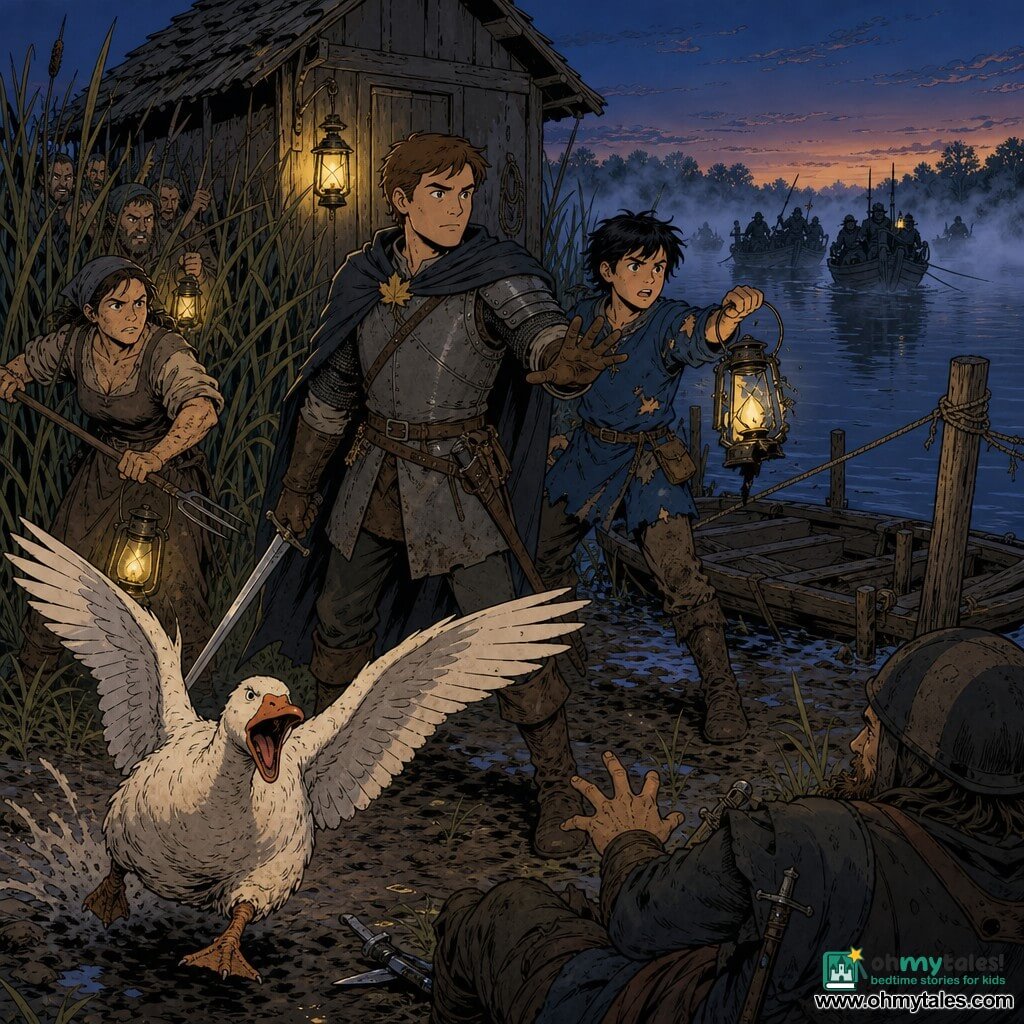
Within minutes, lanterns bobbed from nearby cottages. Farmers and fisherfolk gathered, clutching tools: pitchforks, axes, even a frying pan that looked eager to meet a head.
A broad-shouldered woman with rolled sleeves stepped forward. “I'm Hessa. This is our crossing. Tell us what to do, Sir Knight.”
Aldren looked at their faces—tired, brave, nervous. Not soldiers. Not heroes from tapestries. Just people.
Humility tugged at him again, steady as a hand on his shoulder. He wasn't here to command like a legend. He was here to help.
“We do this together,” Aldren said. “No grand speeches. Simple plans.”
Finn whispered, “That was almost a grand speech.”
Aldren whispered back, “Hush. I'm practicing humility.”
He pointed to the riverbank where reeds grew thick. “Hide half your people there. When the bandits come for the boat, you step out and make noise—shout, wave lanterns. Look like more than you are.”
Finn added, “And if you have any geese, now is their time.”
Hessa frowned. “Geese?”
Finn nodded solemnly. “They're fierce. And they bite.”
A man in the crowd muttered, “We've got Old Nettle. Meanest goose in the marsh.”
“Perfect,” Finn said. “Promote him to captain.”
They worked quickly. Aldren tied the flatboat a little looser, so it could drift just enough to be tempting. He positioned Bramble behind the hut, out of sight. The villagers crouched in reed beds, breath held.
Night settled. Crickets began their steady song. The river whispered.
Then came the sound of oars.
A boat slid into view, long and low. Three, four men in green cloaks. One wore the eel ring.
Aldren's muscles tightened. He wanted to leap out and shine, to prove himself.
Instead, he waited, letting the plan do the heavy lifting.
The bandits glided to the posts. “Easy,” the leader murmured. “Quiet as eels.”
Finn, hidden near Aldren, whispered, “Eels aren't quiet. They're slimy.”
Aldren whispered, “Now is not the time to insult fish.”
The bandits grabbed the tether. The leader stepped onto the flatboat, grinning.
Aldren gave a small hand signal.
Hessa sprang from the reeds, holding a lantern high. “Marshmere stands!”
Villagers rose on both banks, shouting. “Thieves!” “Back!” “This is our river!”
And then, right on cue, Old Nettle the goose charged out, wings spread, honking like a broken trumpet. The goose lunged at a bandit's boot and bit.
The bandit yelped. “What demon bird—?”
The moment cracked the bandits' confidence like ice under a stone. They had expected sleeping cottages, not a chorus of angry humans and one furious goose.
Still, they drew knives. The leader snarled, “Push through!”
Aldren stepped out from behind the hut, sword drawn—not swinging wildly, but held steady, the point aimed like a warning.
“Enough,” he said, voice low. “Leave. No one needs to die for a boat.”
The leader's eyes darted. He saw villagers closing in. He saw the knight. He saw, perhaps, that the easy victory had turned into mud.
He spat into the river. “Another time,” he hissed, and leapt back into his boat. “Row!”
The bandits retreated, oars biting the water. Old Nettle honked triumph, as if claiming the river as his personal kingdom.
The villagers cheered. Finn whooped. Aldren let out a breath he hadn't known he was holding.
Hessa approached, flushed with victory. “You saved us.”
Aldren shook his head. “You saved yourselves. I only… pointed.”
Finn smirked. “And threw in a goose.”
Hessa laughed. “We'll remember Captain Nettle.”
As the villagers dispersed, Bramble emerged, snorting softly. Aldren sheathed his sword, feeling strangely light.
He had not been the tallest figure in the story. He had not done it alone.
And somehow, that felt better than glory.
Chapter 7: The Willow Leaf Memory
Dawn came pale and clean, washing the world in quiet gold. Aldren and Finn rode back toward Willowmere along safer roads, the air smelling of wet earth and fresh bread from distant ovens.
Finn sat behind Aldren, unusually quiet for a boy with a famously fast mouth.
After a while, Aldren said, “You're thinking hard. I can hear it.”
Finn snorted. “You can't hear thinking.”
“I'm a dreamer,” Aldren said. “We hear strange things.”
Finn was silent again. Then he said, softer, “When they had me tied up… I was scared.”
Aldren didn't tease him. He let the words land gently. “Me too,” he admitted. “When I almost fell into the river, I thought, ‘So this is how foolish knights end.'”
Finn gave a small laugh. “You didn't end.”
“No,” Aldren said. “Because I remembered I'm not a legend. Legends don't get cold hands. People do.”
They rode past a field where dew clung to spiderwebs, turning them into strings of pearls.
At the castle gate, Lady Marwyn waited. Her eyes flicked to Finn, then to Aldren's mud-streaked armor and torn sleeve.
“You found him,” she said, and there was something like relief in her stern voice.
Finn hopped down and bowed—awkward but sincere. “My lady. Sorry. I got… misplaced.”
Lady Marwyn raised an eyebrow. “Misplaced by bandits, I hear.”
Finn glanced at Aldren. “Also by my own feet.”
Lady Marwyn's gaze settled on Aldren. “Report.”
Aldren spoke plainly: the ambush, the marsh, the ferry. He did not make himself the shining center. He named Hessa. He praised the villagers. He even mentioned Captain Nettle the goose, because truth mattered.
When he finished, Lady Marwyn nodded once. “Good work. And good sense.”
Finn blurted, “He threw wasps at them.”
Lady Marwyn blinked. “He did what?”
Aldren coughed. “A tactical negotiation with insects.”
For a moment, Lady Marwyn's mouth twitched, almost a smile. “Next time, try words first.”
Finn muttered, “Words don't sting.”
Lady Marwyn turned to Finn. “You will train harder. You will travel with escorts until you've earned better judgment.”
Finn grimaced, then nodded. “Yes, my lady.”
She faced Aldren again and touched the willow-leaf brooch on his cloak. “You wore it.”
Aldren glanced down at the plain bronze leaf. It was scratched now, dulled by mud and river water. Yet it felt heavier in a good way—like a promise kept.
“I did,” he said. “It reminded me to stay small enough to fit through trouble.”
Lady Marwyn studied him, then pressed something into his hand: a thin strip of blue cloth, neatly folded.
Finn's eyes widened. “That's from my tabard!”
Lady Marwyn said, “Found by the forest patrol near the stream. I thought you might want it, Sir Aldren. A token.”
Aldren held the cloth. It was simple, frayed at one edge. Not treasure for a chest. Not proof for a song. But his fingers remembered the moment he'd seen it on the thorn bush—the first solid sign that Finn could be found.
Finn leaned closer. “Why do you look like you're going to cry?”
“I'm not,” Aldren said quickly. “My eyes are… remembering rain.”
Finn grinned. “Sure.”
That night, Aldren sat in his small chamber and tucked the blue cloth into the leather pouch beside the willow-leaf brooch. Outside, the castle was calm. Inside his mind, the adventure replayed: the wasps' furious buzzing, the river's roar, the marsh's mist, the villagers' brave faces, the goose's terrible honk.
He realized the most precious part was not the danger or the victory.
It was the moment he'd chosen to crawl instead of fall, to plan instead of boast, to trust others instead of trying to shine alone.
Aldren closed the pouch and set it on his bedside table like a sacred thing.
Some memories, he knew, were better than trophies.
They were proof that courage could be humble—and still be grand.