Chapter 1: The Oath in the Candlelight
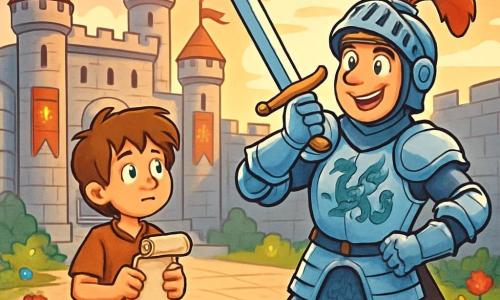
Sir Alden of Briarholt was the kind of knight who said “please” to stable boys and “sorry” to doors when he bumped into them. His armor shone anyway, not because he loved showing off, but because he polished it while listening to old stories and thinking hard.
He also happened to be stubborn as a nailed-shut chest.
That morning, the Great Hall of Lord Carroway smelled of beeswax, hot bread, and the faint worry that lived in every corner of a castle. Banners hung like bright tongues against the stone—lions, stag horns, and the pale moon of the Valley.
At the high table, Lord Carroway leaned forward. “The Trial of Honor begins at dawn tomorrow,” he announced. “Only those who can carry courage, wit, and kindness in the same hand will pass.”
Knights around the hall straightened. Squires whispered. Someone dropped a spoon and pretended it was on purpose.
Alden's fingers tightened around his cup. The Trial of Honor was not simply a tournament. It was a quest set by the old laws of chivalry: a test meant to prove that a knight was more than a person with a sword.
His best friend, a quick-eyed squire named Tamsin, nudged him. “You're staring like the Trial personally insulted you.”
Alden lowered his voice. “I'm going.”
Tamsin blinked. “You're already a knight.”
“I'm not a Knight of the Banner,” Alden said, meaning the highest order—those trusted to carry the lord's own colors. “And I promised my mother I'd earn it by honor, not by luck.”
“Honor is a slippery fish,” Tamsin muttered, but there was admiration in it too.
Lord Carroway's steward, a thin man called Master Rook, stepped down with a scroll. “The Trial has three marks,” he read. “First: retrieve the Ember Seal from the ruined chapel of Stonewake. Second: bring aid to a stranger in need, without being asked. Third: return before the third sunset and place the seal upon the table of judgment.”
A ripple of excitement crossed the hall.
Stonewake was a name people spoke like they were testing a bruise. The chapel had burned long ago. Folks said the wind still carried whispers through its broken arches. Wolves prowled the moors around it. Worse, bandits had been seen on the old road.
Alden stood anyway. The bench scraped loud as a challenge.
“My lord,” he said, stepping into the candlelight, “I would take the Trial.”
Master Rook's gaze slid over him like a cold coin. “Sir Alden is… eager.”
Lord Carroway studied Alden for a long moment, then nodded. “Eagerness is not a sin, if it rides with sense. Very well. Take what you need. Take a companion if you must. But remember—this Trial is not won by steel alone.”
Alden bowed. “I remember.”
Tamsin whispered, “You have a habit of remembering things in the wrong order.”
Alden smiled, gentle as sunrise. “Then remind me.”
“Gladly,” Tamsin said. “Because if you're going into Stonewake, someone needs to tell you when you're about to do something heroic and foolish.”
Alden's stubbornness flared—bright, determined. But beneath it was something softer: the wish to be worthy, and to bring honor back like a torch that could light the whole hall.
He didn't know yet that the Trial of Honor had already begun, right there in the candlelight, in the choice to stand up at all.
Chapter 2: The Road of Riddles
Dawn spilled over the fields like melted gold. Alden and Tamsin rode out through the castle gate, hooves clopping on the bridge, the river beneath them flashing cold and fast.
Alden wore his traveling armor—lighter plates and a blue cloak pinned at the shoulder. Tamsin rode a shaggy pony and carried a bundle of supplies, including a loaf of bread big enough to count as furniture.
“Tell me again why I'm coming,” Tamsin said, shifting the bundle.
“Because you insisted,” Alden replied.
“I insisted because you're the sort of man who would apologize to a bandit for bleeding on his sword.”
“That seems… considerate.”
“That seems… dead,” Tamsin corrected.
The road to Stonewake cut through Briarwood Forest first, where the trees leaned in close as gossip. Birds scolded from branches. A squirrel hurled an acorn at Tamsin's hood and missed by a proud inch.
“Assassin!” Tamsin cried dramatically, ducking.
Alden chuckled, but his eyes kept moving. He watched for broken twigs, unusual tracks, the small signs that told the truth. Courage was not marching forward with your eyes shut. Courage was marching forward with them open.
By midday they reached the old North Bridge—an arched span of stone over a ravine that sang with wind. At the center stood a figure in a patched cloak, leaning on a staff. His beard was tangled like briars, and his hood shadowed his face.
“Toll,” the stranger said.
Alden slowed his horse. “This bridge belongs to Lord Carroway. There is no toll.”
The stranger lifted his head. One eye was cloudy, the other sharp. “There is today. Pay, or turn back.”
Tamsin leaned close and whispered, “Bandit?”
“Maybe,” Alden murmured. “Or something else.”
Alden drew a small pouch of coins. “If you're hungry, take food. If you need shelter, we can speak of it. But I will not pay for what is meant to be shared.”
The stranger's mouth twitched. “Shared,” he repeated, as if tasting the word.
Then he rapped his staff against the stones. “Answer, then. If you would pass without toll—solve my riddle.”
Tamsin groaned. “Oh, good. A bridge with feelings.”
The stranger's voice grew louder, carried by the ravine wind.
“I can be cracked, I can be made,
I can be told, I can be played.
What am I?”
Alden frowned. Tamsin mouthed silent guesses: “Egg? Song? Joke?”
Alden watched the stranger's hands. They were rough, scarred—not the hands of a sheltered hermit. But the question was old and simple, like a key.
“A promise,” Alden said.
Silence settled. Even the wind seemed to pause, curious.
The stranger's sharp eye gleamed. “Correct.”
He stepped aside, staff tapping. “Pass, Sir Alden of Briarholt.”
Alden stiffened. “You know my name.”
“Names travel,” the stranger said. “So do oaths. Remember: a promise is strongest when it binds you to others, not just to yourself.”
Tamsin whispered as they rode on, “That was definitely not a normal toll keeper.”
Alden looked back. The stranger stood in the middle of the bridge, small against the sky, like a question mark carved from cloth.
“Still,” Alden said, “he let us pass.”
Tamsin snorted. “After he reached into your brain and rearranged the furniture.”
They pressed onward. The forest thinned into moorland—wide, open, and lonely. The wind smelled of heather and distant rain. Ahead, on the horizon, rose the broken silhouette of Stonewake Chapel, its towers snapped like old bones.
Alden's heart beat harder, not from fear exactly, but from the weight of what he wanted. He wanted honor, yes. But he also wanted to deserve it.
And the road, it seemed, had decided to test him one riddle at a time.
Chapter 3: The Broken Chapel and the Ember Seal
Stonewake Chapel sat on a hill of gray rock, surrounded by grass that grew in stubborn tufts. The walls were scorched in places, blackened as if the fire had never truly gone out. Empty window frames stared like hollow eyes.
Tamsin swallowed. “Cheerful place.”
Alden dismounted. The air felt thinner here, as if the world itself held its breath.
They stepped through the cracked doorway. Inside, sunlight fell in slanted spears, catching dust that drifted like tiny ghosts. Broken pews lay scattered. A bell rope dangled, frayed and useless.
At the far end, where the altar had once been, a stone table remained, split down the middle. On it sat a small metal case, red-gold and dull with age.
“The Ember Seal,” Alden murmured.
Tamsin reached toward it. “So we just—”
Alden caught Tamsin's wrist gently. “Wait.”
“What? It's right there. It's practically waving.”
Alden pointed. Thin lines in the dust—fresh. Footprints, booted, leading to the altar and back.
“We're not the first,” Alden said. His voice stayed calm, but his shoulders tightened.
Tamsin leaned in, eyes narrowed. “Bandits.”
Alden nodded. He stepped forward anyway, carefully, as if the chapel floor might bite.
When he was three paces from the stone table, a harsh voice rang from above. “Drop the sword, knight!”
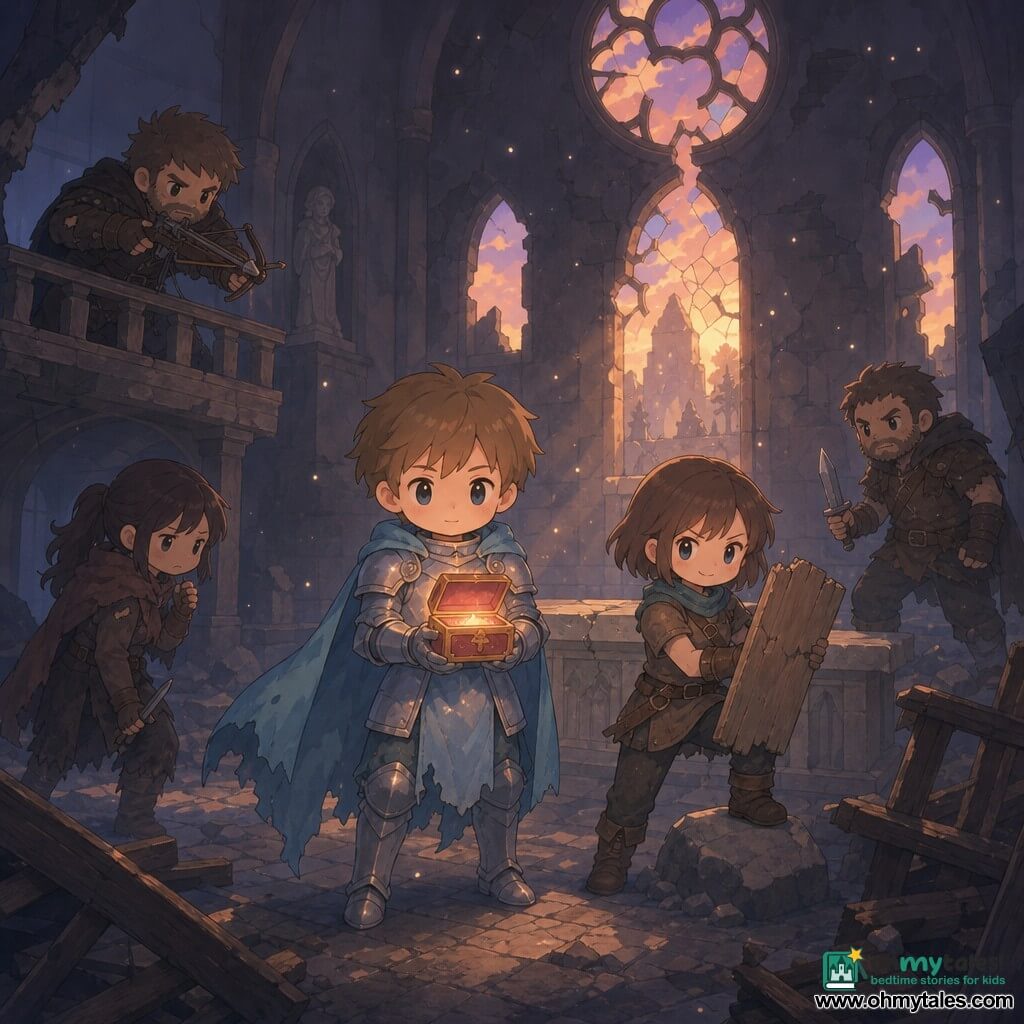
Alden froze. In the collapsed choir loft, three men appeared, crossbows aimed down. Their clothes were mismatched—leather scraps, rough wool—and their faces had the lean hunger of people who had chosen an ugly life.
A fourth man stepped out from behind a pillar at ground level, holding a dagger like he was proud of it. “We've been watching the road,” he said. “A shiny knight and a little squire. Must be the Trial folk.”
Tamsin raised both hands slowly. “Little? I am a respectable height for my age.”
The bandit blinked, confused by the protest. Then he snarled, remembering himself. “Silence. The Seal stays with us. You will leave your horses, your coins, and any dignity you're carrying.”
Alden's mind moved fast. Four bandits. Three above. One close. Fighting would be foolish—not because Alden couldn't fight, but because courage wasn't the same as charging into arrows.
He lifted his hands, palms out. “No need for blood,” he said. “We can share.”
The bandit with the dagger laughed. “Share? With us?”
“Yes,” Alden said steadily. “Food, coins, supplies—take what you need. But the Ember Seal must return to my lord. It is for the Trial of Honor.”
“Honor,” the bandit repeated, tasting the word as if it were sour. “Honor doesn't fill bellies.”
Alden glanced at Tamsin's bundle. The loaf. The dried meat. The apples.
“It can,” Alden said. “If you let it.”
Tamsin's eyes widened slightly. Alden knew what he was about to do, and Tamsin also knew it was both kind and completely maddening.
Alden pulled the bundle from Tamsin's arms and set it on the ground. “Take the food. All of it. And my coin pouch.”
“Sir—” Tamsin hissed.
Alden's voice stayed gentle. “We can go hungry for a day. They might have been hungry for a week.”
The bandit with the dagger hesitated. He hadn't expected surrender with manners.
From above, one of the crossbowmen barked, “Don't be fooled! He'll strike.”
Alden shook his head. “I won't. Not unless you force me.”
Silence stretched, tight as a bowstring. Then, very slowly, the dagger bandit stepped forward, snatched the bread, and shoved it into his bag like it might vanish. He grabbed the coin pouch too.
“Smart,” he muttered. “You buy your life.”
“No,” Alden said. “I buy your chance.”
The bandit's face twisted, as if no one had ever offered him that before. He looked away quickly, embarrassed by a feeling he didn't want.
Alden continued, “In return, leave us the Seal.”
The bandit barked a laugh. “Not a chance.”
Tamsin leaned close to Alden, whispering through clenched teeth. “Your sharing plan is missing the part where we actually get the thing we came for.”
“I know,” Alden whispered back. “Give me a moment.”
Alden raised his voice. “You can keep the Seal,” he said, and saw Tamsin's head whip around in disbelief, “if you can open its case.”
The bandit paused. “What?”
Alden pointed to the metal case. “It isn't a simple box. It's a lock made by the old chapel smiths. I've seen one before. It opens only when two hands press the latches at the same time.”
The bandit glanced up to his men. They shouted down, arguing.
Alden stepped back from the table. “If you try alone, it snaps shut tighter. And if you pry it, the Seal inside cracks. Worthless.”
The bandit with the dagger stared at the case, then at Alden. “You're lying.”
Alden shrugged slightly. “Then pry it.”
The bandit looked again. The case was old but sturdy, no easy hinges. He wasn't a patient man. Patience had probably never fed him either.
“Fine,” he spat. “Open it. Show me.”
Alden walked forward slowly, hands visible. He placed his fingers near one latch and nodded toward the bandit. “You take the other.”
Tamsin held their breath so loudly it felt like a drum.
The bandit hesitated, then stepped in. His dagger hand trembled a little—not from fear, but from the strange closeness of trust.
“Now,” Alden said softly. “Together.”
They pressed.
The case clicked open.
Inside lay the Ember Seal: a coin-sized medallion of copper and ruby enamel, stamped with a phoenix rising. Even in the dim chapel light, it seemed to hold a quiet heat, like a coal that refused to die.
The bandit's eyes widened. Greed sparked.
And that was when Alden moved—not with rage, but with practiced speed. His hand snapped the case shut again, fingers fast, and he slid it toward himself, pulling it back from the bandit's reach.
The bandit lunged, but Alden's shield—still strapped to his arm—came up. The dagger clanged against wood.
From above, crossbows dipped, aiming.
“Tamsin!” Alden shouted.
Tamsin didn't need explaining. The squire grabbed a broken plank from the floor and hurled it upward. It didn't hit anyone, but it smacked the loft railing with a loud crack. Two crossbowmen flinched, bolts loosing wild into the far wall.
Alden used the moment. He kicked dust into the dagger bandit's face—not heroic, but effective—and sprinted. He grabbed Tamsin's arm and dragged them both behind a fallen stone pillar.
“Run!” Alden said.
They dashed through the doorway, leaped onto their horses, and thundered down the hill. Behind them came furious shouts, but the bandits didn't fire again. Perhaps they didn't want to waste bolts. Perhaps, for one heartbeat, they were too stunned that a gentle knight had outwitted them without trying to kill them.
Tamsin, panting as they rode, barked a laugh. “You tricked him with… teamwork.”
Alden held the case tight under his cloak. “Sometimes the best weapon is knowing what someone expects.”
“And what they don't,” Tamsin added, grinning wildly.
Alden's eyes flicked back to the hill. Stonewake shrank behind them. They had the Seal.
But they had also given away all their food and most of their coins.
The Trial of Honor, Alden realized, was not finished with them. It had only changed its shape.
Chapter 4: The Stranger at the Stream
By late afternoon the sky bruised purple with storm clouds. Alden and Tamsin rode with empty bellies and lighter saddlebags. The wind had teeth now.
Tamsin tried to sound cheerful. “Good news: we're heroes.”
Alden nodded. “Yes.”
“Bad news: heroes apparently don't eat.”
Alden's smile was weary. “Not today.”
Rain began as a thin tapping, then thickened to a steady sheet. They left the road to shelter under a cluster of pines near a stream. The water ran fast, brown with stirred-up earth.
Tamsin wrung out their sleeves. “I could chew my own glove.”
“Start with mine,” Alden said, and Tamsin made a face.
They were about to mount again when Alden heard it—faint, sharp, and desperate.
A cry.
He turned his horse toward the sound. “Someone's there.”
Tamsin's expression hardened. “Or it's a trap.”
“It might be,” Alden agreed, and still he went.
They followed the stream to a fallen willow. Beneath it, half in the mud, lay an old man. His leg was twisted at a wrong angle, and his hands clutched a small satchel to his chest as if it contained his last hope.
His eyes fluttered open at the sound of hooves. “Help,” he rasped.
Tamsin slid off the pony, alert. “Who are you?”
“A healer,” the man wheezed. “From Hartsbrook. I was… taking medicine… to the village by the marsh. Slipped.”
Alden crouched beside him. The man's face was gray with pain. Rain ran down his cheeks like tears he hadn't asked for.
Tamsin whispered, “We're already late. And we have no food. And the road's getting worse.”
Alden looked at the man's satchel. He didn't need to open it to guess it held bandages, herbs, maybe small glass vials. Things meant for sharing, not hoarding.
Second mark of the Trial, the steward had said: bring aid to a stranger in need, without being asked.
But Alden didn't think of marks. He thought of the man's shaking breath.
“We help,” Alden said.
Tamsin exhaled hard. “Of course we do. Because if we didn't, you'd look at me with those sad, noble eyes until my soul peeled itself.”
Alden's gentle look was immediate. “Thank you.”
“Don't thank me,” Tamsin grumbled, already pulling a cloak free. “Lift his shoulders on three.”
They worked carefully. Alden used his belt as a strap to steady the injured leg, splinting it against a straight branch. Tamsin's knots were quick and tight.
The healer gasped but didn't scream, and that alone made Alden respect him.
“What's in the satchel?” Tamsin asked.
“Medicine,” the healer whispered. “For the marsh village… fever's there… children burning with it…”
Alden felt the world narrow into a single, clear line. The Trial demanded he return before the third sunset with the Ember Seal. But children were sick now.
He looked at Tamsin. Rain dripped from Tamsin's hair, making them look like an annoyed water sprite.
“If we take him back to Hartsbrook,” Tamsin said slowly, reading Alden's face, “we lose time.”
“Yes.”
“If we take him to the marsh village,” Tamsin went on, “we lose more time.”
“Yes.”
Tamsin pulled their hood up and stared straight at Alden. “You're going to say we should still do it.”
Alden swallowed. His stubbornness pushed one way: finish the Trial, earn the banner, make his mother proud. His softness pushed the other: share what strength he had, even if it cost him.
“I am,” he said quietly.
Tamsin made a strangled sound. “I should have become a baker. Bakers are heroic in a warm, bread-shaped way.”
Alden helped the healer onto his horse, holding him steady. “We can make it,” he said. “If we ride hard.”
The healer's cloudy eyes focused on Alden. “Why?” he whispered. “You don't know me.”
Alden adjusted the old man's cloak against the rain. “Because someone once helped me when they didn't know me.”
Tamsin muttered, “And now we're all trapped in the endless chain of decency.”
They rode toward the marsh.
The land flattened. Wet reeds brushed against their boots. The air smelled of mud and sharp herbs. In the distance, a few huts huddled like frightened animals. Smoke rose thin and weak from their roofs.
As they approached, villagers stumbled out—tired faces, worried eyes. A woman ran forward. “Master Elric!”
The healer lifted a trembling hand. “Still breathing,” he murmured, attempting humor and failing.
Alden dismounted. “He fell by the stream. His leg is injured.”
The woman's gaze jumped to Alden's armor. “A knight… Here?”
Alden nodded. “Do you have a place to set him? Warmth, dry cloth?”
They ushered the healer inside the largest hut. The air within was thick with the sour-sweet smell of sickness. On straw pallets lay children and elders alike, cheeks flushed, lips cracked.
Alden's stomach clenched—not from hunger now, but from helplessness. What could a sword do against a fever?
Master Elric's hands shook as he reached for his satchel. “The medicine… I must…”
Alden stopped him gently. “Rest. Tell us what to do.”
Elric stared, surprised. Then he gave instructions in a weak voice. Boil water. Grind willow bark. Cool cloths for foreheads. A certain herb, steeped just so.
Alden and Tamsin moved like a pair of determined storm clouds. Tamsin fetched water and stoked fires. Alden tore his own clean undershirt into strips for bandages. When a mother hesitated, ashamed to take a knight's cloth, Alden pressed it into her hands.
“Sharing keeps people alive,” he said.
They worked until the rain eased and the hut air warmed. A child's breathing steadied. Someone sobbed quietly with relief.
At last, when the village had what it needed and Master Elric lay resting, the woman clasped Alden's gauntleted hands.
“You came when no one else did,” she said. “We have little, but you must take something.”
She offered a small sack of dried fish and oatcakes, humble and precious.
Tamsin's eyes lit up as if witnessing a miracle. “Food.”
Alden tried to refuse, but the woman's face was firm.
“This is sharing too,” she insisted. “You gave. Now let us give back.”
Alden accepted the sack, bowing his head. “Then I thank you.”
Outside, the clouds thinned. Evening light slipped over the marsh like a blessing.
Tamsin chewed an oatcake and sighed. “If the Trial punishes you for saving children, I will personally challenge the Trial to a duel.”
Alden laughed softly. “It may not punish me.”
Tamsin raised an eyebrow. “That's the most hopeful thing you've said all day.”
They rode again, fed at last, the Ember Seal safe beneath Alden's cloak.
Behind them, in the marsh village, the fires burned steadier, and the sickness had met its first real enemy: people helping people.
Chapter 5: The Third Sunset and the Table of Judgment
The second day's dawn came pale and quick. Alden and Tamsin rode the old road back toward Briarholt with the kind of urgency that made every hoofbeat feel like a heartbeat stolen from the clock.
They passed the North Bridge again at midday. The cloaked stranger was gone. Only the ravine wind remained, humming its endless song.
“Maybe he was never there,” Tamsin said.
Alden shook his head. “He was.”
“How do you know?”
“Because I remember what he said,” Alden replied. “Promises.”
The sky cleared into a hard blue. The sun sank slowly, and with it sank Alden's worry. They had lost time. They had taken the long way for kindness. Would the Trial judge that as failure?
As the third sunset approached, they finally saw Briarholt's towers cutting into the horizon. The castle walls glowed orange in the low light, as if the stone itself held fire.
They galloped across the bridge, through the gate, into the courtyard where servants and squires turned in surprise.
“Sir Alden!” someone called.
Alden barely heard. He dismounted, the Ember Seal case in hand, and strode into the Great Hall. His boots echoed on the stone. Tamsin followed, breathless, hair wild, looking as if they had wrestled the road and won.
The hall was crowded. Knights stood in rows, polished and proud. At the far end, Lord Carroway sat beside the Table of Judgment—an ancient slab of oak bound with iron.
Master Rook stood near it, scroll in hand, eyes thin and assessing.
Alden walked forward and knelt, placing the case on the table with both hands. The sunset's last light bled through the high windows and touched the metal.
“I bring the Ember Seal,” Alden said.
Master Rook leaned in. “Before the third sunset?”
Alden glanced at the window. The sun's edge was a red coin sinking behind the hills. “Before it disappears,” he answered.
Master Rook's mouth tightened. “Very precise.”
Lord Carroway's gaze moved from the case to Alden's face. “And the second mark? Did you aid a stranger, without being asked?”
Alden lifted his head. “Yes, my lord. A healer injured by the stream. We carried him to the marsh village. They were struck by fever. We helped as we could.”
A murmur ran through the hall. Some knights looked impressed. Others looked annoyed, as if kindness were an inconvenient rule.
Master Rook sniffed. “And you did not bring proof?”
Alden's jaw tightened. His stubbornness sparked, but he held it down like a reins on a restless horse. “I brought no token,” he said, “because I did not help for a token.”
Tamsin cleared their throat loudly. “Also, if anyone wants proof, I currently smell like marsh and heroism.”
A few people laughed. Even Lord Carroway's eyes softened.
Master Rook's gaze sharpened. “And what of bandits? The road is dangerous. Did you fight? Did you spill blood for honor?”
Alden's voice stayed steady. “I did not seek blood. I gave food and coin to men who threatened us. Then I took the Seal back with wit, not slaughter.”
A louder murmur now—conflicted, surprised.
Master Rook's lips curled. “So you rewarded criminals.”
Alden rose slowly to his feet, hands at his sides. “I shared what I could spare. Hunger makes monsters of men. Sometimes a loaf of bread does more than a blade.”
Master Rook took a step forward. “A knight's duty is to crush—”
Lord Carroway raised a hand, and silence fell like a dropped curtain.
“A knight's duty,” the lord said, voice deep, “is to protect. To guide. To stand firm without becoming cruel. Tell me, Sir Alden—why did you choose the marsh village, knowing the sunset chased you?”
Alden's throat tightened. He thought of the fevered children. The mother's trembling hands. The quiet relief when breathing steadied.
“Because,” Alden said, “honor that ignores suffering is only a pretty word.”
The hall was so still Alden could hear the candles crackle.
Then Lord Carroway stood.
He walked down from the dais and came to the Table of Judgment. He opened the metal case. The Ember Seal lay within, glowing softly in the torchlight.
Lord Carroway lifted it, then looked not at the ruby enamel, but at Alden.
“The Trial of Honor was forged long ago,” he said, “to keep knights from becoming wolves in armor. Many can swing a sword. Few can share their strength.”
Master Rook's face stiffened, as if he had swallowed a thorn.
Lord Carroway continued, “Sir Alden of Briarholt—stubborn, yes. But gentle. Brave enough to ride into danger, clever enough to outthink it, and resilient enough to lose comfort for the sake of others.”
He placed the Ember Seal on the table, then pressed his palm over it. “By this Seal, I name you Knight of the Banner.”
Alden's chest filled until it ached. Tamsin made a sound that was suspiciously like a pleased squeak, then tried to disguise it with a cough.
Lord Carroway lifted the castle's blue banner, the one stitched with the silver stag. He draped it over Alden's shoulders.
“Rise,” he said. “And let your honor be a shelter, not a weapon.”
Alden rose, eyes bright.
The hall broke into cheers. Even some of the unimpressed knights smiled, perhaps remembering that the stories they loved as children were not about winning, but about doing what was right when it cost something.
Yet as the noise swelled, Alden noticed Master Rook watching him with a look like a locked door.
And locked doors, Alden knew, sometimes hid more than dust.
Chapter 6: The Last Knot, Untied
That night, while the castle celebrated, Alden slipped away from the feast. The banner on his shoulders felt heavier than cloth. It felt like responsibility.
Tamsin followed him out into the courtyard with a chunk of cheese in hand. “You're abandoning your own celebration.”
“I'm thinking,” Alden admitted.
Tamsin chewed thoughtfully. “Dangerous hobby.”
Alden looked up at the watchtower. “Master Rook didn't like the way the Trial ended.”
“Master Rook doesn't like sunshine,” Tamsin said. “Or laughter. Or possibly kittens.”
Alden's mouth twitched. “Still. The bandits at Stonewake—how did they know about the Seal? About the Trial?”
Tamsin's chewing slowed. “Oh.”
Alden nodded. “Someone told them.”
They moved quietly along the shadowed wall. The castle slept in patches: here a guard dozing on a bench, there a window glowing with music.
Near the storage wing, a low voice carried through a half-open door.
“…the bandits failed,” someone hissed.
Alden and Tamsin froze.
Master Rook's voice, sharp as a quill. “Then you were clumsy. The Seal should have been delayed. The Trial should have been—managed.”
Another voice, rough and familiar: the dagger bandit from Stonewake. “We got food and coin. Like you promised. But the knight tricked us.”
Alden's hands clenched. Not in fury alone—also in disappointment. Betrayal felt like cold rain inside your armor.
Master Rook spoke again. “You will try again. Tomorrow, you will stir trouble on the road. I will declare the marsh village a nest of thieves. Lord Carroway will send soldiers. Fear will rise, and in fear I—”
Tamsin's whisper was barely air. “He's going to start a fight.”
Alden's mind raced. If Master Rook turned the castle against the marsh village, the fragile healing there could break. Soldiers might storm in, and desperate villagers might resist. A small lie could become a war.
Peace, Alden thought, was not a thing that simply happened. It was a thing people guarded.
Alden stepped forward and pushed the door wide.
The room fell silent. Master Rook stood beside a barrel, scrolls piled near him. The bandit lurked by the back window, a sack over his shoulder.
Rook's eyes widened, then narrowed. “Sir Alden,” he said smoothly. “Enjoying your new rank?”
Alden's voice was calm, but it carried steel. “I heard enough.”
Tamsin stepped in beside Alden, holding the cheese like it was a weapon. “And I heard everything. Including the part where you tried to turn sick children into ‘managed' fear.”
The bandit shifted, uneasy. He recognized Alden and looked, for one flicker of a second, ashamed.
Master Rook straightened. “You have no proof.”
Alden pointed to the bandit. “He is proof.”
The bandit snapped, “I'm not—”
Alden met his eyes. “You took my food. My coin. I gave them because I chose to share. Don't waste that choice by helping a man who would burn villages to warm his ambition.”
The bandit hesitated. His grip tightened on his sack. “He promised us protection.”
Alden said softly, “I promise you a chance to make this right.”
Master Rook scoffed. “Promises. How quaint.”
Alden took a step closer, banner brushing his shoulder. “A promise is not quaint. It's a bridge. And you've been charging tolls for bridges that belong to everyone.”
For a heartbeat, the room held its breath.
Then the bandit did something unexpected. He dropped his sack. Coins clinked. “He paid us,” the bandit muttered, jerking his chin at Rook. “To cause trouble. To steal. To scare folk.”
Rook's face went pale with anger. “You idiot.”
Tamsin lifted the cheese. “Careful. I'm armed with dairy and righteous fury.”
Alden spoke loudly now, toward the corridor. “Guards!”
Footsteps thundered. Two guards burst in, hands on sword hilts. Alden stepped aside, letting them see Master Rook and the bandit together, the spilled coins, the shameful proof glittering on the floor.
Lord Carroway arrived moments later, robe thrown over his shoulders, expression storm-dark.
Master Rook tried to speak, but Lord Carroway cut him off. “Enough. You used my Trial to sew fear into my lands. You would have turned neighbor against neighbor.”
Rook's voice cracked. “I did it for order!”
“For power,” Lord Carroway corrected.
The bandit stood trembling. “My lord… I—”
Lord Carroway looked at him. “You chose crime.”
The bandit flinched.
Alden stepped forward. “My lord,” he said, “let him repay. Let him help rebuild what he helped harm. Let him bring the food he stole back to those who need it.”
Tamsin added, “And maybe let him carry buckets. Lots of buckets. Sharing includes sharing heavy work.”
The bandit stared at Alden as if the knight had offered him something stranger than mercy: a path.
Lord Carroway's stern gaze softened by a fraction. “Very well. You will work under watch, and you will give back what you can. If you flee, there will be no second chance.”
The bandit nodded quickly, relief and fear tangled together.
Master Rook was taken away, protesting until the corridor swallowed his voice.
When the guards had gone and the courtyard quieted again, Lord Carroway turned to Alden.
“You could have kept silent,” he said. “Enjoyed your banner.”
Alden shook his head. “Honor isn't a prize to hang on a wall. It's a thing you do.”
Lord Carroway studied him, then placed a hand on his shoulder. “Peace is fragile,” he said. “Tonight you protected it.”
Alden bowed. “With help.”
Tamsin lifted the cheese again. “Mostly with this.”
Lord Carroway almost smiled. “Go. Rest. Tomorrow we mend what was threatened.”
As Alden and Tamsin walked back toward the hall, the castle bells began to ring—not for alarm, but for the late hour. Their sound floated over Briarholt's lands like a promise kept.
And for the first time in days, Alden felt the tight knot in his chest loosen.
The road ahead would still have storms. That was always true.
But tonight, peace had been rescued—by courage, by wit, by resilience, and by the stubborn, gentle decision to share.