Chapter 1
The young man walked along the coral beach with a small notebook in his hand. He smelled salt and warm sand. The sun was soft and kind. He had a hat, a trowel, and a very special thing—an amazing sense of direction. He could always find his way back. He could find the smallest stone in a wide blue sea.
“Hello,” he said to the shore. “Today we make a little exhibition.”
“An exhibition?” asked Lani, the elder from the village. She was sitting under a pandanus tree, weaving a tiny basket with patient fingers.
“Yes. A small show about the Lapita people who lived here long ago,” the young man said. He tapped his notebook. “I will pick pieces, clean them, and tell the story. We will hang labels and make a map. People will learn how life used to be.”
Lani smiled. “You look like you have a map in your head,” she said. “You always go exactly where the land asks you.”
The young man laughed. “My feet remember the way. My eyes like patterns.” He knelt and drew a quick line in the sand. The line became a path. He drew the outline of the coral ground and a round patch where the old village might have been. He drew little dots for shells and points for features.
“You must be gentle,” Lani said. “The earth keeps stories, but stories are fragile.”
The young man nodded. He had learned to be gentle. Archaeologists, he thought, are like careful gardeners. They do not pull roots. They brush dirt slowly. They listen to the land.
“Come with me,” he said to Lani and to the two children who followed. “I will show you how we dig with respect.”
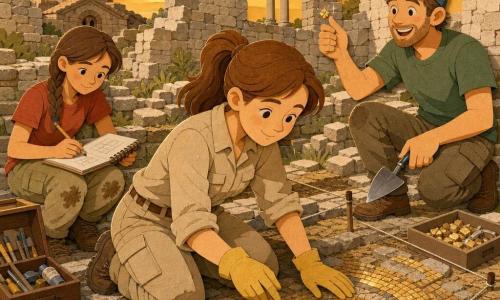
They walked toward the pale line of sand dunes. The waves made soft music. Little crabs ran like tiny drumbeats over coral. The young man set up a square of string on the sand. He set four sticks at the corners. He made a grid.
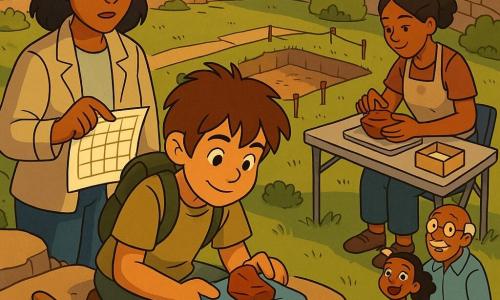
“This is how we make a map,” he explained. “Each square is like a picture box. We dig a little and see what each box holds. We write down where things are. We do not mix them up. Context is important. Context tells the story.”
“What is context?” asked the smaller child.
“It is where something was,” the young man said. “If a shell is next to a piece of pottery, we write that down. It helps us know what people were doing. Were they cooking? Were they making art? Layers, too, are like steps in time. The deeper, the older—usually.”
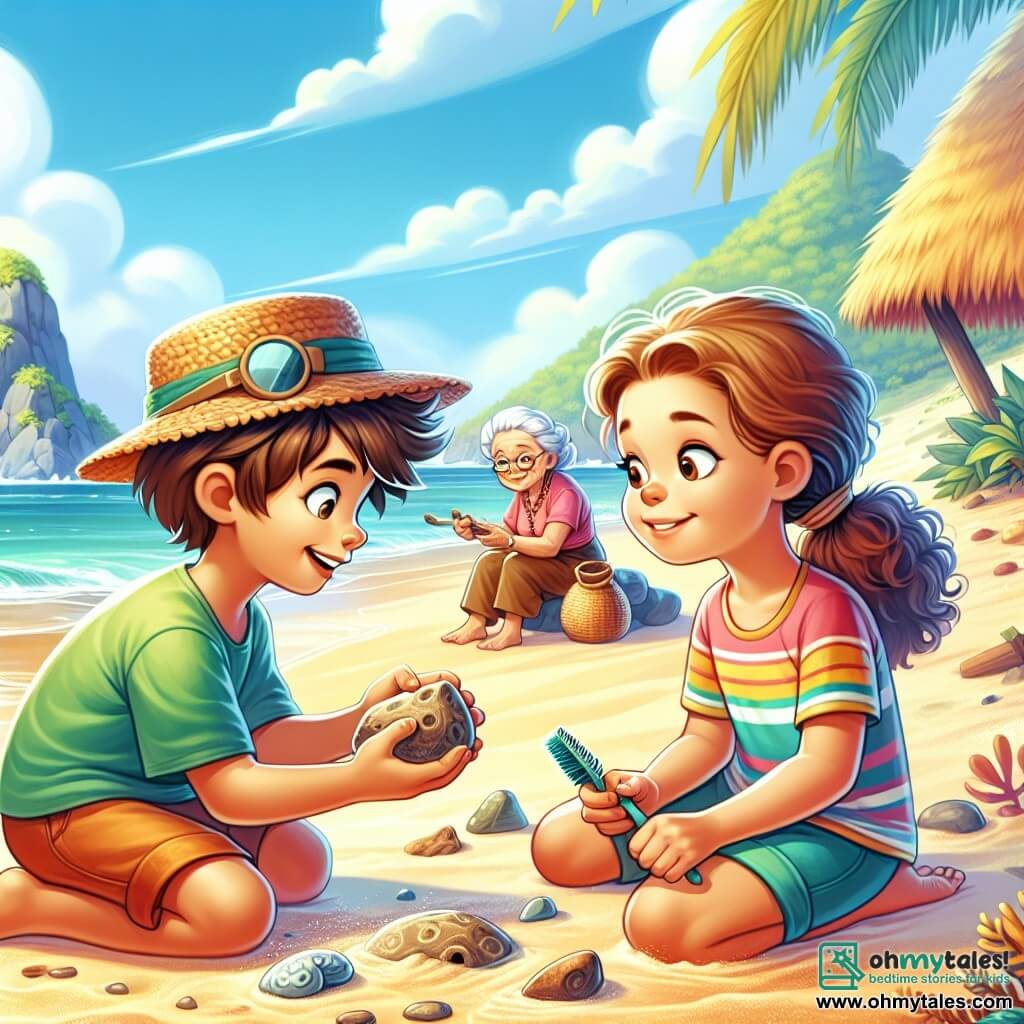
They began. The children brushed the sand with small brushes. Lani watched and hummed. The young man smiled. He had patience. He dug one spoonful at a time. He found tiny pottery sherds with a delicate stamped pattern. They shone like little moons.
“These are Lapita designs,” he said softly. “Long ago, people made pottery with triangle stamps. They carried their stories on clay.” He held a shard up to the sun. The sun made a warm glow through the thin edge.
“Could that go in the exhibition?” asked Lani.
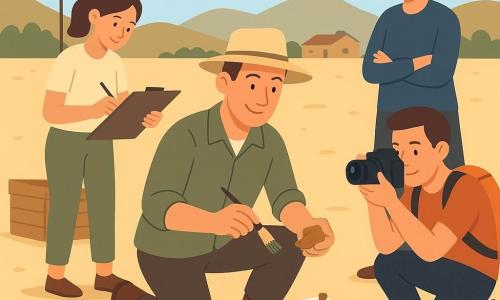
“Yes,” the young man said. “And we will write who found it, where, and what it might mean. We keep notes, sketches, and a photograph. That is our record.”
They worked until the late afternoon light grew kind and orange. The young man's sense of direction found a small rise in the coral, a round, low mound that looked different. He marked it. He felt the ground under his feet say, “Here.”
He smiled and kept his notes close. Perseverance, he thought, is slow work. It is watching, brushing, and waiting. It is not giving up when the rain comes. It is trying again and again, with a calm heart.
Chapter 2
The next morning the sea was a clear glass. The young man met Mira. Mira was an underwater archaeologist. She wore a bright yellow snorkel and a hair knot like a sea-shell. She carried a slat with a pencil and a small waterproof camera.
“Good morning,” she said, swimming up like a friendly fish. “I heard your grid reached the edge of the reef. There might be things under the water.”
“I was thinking the same,” the young man said. “Shall we look together?”
They put on their gear. Mira showed how she dives slowly. “Underwater archaeology means we look where waves wash. We cannot dig with big shovels. We use small tools, and we photograph everything. We make maps beneath the waves, too.”
They swam gently. The coral was soft and bright. Tiny fish flicked like silver coins. The young man felt the water hug him. His sense of direction worked beneath the waves, too. He followed shapes that looked like broken piles of stone.
“See here,” Mira said, pointing with a gloved finger. “These stones are laid like a wall. There's pottery near them, half-buried in sand.”
They put a lightweight net below the pottery so it did not float away. Mira wrote notes on her slate with a greedy pencil that eats water. “We label, we lift gently, and we carry what we find to the lab. Salt is hard on old things. We rinse and treat them with fresh water.”
“How do you lift heavy pieces?” asked one of the village children, watching from the shore.
Mira smiled. “We sometimes use special floating bags. We fill them with air and the object floats up like a quiet balloon. But we must be careful. We never pull too fast. We always make a plan.”
They found a beautiful piece—a rim of pottery with a wavy carved line. The pattern matched some of the small shards the young man found on the beach. They looked like twin notes in a song.
“Good eye,” Mira said. “Now we record everything. Photo, note the place, then gently collect.”
Back on the shore, they laid the pieces on soft cloth. They rinsed the salt with clean water. The small shards made little wet sounds. The young man wrote labels. He drew the pattern again and again until his pencil knew it.
“Would you like to see the map?” he asked Mira. He opened his notebook. The map had tiny symbols: pottery, bones, stone footing. The mound he marked the day before was now a circle of dots. When he traced a line from the shoreline to the mound, he saw a pathway of stones.
Mira leaned close. “This could be a platform,” she said. Her voice grew slow with wonder. “People might have lived here and used that platform. They stood on it and looked at the sea. They had huts, and they cooked, and they sang.”
The young man felt warm. He thought of the rhythms of washing, cooking, and talking. He thought of the small things people leave behind. A pot, a shell, a little stone with a scratch. These are the clues of lives once lived.
As the sun slid down, they covered the finds with damp cloths. They set up little tags and a safe box. The children helped. They learned how to protect the objects like babies. The young man's hands were steady and calm. He felt patient and sure.
Chapter 3
On the third day, the sun stood low and long. Shadows grew like quiet animals across the sand. The young man walked the beach with his notebook, marking shadows and stones. He had taught the children how the light changes what we see.
“Sometimes, a shadow is a secret helper,” he said. “When the sun is low, it slips into small grooves and shows things we could not see before.”
They walked where the reef met the sand. The sea breathed soft. Then a long shadow crossed the beach. It stretched from an old slab of coral. The shadow was odd. It made a dark line where nothing looked special in the bright light.
“Look!” whispered one of the children.
The young man knelt. He felt his heart tip with curiosity. He shaded his eyes. The shadow made a pattern on the coral slab. It was a set of raised shapes. Little ridges and hollows formed a face of shells and lines. A relief, he thought. A raised carving, hidden until the sun knelt low.
“It is like a story carved in stone,” Mira said, swimming close. Her voice was small. “The shadow has revealed the shape.”
The young man smiled so wide his eyes crinkled. “This is why we watch the light,” he said. “Sometimes the land hides things in plain sight until the sun decides to tell us.”
They took soft brushes and a small sponge. The relief was delicate. They could not scrub. They gently cleaned sand from the hollows. The lines came out like a secret being told.
“What could it be?” asked one child, very softly.
“We cannot say for sure,” the young man replied. “But the shapes might mean a face, or a canoe, or a garden. It is a sign. We record it carefully. We take photographs at different times. We draw it with slow lines.”
They waited as the sun moved and the shadow shifted. Each angle showed a new piece of the carving. Sometimes the relief looked like a wave. Sometimes like a woven mat. The light and the shadow made the carving speak.
“This is why archaeology needs patience,” the young man said. “You cannot hurry the sun. You wait. You watch. You listen. You try again tomorrow. Perseverance helps us see the full story.”
Night came softly. They covered the carving with a cloth to keep the sand away. Lani came with warm cups of ginger drink. Everyone felt a small, quiet excitement. The carving was a heart-note from the past, a little wink hidden in stone.
Before sleep, the young man sat alone and wrote in his notebook. He drew the map again. He added the relief and wrote the time the shadow revealed it. He wrote down Mira's notes about the underwater stones. He made a plan for the exhibition: a small table with the pottery, a photo of the relief, a map that shows how people lived close to the reef, and a short note that says how we found these things.
“It will be simple,” he told the stars. “Clear and kind. For children and elders. For people who like to learn slowly.”
Chapter 4
The day of the small exhibition arrived like a friendly bird. The village children placed shells around a low table. Lani made little name cards. The young man set the pottery on soft pillows of sand color. The relief photos were in a neat row. A small map told the path from beach to reef.
“Why show these things?” asked one boy, blinking at the tiny plates.
“To remember,” the young man said. “To learn how people lived, and how they loved their sea. Archaeology helps us listen to the past. It teaches us to be careful. It teaches us to keep notes, to ask questions, and to try again when we do not know.”
Mira stood beside him. “And to work together,” she added. “Underwater and on land. We help each other.”
People came slowly, like the tide. They touched the edge of the pottery through gloves. They read the labels. The children pointed at the photo of the relief and traced the lines with their fingers in the air. Lani told a story about a woman who once watched the ocean and learned the names of stars.
The young man spoke softly into the circle of people. He told how they made the grid and how they found pieces. He showed the careful notes and the slow drawings. He explained how sometimes the sun helps find a hiding shape. He told how Mira lifted a heavy shard with a floating bag. The words were simple and clear.
“Archaeologists are like detectives,” a child said. “But they use brushes, not magnifying glasses.”
The young man laughed. “Yes,” he said. “And they ask the land very politely.”
A grandmother in the back raised her hand. “You were patient,” she said. “You came back each day. You kept looking. That is the best lesson. Perseverance is how we keep stories.”
The young man felt a small warmth in his chest. He thought of the slow mornings, the careful rinsing, the long waits for the sun. He felt proud, but quiet. Pride that did not shout. Pride that smiled.
After the people left, the children slept on the warm sand and the sea sang. The young man and Mira walked to the shore. They looked at the place where the relief rested. The sun was low and kind. A long shadow lay across the stone like a gentle hand.
“Will you keep the carving here?” Mira asked.
“We will protect it,” the young man said. “We will work with the village. It must stay with its people. The exhibition will travel a little to tell others, but the land will have the right to say how it keeps its past.”
Mira nodded. “That is good.”
The young man took one last look at the map in his notebook. He touched the dot that showed the place where they first found the shards. He smiled.
“Thank you,” he whispered, not to any one person. He whispered to the sea, to the stone, to the small pots, and to the people who had once lived there. “Thank you for telling your story.”
The waves replied in soft sounds. The stars came out one by one. The relief seemed to shine in the half-light, a small wink from long ago.
The young man walked back to the village with his hat on his head and his notebook under his arm. He carried with him the lesson he had taught everyone: patience, careful hands, and the joy of finding one more little piece of the past. As he walked, his feet remembered the way home, and the island held the story like a secret the sun liked to tell at evening.