Chapter 1
"Are you ready, Mateo?" called Dr. Lila, her hat tilted against the warm sun.
Mateo smiled. He tightened the straps of his small backpack and looked at the rocky slope above the old hill. The hill was not tall like a mountain. It was an oppidum — an ancient place where people had lived a very long time ago. From the replat rocheux, a flat rock ledge where they stood, Mateo could see the round shape of the old walls in the grass below.
"I am ready," Mateo said. He felt his heart beat a little faster. He was a young archaeologist. He loved dust that smelled like dry earth, little wooden brushes, and the careful work of finding old things.
Dr. Lila pointed. "We will set our tents here for a few weeks. From this ledge, we can watch the whole site. Remember: slow and steady. We listen to the ground."
Mateo nodded. He remembered what Dr. Lila had taught him: archaeology is not a treasure hunt. It is listening to the past with patience. "We must protect the place," he said. "We must learn."
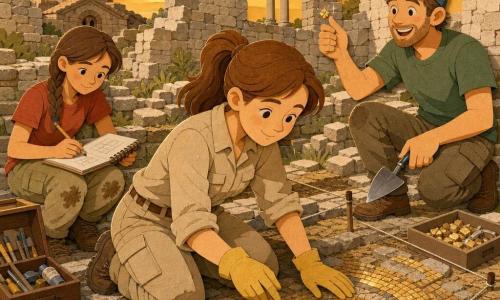
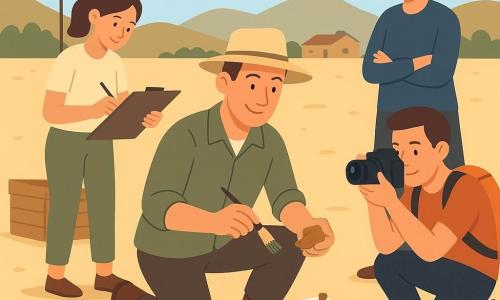
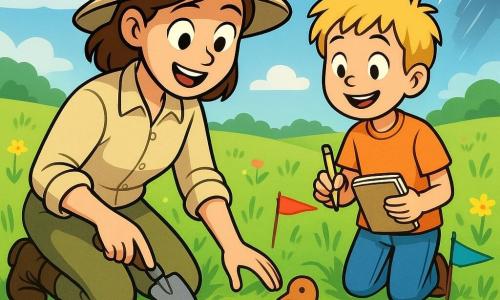
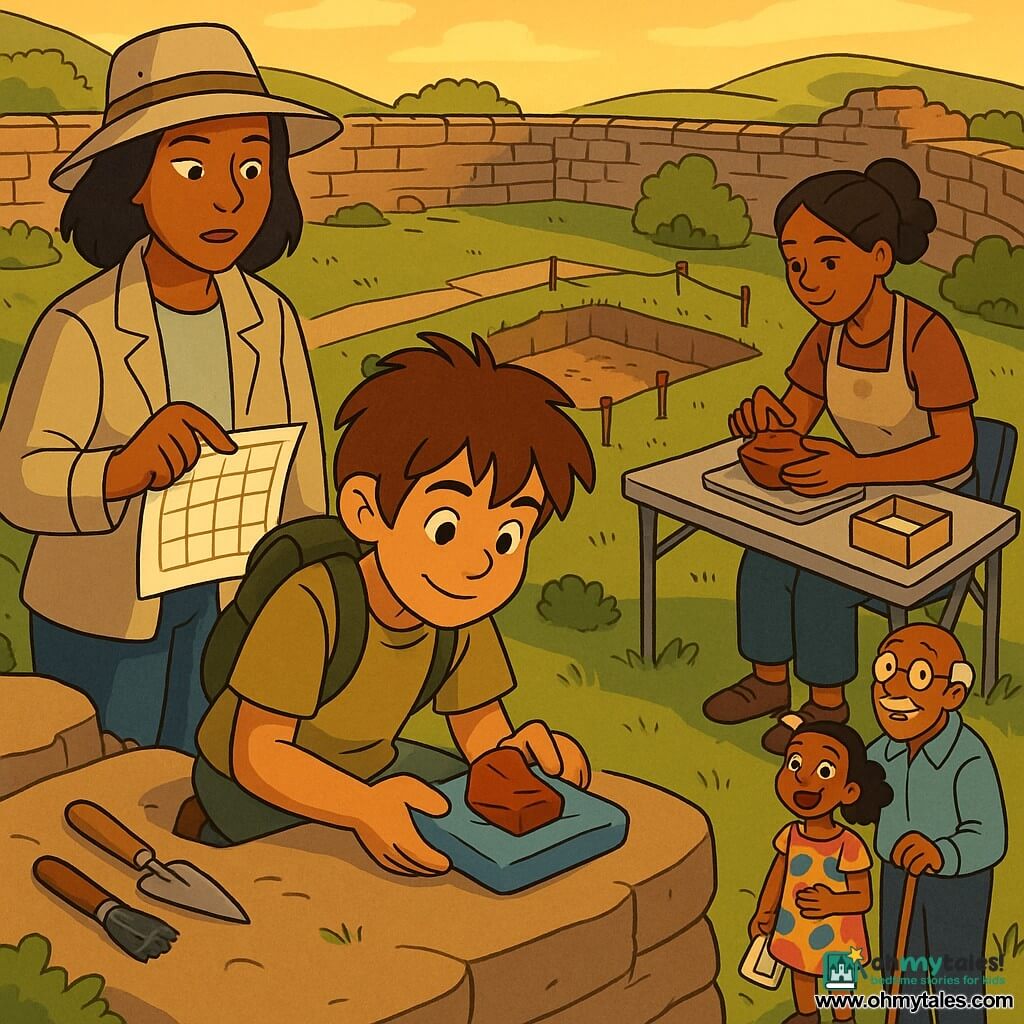
They put down flags, measured squares with string and wooden pegs, and opened a small box of tools. There were little trowels, brushes, sieves, notebooks, and a camera. A radio buzzed softly in the shade of a tree. Other team members arrived, carrying water and smiles.
"Hello!" shouted Rosa, the team's conservator. "I brought blankets for the finds."
"Good!" called Mateo. His job today was to help lay out the squares where people would dig. The team used a grid to make sure each find could be put in the right place on a map. That way, each piece of old pottery, each tiny bone, would tell a story about where it had been.
They worked together happily. The sun warmed their shoulders. Little birds sang in the shrubs. Mateo felt the peace of careful work.
"Mateo," said Dr. Lila softly, "first we plan. Then we dig. If the plan is wrong, we stop and fix it. Always remember that."
"I will," Mateo promised.
Chapter 2
On the second day, Mateo walked to the edge of the rock ledge and knelt down. From here, the oppidum looked like a round island of green. Worn stones formed the circle of an old wall. The team had already marked four squares along the wall where they thought people had lived or worked long ago.
"Those squares look good from here," Mateo said. "We can see the wall and the slope."
"But look," Rosa added. "The main trail people use to visit the site runs right across where we planned to dig. We can't block it."
Dr. Lila frowned and sat on a low rock. "We did not think of the trail. This is an old hill; visitors come. We must protect both the visitors and the site."
A faint worry climbed in Mateo's chest. He had helped plan the squares, and now a trail crossed one of them. If they dug where people walked, they might damage something or make a path unsafe. If they moved the square, they might miss an important find.
"What should we do?" Mateo asked. He could feel his palms a little damp.
Dr. Lila reached across and touched his arm. "This is the work we do. We plan, but we also learn to change the plan. That is not a mistake; that is being careful. Archaeology is like a slow conversation with the past. We must be kind and humble."
They talked with the visitors' leader, who was tending a small group of children. Mateo listened as she explained that the trail had been used by the whole village for years. "Please be careful," she said. "We like to walk here."
Dr. Lila smiled. "We will make a new plan. We want visitors to be safe. We also want to protect the ancient stones."
Everyone gathered around the map. Mateo drew on it with a pencil. "If we move the square a little to the left," he said, "we can keep the trail clear. We might dig from the top of the replat, and work down carefully toward the wall."
Rosa nodded. "That is safer. We will also put up small signs so people know where to walk."
Mateo felt relief. Saying sorry if something was wrong and fixing it felt strong and right. He helped move the pegs and took extra care to mark the new grid lines. They put up temporary boards so visitors could pass without stepping on the site.
"We change plans when we learn new things," Dr. Lila said quietly. "That is humility. It helps the place stay whole."
Chapter 3
The digging began. But it was not like in stories with nameless treasure and sudden gold. It was small and quiet. "Trowel," said Mateo, holding his tool like a tiny singer's instrument. He scraped the earth gently. "Brush," he said, moving the soft hair across a small curve in the dirt.
"Careful," whispered Rosa. "That looks like pottery."
Mateo's breath caught. The soil gave up a small shard of clay decorated with a simple line pattern. It was brown and dusty. He lifted it on a piece of foam and put it in a labeled bag. Then he wrote the number in his notebook and on the map.
"Number 27," said Dr. Lila. "One tiny piece of a bigger story."
They found more pieces—tiny beads of bone, a flint chip, a little stone that might have once been a weight. None of it glittered like treasure. It was careful work: clean the soil, take a photo, measure, write down where the piece came from, and protect it. The conservator wiped each find with a soft cloth and smiled. "These tell us how people cooked, traded, and played," she said.
At midday, they took a break on the replat rocheux. From the flat ledge, the sky felt big and kind. A gentle wind touched their faces. Mateo ate bread and cheese and listened to Dr. Lila tell a story of a bone they had found last season. The bone had been small and curious; when they studied it, they learned about how people on the hill cared for animals.
"Archaeology shows us tiny choices," Dr. Lila said. "A scrap of pot, a piece of cloth, a broken tool—each one helps us understand how people lived. We do not know all at once. We gather pieces slowly."
Mateo thought of the little shard he had found. He felt proud, but he also felt small beside the vast sky. "We are putting together a puzzle," he said. "A huge puzzle."
"Exactly," smiled Dr. Lila. "And every little piece matters."
In the afternoon, a careful noise slowed. Mateo's trowel hit something that sounded different. He stopped. He looked and saw a line of darker soil. He called Dr. Lila. "There is a line here," he whispered.
They worked very slowly. The darker soil formed a narrow channel. "A ditch," Dr. Lila guessed. "Perhaps for water, or a boundary."
Mateo traced the outline with his finger. It felt like a secret seam. "Should we dig more?" he asked.
"Yes, but very gently," said Rosa. "We will take small layers. If we hurry, we could erase a clue."
So they dug little by little, like painters brushing thin layers of paint. Each layer revealed more. Small stones that had been part of a wall appeared. Tiny nails showed up, rusted and humble. The team took careful photos and drew the shape of the ditch in their notebooks. Visitors watched from the marked path, curious and quiet.
That night, with the sky full of stars, Mateo sat on the replat rocheux and watched lights dot the hill. He felt a calm pride. They had found something that told of how the oppidum had been used. But even more, they had learned to move a dig to protect visitors and to listen to the ground.
"This is slow," he said to Dr. Lila. "But it feels right."
"Slow is honest," she answered. "It is our promise to the people who lived here long ago."
Chapter 4
A few days later, the team discovered a corner of a small building beneath the ground. The stones were tidy, stacked by careful hands many summers before. Inside, there were bits of ash and broken bits of pot. The team crouched and photographed, measured, and catalogued. Each find was a soft voice from the past.
Mateo felt his hands steady. He watched the others work and learned. In the mornings he drew maps; in the afternoons he spoke with visitors and showed children how to brush lightly. Children loved the brushes. "Like painting," they said. Mateo laughed. They loved to pretend they were gentle explorers.
One afternoon, there was a problem. The wooden planks they had put for visitors to cross the slope were close to the corner of the building. A group of people wanted a closer look. Mateo noticed the planks pressed into loose soil. Rain had been soft that morning, and the ground was weaker.
"Stop," Mateo said. His voice was clear. "The planks are too close. The weight might shift the stones."
People paused. Dr. Lila came quickly and knelt beside him. She looked at the planks and then at the stones. "Good eye," she said. "We must move the path a little further away and add more boards so the weight spreads out."
They worked together. Some team members lifted the boards; others put extra supports of wood under them. Mateo helped steady the stones. They explained kindly to the visitors why they had to step back.
"It is our job to protect both the site and the people," Dr. Lila said later. "When you plan, you must look ahead. When you see a problem, you change the plan. That does not mean you failed. It means you care."
Mateo felt proud that he had said something. He also felt humble. He had almost missed it. He understood that being careful meant watching all the small things, not just the big ones.
Days turned into a gentle routine. Morning sun, afternoon brushes, evening talks on the replat rocheux. Every find was wrapped and stored. The conservator cleaned bits of pottery and labeled them with patient hands. The team created small displays near the edge of the site where visitors could see copies of tiny finds and learn about archaeology.
One evening, as the sun melted pink into the fields, a little girl came up the path with her grandfather. She had a sketchbook. "We watched you work," she said to Mateo. "I drew the line you found."
Mateo knelt and looked at her drawing. It showed the replat rocheux, the round wall, and a narrow ditch like a sleeping snake. Her lines were bold and true. "It's beautiful," he said.
"It looks like a puzzle," the girl said. "Like all the bits of the hill. Do you think the people who lived here would like us to learn about them?"
Dr. Lila listened and nodded. "I think they would," she said. "They left clues. But we must be gentle. We do not take. We ask questions. We keep them safe."
Mateo smiled. The idea of asking felt right. It honored the past. He felt the humility that Dr. Lila had taught him. They were only guests on this hill.
On the last morning of their week, the team stood on the replat rocheux one more time. Flags fluttered. The small excavation looked like a careful patchwork on the grass. Some finds were on tables, wrapped and labeled, ready for the conservator to study in the lab. Other clues were left untouched under protective boards until they could be studied more.
Dr. Lila placed a hand on Mateo's shoulder. "You did well," she said. "You planned, you changed the plan when needed, and you cared for the place and for the people. That is the heart of our work."
Mateo looked at the maps and the little boxes of finds. He thought of the tiny shard he had found, the ditch like a sleeping snake, the stones of the little building, and the care they had given to move the planks. He heard the birds and the quiet voices of the team. He felt the wide sky above the replat rocheux.
"This is not the end," he said softly.
"No," Dr. Lila agreed. "It is one chapter. We place one more piece."
As they packed away tools and rolled up the tarps, Mateo felt something warm and calm in his chest. It was the feeling of having helped place a piece of the huge puzzle that is the human story. The oppidum kept its quiet safe things. The team had listened, learned, and left a little wiser.
When the last box was loaded and the sun warmed the stones, Mateo sat on the smooth ledge and watched the oppidum below. He touched the map he had drawn and smiled.
"We put a piece in the puzzle," he whispered.
"And the puzzle keeps growing," said Dr. Lila.
Mateo looked up at the wide sky and felt humble, happy, and full of curiosity. Archaeology was not a race to find gold. It was a promise to be patient, to pay attention, and to share what they learned. It was a gentle work that helped people today understand those who came before.
He closed his eyes for a moment and imagined all the small pieces waiting in the ground, patient and kind. Then he joined the team as they walked down from the replat rocheux, one careful step at a time, leaving the hill safe and the past respected, knowing they had placed another piece in the great, slow puzzle of human life.