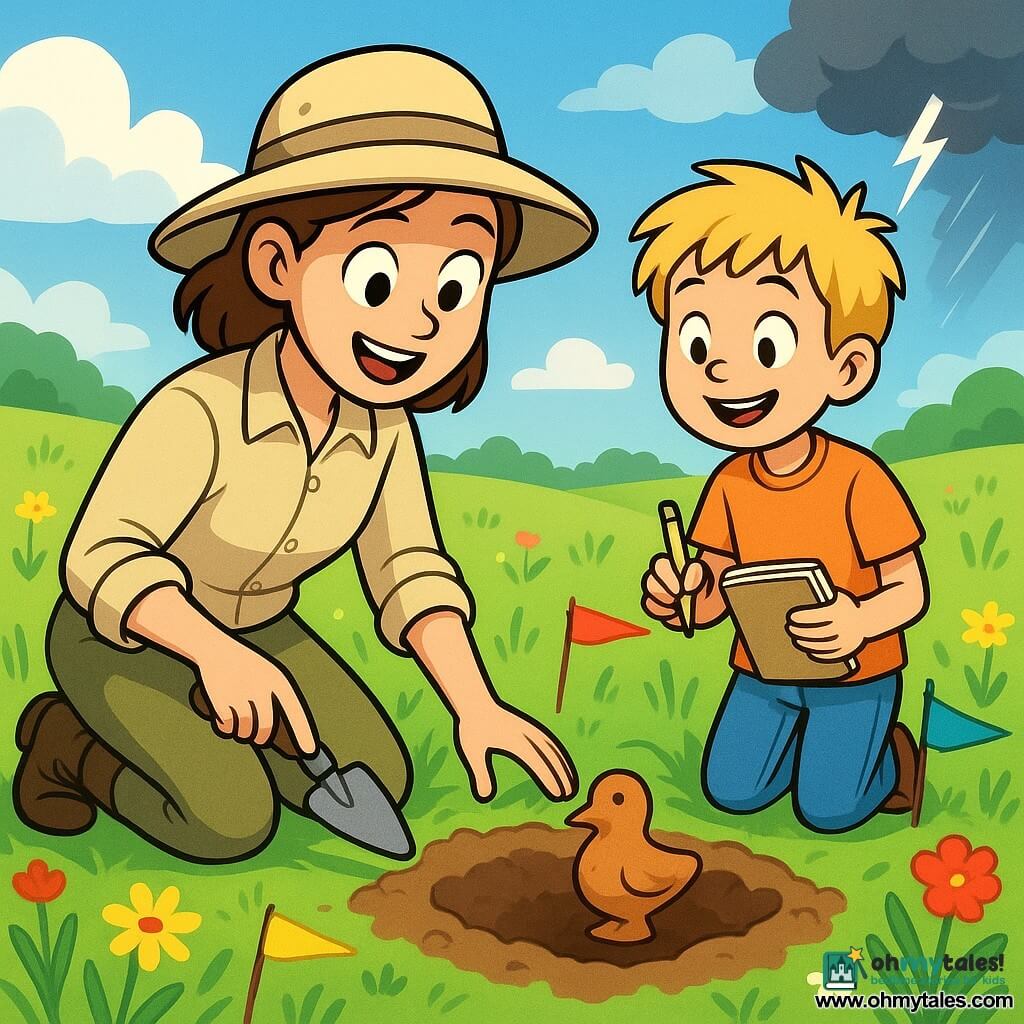
Soft Thunder, Bright Ribbons
Morning light lay on the field like a soft blanket. Dr. Mina crouched in clean, cool grass. She was an archaeologist. She wore a sun hat, sturdy boots, and kind eyes. Far away, thunder rolled like a slow drum. It made her heart skip. Dr. Mina didn't like storms, even far-off ones. But today, she took a slow breath. She hummed a small song she liked. She checked the sky. The clouds were high and white. Safe enough for careful work.
She set out tiny flags, bright as cherries. She tied a ribbon of marking tape to a wooden stake. It fluttered and flicked in the breeze. The tape marked the edges of her grid. Archaeologists make grids so they know exactly where everything is found. A grid is like a map made of string. A square here. A square there. Each square gets a number. Each number tells a little story.
Dr. Mina smiled. She spoke gently, mostly to herself. “Today I will look for an ancient pit,” she whispered. A pit is a hole people long ago dug for food or for trash. Pits can hold seeds, bits of pottery, and clues about daily life. Archaeologists don't dig everywhere. They look and listen to the ground. They take notes and pictures. They study the layers of soil, like the layers of a cake, only made of dirt and time.
She unrolled more string to make straight lines. She clicked her camera for a “before” photo. She opened her small toolkit. There was a metal trowel, a soft brush, a notebook with squared pages, and a measuring tape. There was also a sieve, like a little fence for the dirt to fall through. “Not dinosaurs,” she reminded the air, with a smile. “People. Their homes. Their stories.”
Whispers in the Ground
The field held a hush. Bees hummed. A lapwing called. Thunder mumbled beyond the hills and then grew quiet again. Dr. Mina knelt in Square B4. She scraped a tiny slice of soil with her trowel. Scrape, brush, breathe. Scrape, brush, breathe. She made the surface smooth, like a page. Archaeologists go slow. They must not hurry. Fast digging loses the story.
A patch of dirt looked a little darker. Another patch felt a little softer. Color and feel can mean a lot. Soil changes where people once walked, cooked, or buried their scraps. Dr. Mina drew a small circle on her paper map. She wrote the date. She wrote the time. She wrote “dark stain, soft.”
The breeze grew playful. Sudden and cheeky. It tugged at the bright marking tape on the stake. Pop! The tape slipped free and went dancing across the square. It skimmed over the ground like a ribbon of sunlight. The bright strip startled her and made her laugh. She reached and caught the end before it flew into the brambles.
The ribbon lay across the soil in a neat curve. Dr. Mina paused. The curve of the tape sat over a faint, round shadow in the dirt. It wasn't a shadow from the sun. It was a shadow in the earth itself, a circle shaped by long-ago hands. “Hello there,” she whispered. She pinned the tape back and knelt again, her fear of thunder forgotten for a moment.
She pressed her palm to the ground. It felt cool and steady. She checked her weather radio just in case. Lightning was far away. “We always stop if lightning is near,” she said softly. “Safety first.” She hummed her small song and began to trace the circle with the tip of her trowel.
The Circle's Secret
Scrape, brush, breathe. Dr. Mina worked around the circle. She marked its edge with tiny flags. She took a photo from above. She measured the diameter. She drew its shape, careful as a clockmaker. “This is a pit,” she murmured. A pit made by people is darker because it was filled with different soil. Sometimes there is ash from cooking. Sometimes there are shells, bones, or broken pots. Clues live in the dirt.
She lowered the sieve over a tray. She lifted a small shovel of earth, only from the pit, and shook gently. The fine soil fell soft as sugar. Little bits stayed on top. She saw a tiny seed that looked like a comma. She saw charred crumbs of wood, black and light as feathers. She saw a shard of pottery, curved like a smile. She brushed it with a soft brush. The pottery was not treasure. It was a voice. It said, “People cooked here. People ate here. People laughed here.”
Dr. Mina laid each find on a clean cloth. She labeled them with numbers. Numbers tell where and when. Without numbers, the story gets lost. Archaeologists collect stories, not just things. They write notes. They take photos. They keep the layers in order. What sits on top is newer than what lies below. That is how time stacks in the ground.
Thunder rumbled again, gentle and far. Dr. Mina counted “one, two, three” and listened for the next sound. Counting helped her feel calm. She smiled. “You can rumble,” she said, “and I will listen to the ground.” She went back to the circle and brushed its floor until it felt smooth as a pebble.
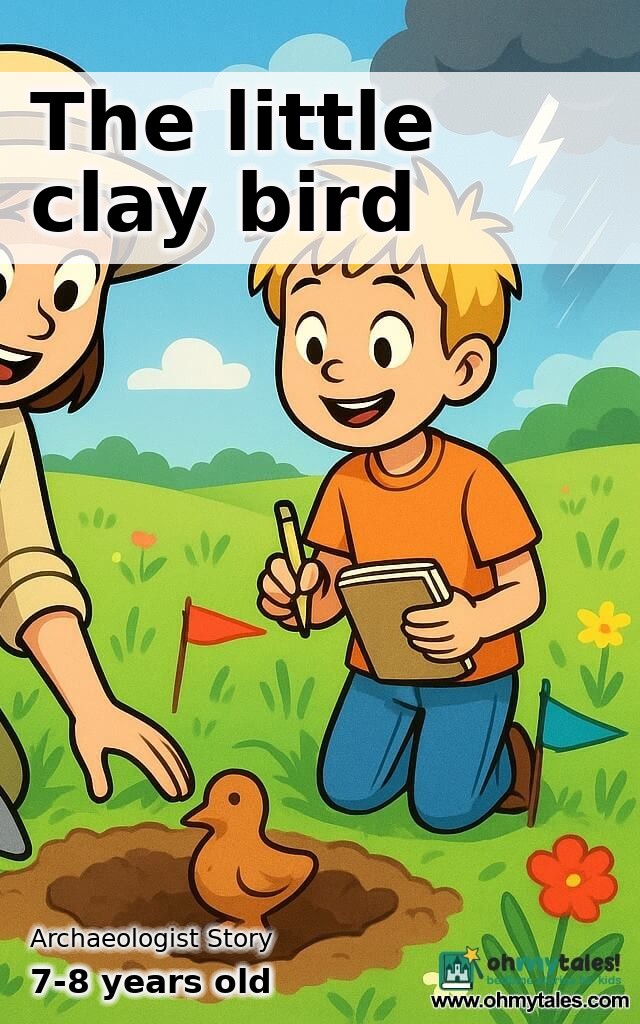
At the very bottom, about as deep as her hand, the soil changed again. It glowed with the soft brown of nut shells. A little shape peeked from the dirt, the size of a robin's egg. Not noisy. Not shiny. Just quiet and patient.
The Small Bright Thing
Dr. Mina held her breath the way you do before a birthday wish. With the tip of her brush, she whisked away dust. A tiny clay bird looked back at her. Its beak was a dot. Its wings were two simple lines. It was small, but it was a song made solid. Perhaps a child once held it. Perhaps someone kept it for luck. She did not know yet. That is what careful work is for.
“Hello, little traveler,” she murmured. She did not lift it right away. First, she took a photo in place. She drew it on the map with the north arrow and the grid square. She wrote its exact spot in her notebook: Unit B4, Pit 1, Level 3. She measured its length with a tiny ruler. She noted the depth. Then, at last, she slid a soft spoon under it and lifted it into a nest of tissue.
The wind grew cooler. A few fat drops of rain ticked on her hat. The storm was moving closer now, but not yet here. Dr. Mina covered the open pit with a clean tarp to keep the rain from washing the layers together. She placed the clay bird in a padded box, labeled with the site name and number. Saved and protected. Warm and safe. A new piece of the puzzle, kept with care.
Archaeologists do this every day. They learn from small things. They protect big stories. They share them with everyone. Later, the little bird would go to a lab to be washed and studied, then to a museum where people could look and wonder.
Dr. Mina packed her tools, each one wiped and counted. She removed the loose marking tape and tied it in a better knot. The field smelled like wet grass and time. Thunder spoke one last soft word and drifted away. Dr. Mina stood very still. She felt proud and calm. Storms would always rumble, but she had her song, her careful steps, and the ground's gentle whisper.
She closed her notebook. The day folded up like a storybook. Somewhere under her feet, other tales waited, sleeping. She smiled at the quiet box in her bag. “Rest well,” she said. And the tiny bird, saved and protected, seemed to glow with a shy, steady light.